1991 FORD FESTIVA ignition
[x] Cancel search: ignitionPage 191 of 454

Back To Article
E - T HEORY/OPERAT ION
1991 ENGINE PERFORMANCE Ford/Mercury T heory & Operation
INTRODUCTION
This article covers basic description and operation of engine performance-related systems and components. Read this article before attempting
to diagnose systems with which you are not completely familiar.
COMPUTERIZED ENGINE CONTROLS
An electronic Control Assembly (ECA) receives and processes signals from various sensors and switches. See Fig. 1 . It then generates signals
which control ignition timing, fuel injection functions and various emission control devices. The ECA has system diagnostic capabilities and
will store trouble codes for use by service technicians.
Fig. 1: Identifying Input Devices & Output Signals (Not All Shown)
Courtesy of FORD MOTOR CO.
ELECTRONIC CONTROL ASSEMBLY (ECA)
The ECA is located under the instrument panel on the driver side. It receives and processes data from sensors, switches and other components.
The ECA generates output signals to control fuel injection, spark timing, other engine functions and emission systems.
CEC INPUT DEVICES
Vehicles are equipped with different combinations of input devices. Not all devices are used on all models. To determine input device usage of
a specific model, see appropriate wiring diagram in WIRING DIAGRAMS article. The available input devices include the following:
BAROMETRIC PRESSURE SENSOR (BP)
This device senses changes in barometric pressure. The ECA uses this information in calculating fuel metering, ignition timing and idle speed.
On Festiva, BP is incorporated into the ECA. On Capri, BP is located on the passenger-side cowl.
BRAKE ON-OFF (BOO) SWITCH
This switch, located at the brake pedal, senses brake operation. The ECA uses this information in calculating fuel metering.
NOTE:Com ponents are grouped into 2 categories. T he first category is CEC INPUT DEVICES, which control or
produce voltage signals m onitored by the control unit. T he second category is CEC OUT PUT SIGNALS,
which are com ponents controlled by the control unit.
Page 1 of 6 MITCHELL 1 ARTICLE - E - THEORY/OPERATION 1991 ENGINE PERFORMANCE Ford/Mercury Theory & Operation
3/10/2009 http://www.eautorepair.net/app/PrintItems.asp?S0=2097152&S1=0&SG=%7B7DD6473C%2DB5BB%2D4F20%2D9D70%2D
...
Page 192 of 454

CLUTCH ENGAGE SWITCH (CES)
This switch is located on the manual transaxle and informs the ECA of transmission operating conditions. The ECA uses this data fo r id l e
speed control and canister purge valve operation.
CRANKSHAFT POSITION SENSOR (CPS) (FESTIVA)
This sensor is located in the distributor and sends engine RPM and crankshaft position data to the ECA. The ECA uses this data in calculating
fuel metering, ignition timing, idle speed control and canister purge valve operation.
CYLINDER IDENTIFICATION SENSOR (CID) (CAPRI)
This sensor is located in the distributor and provides crankshaft position data to the ECA. The ECA uses this data in calculating fuel metering
and ignition timing.
ELECTRICAL LOAD SWITCHES
Blower control, cooling fan, rear window defroster, air conditioning and headlight switches all send signals to the ECA. The ECA uses these
signals for idle speed control.
ENGINE COOLANT TEMPERATURE (ECT) SENSOR
This sensor is located in the intake manifold and sends coolant temperature data to the ECA. The ECA uses this data in calculating fuel
metering, idle speed control and canister purge valve operation.
EXHAUST GAS OXYGEN (EGO) SENSOR
This sensor is located in the exhaust manifold and senses oxygen concentration in the exhaust gas. The ECA uses this data in calculating fuel
metering, idle speed control and canister purge valve operation.
NEUTRAL SAFETY SWITCH (A/T)
This switch is located on the automatic transaxle and sends a signal to the ECA whenever the transaxle is in Neutral or Park ranges. The ECA
uses this signal in calculating fuel metering, idle speed control and canister purge valve operation.
POWER STEERING PRESSURE SWITCH (PSPS)
This switch is located on the power steering pump and sends data about power steering operation to the ECA. The ECA uses this data for idle
speed control.
THROTTLE POSITION SENSOR (TP)
This device is located on the throttle body and contains 2 switches. The Wide Open Throttle (WOT) Switch sends a signal to the ECA when
throttle valve opening is more than 70 degrees. The ECA uses this signal in calculating fuel metering.
The Idle Switch (IDL) sends a signal to the ECA when throttle valve opening is less than 1.5 degrees. The ECA uses this signal for idle speed
control and canister purge valve operation.
VANE AIRFLOW (VAF) METER
This sensor is located in the air cleaner housing and sends intake airflow data to the ECA. The ECA uses this data in calculating fuel metering.
VANE AIR TEMPERATURE (VAT) SENSOR
This sensor is located inside the vane airflow sensor and senses intake air temperature. The ECA uses this data in calculating fu el met erin g,
idle speed control and canister purge valve operation.
CEC OUTPUT SIGNALS
CANISTER PURGE (CANP) SOLENOID
See EMISSION SYSTEMS.
CHECK ENGINE LIGHT
See SELF-DIAGNOSTIC SYSTEM.
FUEL INJECTORS
See FUEL CONTROL.
IDLE SPEED CONTROL BY-PASS AIR (ISC-BPA) VALVE
See IDLE SPEED. NOTE:Vehicles are equipped with different com binations of com puter-controlled com ponents. Not all
com ponents listed below are used on every vehicle. For theory and operation of each output
com ponent, refer to indicated system .
Page 2 of 6 MITCHELL 1 ARTICLE - E - THEORY/OPERATION 1991 ENGINE PERFORMANCE Ford/Mercury Theory & Operation
3/10/2009 http://www.eautorepair.net/app/PrintItems.asp?S0=2097152&S1=0&SG=%7B7DD6473C%2DB5BB%2D4F20%2D9D70%2D
...
Page 195 of 454

IDLE SPEED
While the engine is cold, the Idle Speed Control By-Pass Air (ISC-BPA) Valve increases idle speed to warm the engine quickly. At engine
temperatures less than 140°F (60°C), the valve is open. As the engine warms, the valve begins to close. The valve is fully closed at engine
temperatures higher than 140°F (60°C). Idle speed is also affected by various switches, sensors and load on the engine.
ELECTRONIC IGNITION SYSTEM
CAPRI
A pick-up coil within the distributor sends a signal to a Distributor-Mounted Ignition Module With Vacuum Advance (DMIVA) within the
distributor. The DMIVA then sends a signal which fires the coil. When the coil fires, the distributor directs high voltage current to the spark
plugs. The DMIVA system operates independently of the ECA.
FESTIVA
A pick-up coil within the distributor sends a signal to a transistorized ignition module on the coil bracket. A timing signal also goes from the
ECA to the ignition module. The ignition module then sends a signal which fires the coil. When the coil fires, the distributor directs high
voltage current to the spark plugs.
IGNITION TIMING CONTROL SYSTEM
CAPRI
Spark timing is controlled by vacuum and centrifugal advance mechanisms and by a signal from the ECA. The ECA does not affect ignition
timing on turbo models. On turbo models, a knock sensor and control unit retard ignition timing when knock occurs.
FESTIVA
The ECA generates a spark timing signal from data received from the BP, CPS and VAF. This signal goes to the ignition module. The ignition
module then sends a signal to fire the coil.
HIGH ALTITUDE SPARK ADVANCE CORRECTION
A barometric pressure sensor is incorporated into the ECA on Festiva and is a separate component on Capri. At high altitudes, the ECA sends
a signal to the ignition module to advance ignition timing. This feature is not used on turbo models.
KNOCK SENSOR (CAPRI)
A Knock Sensor (KS) generates a signal when knock occurs. A control unit processes this signal and then sends it to the ignition module to
retard spark timing. The KS is located in the engine block, near the oil pressure switch. This device is only used on 1.6L turbo engines.
KNOCK CONTROL UNIT (CAPRI)
The Knock Control Unit filters normal engine vibration signals from the KS, then sends a signal to the ignition module to retard spark timing.
This unit, used only on 1.6L turbo engines, is located on right side of engine compartment.
EMISSION SYSTEMS
DECELERATION SYSTEM (DASHPOT)
The deceleration control system closes the throttle plate gradually during deceleration. The dashpot prevents engine stalling on deceleration
and provides a smooth transition from deceleration to sudden acceleration.
EVAPORATIVE SYSTEM
CARBON CANISTER
The carbon canister stores vapors from the fuel tank until they are purged and burned in the engine. On Festiva, carbon canister is
located under the brake booster. On Capri, carbon canister is located on the right side of the engine compartment near the cowl panel.
CANISTER PURGE SOLENOID
This component is connected between the carbon canister and intake manifold. When the ECA sends a signal to the solenoid to open,
fuel vapors in the carbon canister are drawn into the engine.
CANISTER PURGE VALVE
This valve opens to purge vapors from the carbon canister into the engine intake system. The valve is part of the canister purge solenoid.
ROLLOVER VENT VALVE
This valve, located in front of the fuel tank, blocks the vapor line in case of vehicle rollover.
This valve, located in front of the fuel tank, blocks the vapor line in case of vehicle rollover.
CATALYTIC CONVERTER
The catalytic converter is in the exhaust system, between the exhaust manifold and the muffler. It converts certain pollutants in the exhaust
Page 5 of 6 MITCHELL 1 ARTICLE - E - THEORY/OPERATION 1991 ENGINE PERFORMANCE Ford/Mercury Theory & Operation
3/10/2009 http://www.eautorepair.net/app/PrintItems.asp?S0=2097152&S1=0&SG=%7B7DD6473C%2DB5BB%2D4F20%2D9D70%2D
...
Page 202 of 454
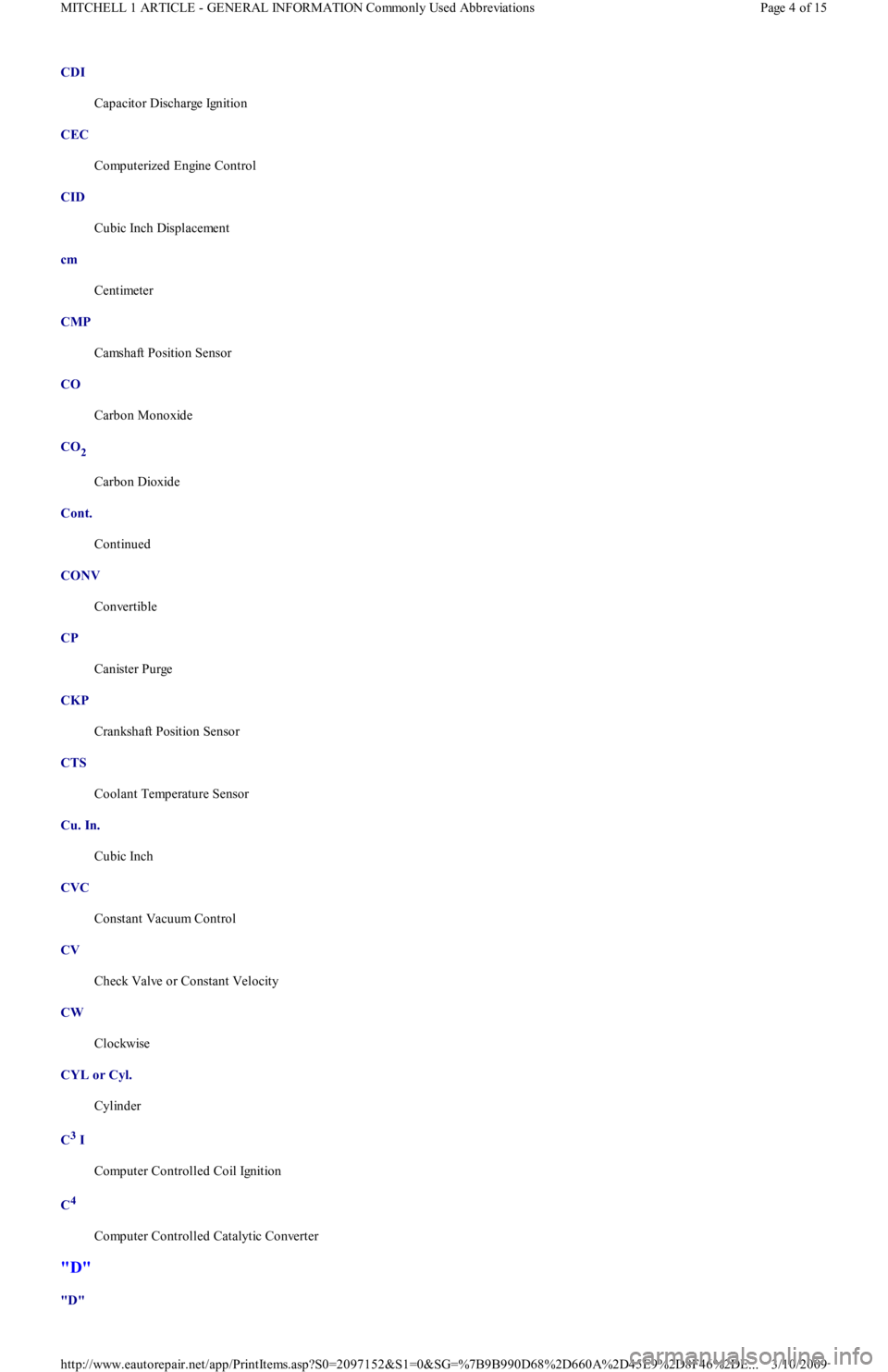
CDI
Capacitor Discharge Ignition
CEC
Computerized Engine Control
CID
Cubic Inch Displacement
cm
Centimeter
CMP
Camshaft Position Sensor
CO
Carbon Monoxide
CO
2
Carbon Dioxide
Cont.
Continued
CONV
Convertible
CP
Canister Purge
CKP
Crankshaft Position Sensor
CTS
Coolant Temperature Sensor
Cu. In.
Cubic Inch
CVC
Constant Vacuum Control
CV
Check Valve or Constant Velocity
CW
Clockwise
CYL or Cyl.
Cylinder
C
3 I
Computer Controlled Coil Ignition
C
4
Computer Controlled Catalytic Converter
"D"
"D"
Page 4 of 15 MITCHELL 1 ARTICLE - GENERAL INFORMATION Commonly Used Abbreviations
3/10/2009 http://www.eautorepair.net/app/PrintItems.asp?S0=2097152&S1=0&SG=%7B9B990D68%2D660A%2D45E9%2D8F46%2DE
...
Page 203 of 454
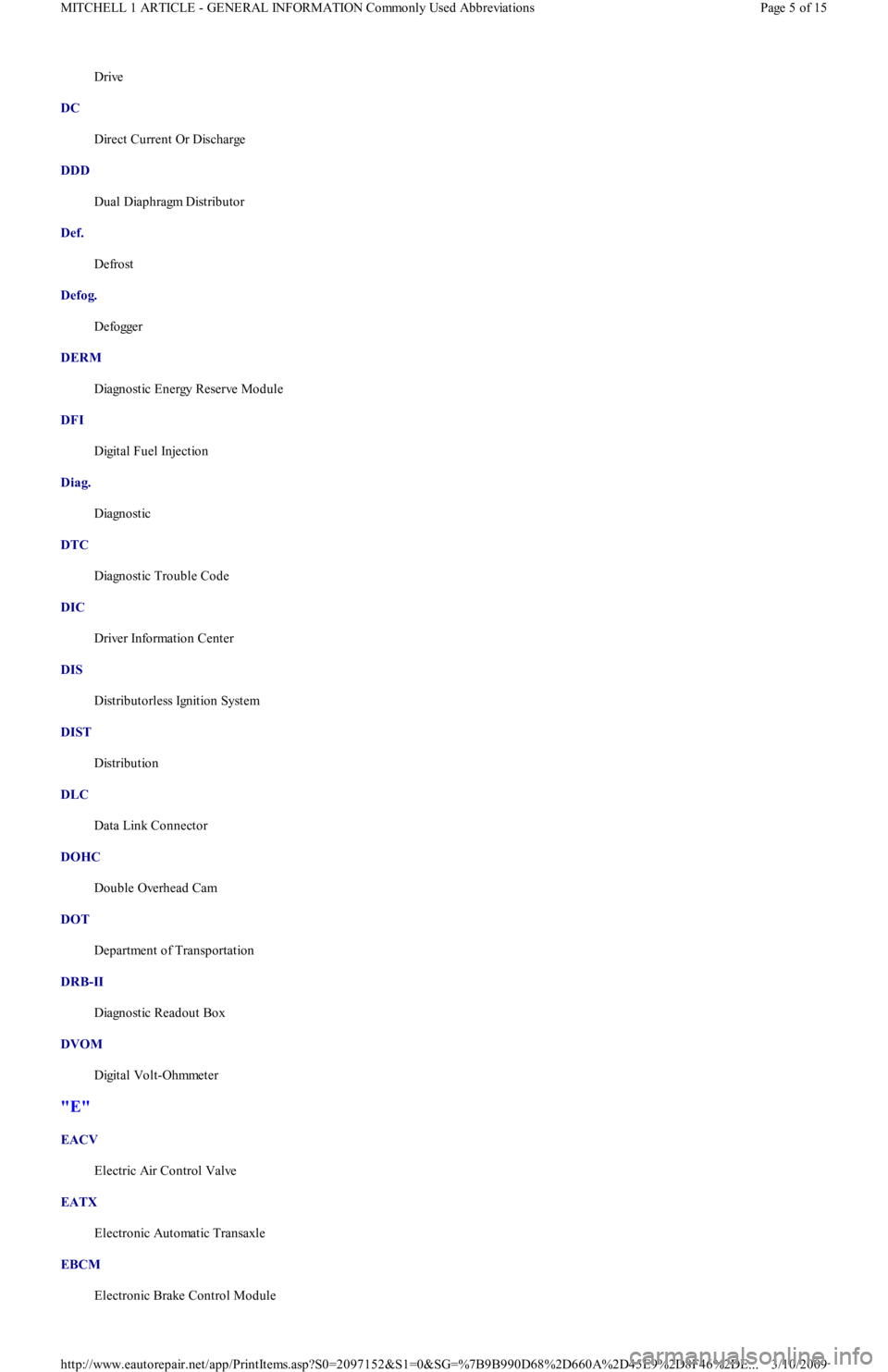
Drive
DC
Direct Current Or Discharge
DDD
Dual Diaphragm Distributor
Def.
Defrost
Defog.
De fo gge r
DERM
Diagnostic Energy Reserve Module
DFI
Digital Fuel Injection
Diag.
Diagnostic
DTC
Diagnostic Trouble Code
DIC
Driver Information Center
DIS
Distributorless Ignition System
DIST
Distribution
DLC
Data Link Connector
DOHC
Double Overhead Cam
DOT
Department of Transportation
DRB-II
Diagnostic Readout Box
DVOM
Digital Volt-Ohmmeter
"E"
EACV
Electric Air Control Valve
EATX
Electronic Automatic Transaxle
EBCM
Electronic Brake Control Module
Page 5 of 15 MITCHELL 1 ARTICLE - GENERAL INFORMATION Commonly Used Abbreviations
3/10/2009 http://www.eautorepair.net/app/PrintItems.asp?S0=2097152&S1=0&SG=%7B9B990D68%2D660A%2D45E9%2D8F46%2DE
...
Page 204 of 454

EBL
Electronic Back Light
ECM
Engine Control Module
ECT
Engine Coolant Temperature Sensor
EDIS
Electronic Distributorless Ignition System
EEC
Electronic Engine Control
EECS
Evaporative Emission Control System
EEPROM
Electronically Erasable PROM
EFE
Early Fuel Evaporation
EGO
Exhaust Gas Oxygen Sensor
EGR
Exhaust Gas Recirculation
ESA
Electronic Spark Advance
ESC
Electronic Spark Control
EST
Electronic Spark Timing
EVAP
Fuel Evaporative System
EVIC
Electronic Vehicle Information Center
EVP
EGR Valve Position Sensor
Exc.
Except
"F"
° F
Fahrenheit (Degrees)
F/B
Fuse Block
Fed.
Page 6 of 15 MITCHELL 1 ARTICLE - GENERAL INFORMATION Commonly Used Abbreviations
3/10/2009 http://www.eautorepair.net/app/PrintItems.asp?S0=2097152&S1=0&SG=%7B9B990D68%2D660A%2D45E9%2D8F46%2DE
...
Page 206 of 454
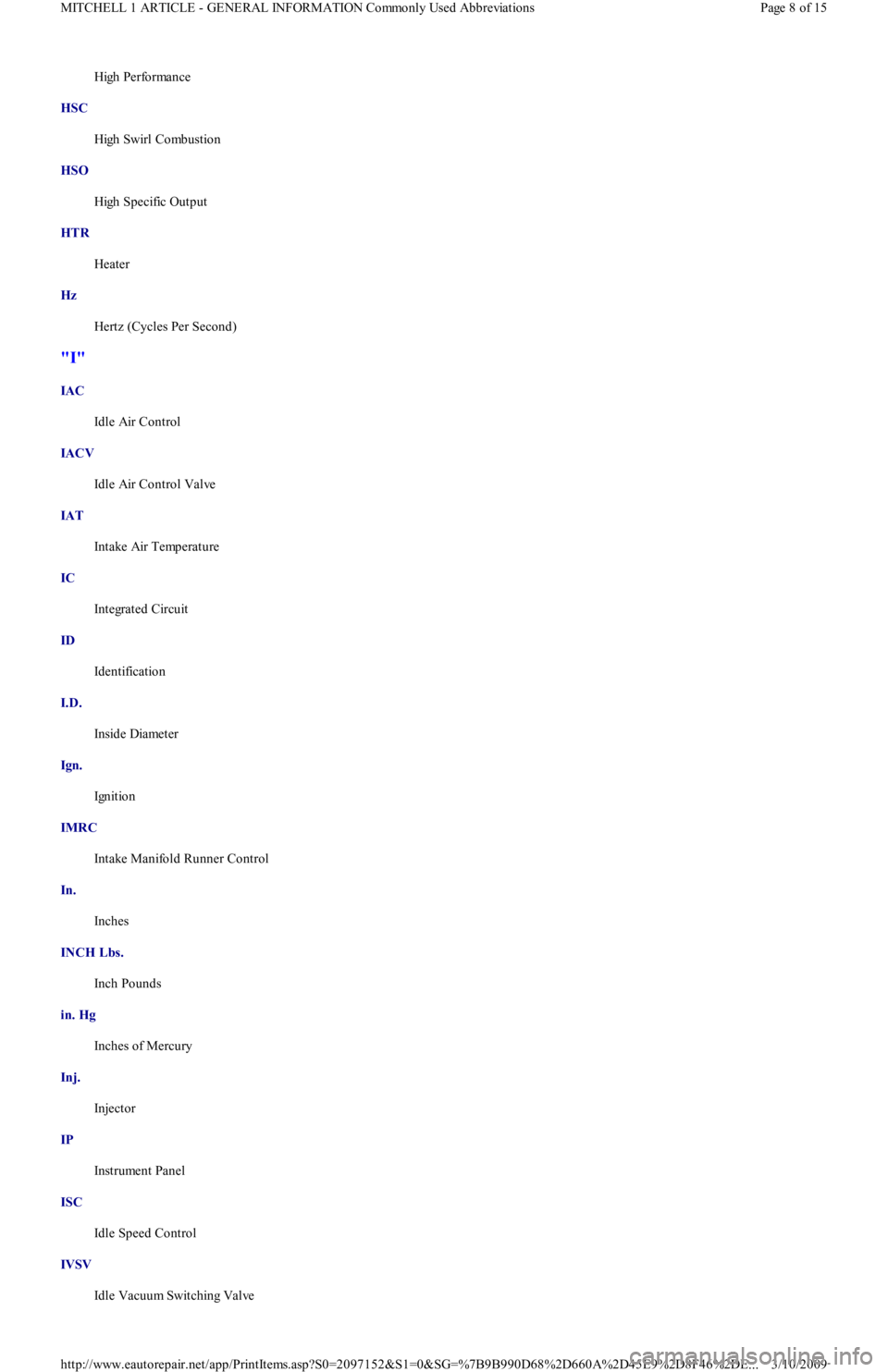
High Performance
HSC
High Swirl Combustion
HSO
High Specific Output
HTR
Heater
Hz
Hertz (Cycles Per Second)
"I"
IAC
Idle Air Control
IACV
Idle Air Control Valve
IAT
Intake Air Temperature
IC
Integrated Circuit
ID
Identification
I.D.
Inside Diameter
Ign.
Ignition
IMRC
Intake Manifold Runner Control
In.
In ch es
INCH Lbs.
Inch Pounds
in. Hg
Inches of Mercury
Inj.
Injector
IP
Instrument Panel
ISC
Idle Speed Control
IVSV
Idle Vacuum Switching Valve
Page 8 of 15 MITCHELL 1 ARTICLE - GENERAL INFORMATION Commonly Used Abbreviations
3/10/2009 http://www.eautorepair.net/app/PrintItems.asp?S0=2097152&S1=0&SG=%7B9B990D68%2D660A%2D45E9%2D8F46%2DE
...
Page 210 of 454
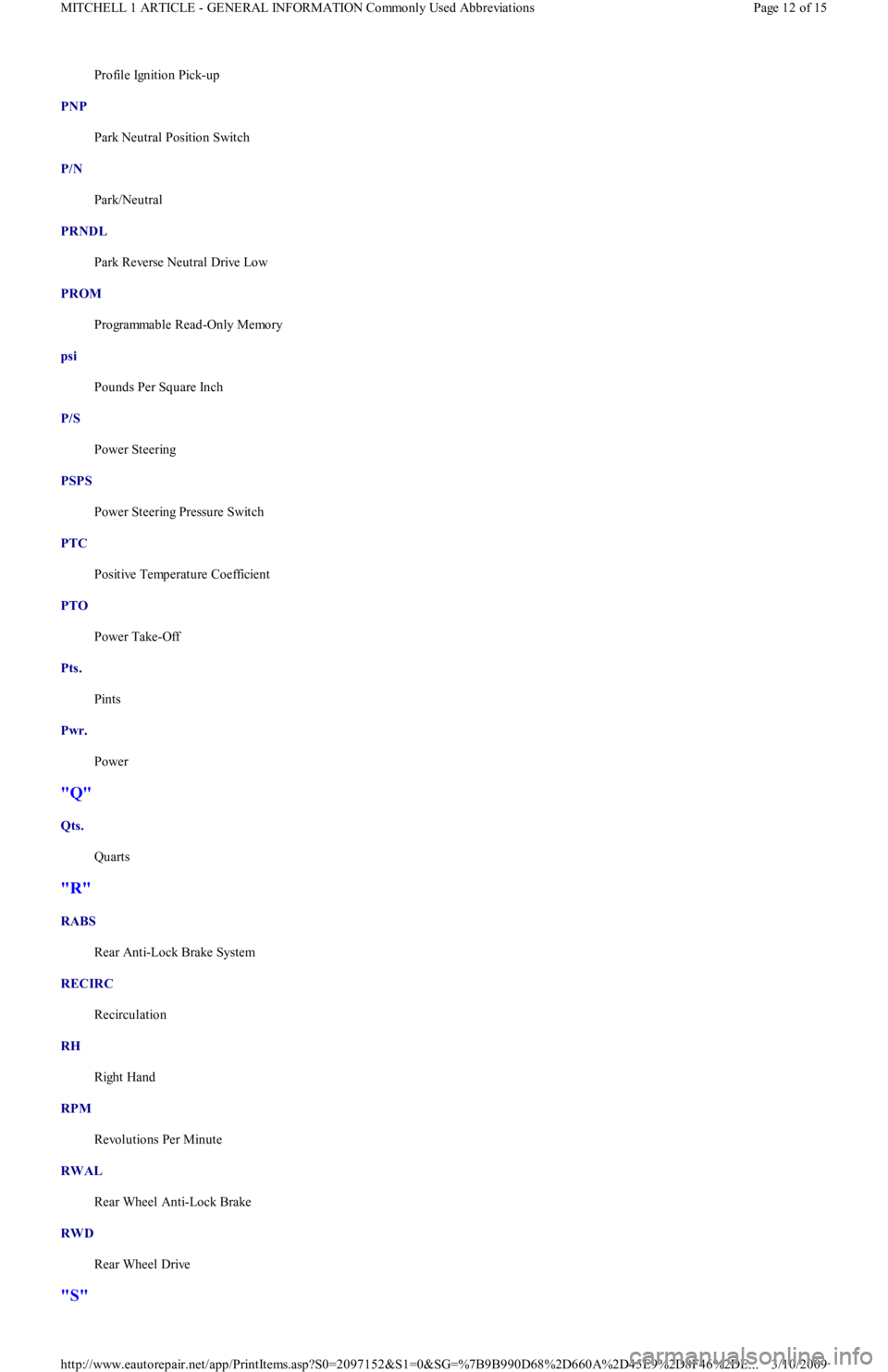
Profile Ignition Pick-up
PNP
Park Neutral Position Switch
P/N
Park/Neutral
PRNDL
Park Reverse Neutral Drive Low
PROM
Programmable Read-Only Memory
psi
Pounds Per Square Inch
P/S
Power Steering
PSPS
Power Steering Pressure Switch
PTC
Positive Temperature Coefficient
PTO
Power Take-Off
Pts.
Pints
Pwr.
Power
"Q"
Qts.
Quarts
"R"
RABS
Rear Anti-Lock Brake System
RECIRC
Recirculation
RH
Right Hand
RPM
Revolutions Per Minute
RWAL
Rear Wheel Anti-Lock Brake
RWD
Rear Wheel Drive
"S"
Page 12 of 15 MITCHELL 1 ARTICLE - GENERAL INFORMATION Commonly Used Abbreviations
3/10/2009 http://www.eautorepair.net/app/PrintItems.asp?S0=2097152&S1=0&SG=%7B9B990D68%2D660A%2D45E9%2D8F46%2DE
...