1991 FORD FESTIVA Spark plug
[x] Cancel search: Spark plugPage 173 of 454
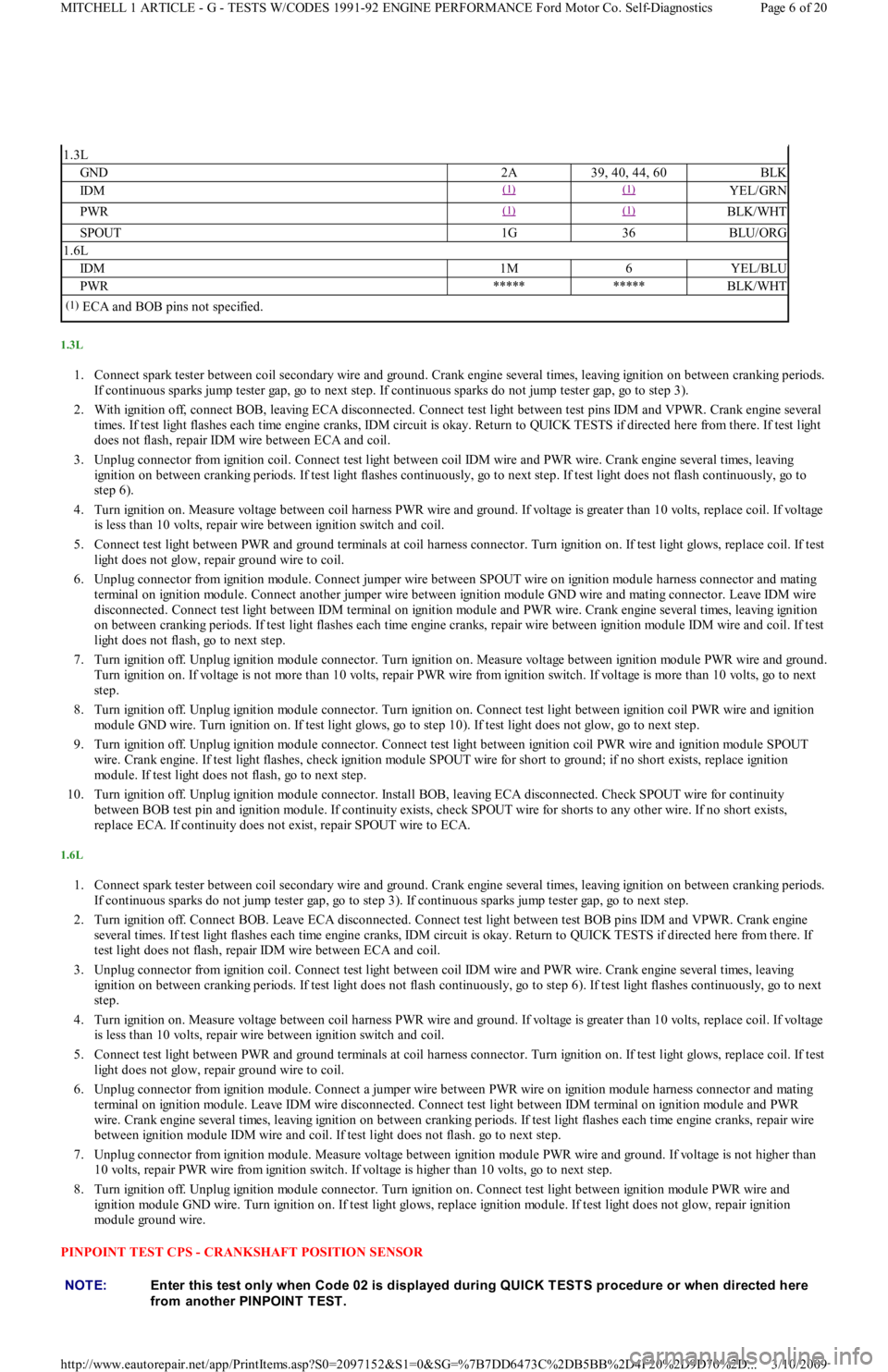
1.3L
1. Connect spark tester between coil secondary wire and ground. Crank engine several times, leaving ignition on between cranking periods.
If continuous sparks jump tester gap, go to next step. If continuous sparks do not jump tester gap, go to step 3).
2. With ignition off, connect BOB, leaving ECA disconnected. Connect test light between test pins IDM and VPWR. Crank engine several
times. If test light flashes each time engine cranks, IDM circuit is okay. Return to QUICK TESTS if directed here from there. If test light
does not flash, repair IDM wire between ECA and coil.
3. Unplug connector from ignition coil. Connect test light between coil IDM wire and PWR wire. Crank engine several times, leaving
ignition on between cranking periods. If test light flashes continuously, go to next step. If test light does not flash continuously, go to
step 6).
4. Turn ignition on. Measure voltage between coil harness PWR wire and ground. If voltage is greater than 10 volts, replace coil. If voltage
is less than 10 volts, repair wire between ignition switch and coil.
5. Connect test light between PWR and ground terminals at coil harness connector. Turn ignition on. If test light glows, replace coil. If test
light does not glow, repair ground wire to coil.
6. Unplug connector from ignition module. Connect jumper wire between SPOUT wire on ignition module harness connector and mating
terminal on ignition module. Connect another jumper wire between ignition module GND wire and mating connector. Leave IDM wire
disconnected. Connect test light between IDM terminal on ignition module and PWR wire. Crank engine several times, leaving ignition
on between cranking periods. If test light flashes each time engine cranks, repair wire between ignition module IDM wire and coil . If t est
light does not flash, go to next step.
7. Turn ignition off. Unplug ignition module connector. Turn ignition on. Measure voltage between ignition module PWR wire and ground.
Turn ignition on. If voltage is not more than 10 volts, repair PWR wire from ignition switch. If voltage is more than 10 volts, go t o n e xt
step.
8. Turn ignition off. Unplug ignition module connector. Turn ignition on. Connect test light between ignition coil PWR wire and ignition
module GND wire. Turn ignition on. If test light glows, go to step 10). If test light does not glow, go to next step.
9. Turn ignition off. Unplug ignition module connector. Connect test light between ignition coil PWR wire and ignition module SPOUT
wire. Crank engine. If test light flashes, check ignition module SPOUT wire for short to ground; if no short exists, replace ignition
module. If test light does not flash, go to next step.
10. Turn ignition off. Unplug ignition module connector. Install BOB, leaving ECA disconnected. Check SPOUT wire for continuity
between BOB test pin and ignition module. If continuity exists, check SPOUT wire for shorts to any other wire. If no short exists,
replace ECA. If continuity does not exist, repair SPOUT wire to ECA.
1.6L
1. Connect spark tester between coil secondary wire and ground. Crank engine several times, leaving ignition on between cranking periods.
If continuous sparks do not jump tester gap, go to step 3). If continuous sparks jump tester gap, go to next step.
2. Turn ignition off. Connect BOB. Leave ECA disconnected. Connect test light between test BOB pins IDM and VPWR. Crank engine
several times. If test light flashes each time engine cranks, IDM circuit is okay. Return to QUICK TESTS if directed here from there. If
test light does not flash, repair IDM wire between ECA and coil.
3. Unplug connector from ignition coil. Connect test light between coil IDM wire and PWR wire. Crank engine several times, leaving
ignition on between cranking periods. If test light does not flash continuously, go to step 6). If test light flashes continuously, go to next
step.
4. Turn ignition on. Measure voltage between coil harness PWR wire and ground. If voltage is greater than 10 volts, replace coil. If voltage
is less than 10 volts, repair wire between ignition switch and coil.
5. Connect test light between PWR and ground terminals at coil harness connector. Turn ignition on. If test light glows, replace coil. If test
light does not glow, repair ground wire to coil.
6. Unplug connector from ignition module. Connect a jumper wire between PWR wire on ignition module harness connector and mating
terminal on ignition module. Leave IDM wire disconnected. Connect test light between IDM terminal on ignition module and PWR
wire. Crank engine several times, leaving ignition on between cranking periods. If test light flashes each time engine cranks, repair wire
between ignition module IDM wire and coil. If test light does not flash. go to next step.
7. Unplug connector from ignition module. Measure voltage between ignition module PWR wire and ground. If voltage is not higher than
10 volts, repair PWR wire from ignition switch. If voltage is higher than 10 volts, go to next step.
8. Turn ignition off. Unplug ignition module connector. Turn ignition on. Connect test light between ignition module PWR wire and
ignition module GND wire. Turn ignition on. If test light glows, replace ignition module. If test light does not glow, repair ignition
module ground wire.
PINPOINT TEST CPS - CRANKSHAFT POSITION SENSOR
1.3L
GND2A39, 40, 44, 60BLK
IDM(1) (1) YEL/GRN
PWR(1) (1) BLK/WHT
SPOUT1G36BLU/ORG
1.6L
IDM1M6YEL/BLU
PWR**********BLK/WHT
(1)ECA and BOB pins not specified.
NOTE:Enter this test only when Code 02 is displayed during QUICK T EST S procedure or when directed here
from another PINPOINT TEST.
Page 6 of 20 MITCHELL 1 ARTICLE - G - TESTS W/CODES 1991-92 ENGINE PERFORMANCE Ford Motor Co. Self-Diagnostics
3/10/2009 http://www.eautorepair.net/app/PrintItems.asp?S0=2097152&S1=0&SG=%7B7DD6473C%2DB5BB%2D4F20%2D9D70%2D
...
Page 195 of 454

IDLE SPEED
While the engine is cold, the Idle Speed Control By-Pass Air (ISC-BPA) Valve increases idle speed to warm the engine quickly. At engine
temperatures less than 140°F (60°C), the valve is open. As the engine warms, the valve begins to close. The valve is fully closed at engine
temperatures higher than 140°F (60°C). Idle speed is also affected by various switches, sensors and load on the engine.
ELECTRONIC IGNITION SYSTEM
CAPRI
A pick-up coil within the distributor sends a signal to a Distributor-Mounted Ignition Module With Vacuum Advance (DMIVA) within the
distributor. The DMIVA then sends a signal which fires the coil. When the coil fires, the distributor directs high voltage current to the spark
plugs. The DMIVA system operates independently of the ECA.
FESTIVA
A pick-up coil within the distributor sends a signal to a transistorized ignition module on the coil bracket. A timing signal also goes from the
ECA to the ignition module. The ignition module then sends a signal which fires the coil. When the coil fires, the distributor directs high
voltage current to the spark plugs.
IGNITION TIMING CONTROL SYSTEM
CAPRI
Spark timing is controlled by vacuum and centrifugal advance mechanisms and by a signal from the ECA. The ECA does not affect ignition
timing on turbo models. On turbo models, a knock sensor and control unit retard ignition timing when knock occurs.
FESTIVA
The ECA generates a spark timing signal from data received from the BP, CPS and VAF. This signal goes to the ignition module. The ignition
module then sends a signal to fire the coil.
HIGH ALTITUDE SPARK ADVANCE CORRECTION
A barometric pressure sensor is incorporated into the ECA on Festiva and is a separate component on Capri. At high altitudes, the ECA sends
a signal to the ignition module to advance ignition timing. This feature is not used on turbo models.
KNOCK SENSOR (CAPRI)
A Knock Sensor (KS) generates a signal when knock occurs. A control unit processes this signal and then sends it to the ignition module to
retard spark timing. The KS is located in the engine block, near the oil pressure switch. This device is only used on 1.6L turbo engines.
KNOCK CONTROL UNIT (CAPRI)
The Knock Control Unit filters normal engine vibration signals from the KS, then sends a signal to the ignition module to retard spark timing.
This unit, used only on 1.6L turbo engines, is located on right side of engine compartment.
EMISSION SYSTEMS
DECELERATION SYSTEM (DASHPOT)
The deceleration control system closes the throttle plate gradually during deceleration. The dashpot prevents engine stalling on deceleration
and provides a smooth transition from deceleration to sudden acceleration.
EVAPORATIVE SYSTEM
CARBON CANISTER
The carbon canister stores vapors from the fuel tank until they are purged and burned in the engine. On Festiva, carbon canister is
located under the brake booster. On Capri, carbon canister is located on the right side of the engine compartment near the cowl panel.
CANISTER PURGE SOLENOID
This component is connected between the carbon canister and intake manifold. When the ECA sends a signal to the solenoid to open,
fuel vapors in the carbon canister are drawn into the engine.
CANISTER PURGE VALVE
This valve opens to purge vapors from the carbon canister into the engine intake system. The valve is part of the canister purge solenoid.
ROLLOVER VENT VALVE
This valve, located in front of the fuel tank, blocks the vapor line in case of vehicle rollover.
This valve, located in front of the fuel tank, blocks the vapor line in case of vehicle rollover.
CATALYTIC CONVERTER
The catalytic converter is in the exhaust system, between the exhaust manifold and the muffler. It converts certain pollutants in the exhaust
Page 5 of 6 MITCHELL 1 ARTICLE - E - THEORY/OPERATION 1991 ENGINE PERFORMANCE Ford/Mercury Theory & Operation
3/10/2009 http://www.eautorepair.net/app/PrintItems.asp?S0=2097152&S1=0&SG=%7B7DD6473C%2DB5BB%2D4F20%2D9D70%2D
...
Page 223 of 454
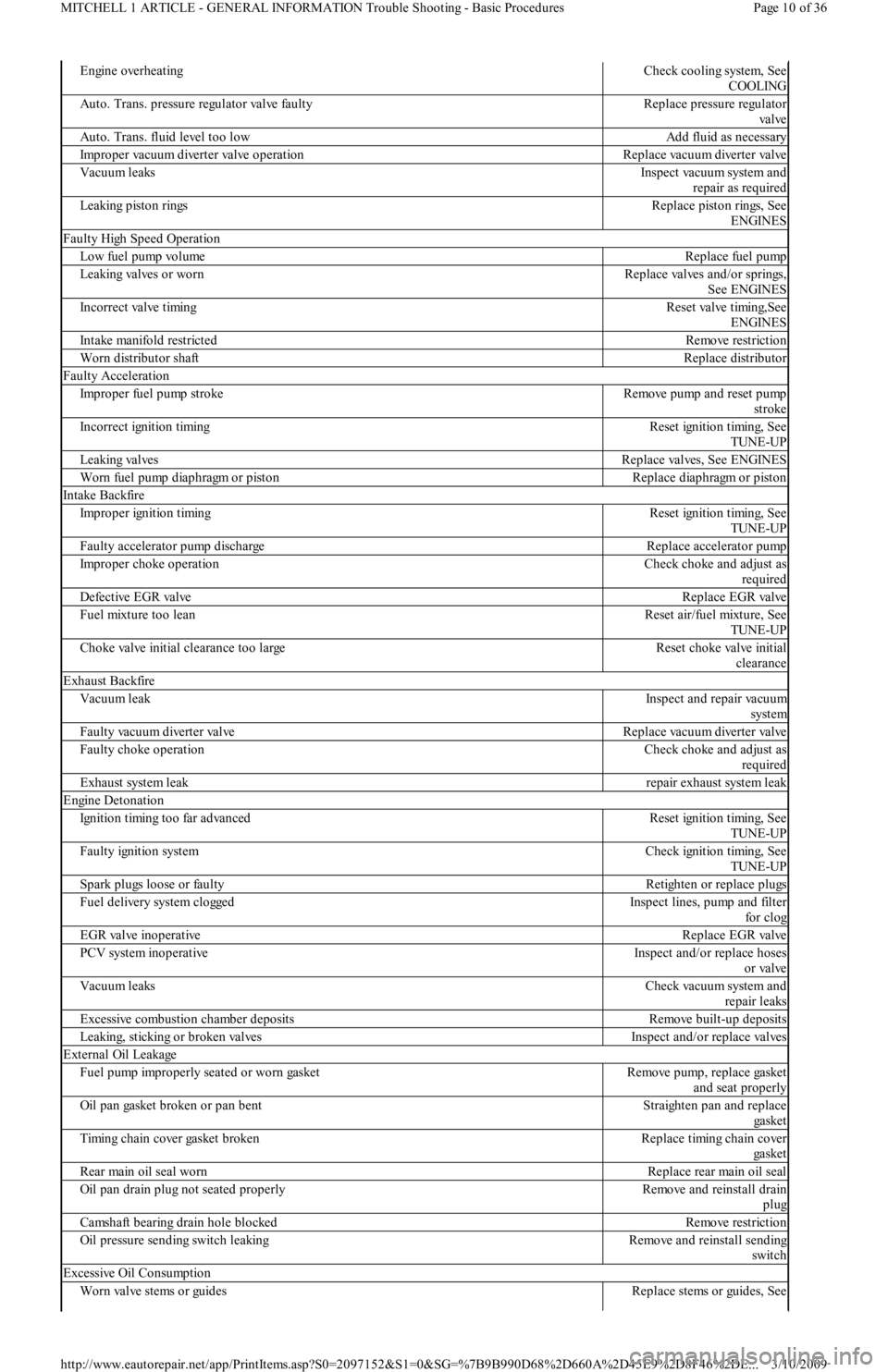
Engine overheatingCheck cooling system, See
COOLING
Auto. Trans. pressure regulator valve faultyReplace pressure regulator
va l ve
Auto. Trans. fluid level too lowAdd fluid as necessary
Improper vacuum diverter valve operationReplace vacuum diverter valve
Vacuum leaksInspect vacuum system and
repair as required
Leaking piston ringsReplace piston rings, See
ENGINES
Faulty High Speed Operation
Low fuel pump volumeReplace fuel pump
Le a kin g va l ve s o r wo r nReplace valves and/or springs,
See ENGINES
Incorrect valve timingReset valve timing,See
ENGINES
In t ake man ifo l d rest rict edRemove restriction
Worn distributor shaftReplace distributor
Faulty Acceleration
Improper fuel pump strokeRemove pump and reset pump
stroke
Incorrect ignition timingReset ignition timing, See
TUNE-UP
Le a kin g va l ve sReplace valves, See ENGINES
Worn fuel pump diaphragm or pistonReplace diaphragm or piston
In t ake Backfire
Improper ignition timingReset ignition timing, See
TUNE-UP
Faulty accelerator pump dischargeReplace accelerator pump
Improper choke operationCheck choke and adjust as
required
Defective EGR valveReplace EGR valve
Fuel mixture too leanReset air/fuel mixture, See
TUNE-UP
Choke valve initial clearance too largeReset choke valve initial
clearance
Exhaust Backfire
Vacuum leakInspect and repair vacuum
system
Faulty vacuum diverter valveReplace vacuum diverter valve
Faulty choke operationCheck choke and adjust as
required
Exhaust system leakrepair exhaust system leak
Engine Detonation
Ignition timing too far advancedReset ignition timing, See
TUNE-UP
Faulty ignition systemCheck ignition timing, See
TUNE-UP
Spark plugs loose or faultyRetighten or replace plugs
Fuel delivery system cloggedInspect lines, pump and filter
fo r cl o g
EGR valve inoperativeReplace EGR valve
PCV system inoperativeInspect and/or replace hoses
or valve
Vacuum leaksCheck vacuum system and
repair leaks
Excessive combustion chamber depositsRemove built-up deposits
Leaking, sticking or broken valvesInspect and/or replace valves
External Oil Leakage
Fuel pump improperly seated or worn gasketRemove pump, replace gasket
and seat properly
Oil pan gasket broken or pan bentStraighten pan and replace
ga ske t
Timing chain cover gasket brokenReplace timing chain cover
ga ske t
Rear main oil seal wornReplace rear main oil seal
Oil pan drain plug not seated properlyRemove and reinstall drain
plug
Camshaft bearing drain hole blockedRemove restriction
Oil pressure sending switch leakingRemove and reinstall sending
switch
Excessive Oil Consumption
Worn valve stems or guidesReplace stems or guides, See
Page 10 of 36 MITCHELL 1 ARTICLE - GENERAL INFORMATION Trouble Shooting - Basic Procedures
3/10/2009 http://www.eautorepair.net/app/PrintItems.asp?S0=2097152&S1=0&SG=%7B9B990D68%2D660A%2D45E9%2D8F46%2DE
...
Page 225 of 454
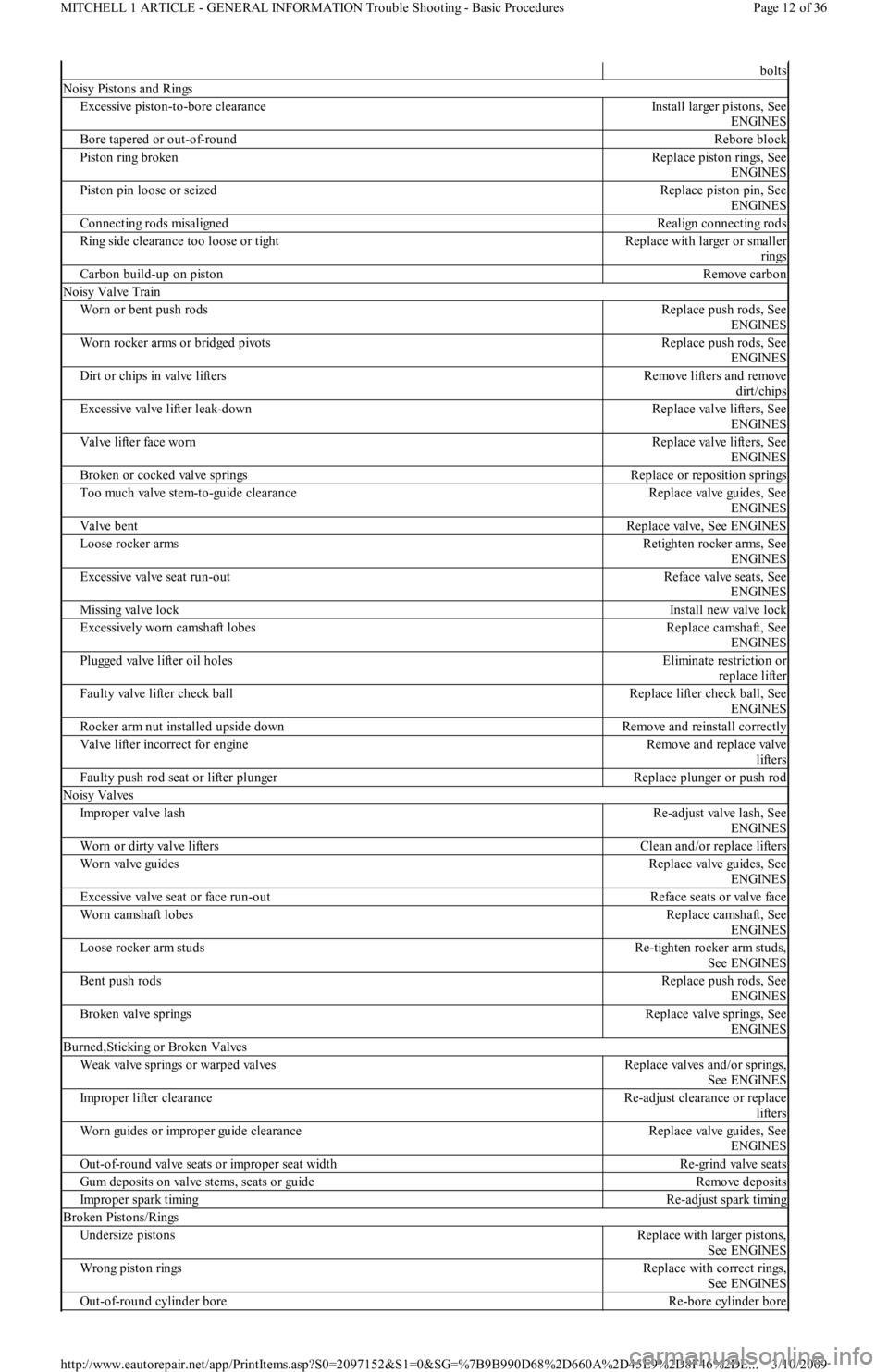
bolts
Noisy Pistons and Rings
Excessive piston-to-bore clearanceInstall larger pistons, See
ENGINES
Bore tapered or out-of-roundRebore block
Piston ring brokenReplace piston rings, See
ENGINES
Piston pin loose or seizedReplace piston pin, See
ENGINES
Connecting rods misalignedRealign connecting rods
Ring side clearance too loose or tightReplace with larger or smaller
rings
Carbon build-up on pistonRemove carbon
Noisy Valve Train
Worn or bent push rodsReplace push rods, See
ENGINES
Worn rocker arms or bridged pivotsReplace push rods, See
ENGINES
Dirt or chips in valve liftersRemove lifters and remove
dirt/chips
Excessive valve lifter leak-downReplace valve lifters, See
ENGINES
Valve lifter face wornReplace valve lifters, See
ENGINES
Broken or cocked valve springsReplace or reposition springs
Too much valve stem-to-guide clearanceReplace valve guides, See
ENGINES
Valve bentReplace valve, See ENGINES
Loose rocker armsRetighten rocker arms, See
ENGINES
Excessive valve seat run-outReface valve seats, See
ENGINES
Missing valve lockInstall new valve lock
Excessively worn camshaft lobesReplace camshaft, See
ENGINES
Plugged valve lifter oil holesEliminate restriction or
replace lifter
Faulty valve lifter check ballReplace lifter check ball, See
ENGINES
Rocker arm nut installed upside downRemove and reinstall correctly
Valve lifter incorrect for engineRemove and replace valve
lifters
Faulty push rod seat or lifter plungerReplace plunger or push rod
Noisy Valves
Improper valve lashRe-adjust valve lash, See
ENGINES
Worn or dirty valve liftersClean and/or replace lifters
Wo r n va l ve gu id e sReplace valve guides, See
ENGINES
Excessive valve seat or face run-outReface seats or valve face
Worn camshaft lobesReplace camshaft, See
ENGINES
Loose rocker arm studsRe-tighten rocker arm studs,
See ENGINES
Bent push rodsReplace push rods, See
ENGINES
Broken valve springsReplace valve springs, See
ENGINES
Burned,Sticking or Broken Valves
Weak valve springs or warped valvesReplace valves and/or springs,
See ENGINES
Improper lifter clearanceRe-adjust clearance or replace
lifters
Worn guides or improper guide clearanceReplace valve guides, See
ENGINES
Out-of-round valve seats or improper seat widthRe-grind valve seats
Gum deposits on valve stems, seats or guideRemove deposits
Improper spark timingRe-adjust spark timing
Broken Pistons/Rings
Undersize pistonsReplace with larger pistons,
See ENGINES
Wrong piston ringsReplace with correct rings,
See ENGINES
Out-of-round cylinder boreRe-bore cylinder bore
Page 12 of 36 MITCHELL 1 ARTICLE - GENERAL INFORMATION Trouble Shooting - Basic Procedures
3/10/2009 http://www.eautorepair.net/app/PrintItems.asp?S0=2097152&S1=0&SG=%7B9B990D68%2D660A%2D45E9%2D8F46%2DE
...
Page 234 of 454
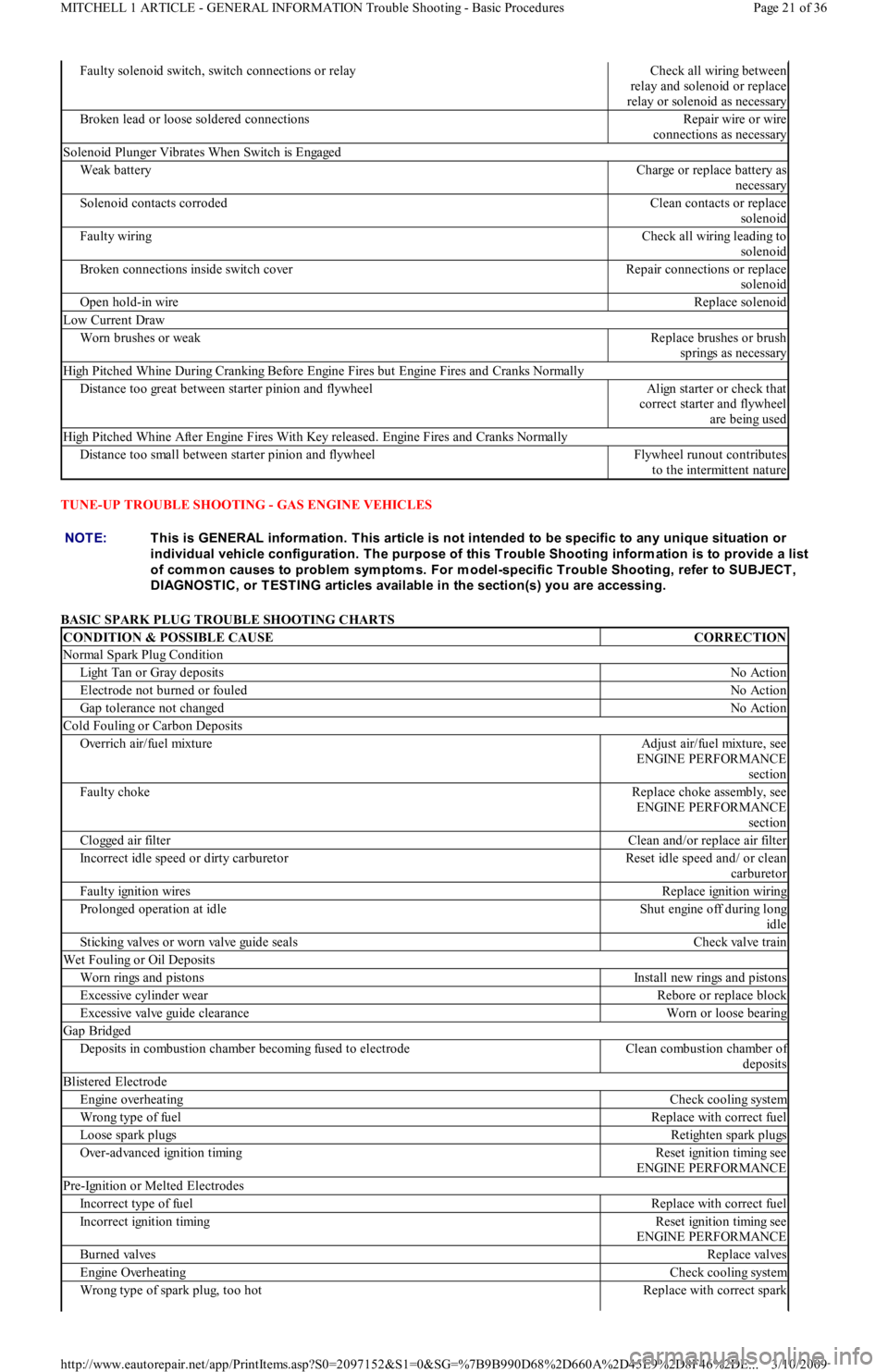
TUNE-UP TROUBLE SHOOTING - GAS ENGINE VEHICLES
BASIC SPARK PLUG TROUBLE SHOOTING CHARTS
Faulty solenoid switch, switch connections or relayCheck all wiring between
relay and solenoid or replace
relay or solenoid as necessary
Broken lead or loose soldered connectionsRepair wire or wire
connections as necessary
Solenoid Plunger Vibrates When Switch is Engaged
Weak batteryCharge or replace battery as
necessary
Solenoid contacts corrodedClean contacts or replace
solenoid
Faulty wiringCheck all wiring leading to
solenoid
Broken connections inside switch coverRepair connections or replace
solenoid
Open hold-in wireReplace solenoid
Low Current Draw
Worn brushes or weakReplace brushes or brush
springs as necessary
High Pitched Whine During Cranking Before Engine Fires but Engine Fires and Cranks Normally
Distance too great between starter pinion and flywheelAlign starter or check that
correct starter and flywheel
are being used
High Pitched Whine After Engine Fires With Key released. Engine Fires and Cranks Normally
Distance too small between starter pinion and flywheelFlywheel runout contributes
to the intermittent nature
NOTE:This is GENERAL inform ation. This article is not intended to be specific to any unique situation or
individual vehicle configuration. T he purpose of this T rouble Shooting inform ation is to provide a list
of com m on causes to problem sym ptom s. For m odel-specific T rouble Shooting, refer to SUBJECT ,
DIAGNOST IC, or T EST ING articles available in the section(s) you are accessing.
CONDITION & POSSIBLE CAUSECORRECTION
Normal Spark Plug Condition
Light Tan or Gray depositsNo Action
Electrode not burned or fouledNo Action
Gap tolerance not changedNo Action
Cold Fouling or Carbon Deposits
Overrich air/fuel mixtureAdjust air/fuel mixture, see
ENGINE PERFORMANCE
section
Faulty chokeReplace choke assembly, see
ENGINE PERFORMANCE
section
Clogged air filterClean and/or replace air filter
Incorrect idle speed or dirty carburetorReset idle speed and/ or clean
carburetor
Faulty ignition wiresReplace ignition wiring
Prolonged operation at idleShut engine off during long
idle
Sticking valves or worn valve guide sealsCheck valve train
Wet Fouling or Oil Deposits
Worn rings and pistonsInstall new rings and pistons
Excessive cylinder wearRebore or replace block
Excessive valve guide clearanceWorn or loose bearing
Gap Bridged
Deposits in combustion chamber becoming fused to electrodeClean combustion chamber of
deposits
Blistered Electrode
Engine overheatingCheck cooling system
Wrong type of fuelReplace with correct fuel
Loose spark plugsRetighten spark plugs
Over-advanced ignition timingReset ignition timing see
ENGINE PERFORMANCE
Pre-Ignition or Melted Electrodes
Incorrect type of fuelReplace with correct fuel
Incorrect ignition timingReset ignition timing see
ENGINE PERFORMANCE
Burned valvesReplace valves
Engine OverheatingCheck cooling system
Wrong type of spark plug, too hotReplace with correct spark
Page 21 of 36 MITCHELL 1 ARTICLE - GENERAL INFORMATION Trouble Shooting - Basic Procedures
3/10/2009 http://www.eautorepair.net/app/PrintItems.asp?S0=2097152&S1=0&SG=%7B9B990D68%2D660A%2D45E9%2D8F46%2DE
...
Page 235 of 454
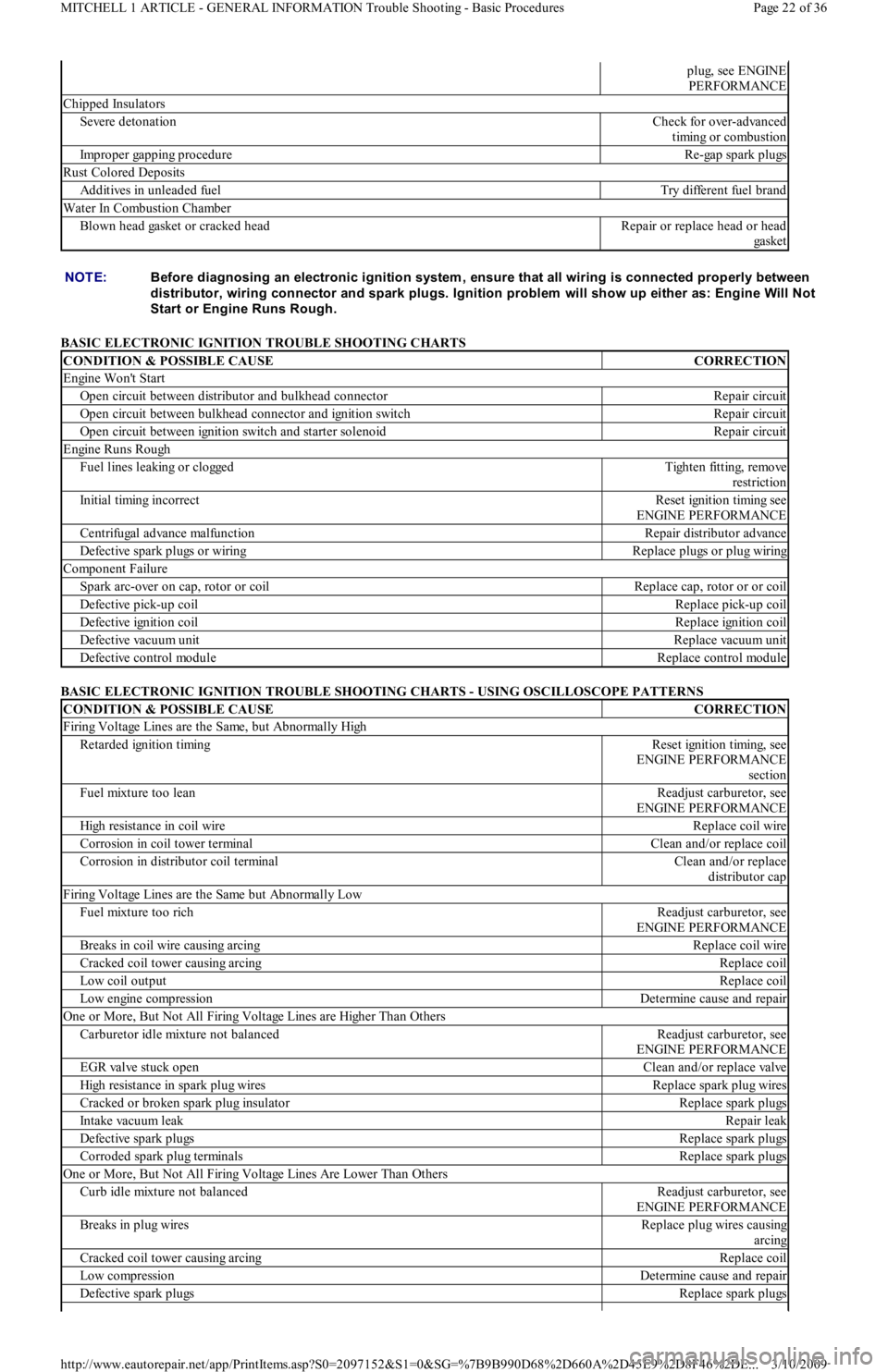
BASIC ELECTRONIC IGNITION TROUBLE SHOOTING CHARTS
BASIC ELECTRONIC IGNITION TROUBLE SHOOTING CHARTS - USING OSCILLOSCOPE PATTERNS
plug, see ENGINE
PERFORMANCE
Chipped Insulators
Severe detonationCheck for over-advanced
timing or combustion
Improper gapping procedureRe-gap spark plugs
Rust Colored Deposits
Additives in unleaded fuelTry different fuel brand
Water In Combustion Chamber
Blown head gasket or cracked headRepair or replace head or head
ga ske t
NOTE:Before diagnosing an electronic ignition system , ensure that all wiring is connected properly between
distributor, wiring connector and spark plugs. Ignition problem will show up either as: Engine Will Not
Start or Engine Runs Rough.
CONDITION & POSSIBLE CAUSECORRECTION
Engine Won't Start
Open circuit between distributor and bulkhead connectorRepair circuit
Open circuit between bulkhead connector and ignition switchRepair circuit
Open circuit between ignition switch and starter solenoidRepair circuit
Engine Runs Rough
Fuel lines leaking or cloggedTigh t e n fit t in g, r e mo ve
restriction
Initial timing incorrectReset ignition timing see
ENGINE PERFORMANCE
Centrifugal advance malfunctionRepair distributor advance
Defective spark plugs or wiringReplace plugs or plug wiring
Component Failure
Spark arc-over on cap, rotor or coilReplace cap, rotor or or coil
Defective pick-up coilReplace pick-up coil
Defective ignition coilReplace ignition coil
Defective vacuum unitReplace vacuum unit
Defective control moduleReplace control module
CONDITION & POSSIBLE CAUSECORRECTION
Firing Voltage Lines are the Same, but Abnormally High
Retarded ignition timingReset ignition timing, see
ENGINE PERFORMANCE
section
Fuel mixture too leanReadjust carburetor, see
ENGINE PERFORMANCE
High resistance in coil wireReplace coil wire
Corrosion in coil tower terminalClean and/or replace coil
Corrosion in distributor coil terminalClean and/or replace
distributor cap
Firing Voltage Lines are the Same but Abnormally Low
Fuel mixture too richReadjust carburetor, see
ENGINE PERFORMANCE
Breaks in coil wire causing arcingReplace coil wire
Cracked coil tower causing arcingReplace coil
Low coil outputReplace coil
Low engine compressionDetermine cause and repair
One or More, But Not All Firing Voltage Lines are Higher Than Others
Carburetor idle mixture not balancedReadjust carburetor, see
ENGINE PERFORMANCE
EGR valve stuck openClean and/or replace valve
High resistance in spark plug wiresReplace spark plug wires
Cracked or broken spark plug insulatorReplace spark plugs
Intake vacuum leakRepair leak
Defective spark plugsReplace spark plugs
Corroded spark plug terminalsReplace spark plugs
One or More, But Not All Firing Voltage Lines Are Lower Than Others
Curb idle mixture not balancedReadjust carburetor, see
ENGINE PERFORMANCE
Breaks in plug wiresReplace plug wires causing
arcing
Cracked coil tower causing arcingReplace coil
Low compressionDetermine cause and repair
Defective spark plugsReplace spark plugs
Page 22 of 36 MITCHELL 1 ARTICLE - GENERAL INFORMATION Trouble Shooting - Basic Procedures
3/10/2009 http://www.eautorepair.net/app/PrintItems.asp?S0=2097152&S1=0&SG=%7B9B990D68%2D660A%2D45E9%2D8F46%2DE
...
Page 236 of 454
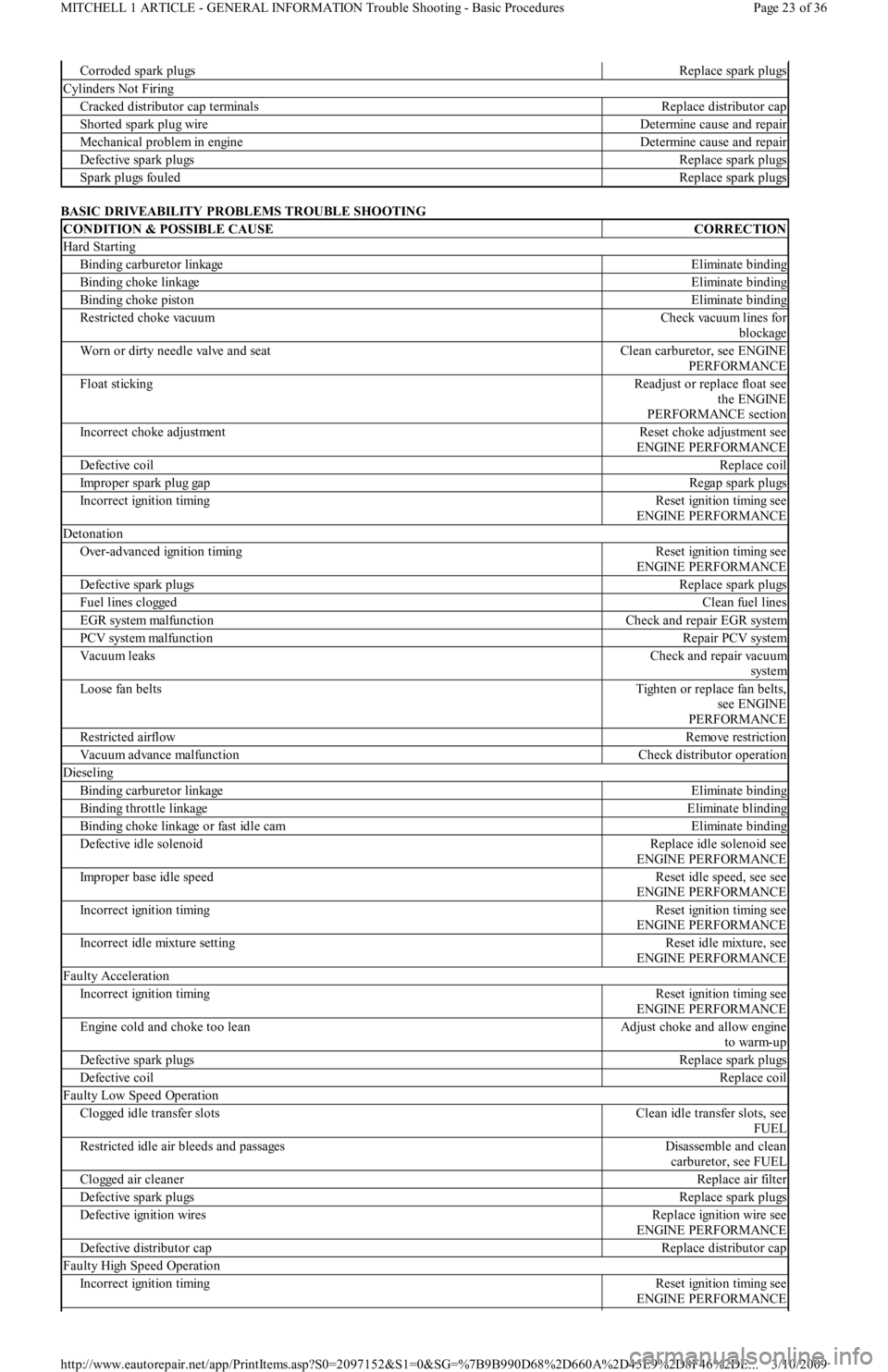
BASIC DRIVEABILITY PROBLEMS TROUBLE SHOOTING
Corroded spark plugsReplace spark plugs
Cylinders Not Firing
Cracked distributor cap terminalsReplace distributor cap
Shorted spark plug wireDetermine cause and repair
Mechanical problem in engineDetermine cause and repair
Defective spark plugsReplace spark plugs
Spark plugs fouledReplace spark plugs
CONDITION & POSSIBLE CAUSECORRECTION
Hard Starting
Binding carburetor linkageEliminate binding
Binding choke linkageEliminate binding
Binding choke pistonEliminate binding
Restricted choke vacuumCheck vacuum lines for
blockage
Worn or dirty needle valve and seatClean carburetor, see ENGINE
PERFORMANCE
Float stickingReadjust or replace float see
the ENGINE
PERFORMANCE section
Incorrect choke adjustmentReset choke adjustment see
ENGINE PERFORMANCE
Defective coilReplace coil
Improper spark plug gapRegap spark plugs
Incorrect ignition timingReset ignition timing see
ENGINE PERFORMANCE
Detonation
Over-advanced ignition timingReset ignition timing see
ENGINE PERFORMANCE
Defective spark plugsReplace spark plugs
Fuel lines cloggedClean fuel lines
EGR system malfunctionCheck and repair EGR system
PCV system malfunctionRepair PCV system
Vacuum leaksCheck and repair vacuum
system
Loose fan beltsTighten or replace fan belts,
see ENGINE
PERFORMANCE
Restricted airflowRemove restriction
Vacuum advance malfunctionCheck distributor operation
Dieseling
Binding carburetor linkageEliminate binding
Binding throttle linkageEliminate blinding
Binding choke linkage or fast idle camEliminate binding
Defective idle solenoidReplace idle solenoid see
ENGINE PERFORMANCE
Improper base idle speedReset idle speed, see see
ENGINE PERFORMANCE
Incorrect ignition timingReset ignition timing see
ENGINE PERFORMANCE
Incorrect idle mixture settingReset idle mixture, see
ENGINE PERFORMANCE
Faulty Acceleration
Incorrect ignition timingReset ignition timing see
ENGINE PERFORMANCE
Engine cold and choke too leanAdjust choke and allow engine
to warm-up
Defective spark plugsReplace spark plugs
Defective coilReplace coil
Faulty Low Speed Operation
Clogged idle transfer slotsClean idle transfer slots, see
FUEL
Restricted idle air bleeds and passagesDisassemble and clean
carburetor, see FUEL
Clogged air cleanerReplace air filter
Defective spark plugsReplace spark plugs
Defective ignition wiresReplace ignition wire see
ENGINE PERFORMANCE
Defective distributor capReplace distributor cap
Faulty High Speed Operation
Incorrect ignition timingReset ignition timing see
ENGINE PERFORMANCE
Page 23 of 36 MITCHELL 1 ARTICLE - GENERAL INFORMATION Trouble Shooting - Basic Procedures
3/10/2009 http://www.eautorepair.net/app/PrintItems.asp?S0=2097152&S1=0&SG=%7B9B990D68%2D660A%2D45E9%2D8F46%2DE
...
Page 237 of 454
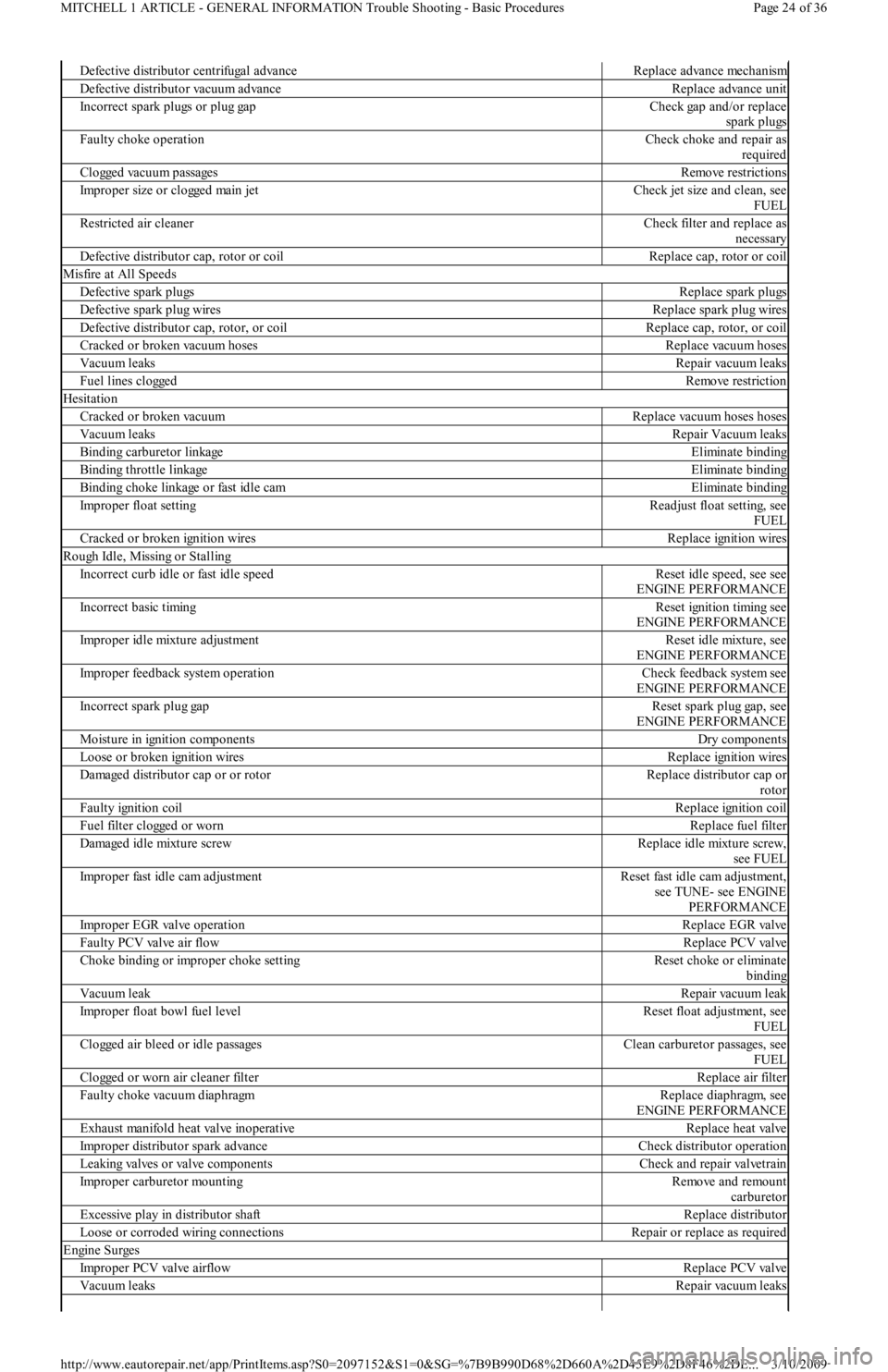
Defective distributor centrifugal advanceReplace advance mechanism
Defective distributor vacuum advanceReplace advance unit
Incorrect spark plugs or plug gapCheck gap and/or replace
spark plugs
Faulty choke operationCheck choke and repair as
required
Clogged vacuum passagesRemove restrictions
Improper size or clogged main jetCheck jet size and clean, see
FUEL
Restricted air cleanerCheck filter and replace as
necessary
Defective distributor cap, rotor or coilReplace cap, rotor or coil
Misfire at All Speeds
Defective spark plugsReplace spark plugs
Defective spark plug wiresReplace spark plug wires
Defective distributor cap, rotor, or coilReplace cap, rotor, or coil
Cracked or broken vacuum hosesReplace vacuum hoses
Vacuum leaksRepair vacuum leaks
Fuel lines cloggedRemove restriction
Hesitation
Cracked or broken vacuumReplace vacuum hoses hoses
Vacuum leaksRepair Vacuum leaks
Binding carburetor linkageEliminate binding
Binding throttle linkageEliminate binding
Binding choke linkage or fast idle camEliminate binding
Improper float settingReadjust float setting, see
FUEL
Cracked or broken ignition wiresReplace ignition wires
Rough Idle, Missing or Stalling
Incorrect curb idle or fast idle speedReset idle speed, see see
ENGINE PERFORMANCE
Incorrect basic timingReset ignition timing see
ENGINE PERFORMANCE
Improper idle mixture adjustmentReset idle mixture, see
ENGINE PERFORMANCE
Improper feedback system operationCheck feedback system see
ENGINE PERFORMANCE
Incorrect spark plug gapReset spark plug gap, see
ENGINE PERFORMANCE
Moisture in ignition componentsDry components
Loose or broken ignition wiresReplace ignition wires
Damaged distributor cap or or rotorReplace distributor cap or
rotor
Faulty ignition coilReplace ignition coil
Fuel filter clogged or wornReplace fuel filter
Damaged idle mixture screwReplace idle mixture screw,
see FUEL
Improper fast idle cam adjustmentReset fast idle cam adjustment,
see TUNE- see ENGINE
PERFORMANCE
Improper EGR valve operationReplace EGR valve
Faulty PCV valve air flowReplace PCV valve
Choke binding or improper choke settingReset choke or eliminate
binding
Vacuum leakRepair vacuum leak
Improper float bowl fuel levelReset float adjustment, see
FUEL
Clogged air bleed or idle passagesClean carburetor passages, see
FUEL
Clogged or worn air cleaner filterReplace air filter
Faulty choke vacuum diaphragmReplace diaphragm, see
ENGINE PERFORMANCE
Exhaust manifold heat valve inoperativeReplace heat valve
Improper distributor spark advanceCheck distributor operation
Leaking valves or valve componentsCheck and repair valvetrain
Improper carburetor mountingRemo ve an d remo u n t
carburetor
Excessive play in distributor shaftReplace distributor
Loose or corroded wiring connectionsRepair or replace as required
Engine Surges
Improper PCV valve airflowReplace PCV valve
Vacuum leaksRepair vacuum leaks
Page 24 of 36 MITCHELL 1 ARTICLE - GENERAL INFORMATION Trouble Shooting - Basic Procedures
3/10/2009 http://www.eautorepair.net/app/PrintItems.asp?S0=2097152&S1=0&SG=%7B9B990D68%2D660A%2D45E9%2D8F46%2DE
...