1990 VOLKSWAGEN TRANSPORTER oil dipstick
[x] Cancel search: oil dipstickPage 45 of 165
Downloaded from www.Manualslib.com manuals search engine
I CONTROLSAND EQUIPMENT
WARNING If the brake warning
light
does not go
out
with
the engine running and the parking brake released or lights up
while driving, the fluid level
in
the brake
fluid reservoir may
be
too low.
This might be
due
to
a
leak in one of the two independently functioning brake circuits.
If the brake pedal travel has increased,
one of the brake circuits may have
failed.
Avoid driving the vehicle and have it towed to the nearest Volkswa
gen dealer or qualified workshop for re pair.
If brake pedal travel has not increased
and
braking performance remains un
impaired,
proceed carefully to
your
nearest Volkswagen dealer or qualified
workshop to have the braking system inspected and corrected.
For detailed information see
"Brakes" on
page 29. 2-
Safety belt
|
A
FASTEN
BELTS
Refer
to
"Safety belts"
on
page
14 for
details.
3
-
Turn
signals E^
Refer
to
"Turn
signal/headlight dimmer
switch lever" on page 49 for details.
4
- Alternator
This
light comes
on
when
the
ignition
is
turned on and goes out after the engine
is
started.
If the
light does
not go out
after
starting
and
revving-up
the
engine
momentarily
or
lights
up
while driving,
there may be a malfunction
in
the electrical system
or
the V-belt
to
the alternator may be loose
or
broken.
In
this
case,
turn
the engine off and
contact
your
Volkswagen dealer.
5
- For additional
light
6
- For additional
light
7
- Engine Oil pressure
When
the
ignition
is
turned
on, the oil
pressure warning light comes on for a bulb
check.
It
should
go out
after
the
engine
has
started.
If the
warning light does
not go out or
flashes
while driving
(above
2000
engine rpm a buzzer
will
sound simultaneously),
it
indicates,
that the oil pressure is too low.
Stop the engine immediately, check the
engine
oil
level
and add
oil, if necessary.
If engine oil level is normal, but the
light
continues to flash, do not continue to
operate the vehicle. This could damage
the engine.
Turn
the engine off and contact the nearest Volkswagen dealer for assistance.
The oil pressure warning
light
is not an indicator for low engine oil level. To
check
the oil level, always use dipstick
(see page 99).
Make
it a habit to have the engine oil
level checked
with
every
fuel filling.
www.westfaliaT3.info - a useful website for owners and enthusiasts of VW Westfalia T25 / T3 Campervans
Page 89 of 165
Downloaded from www.Manualslib.com manuals search engine
VEHICLE OPERATION
After driving over
difficult
terrain,
espe
cially through water or mud, the following
is
important:
• Disengage the differential lock*.
• After long drives through deep mud, the
brakes must be checked and cleaned if
they are
dirty.
This will prevent damage to
the brakes and premature wear.
• After driving through deep water, take
out oil dipstick and check to see whether
there are drops of water on the dipstick or if the oil level has risen. In
that
case,
the oil
must be changed immediately.
• If during an off-road drive the vehicle
has
become stuck (dug its way
into
the
ground) or the underside was stuck by
rocks
or similar, check undercarriage,
brake lines and oil pan for damage. • The engine compartment and vehicle
underbody must be cleaned if they are
very
dirty
so
that
the function of all mova ble and electrical/electronic parts is main
tained.
•
Clean
heavy soil from wheels and tires,
check
tires for damage or foreign objects in treads.
•
Clean
turn
signals, lights and license
plate.
• Dry brake system by driving a short dis
tance
with
brake pedal slightly depressed.
This
will help regaining normal braking ac
tion
and help prevent the possibility of the
vehicle pulling to one side while braking.
Performance
testing
If the
Vanagon/Transporter
Syncro re
quires
testing
on a
dynamometer
(en
gine
output
analysis and
brake
test)
the
transaxle
drive
shaft
must
be discon nected.
The
differential
lock
must
not be en gaged.
84 "where applicable
www.westfaliaT3.info - a useful website for owners and enthusiasts of VW Westfalia T25 / T3 Campervans
Page 104 of 165
Downloaded from www.Manualslib.com manuals search engine
VEHICLE CARE
ENGINE OIL
Engine oil consumption t 3 normal for your engine to consume oil.
T-Q
rate of oil consumption depends on
re quality and viscosity of
oil,
the speed at
Mich
the engine is operated, the climate,
read
conditions as well as the amount of : ution and oxidation of the lubricant.
Because
of these variables, no standard
•e:e
of oil consumption can be esta-
:
shed,
but drivers should expect an in
creased
oil consumption at high speeds
s.nd when the engine is new.
• The
engine
in your
vehicle
depends
on oil to
lubricate
and cool all of its
mov
ing
parts.
Therefore
the
engine
oil
should be checked
regularly
and
kept
at
the
required
level.
•
Make
it a
habit
to
have
the
engine
oil
level
checked
with
every
fuel
filling.
• Lack of
sufficient
engine
oil may
lead
to
severe
engine
damage.
• The oil pressure
warning
light
is not
an oil
level
indicator.
Always
heed
WARNINGS
on
page
97.
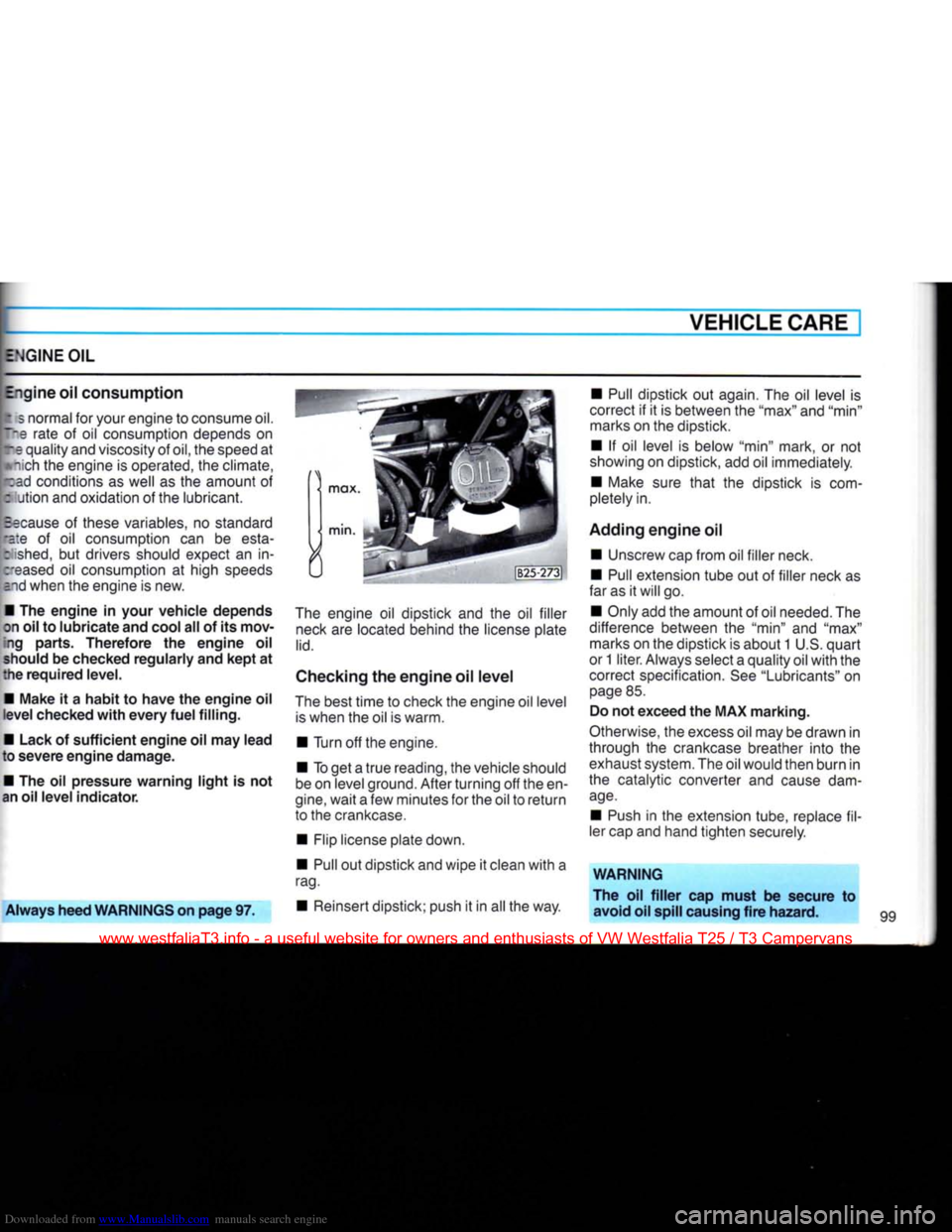
The
engine oil dipstick and the oil filler
neck
are located behind the license plate
lid.
Checking the
engine
oil
level
The
best time to check the engine oil level
is
when the oil is warm.
• Turn off the engine.
• To get a true reading, the vehicle should
be
on level ground. After turning off the en
gine,
wait a few minutes for the oil to return
to the crankcase.
• Flip license plate down.
• Pull out dipstick and wipe it clean
with
a
rag.
• Reinsert dipstick; push it in all the way. • Pull dipstick out again. The oil level is
correct if it is between the "max" and "min" marks on the dipstick.
• If oil level is below "min" mark, or not
showing on dipstick, add oil immediately.
• Make sure
that
the dipstick is com
pletely in.
Adding
engine
oil • Unscrew cap from oil filler neck.
• Pull extension tube out of filler neck as
far as it will go.
• Only add the amount of oil needed. The
difference between the "min" and "max" marks on the dipstick is about
1
U.S. quart
or
1
liter. Always select a quality oil
with
the
correct specification. See "Lubricants" on
page
85.
Do not exceed the MAX
marking.
Otherwise,
the excess oil may be drawn in
through the crankcase breather into the exhaust system. The oil would then burn in
the catalytic converter and cause dam
age.
•
Push
in the extension tube, replace fil
ler cap and hand tighten securely.
WARNING
The oil
filler
cap
must
be secure to avoid oil spill causing
fire
hazard.
www.westfaliaT3.info - a useful website for owners and enthusiasts of VW Westfalia T25 / T3 Campervans
Page 105 of 165
Downloaded from www.Manualslib.com manuals search engine
VEHICLE CARE
Changing the
engine
oil
Have
your engine oil changed regularly,
but at least twice a year (see Maintenance
booklet).
This
is very important because the lubri cating properties of oil diminish gradually
during normal operation of the vehicle.
If you drive mostly short distances, or if
you operate the vehicle in dusty
areas,
or under predominantly stop-and-go traffic
conditions, or when temperatures remain below freezing for extended periods, the
engine oil should be changed more fre
quently.
Due
to the detergent additives in the oil,
the fresh oil will look dark after the engine
has
been running for a short time. This is
normal and there is no reason to change
the oil more often than recommended by
the manufacturer.
Always
heed
WARNINGS
on
page
96
100 and97-
WARNING
•
Drain
the oil
into
a
container
that
is
designed for
this
purpose, one
that
is
large
enough to hold at
least
the oil
filling
of your
engine.
•
Wear
eye
protection.
• To
reduce
the
risk
of burns
from
hot
engine
oil let the
engine
cool
down
to
the touch.
•
When
removing
the oil
drain
plug
with
your fingers,
keep
as far
away
as possible.
Always
keep
your
forearm
parallel
to the ground to
help
prevent
hot oil
from
running
down
your arm.
• Engine oil is poisonous. Keep it
well
out of the
reach
of children. Con
tinuous
contact
with
used
engine
oil is
harmful
to your skin.
Always
protect
your skin by
washing
thoroughly
with
soap and
water.
•
Always
dispose of used
engine
oil
properly.
Do not
dump
it on
garden
soil,
wooded
areas,
into
open
streams
or
down
sewage
drains.
• Recycle used
engine
oil by
taking
it to
a used
engine
oil collection
facility
in
your
area,
or
contact
a service
station.
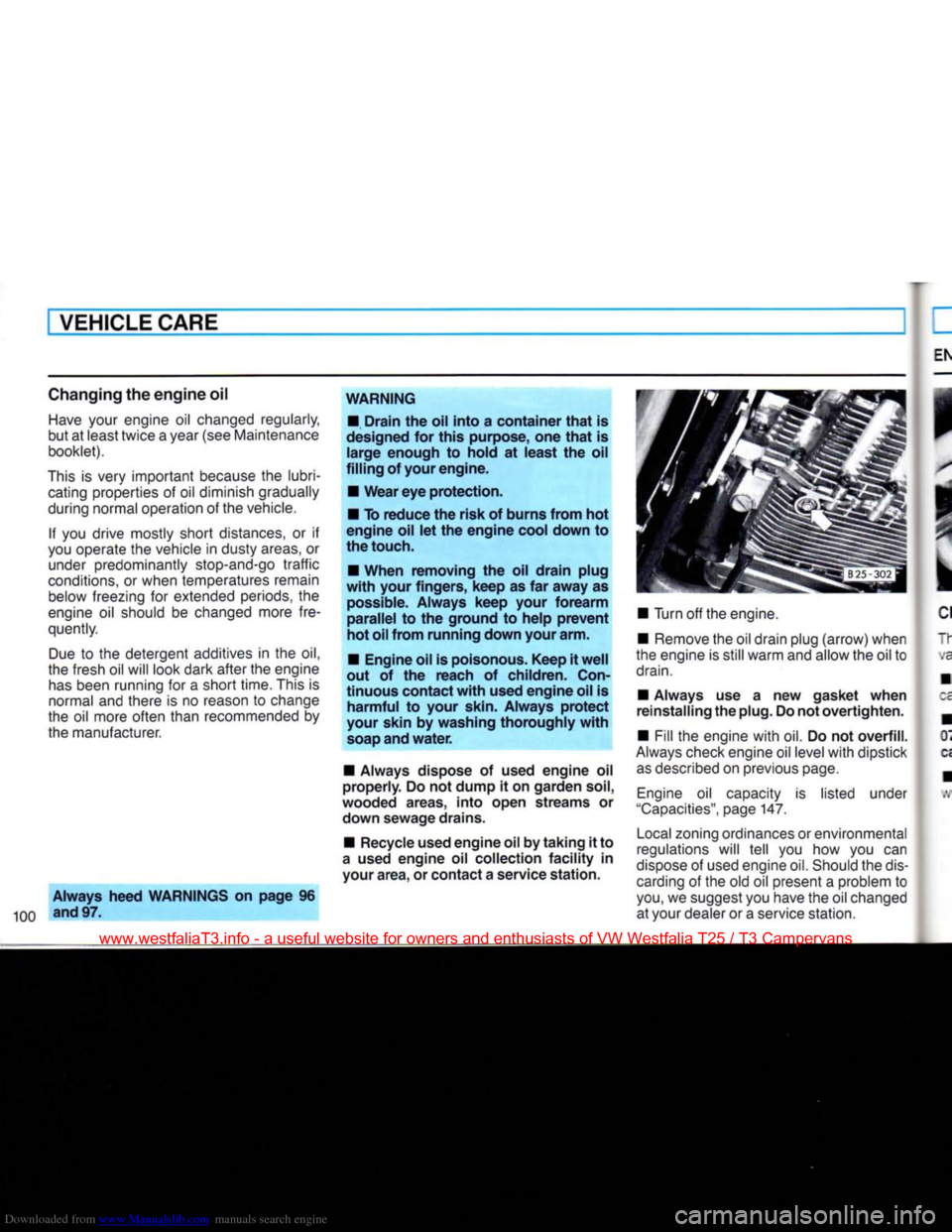
• Turn off the engine.
• Remove the oil drain plug (arrow) when
the engine is still warm and allow the oil to
drain.
•
Always
use a new
gasket
when
reinstalling
the plug. Do not
overtighten.
•
Fill
the engine
with
oil. Do not
overfill.
Always
check engine oil level
with
dipstick
as
described on previous page.
Engine
oil capacity is listed under
"Capacities",
page 147.
Local
zoning ordinances or environmental
regulations will tell you how you can
dispose
of used engine oil. Should the dis carding of the old oil present a problem to
you,
we suggest you have the oil changed
at your dealer or a service station.
www.westfaliaT3.info - a useful website for owners and enthusiasts of VW Westfalia T25 / T3 Campervans
Page 106 of 165
Downloaded from www.Manualslib.com manuals search engine
VEHICLE CARE
ENGINE OIL FILTER
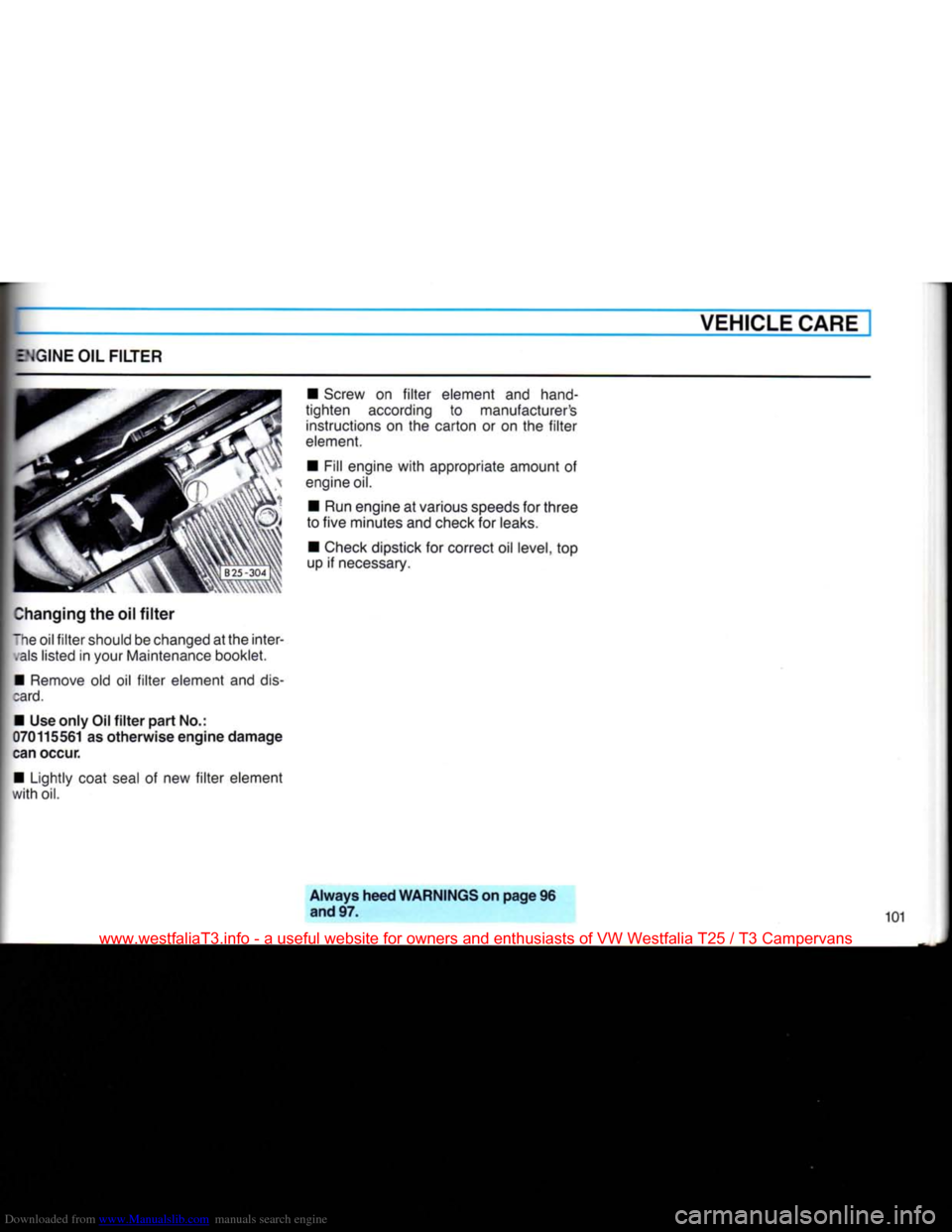
: he oil
filter
should be changed at the inter-
,als
listed in your Maintenance booklet.
• Remove old oil
filter
element and dis
card.
• Use
only
Oil
filter
part
No.:
070115561
as
otherwise
engine
damage
can occur.
• Lightly coat seal of new
filter
element
with
oil. • Screw on
filter
element and hand-
tighten according to manufacturer's instructions on the carton or on the
filter
element.
• Fill engine
with
appropriate amount of
engine oil.
• Run engine at various speeds for three
to five minutes and check for leaks.
• Check dipstick for correct oil level, top
up if necessary.
Always
heed
WARNINGS
on
page
96 and 97. 101
www.westfaliaT3.info - a useful website for owners and enthusiasts of VW Westfalia T25 / T3 Campervans
Page 107 of 165
Downloaded from www.Manualslib.com manuals search engine
VEHICLE CARE
AUTOMATIC TRANSMISSION FLUID / MANUAL TRANSMISSION OIL
Automatic Transmission Fluid
The torque converter and the transmis
sion are lubricated with Automatic Trans mission Fluid (ATF).
The final drive requires hypoid oil SAE 90,
which does not have to be changed.
Checking the ATF level
The ATF has to be checked at frequent intervals, for instance, when the engine
oil is being checked or at least at the intervals specified in your Maintenance
booklet.
Always heed WARNINGS on page 97. A correct ATF level is very important for
transmission operation.
To obtain an accurate reading, the
vehicle must be on level ground, and the
fluid must have reached operating
tem
perature. Normally, after a cold-start the
fluid will reach operating temperature when the vehicle has been driven for ab
out 6 miles or 10 km. If the ATF is too cool
or too hot, the fluid level reading will be inaccurate.
WARNING Before checking the ATF, the selector
lever must be securely locked in the Park position and the parking brake ap
plied firmly.
Checking the ATF level is potentially hazardous because the hot engine has
to be running during the check. Do not
attempt to check the ATF before read ing all WARNINGS on page 97.
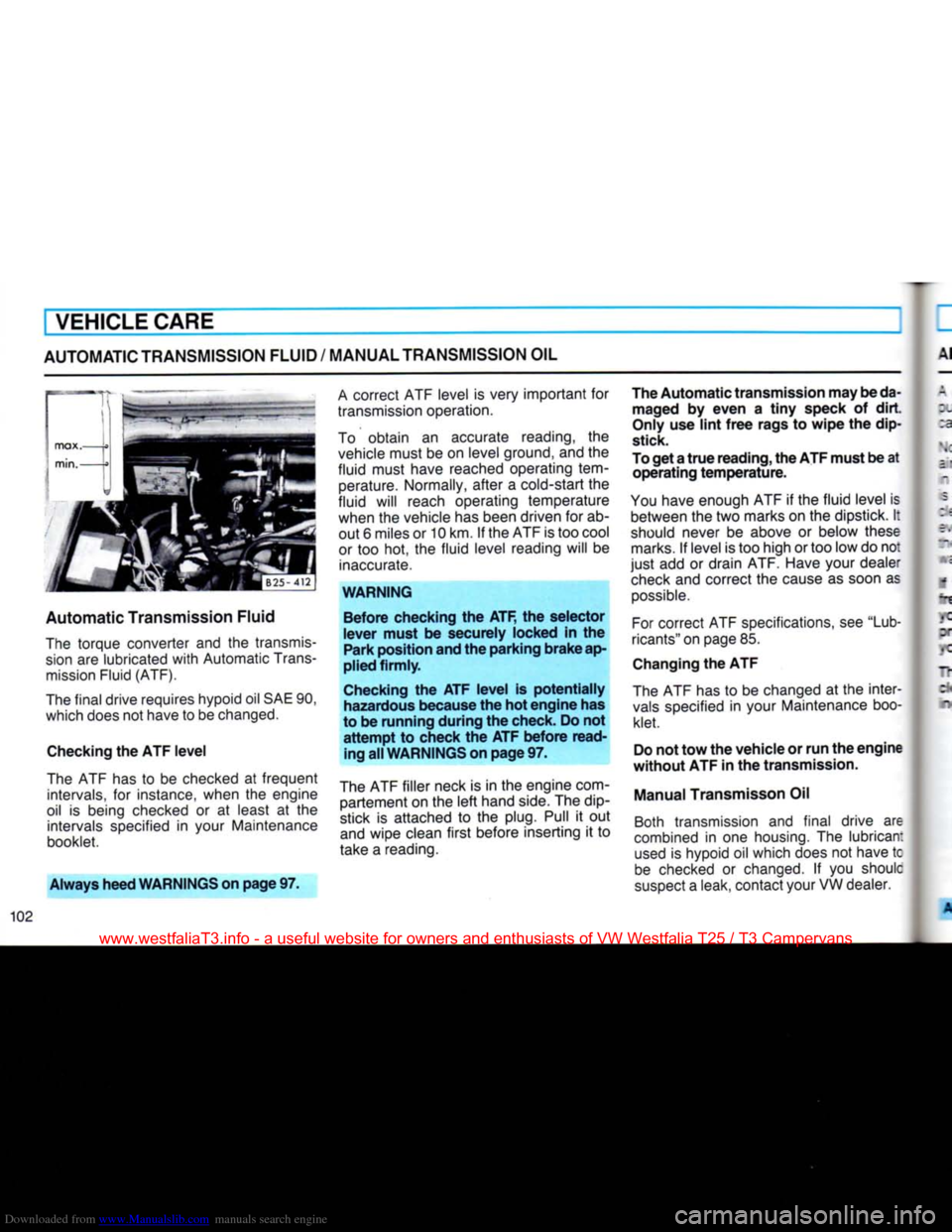
The ATF filler neck is in the engine com- partement on the left hand side. The dip
stick is attached to the
plug.
Pull it out
and wipe clean first before inserting it to
take a reading. The Automatic transmission may be da
maged by even a tiny speck of dirt.
Only use lint free rags to wipe the dip
stick.
To get a true reading, the ATF must be at operating temperature.
You have enough ATF if the fluid level is between the two marks on the dipstick. I:
should never be above or below these marks. If level is too high or too low do not
just add or drain ATF. Have your dealer check and correct the cause as soon as possible.
For correct ATF specifications, see "Lub
ricants" on page 85.
Changing the ATF
The ATF has to be changed at the inter vals specified in your Maintenance booklet.
Do not tow the vehicle or run the engine
without ATF in the transmission.
Manual Transmisson Oil Both transmission and final drive are
combined in one housing. The lubrican: used is hypoid oil which does not have tc
be checked or changed. If you shoulc
suspect a leak, contact your VW dealer.
www.westfaliaT3.info - a useful website for owners and enthusiasts of VW Westfalia T25 / T3 Campervans
Page 152 of 165

Downloaded from www.Manualslib.com manuals search engine
TECHNICAL DATA
V-BELTS
CAPACITIES
for waterpump/alternator. 9.5 x 1100 LA
Fuel
tank 16.0 gal/60 liters
for A/C compressor . . . 12.5x1153 LA Syncro:
for power steering .... 9.5 x 1080 18.5 gal/70 liters Noteg
Reserve
(of
total
capacity) >. .. 2.5 gal/10 liters
The V-belts are among the most severely Coolin3
sVstem186
^t/17-5 ll,ers
stressed
parts of a vehicle. The belts there- Automatic
fore have very high quality requirements. transmission fluid (ATF) 3.2 qt/3.0 liters
When replacing a belt, it is not sufficient to Windshield washer container 4.3 qt/4.2 liters
use
just
any belt of the same
size.
For safe
operation, use only Original Volkswagen
Rear
window washer container 1.1 qt/1.0 liters
V-belts
specially designed for your Engine oil
vehicle.
The correct belts can be obtained
with
filter
change 4.8 qt/4.5 liters at your Volkswagen dealership.
without
filter
change 4.2 qt/4.0 liters
Do
not
fill
above "max" mark.
The oil level should be checked while topping up.
Difference between "min" and "max" marks
on the dipsticks is approx. 1 qt/1 liter
www.westfaliaT3.info - a useful website for owners and enthusiasts of VW Westfalia T25 / T3 Campervans
Page 161 of 165

Downloaded from www.Manualslib.com manuals search engine
GAS
STATION
INFORMATION
1 -
Jack
and tools, see page 123.
2
- Windshield washer container, capacity 4.3 qt/4.2 liters.
3
-
Fuse
box, see page 128.
4 - Brake
fluid
reservoir, see page 108.
5
- Spare wheel, see page 124.
6 - Battery, see page 109.
7 -
Fuel
filler neck (rear wheel drive), capacity 16 gal/60 liters.
8 -
Rear
window washer container, capacity 1.1 qt/1.0 liters.
9 -
Fuel
filler neck (syncro), capacity 18.5 gal/70 liters.
10 - Air cleaner, see page 103.
11 - Power steering
fluid
reservoir, see page 103.
12 - Engine oil dipstick/oil filler neck, see page 99.
13
- Coolant
refill
tank, see page 105.
14 - ATF dipstick, see page 102.
157
www.westfaliaT3.info - a useful website for owners and enthusiasts of VW Westfalia T25 / T3 Campervans