1990 VOLKSWAGEN TRANSPORTER overheating
[x] Cancel search: overheatingPage 43 of 165
Downloaded from www.Manualslib.com manuals search engine
CONTROLS
AND
EQUIPMENT
WARNING continned •
The
engine compartment
of any
motor vehicle
is a
potentially hazard
ous
area.
Before you check anything in the engine compartment, stop
the
engine and
let it
cool down. Always
exercise extreme caution when work
ing
one the
engine. Heed
all of the
WARNINGS on page
97.
Reduce the risk
of
scalding from
hot
coolant by following these steps.
• If the coolant reservoir cap must be
removed, wait until
the
engine
has
cooled down.
• Protect face, hands
and
arms
by
covering
the cap
with
a
large, thick
rag
to
protect against escaping fluid
and
steam.
• Carefully and slowly
turn
cap
one
turn
to
allow excess pressure
to es
cape before completely removing
cap.
•
To
help avoid being burned,
do not
spill
antifreeze
or
coolant
on the ex
haust system
or hot
engine parts.
Under
some conditions, the ethylene
glycol
in
engine coolant
is
combusti
ble.
If a
visual check shows that coolant level
and V-belt
are
normal,
but the
warning light continues to
flash,
contact
your
near
est dealer
to
have
the
cause located
and
corrected.
For more details see "Cooling system"
on
page 104.
If the
coolant gauge needle nears
the
upper end
of
the scale and the engine ap
pears
to be
overheating,
turn
off the air
conditioner.
Do
not
install accessories
(fog
lights
or
in
sect screens,
for
example)
on top of the
front
bumper.
They
may
restrict engine
cooling.
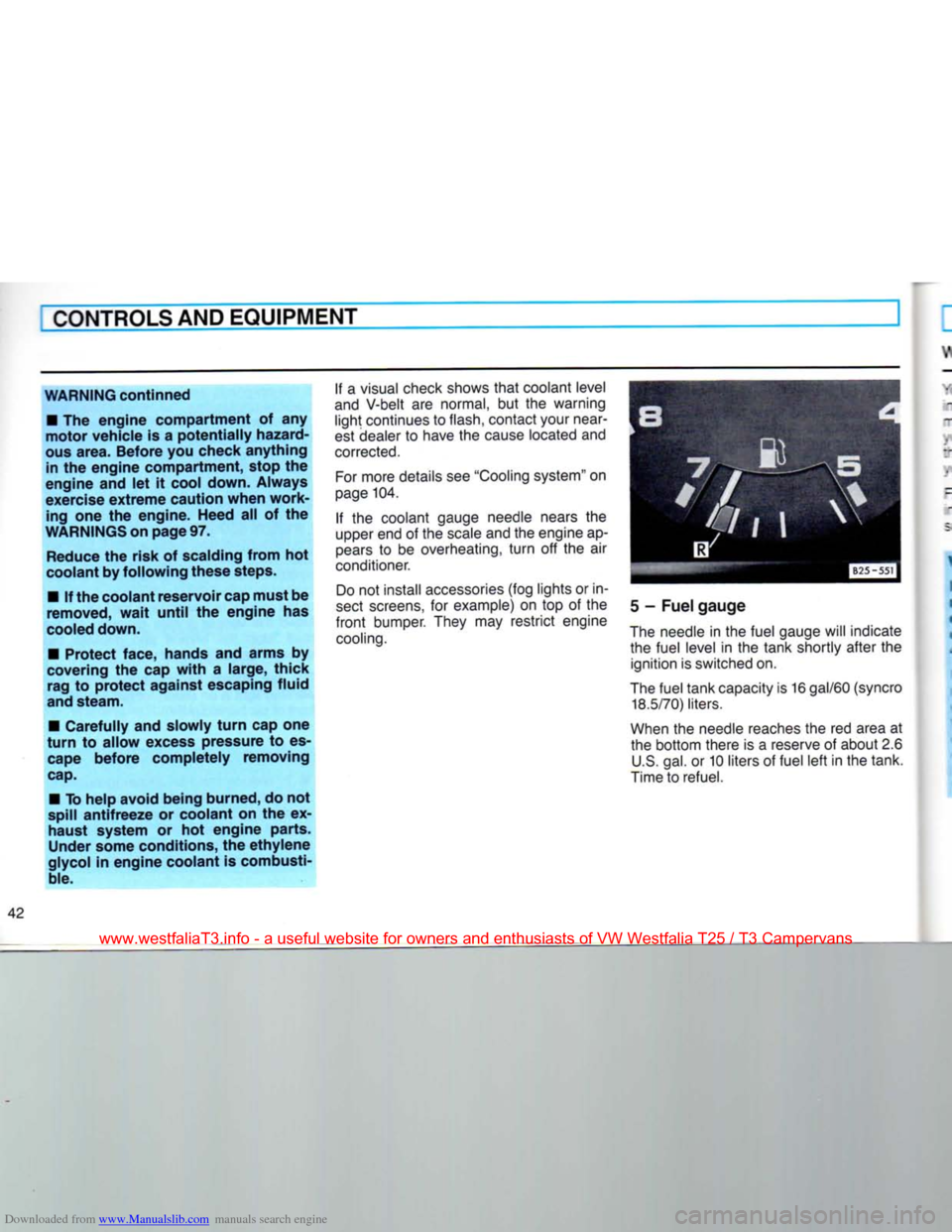
5
-
Fuel gauge
The needle
in
the fuel gauge will indicate the fuel level
in the
tank shortly after
the
ignition is switched on.
The fuel tank capacity is
16
gal/60
(syncro
18.5/70)
liters.
When
the
needle reaches the
red
area
at
the bottom there
is a
reserve
of
about 2.6 U.S. gal.
or
10 liters
of
fuel left in the tank.
Time to refuel.
www.westfaliaT3.info - a useful website for owners and enthusiasts of VW Westfalia T25 / T3 Campervans
Page 60 of 165
Downloaded from www.Manualslib.com manuals search engine
CONTROLS AND EQUIPMENT
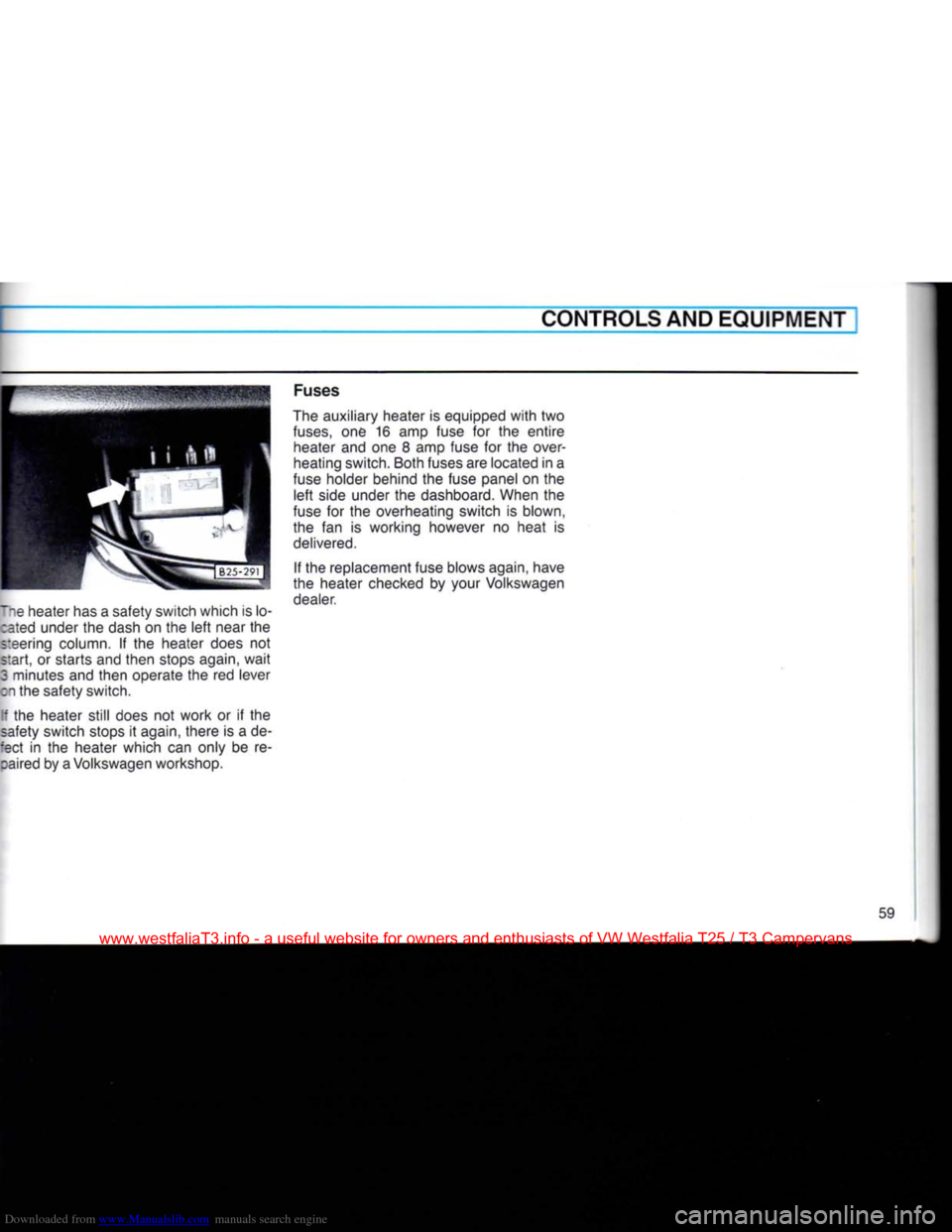
lie heater has a safety switch which is lo- :ated under the dash on the left near the
steering column. If the heater does not
start, or starts and then stops again, wait
3 minutes and then operate the red lever
on the safety switch.
[f the heater still does not work or if the
safety switch stops it again, there is a de-
:ect in the heater which can only be re- :aired by a Volkswagen workshop. Fuses
The auxiliary heater is equipped with two
fuses,
one 16 amp fuse for the entire heater and one 8 amp fuse for the over
heating switch. Both fuses are located in a
fuse holder behind the fuse panel on the left side under the dashboard. When the
fuse for the overheating switch is blown,
the fan is working however no heat is
delivered.
If the replacement fuse blows again, have
the heater checked by your Volkswagen dealer.
59
www.westfaliaT3.info - a useful website for owners and enthusiasts of VW Westfalia T25 / T3 Campervans
Page 109 of 165
Downloaded from www.Manualslib.com manuals search engine
VEHICLE
CARE
COOLING
SYSTEM
The cooling system
is
sealed and gener ally requires little attention.
The cooling system has been filled at the factory with
a
permanent coolant which
does not need to be changed. The coolant
consists
of a
mixture
of
water
and the
manufacturer's coolant additive
G 11 —
antifreeze
on
glycol basis with anticorro-
sion additives (40% for USA
models;
50%
for Canadian models).
This
mixture
assures
the
necessary frost protection
and protects
the
entire cooling system
against corrosion and
scaling,
and raises
the boiling point of the coolant.
Do
not
reduce
the
concentration
of the
coolant
in the
summer
by
adding plain
water.
The coolant additive proportion
must
be at least
40%
but not more than
60%,
to
maintain the antifreeze protection
and the cooling efficiency. For year round driving, antifreeze is added
at the factory for temperatures down to:
-13°
F/-25°C(USA)
-40°
F/-40°
C
(Canada)
Only
use
quality phosphate-free
anti
freeze containing ethylene glycol. Such antifreeze
is
available at
your
Volkswagen
dealer.
WARNING Antifreeze is poisonous. Always store antifreeze in its original container and
well
out of the reach of children. If you drain
the
coolant,
it must
be
caught
and
safely stored. Drained coolant should normally not be reused. Always des-
pose
of used coolant observing all en
vironmental regulations.
Coolant losses
Coolant losses may indicate
a
leak in
the
cooling
system.
In
this
case,
the
cooling
system should
be
inspected immediately by
your
Volkswagen dealer.
It is not
suffi
cient merely to add coolant.
In a
sealed system, losses can only occur
if
the
boiling point
of the
coolant
is ex
ceeded as
a
result of overheating.
Overheating can occur
if:
•
the
flow
of air to the
radiator
is
obstructed
by
leaves, dust, insects
or by
additional
lights installed
in
front
of the
radiator grille;
•
the boiling point of the coolant has been
reduced
due to an
incorrect mixture
of
coolant and water;
•
the
radiator fan
is not
working
- see
"Radiator
fan",
or;
•
the vehicle is being driven up
a
long
hill
j
in
a
low gear with engine speed
very
high
and
at
very
high ambient temperature
-
see
"Radiator fan".
If
the cause for the overheating cannot
be
determined
and
corrected, contact
your
Volkswagen dealer immediately, other-
I
wise serious engine damage could result.
104
Always
heed
WARNING on page
97.
www.westfaliaT3.info - a useful website for owners and enthusiasts of VW Westfalia T25 / T3 Campervans
Page 134 of 165

Downloaded from www.Manualslib.com manuals search engine
DO-IT-YOURSELF-SERVICE
Fuse arrangement No. Component Amp. No. Component Amp.
From left to right: 1
Radiator fan 30 17 Windshield wiperengine 10
2 Brake lights 10
18 Brake warning light,
3 Interior lights, illuminated heated driver's seat,
Make-up mirror, clock,
ciga
cruise control system 10
rette lighter, radio 15 19 Turn signals 10
4 Emergency flasher system 15 20 Number plate light,
5 Vacant headlight washer
10
6 Vacant 21 Low beam left
10
7 Tail and side light left 10
22 Low beam right 10
8 Tail and side light right
10
9 High beam right 10
10 High beam left
10 Additional fuses
11 Windshield wipers and washer
15 (in separate holders)
12 Cruise control system
Air conditioner, power above the fuse box:
windows, auxiliary heater, Instrument lightning
10
electric outside mirrors, Overheating fuse for auxiliary heater
10
auxiliary heat exchanger, Main fuse for auxiliary heater
20
rear window wiper 20 Central locking 20
13 Fresh air fan
20 Automatic fuse for window lifter
20
14 Rear window heating, heated
rear view mirror, light for Color codes
15
16 lighting switch
Back-up lights
Double tone horn 20
10
15 10 Amp. fuses - red
15 Amp. fuses - blue
15
16 lighting switch
Back-up lights
Double tone horn 20
10
15 20 Amp. fuses - yellow
30 Amp. fuses - green
The number on the face of the fuse is the amperage rating.
www.westfaliaT3.info - a useful website for owners and enthusiasts of VW Westfalia T25 / T3 Campervans
Page 149 of 165
Downloaded from www.Manualslib.com manuals search engine
TECHNICAL
DESCRIPTION
EMISSION
CONTROL SYSTEM
In the
interest
of
clean
air Pollution of our environment has become
a
problem
that
is of increasing concern to
all of us. We urge you to
join
us in our ef
forts
for cleaner air in controlling the pollu
tants emitted from the automobile.
You
can make a significant contribution to
keeping our air clean by:
• Always using lead free gasoline.
• Not
letting
your vehicle idle
unnecessa
rily.
• Following the recommended preven
tive maintenance schedule contained in
the maintenance booklet.
• Not removing or altering the emission
control system.
• Taking the precautions described
below to prevent damage to the emission
control system in your vehicle.
Volkswagen
warrants the Emission
Con
trol
System in your new vehicle under the
terms and conditions set
forth
in the War ranty booklet.
Your
Volkswagen is equipped
with
such a
system,
which contains the following major components.
Catalytic
converter
The catalytic converter is an efficient
"clean-up"
device
built
into
the exhaust system of the vehicle. The catalytic conver
ter burns the undesirable pollutants in the exhaust gas before it is released
into
the
atmosphere.
The
exclusive
use of
unleaded
fuel
is cri
tically
important
for the
life
of the
cataly
tic
converter
and
proper
functioning
of
the
engine.
The
catalytic
converter
will
be
perma
nently
damaged
by
•
exceeding
the "max"
marking
when
adding
engine
oil (see
page
99)
• push or tow
starting
your
vehicle
•
misfiring
of the
engine
•
turning
off the
ignition
while
the
vehicle
is
moving
or
•
other
unusual
operating
conditions. Do not
continue
to
operate
your
vehicle
under
these
conditions, as
otherwise
fuel
can
reach
the
catalytic
converter.
This could
result
in
overheating
of the
converter,
requiring
its
replacement.
For
maintenance intervals refer to your
Maintenance booklet.
Oxygen
Sensor (OXS)
The oxygen sensor, installed in the exhaust manifold, continuously
senses
the oxygen content of the exhaust and
signals
the information to an electronic
control
unit.
Carbon
canister
The vehicle is equipped
with
a carbon canister to prevent fuel vapor from
esca
ping
into
the atmosphere.
The vapor is passed
into
the carbon canister, where it is retained when the
engine is turned off. When the engine is running, a valve allows air
into
the canister,
and the fuel vapor is passed to the engine
for combustion.
The system does not require any main
tenance.
144
www.westfaliaT3.info - a useful website for owners and enthusiasts of VW Westfalia T25 / T3 Campervans
Page 150 of 165
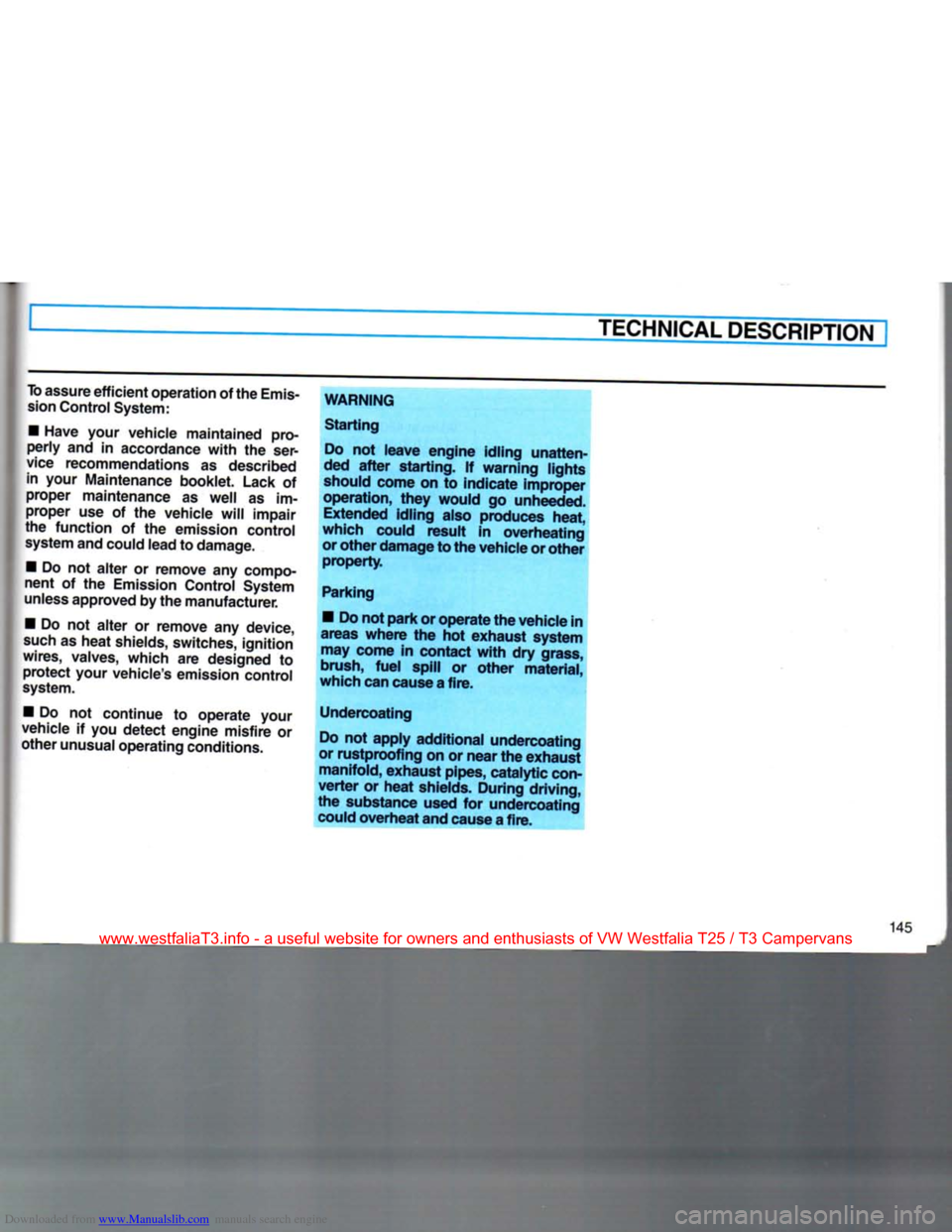
Downloaded from www.Manualslib.com manuals search engine
TECHNICAL
DESCRIPTION
To
assure
efficient
operation
of
the
Emis
sion
Control
System:
•
Have
your
vehicle maintained pro
perly and in accordance
with
the ser
vice recommendations as described in
your
Maintenance booklet. Lack of
proper maintenance as
well
as im
proper use of the vehicle
will
impair
the function of the emission control
system
and
could
lead
to
damage.
•
Do not alter or remove any compo
nent of the Emission Control System
unless
approved
by
the
manufacturer.
•
Do not alter or remove any device,
such
as heat shields, switches, ignition
wires, valves, which are designed to protect
your
vehicle's emission control
system.
•
Do not continue to operate
your
vehicle if you detect engine misfire or
other
unusual
operating conditions. WARNING
Starting
Do
not leave engine idling unatten
ded
after starting. If warning lights should come on to indicate improper
operation,
they would go unheeded. Extended idling also produces heat,
which could result in overheating
or other
damage
to
the
vehicle
or
other
property.
Parking
•
Do
not
park
or
operate
the
vehicle
in
areas
where the hot exhaust system
may
come in contact
with
dry grass,
brush,
fuel spill or other material,
which
can
cause
a
fire.
Undercoating
Do
not apply additional undercoating
or rustproofing on or
near
the
exhaust
manifold,
exhaust
pipes,
catalytic
con
verter
or heat shields. During driving,
the substance used for undercoating
could
overheat
and
cause
a
fire.
www.westfaliaT3.info - a useful website for owners and enthusiasts of VW Westfalia T25 / T3 Campervans