1990 VOLKSWAGEN TRANSPORTER tow
[x] Cancel search: towPage 37 of 165
Downloaded from www.Manualslib.com manuals search engine
CONTROLS
AND EQUIPMENT
1 - Position for steep hills
This
position is to be
used
for mountain
driving
or
slow
driving.
It
also
provides
for
maximum
engine
braking effect. To
engage this gear depress the push but
ton in the handle of the selector lever
first. In "1" the
transmission
will
stay
in first
gear
and will not upshift.
The road speed must not exceed 33 mph
or
53 km/h. Only shift down into "1"
when the speed is below this speeds.
WARNING
Do
not shift to a lower driving position
until vehicle speed has dropped below
the specified limits otherwise engine
speed
will
suddenly increase and may
cause
engine damage and
loss
of
vehicle control. Driving the automatic transmission
Starting the engine
The
selector
lever
must be in Neutral or Park. If one of the driving
positions
is
engaged
a
safety
switch will prevent the
engine
from
being
started.
Emergency
starting
Your
Volkswagen
with
Automatic
Transmis
sion
cannot
be started by
pushing
or tow
ing.
If
engine
does
not start
because
of
dis
charged
battery, the
vehicle
can be started
with jumper
cables.
Refer
to
"Emergency
starting
with jumper
cables".
Should
the
engine
fail to start
consult
your
nearest
Volkswagen
dealer.
Selecting
a driving position
WARNING
•
Apply the foot brake before select
ing a driving position when the vehicle
is
stationary.
When the selector lever is in a driving
position,
the vehicle may creep even at
idle speed. Therefore, do not release
the parking brake or foot brake until
you
are ready to move, because power
is
transmitted to the wheels as soon as
a driving position is engaged.
•
Do not accelerate
while
selecting
a driving position. At this
time
the en
gine must run at idle speed so
that
no undue stress
will
be placed on the auto
matic clutches in the transmission.
•
Never have any position engaged
when checking in the engine compart ment. Make sure the selector lever is
securely
locked into the P position
with
the parking brake firmly set. Otherwise, any increase in engine speed may set
the vehicle in motion, even
with
the parking brake applied.
www.westfaliaT3.info - a useful website for owners and enthusiasts of VW Westfalia T25 / T3 Campervans
Page 38 of 165
Downloaded from www.Manualslib.com manuals search engine
CONTROLS
AND
EQUIPMENT
•
Never shift into Reverse (R) or Park
(P) when the vehicle is in motion.
•
Do not remove the key from the ig
nition steering lock until you have
parked the vehicle, because removal
of the key
will
lock the steering wheel.
•
If the selector lever is unintention
ally moved into Neutral (N)
while
driv
ing,
take
your foot off the accelerator pedal and
wait
until the engine speed
has
dropped to idling before selecting
a driving position.
Maneuvering
•'/hen
alternating between forward and
-averse
- for
instance,
while
maneuvering
ne
vehicle
into a tight parking
space
-
:nly
shift when the
vehicle
has
come
to a
full stop and the
engine
is running at idle
soeed.
Stuck
in snow, mud or sand
When
alternating between forward and
reverse
in an effort to free the
vehicle,
depress
the
accelerator
pedal
slightly
while
the
transmission
is in
gear,
and
release
the
accelerator
pedal
while
shifting.
Do not
race
the
engine
and
avoid
spinning
the
wheels.
Do not repeat
"rocking"
back and
forth
with
wheels
spinning
at high engine speed and heavy
throttle,
as serious damage may
be caused to the automatic transmis
sion
and other critical parts.
Kickdown
device
The
kickdown
device
gives
maximum
acceleration
when the
accelerator
pedal
is
pressed
down
past
the full throttle
posi
tion.
Depending
on
road
speed
and
engine
speed,
either the upshift is
delayed
(forced
throttle) or the box
changes
down
into
the next lower
gear.
WARNING
Be
careful when using the kickdown on
slippery
roads. Rapid acceleration may
cause
skidding.
Stopping
•
When
stopping briefly, at a traffic light
for
example,
it is not
necessary
to
move
the
selector
lever
to
Neutral.
Simply
apply
the
brakes.
To start
again
release
brake
and
accelerate.
•
The driving
positions
must
never
be
used
for holding the
vehicle
at rest
uphill.
Always
use your foot
brakes
when
stopped
on
inclines.
WARNING
•
Never get out of the driver's seat
when the engine is running and the
selector
lever is not securely locked in
the P position.
•
If you must leave the vehicle move
the selector lever securely into the P
position
and apply parking brake
firmly.
Towing
To
tow the
vehicle
see instructions
"Emergency
towing" on
page
138.
www.westfaliaT3.info - a useful website for owners and enthusiasts of VW Westfalia T25 / T3 Campervans
Page 45 of 165
Downloaded from www.Manualslib.com manuals search engine
I CONTROLSAND EQUIPMENT
WARNING If the brake warning
light
does not go
out
with
the engine running and the parking brake released or lights up
while driving, the fluid level
in
the brake
fluid reservoir may
be
too low.
This might be
due
to
a
leak in one of the two independently functioning brake circuits.
If the brake pedal travel has increased,
one of the brake circuits may have
failed.
Avoid driving the vehicle and have it towed to the nearest Volkswa
gen dealer or qualified workshop for re pair.
If brake pedal travel has not increased
and
braking performance remains un
impaired,
proceed carefully to
your
nearest Volkswagen dealer or qualified
workshop to have the braking system inspected and corrected.
For detailed information see
"Brakes" on
page 29. 2-
Safety belt
|
A
FASTEN
BELTS
Refer
to
"Safety belts"
on
page
14 for
details.
3
-
Turn
signals E^
Refer
to
"Turn
signal/headlight dimmer
switch lever" on page 49 for details.
4
- Alternator
This
light comes
on
when
the
ignition
is
turned on and goes out after the engine
is
started.
If the
light does
not go out
after
starting
and
revving-up
the
engine
momentarily
or
lights
up
while driving,
there may be a malfunction
in
the electrical system
or
the V-belt
to
the alternator may be loose
or
broken.
In
this
case,
turn
the engine off and
contact
your
Volkswagen dealer.
5
- For additional
light
6
- For additional
light
7
- Engine Oil pressure
When
the
ignition
is
turned
on, the oil
pressure warning light comes on for a bulb
check.
It
should
go out
after
the
engine
has
started.
If the
warning light does
not go out or
flashes
while driving
(above
2000
engine rpm a buzzer
will
sound simultaneously),
it
indicates,
that the oil pressure is too low.
Stop the engine immediately, check the
engine
oil
level
and add
oil, if necessary.
If engine oil level is normal, but the
light
continues to flash, do not continue to
operate the vehicle. This could damage
the engine.
Turn
the engine off and contact the nearest Volkswagen dealer for assistance.
The oil pressure warning
light
is not an indicator for low engine oil level. To
check
the oil level, always use dipstick
(see page 99).
Make
it a habit to have the engine oil
level checked
with
every
fuel filling.
www.westfaliaT3.info - a useful website for owners and enthusiasts of VW Westfalia T25 / T3 Campervans
Page 49 of 165
Downloaded from www.Manualslib.com manuals search engine
fCONTROLS AND EQUIPMENT
TURN SIGNAL / HEADLIGHT DIMMER SWITCH LEVER
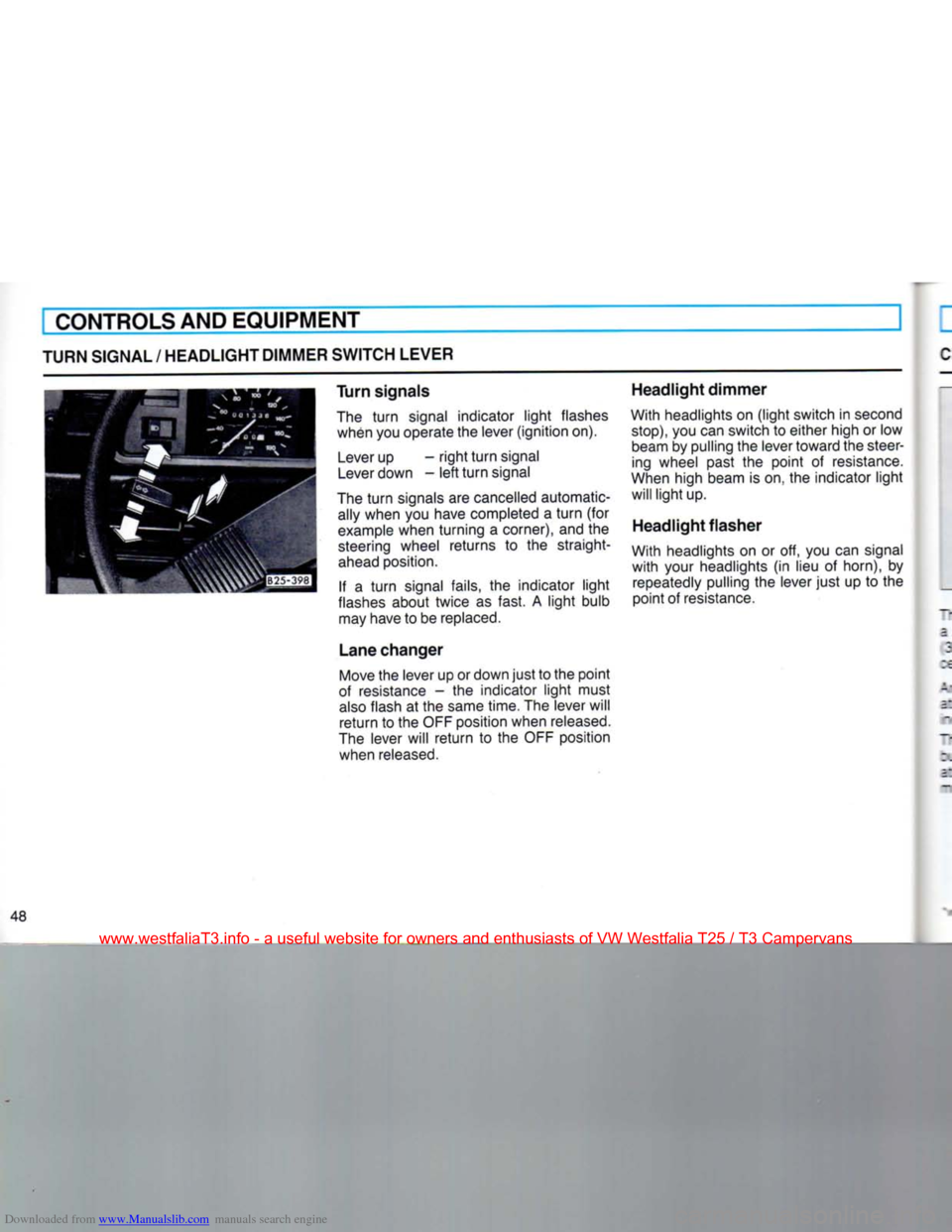
Turn signals
The turn signal indicator light flashes when you operate the lever (ignition on).
Lever up - right turn signal
Lever down - left turn signal
The turn signals are cancelled automatic ally when you have completed a turn (for
example when turning a corner), and the
steering wheel returns to the straight-
ahead position.
If a turn signal fails, the indicator light
flashes about twice as fast. A light bulb may have to be replaced. Headlight dimmer
With headlights on (light switch in second
stop),
you can switch to either high or low beam by pulling the lever toward the steering wheel past the point of resistance.
When high beam is on, the indicator light will light up.
Headlight flasher
With headlights on or off, you can signal with your headlights (in lieu of horn), by repeatedly pulling the lever just up to the
point of resistance.
Lane changer
Move the lever up or down just to the point
of resistance - the indicator light must also flash at the same time. The lever will
return to the OFF position when released.
The lever will return to the OFF position when released.
www.westfaliaT3.info - a useful website for owners and enthusiasts of VW Westfalia T25 / T3 Campervans
Page 51 of 165
Downloaded from www.Manualslib.com manuals search engine
CONTROLS AND EQUIPMENT
WIPER
AND WASHER SYSTEM
The
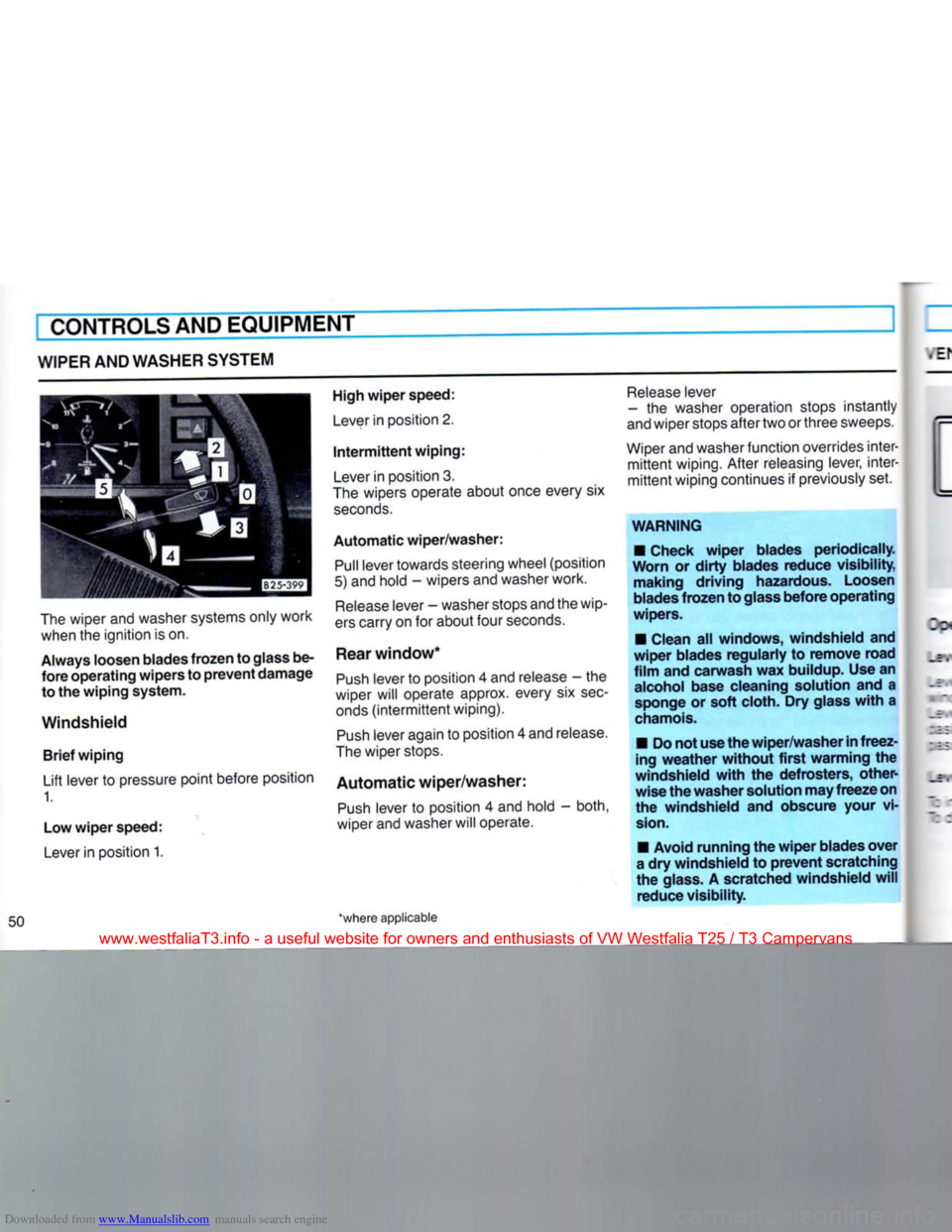
wiper and washer systems only work when the ignition is on.
Always
loosen blades
frozen
to glass be
fore
operating
wipers
to
prevent
damage
to the
wiping
system.
Windshield
Brief
wiping
Lift lever to pressure point before position 1.
Low
wiper
speed:
Lever
in position 1.
High
wiper
speed:
Lever
in position 2.
Intermittent
wiping:
Lever
in position 3.
The
wipers operate about once every six
seconds.
Automatic
wiper/washer:
Pull
lever towards steering wheel (position
5) and hold - wipers and washer work.
Release
lever - washer stops and the wip
ers
carry on for about four
seconds.
Rear
window*
Push
lever to position 4 and release - the
wiper will operate approx. every six
sec
onds
(intermittent
wiping).
Push
lever again to position 4 and release.
The
wiper stops.
Automatic
wiper/washer:
Push
lever to position 4 and hold - both,
wiper and washer will operate.
*where applicable
Release
lever
- the washer operation stops instantly
and
wiper stops after two or three sweeps.
Wiper
and washer function overrides inter
mittent
wiping. After releasing lever, inter
mittent
wiping continues if previously set.
WARNING
• Check
wiper
blades
periodically.
Worn
or
dirty
blades
reduce
visibility,
making
driving
hazardous. Loosen
blades
frozen
to glass
before
operating
wipers.
• Clean all
windows,
windshield
and
wiper
blades
regularly
to
remove
road
film
and
carwash
wax buildup. Use an alcohol base cleaning solution and a sponge or
soft
cloth. Dry glass
with
a
chamois.
• Do not use the
wiper/washer
in
freez
ing
weather
without
first
warming
the
windshield
with
the
defrosters,
other
wise
the
washer
solution may
freeze
on
the
windshield
and obscure your vi
sion.
• Avoid
running
the
wiper
blades
over
a dry
windshield
to
prevent
scratching
the glass. A scratched
windshield
will
reduce
visibility.
www.westfaliaT3.info - a useful website for owners and enthusiasts of VW Westfalia T25 / T3 Campervans
Page 53 of 165
Downloaded from www.Manualslib.com manuals search engine
CONTROLS
AND EQUIPMENT
WARNING
• Good
visibility
comes
with
windows
free
of
fog,
condensation and
frost.
• For clear
visibility
and safe
driving
it
is
extremely
important
that
you
thor
oughly
familiarize
yourself
with
and fol low the
operating
instructions
pertain
ing to the proper use and
function
of
the
ventilation/heating
and defogging/
defrosting
system in
this
manual. If in
doubt,
consult your Volkswagen
dealer.
•
Maximum
heating
output
and
fast
defrosting
can be
obtained
only
after
the
engine
has reached
operating
tem
perature.
Defogging and
defrosting
wind
shield and side
windows
• Slide all control levers to the extreme
right and
turn
fan control switch E to speed
setting 2.
• The fan control switch for the
secon
dary heat exchanger should be
OFF.
Warming
up vehicle
interior
quickly • Slide levers
A,
B and D to extreme right.
• Slide lever C to extreme left.
• Open air outlets 3.
• Turn fan control switch E to speed
setting 2.
Warming
up vehicle
interior
normally
Once
the windshield and side windows
are
clear and the vehicle interior is warm,
you may want to set the controls as fol
lows:
• Slide lever A to the left.
• Slide lever B to desired temperature
setting.
• Slide lever C toward center.
• Turn fan control switch E to speed
setting 1.
Outside air
ventilation
With lever B at extreme left, outside air is emitted from all open outlets.
Hints
• All operating controls, except fan
con
trol
switch E and fan control switch for the
secondary
heat exchanger can be ad
justed to any intermediate position.
• Stale air is drawn out of the vehicle
interior through vents on the inside
front
door
panels. The vents can be opened or
closed
by sliding the lever forward or
rearward.
52
www.westfaliaT3.info - a useful website for owners and enthusiasts of VW Westfalia T25 / T3 Campervans
Page 68 of 165
![VOLKSWAGEN TRANSPORTER 1990 T4 / 4.G Owners Manual Downloaded from www.Manualslib.com manuals search engine
CONTROLS AND EQUIPMENT]
VANITY MIRROR* ASSIST HANDLES/COAT HOOKS*
N VISORS
>fcu
can
lift
the
visor
on the
drivers side
out
cf
th](/manual-img/18/7415/w960_7415-67.png "VOLKSWAGEN TRANSPORTER 1990 T4 / 4.G Owners Manual Downloaded from www.Manualslib.com manuals search engine
CONTROLS AND EQUIPMENT]
VANITY MIRROR* ASSIST HANDLES/COAT HOOKS*
N VISORS
>fcu
can
lift
the
visor
on the
drivers side
out
cf
th")
Downloaded from www.Manualslib.com manuals search engine
CONTROLS AND EQUIPMENT]
VANITY MIRROR* ASSIST HANDLES/COAT HOOKS*
N VISORS
>fcu
can
lift
the
visor
on the
driver's side
out
cf
the
center mounting
and
move
it
toward
Te
door window
to
protect against side :
are.
[B25-377J
A
vanity mirror is
located
on the
back
of
the
sun
visor
on the
passenger's side.
To illuminate
the
vanity mirror, slide
the
switch (arrow).
When
the sun
visor
is
tilted
up,
illumination is shut
off
automatically. Assist handles
and
coat hooks
are
intended
for
your convenience.
WARNING • Hang clothes
in
such a way that they
do
not
impair
the
driver's vision.
•
Do not
hang heavy objects
on the
coat hooks,
as
they could cause per
sonal injury
in the
event
of a
sudden
stop.
'where applicable 67
www.westfaliaT3.info - a useful website for owners and enthusiasts of VW Westfalia T25 / T3 Campervans
Page 72 of 165
Downloaded from www.Manualslib.com manuals search engine
VEHICLE
OPERATION
In the
driver's
seat
•
Check operation of horn.
•
Adjust seat for easy reach of controls.
•
Adjust head restraints to your
size.
•
Adjust inside and outside rear view mir-
brs.
•
Use safety belts as directed.
•
Assure yourself
that
all passengers,
especially
children, are properly buckled up.
•
Check operation of
foot
and parking
orakes.
•
Check all warning and indicator lights
v/hen starting the engine.
•
Do not leave vehicle idling unattended.
•
Lock all doors
from
inside to prevent in advertent opening of doors
from
inside
and unwanted
entry
from
outside. On the
road
•
Always drive defensively. Expect the
unexpected.
•
Observe speed
limits
and obey road
signs.
•
Use signals to indicate
turns
and lane
changes.
•
Turn on headlights at dusk.
•
Always keep a safe distance
from
the
vehicle in
front
of you, depending on
traf
fic, road and weather conditions.
•
Reduce speed at
night
and during incle
ment weather.
•
If you smell gas fumes in the vehicle,
drive
with
the windows open, but keep the rear lid
closed.
Have the cause im
mediately located and corrected.
•
Make frequent rest stops, at least
after
every two hours of driving.
•
When
tired
pull off the road, stop and
take a rest. Turn the engine off. Do not sit in the vehicle
with
engine idling. Engine exhaust is dangerous if inhaled.
•
When stopped or parked, always set
the parking brake. Move the selector lever
to "P" (Automatic transmission) or move
the gearshift lever to reverse or
first
gear (Manual transmission). When parking on
hills,
turn
wheels
toward
the curb.
•
When stalled or stopped for repairs,
move the vehicle well off the road. Turn on
emergency flasher and use other warning
devices
to alert other motorists. Do not park or operate the vehicle in areas where
the hot exhaust system may come in
con
tact
with
dry
grass,
brush, fuel spill or other material which can cause a fire.
•
Make it a habit to have the engine oil
checked
with
every fuel filling.
www.westfaliaT3.info - a useful website for owners and enthusiasts of VW Westfalia T25 / T3 Campervans