1990 VOLKSWAGEN TRANSPORTER key
[x] Cancel search: keyPage 38 of 165
Downloaded from www.Manualslib.com manuals search engine
CONTROLS
AND
EQUIPMENT
•
Never shift into Reverse (R) or Park
(P) when the vehicle is in motion.
•
Do not remove the key from the ig
nition steering lock until you have
parked the vehicle, because removal
of the key
will
lock the steering wheel.
•
If the selector lever is unintention
ally moved into Neutral (N)
while
driv
ing,
take
your foot off the accelerator pedal and
wait
until the engine speed
has
dropped to idling before selecting
a driving position.
Maneuvering
•'/hen
alternating between forward and
-averse
- for
instance,
while
maneuvering
ne
vehicle
into a tight parking
space
-
:nly
shift when the
vehicle
has
come
to a
full stop and the
engine
is running at idle
soeed.
Stuck
in snow, mud or sand
When
alternating between forward and
reverse
in an effort to free the
vehicle,
depress
the
accelerator
pedal
slightly
while
the
transmission
is in
gear,
and
release
the
accelerator
pedal
while
shifting.
Do not
race
the
engine
and
avoid
spinning
the
wheels.
Do not repeat
"rocking"
back and
forth
with
wheels
spinning
at high engine speed and heavy
throttle,
as serious damage may
be caused to the automatic transmis
sion
and other critical parts.
Kickdown
device
The
kickdown
device
gives
maximum
acceleration
when the
accelerator
pedal
is
pressed
down
past
the full throttle
posi
tion.
Depending
on
road
speed
and
engine
speed,
either the upshift is
delayed
(forced
throttle) or the box
changes
down
into
the next lower
gear.
WARNING
Be
careful when using the kickdown on
slippery
roads. Rapid acceleration may
cause
skidding.
Stopping
•
When
stopping briefly, at a traffic light
for
example,
it is not
necessary
to
move
the
selector
lever
to
Neutral.
Simply
apply
the
brakes.
To start
again
release
brake
and
accelerate.
•
The driving
positions
must
never
be
used
for holding the
vehicle
at rest
uphill.
Always
use your foot
brakes
when
stopped
on
inclines.
WARNING
•
Never get out of the driver's seat
when the engine is running and the
selector
lever is not securely locked in
the P position.
•
If you must leave the vehicle move
the selector lever securely into the P
position
and apply parking brake
firmly.
Towing
To
tow the
vehicle
see instructions
"Emergency
towing" on
page
138.
www.westfaliaT3.info - a useful website for owners and enthusiasts of VW Westfalia T25 / T3 Campervans
Page 39 of 165
Downloaded from www.Manualslib.com manuals search engine
CONTROLS AND EQUIPMENT
STEERING LOCK/IGNITION/STARTER
SWITCH
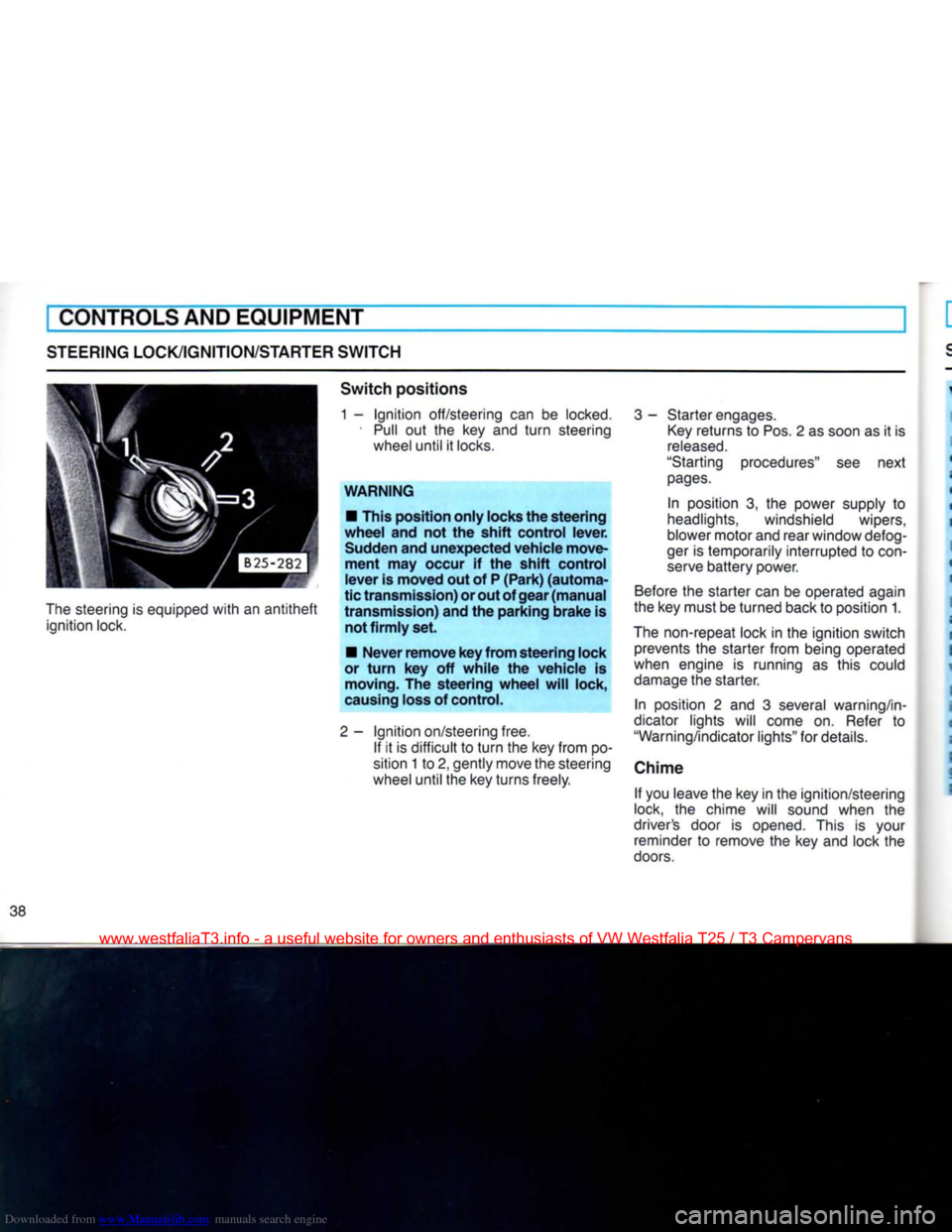
The
steering is equipped
with
an
antitheft
ignition lock.
Switch
positions
1 -
Ignition
off/steering can be
locked.
•
Pull
out the key and
turn
steering wheel until it
locks.
WARNING
• This position
only
locks the
steering
wheel
and not the
shift
control
lever.
Sudden and
unexpected
vehicle
move
ment
may occur if the
shift
control
lever
is
moved
out of P
(Park)
(automa
tic
transmission)
or out of
gear
(manual
transmission)
and the
parking
brake
is not
firmly
set.
•
Never
remove
key
from
steering
lock
or
turn
key off
while
the
vehicle
is moving. The
steering
wheel
will
lock,
causing loss of control.
2-
Ignition
on/steering free. If it is difficult to
turn
the key from po
sition 1 to 2, gently move the steering
wheel until the key turns freely.
3
- Starter engages.
Key
returns to Pos. 2 as soon as it is
released.
"Starting procedures" see next
pages.
In position 3, the power supply to
headlights, windshield wipers,
blower motor and rear window defog-
ger
is temporarily interrupted to
con
serve
battery power.
Before
the starter can be operated again
the key must be turned back to position 1.
The
non-repeat lock in the ignition switch prevents the starter from being operated
when engine is running as this could
damage
the starter.
In position 2 and 3 several warning/in
dicator lights will come on.
Refer
to
"Warning/indicator lights" for details.
Chime If you leave the key in the ignition/steering
lock, the chime will sound when the
driver's door is opened. This is your reminder to remove the key and lock the
doors.
www.westfaliaT3.info - a useful website for owners and enthusiasts of VW Westfalia T25 / T3 Campervans
Page 40 of 165
Downloaded from www.Manualslib.com manuals search engine
CONTROLS
AND
EQUIPMENT
STARTING
PROCEDURES
WARNING
•
Fasten safety belts before driving.
•
Never
start or let the engine run in a
confined or enclosed, unventilated
area.
Exhaust fumes from the engine
contain carbon monoxide, which is a
colorless
and odorless gas. Carbon monoxide can be
fatal
if inhaled.
•
Never
leave engine idling unatten
ded.
An unattended vehicle with a run
ning
engine is potentially hazardous.
•
Do not park or operate the vehicle in
areas
where the hot exhaust system may come in contact with dry grass,
brush,
fuel
spill
or other
material,
which can cause a fire.
•
Do not leave engine unattended at
idle.
When starting engine, be ready to
drive off immediately. Maintain moder
ate
speed until the engine is
com
pletely warm. Remember that
your
en
gine performs best at operating
tem
perature.
Automatic
Transmission
Engine will only start with selector lever in
Neutral or Park.
Manual
Transmission
Start with gearshift lever in Neutral, clutch
pedal
depressed, so that the starter only
has
to crank the engine.
Starting
engine
•
Do not depress accelerator pedal
when starting. At extrem low temperatures
the engine will probably start better, if you depress accelerator pedal slighly.
•
As soon as the engine starts, release
the ignition key.
•
If the engine does not start the first time
or
stalls,
turn
the ignition off and restart. Depress the accelerator pedal slowly
during the second starting attempt.
•
Operate the starter for no more than
10
seconds.
•
Allow about 30 seconds between each
starting
attempt.
STOPPING
ENGINE
Do not stop engine immediately after
hard or extended driving. Keep engine
running for about two minutes to pre
vent
excessive heat build-up.
WARNING
•
Before you check anything in the
engine compartment, stop the engine and let it cool down. Hot components
can
burn skin on contact.
•
The radiator fan switches on auto
matically
when the coolant reaches a cer
tain
temperature and will continue to run
(even
with ignition off) until the coolant
temperature drops.
39
www.westfaliaT3.info - a useful website for owners and enthusiasts of VW Westfalia T25 / T3 Campervans
Page 50 of 165
Downloaded from www.Manualslib.com manuals search engine
I
CONTROLS AND
EQUIPMENT
CRUISE
CONTROL*
JB33-509
The cruise control allows you
to
maintain a constant cruising speed above
22 mph
35
km/h),
without
actuating
the ac
celerator pedal.
Any
manual operation, such
as
acceler ating, gearshifting
or
braking can be done independently
of
the cruise control.
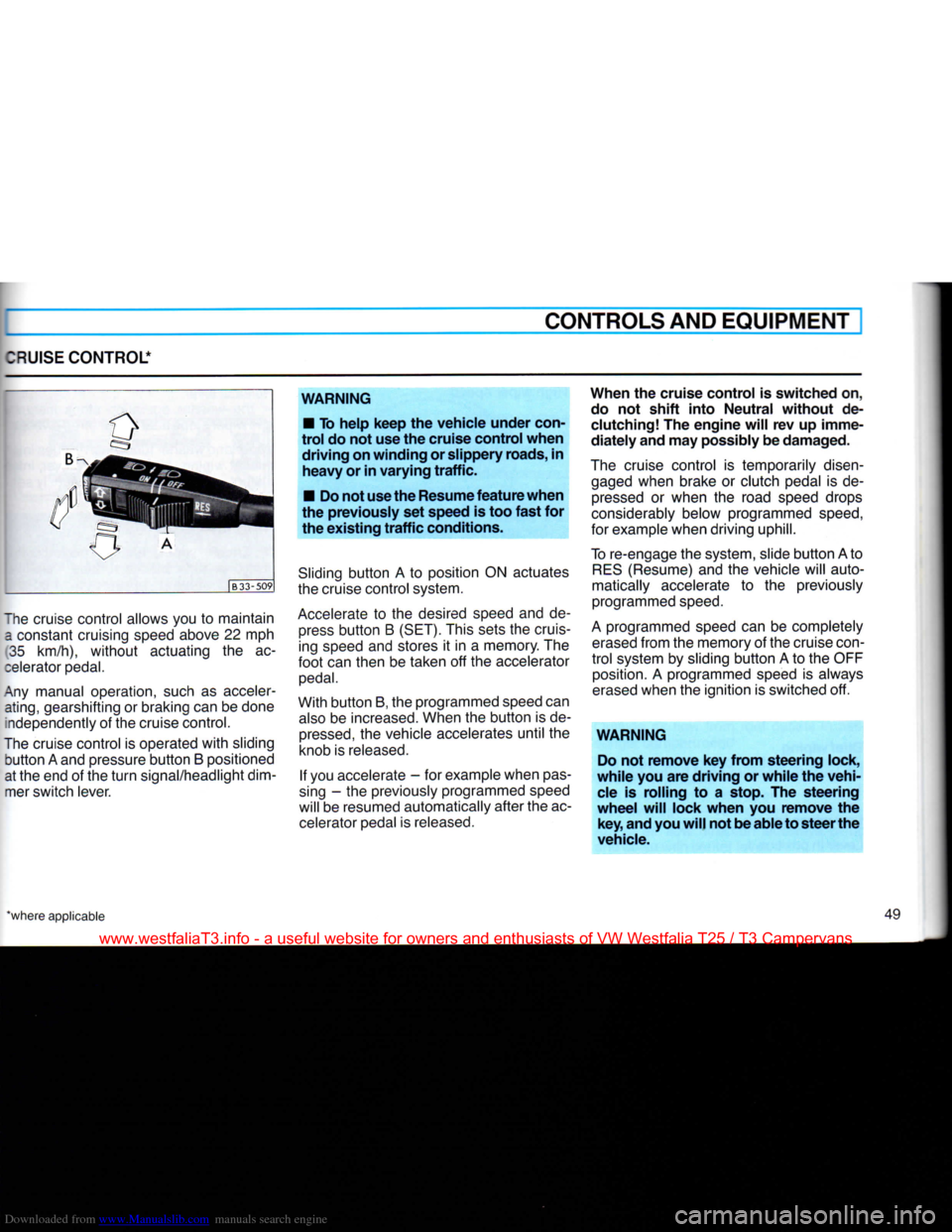
The cruise control
is
operated
with
sliding
button
A
and pressure
button
B
positioned
at the end
of
the
turn
signal/headlight dim mer switch lever.
WARNING
•
To help keep the vehicle under
con
trol do not use the cruise control when driving on winding or slippery
roads,
in heavy or in varying traffic.
•
Do not
use
the
Resume
feature when
the previously set speed is too fast for the existing traffic
conditions.
Sliding
button
A to
position
ON
actuates
the cruise control system.
Accelerate
to the
desired speed
and de
press
button
B
(SET).
This sets
the
cruising speed and stores
it in a
memory. The
foot
can then
be
taken
off the
accelerator
pedal.
With
button
B, the programmed speed can
also
be
increased. When
the
button
is
de
pressed,
the
vehicle accelerates
until
the
knob
is
released.
If
you accelerate
- for
example when
pas
sing
- the
previously programmed speed
will
be
resumed automatically after the ac celerator pedal
is
released.
When the cruise control is switched on,
do
not shift into Neutral without de
clutching!
The engine
will
rev up imme
diately and may
possibly
be damaged.
The cruise control
is
temporarily disen gaged when brake
or
clutch pedal
is de
pressed
or
when
the
road speed drops
considerably below programmed
speed,
for example when driving uphill.
To
re-engage the system, slide
button
A to
RES
(Resume) and
the
vehicle will auto
matically accelerate
to the
previously
programmed
speed.
A
programmed speed can
be
completely
erased
from the memory
of
the cruise
con
trol
system
by
sliding
button
A to the
OFF position.
A
programmed speed
is
always
erased
when the ignition
is
switched
off.
WARNING
Do
not remove key from steering lock,
while you are driving or while the vehi
cle
is rolling to a stop. The steering
wheel
will
lock when you remove the key, and
you
will
not be able to steer the
vehicle.
'where applicable 49
www.westfaliaT3.info - a useful website for owners and enthusiasts of VW Westfalia T25 / T3 Campervans
Page 64 of 165
Downloaded from www.Manualslib.com manuals search engine
CONTROLS AND
EQUIPMENT
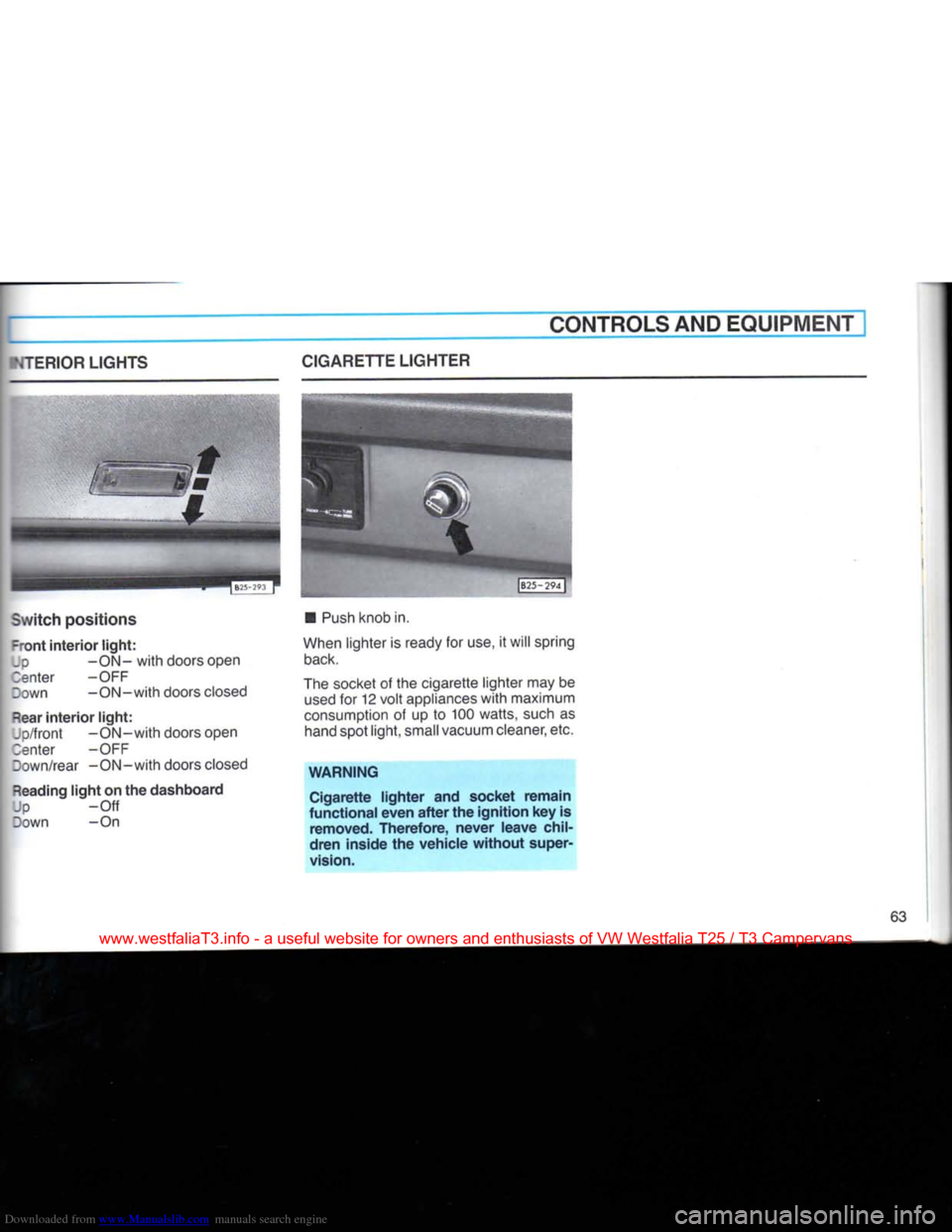
NTERIOR
LIGHTS
Switch
positions
-ront
interior
light:
Up
-ON-with doors open 3enter -OFF
Down -ON-with doors closed
Rear
interior
light:
Jp/front -ON-with doors open
3enter -OFF
Down/rear -ON-with doors closed
Reading
light
on the dashboard |p -Off
Down -On CIGARETTE
LIGHTER
•
Push
knob in.
When lighter is ready for use, it will spring
back.
The socket of the cigarette lighter may be
used
for 12
volt
appliances
with
maximum
consumption of up to 100 watts, such as hand spot
light,
small vacuum cleaner, etc.
WARNING
Cigarette lighter and socket remain
functional even after the ignition key is
removed.
Therefore, never leave
chil
dren inside the vehicle
without
super
vision.
63
www.westfaliaT3.info - a useful website for owners and enthusiasts of VW Westfalia T25 / T3 Campervans
Page 65 of 165
Downloaded from www.Manualslib.com manuals search engine
CONTROLS AND EQUIPMENT
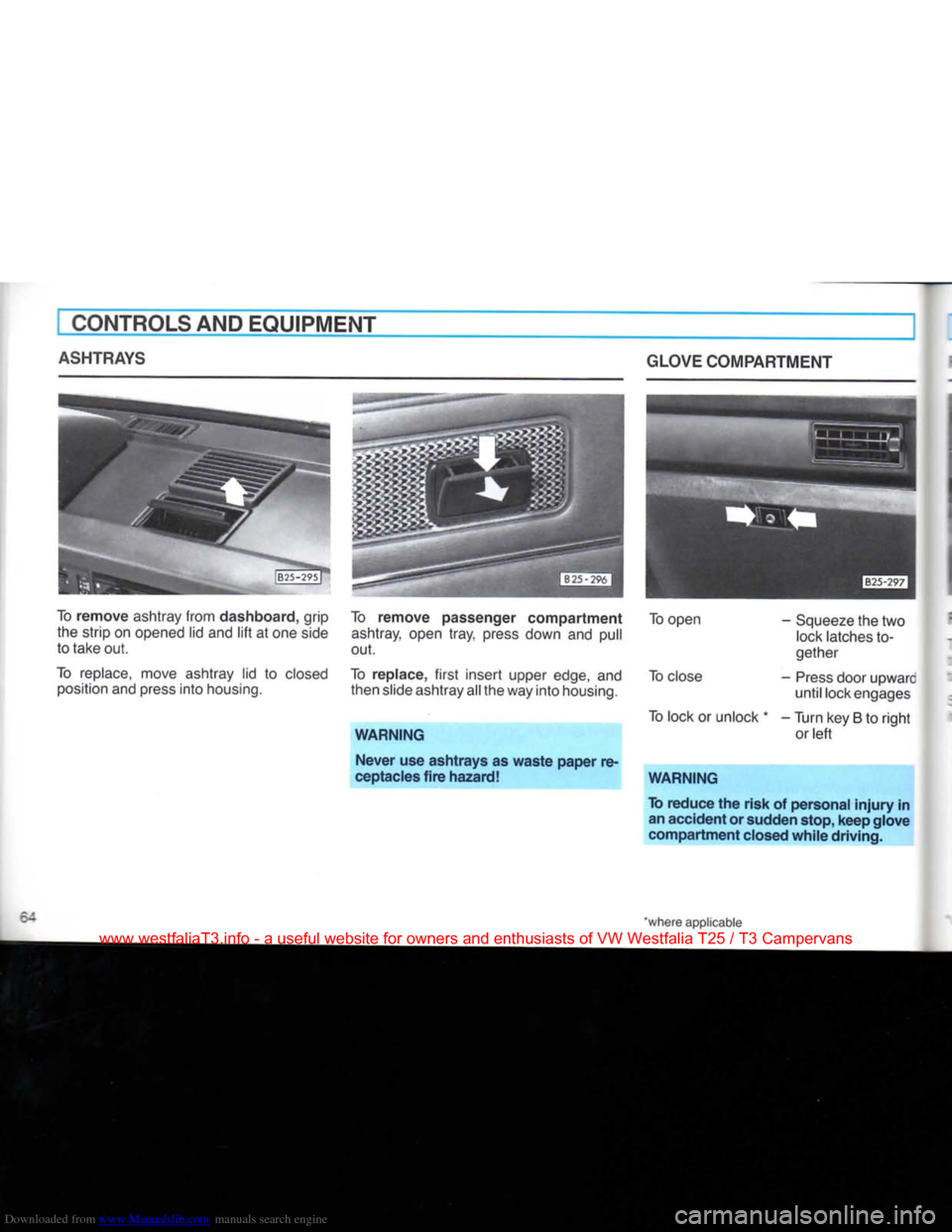
ASHTRAYS
To remove ashtray from dashboard, grip the strip on opened lid and lift at one side
to take out.
To replace, move ashtray lid to closed position and press into housing. To remove passenger compartment
ashtray, open tray, press down and pull
out.
To replace, first insert upper edge, and then slide ashtray all the way into housing.
WARNING Never use ashtrays as waste paper re
ceptacles fire hazard! GLOVE COMPARTMENT
To open - Squeeze the two lock latches to
gether
To close - Press door upwarc until lock engages
To lock or unlock * - Turn key B to right or left
WARNING
To reduce the risk of personal injury in an accident or sudden stop, keep glove compartment closed while driving.
*where applicable
www.westfaliaT3.info - a useful website for owners and enthusiasts of VW Westfalia T25 / T3 Campervans
Page 90 of 165
Downloaded from www.Manualslib.com manuals search engine
VEHICLE CARE
=UELTANK
|he fuel filler neck is located above the -gnt
front
wheel. Syncro model: above the
-;nt rear wheel.
mm key A (see page 7) is used for the lock-
acle
tank cap. The syncro model has a separate key for the lockable tank cap.
capacity of the tank is 16.0 gal/60
:ers
(Reserve is 2.5 gal/10 liters of
total
rapacity).
5/ncro model: 18.5 gal/70 liters (Reserve
2
5 gal/10 liters of
total
capacity). Trouble-free refueling depends on the cor
rect use of the filler nozzle.
Always
insert the nozzle fully
into
the fuel filler neck, to completely open the spring-loaded flap located
just
below the filler
neck opening. Make sure the filler nozzle
is
not tilted.
Do
not
fill
the fuel tank too quickly, other
wise the fuel may foam up and cause the
nozzle
to switch off too
soon.
As
soon as the nozzle switches off auto matically for the
first
time, the tank is full.
Do
not try to add more fuel, because the
expansion
space in the fuel tank will be
filled - the fuel can then overflow when it
becomes
warm.
WARNING
Never
carry
additional
fuel
containers
in
your
vehicle.
Such
containers,
full
or
empty,
may
leak,
cause an explosion,
or
result
in
fire
in case of a collision.
85
www.westfaliaT3.info - a useful website for owners and enthusiasts of VW Westfalia T25 / T3 Campervans
Page 95 of 165
Downloaded from www.Manualslib.com manuals search engine
VEHICLE
CARE
EXTERIOR
Washing
and
waxing
The
paint on your Volkswagen is very dura ble but must be protected
from
losing its
luster due to outside influences. There
fore, wash and wax your Volkswagen
often. The longer the
dirt
is
left
on the paint, the greater the risk of damaging the
glossy
finish, either by scratching if the
dirt
is
rubbed
into
the paint, or simply by the
chemical
effect
dirt
particles have on the paint surface.
Do not
wash
or wax in
direct
sunlight,
or
when
the
sheet
metal
is hot. Do not use hot
water.
Lukewarm
to cool
water
is
kinder
to the
paint.
WARNING
•
Do not
wash,
wax or dry the
vehicle
with
the
engine
running.
•
Do not
clean
the
underside
of chas
sis,
fenders,
wheel
covers, etc.,
without
protecting
your
hands
and
arms.
You
may cut
yourself
on
sharp-edged
metal
parts.
•
Moisture,
ice and
road
salt
on
brakes
may
affect
braking
efficiency.
Test
the
brakes
carefully
after
each
vehicle
wash.
Do
not aim the water jet directly at door,
hatch or rear lid locks. Tape the key holes
to prevent water
from
seeping
into
the lock
cylinders.
Water in lock cylinders should be removed
with
compressed air. To pre
vent locks
from
freezing in the winter, squirt glycerine or lock de-icer
into
the lock
cylinders.
Do not use any
solution
that
can
damage
the
body
paint.
Use
plenty of water, a car-wash and wax
solution and a soft sponge or hose brush.
Begin
by spraying water over the dry sur
face
to remove all loose
dirt
before apply ing the car-wash and wax solution. Use
plenty of water to rinse the vehicle off.
Wipe
everything dry
with
a chamois to avoid water spots.
When
having your vehicle washed at an automatic car
wash,
be sure to observe all
the precautions suggested by the
esta
blishment.
The
underside of the vehicle picks up d ~
and road salt. To guard against corrosic it is important to remove mud, debris a":
road salt
from
the underside
with
i
powerful jet of water. Be sure to include t"
wheel housings, bumpers, muffler, tailp :- and brackets. This should be done twice
year
and is best accomplished after the \ hide has been driven through a hea
rain.
Let engine and exhaust cool do,"
before washing.
Waxing
is not really needed when y:.
have
used a car-wash and wax solution
you do not use a car-wash liquid
with
wa^ apply wax to preserve the natural shine :
the body paint. To obtain a long last-:
finish,
apply hard wax. Wax again whe
water remains on the surface in lar:-
patches
instead of forming beads a": rolling off.
This
will
make
dirt
easier to remove e :
will
prevent the paint
from
being damage:
from
industrial dust, tree sap or bird drz~-
pings.
Use
a polish when it becomes evident tha:
waxing no longer accomplishes the jot
the polish you are using does not conta
wax, apply hard wax after polishing.
www.westfaliaT3.info - a useful website for owners and enthusiasts of VW Westfalia T25 / T3 Campervans