1990 VOLKSWAGEN CORRADO oil
[x] Cancel search: oilPage 854 of 906

WAVEFORMS - INJECTOR PATTERN TUTORIAL
Article Text (p. 10)
1990 Volkswagen Corrado
For Volkswagen Technical Site: http://vw.belcom.ru
Copyright © 1998 Mitchell Repair Information Company, LLC
Thursday, March 23, 2000 09:52PM
CURRENT CONTROLLED CIRCUIT ("PEAK & HOLD")
The current controlled driver inside the computer is more
complex than a voltage controlled driver because as the name implies,
it has to limit current flow in addition to its ON-OFF switching
function. Recall, this driver typically requires injector circuits
with a total leg resistance of less than 12 ohms.
Once the driver is turned ON, it will not limit current flow
until enough time has passed for the injector pintle to open. This
period is preset by the particular manufacturer/system based on the
amount of current flow needed to open their injector. This is
typically between two and six amps. Some manufacturers refer to this
as the "peak" time, referring to the fact that current flow is allowed
to "peak" (to open the injector).
Once the injector pintle is open, the amp flow is
considerably reduced for the rest of the pulse duration to protect the
injector from overheating. This is okay because very little amperage
is needed to hold the injector open, typically in the area of one amp
or less. Some manufacturers refer to this as the "hold" time, meaning
that just enough current is allowed through the circuit to "hold" the
already-open injector open.
There are a couple methods of reducing the current. The most
common trims back the available voltage for the circuit, similar to
turning down a light at home with a dimmer.
The other method involves repeatedly cycling the circuit ON-
OFF. It does this so fast that the magnetic field never collapses and
the pintle stays open, but the current is still significantly reduced.
See the right side of Fig. 1 for an illustration.
The advantage to the current controlled driver circuit is the
short time period from when the driver transistor goes ON to when the
injector actually opens. This is a function of the speed with which
current flow reaches its peak due to the low circuit resistance. Also,
the injector closes faster when the driver turns OFF because of the
lower holding current.
NOTE: Never apply battery voltage directly across a low resistance
injector. This will cause injector damage from solenoid coil
overheating.
THE TWO WAYS INJECTOR CIRCUITS ARE WIRED
Like other circuits, injector circuits can be wired in one of
two fundamental directions. The first method is to steadily power the
injectors and have the computer driver switch the ground side of the
circuit. Conversely, the injectors can be steadily grounded while the
driver switches the power side of the circuit.
There is no performance benefit to either method. Voltage
controlled and current controlled drivers have been successfully
implemented both ways.
However, 95% percent of the systems are wired so the driver
controls the ground side of the circuit. Only a handful of systems use
the drivers on the power side of the circuit. Some examples of the
Page 855 of 906

WAVEFORMS - INJECTOR PATTERN TUTORIAL
Article Text (p. 11)
1990 Volkswagen Corrado
For Volkswagen Technical Site: http://vw.belcom.ru
Copyright © 1998 Mitchell Repair Information Company, LLC
Thursday, March 23, 2000 09:52PM
latter are the 1970's Cadillac EFI system, early Jeep 4.0 EFI (Renix
system), and Chrysler 1984-87 TBI.
INTERPRETING INJECTOR WAVEFORMS
INTERPRETING A VOLTAGE CONTROLLED PATTERN
NOTE: Voltage controlled drivers are also known as "Saturated
Switch" drivers. They typically require injector circuits
with a total leg resistance of 12 ohms or more.
NOTE: This example is based on a constant power/switched ground
circuit.
* See Fig. 2 for pattern that the following text describes.
Point "A" is where system voltage is supplied to the
injector. A good hot run voltage is usually 13.5 or more volts. This
point, commonly known as open circuit voltage, is critical because the
injector will not get sufficient current saturation if there is a
voltage shortfall. To obtain a good look at this precise point, you
will need to shift your Lab Scope to five volts per division.
You will find that some systems have slight voltage
fluctuations here. This can occur if the injector feed wire is also
used to power up other cycling components, like the ignition coil(s).
Slight voltage fluctuations are normal and are no reason for concern.
Major voltage fluctuations are a different story, however. Major
voltage shifts on the injector feed line will create injector
performance problems. Look for excessive resistance problems in the
feed circuit if you see big shifts and repair as necessary.
Note that circuits with external injector resistors will not
be any different because the resistor does not affect open circuit
voltage.
Point "B" is where the driver completes the circuit to
ground. This point of the waveform should be a clean square point
straight down with no rounded edges. It is during this period that
current saturation of the injector windings is taking place and the
driver is heavily stressed. Weak drivers will distort this vertical
line.
Point "C" represents the voltage drop across the injector
windings. Point "C" should come very close to the ground reference
point, but not quite touch. This is because the driver has a small
amount of inherent resistance. Any significant offset from ground is
an indication of a resistance problem on the ground circuit that needs
repaired. You might miss this fault if you do not use the negative
battery post for your Lab Scope hook-up, so it is HIGHLY recommended
that you use the battery as your hook-up.
The points between "B" and "D" represent the time in
milliseconds that the injector is being energized or held open. This
line at Point "C" should remain flat. Any distortion or upward bend
indicates a ground problem, short problem, or a weak driver. Alert
readers will catch that this is exactly opposite of the current
Page 858 of 906

WAVEFORMS - INJECTOR PATTERN TUTORIAL
Article Text (p. 14)
1990 Volkswagen Corrado
For Volkswagen Technical Site: http://vw.belcom.ru
Copyright © 1998 Mitchell Repair Information Company, LLC
Thursday, March 23, 2000 09:52PM
injector. A good hot run voltage is usually 13.5 or more volts. This
point, commonly known as open circuit voltage, is critical because the
injector will not get sufficient current saturation if there is a
voltage shortfall. To obtain a good look at this precise point, you
will need to shift your Lab Scope to five volts per division.
You will find that some systems have slight voltage
fluctuations here. This could occur if the injector feed wire is also
used to power up other cycling components, like the ignition coil(s).
Slight voltage fluctuations are normal and are no reason for concern.
Major voltage fluctuations are a different story, however. Major
voltage shifts on the injector feed line will create injector
performance problems. Look for excessive resistance problems in the
feed circuit if you see big shifts and repair as necessary.
Point "B" is where the driver completes the circuit to
ground. This point of the waveform should be a clean square point
straight down with no rounded edges. It is during this period that
current saturation of the injector windings is taking place and the
driver is heavily stressed. Weak drivers will distort this vertical
line.
Point "C" represents the voltage drop across the injector
windings. Point "C" should come very close to the ground reference
point, but not quite touch. This is because the driver has a small
amount of inherent resistance. Any significant offset from ground is
an indication of a resistance problem on the ground circuit that needs
repaired. You might miss this fault if you do not use the negative
battery post for your Lab Scope hook-up, so it is HIGHLY recommended
that you use the battery as your hook-up.
Right after Point "C", something interesting happens. Notice
the trace starts a normal upward bend. This slight inductive rise is
created by the effects of counter voltage and is normal. This is
because the low circuit resistance allowed a fast build-up of the
magnetic field, which in turn created the counter voltage.
Point "D" is the start of the current limiting, also known as
the "Hold" time. Before this point, the driver had allowed the current
to free-flow ("Peak") just to get the injector pintle open. By the
time point "D" occurs, the injector pintle has already opened and the
computer has just significantly throttled the current back. It does
this by only allowing a few volts through to maintain the minimum
current required to keep the pintle open.
The height of the voltage spike seen at the top of Point "D"
represents the electrical condition of the injector windings. The
height of this voltage spike (inductive kick) is proportional to the
number of windings and the current flow through them. The more current
flow and greater number of windings, the more potential for a greater
inductive kick. The opposite is also true. The less current flow or
fewer windings means less inductive kick. Typically you should see a
minimum 35 volts.
If you see approximately 35 volts, it is because a zener
diode is used with the driver to clamp the voltage. Make sure the
beginning top of the spike is squared off, indicating the zener dumped
the remainder of the spike. If it is not squared, that indicates the
spike is not strong enough to make the zener fully dump, meaning there
Page 893 of 906
WIRING DIAGRAM SYMBOLS
Article Text (p. 3)
1990 Volkswagen Corrado
For Volkswagen Technical Site: http://vw.belcom.ru
Copyright © 1998 Mitchell Repair Information Company, LLC
Thursday, March 23, 2000 09:53PM
Blue ................... BLU ................... BU
Brown .................. BRN ................... BN
Clear .................. CLR ................... CR
Dark Blue ............ DK BLU ............... DK BU
Dark Green ........... DK GRN ............... DK GN
Green .................. GRN ................... GN
Gray ................... GRY ................... GY
Light Blue ........... LT BLU ............... LT BU
Light Green .......... LT GRN ............... LT GN
Orange ................. ORG ................... OG
Pink ................... PNK ................... PK
Purple ................. PPL ................... PL
Red .................... RED ................... RD
Tan .................... TAN ................... TN
Voilet ................. VIO ................... VI
White .................. WHT ................... WT
Yellow ................. YEL ................... YLÄÄÄÄÄÄÄÄÄÄÄÄÄÄÄÄÄÄÄÄÄÄÄÄÄÄÄÄÄÄÄÄÄÄÄÄÄÄÄÄÄÄÄÄÄÄÄÄÄÄÄÄÄÄÄ WIRING DIAGRAM SYMBOL IDENTIFICATION
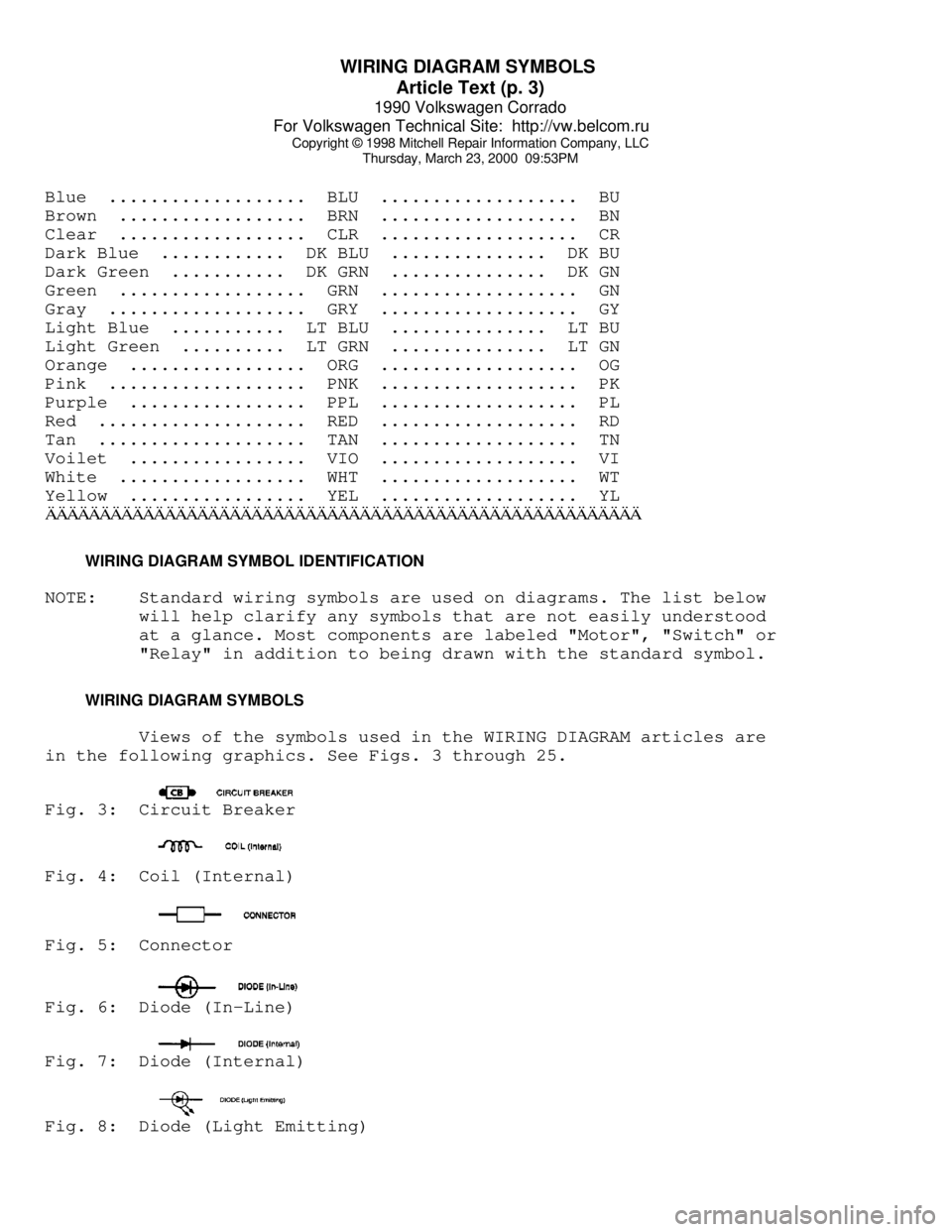
NOTE: Standard wiring symbols are used on diagrams. The list below
will help clarify any symbols that are not easily understood
at a glance. Most components are labeled "Motor", "Switch" or
"Relay" in addition to being drawn with the standard symbol.
WIRING DIAGRAM SYMBOLS
Views of the symbols used in the WIRING DIAGRAM articles are
in the following graphics. See Figs. 3 through 25.Fig. 3: Circuit BreakerFig. 4: Coil (Internal)Fig. 5: ConnectorFig. 6: Diode (In-Line)Fig. 7: Diode (Internal)Fig. 8: Diode (Light Emitting)
Page 896 of 906

WIRING DIAGRAMS
Article Text
1990 Volkswagen Corrado
For Volkswagen Technical Site: http://vw.belcom.ru
Copyright © 1998 Mitchell Repair Information Company, LLC
Thursday, March 23, 2000 09:53PM
ARTICLE BEGINNING
1990 WIRING DIAGRAMS
Volkswagen
Corrado
COMPONENT LOCATION MENU
COMPONENT LOCATIONS TABLEÄÄÄÄÄÄÄÄÄÄÄÄÄÄÄÄÄÄÄÄÄÄÄÄÄÄÄÄÄÄÄÄÄÄÄÄÄÄÄÄÄÄÄÄÄÄÄÄÄÄÄÄÄÄÄÄÄÄÄÄComponent Figure No. (Location)
A/C COMP CLUTCH ................................. 4 (D 14)
A/C SYSTEM ................................. 4 (D-E 12-15)
ABS SYSTEM ................................... 2 (B-E 4-7)
ALTERNATOR ....................................... 1 (B 3)
AUTO SEAT BELTS ............................ 7 (B-E 25-27)
BACK-UP LIGHT SWITCH ............................ 6 (E 20)
BATTERY .......................................... 1 (A 2)
BEAM SELECT SWITCH .............................. 4 (A 12)
BRAKE & PARK BRAKE INDICATOR .................... 6 (A 22)
BRAKE FLUID LEVEL WARNING SWITCH ........ 2, 6 (E 6, A 23)
CASSETTE STORAGE LIGHT .......................... 6 (E 23)
CENTRAL LOCKS ................................ 8 (A 28-31)
CIG LIGHTER ..................................... 5 (A 16)
CRUISE CONTROL SYSTEM .......................... 2 (A 4-6)
DEFOG SWITCH .................................... 6 (E 21)
DIGIFANT CONTROL UNIT .......................... 1 (C-D 3)
DOOR SWITCHES ................................... 9 (E 35)
ECS-MALFUNCTION IND LIGHT & SWITCH ............... 3 (E 8)
EMERGENCY FLASHER SWITCH ..................... 4 (A 12-14)
FOG LIGHT ........................................ 1 (C 1)
FOG LIGHT SWITCH ................................ 4 (A 15)
FRESH AIR SWITCH ILLUM LIGHTS ................... 4 (D 12)
FUEL INJECTORS ................................. 1 (D-E 2)
FUEL PUMP AFTER RUN CONTROL UNIT ................ 3 (E 11)
FUEL TANK UNIT ................................ 3 (E 9-10)
FUS #23 ......................................... 4 (D 13)
FUSE/RELAY PANEL LAYOUT .................... 8 (D-E 29-31)
FUSE/RELAY PANEL ..................... 3, 4, 5, 6 (C 8-23)
GLOVE COMPT LIGHT ............................... 6 (D 23)
HEATED CRANKCASE BREATHER ....................... 3 (D 10)
HEATED SEATS ............................... 9 (C-E 32-34)
IGNITION COIL .................................... 1 (E 3)
IGNITION SWITCH .................................. 3 (A 8)
INSTRUMENT CLUSTER ......................... 7 (A-E 24-26)
INTERIOR LIGHT DELAY SWITCH ..................... 9 (E 33)
LEFT REAR MICRO SWITCH .......................... 7 (D 25)
LEFT SEAT BELT CONTROL UNIT ..................... 7 (D 27)
LIGHT SWITCH ................................. 3 (A 10-11)
LUGGAGE COMPT LIGHT ............................. 5 (A 17)
Page 897 of 906

WIRING DIAGRAMS
Article Text (p. 2)
1990 Volkswagen Corrado
For Volkswagen Technical Site: http://vw.belcom.ru
Copyright © 1998 Mitchell Repair Information Company, LLC
Thursday, March 23, 2000 09:53PM
MAKEUP MIRROR ................................ 9 (E 33-34)
MIRROR HEATERS .................................. 9 (B 33)
MULTI-FUNCTION MEMORY & IND RECALL SWITCH ....... 5 (A 19)
O2 SENSOR ........................................ 1 (D 1)
PARK BRAKE SWITCH ............................... 6 (A 23)
POWER MIRROR ............................... 9 (A-B 32-33)
POWER WINDOW ............................... 8 (B-D 28-31)
RADIATOR COOLING FAN ............................. 2 (A 6)
RADIATOR COOLING FAN AFTER RUN CTRL UNIT ......... 2 (A 7)
RADIO (PARTIAL) .............................. 9 (A 33-34)
REAR SPOILER ................................. 6 (A 20-22)
RIGHT SEAT BELT CONTROL UNIT .................... 7 (C 27)
STARTER .......................................... 1 (A 3)
STOP LIGHT SWITCH ............................... 6 (B 21)
SUNROOF SWITCH ............................... 8 (E 28-29)
WIPER SYSTEM ............................... 5 (D-E 16-19)
WASHER NOZZLE HEATER ............................ 5 (E 19)ÄÄÄÄÄÄÄÄÄÄÄÄÄÄÄÄÄÄÄÄÄÄÄÄÄÄÄÄÄÄÄÄÄÄÄÄÄÄÄÄÄÄÄÄÄÄÄÄÄÄÄÄÄÄÄÄÄÄÄÄ WIRING DIAGRAMS