1990 MITSUBISHI SPYDER clock
[x] Cancel search: clockPage 304 of 2103
ENGINE
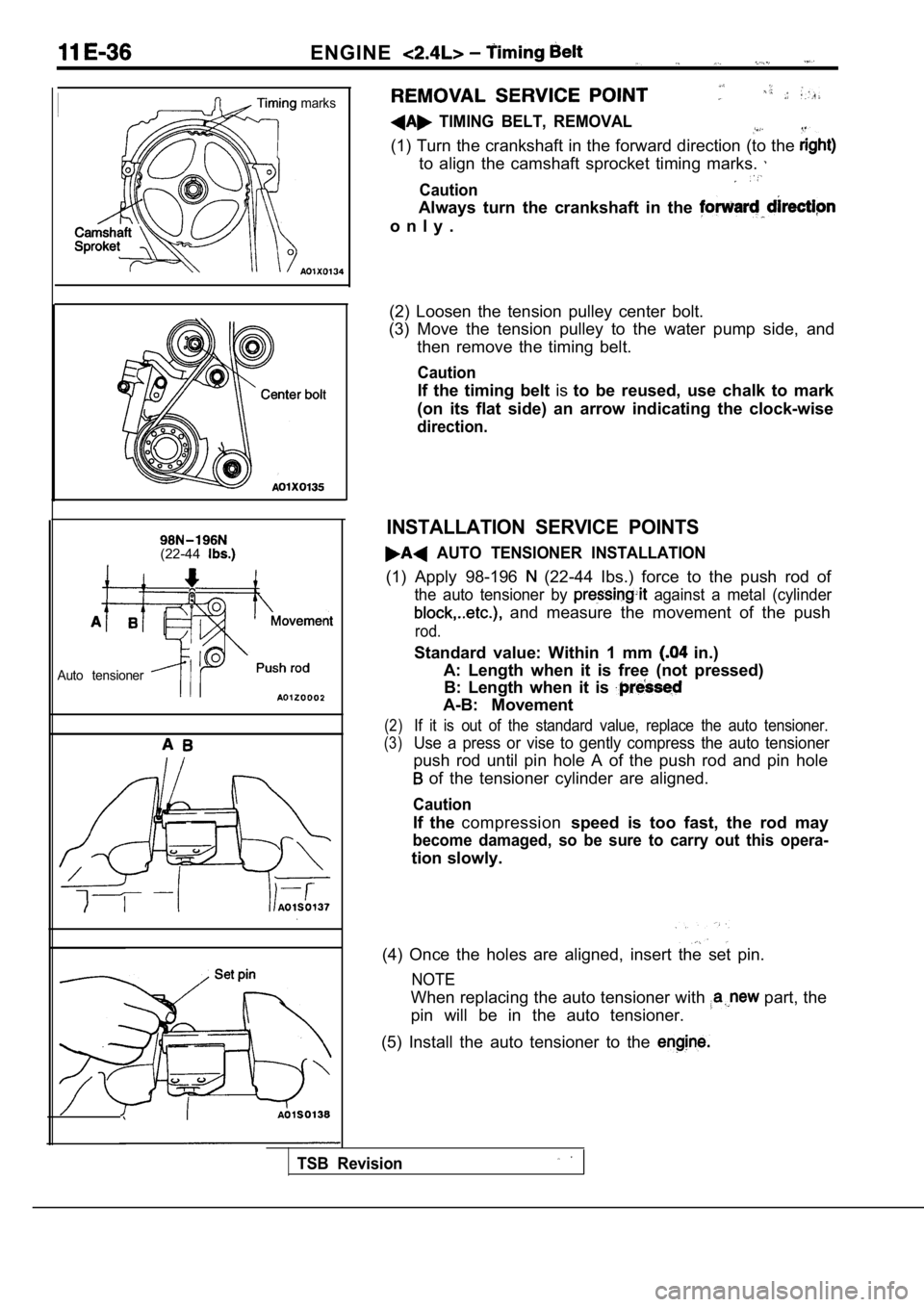
marks
(22-44
Auto tensioner
TIMING BELT, REMOVAL
(1) Turn the crankshaft in the forward direction (to the
to align the camshaft sprocket timing marks.
Caution
Always turn the crankshaft in the
o n l y .
(2) Loosen the tension pulley center bolt.
(3) Move the tension pulley to the water pump side, and
then remove the timing belt.
Caution
If the timing belt isto be reused, use chalk to mark
(on its flat side) an arrow indicating the clock-wi se
direction.
INSTALLATION SERVICE POINTS
AUTO TENSIONER INSTALLATION
(1) Apply 98-196 (22-44 Ibs.) force to the push rod of
the auto tensioner by against a metal (cylinder
and measure the movement of the push
rod.
Standard value: Within 1 mm in.)
A: Length when it is free (not pressed) B: Length when it is
A-B: Movement
(2)If it is out of the standard value, replace the aut o tensioner.
(3)Use a press or vise to gently compress the auto ten sioner
push rod until pin hole A of the push rod and pin hole
of the tensioner cylinder are aligned.
Caution
If the compression speed is too fast, the rod may
become damaged, so be sure to carry out this opera-
tion slowly.
(4) Once the holes are aligned, insert the set pin.
NOTE
When replacing the auto tensioner with part, the
pin will be in the auto tensioner.
(5) Install the auto tensioner to the
TSB Revision
Page 305 of 2103
E N G I N E Timing Belt
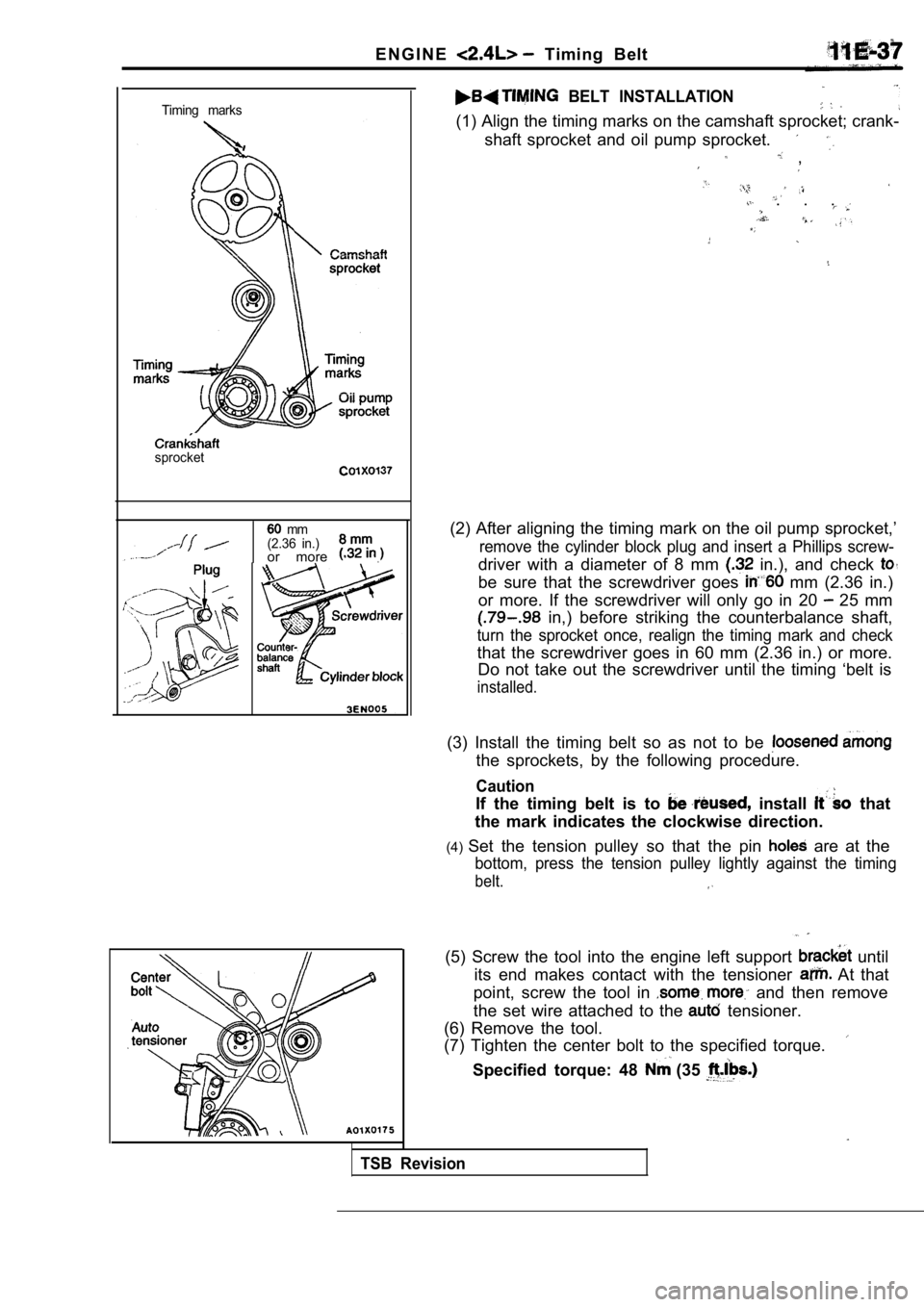
Timing marks
sprocket
mm
(2.36 in.)
or more .
BELT INSTALLATION
(1) Align the timing marks on the camshaft sprocket ; crank-
shaft sprocket and oil pump sprocket.
,
. . .
(2) After aligning the timing mark on the oil pump sprocket,’
remove the cylinder block plug and insert a Phillips screw-
driver with a diameter of 8 mm in.), and check
be sure that the screwdriver goes mm (2.36 in.)
or more. If the screwdriver will only go in 20
25 mm
in,) before striking the counterbalance shaft,
turn the sprocket once, realign the timing mark and check
that the screwdriver goes in 60 mm (2.36 in.) or mo re.
Do not take out the screwdriver until the timing ‘b elt is
installed.
(3) Install the timing belt so as not to be
the sprockets, by the following procedure.
Caution
If the timing belt is to install that
the mark indicates the clockwise direction.
(4) Set the tension pulley so that the pin
are at the
bottom, press the tension pulley lightly against th e timing
belt.
TSB Revision
(5) Screw the tool into the engine left support until
its end makes contact with the tensioner
At that
point, screw the tool in
and then remove
the set wire attached to the
tensioner.
(6) Remove the tool.
(7) Tighten the center bolt to the specified torque .
Specified torque: 48 (35
Page 306 of 2103
ENGINE Belt
48
Auto tensioner
A
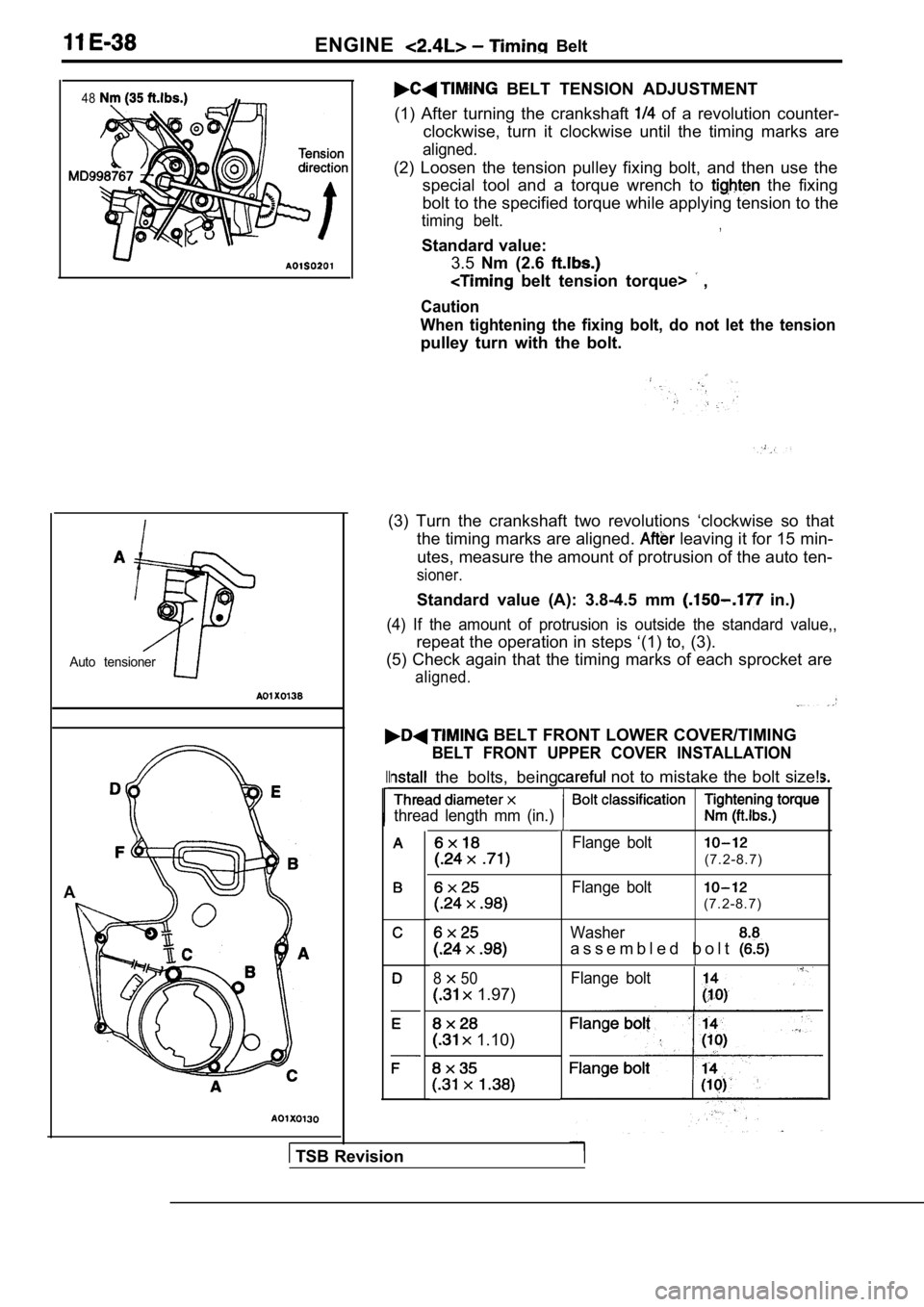
BELT TENSION ADJUSTMENT
(1) After turning the crankshaft
of a revolution counter-
clockwise, turn it clockwise until the timing marks are
aligned.
(2) Loosen the tension pulley fixing bolt, and then use the
special tool and a torque wrench to
the fixing
bolt to the specified torque while applying tension to the
timing belt.,
Standard value:
3.5 Nm (2.6
belt tension torque> ,
Caution
When tightening the fixing bolt, do not let the ten sion
pulley turn with the bolt.
(3) Turn the crankshaft two revolutions ‘clockwise so that
the timing marks are aligned.
leaving it for 15 min-
utes, measure the amount of protrusion of the auto ten-
sioner.
Standard value (A): 3.8-4.5 mm in.)
(4) If the amount of protrusion is outside the standard value,,
repeat the operation in steps ‘(1) to, (3).
(5) Check again that the timing marks of each sproc ket are
aligned.
BELT FRONT LOWER COVER/TIMING
BELT FRONT UPPER COVER INSTALLATION
II the bolts, being
thread length mm (in.)
850
1.97)
1.10)
not to mistake the bolt size!
Flange bolt
(7.2-8.7)
Flange bolt
(7.2-8.7)
Washer
a s s e m b l e d b o l t
Flange bolt
TSB Revision
Page 329 of 2103
ENGINE OVERHAUL Belt
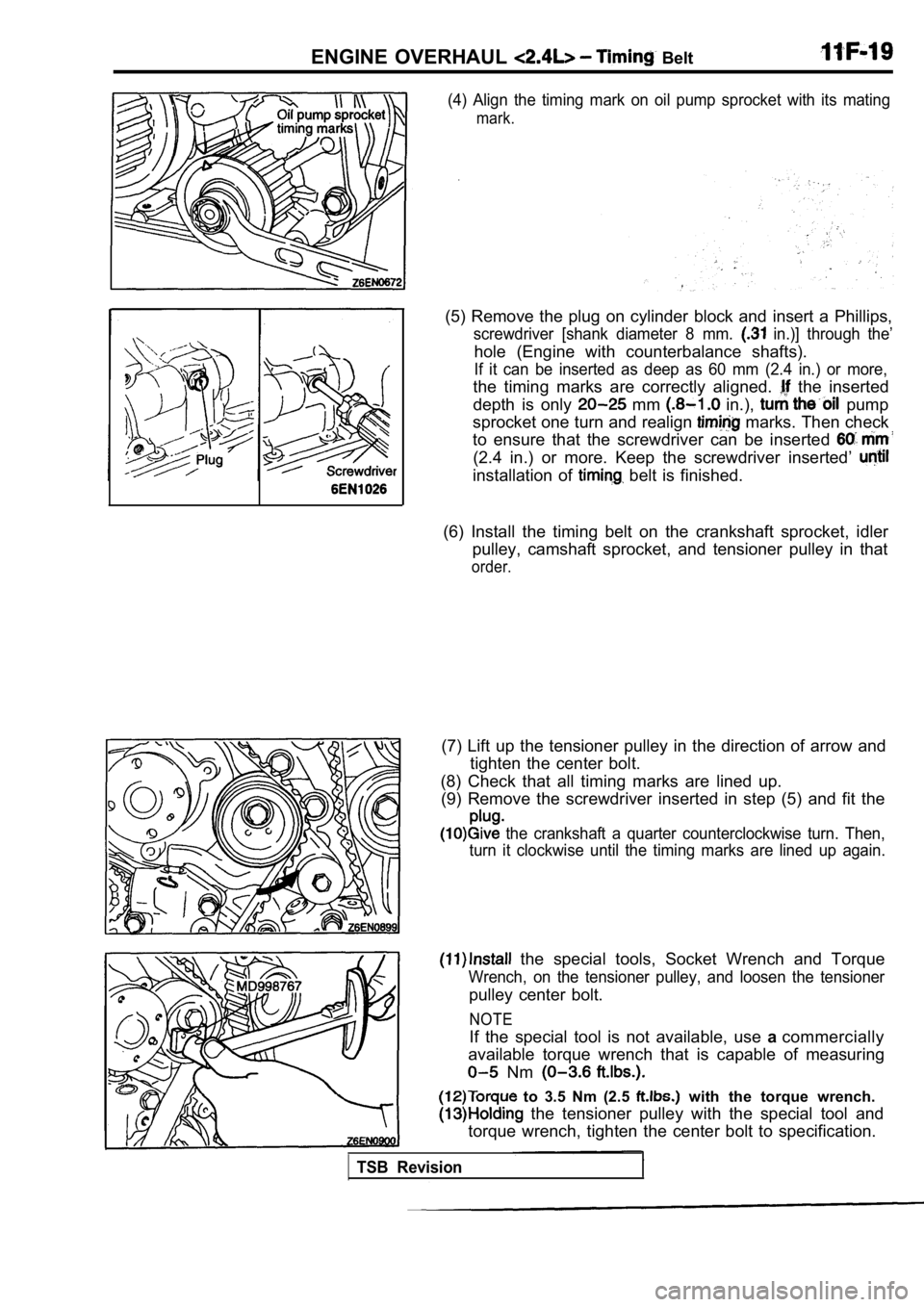
(4) Align the timing mark on oil pump sprocket with its mating
mark.
(5) Remove the plug on cylinder block and insert a Phillips,
screwdriver [shank diameter 8 mm. in.)] through the’
hole (Engine with counterbalance shafts).
If it can be inserted as deep as 60 mm (2.4 in.) or more,
the timing marks are correctly aligned. the inserted
depth is only
mm in.), pump
sprocket one turn and realign
marks. Then check
to ensure that the screwdriver can be inserted
(2.4 in.) or more. Keep the screwdriver inserted’
installation of belt is finished.
(6) Install the timing belt on the crankshaft sproc ket, idler
pulley, camshaft sprocket, and tensioner pulley in that
order.
(7) Lift up the tensioner pulley in the direction of arrow and
tighten the center bolt.
(8) Check that all timing marks are lined up. (9) Remove the screwdriver inserted in step (5) and fit the
the crankshaft a quarter counterclockwise turn. Then,
turn it clockwise until the timing marks are lined up again.
the special tools, Socket Wrench and Torque
Wrench, on the tensioner pulley, and loosen the ten sioner
pulley center bolt.
to 3.5 Nm (2.5 with the torque wrench.
the tensioner pulley with the special tool and
torque wrench, tighten the center bolt to specifica tion.
NOTE
If the special tool is not available, use acommercially
available torque wrench that is capable of measurin g
Nm
TSB Revision
Page 330 of 2103
ENGINE OVERHAUL .
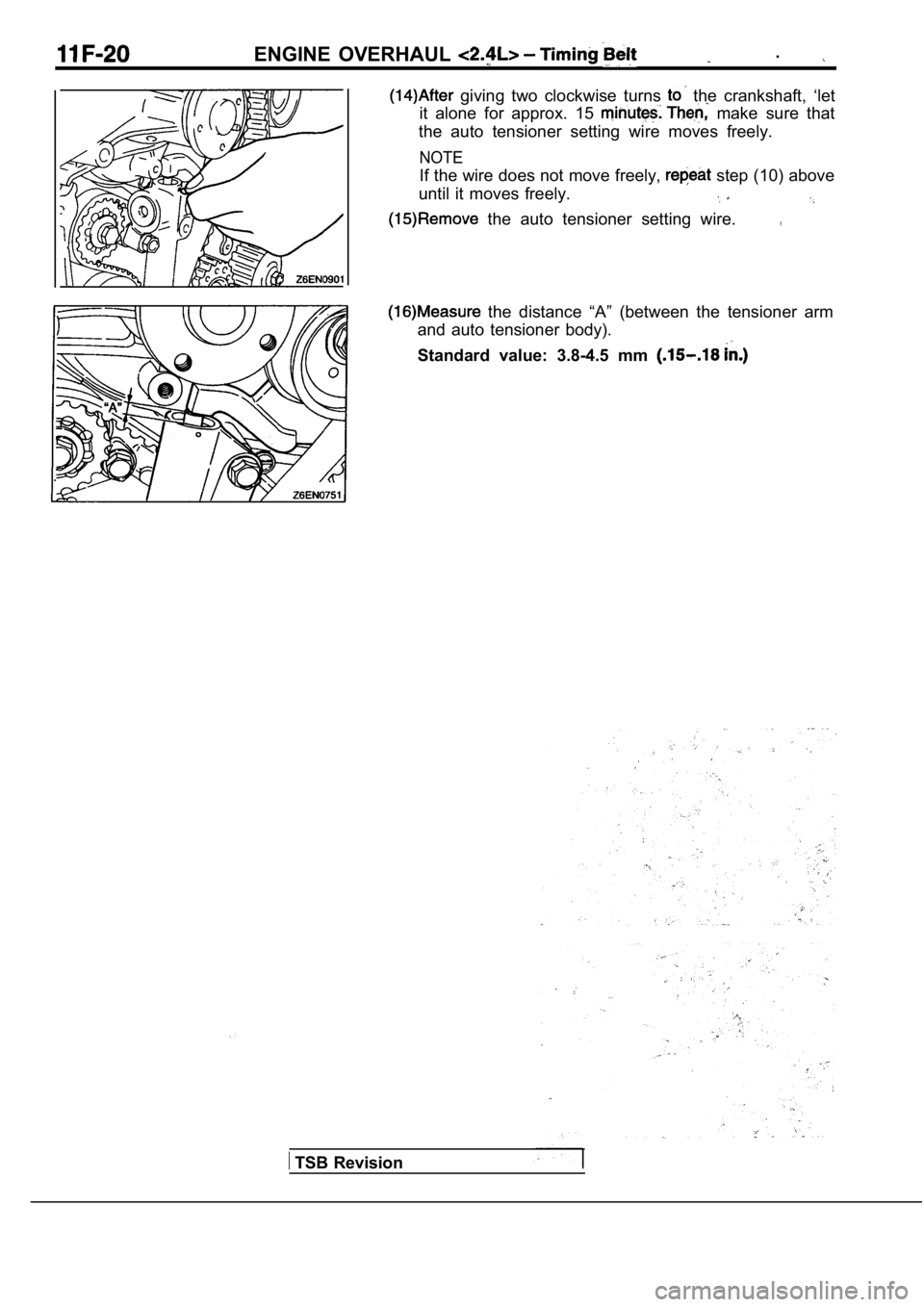
giving two clockwise turns the crankshaft, ‘let
it alone for approx. 15
make sure that
the auto tensioner setting wire moves freely.
NOTE
If the wire does not move freely, step (10) above
until it moves freely.
the auto tensioner setting wire.,
TSB Revision
the distance “A” (between the tensioner arm
and auto tensioner body).
Standard value: 3.8-4.5 mm
Page 394 of 2103
ENGINE (NON-TURBO)>
LEAK DETECTION PUMP MONITOR
Related diagnosis trouble codes (DTC)
l EVAP leak monitor small leak detected
l
EVAP leak monitor large leak detected
l
EVAP leak monitor pinched hose found
Operation
The leak detection assembly incorporates two primar y functions: it must detect a the
system and seal the evaporative system so the leak detection test can be run.. .
The’ primary components within the assembly are: A three port solenoid activates ‘both of the
functions listed above; a pump which contains a swi tch; two check valves and a spring/diaphragm, a’
canister vent valve (CVV) seal which contains a spr ing loaded vent seal valve.
Immediately after a cold start, between predetermin ed temperature thresholds limits, the three port
solenoid is briefly energized. This initializes the pump by drawing air into the pump cavity and also closes
the vent seal. During non test conditions the vent seal is held open by the pump diaphragm assembly
which pushes it open at the full travel position. The vent seal will remain closed while the pump is c ycling
due to the reed switch triggering of the three port solenoid that prevents the diaphragm assembly from
reaching full travel. After the brief initializatio n period, the solenoid is de-energized allowing atm ospheric
pressure to enter the pump cavity, thus permitting the spring to drive the diaphragm which forces air
out of the pump cavity and into the vent system. Wh en the solenoid is energized and de-energized,
the cycle is repeated creating flow in typical diaphragm pump fashion. The pump is controlled in 2 mod es:
Pump Mode: The pump is cycled at a fixed rate to achieve a rapid pressure build in order to shorten
the overall test length.
Test Mode: The solenoid is energized with a fixed d uration pulse. Subsequent fixed pulses occur
when the diaphragm reaches the Switch closure point .
The spring in the pump is set so that the system wi ll achieve an equalized pressure of about 7.5”
The cycle rate of pump strokes is quite rapid as the system begins to pump up to this pressure.
As the pressure
the cycle rate starts to drop off. If there is no leak in the system, the pump
would eventually stop pumping at the equalized pres sure. If there is a leak, it will continue to pump
at a rate representative of the flow characteristic of the size of the leak. From this information we can
determine if the leak is larger than the required d etection limit (currently set at
orifice by CARB).
If a leak is revealed during the leak test portion of the test, the test is terminated at the end of the
mode and no further system checks will be performed .
After passing the leak detection phase of the test, system pressure is maintained by turning on the
solenoid until the purge system is activated. Purg e activation in effect creates a leak. The cycle
rate is again interrogated and when it increases du e to the flow through the purge system, the leak
check portion of the diagnostic is complete.
The canister vent valve will unseal the system afte r completion of the test sequence as the pump
diaphragm assembly moves to the full travel positio n.
Evaporative system functionality will be verified b y using the stricter evap purge flow monitor. At an
appropriate warm idle the LDP will be energized to seal the canister vent. The purge flow will be clocked
up from some small value in an attempt to see a shi ft in the 02 control system. If fuel vapor, indicated
by a shift in the 02 control, is present the test i s passed. If not, it is assumed that the purge syst em
is not functioning in some respect. The LDP is agai n turned off and the test is ended.
TSB Revision
Page 643 of 2103
Throttle
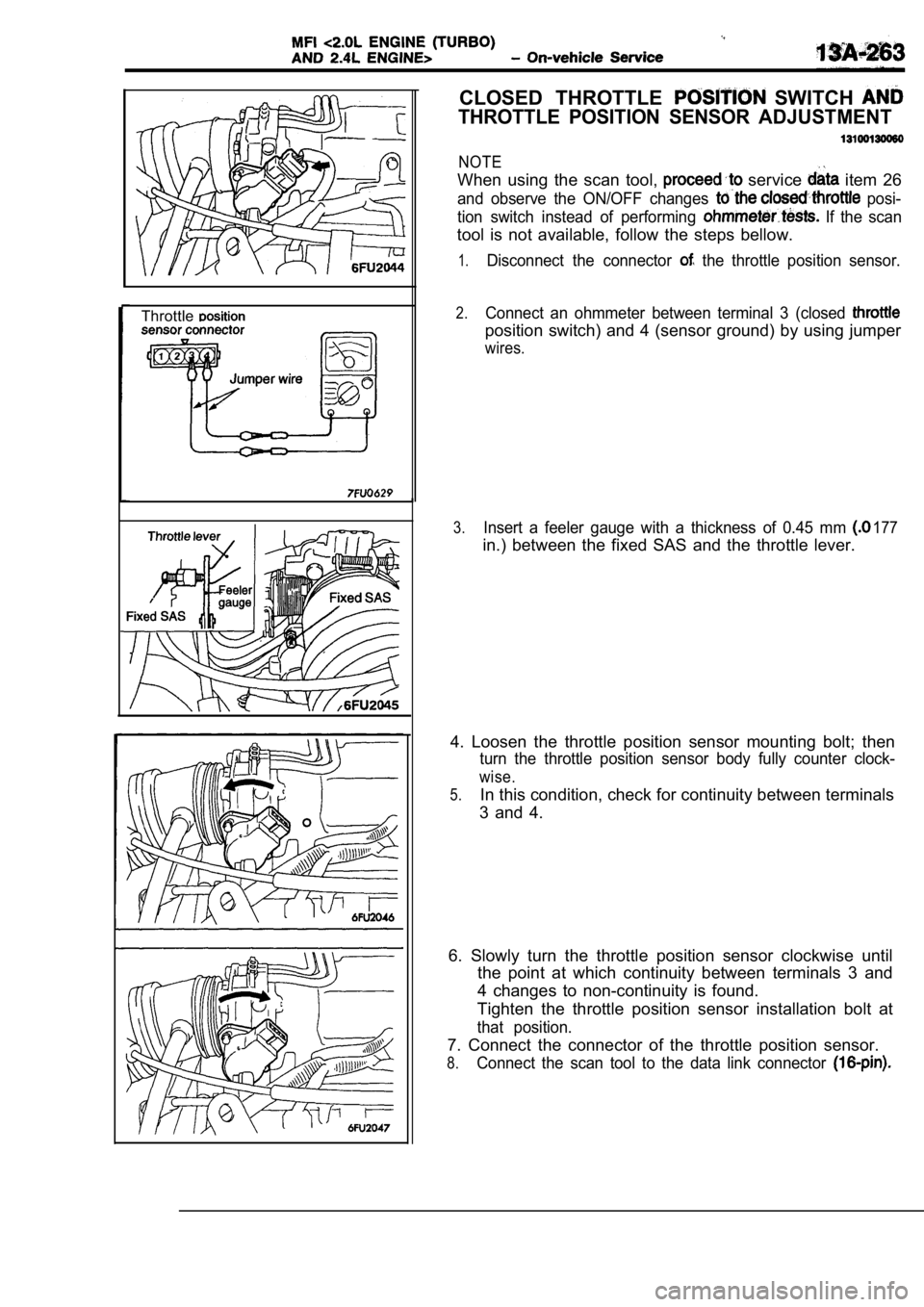
CLOSED THROTTLE SWITCH
THROTTLE POSITION SENSOR ADJUSTMENT
NOTE
When using the scan tool, service item 26
and observe the ON/OFF changes posi-
tion switch instead of performing
If the scan
tool is not available, follow the steps bellow.
1.Disconnect the connector the throttle position sensor.
2.Connect an ohmmeter between terminal 3 (closed
position switch) and 4 (sensor ground) by using jum per
wires.
177
3.Insert a feeler gauge with a thickness of 0.45 mm
in.) between the fixed SAS and the throttle lever.
4. Loosen the throttle position sensor mounting bol t; then
turn the throttle position sensor body fully counter clock-
wise.
5.In this condition, check for continuity between terminals
3 and 4.
6. Slowly turn the throttle position sensor clockwi se until
the point at which continuity between terminals 3 a nd
4 changes to non-continuity is found.
Tighten the throttle position sensor installation b olt at
that position.
7. Connect the connector of the throttle position s ensor.
8.Connect the scan tool to the data link connector
Page 645 of 2103
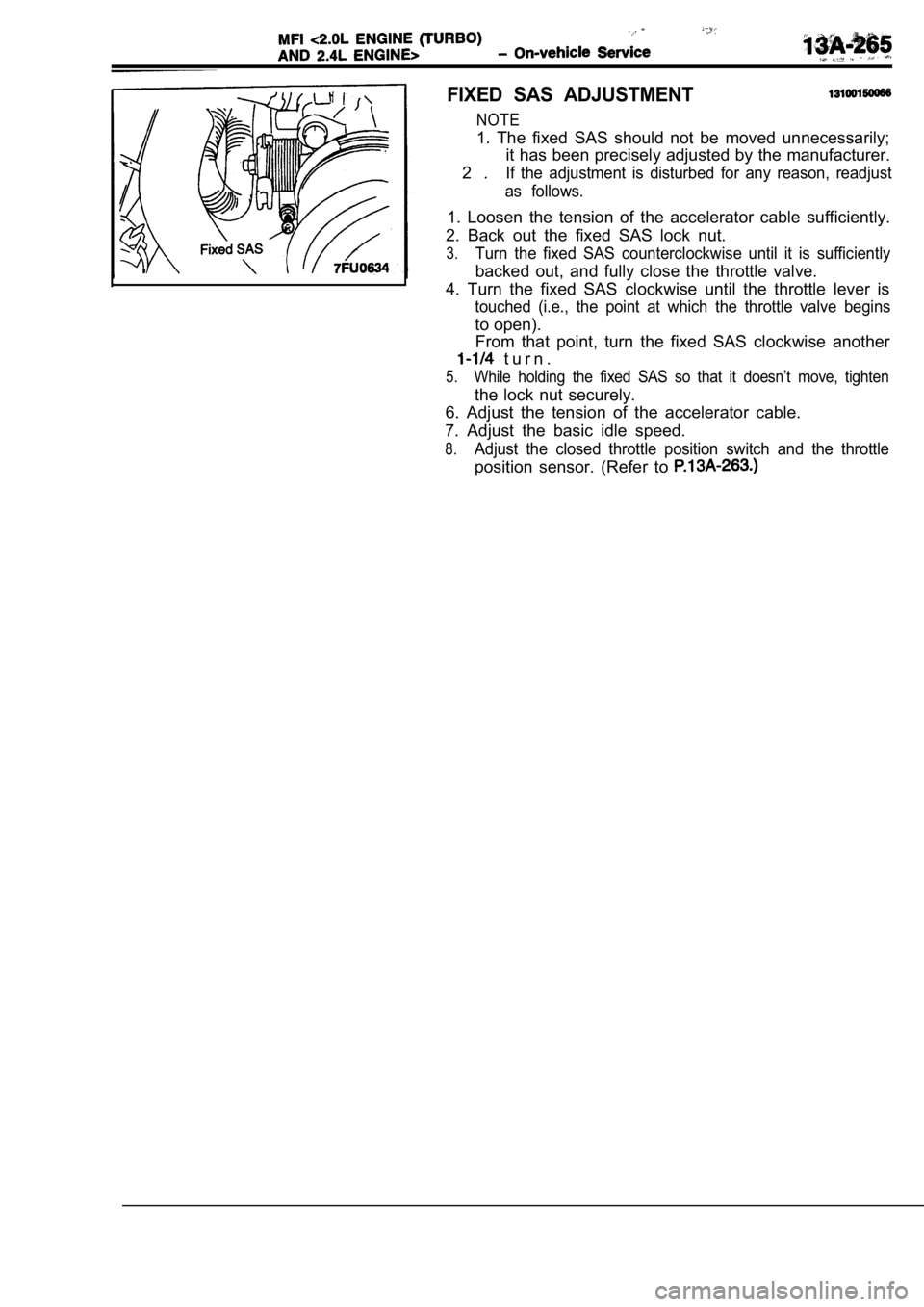
FIXED SAS ADJUSTMENT
NOTE
1. The fixed SAS should not be moved unnecessarily;it has been precisely adjusted by the manufacturer.
2 .
If the adjustment is disturbed for any reason, read just
as follows.
1. Loosen the tension of the accelerator cable suff iciently.
2. Back out the fixed SAS lock nut.
3.Turn the fixed SAS counterclockwise until it is suf ficiently
backed out, and fully close the throttle valve.
4. Turn the fixed SAS clockwise until the throttle lever is
touched (i.e., the point at which the throttle valve begins
to open).
From that point, turn the fixed SAS clockwise anoth er
t u r n .
5.While holding the fixed SAS so that it doesn’t move , tighten
the lock nut securely.
6. Adjust the tension of the accelerator cable.
7. Adjust the basic idle speed.
8.Adjust the closed throttle position switch and the throttle
position sensor. (Refer to