1990 MITSUBISHI ECLIPSE rod
[x] Cancel search: rodPage 199 of 391

17-6REAR SUSPENSION <2WD> - Three-link Suspension
SUSPENSION BUSHINGS
In order to improve both the driving stability and
riding comfort even further, and to reduce vibration
and noise, the optimum spring characteristic has
been employed for each suspension bushing.
The front end of the trailing arm is elastically
coupled to the body via a rubber bushing of high
spring capacity. This rubber bushing has an asym-
metrical non-linear characteristic in the front-rear
direction. and therefore functions to reduce thetransmission of tire vibration input to the body itself.
Individual independent bushings (with non-linear
characteristics) are also employed at the couplings
to the body of the shock absorbers and the coil
springs; these, together with the use of spring pads
with large channels, serve to reduce the transmis-
sion of vibrations to the body, thereby improving
even further the driving stability and riding comfort.
Lateral rod bushingBushina A
hannel
f3ub
Torsional
barArm
bushmg\/HollowHoilow
Section A-A
Page 208 of 391

REAR SUSPENSION- Double Wishbone Suspension17-15TRAILING ARM
The trailing arm has a welded axle housing, knuckle
and shock absorber bracket. The axle housing is
machined after welded to the trailing arm to
improve its presicion. The arm has a connecting rod
for toe-in correction. The connecting rod consists ofa rod rubber and trailing arm bushing. It is inserted
into the trailing arm and can make a rotary motion
relative to the bolt.
Section A-A
bBBolt
ubber
RodRod12A0045
Ii
Connecting rod
Section C-C
Trailing armbushiyg
\Co;lnecting
rod1240043
Section B-B
Knuckleii-l /
Shock absorber bracket,,
I12ACO51
Page 240 of 391

_-
21-16AUTOMATIC TRANSAXLE - General InformationAUTOMATIC
TRANSAXLE
GENERAL INFQRMATIONRzlBBACF4A22 automatic transaxles with different shift pattern are introduced to match engine output characteristics.
These F4A22 automatic transaxles are transaxles of KM1 70 Type II series and each is a two-mode
electronically controlled automatic transaxle with shift patterns of two modes.
SPECIFICATIONS
Items
Transaxle modelTorque convertor
Me
Stall torque ratio
TransaxleType
Gear ratio
1 St
2nd
3rd4th
ReversePrimary reduction ratio
Differential gear ratio
Friction elements
Number of front clutch discs
Number of rear clutch discs
Number of end clutch discs
Number of low/reverse brake discs
Number of
kickdown brake bandControl system
Manual control system
Shift pattern type
Solenoid yalve operationShift control
(2)
Pressure control
Damper clutch controlDiagnosis
Indication method
Number of diagnosis items
Speedometer gear ratio
ATFOil quantityliter
(qts.)
Specifications-4A22-2-MPAl3element, 1 -stage,
2-phase with damper clutch
2.17l-speed forward, l-speed reverse
2.846
1.581
1
.ooo
3.685
2.176
1.125
3.611V&N-D-2-L (lever type) with overdrive switch
Two-mode electronic-hydraulic control type
ON-OFF controlDuty control
Duty control
Indication with
LEDs
24
29136
MOPAR ATF PLUS (AUTOMATIC TRANSMISSIOI
FLUID TYPE 7176VAutomatic Transmission Fluid“DEXRON” or “DEXRON II”
\I6.1
(6.4)J
Page 252 of 391

.-
I
21-28AUTOMATIC TRANSAXLE - Transaxle Mechanism
KICKDOWN BRAKE
/Kickdown band
r\\ IKickdown sleeve
- Kickdown servo
switch
;‘- Locknut
Apply pressure
(2nd pressure)
1 Release pre&re (3rd pressure)I,
/ --Anchor
1750219The kickdown brake is a band type brake; it is
piston and rod moves toward the left, tightening the
composed of a kickdown band, drum, kickdownbrake band to hold the kickdown drum. As a result,
servo, switch and anchor.the reverse sun gear (interlocked with the kickdown
When the
2nd pressure is admitted to the apply sidedrum) is held. This brake functions during 2nd gear
chamber of,kickdown servo cylinder, the kickdownand during overdrive.
Page 255 of 391
iAUTOMATIC TRANSAXLE
- Transaxle Mechanism
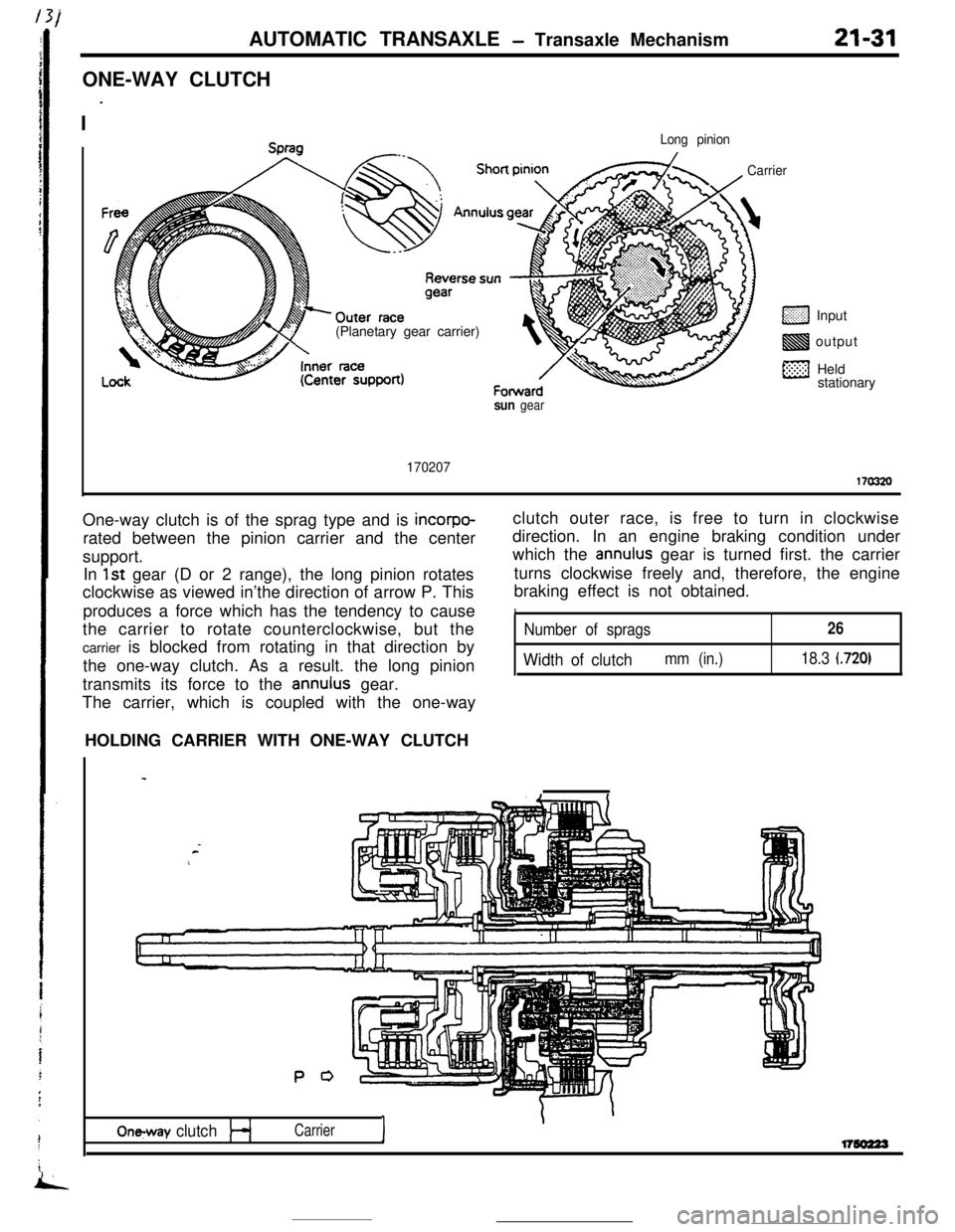
ONE-WAY CLUTCH
I
’
21-31
Long pinion(Planetary gear carrier)
CarrierInput
output
Held
stationary
sun gear
170207170320One-way clutch is of the sprag type and is
incorpo-rated between the pinion carrier and the center
support.
In
1st gear (D or 2 range), the long pinion rotates
clockwise as viewed in’the direction of arrow P. This
produces a force which has the tendency to cause
the carrier to rotate counterclockwise, but the
carrier is blocked from rotating in that direction by
the one-way clutch. As a result. the long pinion
transmits its force to the
annulus gear.
The carrier, which is coupled with the one-wayclutch outer race, is free to turn in clockwise
direction. In an engine braking condition under
which the
annulus gear is turned first. the carrier
turns clockwise freely and, therefore, the engine
braking effect is not obtained.
INumber of sprags26
Width of clutchmm (in.)18.3 (720)HOLDING CARRIER WITH ONE-WAY CLUTCH
P 0
On-y clutchI
\Carrierl7so223
Page 263 of 391

AUTOMATIC TRANSAXLE - Transaxle Mechanism
PARKING MECHANISM
rking sprag (Annulus gear)Detent plateWanual control shaft)
Detent ball
17ooo7When the shift is in the “P” range, the parking pawl
paw1 cannot be moved upward, and the cam, while
engages with the parking sprag provided on outerpressing the spring, collides with the parking
paw1circumference of the
annulus gear to fasten theand the suppon, and is withheld in this condition. If
output shaft, preventing wheels from rotating. Inthe vehicle is moved even slightly in this condition,
other words, when the selector lever is set to thethe turning of wheels causes the
annulus gear to
“P” range, the detent plate and the parking spragturn as well. Since the cam is pressed in the
rod move in the direction of arrow, causing the camdirection of arrow, the parking pawl is pushed up as
on the parking sprag rod to push up the parking paw1a bottom of the sprag aligns with the parking sprag
to engage with the sprag.to engage with the sprag.
In case the parking paw1 collides against a crest of
the sprag, only the rod moves because the parkingIn this way, the parking mechanism eliminates any
chances of the vehicle from being idly moved.
Page 269 of 391
‘4) Once the operation is step (2) is completed, the
hydraulic control device functions by hydraulic
pressure force to change the state of the
clutches and brakes to accomplish the gear
shifting. To minimize the shock that would
otherwise be produced during gear shifting,
hydraulic pressure is controlled during the gear
shifting period by the “duty control” of the
pressure control solenoid valve. The duty control
is explained later.
‘HYDRAULIC PRESSURE CONTROL DURING
SHFIING(1) The hydraulic pressure that functions during
gear shifting to engage the clutches and apply
the brakes is regulated by the pressure control
valve, The hydraulic pressure that works on the
pressure control valve is further regulated by the
pressure control solenoid valve which functions
under the control of the transaxle control unit.
The transaxle control unit controls the solenoid
valve through the duty control, thus providing
appropriate regulation of the hydraulic pressure.
(2)
(3)
(4)The transaxle control unit decides the timing of
the gear shifting period (during which ‘it per-
forms hydraulic pressure control for gear shift-
ing) according to the change in the kickdown
drum rotating speed that it detects. The unit
identifies the time just before the kickdown
brake is applied and uses that as the timing for
initiating control of the hydraulic pressure which
is to be applied to the kickdown brake.
When the transaxle is cold, the fluid viscosity is
high, causing slower oil pressure response. in
such conditions, the transaxle control unit pro-
vides a correction for the oil pressure by
changing the control duty of the pressure control
solenoid valve.
This control is performed when the fluid temper-
atures as indicated by the oil temperature
sensor is lower than
60°C (140°F).After the engine has been started and the
vehicle is inmotion, the transaxle
continues torefine its performance
est possiblegear shifting.control unit
for smooth-
tHFigure B
- Duty(%)
17500661750067
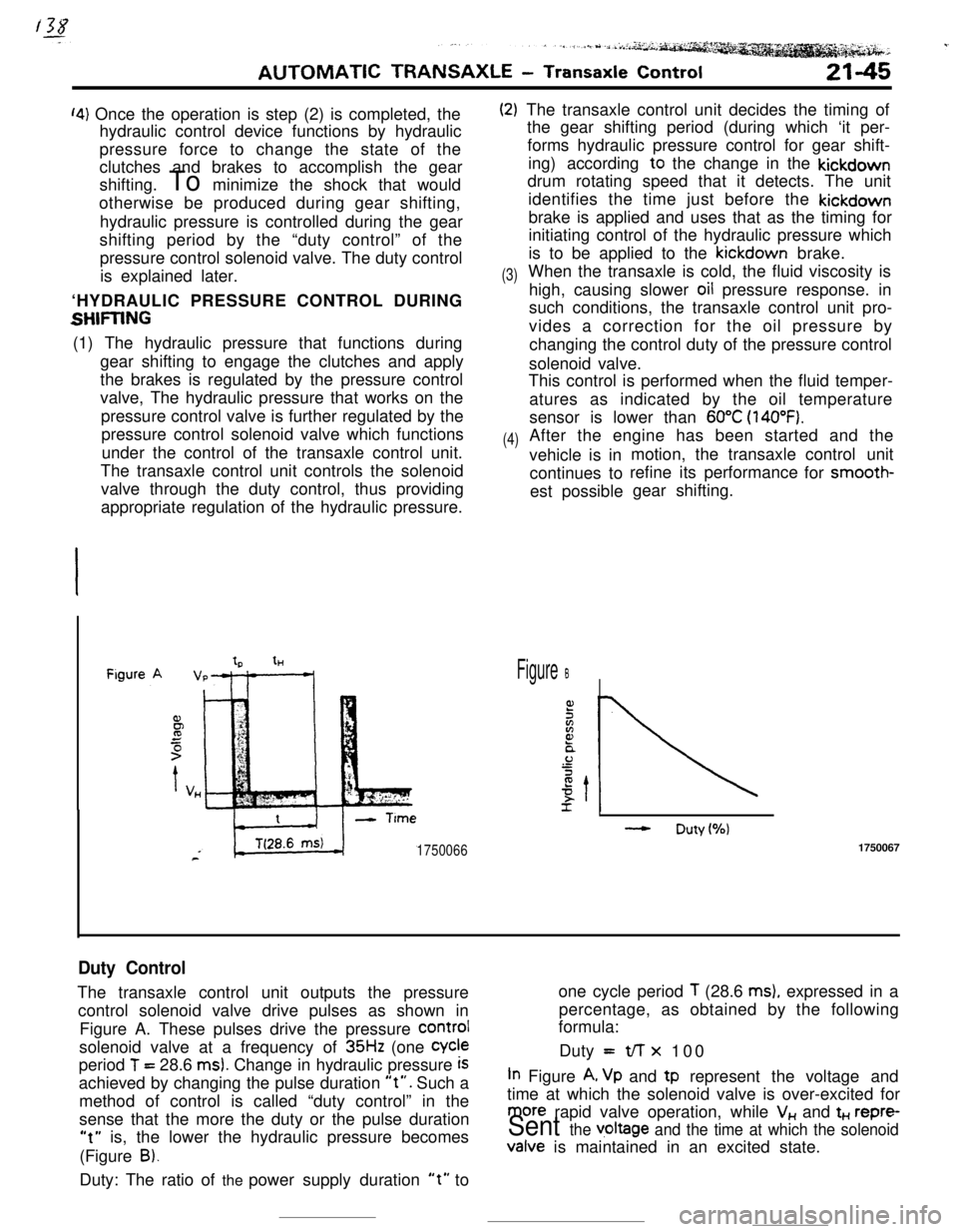
Duty ControlThe transaxle control unit outputs the pressureone cycle period
T (28.6 ms), expressed in a
control solenoid valve drive pulses as shown inpercentage, as obtained by the following
formula:
Figure A. These pulses drive the pressure
COrmIsolenoid valve at a frequency of
35Hz (one Cycleperiod
T = 28.6 ms). Change in hydraulic pressure iSDuty =t/-r x 100
achieved by changing the pulse duration
“t”. Such aIn Figure A, Vp and tp represent the voltage and
method of control is called “duty control” in thetime at which the solenoid valve is over-excited for
sense that the more the duty or the pulse duration
more rapid valve operation, while V,, and t+., repre-
“t” is, the lower the hydraulic pressure becomesSent the v,oltage and the time at which the solenoid(Figure
B).Valve is maintained in an excited state.
Duty: The ratio of the power supply duration
“t” to
Page 271 of 391
AUTOMATIC TRANSAXLE - Transaxle Control21-47
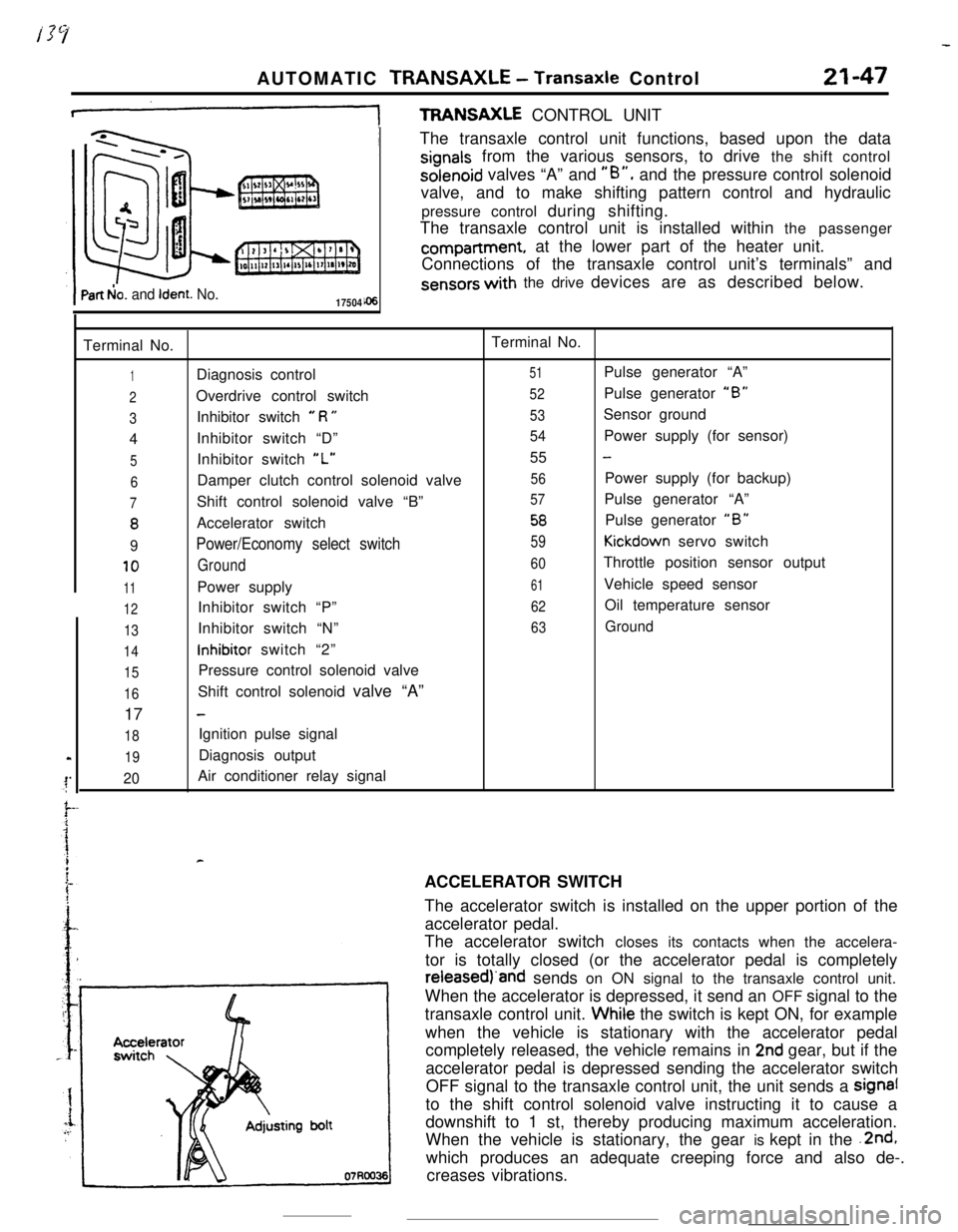
+TFWNSAXLE CONTROL UNIT
Part b!o. and Ident. No.17504The transaxle control unit functions, based upon the data
signals from the various sensors, to drive the shift controlsolenoid valves “A” and
“B”, and the pressure control solenoid
valve, and to make shifting pattern control and hydraulic
pressure control during shifting.
The transaxle control unit is installed within the passengercompartment, at the lower part of the heater unit.
Connections of the transaxle control unit’s terminals” and
sensors with the drive devices are as described below.
Terminal No.Terminal No.
1Diagnosis control51Pulse generator “A”
2Overdrive control switch52Pulse generator “B”
3Inhibitor switch e R U53Sensor ground
4Inhibitor switch “D”
54Power supply (for sensor)
5Inhibitor switch “L”55 -
6Damper clutch control solenoid valve56Power supply (for backup)
7Shift control solenoid valve “B”57Pulse generator “A”
8Accelerator switch58Pulse generator “B”
9Power/Economy select switch59Kickdown servo switch
10Ground60Throttle position sensor output
11Power supply61Vehicle speed sensor
12Inhibitor switch “P”62Oil temperature sensor
13Inhibitor switch “N”63Ground
14inhibitor switch “2”
15Pressure control solenoid valve
16Shift control solenoid valve “A”
17
-
18Ignition pulse signal
19Diagnosis output
20Air conditioner relay signal
rACCELERATOR SWITCH
The accelerator switch is installed on the upper portion of the
accelerator pedal.
The accelerator switch closes its contacts when the accelera-
tor is totally closed (or the accelerator pedal is completelyreieasedj‘and sends on ON signal to the transaxle control unit.
When the accelerator is depressed, it send an OFF signal to the
transaxle control unit. Whiie the switch is kept ON, for example
when the vehicle is stationary with the accelerator pedal
completely released, the vehicle remains in
2nd gear, but if the
accelerator pedal is depressed sending the accelerator switch
OFF signal to the transaxle control unit, the unit sends a signal
to the shift control solenoid valve instructing it to cause a
downshift to 1 st, thereby producing maximum acceleration.
When the vehicle is stationary, the gear is kept in the .2nd,
which produces an adequate creeping force and also de-.
creases vibrations.