Page 374 of 391
25-2EMISSION CONTROL SYSTEMS - General Information
GENERAL INFORMATION
There are three sources of vehicle exhaust emis-
sions generated: the exhaust gases resulting from
combustion, the blow-by gases generated within
the crankcase, and the evaporative emissions
generated from the fuel tank and other components
of the fuel line.
The emissions-control system, which is designed to
control the discharge of these exhaust gases into
the atmosphere, is composed of the following
system components.
(1) Exhaust emission control system
(2) Crankcase emission control system
(3) Evaporative emission control system
R258A’The exhaust emissions-control system reduces the
amount of carbon monoxide, hydro carbon and
oxides of nitrogen in the exhaust gases by adding
the exhaust gas recirculation device and the cataly-
tic converter to fundamental improvements such as
improvement of the combustion chamber and the
camshaft, as well as other improvements to the
engine such as feedback control of the air/fuel ratio
by the electronically controlled fuel injection sys-
tem.
The crankcase emissions-control system is a closed
type so that blow-by gases are not discharged out to
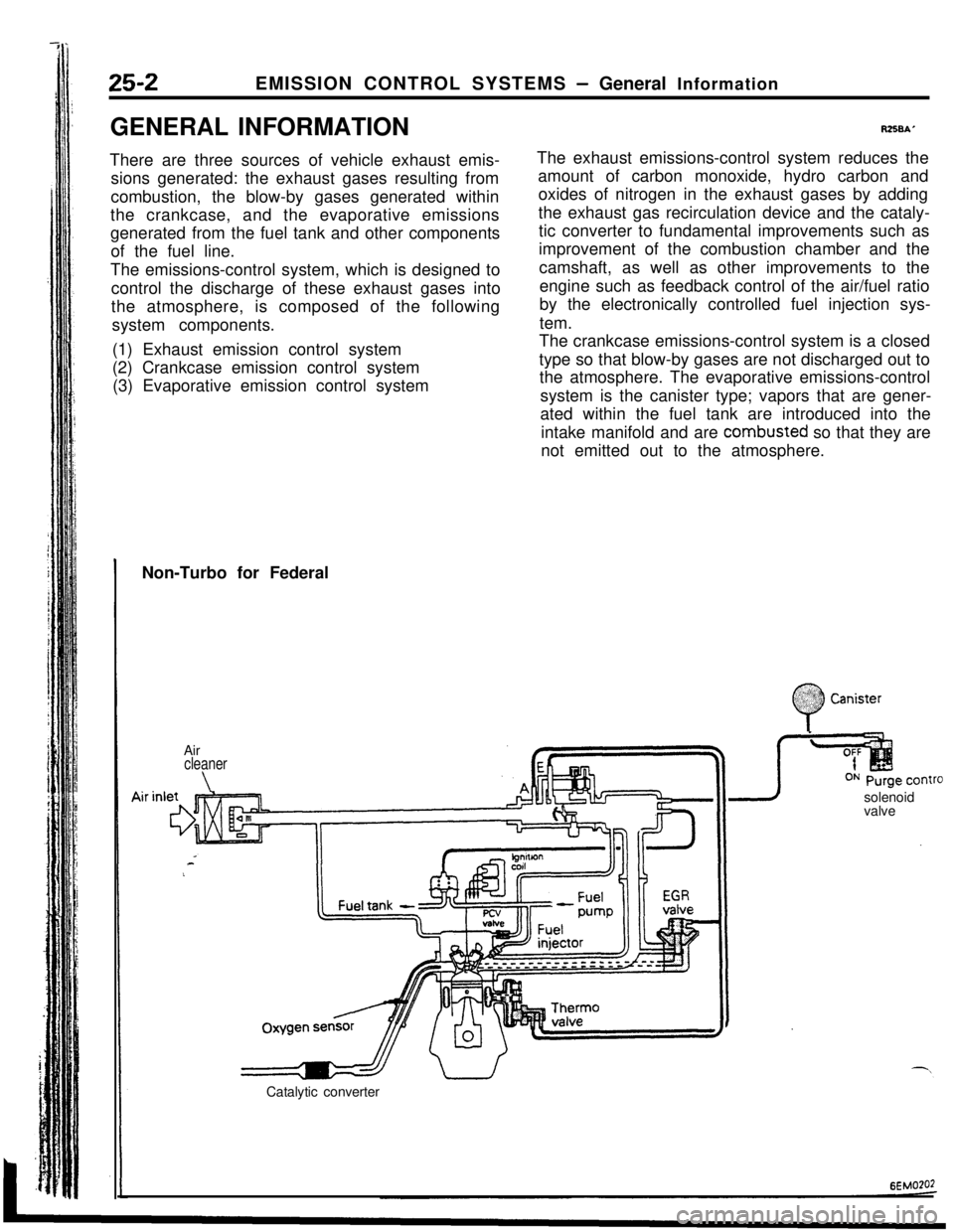
the atmosphere. The evaporative emissions-control
system is the canister type; vapors that are gener-
ated within the fuel tank are introduced into the
intake manifold and are combusted so that they are
not emitted out to the atmosphere.
Non-Turbo for Federal
Air
cleaner
\solenoid
valve
Catalytic converter
:
0
$2:) Canister:.:
Page 376 of 391

--.
25-2EMISSION CONTROL SYSTEMS - General Information
GENERAL INFORMATION
There are three sources of vehicle exhaust emis-
sions generated: the exhaust gases resulting from
combustion, the blow-by gases generated within
the crankcase, and the evaporative emissions
generated from the fuel tank and other components
of the fuel line.
The emissions-control system, which is designed to
control the discharge of these exhaust gases into
the atmosphere,is composed of the following
system components.
(1) Exhaust emission control system
(2) Crankcase emission control system
(3) Evaporative emission control system
RZSBAThe exhaust emissions-control system reduces the
amount of carbon monoxide, hydro carbon and
oxides of nitrogen in the exhaust gases by adding
the exhaust gas recirculation device and the cataly-
tic converter to fundamental improvements such as
improvement of the combustion chamber and the
camshaft, as well as other improvements to the
engine such as feedback control of the air/fuel ratio
by the electronically controlled fuel injection sys-
tem.
The crankcase emissions-control system is a closed
type so that blow-by gases are not discharged out to
the atmosphere. The evaporative emissions-control
system is the canister type; vapors that are gener-
ated within the fuel tank are introduced into the
intake manifold and are combusted so that they are
not emitted out to the atmosphere.
Non-Turbo for Federal
.;. :
0
.%??? CanisterAir
cleaner
\valveOxygenFuel tank
-a I”’ ,T
sensr’
Catalytic converter
6EMO?O2
Page 383 of 391

---- .~ _ _EMISSION CONTROL SYSTEMS
- Catalytic Converter I Air-fuel Mixture Ratio Control System25-9
,ATALYTlC CONVERTERRZXIAAAThe catalytic converter is installed on the middle ofand surrounded by a stainless steel shell.
the exhaust pipe under the floor.The catalytic converter oxidizes carbon monoxide
This catalytic converter uses a monolithic type
catalyst with a honeycomb structure that has itsand hydrocarbon, and reduces oxides of nitrogen.
surface coated with catalytic components. Thewhich are present in the exhaust gas, in order to
minimize their emission levels.
catalyst is supported by a stainless steel wire mesh
Exhaust air
3Stainlesssteei shell
\CoverStainless steel wire mesh
lEM0031
AIR-FUEL MIXTURE RATIO CONTROL
SYSTEMThe
MPI system is a system which employs the signals from
the oxygen sensor to activate and control the injector installed
at the each cylinder head thus precisely regulating the air-fuel
mixture ratio and reducing emissions,
This in turn allows the engine to produce exhaust gases of the
proper composition to permit the use of a three-way catalytic
converter. The three-way catalytic converter is designed to
convert the three pollutants
(1) hydrocarbons (HC), (2) carbon
monoxide (CO), and
(3) oxides of Nitrogen (NOx) into harmiess
substances.There are two operating modes in the
MPI system:
(1) Open Loop
Air-fuel ratio is controlled by information programmed into
the engine control unit at manufacture.
(2) Closed Loop
Air-fuel ratio is varied by the engine control unit based on
information supplied by the oxygen sensor.
NOTEFor detailed information concerning the
MPI system, refer
to Fuel System.
Page 387 of 391
EMISSION CONTROL SYSTEMS- Evaporative Emission Control System25-13
IFrom canister1
,To intake air plenum or throttle body
7EMOlPControl
relavPurge control
solenoid valve
Battery
g
6
,zEngine control
unit
From throttle body
4To purge
control
valve
SEMo2laControl relay
3:
1.
Purge control
solenoid valve
zBattery g
Engtne controlunii
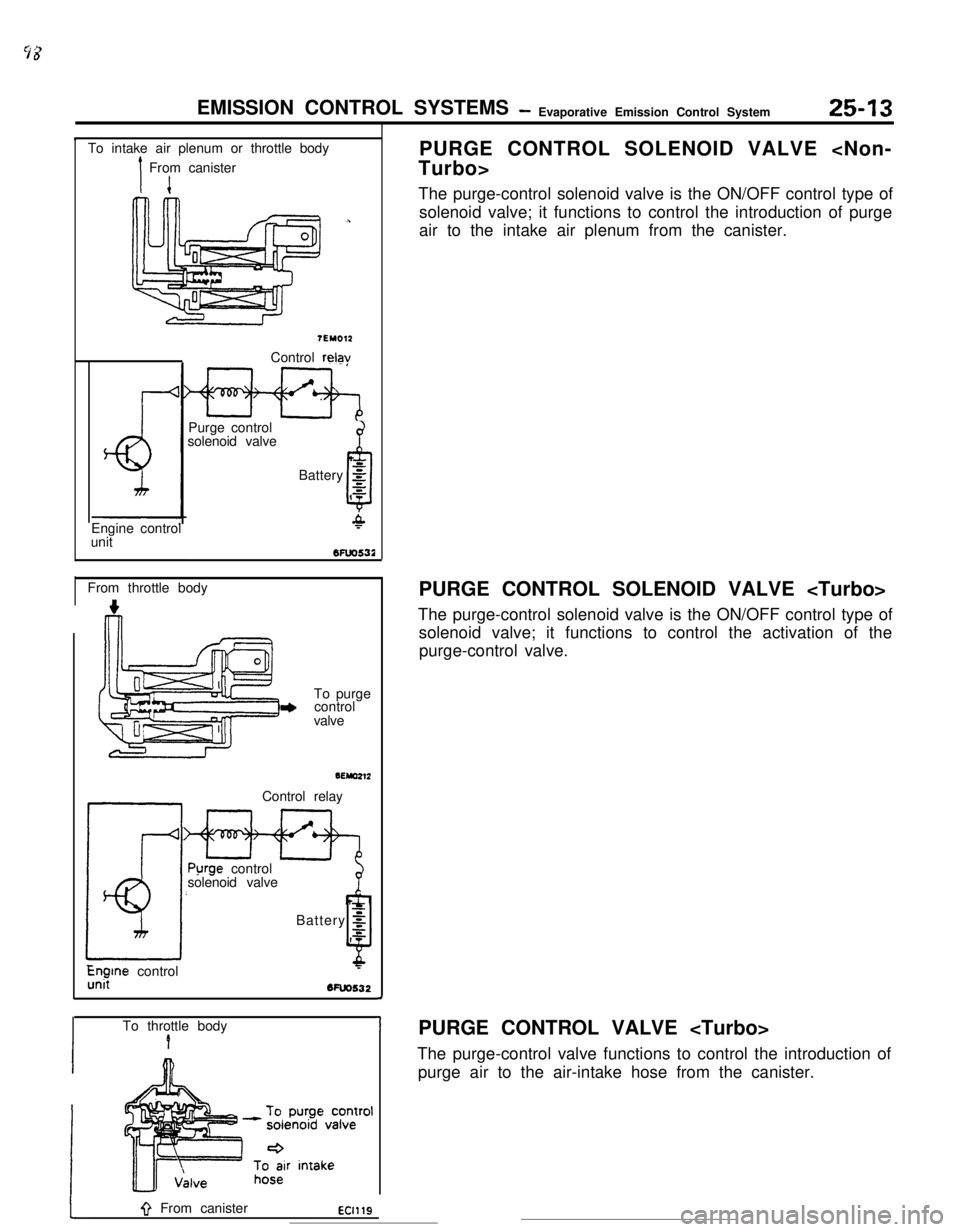
bfuo532JPURGE CONTROL SOLENOID VALVE
Turbo>
The purge-control solenoid valve is the ON/OFF control type of
solenoid valve; it functions to control the introduction of purge
air to the intake air plenum from the canister.
PURGE CONTROL SOLENOID VALVE
The purge-control solenoid valve is the ON/OFF control type of
solenoid valve; it functions to control the activation of the
purge-control valve.
ITo throttle body11PURGE CONTROL VALVE
The purge-control valve functions to control the introduction of
purge air to the air-intake hose from the canister.
0 From canister
Page 388 of 391

--.25-14EMISSION CONTROL SYSTEMS
- Evaporative Emisson Control System
Pressure valveTo overfill
’ limiter
40
” Ball
Bail
\From fuel tank03E51fOVERFILL LIMITER (TWO-WAY VALVE)
The overfill limiter consists of a pressure valve and a vacuum
valve. The pressure valve is designed to open when the fuel
tank internal pressure has increased over the normal pressure
and the vacuum valve opens when a vacuum has been
producted in the tank.
FUEL CHECK VALVE
The fuel check valve is used to prevent fuel leaks if the vehicle
rolls over. This valve is connected in the fuel vapor line
(between canister and overfill limiter) and is installed on thefirewall.
The fuel check valve contains two balls, as shown in the
illustration. Under normal conditions, the fuel vapor passage in
the valve is opened, but if roll-over occurs one of the balls
closes the fuel passage, thus preventing fuel leaks.
FUEL FILLER CAPThe fuel filler cap is equipped with a relief valve to prevent the
escape of fuel vapor into the atmosphere.
.
-
Page 391 of 391

UNITED STATES
The special service tools referred to herein are required for certain service operations. These special service tools
or their equivalent, if not obtainable through a local source are available through the following outlet.32615 Park Lane, Garden City, Michigan 48135, U.S.A.
TRIANGLE SPECIAL PRODUCTS GROUP
(MILLER SPECIAL TOOLS)
DIVISION OF THE TRIANGLE CORPORATION
CANADA .
b’f CANADA
1, CHRYSLERThe special service tools referred to herein are required for certain service operations. These special
service tools
or their equivalent, if not obtainable through a local source are available through the following outlet.
C 8r D Riley Enterprises Ltd., P.O. Box 243, Amherstburg, Ontario N9V 224INTERNATIONAL
!!!hif INTERNA’IIONAL
1, CHRYSLERThe special service toOk referred to herein are required for certain service operations. These special
service tools
or their equivalent, if not obtainable through a local source are available through the following outlet.
32615 Park Lane, Garden City, Michigan 48135, U.S.A.
TRIANGLE SPECIAL PRODUCTS GROUP
(MILLER SPECIAL TOOLS)
DIVISION OF THE TRIANGLE CORPORATION