Page 44 of 346
FI-10 EFI SYSTEM - inspection Precautions
L Fco97 FlOO91
I
. FI159
i. 4 Gasket
New
‘Gasket
I / FM067 FHOE
Fulcrum Length
19
54
-.
(b) insert the tester probe into the connector from the
wiring side when-checking the continuity,,amperage
L
or voltage.
(c) Do not apply unnecessary force to the terminal.
(d) After checking, install the water-proofing rubber on
the connector securely.
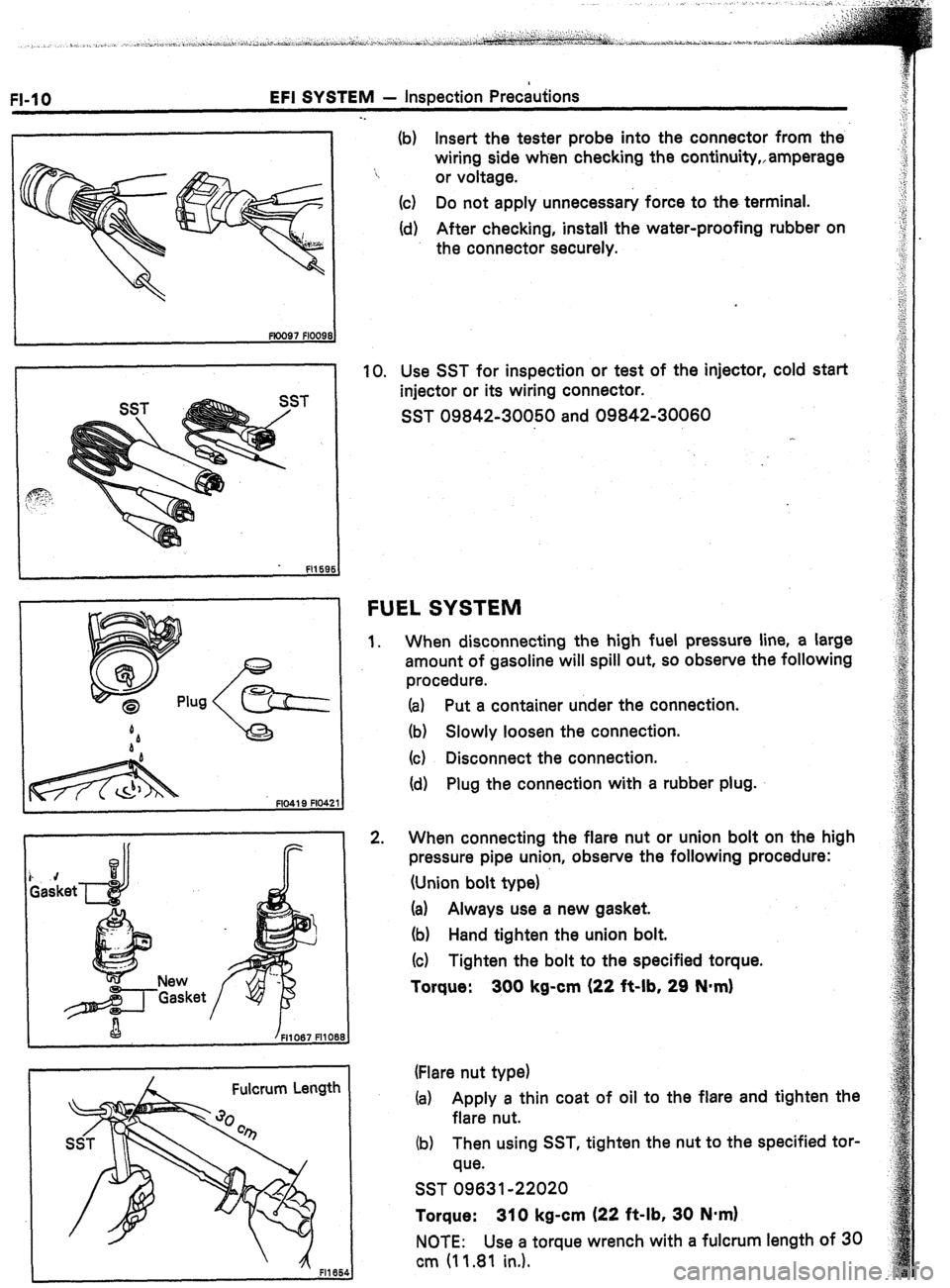
10. Use SST for inspection or test of the injector, cold start
injector or its wiring connector.
SST 09842-30050 and 09842-30060
FUEL SYSTEM
1.
2. When disconnecting the high fuel pressure line, a large
amount of gasoline will spill out, so observe the following
procedure.
(a) Put a container under the connection.
(b) Slowly loosen the connection.
(c) Disconnect the connection.
(d) Plug the connection with a rubber plug.
When connecting the flare nut or union bolt on the high
pressure pipe union, observe the following procedure:
(Union bolt type)
(a) Always use a new gasket.
(b) Hand tighten the union bolt.
(c) Tighten the bolt to the specified torque.
Torque: 300 kg-cm (22 it-lb, 29 N*m)
(Flare nut type)
(a) Apply a thin coat of oil to the flare and tighten the
flare nut.
(b) Then using SST, tighten the nut to the specified tor-
que.
SST 09631-22020
Torque: 310 kg-cm (22 ft-lb, 30 N*m)
NOTE: Use a torque wrench with a fulcrum length of 30
cm (11.81 in.).
Page 50 of 346
l-16 EFI SYSTEM - Troubleshooting
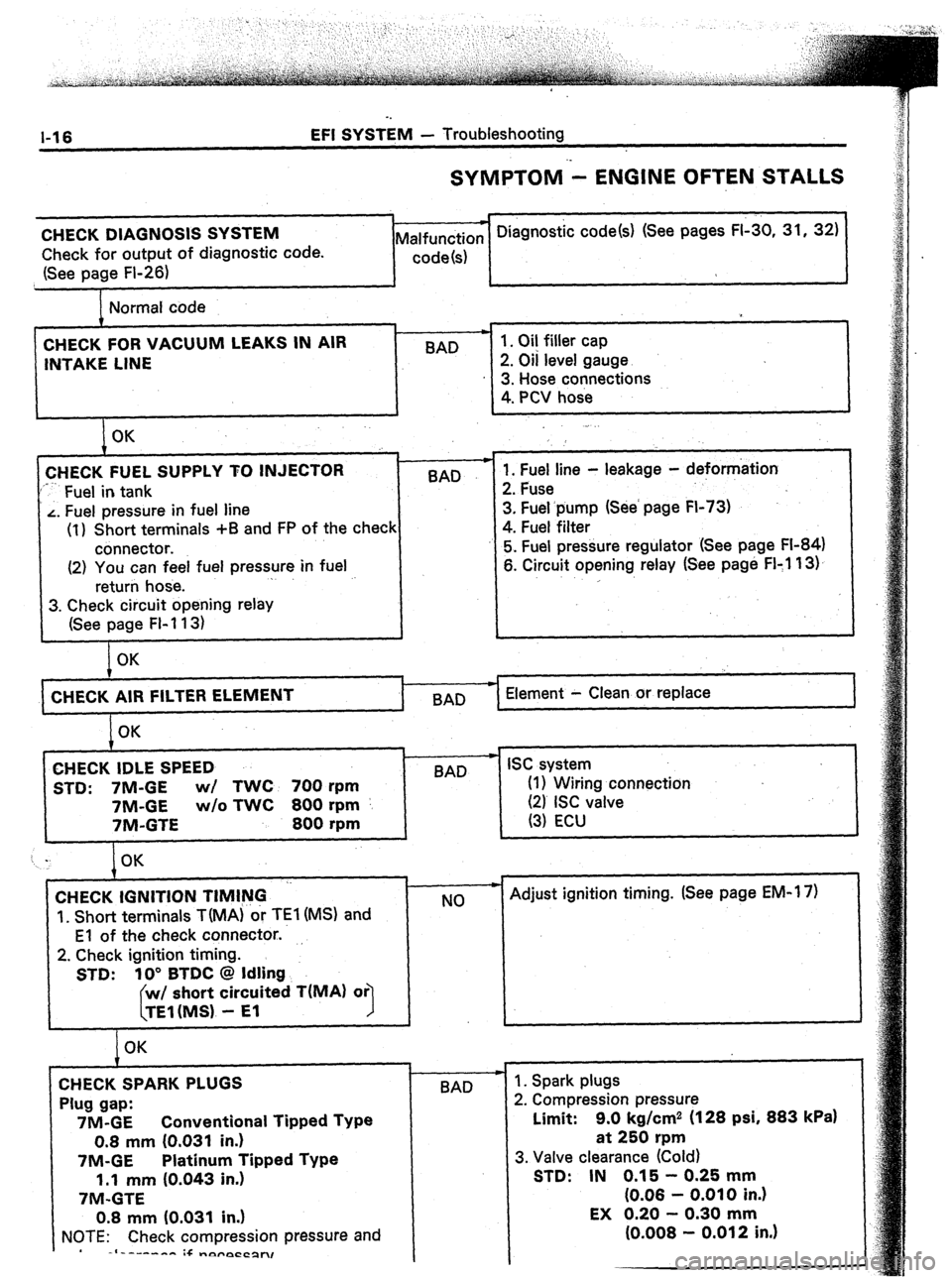
SYMPTOM - ENGINE OFTEN STALLS
CHECK DIAGNOSIS SYSTEM
Check for output of diagnostic code.
(See page Fl-26) * Diagnostic code(s) (See pages FI-30, 31, 32)
Malfunction
code(s)
Normal code
CHECK FOR VACUUM LEAKS IN AIR
INTAKE LINE BAD 1. Oil filler cap
2. Oil level gauge
3. Hose connections
4. PCV hose
I OK
CHECK FUEL SUPPLY TO INJECTOR
‘*-- Fuel in tank BAD
L. Fuel pressure in fuel line
(1) Short terminals +B and FP of the check
connector.
(2) You can feel fuel pressure in fuel
return hose. .
3. Check circuit opening relay
(See page FI-113) .
1. Fuel line - leakage - deformation
2. Fuse
3. Fuel.pump (See’ page FI-73)
4. Fuel filter
5. Fuel pressure regulator (See page FI-84)
6. Circuit opening relay (See page FI:1 13).
,
OK
CHECK AIR FILTER
I BAD Element - Clean or replace
OK
CHECK IDLE SPEED
STD: 7M-GE wl TWC 700 rpm
7M-GE w/o TWC 800 rpm
7M-GTE 800 rpm
t w
BAD ISC system
(I 1 Wiring connection
(21 ISC valve
(3) ECU
CHECK IGNITION TIMING ‘-
‘I. Short terminals TiMA) or TEl (MS) and
El of the check connector..
2. Check ignition timing.
STD: 10” BTDC @ Idling
short circuited T(MA) or
1
OK
CHECK SPARK PLUGS
Plug gap:
7M-GE Conventional Tipped Type
0.8 mm (0.031 in.)
7M-GE Platinum Tipped Type
1.1 mm (0.043 in.)
7M-GTE
0.8 mm (0.031 in.)
NOTE: Check compression pressure and
-I------- :+ -nyrpCCpn, c
NO
-I-
BAD - Adjust ignition timing. (See page EM-1 7)
1. Spark plugs
2. Compression pressure
Limit: 9.0 kg/cm2 (128 psi, 883
kPa)
at 250 rpm
3. Valve clearance (Cold)
STD: IN 0.15 - 0.25 mm
(0.06 - 0.010 in.)
Page 56 of 346
Ii-22 EFI SYSiiM - Troubleshooting
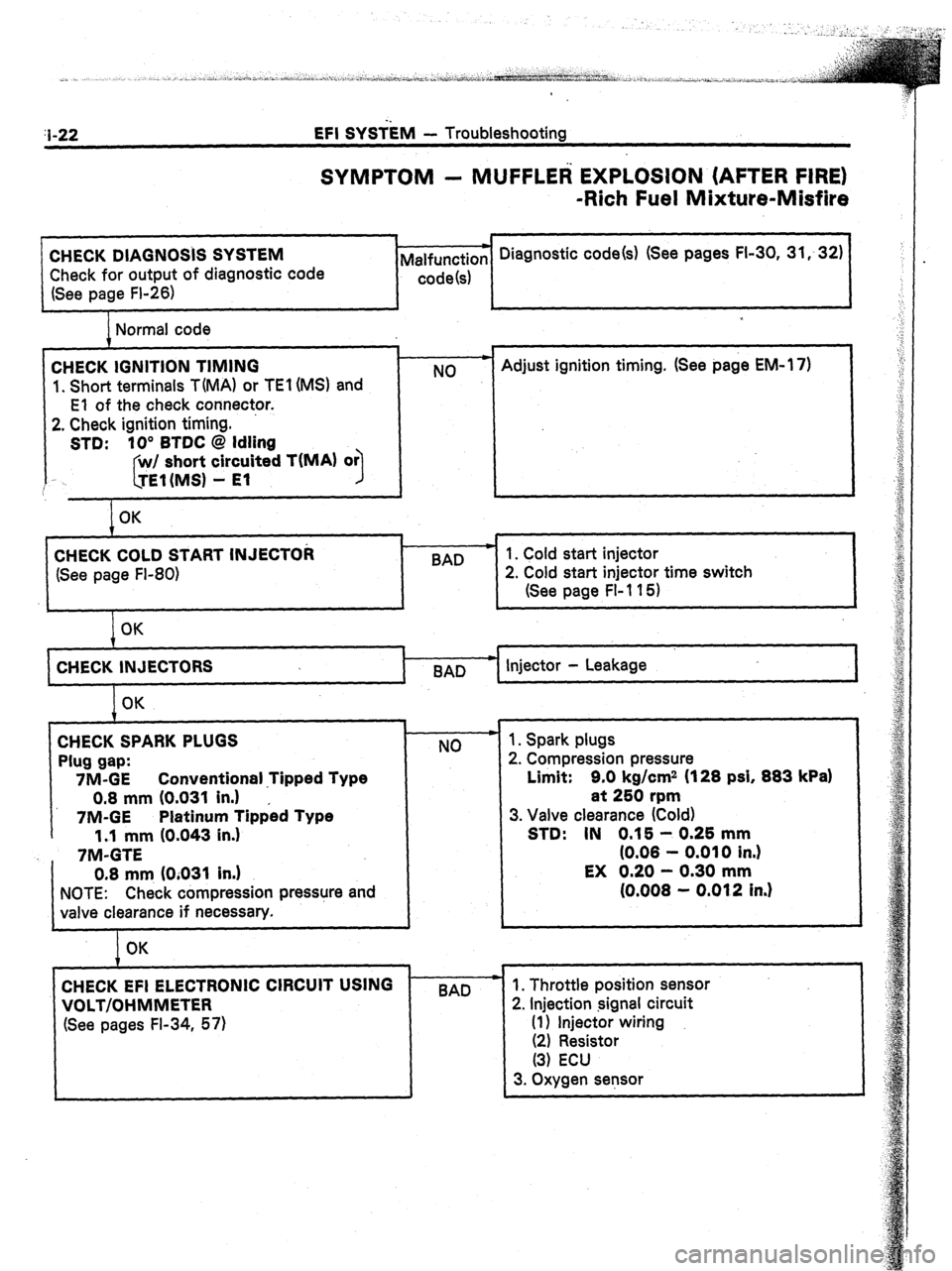
SYMPTOM - MUFFLER EXPLOSION (AFTER FIRE)
-Rich Fuel Mixture-Misfire
CHECK DIAGNOSIS SYSTEM
Check for output of diagnostic code
(See page FI-26) pm Diagnostic code(s) (See pages Fl-30, 31, 32)
Malfunction
code(s)
4
c
Normal code
CHECK IGNITION TIMING
1. Short terminals TiMA) or TEl (MS) and
El of the check connector.
2. Check ignition timing.
STD: IO” BTDC @ Idling
w/ short circuited TfMA) or
C TEl(MS) - El I
OK NO
BAD
I-
Adjust ignition timing. (See page EM- 17)
I
1. Cold start injector
2. Cold start injector time switch
(See page FI- 115)
1
CHECK INJECTORS
BAD injector - Leakage
I
I OK
CHECK SPARK PLUGS
Plug gap:
7M-GE Conventional .Tipped Type
0.8 mm (0.031 in.)
7M-GE Platinum Tipped Type
1.1 mm (0.043 in.)
7M-GTE
0.8 mm (OiO31 in.)
NOTE: Check compression pressure and
valve clearance if necessary.
OK
CHECK EFI ELECTRONIC CIRCUIT USING
VOLT/OHMMETER
(See pages Fl-34, 57) NO
BAD - 1. Spark plugs
2. Compression pressure
Limit: 9.0 kg/cm2 (128 psi, 883
kPa)
at 250 rpm
3. Valve clearance (Cold)
STD: IN 0.15 - 0.25 mm
(0.06 - 0.010 in.)
EX 0.20 - 0.30 mm
(0.006 - 0.012 in.)
i
1. Throttle position sensor
2. Injection signal circuit
(I) Injector wiring
(2) Resistor
(3) ECU
3. Oxygen sensor
Page 113 of 346
EFI SYSTEM - Fuel System
FI-79
. .
/
A Fulcrum Length
2 - 7 mm (0.08 1 0.28 in.)
Pipe Hose
k ’
em -m-d-‘,
--
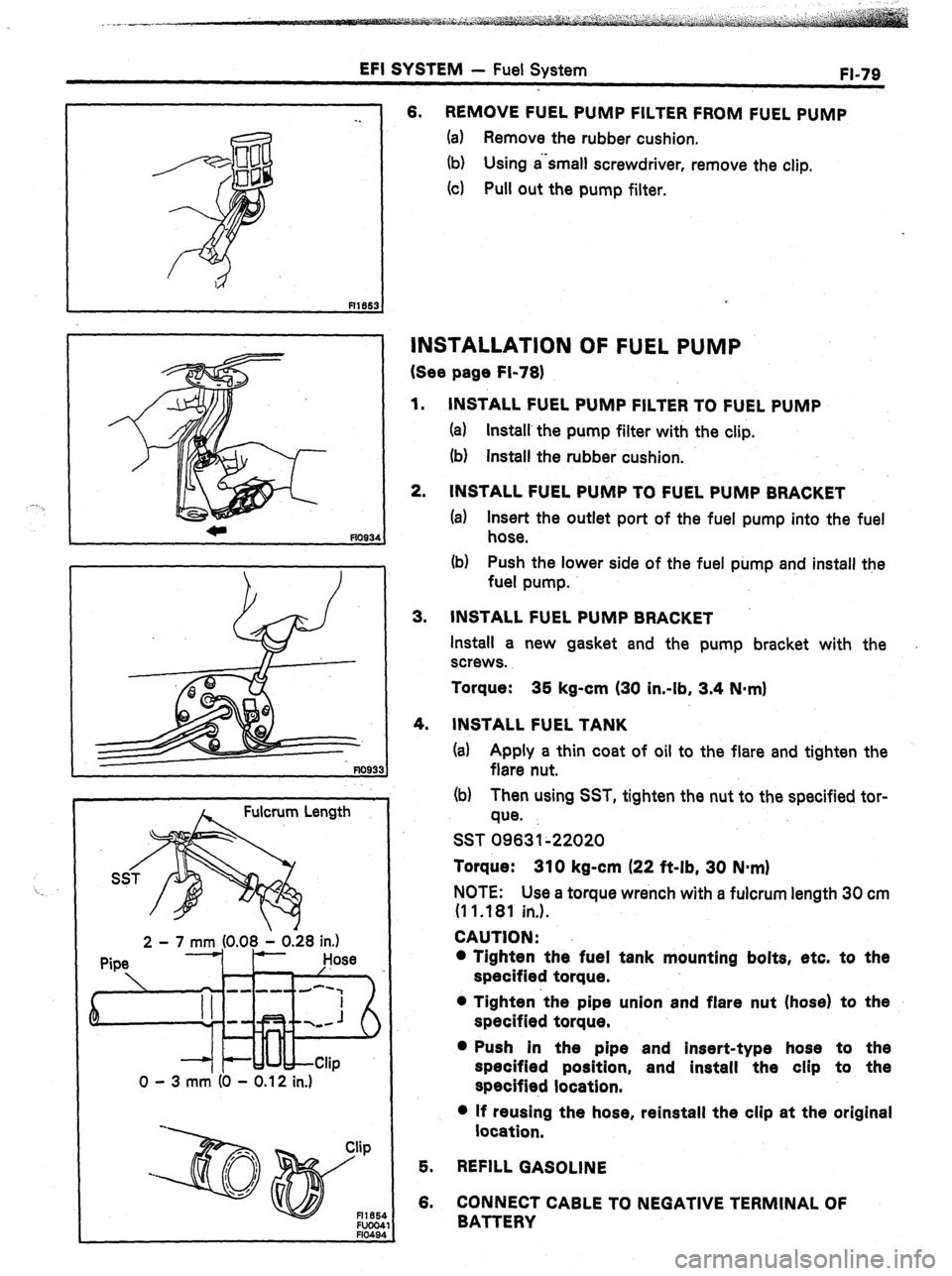
0 - 3 mm (0 - 0.12 in.) 6. REMOVE FUEL PUMP FILTER FROM FUEL PUMP
(a) Remove the rubber cushion.
(b) Using a‘small screwdriver, remove the clip.
(4 Pull out the pump filter.
INSTALLATION OF FUEL PUMP
(See page Fi-78)
1.
2. INSTALL FUEL PUMP FILTER TO FUEL PUMP
(a) Install’the pump filter with the clip.
(b) install the rubber cushion.
INSTALL FUEL PUMP TO FUEL PUMP BRACKET
(a) Insert the outlet port of the fuel pump into the fuel
hose.
(b) Push the lower side of the fuel pump and install the
fuel pump.
3. INSTALL FUEL PUMP BRACKET
Install a new gasket and the pump bracket with the
screws.
Torque: 35 kg-cm (30 in-lb, 3.4 N-m)
4.
INSTALL FUEL TANK
(a) Apply a thin coat of oil to the flare and tighten the
flare nut.
(b) Then using SST, tighten the nut to the specified tor-
que.
SST 09631~22020
Torque: 310 kg-cm (22 ft-lb, 30 N-m)
NOTE: Use a torque wrench with a fulcrum length 30 cm
(1 1 .181 in.).
CAUTION:
l Tighten the fuel tank mounting bolts, etc. to the
specified torque.
l Tighten ‘the pipe union and flare nut (hose) to the
specified torque.
l Push in the pipe and insert-type hose to the
specified position, and install the clip to the
specified location.
l If reusing the hose, reinstall the clip at the original
location,
5. REFILL GASOLINE
6. CONNECT CABLE TO NEGATIVE TERMINAL OF
BATTERY
Page 330 of 346
x-2 TURBOCHARGER SYSTEM - Description
.
DESCRIPTION
-.
“
Oxygen
. Turbine Wheel
Sensor
.
I Full-floating Bearing
Valve
Oil P&sage
From Oil Inlet Pipe
Intercooler Pipe Arrangement
TdO
CSOll5 Fl2
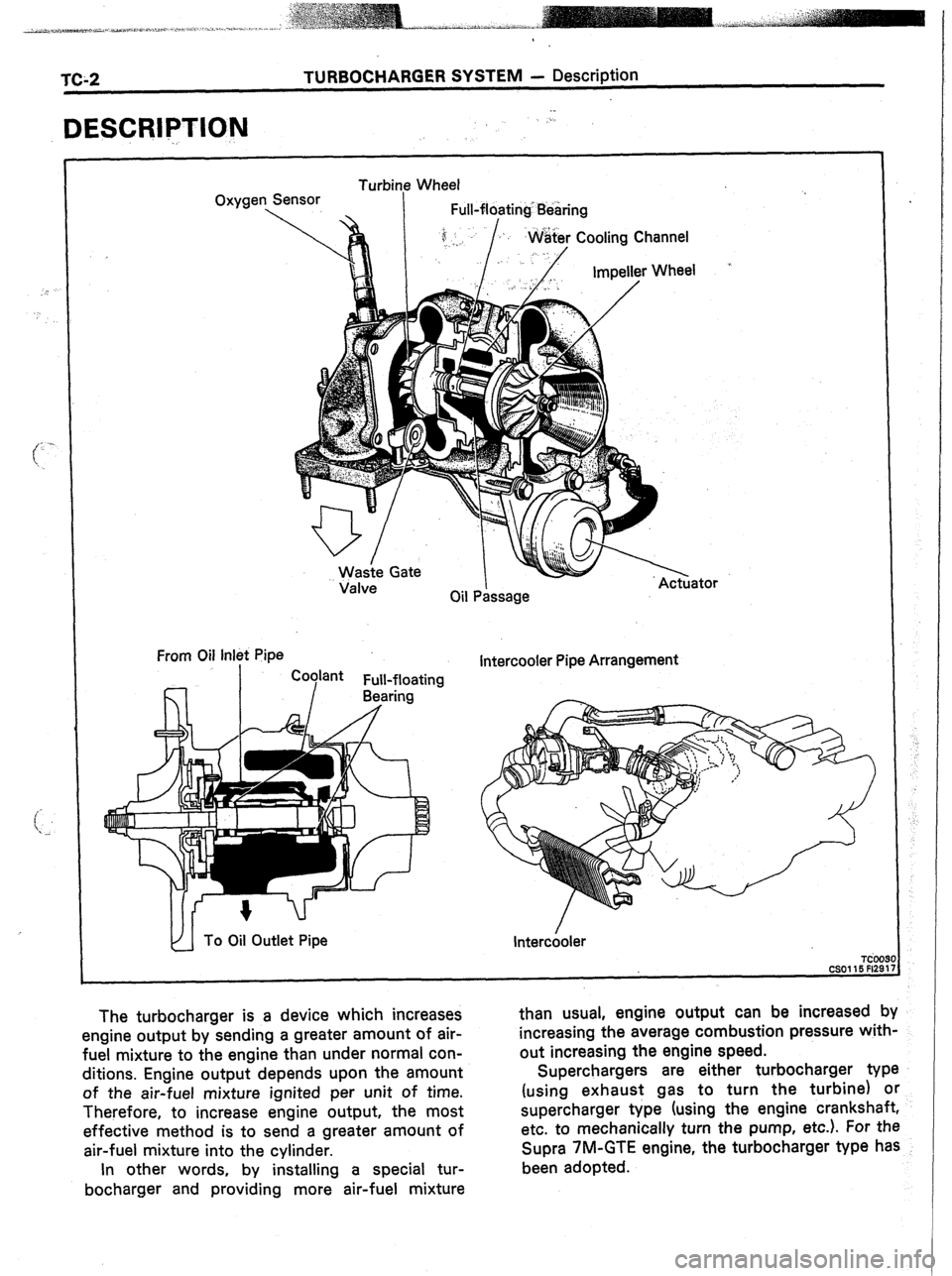
The turbocharger is a device which increases
engine output by sending a greater amount of air-
fuel mixture to the engine than under normal con-
ditions. Engine output depends upon the amount
of the air-fuel mixture ignited per unit of time.
Therefore, to increase engine output, the most
effective method is to send a greater amount of
air-fuel mixture into the cylinder. than usual, engine output can be increased by
.
increasing the average combustion pressure with-
out increasing the engine speed.
Superchargers are either turbocharger type
(using exhaust gas to turn the turbine) or
supercharger type (using the engine crankshaft,
etc. to mechanically turn the pump, etc.). For the
Supra 7M-GTE engine, the turbocharger type has
been adopted.
In other words, by installing a special tur-
bocharger and providing more air-fuel mixture