1987 TOYOTA CELICA sensor
[x] Cancel search: sensorPage 7 of 346
INTRODUCTION - General Repair Instructions
IN-S
(b) Recoating of Precoated Parts
(1) Clean off the old adhesive from the part’s
threads.
(2) Dry with compressed air.
(3) Apply the specified seal lock adhesive to the
part’s threads.
(c) Precoated parts are indicated in the component
illustrations by the “*” symbol.
7. When necessary, use a sealer or gaskets to prevent leaks.
8. Carefully observe all specifications for bolt torques.
Always use a torque wrench.
9. Use of special service tools (SST) and special service
materials (SSM) may be required, depending on the nature
of the repair. Be sure to use SST and SSM where specified
and follow the proper work procedure. A list of SST and
SSM can be found at the back of this manual.
10. When replacing fuses, be sure the new fuse is the correct
amperage. DO NOT exceed the fuse amp rating or use one
of a lower rating.
11. Care must be taken when jacking up and supporting the
vehicle. Be sure to lift and support the vehicle at the
proper locations.
(a) If the vehicle is to be jacked up only at the front or
rear end, be sure to block the wheels in order to
ensure safety.
(b) After the vehicle is jacked up, be sure to support it on
stands. It is extremely dangerous to do any work on
the vehicle raised on a jack alone, even for a small job
that can be finished quickly.
WRONG
CORRECT 12. Observe the following precautions to avoid damaging the
parts:
(a) Do not open the cover or the case of the ECU unless
absolutely necessary. (If the IC terminals are touched,
the IC may be destroyed by static electricity.)
(b) Be careful not to drop electrical components, such as
sensors or relays. If they are dropped on a hard floor,
they should be replaced and not reused.
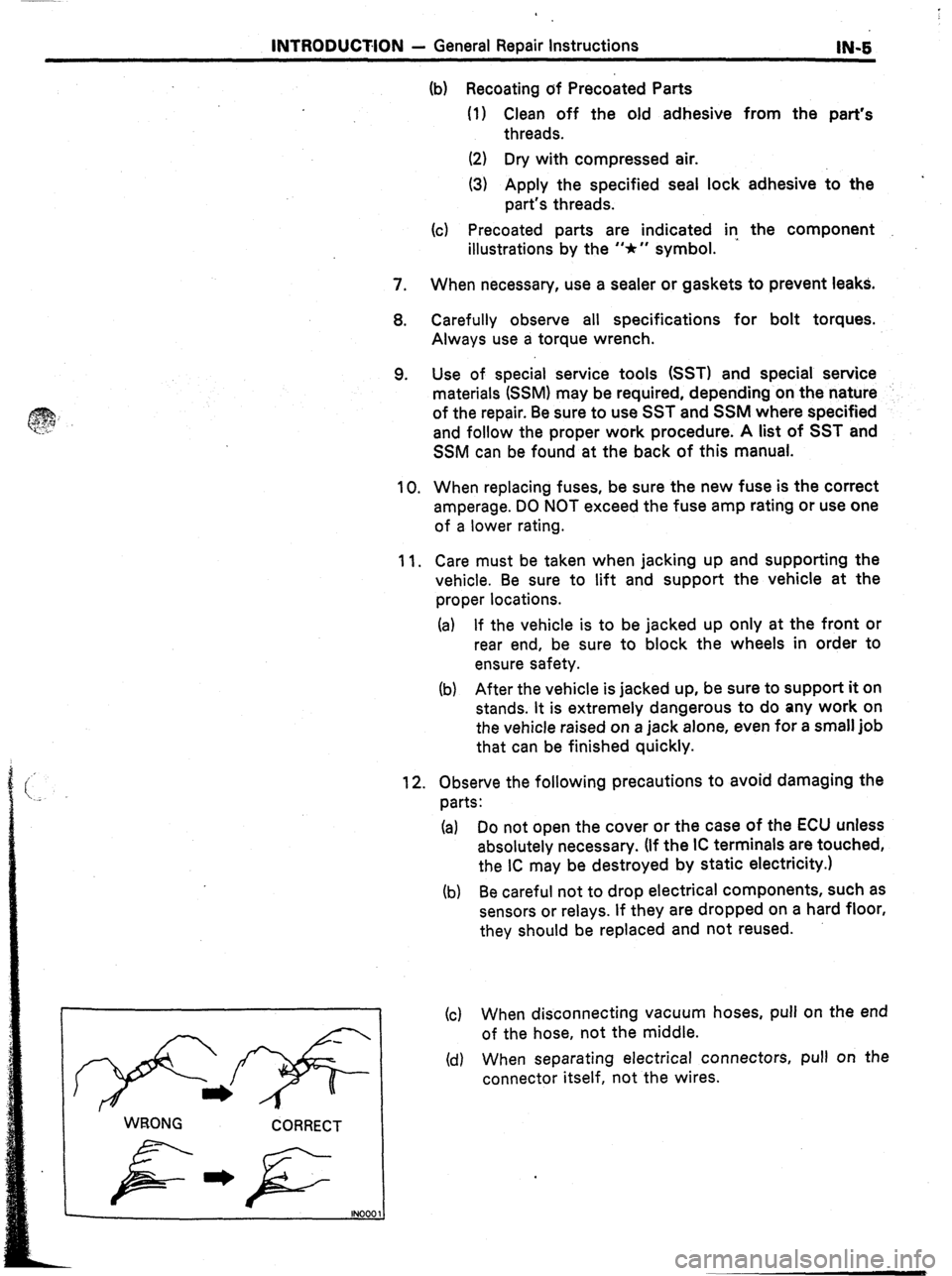
(c) When disconnecting vacuum hoses, pull on the end
of the hose, not the middle.
(d) When separating electrical connectors, pull on the
connector itself, not the wires.
Page 35 of 346
FI-1
i’.. ;
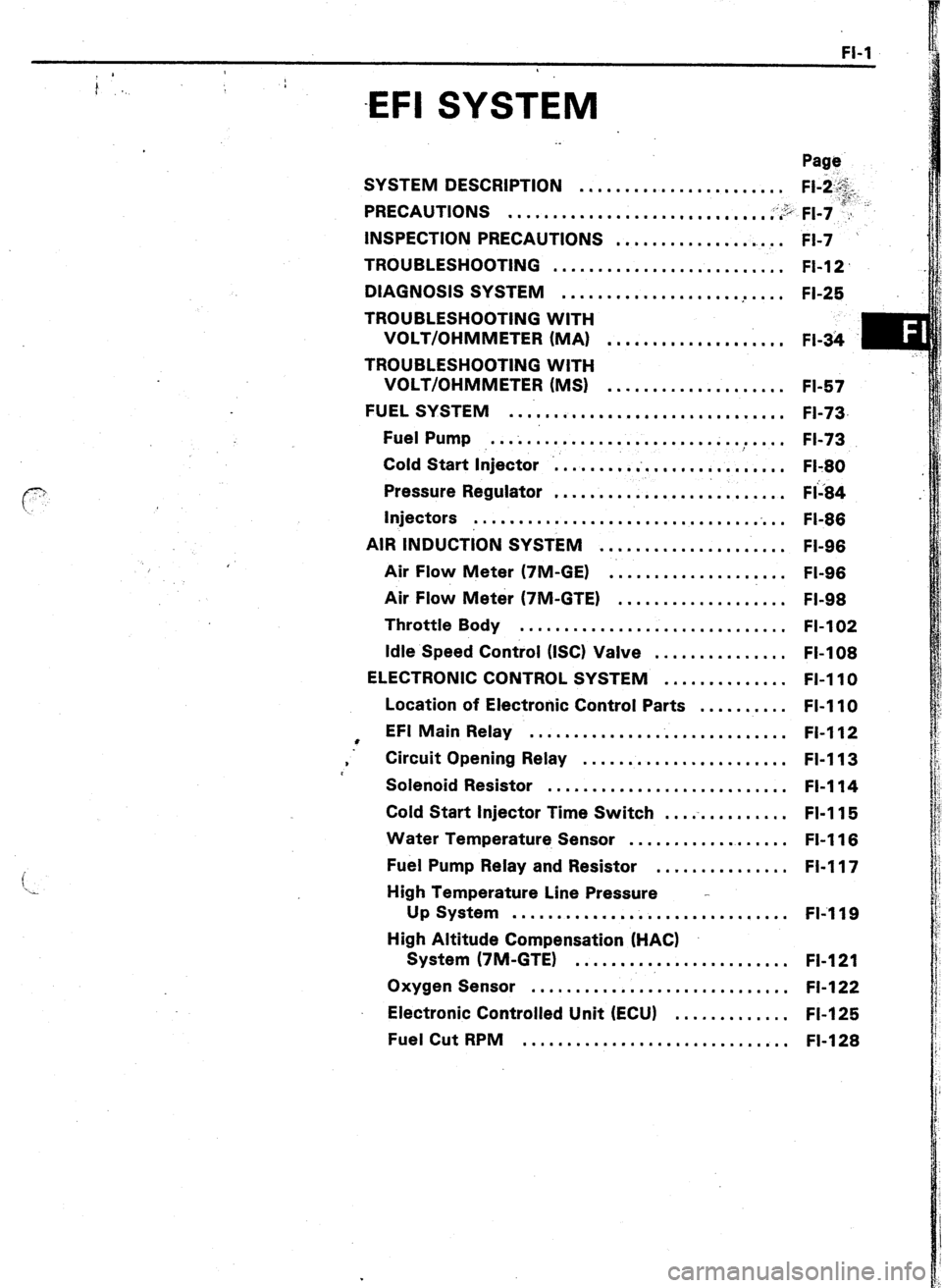
-EFI SYSTEM
i
‘x
. .
Page
SYSTEM DESCRIPTION
....................... Fl-i.&.
PRECAUTIONS
;;:“, F,-, ;a”“- .............................. . ....
INSPECTION PRECAUTIONS
FI-7 . ....................
TROUBLESHOOTING
.......................... FI-12
DIAGNOSIS SYSTEM
.................... .
.... FI-25
TROUBLESHOOTING WITH
VOLT/OHMMETER (MA)
.................... FI-34
m
.:
TROUBLESHOOTING WITH
VOLT/OHMMETER (MS)
.................... FI-57
FUEL SYSTEM
................................ FI-73,
Fuel Pump ..................................
FI-73
Cold Start Injector ...........................
Fl-80
Pressure Regulator
.......................... FI’i84 ..
Injectors
.............................. ..i ..
FI-86
AIR INDUCTION SYSTEM
..................... FI-96
Air Flow Meter (7M-GE)
..................... FI-96
Air Flow Meter (7M-GTE)
................... FI-98
Throttle Body
.............................. FI-102
Idle Speed Control (ISC) Valve
............... FI-108
ELECTRONIC CONTROL SYSTEM .............. FI-110
Location of Electronic Control Parts .......... FI-110
l EFI Main Relay
............................. Fl-112
. Circuit Opening Relay ....................... FI-113
Solenoid Resistor
........................... Fl-114
Cold Start Injector Time Switch ...............
FI-115
Water Temperature Sensor ..................
FI-116
Fuel Pump Relay and Resistor ............... FI-117
High Temperature Line Pressure -
Up System ............................... FIi119
High Altitude Compensation (HACK
System (7M-GTE)
........................ FI-121
Oxygen Sensor .............................
FI-122
Electronic Controlled Unit (ECU) .............
FI-125
Fuel Cut RPM
.............................. FI-128
Page 36 of 346
Circuit
Opening
Fuel Pump Relay
I
Warning 1
I :..I-, -7-I ECU
P 1
L-
VSV (FPU)
Electronic
Load
di!=
Check C&tnector
A/C Compressc
I-=-
Szeed Sensor
IIIII:IIlI Igniter w/coil
l---it-
Start‘lnjector Time Switch
Water Te&p. Sensor
TWC
Neutral Start
Switch (A/T)
Page 37 of 346
![TOYOTA CELICA 1987 Service Repair Manual Circuit
Opening
Relay Fuel Pump Relay
“CHECK 1 f-- 1 ] : :
llll II :
: :
ENGINE”
Warning
Light ECU
I iIll
+-,llllllllllll
Electronic
Load Air Temp. Sensor
Check Connector 1 1 1 / 1](/manual-img/14/57451/w960_57451-36.png "TOYOTA CELICA 1987 Service Repair Manual Circuit
Opening
Relay Fuel Pump Relay
“CHECK 1 f-- 1 ] : :
llll II :
: :
ENGINE”
Warning
Light ECU
I iIll
+-,llllllllllll
Electronic
Load Air Temp. Sensor
Check Connector 1 1 1 / 1")
Circuit
Opening
Relay Fuel Pump Relay
“CHECK 1 f-- 1 ] : :
llll II :
: :
ENGINE”
Warning
Light ECU
I iIll
+-,llllllllllll
Electronic
Load Air Temp. Sensor
Check Connector 1 1 1 / 1 1 1 1 1 1 1 1
:uator
Igniter w/r-:’ ’
A/C Compressor
& 1 wTwy 1 To Charcoal Canister
Neutral Start
Switch (A/T)
Page 40 of 346
1-6 EFI SYSTEM - System Description
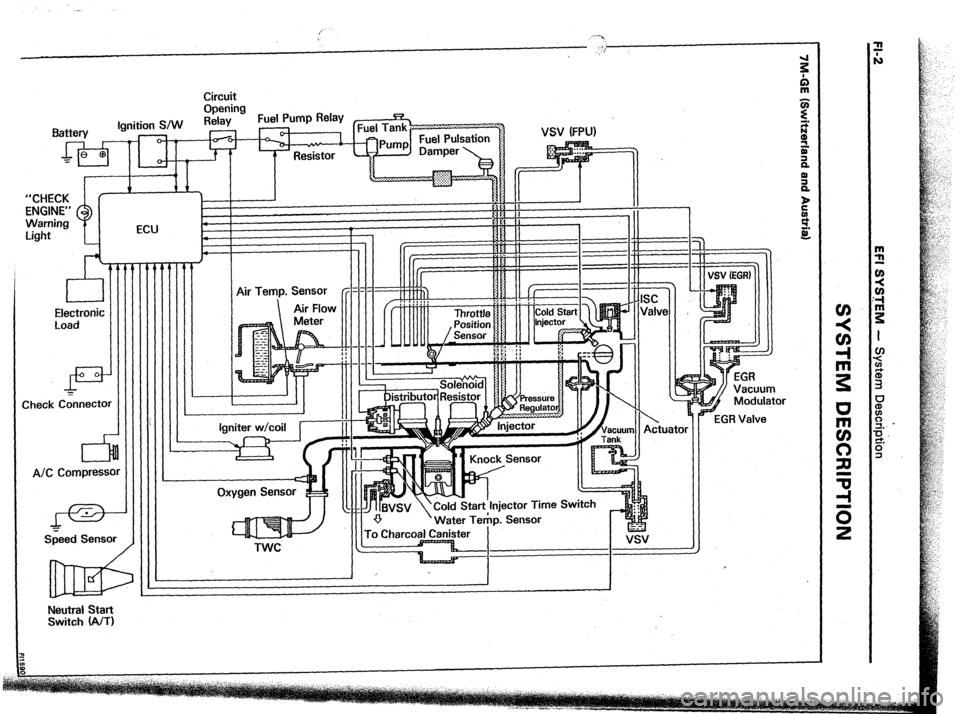
‘he .EFI system is composed of 3 basic sub
;ystems; Fuel Induction, Air Induction and
Ziectronic Control.
FUEL SYSTEM
An electric fuel pump supplies sufficient fuel,
under a constant pressure, to the injectors. These
injectors inject a metered quantity of fuel into the
intake manifold in accordance with signals from
the ECU (Electronic Control Unit).
AIR INDUCTION SYSTEM
The air induction system provides sufficient air for
engine operation.
[3: ‘I
i&TRONIC CONTROL SYSTEM
The 7M-GE, 7M-GTE engines are equipped wifh a
Toyota Computer Control System (TCCS) which
centrally controls the EFI, ESA, Diagnosis systems,
etc. by means of an Electronic Control Unit (ECU -
for-merly EFI computer) employing a microcom-
puter.
By means of the ECU, the TCCS controls the
following functions:
1. Electronic Fuel injection (EFI)
The ECU receivers signals from,various sen-
sors indicating changing engine operating
conditions such as:
Exhaust oxygen content (w/ TWC)
Intake air volume
i Intake air temperature
Coolant temperature
Engine rpm
Vehicle speed
Acceleration/deceleration etc.
These signals are utilized by the ECU to
determine the injection duration necessary for
an optimum air-fuel ratio.
2. Electronic Spark Advance (ESA)
The ECU is programmed with data for
optimum ignition timing under any and all
operating conditions. Using data provided by
sensors which monitor various engine func-
tions (rpm, A/C signal, coolant temperature,
etc.), the microcomputer (ECU) triggers the
spark at precisely the right instant. (See IG
section) 3. Idle Speed Control (IX)
The ECU is programmed with, target idling
speed values to respond to different engine
conditions (coolant temperature, air condi-
tioner on/off, etc.). Sensors transmit signals
to the ECU which control the flow of air
through the bypass of the throttle valve and
adjust idle speed to the target value.
(See pages FI-53, 7 1, 108) ’
4. Diagnosis
The ECU detects any malfunctions or abnor-
malities in the sensor network and tights the
“CHECK ENGINE” warning light on the instru-
ment panel. At the same time, the trouble is
identified and a diagnostic code is recorded
by the ECU.
5. Fail-Safe Function ’
In the event of computer malfunction, a back-
up circuit will take over to provide minimal
drivability. Simultaneously, the “CHECK
ENGINE” warning light will come on.
Page 41 of 346
EFI SYSTEM
- Precautions, Inspection Precautions
FI-7
PRECAUTIONS
._
1. Before working on the fuel system, disconnect the
negative terminal from the battery.
NOTE: Any diagnosis code retained by the computer will
be erased when the battery terminal is removed.
Therefore, if necessary, read the diagnosis before
removimg the battery terminal.
2. Do not smoke or work near an open flame when work-
ing on the fuel system.
3. Keep gasoline off rubber or leather parts.
INSPECTION PRECAUTl.ONS
MAINTENANCE PRECAUTIONS
1. INSURE CORRECT ENGINE TUNE-UP
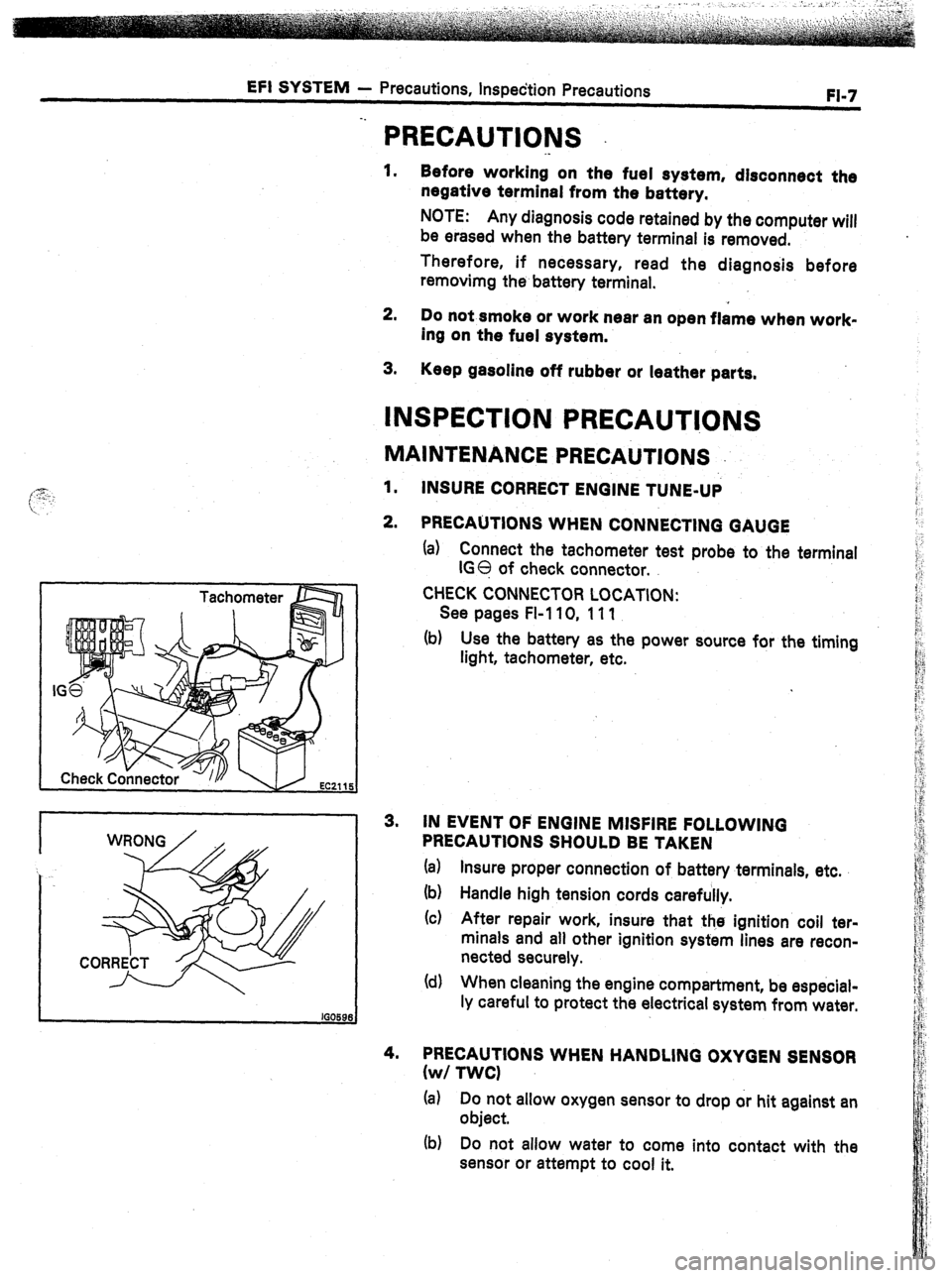
2. PRECAUTIONS WHEN CONNECTING GAUGE
(a) Connect the tachometer test probe to the terminal
IGO of check connector.
CHECK CONNECTOR LOCATION:
See pages FI-110, 111
(b) Use the battery as the power source for the timing
light, tachometer, etc.
3. IN EVENT OF ENGINE MISFIRE FOLLOWING
PRECAUTIONS SHOULD BE TAKEN
(a) Insure proper connection of battery terminals, etc.
(b) Handle high tension cords carefully.
(c) After repair work, insure that the ignition coil ter-
minals and all other ignition system lines are recon-
nected securely.
(d) When cleaning the engine compartment, be especial-
ly careful to protect the electrical system from water.
4. PRECAUTIONS WHEN HANDLING OXYGEN SENSOR
(w/ TWCI
(a) Do not allow oxygen sensor to drop or hit against an
object.
(b) Do not allow water to come into contact with the
sensor or attempt to cool it.
Page 46 of 346
1-12 EFI SYSTEM - Troubleshooting’
FlO48
TROUBLESH~~TI~~G
. .
TROUBLESHOOTING HlhJTS
1. Engine troubles are usually not caused by the EFI system.
When troubleshooting, always first check the condition of
the other systems.
(a) Electronic source
0 Battery
0 Fusible links
0 Fuses
(b) Body ground
(cl Fuel supply
0 Fuel leakage
0 Fuel filter
0 Fuel pump
(d) Ignition system
0 Spark plug
0 High-tension cord
l Distributor (7M-GE) or cam position sensor (7M-
GTE)
0 Igniter and ignition coil
(e) Air induction system
0 Vacuum leaks
(f) Emission control system
0 PCV system
0 EGR system (w/ EGR)
(g) Others
l Ignition timing (ESA system)
0 Idle speed (ISC system)
-r
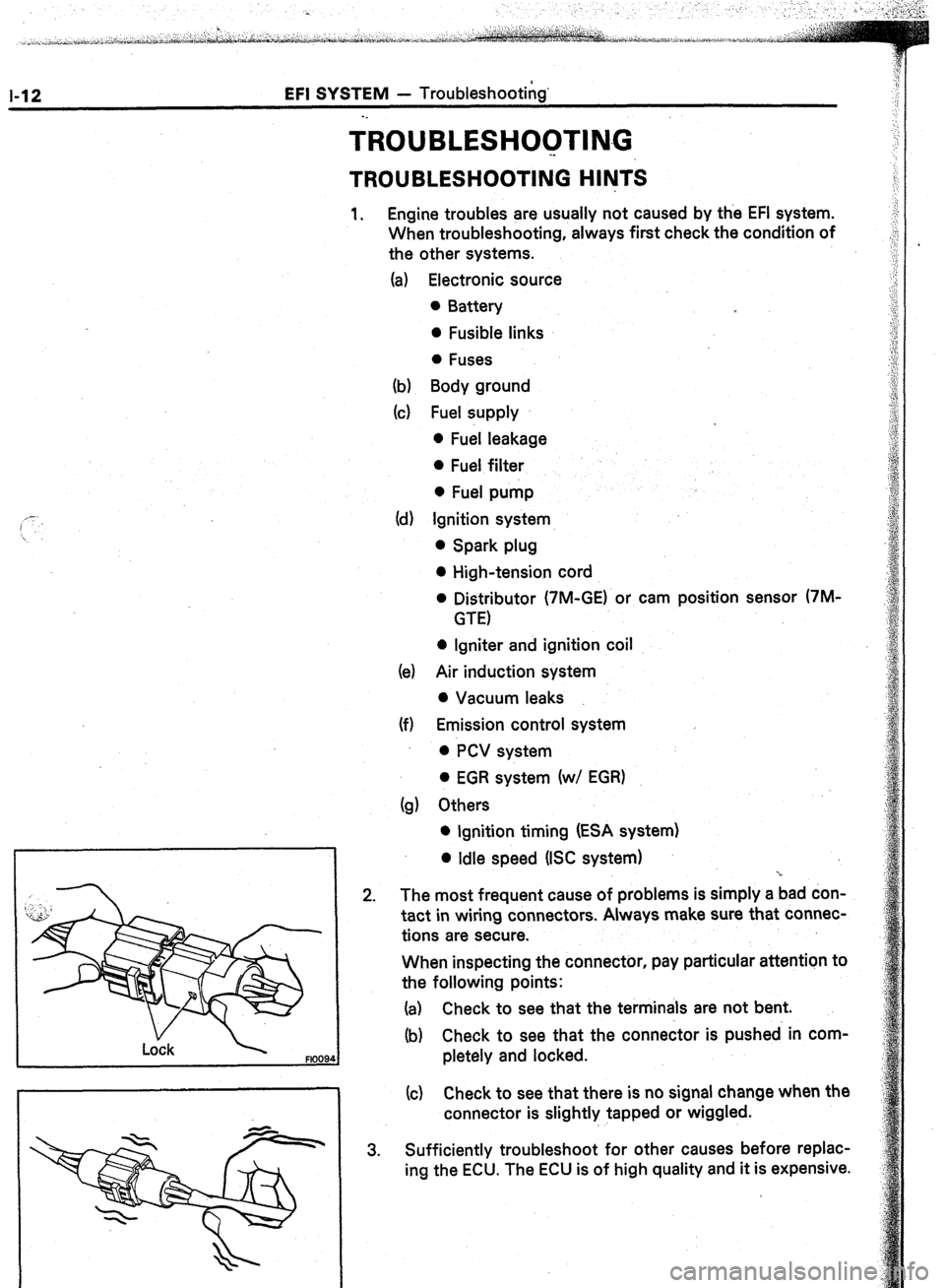
2. The most frequent cause of problems is simply a bad don-
tact in wiring connectors. Always make sure that connec-
tions are secure.
When inspecting the connector, pay particular attention to
the following points:
(a) Check to see that the terminals are not bent.
(b) Check to see that the connector is pushed in com-
pletely and locked.
(c) Check to see that there is no signal change when the
connector is slightly tapped or wiggled.
3. Sufficiently troubleshoot for other causes before replac-
ing the ECU. The ECU is of high quality and it is expensive.
Page 48 of 346
EFI SYSTEM - Troubleshootina
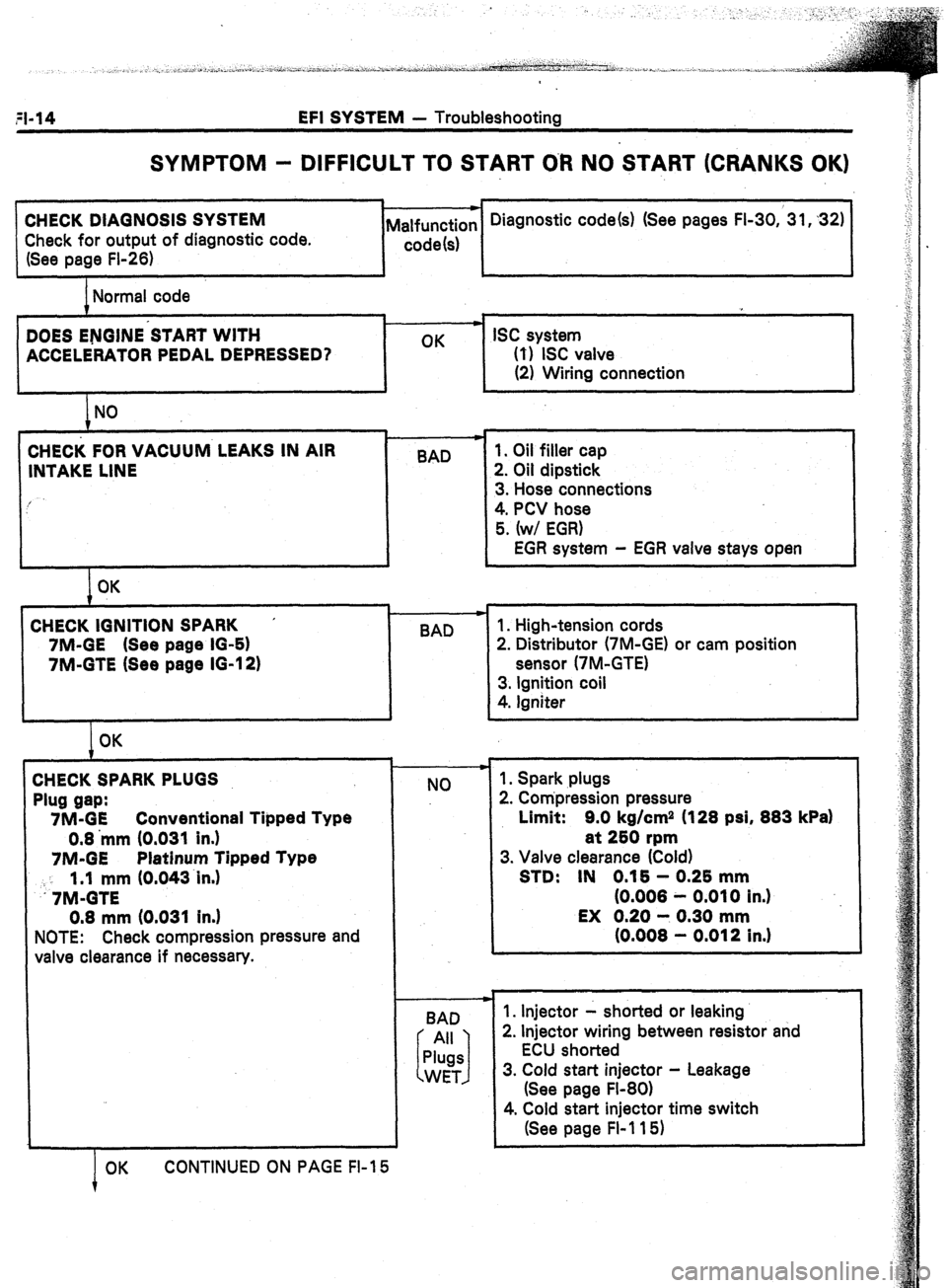
SYMPTOM - DIFFICULT TO START O-R NO START (CRANKS OK)
CHECK DIAGNOSIS SYSTEM
Check for output of diagnostic code.
(See page FI-26) Diagnostic code(s) (See pages FI-30,‘31,32)
Normal code
DOES ENGINE’START WITH
ACCELERATORPEDALDEPRESSED? OK ISC system
0) ISC valve
(2) Wiring connection
i NO I
CHECK FOR VACUUM LEAKS IN AIR I
BAD
INTAKE LINE
I OK
CHECK IGNITION SPARK ’
7M-GE (See page IO-61
7M-GTE (See page IG-12)
t OK
CHECKSPARKPLUGS
Plug gap:
7M-GE Conventional Tipped Type
0.8 ‘mm (0.031 In.)
7M-GE Platinum Tipped Type
: : 1.1 mm (0.043~in.)
.7M-GTE
0.8 mm (0.031 In.)
NOTE: Check compression pressure and
valve clearance if necessary.
OK CONTINUED ON PAGE FI-15
!
I
.
BAD 1. Oil filler cap
2. Oil dipstick
3. Hose connections
4. PCV hose
5. (w/ EGR)
EGR system - EGR valve stays open
1. High-tension cords
2. Distributor (‘IM-GE) or cam position
sensor (7M-GTE)
3. Ignition coil
4. Igniter
+
NO
BAD 1. Spark plugs
2. Compression pressure
Limit: 9.0 kg/cm2 (128 psi, 883 kPa)
at 250 rpm
3. Valve clearance (Cold)
STD: IN 0.16 - 0.25 mm
(0.008 - 0.010 in.)
EX 0.20 - 0.30 mm
(0.008 - 0.012 in.1
1. Injector - shorted or leaking
2. Injector wiring between resistor and
ECU shorted
3. Cold start injector - Leakage
(See page Fl-80)
4. Cold start injector time switch
(See page Fl-115)