1987 TOYOTA CELICA belt
[x] Cancel search: beltPage 9 of 346
CH-2 CHARGING SY&EM - Precautions, Troubleshooting
._
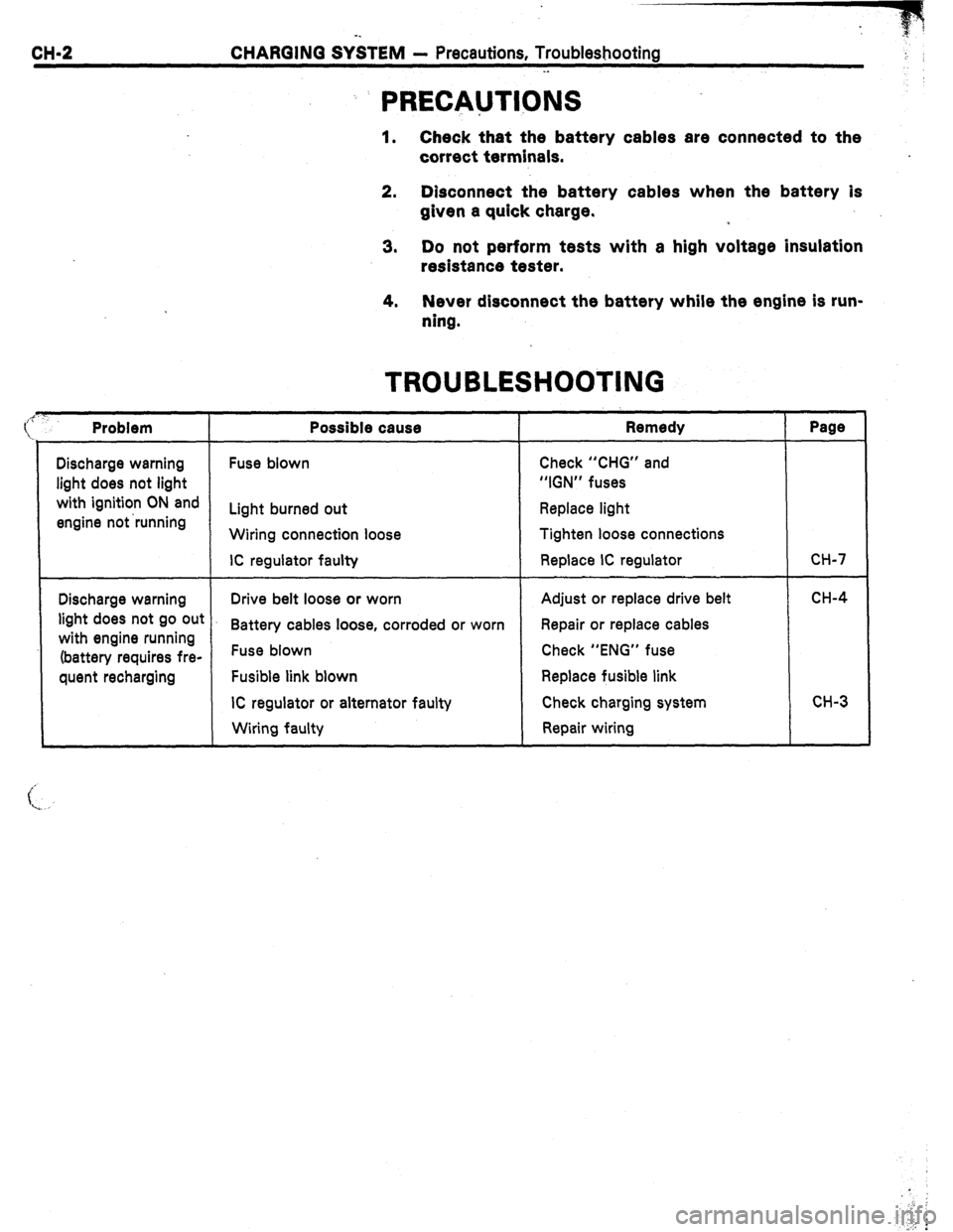
: PRECAUTIONS
1. Check that the battery cables are connected to the
correct terminals.
2. Disconnect the battery cables when the battery is
given a quick charge.
3. Do not perform tests with a high voltage insulation
resistance tester.
4. Never disconnect the battery while the engine is run-
ning.
Discharge warning
light does not light
with ignition ON and
engine not ‘running
Problem
Discharge warning
light does not go out
with engine running
(battery requires fre-
quent recharging
Possible cause
Fuse blown
Light burned out
Wiring connection loose
IC regulator faulty
TROUBLESHOOTING
Remedy
Check “CHG” and
“IGN” fuses
Replace light
Tighten loose connections
Replace IC regulator
Drive belt loose or worn
Battery cables loose, corroded or worn
Fuse blown
Fusible link blown
IC regulator or alternator faulty
Wiring faulty Adjust or replace drive belt
Repair or replace cables
Check “ENG” fuse
Replace fusible link
Check charging system
Repair wiring
Page
CH-7
CH-4
CH-3
Page 23 of 346
. COOLING SYSTEM - Description
co;3
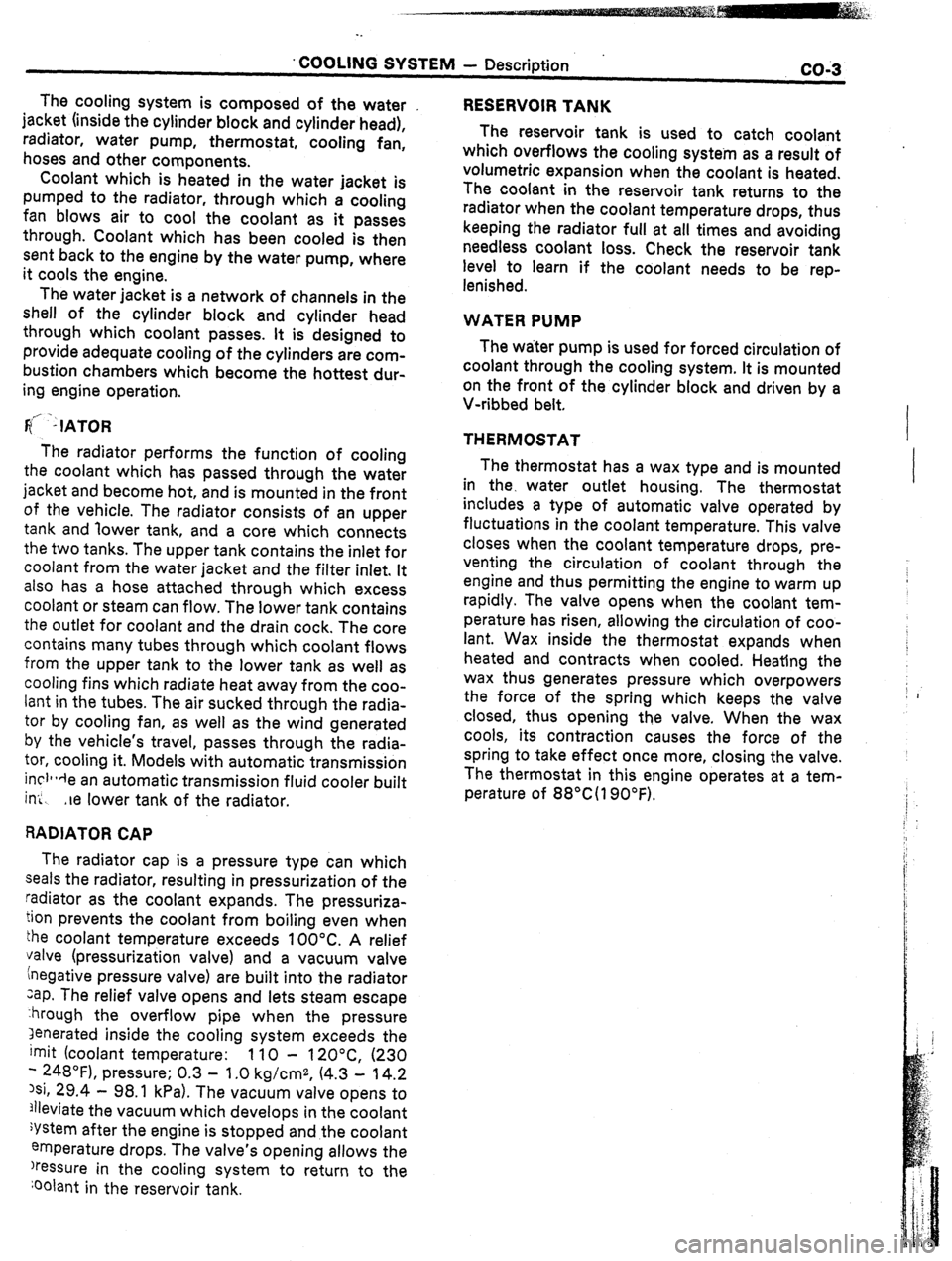
RESERVOIR TANK
The reservoir tank is used to catch coolant
which overflows the cooling systein as a result of
volumetric expansion when the coolant is heated.
The coolant in the reservoir tank returns to the
radiator when the coolant temperature drops, thus
keeping the radiator full at all times and avoiding
needless coolant loss. Check the reservoir tank
level to learn if the coolant needs to be rep-
lenished.
WATER PUMP
The water pump is used for forced circulation of
coolant through the cooling system. It is mounted
on the front of the cylinder block and driven by a
V-ribbed belt,
THERMOSTAT I The cooling system is composed of the water
jacket (inside the cylinder block and cylinder head),
radiator, water pump, thermostat, cooling fan,
hoses and other components.
Coolant which is heated in the water
jacket is
pumped to the radiator, through which a cooling
fan blows air to cool the coolant as it passes
through. Coolant which has been cooled is then
sent back to the engine by the water pump, where
it cools the engine.
The water jacket is a network of channels in the
shell of the cylinder block and cylinder head
through which coolant passes. It is designed to
provide adequate cooling of the cylinders are com-
bustion chambers which become the hottest dur-
ing engine operation.
F(/ “ IATOR
The radiator performs the function of cooling
the coolant which has passed through the water
jacket and become hot, and is mounted in the front
of the vehicle. The radiator consists of an upper
tank and ‘lower tank, and a core which connects
the two tanks. The upper tank contains the inlet for
coolant from the water jacket and the filter inlet. It
also has a hose attached through which excess
coolant or steam can flow. The lower tank contains
the outlet for coolant and the drain cock. The core
contains many tubes through which coolant flows
from the upper tank to the lower tank as well as
cooling fins which radiate heat away from the coo-
lant in the tubes. The air sucked through the radia-
tor by cooling fan, as well as the wind generated
by the vehicle’s travel, passes through the radia-
tor, cooling it. Models with automatic transmission
incrl*-le an automatic transmission fluid cooler built
in:.
.le lower tank of the radiator.
RADIATOR CAP
The radiator cap is a pressure type can which
seals the radiator, resulting in pressurization of the
radiator as the coolant expands. The pressuriza-
tion prevents the coolant from boiling even when
the coolant temperature exceeds 100°C. A relief
valve (pressurization valve) and a vacuum valve
(negative pressure valve) are built into the radiator
zap. The relief valve opens and lets steam escape
:hrough the overflow pipe when the pressure
3enerated inside the cooling system exceeds the
imit (coolant temperature:
110 - 1 20°C, (230
- 248”F), pressure; 0.3 - 1 .O kg/cmz, (4.3 - 14.2
)si, 29.4 - 98.1 kPa). The vacuum valve opens to
3ljeviate the vacuum which develops in the coolant
system after the engine is stopped and the coolant
emperature drops. The valve’s opening allows the
)ressure in the cooling system to return to the
Qclant in the reservoir tank. The thermostat has a wax type and is mounted
in the. water outlet housing. The thermostat
includes a type of automatic valve operated by
fluctuations in the coolant temperature. This valve
closes when the coolant temperature drops, pre-
venting the circulation of coolant through the
engine and thus permitting the engine to warm up
rapidly. The valve opens when the coolant tem-
perature has risen, allowing the circulation of coo-
lant. Wax inside the thermostat expands when
heated and contracts when cooled. Heating the
wax thus generates pressure which overpowers
the force of the spring which keeps the valve
closed, thus opening the valve. When the wax
cools, its contraction causes the force of the
spring to take effect once more, closing the valve.
The thermostat in this engine operates at a tem-
perature of 88”C(19O”F).
I
I
Page 24 of 346
co-4 CQOLING SYSTEM - Troubleshootmg
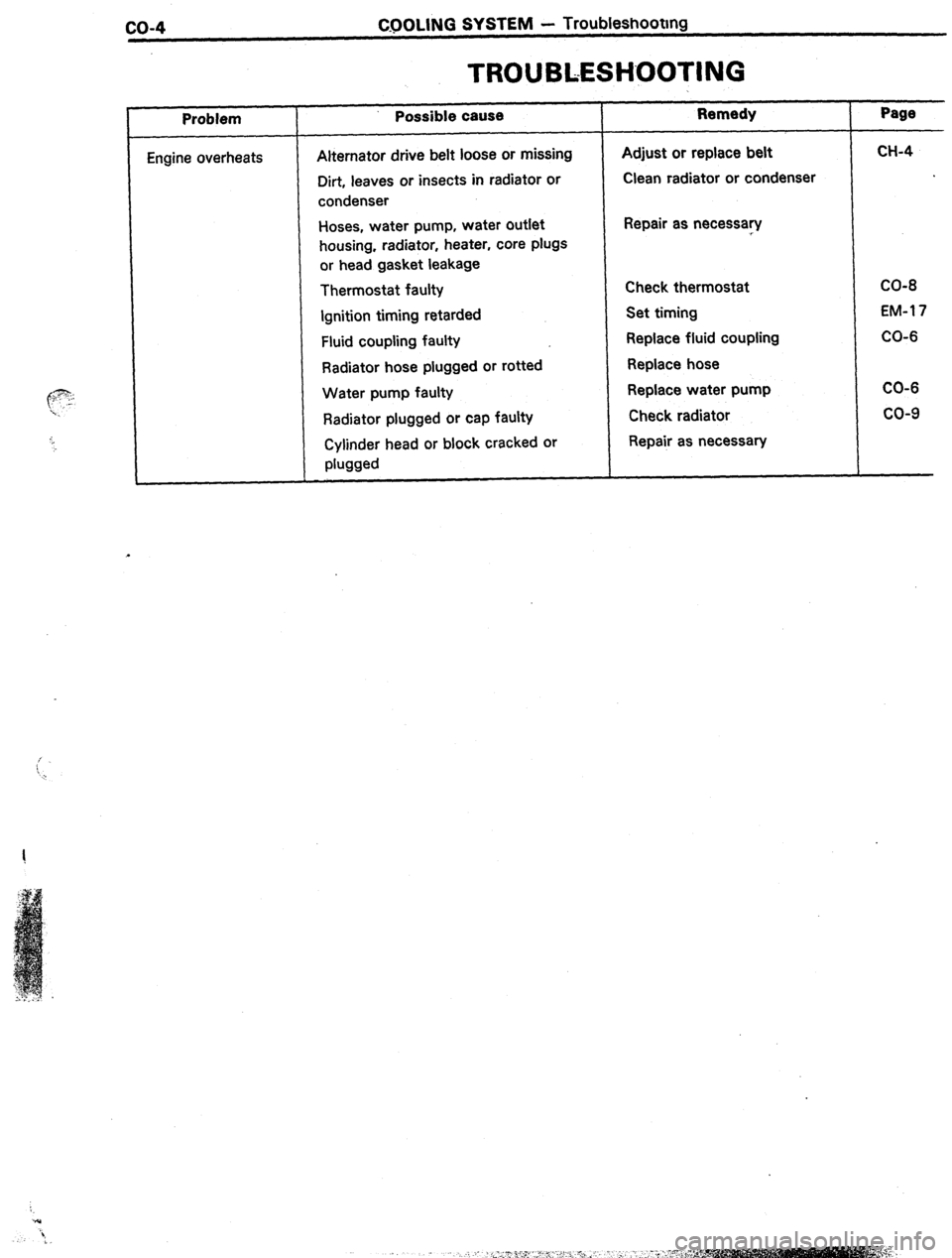
TROUBLESHOOTING
, Problem
Engine overheats Possible cause
Alternator drive belt loose or missing
Dirt, leaves or insects in radiator or
condenser
Hoses, water pump, water outlet
housing, radiator, heater, core plugs
or head gasket leakage
Thermostat faulty
Ignition timing
retarded
Fluid coupling faulty
Radiator hose plugged or rotted
Water pump faulty
Radiator plugged or cap faulty
Cylinder head or block cracked or
phwd Remedy
Adjust or replace belt
Clean radiator or condenser
Repair as necessary
Check thermostat
Set timing
Replace fluid coupling
Replace hose
Replace water pump
Check radiator
Repair as necessary Page
CH-4
CO-8
EM-l 7
CO-6
CO-6
co-9
Page 26 of 346
CO-6
C6OLlNG SYSTEM - Water Puma
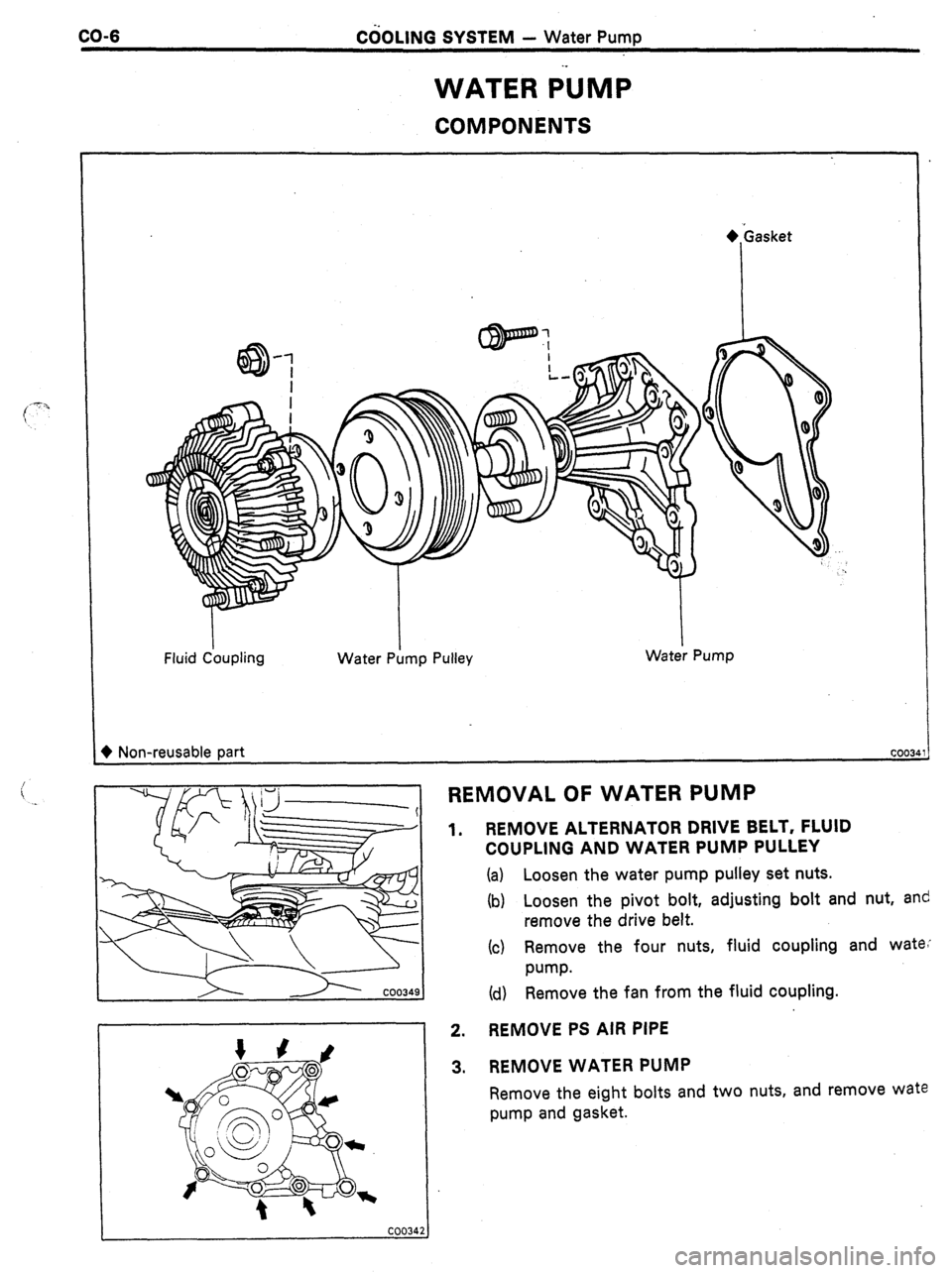
WATER ilJMP
COMPONENTS
Fluid Ckqling Water P;lmp Pulley Water Pump
+ Non-reusable part COOL3
c REMOVAL OF WATER PUMP ._
1. REMOVE ALTERNATOR DRIVE BELT, FLUID
COUPLING AND WATER PUMP PULLEY
(a) Loosen the water pump pulley set nuts.
(b) Loosen the pivot bolt, adjusting bolt and nut, and
remove the drive belt.
(c) Remove the four nuts, fluid coupling and wate,
w-w.
(d) Remove the fan from the fluid coupling.
2. REMOVE PS AIR PIPE
3. REMOVE WATER PUMP
Remove the eight bolts and two nuts, and remove wate
pump and gasket.
Page 27 of 346
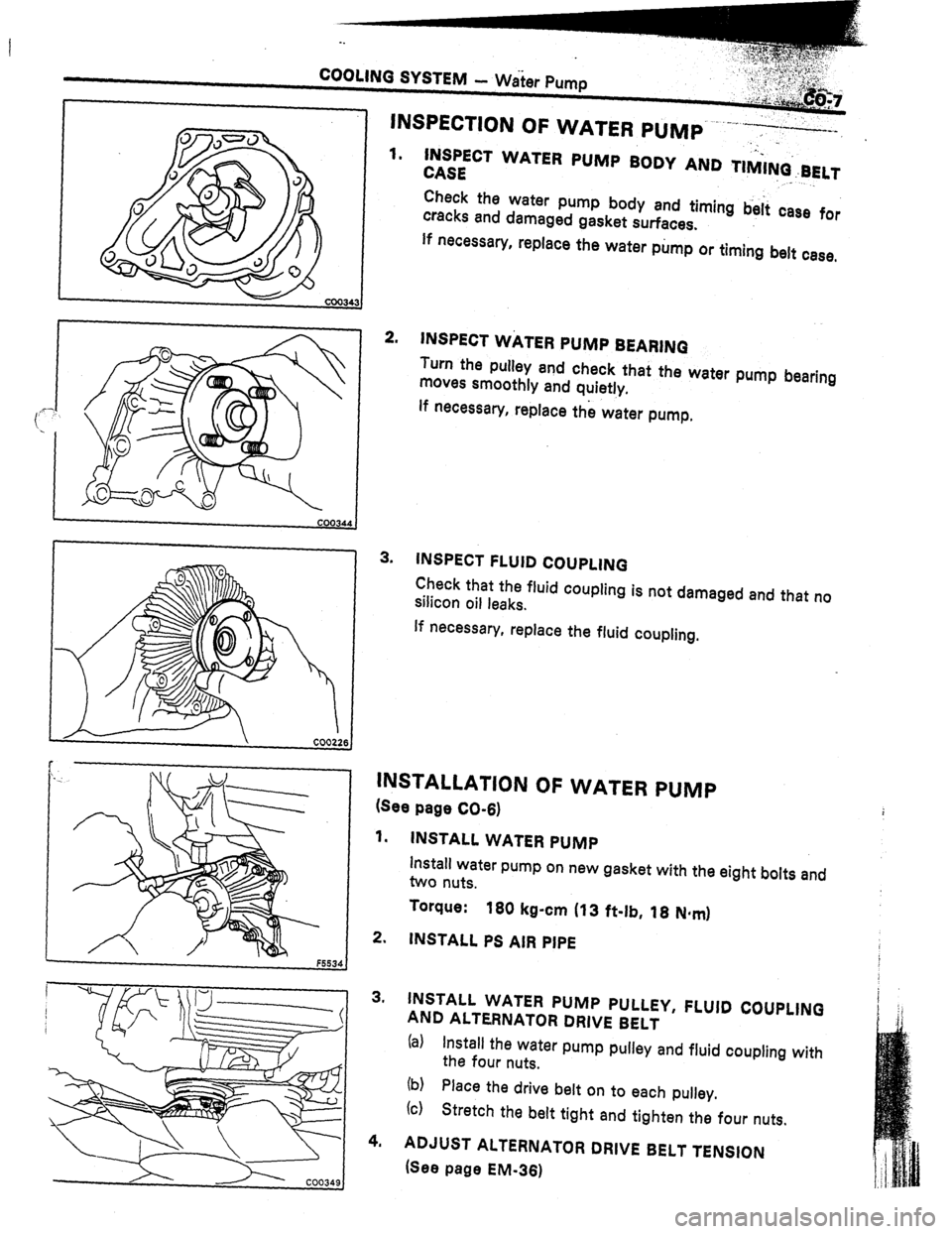
1.
2.
3.
.._ INSPECT WATER PUMP BODY AND TIMI+BELT
CASE ” ._
Check the water pump body and timing b&i case for
cracks and damaged gasket surfaces.
If necessary, replace the water pump or timing belt case,
INSPECT WATER PUMP BEARINQ
Turn the pulley and check that the water pump bearing
moves smoothly and quietly.
lf necessary, replace the water pump,
INSPECT FLUID COUPLING
Check that the fluid coupling is not damaged and that no
silicon oil leaks.
If necessary, replace the fluid coupling.
INSTALLATION OF WATER PUMP
(See page CO-6)
1. INSTALL WATER PUMP
install water pump on new gasket with the eight bolts and
two nuts.
Torque:
160 kg-cm (13 ft-lb, 18 N*mI
2. INSTALL PS AIR PIPE
3. INSTALL WATER PUMP PULLEY, FLUID COUPLING
AND ALTERNATOR DRIVE BELT
(al Install the water pump pulley and fluid coupling with
the four nuts.
(b)
(c) Place the drive belt on to each pulley.
Stretch the belt tight and tighten the four nuts.
4. ADJUST ALTERNATOR DRIVE BELT TENSION
(See page EM-361
Page 47 of 346
EFI SYSTEM - Troubleshdoting
FI-13
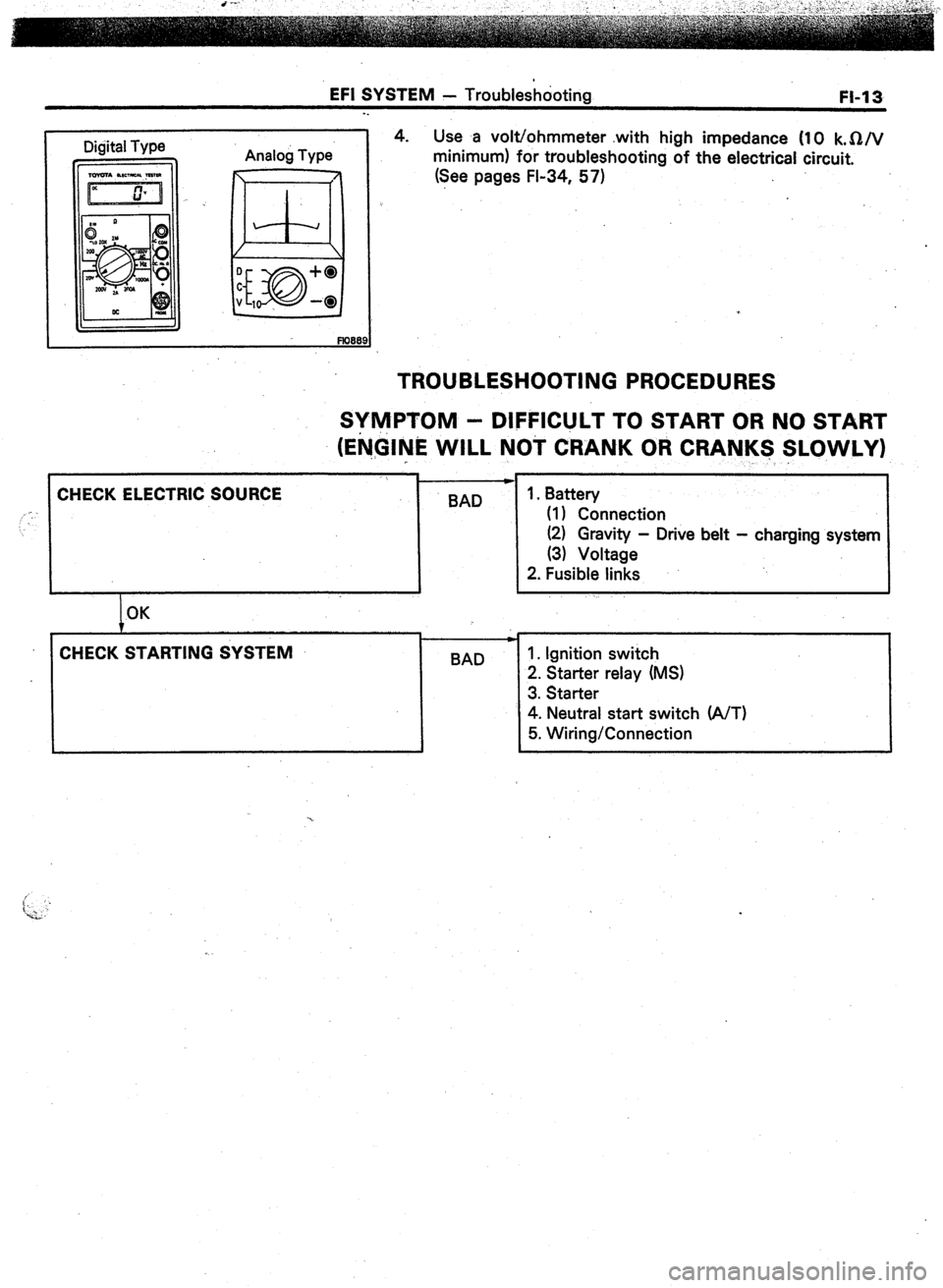
. .
Digital Type
Analog Type 4. Use a volt/ohmmeter .with high impedance (10 k.RN
minimum) for troubleshooting of the electrical circuit.
(See pages FL34, 57)
TROUBLESHOOTING PROCEDURES
SYMPTOM - DIFFICULT TO START OR NO START
(EbIJiiIf)l& WILL NO? CRANK OR CRANK$ SLOWLY)
w
CHECK ELECTRIC SOURCE
BAD 1. Battery
.-
(1) Connection
(2) Gravity - Drive belt - charging system
(3) Voltage
2. Fusible links
OK
CHECK STARTING SYSTEM c
BAD 1. Ignition switch
2. Starter relay (MS)
3. Starter
4. Neutral start switch (A/T)
5. Wiring/Connection
Page 163 of 346
-.
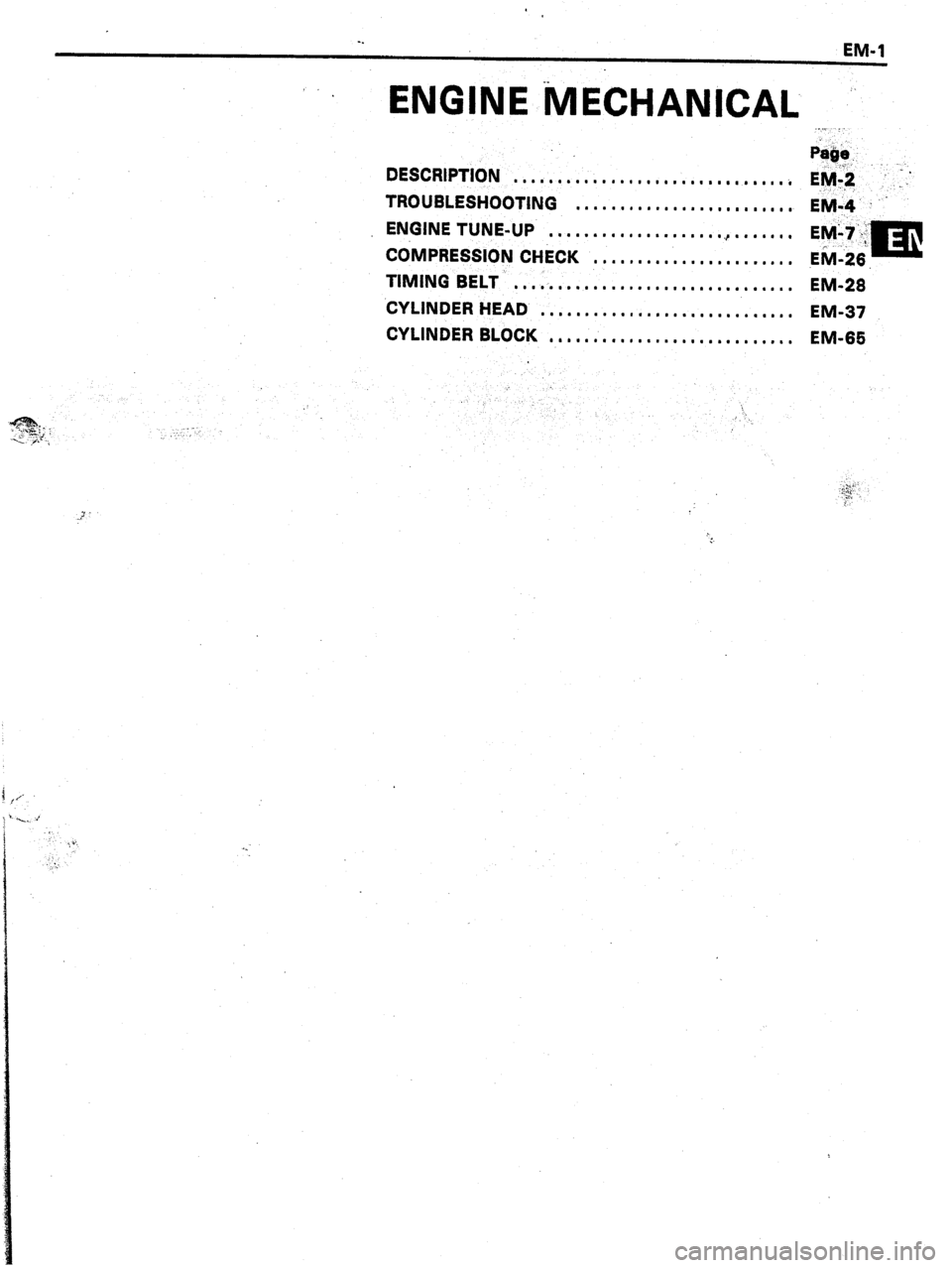
EM-1
I
ENGINE MECHANICAL .’ ../_ :.
F&e.
DESCRIPTION
. . . ..1........111.......~....~.~ E+ -;.’
TROUBLESHOOTING
. . . . . . . . . . . . . . . . n . ma m I. I.
EM-4’ ”
ENGINE TUNE-UP
. . . . . . . . . . . . ..~......~.......
COMPRESSION CHECK
s e . . . . . . . . . . . . . , . . . . . . .
TIMING BELT
,,,..,....................*.*...
EM-28
CYLINDER HEAD
. . . . . . . . . . . . . . ..*............
EM-37
CYLINDER BLOCK
1”1......1...............,..
EM-66
Page 165 of 346
ENGINE MECHANICAL -, Description
EM-3
The 7M-GE, 7M-GTE engines are an in-line 6-
cylinder engine with the cylinders numbered l-2-
3-4-5-6 from the front. The crankshaft is sup-
ported by 7 bearings specified by the inside of the
crankcase. These bearings are made of kelmet.
.The crankshaft is integrated with 8 weights
which are cast along with it for balancing. Oil holes
‘are built into the crankshaft for supplying oil to the
connecting rods, pistons and other components.
These engine’s ignition order is l-5-3-6-2-4 .
The cylinder head is made of aluminum alloy, with
a cross flow type intake and exhaust layout and
with pent roof type combustion chambers. The
spark plugs are located in the center of the com-
bustion chambers.
Exhaust and intake valves are equipped with
irregular pitch springs with symmetrical ends
made of oil tempered silicon chrome steel wire
which are capable of following the valves even at
,high engine speeds.
Both the exhaust side cam shaft and the. intake
side cam shaft are driven by a single timing belt.
The cam journal is supported at 7 places between
the valve lifters of each cylinder and on the
cylinder head of front end. Lubrication of the cam
journal and cam is accomplished by oil being sup-
plied through the oiler port in the center of the
camshaft.
Adjustment of the valve clearance is done by
means of an outer shim type system, in which
valve adjusting shims are located above the valve
lifters. This permits replacement of the shims
without removal of the camshafts.
The resin timing belt cover is made in 2 pieces.
Pistons are made of highly temperature-resis-
tant aluminum alloy, and depressions are built into
the piston head to prevent interference with
valves.
Piston pins are the full-floating type, with the
pins fastened to neither the piston boss nor the
connecting rods. Instead, snap rings are fitted on
both ends of the pins, preventing the pins from
falling out.
The No. 1 compression ring is made of stainless
steel and the No. 2 compression ring is made of
cast iron. The oil ring is made of a combination of
stainless steel. The outer diameter of each piston
ring is slightly larger than the diameter of the
piston
and the flexibility of the rings allows them
to hug the cylinder walls when they are mounted
on the piston. Compression rings No. 1 and No. 2
work to prevent the leakage of gas from the
cylinder and the oil ring works to scrape oil off the
cylinder walls to prevent it from entering the com-
bustion chamber.
The cylinder block is made of cast iron. It has 6
cylinders which are approximately 1.6 times the
length of the piston stroke. The top of the cylin- ders is closed off by the cylinder head and the
lower end of the cylinders becomes the crankcase,
in which the crankshaft is installed. In addition,- the
cylinder block contains a water jacket, through
which coolant is pumped to cool the cylinders.
The .oil pan is bolted onto the botiom of the
cylinder block. The oil pan is an oil reservoir made .
of pressed steel sheet. A dividing plate’is included
-inside the oil pan to keep sufficient oil in the bot-
tom of the pan even when the vehicle is tilted. This
dividing plate also prevent5 the oil from making
waves when the vehicle is stopped suddenly and
thus shifting the oil away from the oil pump suc-
tion pipe.