Page 41 of 346
EFI SYSTEM
- Precautions, Inspection Precautions
FI-7
PRECAUTIONS
._
1. Before working on the fuel system, disconnect the
negative terminal from the battery.
NOTE: Any diagnosis code retained by the computer will
be erased when the battery terminal is removed.
Therefore, if necessary, read the diagnosis before
removimg the battery terminal.
2. Do not smoke or work near an open flame when work-
ing on the fuel system.
3. Keep gasoline off rubber or leather parts.
INSPECTION PRECAUTl.ONS
MAINTENANCE PRECAUTIONS
1. INSURE CORRECT ENGINE TUNE-UP
2. PRECAUTIONS WHEN CONNECTING GAUGE
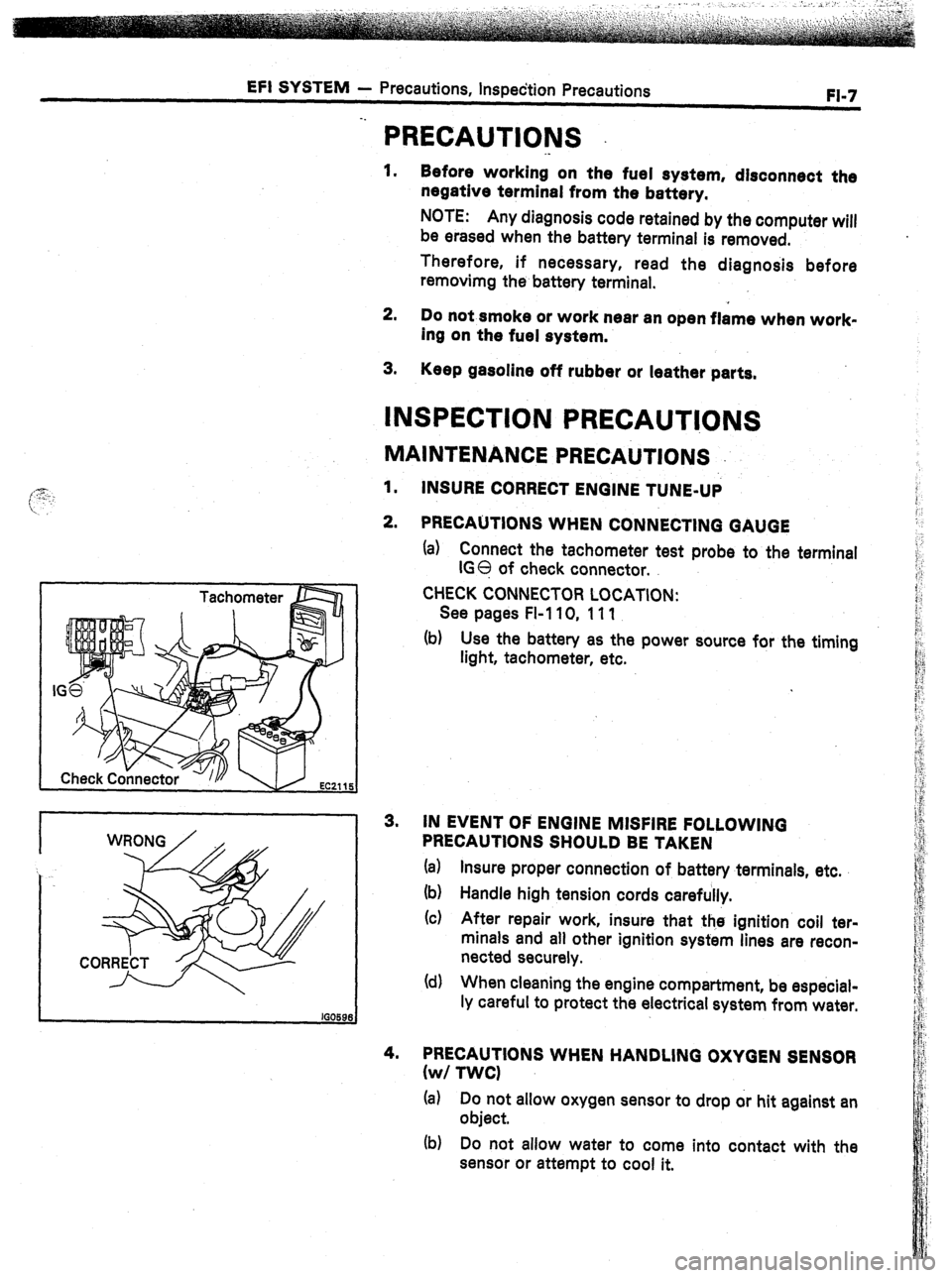
(a) Connect the tachometer test probe to the terminal
IGO of check connector.
CHECK CONNECTOR LOCATION:
See pages FI-110, 111
(b) Use the battery as the power source for the timing
light, tachometer, etc.
3. IN EVENT OF ENGINE MISFIRE FOLLOWING
PRECAUTIONS SHOULD BE TAKEN
(a) Insure proper connection of battery terminals, etc.
(b) Handle high tension cords carefully.
(c) After repair work, insure that the ignition coil ter-
minals and all other ignition system lines are recon-
nected securely.
(d) When cleaning the engine compartment, be especial-
ly careful to protect the electrical system from water.
4. PRECAUTIONS WHEN HANDLING OXYGEN SENSOR
(w/ TWCI
(a) Do not allow oxygen sensor to drop or hit against an
object.
(b) Do not allow water to come into contact with the
sensor or attempt to cool it.
Page 45 of 346
EFI SYSTEM
- inspection Precautions
FI-11
I CORRECT i
Gro
Q * Delivery
Ring pipe
*
Black Ring
Delivew
Pipe -
O-Ring
-Grommet
3.
4.
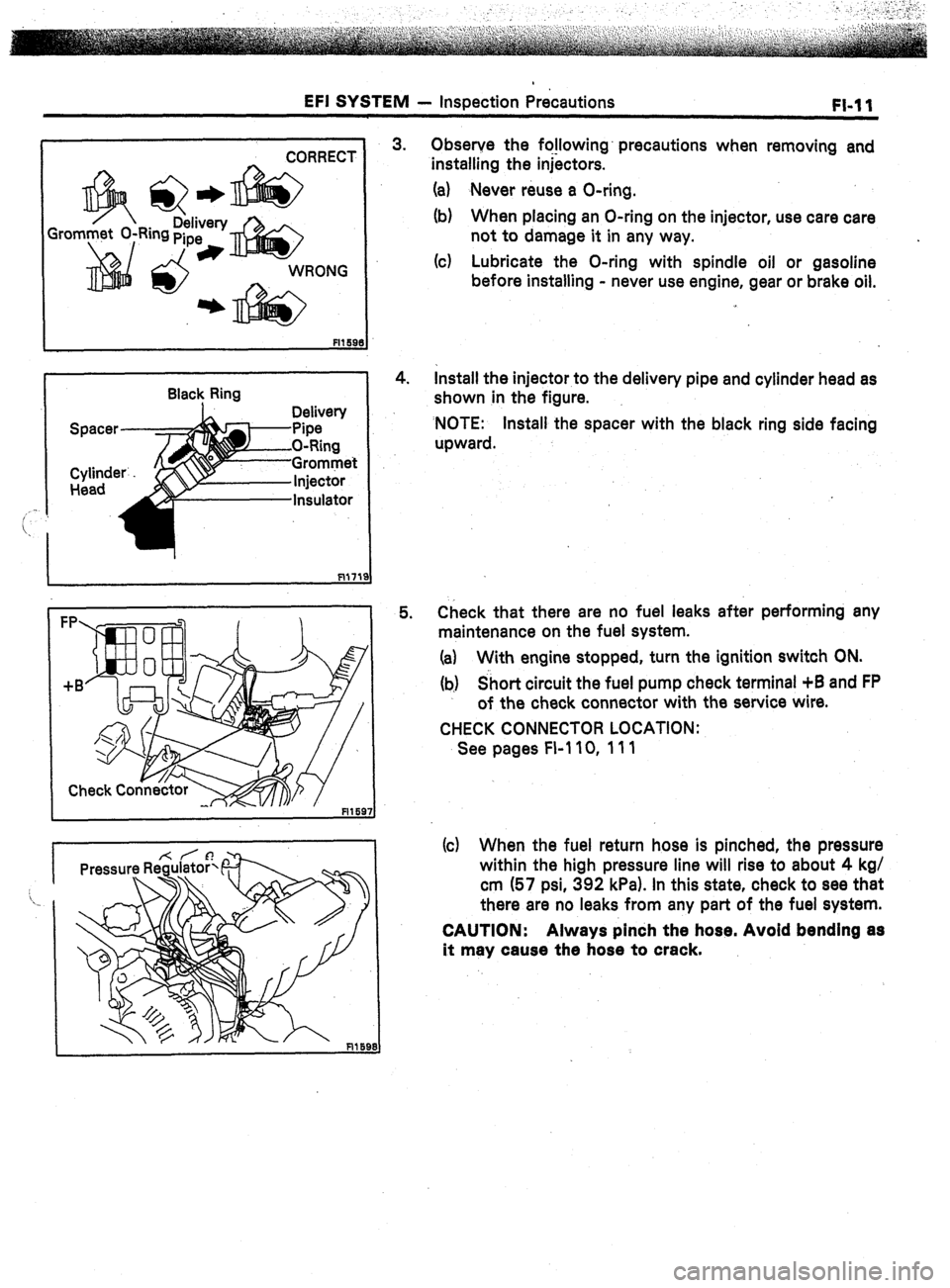
5. Observe the fo!lowing’ precautions when removing and
installing the injectors.
(a) Never reuse a O-ring.
(b) When placing an O-ring on the injector, use care care
not to damage it in any way.
(c) Lubricate the O-ring with spindle oil or gasoline
before installing - never use engine, gear or brake oil.
Install the injector to the delivery pipe and cylinder head as
shown in the figure.
‘NOTE: Install the spacer with the black ring side facing
upward.
Check that there are no fuel leaks after performing any
maintenance on the fuel system.
(a) With engine stopped, turn the ignition switch ON.
(b) Short circuit the fuel pump check terminal +B and FP
of the check connector with the service wire.
CHECK CONNECTOR LOCATION:
See pages FI-110, 111
(c) When the fuel return hose is pinched, the pressure
within the high pressure line will rise to about 4 kg/
cm (57 psi, 392 kPa). In this state, check to see that
there are no leaks from any part of the fuel system.
CAUTION: Always pinch the hose. Avoid bending as
it may cause the hose to crack.
Page 46 of 346
1-12 EFI SYSTEM - Troubleshooting’
FlO48
TROUBLESH~~TI~~G
. .
TROUBLESHOOTING HlhJTS
1. Engine troubles are usually not caused by the EFI system.
When troubleshooting, always first check the condition of
the other systems.
(a) Electronic source
0 Battery
0 Fusible links
0 Fuses
(b) Body ground
(cl Fuel supply
0 Fuel leakage
0 Fuel filter
0 Fuel pump
(d) Ignition system
0 Spark plug
0 High-tension cord
l Distributor (7M-GE) or cam position sensor (7M-
GTE)
0 Igniter and ignition coil
(e) Air induction system
0 Vacuum leaks
(f) Emission control system
0 PCV system
0 EGR system (w/ EGR)
(g) Others
l Ignition timing (ESA system)
0 Idle speed (ISC system)
-r
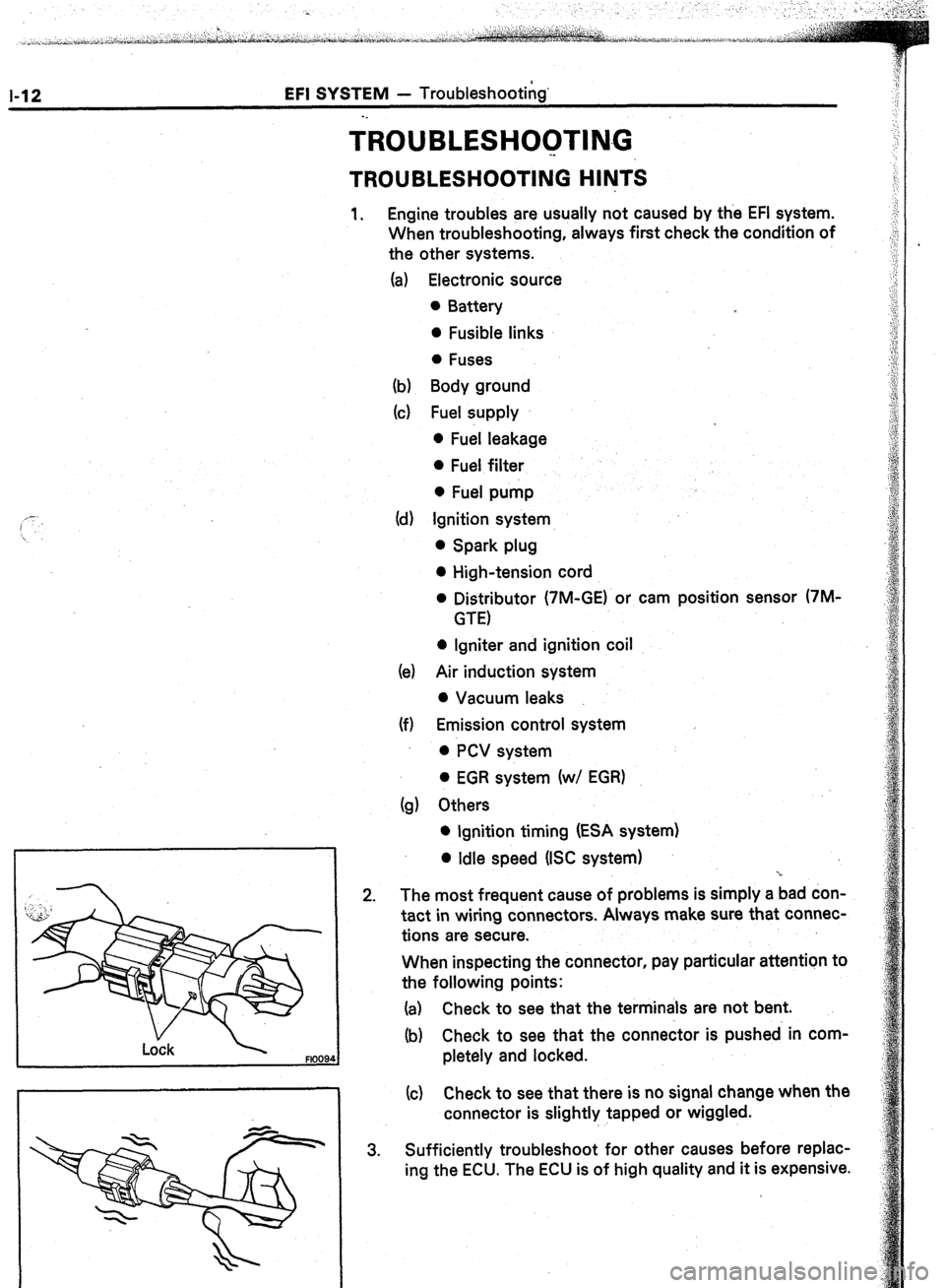
2. The most frequent cause of problems is simply a bad don-
tact in wiring connectors. Always make sure that connec-
tions are secure.
When inspecting the connector, pay particular attention to
the following points:
(a) Check to see that the terminals are not bent.
(b) Check to see that the connector is pushed in com-
pletely and locked.
(c) Check to see that there is no signal change when the
connector is slightly tapped or wiggled.
3. Sufficiently troubleshoot for other causes before replac-
ing the ECU. The ECU is of high quality and it is expensive.
Page 48 of 346
EFI SYSTEM - Troubleshootina
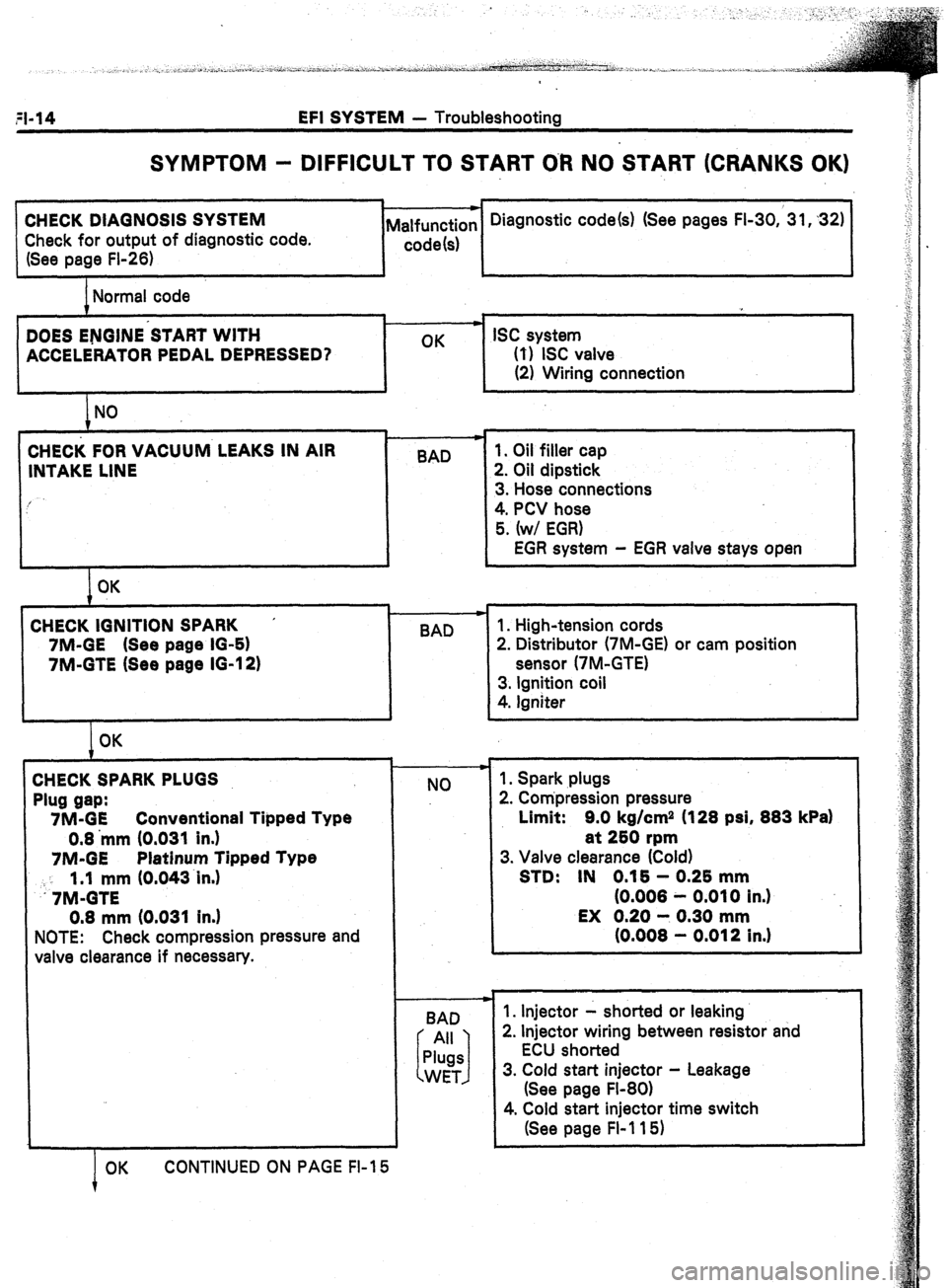
SYMPTOM - DIFFICULT TO START O-R NO START (CRANKS OK)
CHECK DIAGNOSIS SYSTEM
Check for output of diagnostic code.
(See page FI-26) Diagnostic code(s) (See pages FI-30,‘31,32)
Normal code
DOES ENGINE’START WITH
ACCELERATORPEDALDEPRESSED? OK ISC system
0) ISC valve
(2) Wiring connection
i NO I
CHECK FOR VACUUM LEAKS IN AIR I
BAD
INTAKE LINE
I OK
CHECK IGNITION SPARK ’
7M-GE (See page IO-61
7M-GTE (See page IG-12)
t OK
CHECKSPARKPLUGS
Plug gap:
7M-GE Conventional Tipped Type
0.8 ‘mm (0.031 In.)
7M-GE Platinum Tipped Type
: : 1.1 mm (0.043~in.)
.7M-GTE
0.8 mm (0.031 In.)
NOTE: Check compression pressure and
valve clearance if necessary.
OK CONTINUED ON PAGE FI-15
!
I
.
BAD 1. Oil filler cap
2. Oil dipstick
3. Hose connections
4. PCV hose
5. (w/ EGR)
EGR system - EGR valve stays open
1. High-tension cords
2. Distributor (‘IM-GE) or cam position
sensor (7M-GTE)
3. Ignition coil
4. Igniter
+
NO
BAD 1. Spark plugs
2. Compression pressure
Limit: 9.0 kg/cm2 (128 psi, 883 kPa)
at 250 rpm
3. Valve clearance (Cold)
STD: IN 0.16 - 0.25 mm
(0.008 - 0.010 in.)
EX 0.20 - 0.30 mm
(0.008 - 0.012 in.1
1. Injector - shorted or leaking
2. Injector wiring between resistor and
ECU shorted
3. Cold start injector - Leakage
(See page Fl-80)
4. Cold start injector time switch
(See page Fl-115)
Page 50 of 346
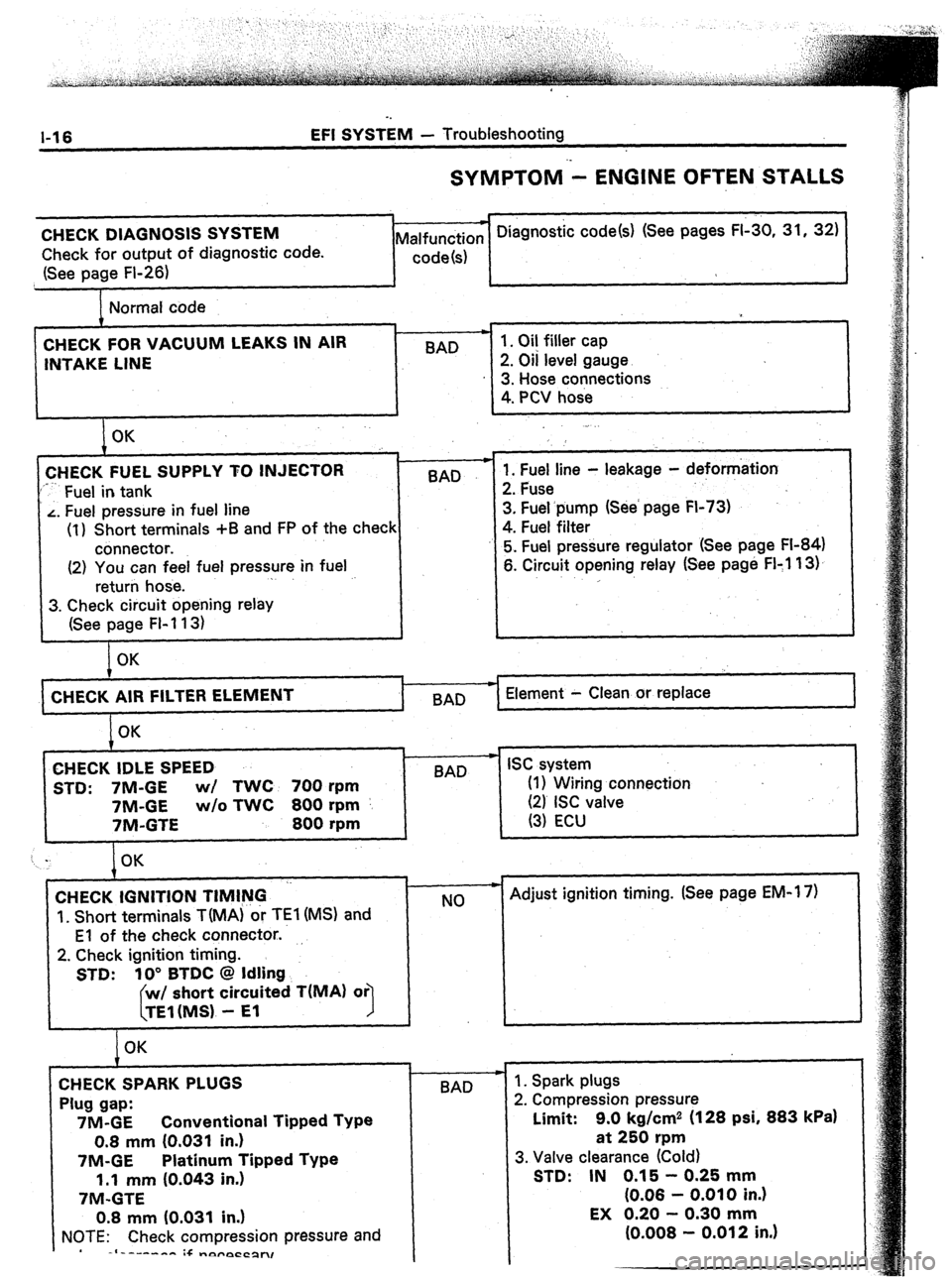
l-16 EFI SYSTEM - Troubleshooting
SYMPTOM - ENGINE OFTEN STALLS
CHECK DIAGNOSIS SYSTEM
Check for output of diagnostic code.
(See page Fl-26) * Diagnostic code(s) (See pages FI-30, 31, 32)
Malfunction
code(s)
Normal code
CHECK FOR VACUUM LEAKS IN AIR
INTAKE LINE BAD 1. Oil filler cap
2. Oil level gauge
3. Hose connections
4. PCV hose
I OK
CHECK FUEL SUPPLY TO INJECTOR
‘*-- Fuel in tank BAD
L. Fuel pressure in fuel line
(1) Short terminals +B and FP of the check
connector.
(2) You can feel fuel pressure in fuel
return hose. .
3. Check circuit opening relay
(See page FI-113) .
1. Fuel line - leakage - deformation
2. Fuse
3. Fuel.pump (See’ page FI-73)
4. Fuel filter
5. Fuel pressure regulator (See page FI-84)
6. Circuit opening relay (See page FI:1 13).
,
OK
CHECK AIR FILTER
I BAD Element - Clean or replace
OK
CHECK IDLE SPEED
STD: 7M-GE wl TWC 700 rpm
7M-GE w/o TWC 800 rpm
7M-GTE 800 rpm
t w
BAD ISC system
(I 1 Wiring connection
(21 ISC valve
(3) ECU
CHECK IGNITION TIMING ‘-
‘I. Short terminals TiMA) or TEl (MS) and
El of the check connector..
2. Check ignition timing.
STD: 10” BTDC @ Idling
short circuited T(MA) or
1
OK
CHECK SPARK PLUGS
Plug gap:
7M-GE Conventional Tipped Type
0.8 mm (0.031 in.)
7M-GE Platinum Tipped Type
1.1 mm (0.043 in.)
7M-GTE
0.8 mm (0.031 in.)
NOTE: Check compression pressure and
-I------- :+ -nyrpCCpn, c
NO
-I-
BAD - Adjust ignition timing. (See page EM-1 7)
1. Spark plugs
2. Compression pressure
Limit: 9.0 kg/cm2 (128 psi, 883
kPa)
at 250 rpm
3. Valve clearance (Cold)
STD: IN 0.15 - 0.25 mm
(0.06 - 0.010 in.)
Page 51 of 346
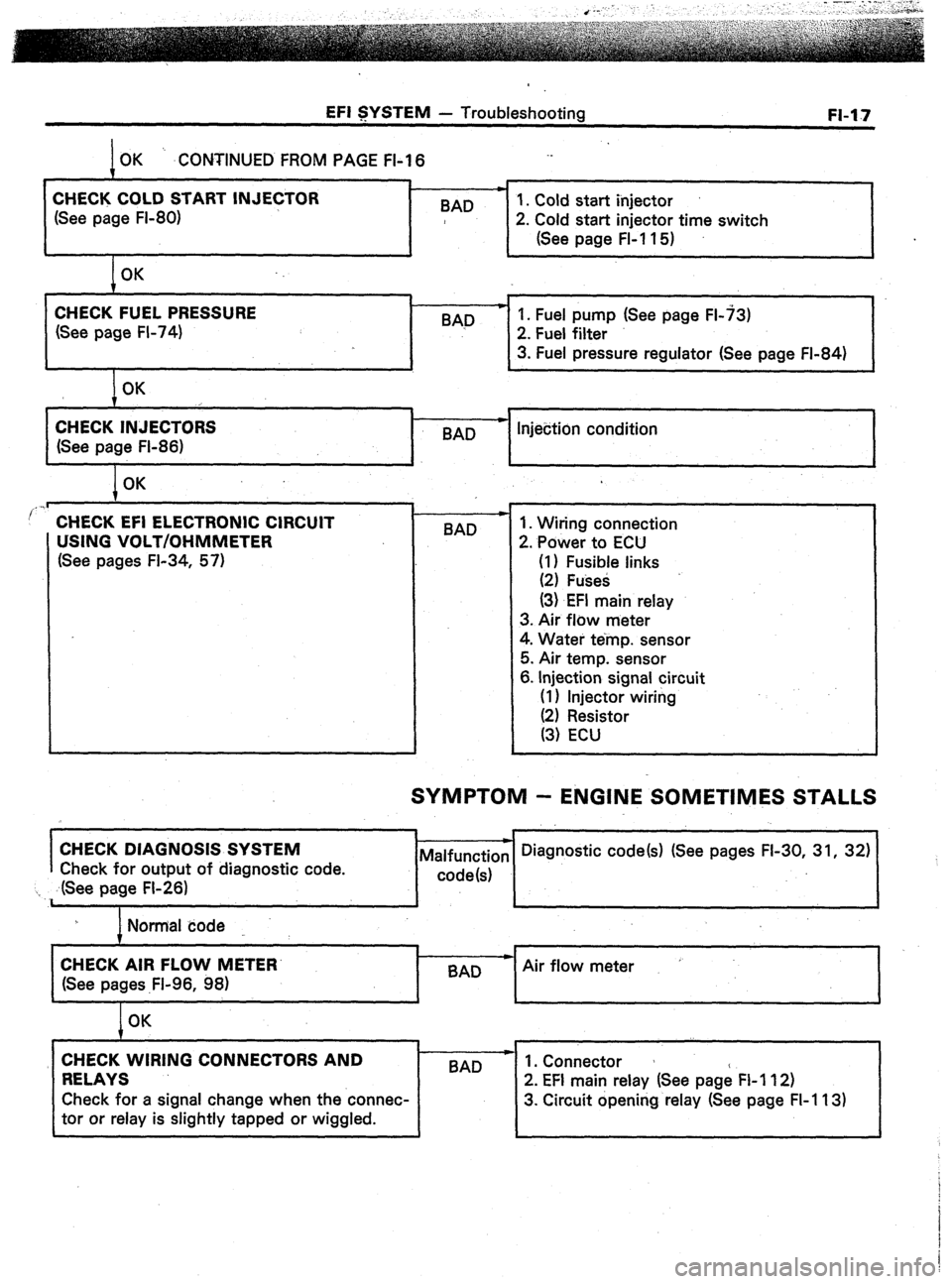
EFI SYSTEM - Troubleshooting
OK ‘. .CONTINUED FROM PAGE FI-I 6
m
CHECK COLD START INJECTOR
1. Cold start injector
(See page FI-80) BAD
2. Cold start injector time switch
(See page FL11 5)
OK FI-17
CHECK FUEL PRESSURE
(See page FI-74) BAD p 1. Fuel pump (See page FL73)
2. Fuel filter
3. Fuel pressure regulator (See page FI-84)
OK
CHECK INJECTORS
(See page FI-86) c
-
BAD Injection condition
I OK
..I
’ CHECK EFI ELECTRONIC CIRCUIT
USING VOLT/OHMMETER
(See pages FI-34, 57) BAD 1. Wiring connection
2. Power to ECU
(I) Fusible links
(2) Fuses
(3) EFI main relay
3. Air flow meter
4. Water temp. sensor
5. Air temp. sensor
6. Injection signal circuit
(I 1 Injector wiring
SYMPTOM - ENGINE SOMETIMES STALLS
I
CHECK DIAGNOSIS SYSTEM
Check for output of diagnostic code.
‘I ,. ,dSee page FI-26)
I Normal code
I
CHECK AIR FLOW METER’
Air flow meter
(See pages .Fl-96, 98)
I
OK
CHECK WIRING CONNECTORS AND
RELAYS 1 BAD --
2’ EFI main relay (See page FI 112)
Check for a signal change when the connec- 3. Circuit opening relay (See page FI-113)
tor or relay is slightly tapped or wiggled.
Page 54 of 346
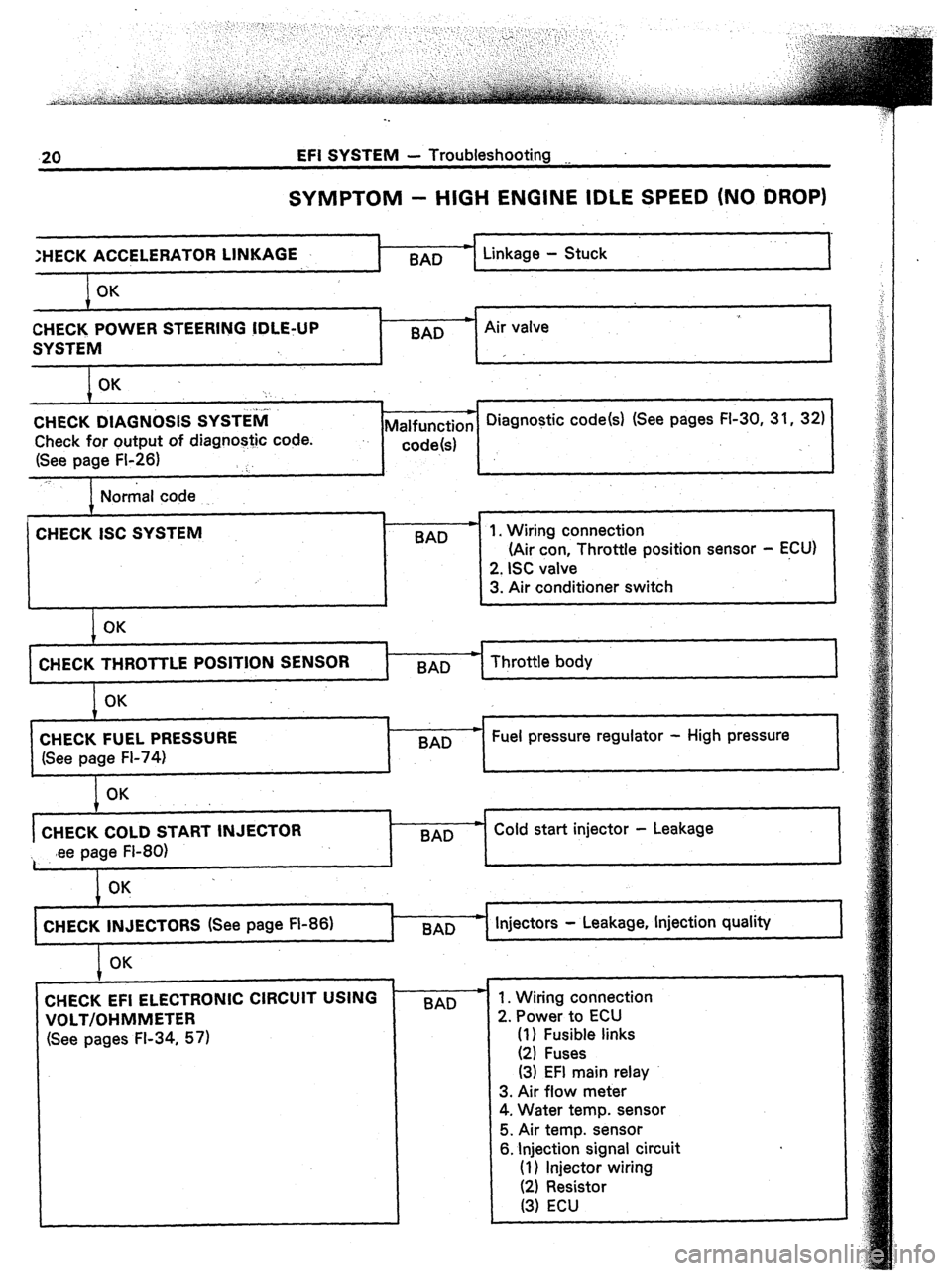
.20 EFI SYSTEM - Troubleshooting __
SYMPTOM - HIGH ENGINE IDLE SPEED (NO DROP)
:HECK ACCELERA
OK
CHECK POWER STEERING !DLE+JP
SYSTEM
OK .
‘:
j..l.
CHECK DIAGNOSIS SYSTEM
Check for output of diagnostic code.
(See page FI-26) ‘:.
_T I Linkage - Stuck
I
9
BAD * Air valve
I
r
* Diagnostic code(s) (See pages FI-30, 31, 32)
Malfunction
..
code!s)
Normal code
.
CHECK ISC SYSTEM
BAD
I
OK
71
(Air con Throttle posrtron sensor - ECU)
1 CHECK THROTTLE POSITION SENSOR
t-x- Throttle body
OK
CHECK FUEL PRESSURE
(See page FI-74) 7
BAD w Fuel pressure regulator - High pressure
OK
CHECK COLD START INJECTOR
~ .ee page FI-80) BAD w Cold start injector - Leakage
CHECK INJECTORS (See page FI-86)
I Injectors - Leakage, Injection quality
I OK
CHECK EFI ELECTRONIC CIRCUIT USING
VOLT/OHMMETER
(See pages FI-34, 57) BAD - 1. Wiring connection
2. Power to ECU
(1) Fusible links
(2) Fuses
(3) EFI main relay
3. Air flow meter
4. Water temp. sensor
5. Air temp. sensor
6. Injection signal circuit
(1) Injector wiring
(2) Resistor
(3) ECU
Page 55 of 346
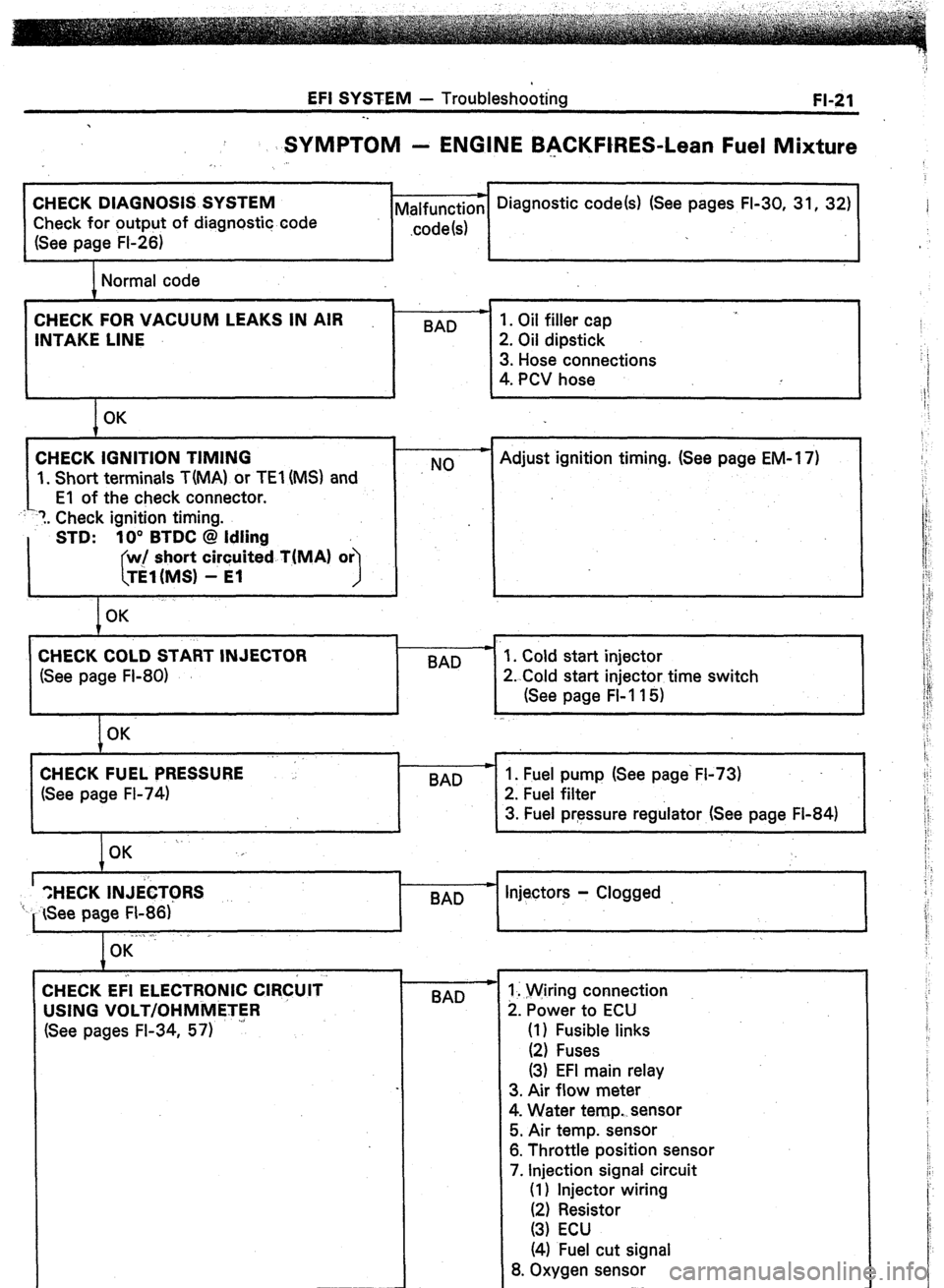
EFI SYSTEM - Troubleshooting
FI-21
-.
SYMPTOM - ENGINE BACKFtRES-Lean Fuel Mixture
CHECK DIAGNOSIS SYSTEM
Check for output of diagnostic code
(See page FI-26) Malfunction --) Diagnostic code(s) (See pages FI-30, 31, 32)
.code 1s) j
,
Normal code
CHECK FOR VACUUM LEAKS IN AIR
INTAKE LINE
1. Short terminals T(MA) or TEl (MS) and BAD -
NO 1. Oil filler cap
2. Oil dipstick
3. Hose connections
4. PCV hose
Adjust ignition timing. (See page EM-1 7)
1. Cold start injector
2. Cold start injector time switch
(See page FI-115)
CHECK FUEL PRESSURE
(See page FI-74)
I
I
BAD 1. Fuel pump (See page‘ FI-73)
2. Fuel filter
3. Fuel pressure regulator (See page Fl-84)
I
’ “,HECK INJib
‘I- See page FI-86)’ - Injectors - Clogged
BAD
. ., .l
I OK
CHECK Eii ELECTRONIC ClR&lT
USING VOLT/OHMMETER
(See pages FI-34, 57)
4
BAD 1. Wiring connection
2. Power to ECU
(1) Fusible links
(2) Fuses
(3) EFI main relay
3. Air flow meter
4. Water temp. sensor
5. Air temp. sensor
6. Throttle position sensor
7. Injection signal circuit
(1) Injector wiring
Ii, zesstor
(4) Fuel cut signal
8. Oxygen sensor