1987 PORSCHE 944 coolant temperature
[x] Cancel search: coolant temperaturePage 39 of 66
When the engine is cold, the coolant level
should reach the minimum mark on the
expansion tank. When the engine is warm, the coolant level will be above the minimum mark. Since the closed cooling system loses almost
no coolant, topping up is normally not
required. An obvious loss of coolant indicates
leakage. In this case contact your dealer.
WARNING
Do not open the filler cap when the engine is hot because of the danger of
scalding. Allow the engine to cool down.
Protect your hands, arms and face.
Using a thick rag, open the cap carefully and only enough to allow excess
pressure to escape before removing the
cap.
To avoid damage to the engine, only add
cold antifreeze and cold water
to the cooling system when the engine is also cold. A warm engine should only be topped up if the coolant level has dropped appreciably below
the minimum mark. Too much added coolant
will escape through the pressure cap when coolant warms up.
If more than about 1.06 U.S qt or 1 liter must
be added, the cooling system should be bled.
Winter operation At the beginning of the winter season, have the coolant checked for anti-freeze
concentration.
The ratio between water and anti-freeze
necessary to prevent freezing depends on the
anticipated outside temperatures. The ratios
can be taken from the mixing chart listed
under "Filling Capacities" or from the container of the antifreeze manufacturer.
Increasing the anti-freeze in the coolant
further than shown on the container is not
only uneconomical, it is also detrimental to engine cooling.
75
944 Draining the coolant
Engine must be cold
1. Move temperature control lever to "warm".
2.
Remove filler cap from expansion tank.
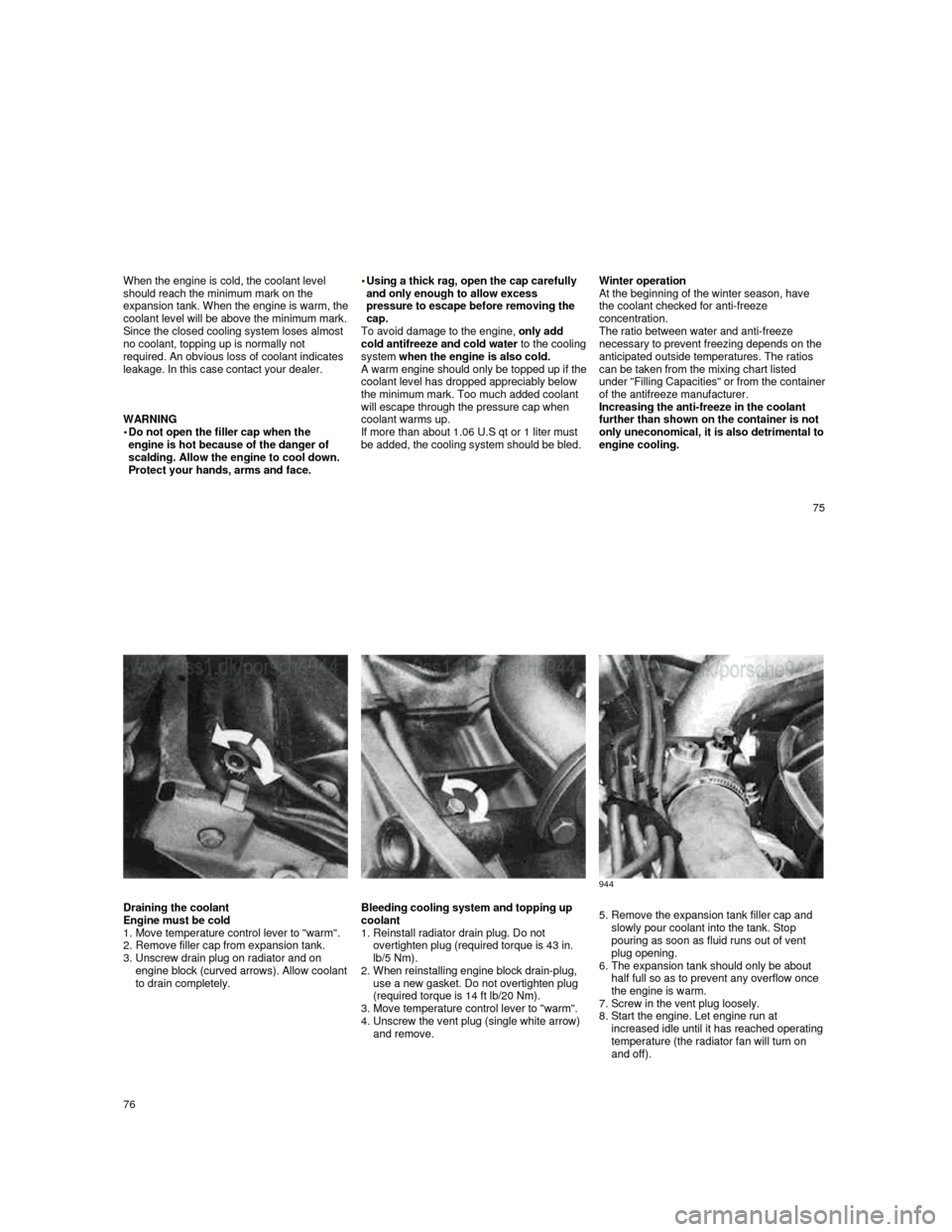
3. Unscrew drain plug on radiator and on engine block (curved arrows). Allow coolant to drain completely.
Bleeding cooling system and topping up
coolant
1. Reinstall radiator drain plug. Do not overtighten plug (required torque is 43 in.
lb/5 Nm).
2.
When reinstalling engine block drain-plug,
use a new gasket. Do not overtighten plug
(required torque is 14 ft lb/20 Nm).
3.
Move temperature control lever to "warm".
4. Unscrew the vent plug (single white arrow)
and remove.
5. Remove the expansion tank filler cap and
slowly pour coolant into the tank. Stop
pouring as soon as fluid runs out of vent
plug opening.
6.
The expansion tank should only be about
half full so as to prevent any overflow once
the engine is warm.
7.
Screw in the vent plug loosely.
8. Start the engine. Let engine run at increased idle until it has reached operating temperature (the radiator fan will turn on
and off).
76
Page 42 of 66
944
5. Press together the housing cover with the air intake funnel (944 Turbo) and carefully
place in position. Tighten fastening screws,
connect hose and screw down hose clamp.
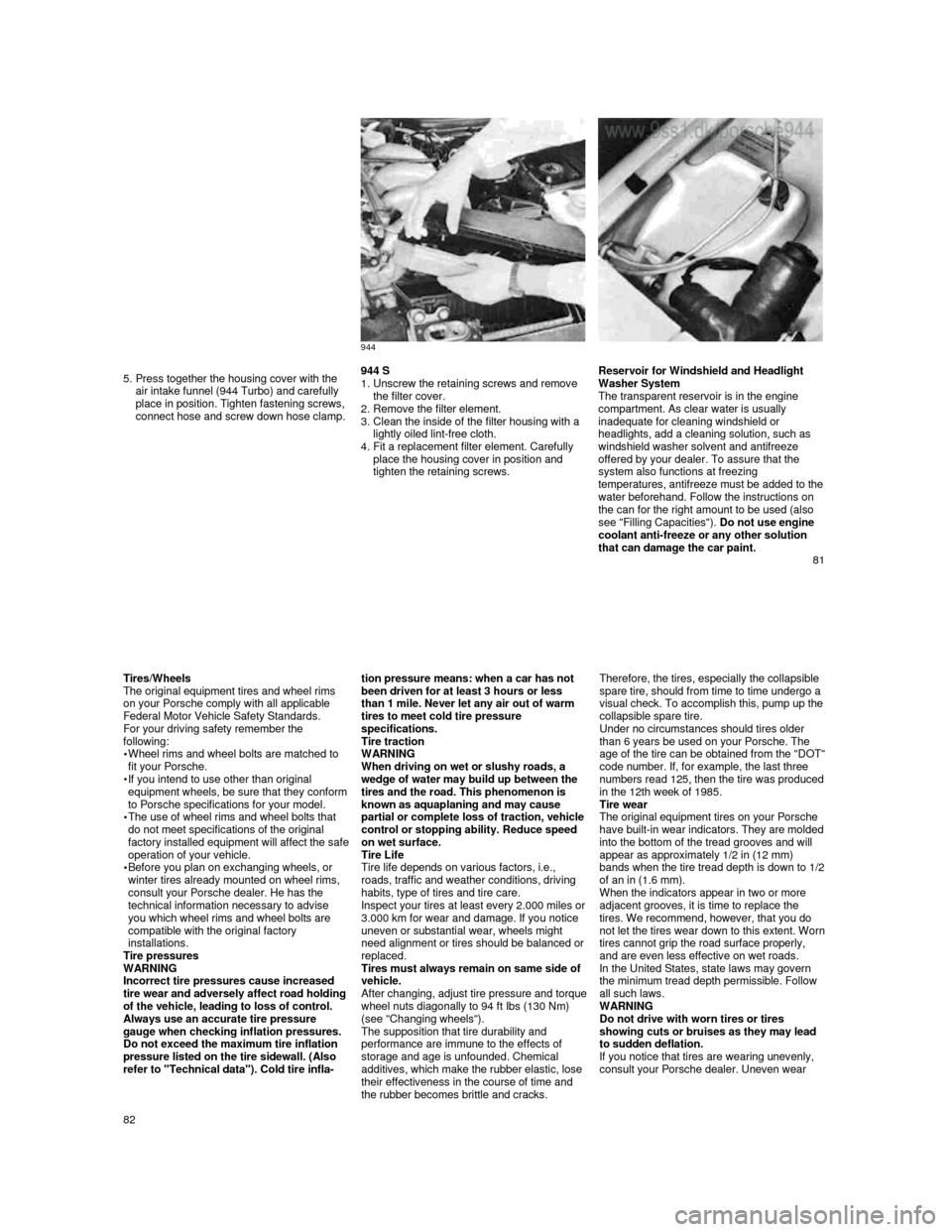
944 S
1. Unscrew the retaining screws and remove
the filter cover.
2.
Remove the filter element.
3. Clean the inside of the filter housing with a
lightly oiled lint-free cloth.
4.
Fit a replacement filter element. Carefully
place the housing cover in position and
tighten the retaining screws.
Reservoir for Windshield and Headlight
Washer System
The transparent reservoir is in the engine
compartment. As clear water is usually
inadequate for cleaning windshield or
headlights, add a cleaning solution, such as
windshield washer solvent and antifreeze offered by your dealer. To assure that the
system also functions at freezing
temperatures, antifreeze must be added to the water beforehand. Follow the instructions on the can for the right amount to be used (also
see "Filling Capacities"). Do not use engine
coolant anti-freeze or any other solution
that can damage the car paint.
81
Tires/Wheels
The original equipment tires and wheel rims
on your Porsche comply with all applicable
Federal Motor Vehicle Safety Standards.
For your driving safety remember the
following:
Wheel rims and wheel bolts are matched to
fit your Porsche.
If you intend to use other than original equipment wheels, be sure that they conform to Porsche specifications for your model. The use of wheel rims and wheel bolts that
do not meet specifications of the original
factory installed equipment will affect the safe operation of your vehicle. Before you plan on exchanging wheels, or winter tires already mounted on wheel rims, consult your Porsche dealer. He has the
technical information necessary to advise
you which wheel rims and wheel bolts are
compatible with the original factory
installations.
Tire pressures
WARNING
Incorrect tire pressures cause increased
tire wear and adversely affect road holding of the vehicle, leading to loss of control.
Always use an accurate tire pressure
gauge when checking inflation pressures.
Do not exceed the maximum tire inflation
pressure listed on the tire sidewall. (Also
refer to "Technical data"). Cold tire infla-
tion pressure means: when a car has not been driven for at least 3 hours or less
than 1 mile. Never let any air out of warm
tires to meet cold tire pressure
specifications.
Tire traction
WARNING
When driving on wet or slushy roads, a
wedge of water may build up between the
tires and the road. This phenomenon is
known as aquaplaning and may cause
partial or com
plete loss of traction, vehicle control or stopping ability. Reduce speed
on wet surface.
Tire Life
Tire life depends on various factors, i.e.,
roads, traffic and weather conditions, driving
habits, type of tires and tire care.
Inspect your tires at least
every 2.000 miles or 3.000 km for wear and damage. If you notice
uneven or substantial wear, wheels might
need alignment or tires should be balanced or
replaced.
Tires must always remain on same side of
vehicle.
After changing, adjust tire pressure and torque wheel nuts diagonally to 94 ft Ibs (130 Nm) (see "Changing wheels").
The supposition that tire durability and
performance are immune to the effects of
storage and age is unfounded. Chemical
additives, which make the rubber elastic, lose
their effectiveness in the course of time and
the rubber becomes brittle and cracks.
Therefore, the tires, especially the collapsible
spare tire, should from time to time undergo a
visual check. To accomplish this,
pump up the collapsible spare tire.
Under no circumstances should tires older
than 6 years be used on your Porsche. The
age of the tire can be obtained from the "DOT" code number. If, for example, the last three
numbers read 125, then the tire was produced in the 12th week of 1985.
Tire wear
The original equipment tires on your Porsche
have built-
in wear indicators. They are molded into the bottom of the tread grooves and will
appear as approximately 1/2 in (12 mm)
bands when the tire tread depth is down to
1/2 of an in (1.6 mm).
When the indicators appear in two or more
adjacent grooves, it is time to replace the
tires. We recommend, however, that you do
not let the tires wear down to this extent. Worn tires cannot grip the road surface properly,
and are even less effective on wet roads.
In the United States, state laws may govern
the minimum tread depth permissible. Follow
all such laws.
WARNING
Do not drive with worn tires or tires
showing cuts or bruises as they may lead
to sudden deflation.
If you notice that tires are wearing unevenly,
consult your Porsche dealer. Uneven wear
82
Page 53 of 66
Fuel Evaporation Control
Fuel Tank Venting
The expansion chamber and the roll over valve prevent fuel from escaping to the outside at
extreme high outside temperatures and when
the car is driven or parked at an incline or in
any other nonlevel position. The safety valve
works as a restrictor in the tank vent line between the expansion chamber and the
canister.
Vapor Control System and Storage
When the fuel tank is filled, vapors are
collected in the expansion chamber and filler
tube by a vent l
ine leading the vapors via a roll over valve to the activated carbon canister where they are stored as long as the engine does not run. During engine operation, the
vapors are stored in the activated carbon
canister as long as the control valve I
(ON/OFF valve) is in the OFF-position.
The control valve I stops purging of the
canister during all other operating conditions of the engine if the coolant temperature of the
engine is below a defined temperature.
Purge System
Fuel vapors from the carbon canister will be
mixed with fresh air taken from the ambient
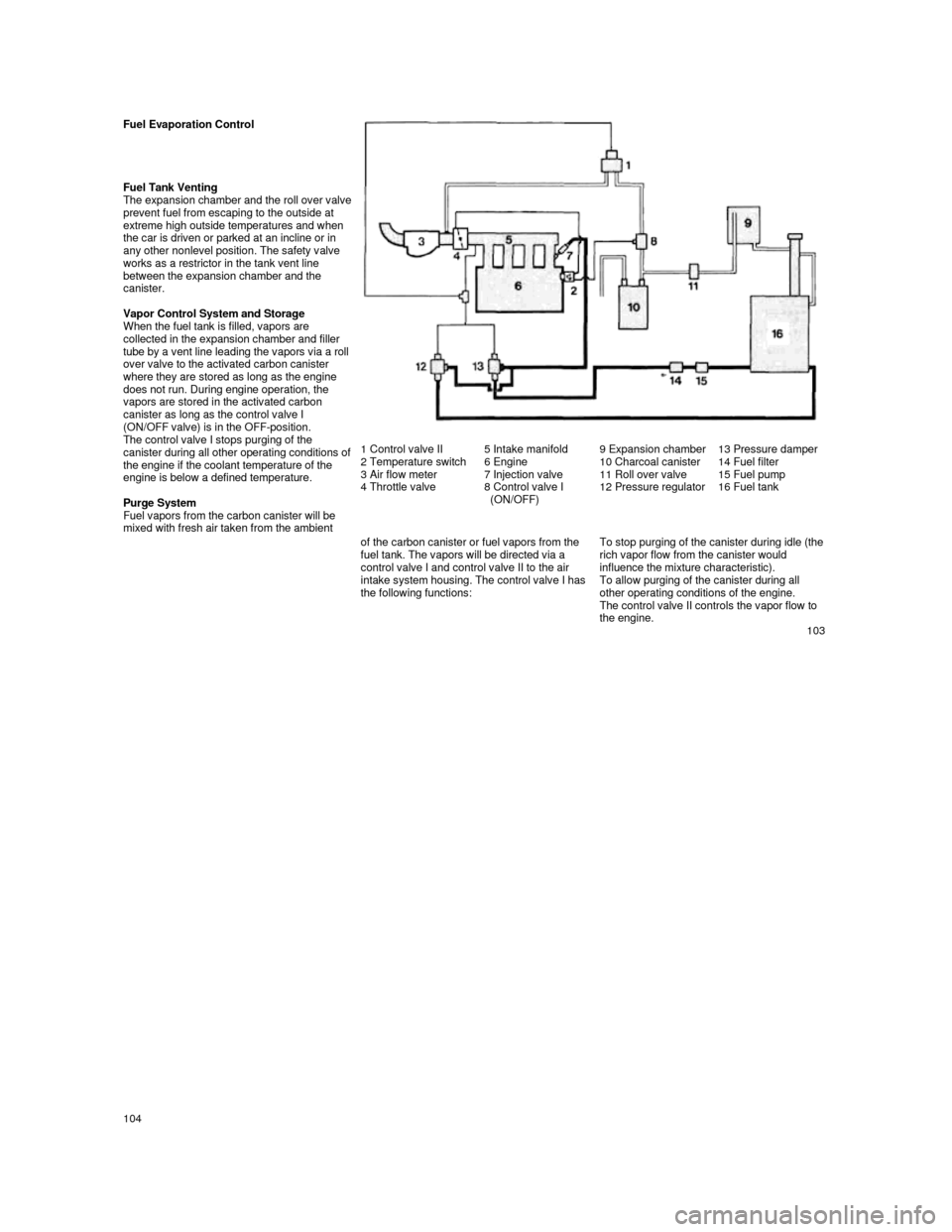
1 Control valve II
2 Temperature switch
3 Air flow meter
4 Throttle valve 5 Intake manifold
6 Engine
7 Injection valve
8 Control valve I
(ON/OFF) 9 Expansion chamber
10 Charcoal canister
11 Roll over valve
12 Pressure regulator
13 Pressure damper 14 Fuel filter
15 Fuel pump
16 Fuel tank
of the carbon canister or fuel vapors from the
fuel tank. The vapors will be directed via a
control valve I and control valve II to the air
intake system housing. The control valve I has the following functions:
To stop purging of the canister during idle (the rich vapor flow from the canister would
influence the mixture characteristic).
To allow purging of the canister during all
other operating conditions of the engine.
The control valve II controls the vapor flow to
the engine.
103
http://www.9ss1.dk/porsche944
104
Page 65 of 66
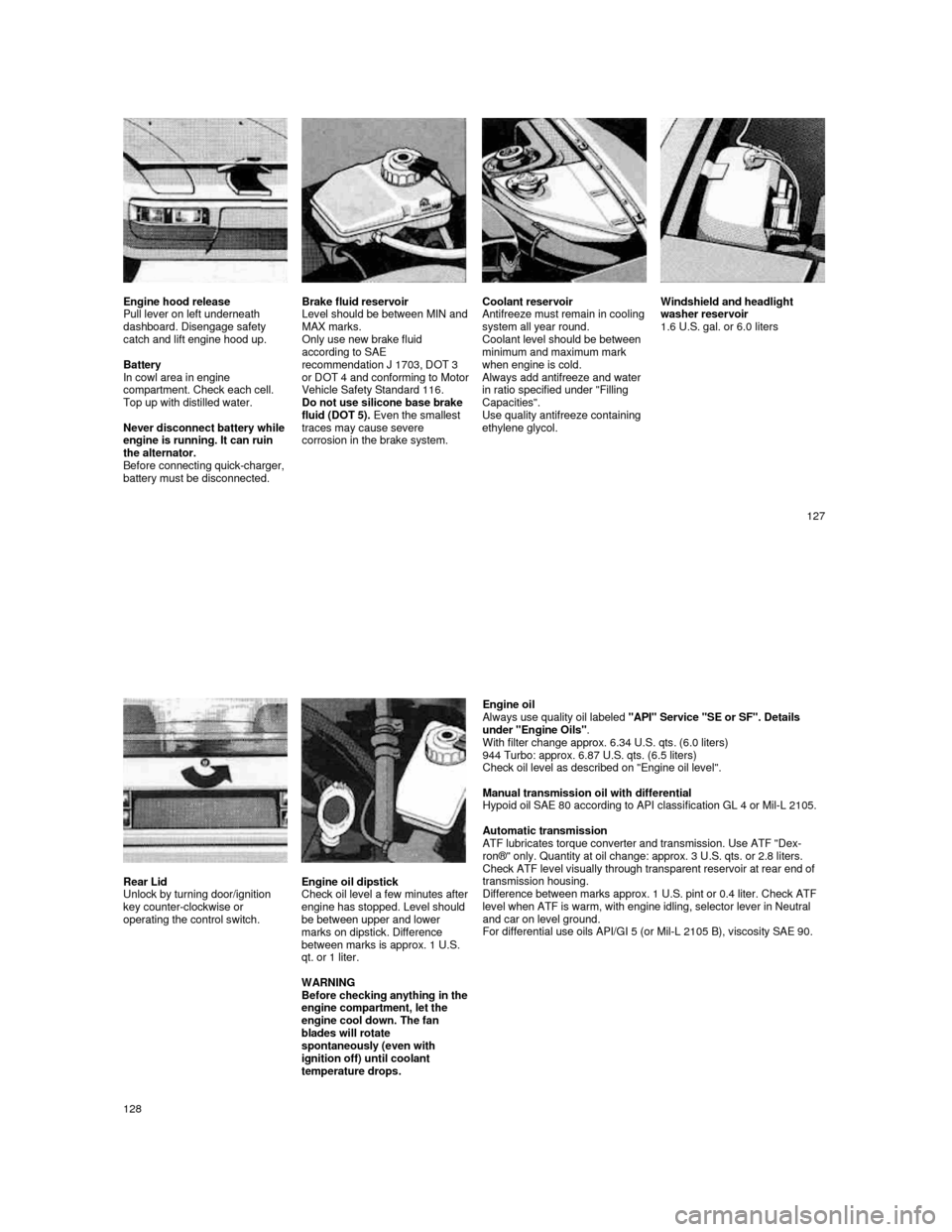
Engine hood release
Pull lever on left underneath
dashboard. Disengage safety
catch and lift engine hood up.
Battery
In cowl area in engine
compartment. Check each cell.
Top up with distilled water.
Never disconnect battery while
engine is running. It can ruin
the alternator.
Before connecting quick-charger,
battery must be disconnected. Brake fluid reservoir
Level should be between MIN and MAX marks.
Only use new brake fluid
according to SAE
recommendation J 1703, DOT 3
or DOT 4 and conforming to Motor Vehicle Safety Standard 116.
Do not use silicone base brake
fluid (DOT 5). Even the smallest
traces may cause severe
corrosion in the brake system.
Coolant reservoir
Antifreeze must remain in cooling
system all year round.
Coolant level should be between
minimum and maximum mark
when engine is cold. Always add antifreeze and water in ratio specified under "Filling
Capacities".
Use quality antifreeze containing
ethylene glycol.
Windshield and headlight
washer reservoir
1.6 U.S. gal. or 6.0 liters
127
Rear Lid
Unlock by turning door/ignition
key counter-clockwise or
operating the control switch.
Engine oil dipstick
Check oil level a few minutes after engine has stopped. Level should
be between upper and lower
marks on dipstick. Difference
between marks is approx. 1 U.S.
qt. or 1 liter.
WARNING
Before checking anything in
the engine compartment, let the
engine cool down. The fan
blades will rotate
spontaneously (even with
ignition off) until coolant
temperature drops.
Engine oil Always use quality oil labeled "API" Service "SE or SF". Details
under "Engine Oils" .
With filter change approx. 6.34 U.S. qts. (6.0 lite rs)
944 Turbo: approx. 6.87 U.S. qts. (6.5 liters)
Check oil level as described on "Engine oil level".
Manual transmission oil with differential
Hypoid oil SAE 80 according to API classification G L 4 or Mil-L 2105.
Automatic transmission
ATF lubricates torque converter and transmission. U se ATF "Dex-
ron®" only. Quantity at oil change: approx. 3 U.S. qts. or 2.8 liters.
Check ATF level visually through transparent reserv oir at rear end of
transmission housing.
Difference between marks approx. 1 U.S. pint or 0.4 liter. Check ATF
level when ATF is warm, with engine idling, selecto r lever in Neutral
and car on level ground.
For differential use oils API/GI 5 (or Mil-L 2105 B ), viscosity SAE 90.
128