Page 100 of 284

8-80 CHARGING SYSTEM - Service Adjustment Procedures
Ignition
switch Alternator
Voltmeter
I
lid-hi! @ Ammeter e Load
6EK52
(5) Disconnect the alternator output wire from the alternator “B”
terminal.
(6) Connect a DC ammeter (0 to 100 A) in series between the “B”
terminal and the disconnected output wire. Connect the (+I
lead of the ammeter to the “B” terminal and connect the (-1
lead wire to the disconnected output wire.
(7) Set the engine tachometer and connect the battery ground
cable.
Test
(1) Turn on the ignition switch and-check that the voltmeter indi-
cates the following value.
Voltage : Battery voltage
If it reads 0 V, there is an open circuit in the wire between the
alternator “S” terminal and the battery (+) or the fusible link
is blown.
(2) Start the engine. Keep all lights and accessories off.
(3) Run the engine at a speed of about 2500 rpm and read the
voltmeter when the alternator output current drops to 10 A or
less.
Result
(1) If the voltmeter reading agrees with the value listed in the
regulating voltage table below, the voltage regulator is func-
tioning correctly. If the reading is other than the standard
value, the voltage regulator or the alternator is faulty.
Regulating voltage table
Voltage regulator ambient Regulating voltage V
temperature “C (“F)
-20 (-4) 14.2-15.4
20 (68) 13.9-14.9
60 (140) 13.4-14.6
80 (176) 13.1-14.5
1 STB Revision
Page 101 of 284

CHARGING SYSTEM - Service Adjustment Procedures 8-81
(2) Upon completion of the test, set the engine speed at idle and
turn off the ignition switch.
(3) Disconnect the battery ground cable.
(4) Remove the test voltmeter and ammeter and the engine ta-
chometer.
(5) Connect the alternator output wire to the alternator “B” ter-
minal.
(6) Connect the battery ground cable.
ll3Y1848 2. Remove battery from vehicle.
Caution
White
I Blue
I Care should be taken in the event battery case is cracked
or leaking to protect hands from the electrolyte. A suit-
able pair of rubber gloves (not the household type) should
be worn when removing battery by hand.
3. Inspect battery carrier for damage caused by loss of acid from
battery. If acid damage is present, it will be necessary to clean
area with a solution of clean warm water and baking soda.
Scrub area with a stiff bristle brush and wipe off with a cloth
moistened with ammonia or baking soda in water.
4. Clean top of battery with same solutions as described in Step
(3).
INSPECTION OF BATTERY NOBEIBA
VISUAL INSPECTION OF BATTERY (1)
The batten/ contains a visual test indicator which gives blue signal
when an adequate charge level exists, and white signal when
charging is required.
VISUAL INSPECTION OF BAlTERY (2)
Make sure ignition switch is in Off position and all battery feed
accessories are Off.
1. Disconnect ground cable from battery before disconnecting
(+) cable.
5. Inspect battery case and cover for cracks. If cracks are
present, battery must be replaced.
6. Clean the battery post with a suitable battery post cleaning
tool.
7. Clean the inside surfaces of the terminal clamps with a suit-
able battery terminal cleaning tool. Replace damaged or frayed
cables and broken terminals clamps.
8. Install the battery in vehicle.
9. Connect (+) and (-) cables to battery in the order of mention.
10. Tighten the clamp nut securely.
1 STB Revision
Page 102 of 284
8-82 CHARGING SYSTEM - Service Adjustment Procedures
BATTERY CHARGING NOEEICDZ
Caution
When batteries are being charged, an explosive gas forms
beneath the cover of each cell. Do not smoke near batteries
on charge or which have recently been charged. Do not
break live circuits at the terminals of the batteries on
charge. A spark will occur where the live circuit is broken.
Keep all open flames away from the battery.
Battery electrolyte temperature may temporarily be allowed to
rise to 55°C (131°F). Increase of electrolyte temperature above
55°C (131°F) is harmful to the battery, causing deformation of
battery cell, decrease in life of battery, etc.
CHARGE RATE
If the test indicator is white, the battery should be charged as
outlined below.
When the dot appears or when maximum charge shown
below is reached, charging should be stopped.
NOTE
If the indicator does not turn to blue even after the battery is
charged, the battery should be replaced; do not overcharge.
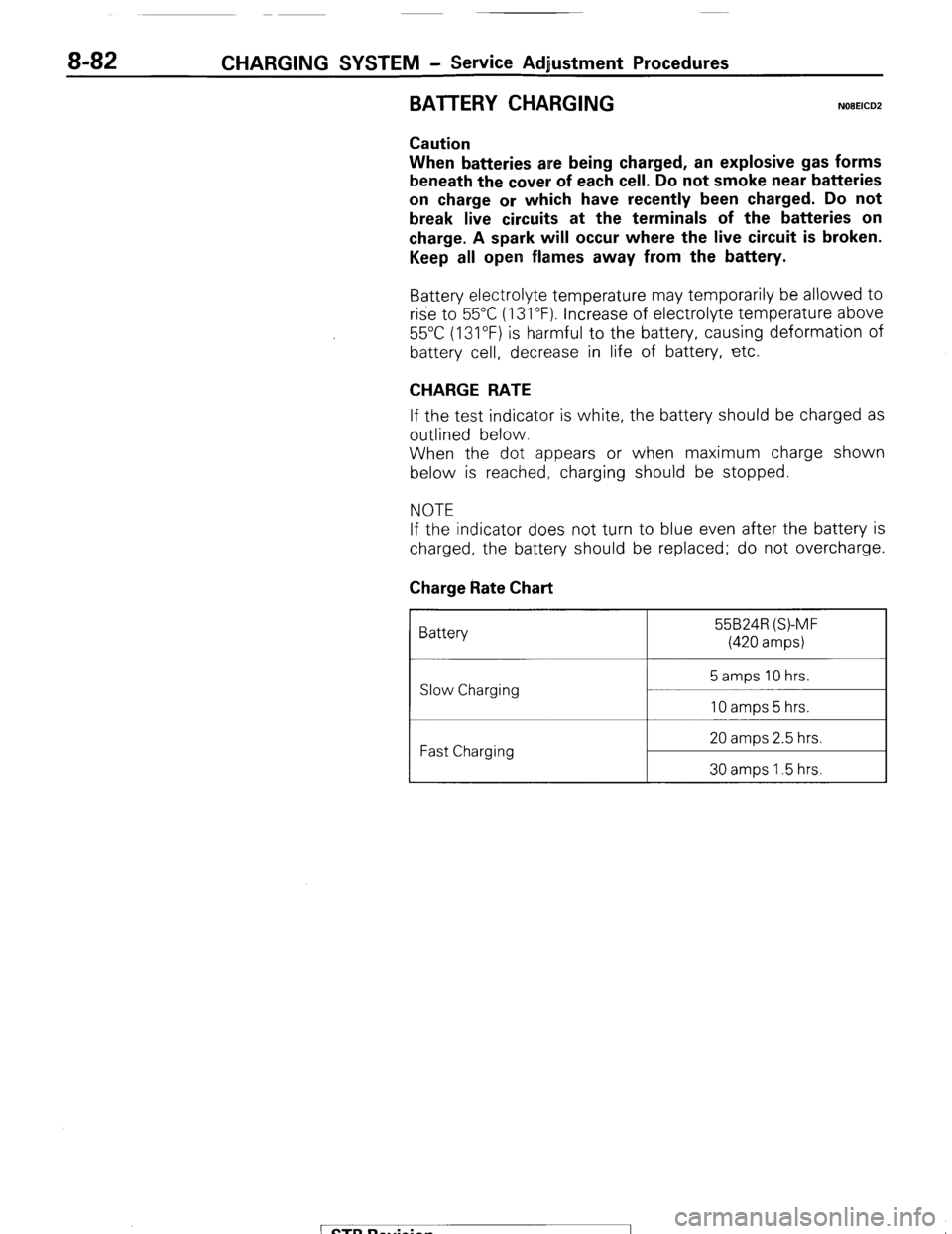
Charge Rate Chart
Battery 55B24R (S)-MF
(420 amps)
Slow Charging
Fast Charging 20 amps 2.5 hrs.
30 amps 1.5 hrs.
/ STB Revision
Page 111 of 284

STARTING SYSTEM-General Information 8-91
STARTING SYSTEM
GENERAL INFORMATION
NOBFAAJ
The electrical circuit of the starter system consists of battery, starter motor, solenoid switch, ignition switch,
inhibitor switch, connecting wire and battery cable.
In the starter system and electrical circuit, electricity flows to activate the coils of the starter motor solenoid when
the ignition switch is turned to the start position. In so doing, the solenoid plunger and clutch shift lever move, the
clutch pinion engages with the ring gear and then the solenoid contacts shut and the starter motor cranks.
As soon as the engine begins to run and, in order to prevent damage due to over-revolution by the armature starter,
the running clutch pinion gear over-rides, Thus in order not to cause damage to the starter motor once the engine
is running, the ignition switch must be immediately turned back to the ON position.
The starter motor is the reduction-drive type, and is compact and lightweight.
Inhibiter switch
-
I lEL151
1 STB Revision
Page 114 of 284

8-94 STARTING SYSTEM -Troubleshooting
TROUBLESHOOTING NOFH-
Symptom
Engine will not crank
Engine cranks slowly
Starter keeps running
Starter spins but en-
Jine will not crank Probable cause Remedy Reference
paw
Battery charge low Check battery specific gravity 8-81
,
I Charge or replace battery 8-82
Battery cables loose, corroded or worn Repair or replace cables 8-81
__~
Inhibitor Switch faulty Adjust or replace switch Refer to
(Vehicle with automatic transmission only) GROUP 21.
Fusible link blown
Replace fusible link 8-69
Starter motor faulty
Repair starter motor 8-97
Ignition switch faulty Replace ignition switch 8-l 22
Battery charge low Check battery specific gravity 8-8 1
Charge or replace battery 8-82
Battery cables loose, corroded or worn
Repair or replace cables 8-8 1
Starter motor faulty Repair starter motor 8-97
Starter motor faulty Repair starter motor 8-97
Ignition switch faulty
Replace ignition switch 8-l 22
I
Short in wiring
Repair wiring -
Pinion gear teeth broken or starter motor Repair starter motor 8-97
faulty
Ring gear teeth broken Replace flywheel ring gear or Refer to
torque converter GROUP 9.
1 STB Revision
-7
Page 116 of 284
8-96 STARTING SYSTEM - Circuit Diagram
(VEHICLES WITH AN AUTOMATIC TRANSMISSION)
I
Sub fusible link
A-23 (IGN . SW)
_ 5-WI-754 1
0.5-G 1, 1,
L-l m 1 L-W
Battery Ignition switch
c-47
2-BY-Z-BY*2
N P
!-BY Z-BY1 (Z-BY*]
L-l
R BY BY
“I “2
Remark
For information concerning the ground points (example:
q ),
refer to P.8-7.
Wiring color code
B: Black
Br: Brown
G: Green
Gr: Gray L: Blue
LI: Light blue
0: Orange P: Pink Lg: Light green
R: Red
Y: Yellow
W: White
STB Revision
Page 117 of 284
STARTING WSTEM - Starter Motor 8-97
STARTER MOTOR
REMOVAL AND INSTALLATION NOBFJAE
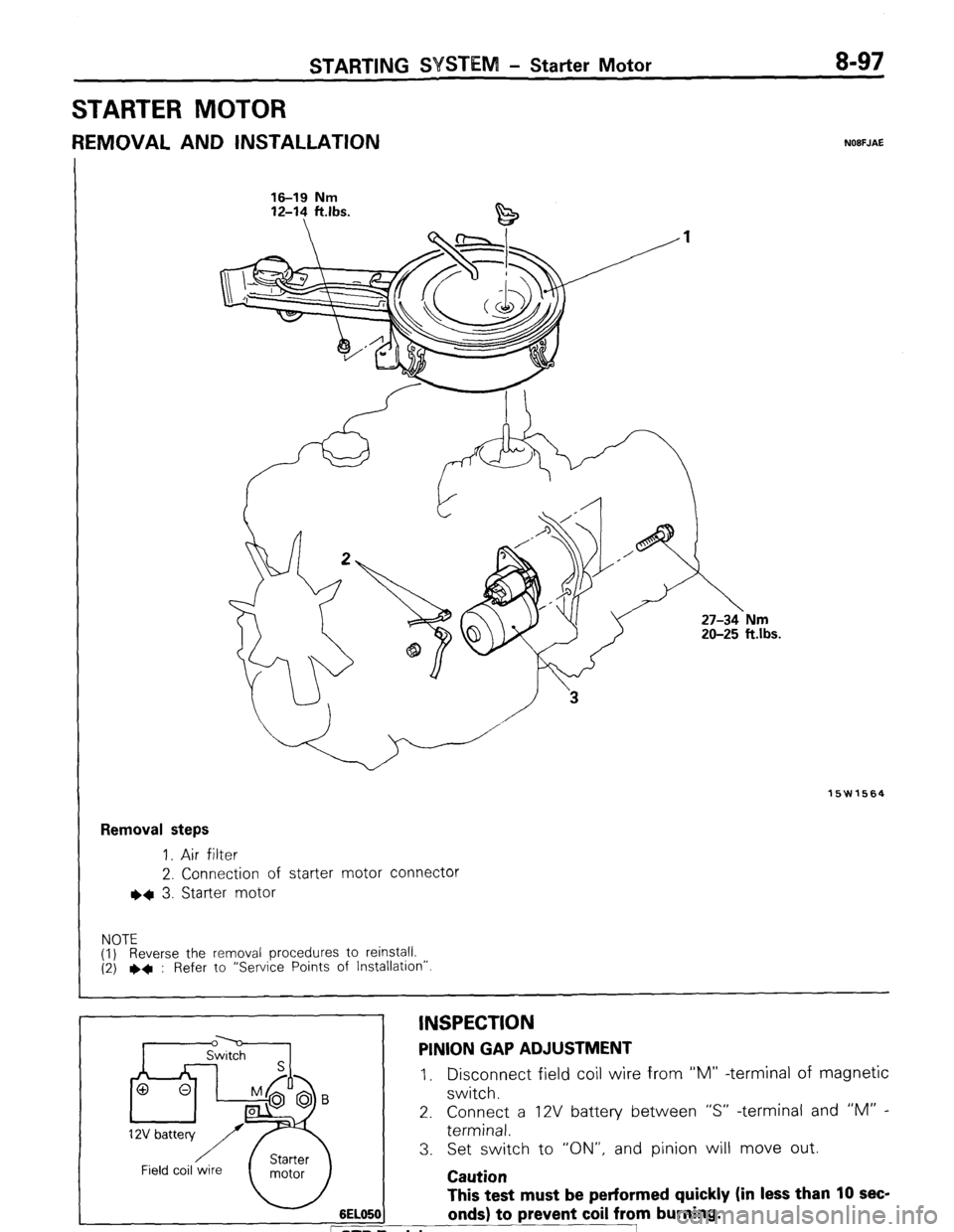
16-19 Nm 16-19 Nm
12-l? ft.lbs. 12-14 ft.lbs.
15W1564
Removal steps
1. Air filter
2. Connection of starter motor connector
l * 3. Starter motor
NOTE
(1) Reverse the removal procedures to reinstall.
(2) ++ : Refer to “Service Points of Installation”
6EL05( This test must be performed quickly (in less than 10 sec-
onds) to prevent coil from burning. D Revision
INSPECTION PINION GAP ADJUSTMENT
I, Disconnect field coil wire from “M” -terminal of magnetic
switch.
2. Connect a 12V battery between “S” -terminal and “M” -
terminal.
3. Set switch to “ON”, and pinion will move out.
Caution
Page 118 of 284

8-98 STARTING SYSTEM -Starter Motor
Pinion
6EL003
lEL113
/ Field coil wire
Field coil wire
4. Check pinion to stopper clearance (pinion gap) with a feeler
gauge.
Standard value : 0.5-2.0 mm (.020-.079 in.)
5. If pinion gap is out of specification, adjust by adding or remov-
ing gaskets between magnetic switch and front bracket.
PULL-IN TEST OF MAGNETIC SWITCH
1. Disconnect field coil wire from M-terminal of magnetic switch.
2. Connect a 12V battery between S-terminal and M-terminal.
Caution
This test must be performed quickly (in less than 10 sec-
onds) to prevent coil from burning.
3. If pinion moves out, then pull-in coil is good. If it doesn’t,
replace magnetic switch.
HOLD-IN TEST OF MAGNETIC SWITCH
1.
2. Disconnect field coil wire from M-terminal of in;ignetic switch.
Connect a 12V battery between S-terminal and body.
Caution
This test must be performed quickly (in less than 10 sec-
onds) to prevent coil from burning.
3. If pinion remains out, everything is in order. If pinion moves in,
hold-in circuit is open. Replace magnetic switch.
1 ST6 Revision