Page 195 of 284
WIPER AND WASHER SYSTEM - Rear Wiper 8-175
SERVICE POINTS OF REMOVAL
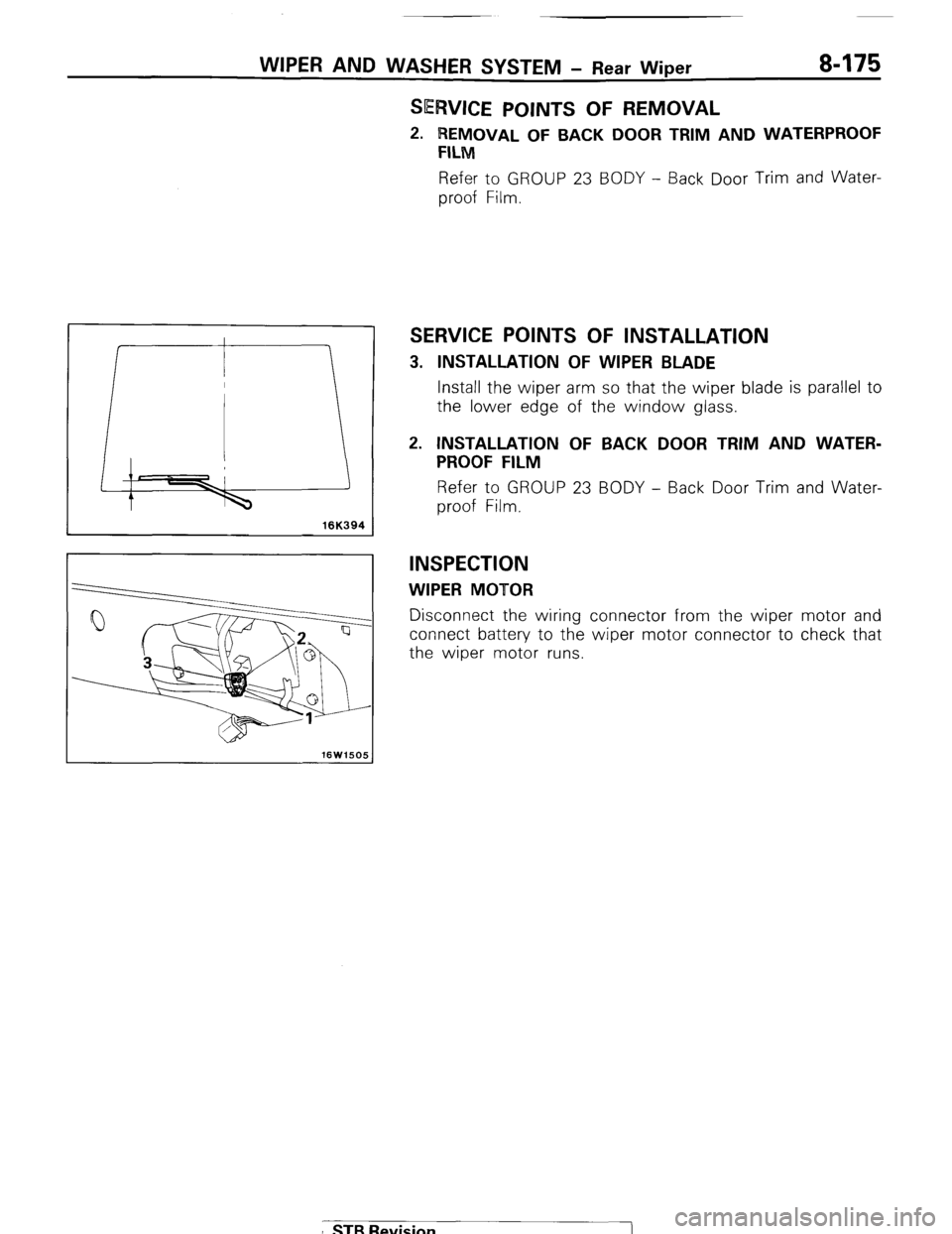
2. REMOVAL OF BACK DOOR TRIM AND WATERPROOF
FILM
Refer to GROUP 23 BODY - Back Door Trim and Water-
proof Film.
I 16K394 1
SERVICE POINTS OF INSTALLATION
3. INSTALLATION OF WIPER BLADE
Install the wiper arm so that the wiper blade is parallel to
the lower edge of the window glass.
2. INSTALLATION OF BACK DOOR TRIM AND WATER-
PROOF FILM
Refer to GROUP 23 BODY - Back Door Trim and Water-
proof Film.
INSPECTION
WIPER MOTOR
Disconnect the wiring connector from the wiper motor and
connect battery to the wiper motor connector to check that
the wiper motor runs.
I STB Revision
Page 196 of 284
8476 WIPER AND WASHER SYSTEM - Rear Wiper
16W1541
Battery
2.3
t
Battery
-
To wiper
motor bracket +
10w1543
OPERATION CHECK
Connect battery (+ :I to terminal 1 and battery ( -) to terminal 3
to ch’eck that the motor runs.
AUTOMATIC OPERATION CHECK
(1) Connect battery (+) to terminal 1 and. battery ( - ) to
terminal 3 to run the motor.
(2) While the motor is running, disconnect terminal 1 to stop
the motor.
(3) Connect terminal 2 to terminal 3 and connect battery (+)
to terminal 1 and battery (-) to wiper motor bracket to
check that the motor starts to run again and then stops.
1 STB Revision
-7
Page 197 of 284
WIPER AND WASHER SYSTEM - Windshield Washer 8-177
WINDSHIELD WASHER
REMOVAL AND INSTALLATION N08KlAD
16W1556
1. Windshild washer tank
2. Washer motor and pump
3. Washer tube
4. Washer nozzle
::I:;rl _
INSPECTION
+ -
WASHER MOTOR AND PUMP
Make the check while the motor is installed to the washer
tank.
1
2
18K1514
(1) Check to be sure that there is washer fluid in the washer
tank.
(2) Check to be sure that the washer motor operates and the
fluid is forced out under pressure when the battery’s
positive (+) terminal is connected to terminal 2 and the negative ( -) terminal is connected to terminal I.
[ STB Revision
Page 199 of 284
I 1
+ -
li.if 1
2
WIPER AND WASHER SYSTEM - Rear Washer / Headlight Washer 8-179 (1) Check to be sure that there is washer fluid in the washer
tank.
(2) Check to be sure that the washer motor operates and the
fluid is forced out under pressure when the battery’s
positive (+) terminal is connected to terminal 2 and the
negative (-) terminal is connected to terminal 1.
INSPECTION
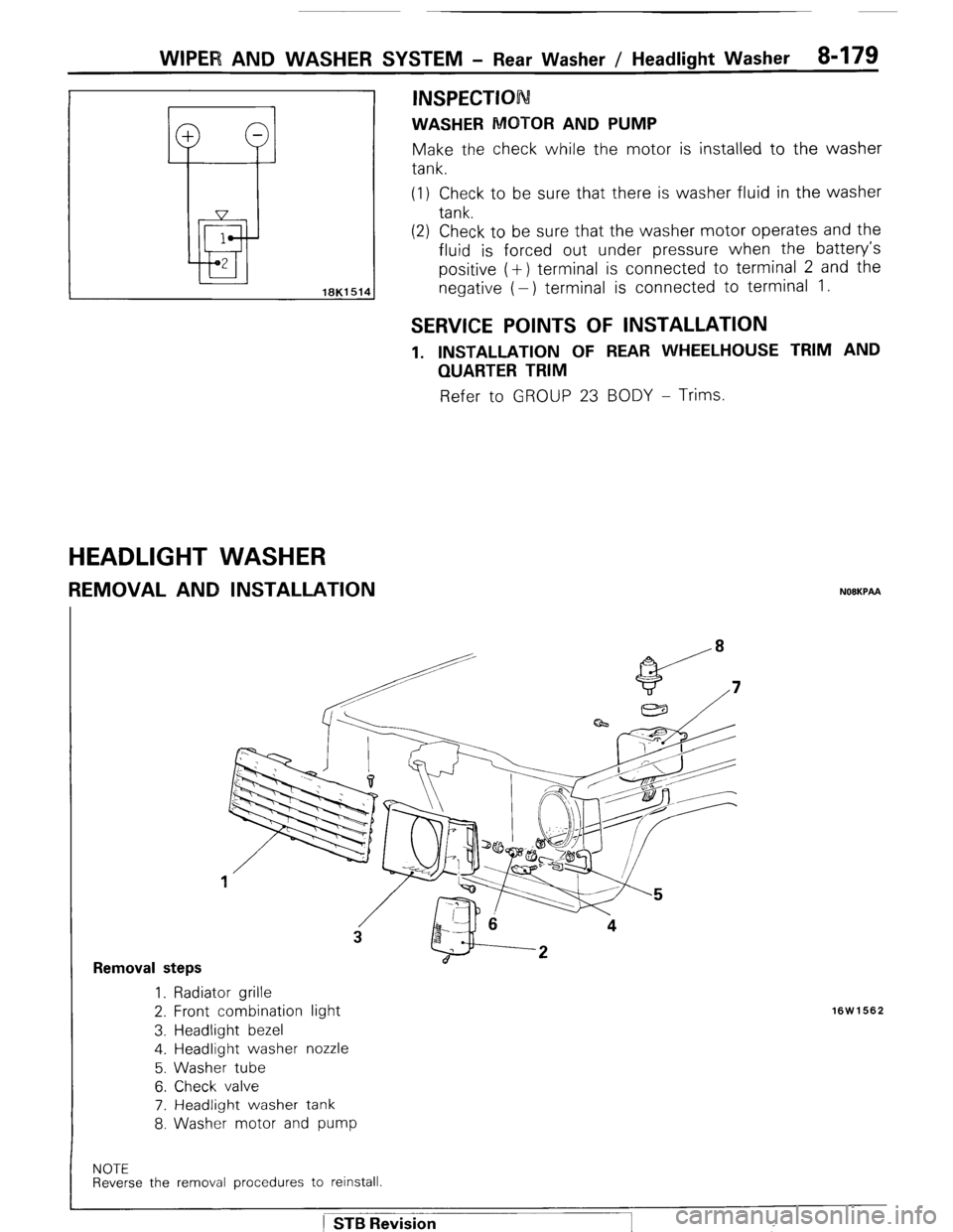
WASHER MOTOR AND PUMP Make the check while the motor is installed to the washer
tank.
SERVICE POINTS OF INSTALLATION
1. INSTALLATION OF REAR WHEELHOUSE TRIM AND
QUARTER TRIM Refer to GROUP 23 BODY - Trims.
HEADLIGHT WASHER
REMOVAL AND INSTALLATION NOEKPAA
Removal steps 1. Radiator grille
2. Front combination light
3. Headlight bezel
4. Headlight washer nozzle
5. Washer tube
6. Check valve
7. Headlight washer tank
8. Washer motor and pump
16W1562
NOTE Reverse the removal procedures to reinstall.
) STB Revision
Page 200 of 284
WIPER AND WASHER SYSTEM - Headlight Washer
INSPECTION
WASHER MOTOR AND PUMP
Make the check while the motor is installed to the washer
tank.
(1) Check to be sure that there is washer fluid in the washer
tank.
16Wl544
(2) Check to be sure that the washer motor operates and the
fluid is forced out under pressure when the battery’s
positive (+) terminal is connected to terminal 2 and the
negative (-) terminal is connected to terminal 3.
18W943
Test light
16W945
HEADLIGHT WASHER RELAY
Remove the headlight washer relay (located a
of the left side cowl side trim). It the upper part
WASHER OPERATION CHECK
(1) Connect the battery and the test light to the relay as
,shown in the figure.
(2) If, when terminal 1 is connected to the negative (-)
terminal of the battery, the light illuminates (for about 0.5
second), the unit is operating normally.
1 STB Revision -1
Page 206 of 284
8486 HORN - Horn
HORN
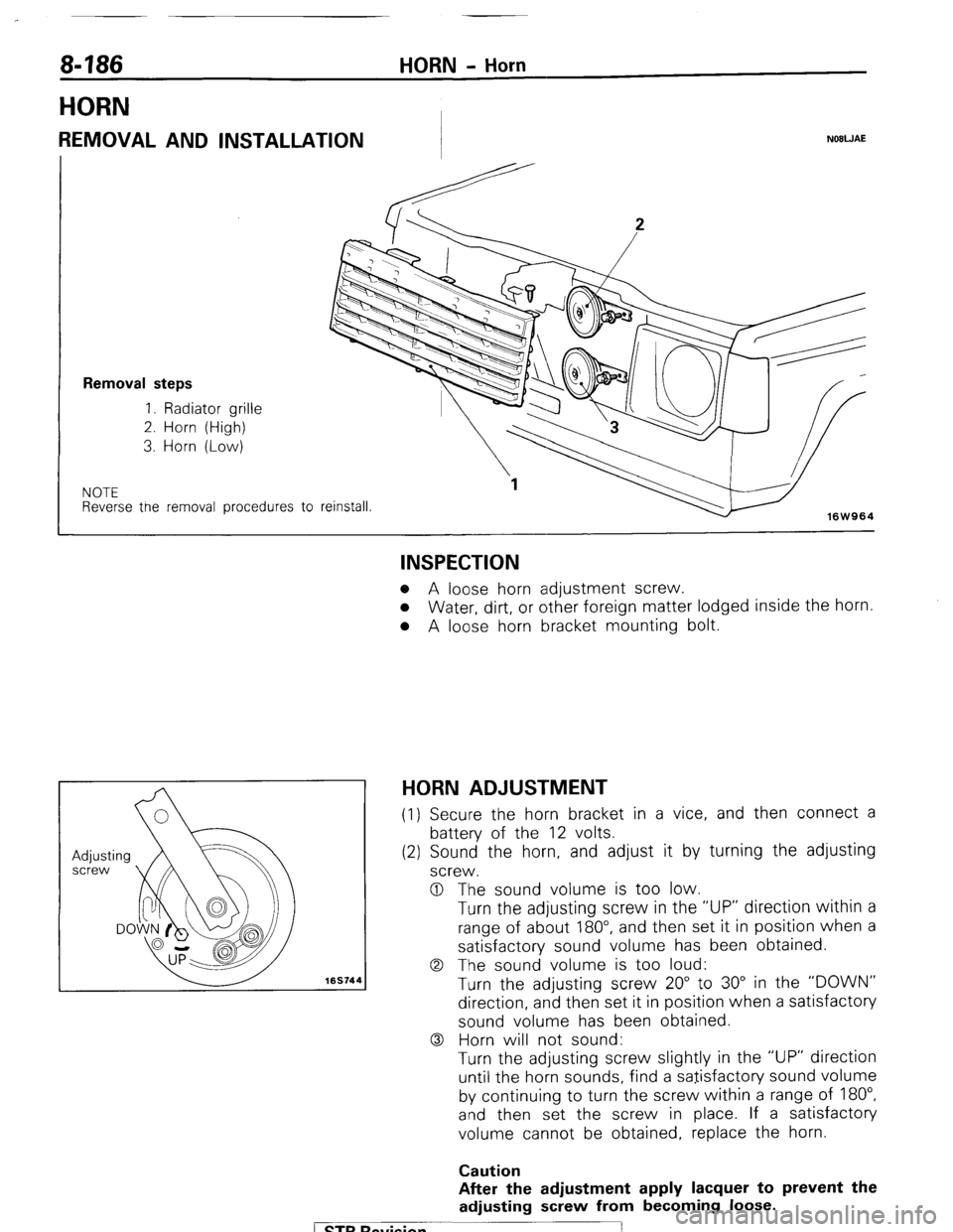
REMOVAL AND INSTALLATION NOBWAE
Removal steps
1. Radiator grille
2. Horn (High)
3. Horn (Low)
NOTE Reverse tne removal procedures to
reinstall.
16W964
169744
INSPECTION o A loose horn adjustment screw.
o Water, dirt, or other foreign matter lodged inside the horn.
l A loose horn bracket mounting bolt.
HORN ADJUSTMENT (1) Secure the horn bracket in a vice, and then connect a
battery of the 12 volts.
(2) Sound the horn, and adjust it by turning the adjusting
screw.
0 The sound volume is too low.
Turn the adjusting screw in the “UP” direction within a
range of about 180”, and then set it in position when a
satisfactory sound volume has been obtained.
0 The sound volume is too loud:
Turn the adjusting screw 20” to 30” in the “DOWN”
direction, and then set it in position when a satisfactory
sound volume has been obtained.
0 Horn will not sound:
Turn the adjusting screw slightly in the “UP” direction
until the horn sounds, find a satisfactory sound volume
by continuing to turn the screw within a range of 180”,
and then set the screw in place. If a satisfactory
volume cannot be obtained, replace the horn.
Caution
After the adjustment apply lacquer to prevent the
adjusting screw from becoming loose.
1 ST6 Revision
Page 214 of 284
8-194 AUDIO SYSTEM - Circuit Diagram
CIRCUIT DIAGRAM
I
RADIO/CASSETTE DECK CIRC,UIT
LW
033 w
Ignition switch
Battery A-02 IL-
Sub fusible link
0 1.25-B A-23 0.5-G 2 w
1 5-w 5-w ll5-w m -
u
Main fusible
link
N To light control
relav Z-RW 3 4
[Refer to P.8-461
Z-RW,,:
To air conditioner,LW
[Refer to P.8-561
To combination
By meter 4
[Refer to P.8-521
DIN Cable
I
/
J
I Y
=z
I
c- 45 -
It, /II
1 L
Radio Tape player
[ STB Revision
Page 227 of 284

BACK DOOR WINDOW DEFOGGER - Printed Heater Lines B-207
Normal characteristic curve
Voltage
I;\
Positive
terminal Printed heater line Negative
terminal
Abnormal characteristic curve
Voltage
IZV
6V
ov :-
Tf I Open-circuit
I point
I
i
!
Positive Printed heater line Negative
terminal terminal
161332
Alignme.nt holes
Masking tape
16FfiSCl
PRINTED HEATER LINES
INSPECTION N08PKAA
1. The printed heater lines should be tested while the engine
is running at 2,000 rpm and the battery is being charged.
2. Turn the defogger switch to the “ON” position, and use
voltmeter to measure the voltage of each printed heater
line at the back door window glass center point “A”.
3. If all of the heater lines indicate approximately 6V, the back
door window printed heater lines are functioning properly.
4. If a voltage of 12V is indicated at point “A”, the heater line
is broken between point “A” and the negative (-) terminal.
Move the test probe gradually toward the negative (-)
terminal, and search for the place where there is a sudden
change in the voltage (to 0 V).
5. This place where the voltage suddenly changes indicates
the location of the broken heater line.
6. If OV is indicated at point “A”, the heater line is broken
between point “A” and the positive (+) terminal. Find the
point where there is a sudden change in the voltage (to
12V). as described in step 4. above.
REPAIR
I. Prepare the following items:
e Conductive paint
@ Paint thinner
e Masking tape, decal, etc.
a, Unleaded gasoline
@ Thin brush
Wipe the glass adjacent to the broken heater line, clean
with unleaded gasoline, and bond a decal or masking tape
as shown.
2. Shake the electroconductive paint container well, and
remove the amount of paint needed. Dilute it with a small
quantity of paint thinner, and apply three coats with the
brush at intervals of about 15 minutes.
3. Remove the tape or decal and leave the repaired defogger
unused for a while before supplying power.
4. For a better finish, scrape away excess deposits with a
knife after drying is complete (one day later).
Caution
After repair, clean the glass with a soft dry shop towel
or wipe along the printed heater line with a slightly
moistened shop towel.
1 STB Revision