Page 121 of 284

STARTING SYSTEM-Starter Motor 8-101
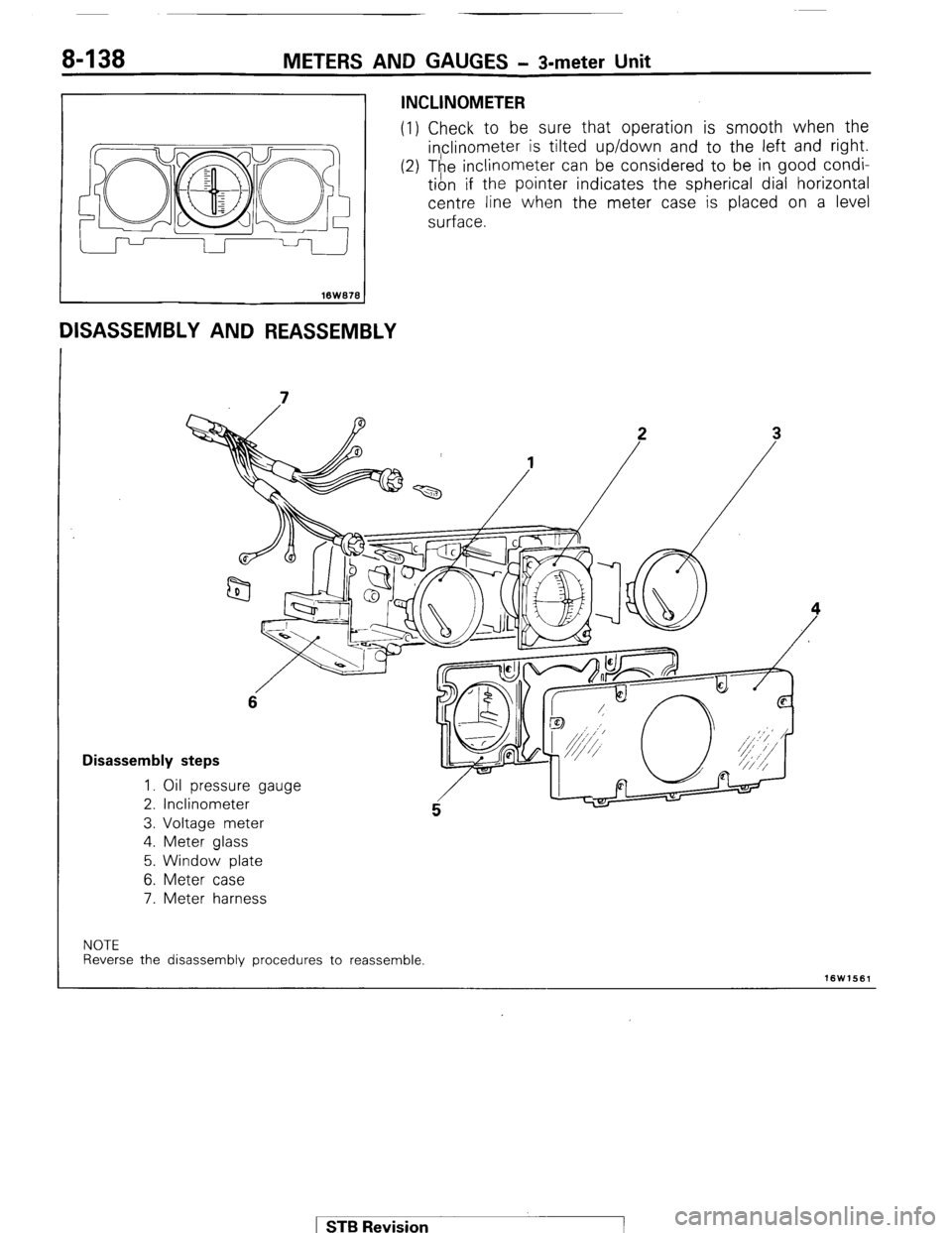
Snap
L Armature
1ELlO
pi-
SERVICE POINTS OF DISASSEMBLY
9. CAUTION OF ARMATURE/ll. BALL
When removing the armature, do not lose the ball which acts
as a bearing for the armature and tip.
17. DISASSEMBLY OF SNAP RING/18. STOP RING
(1) Push the stop ring towards the snap ring using the proper
socket.
(2) After removal of the snap ring with the snap ring pliers,
remove the stop ring and the over-running clutch.
CLEANING STARTER MOTOR PARTS
1, Do not immerse parts in cleaning solvent. Immersing the yoke
and field coil assembly and/or armature will damage insulation.
Wipe these parts with a cloth only.
2. Do not immerse drive unit in cleaning solvent. Overrunning
clutch is pre-lubricated at the factory and solvent will wash
lubrication from clutch.
3. The drive unit may be cleaned with a brush moistened with
cleaning solvent and wiped dry with a cloth.
INSPECTION
CHECKING COMMUTATOR
(1) Place the armature on a pair of V blocks and check run-out with
a dial gauge.
Standard value : 0.05 mm (-0020 in.)
Limit : 0.1 mm (.0039 in.)
wision
I
Page 123 of 284
STARTING SYSTEM -Starter Motor 8-103
E i&l
-Limit line
1ELOlI
New brush
Soidered
(Make sure that
there is no excess
solder on brush
surface)
Surface marked If
1ELM
6EL082
1FL 108
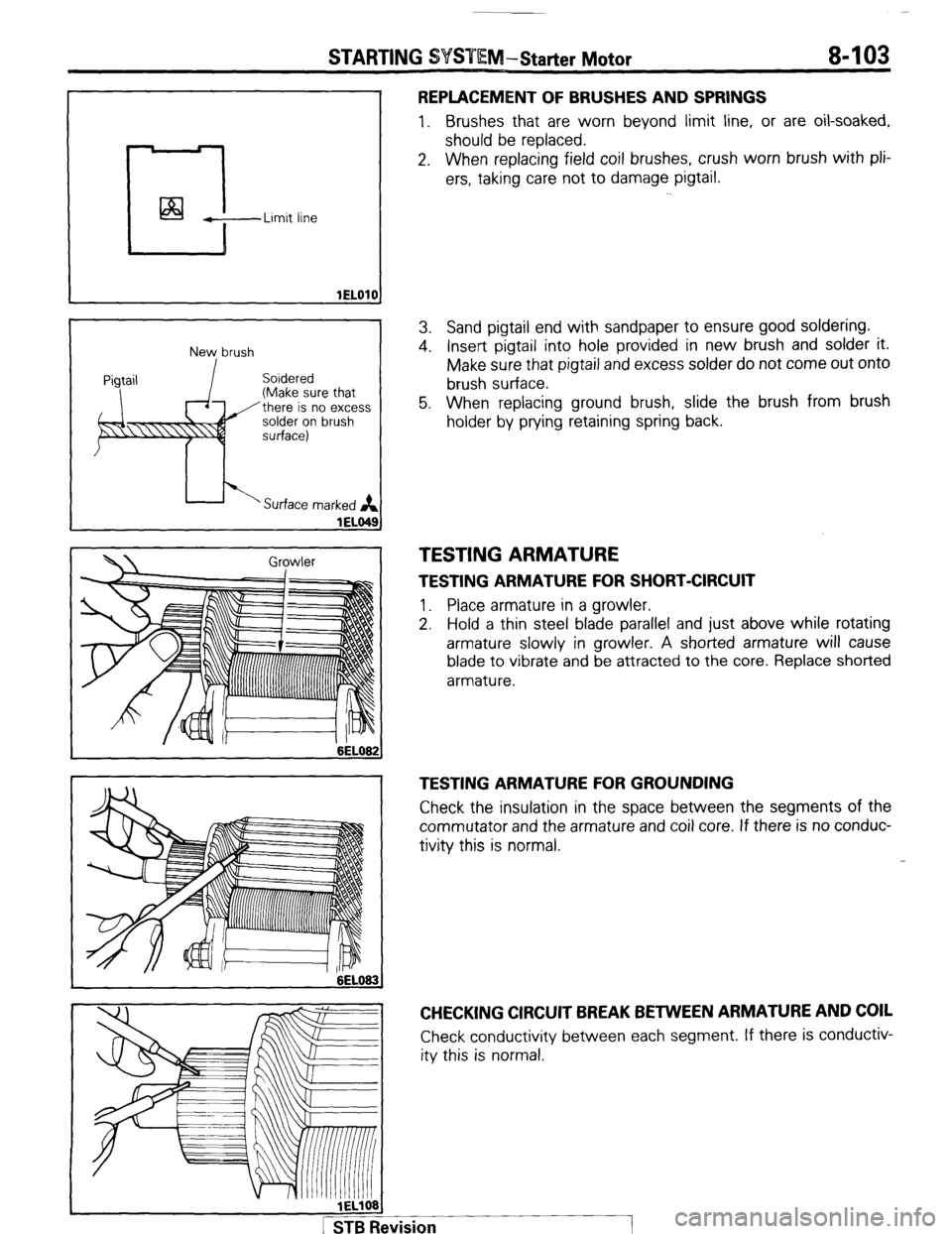
REPLACEMENT OF BRUSHES AND SPRINGS
1. Brushes that are worn beyond limit line, or are oil-soaked,
should be replaced.
2. When replacing field coil brushes, crush worn brush with pli-
ers, taking care not to damage pigtail.
3. Sand pigtail end with sandpaper to ensure good soldering.
4. Insert pigtail into hole provided in new brush and solder it.
Make sure that pigtail and excess solder do not come out onto
brush surface.
5. When replacing ground brush, slide the brush from brush
holder by prying retaining spring back.
TESTING ARMATURE
TESTING ARMATURE FOR SHORT-CIRCUIT
1. Place armature in a growler.
2. Hold a thin steel blade parallel and just above while rotating
armature slowly in growler. A shorted armature will cause
blade to vibrate and be attracted to the core. Replace shorted
armature.
TESTING ARMATURE FOR GROUNDING
Check the insulation in the space between the segments of the
commutator and the armature and coil core. If there is no conduc-
tivity this is normal.
CHECKING CIRCUIT BREAK BETWEEN ARMATURE AND COIL
Check conductivity between each segment. If there is conductiv-
ity this is normal.
1 STB Revision
Page 133 of 284

IGNITION SYSTEM-Service Adjustment Procedures 8-113
SPARK TEST - ENGINE CANNOT BE CRANKED
If spark test is performed by cranking while the catalyst is hot,
unburned gas will be supplied to the catalyst, and this is not de-
sirable to the catalyst.
For this reason, use the following methods which allow spark test
to be performed without cranking.
1. Remove the distributor cap.
2. Check signal rotor position in relation to the pick-up. If it is not
the position shown in the illustration, turn the crankshaft man-
ually so that the projection of the signal rotor is moved away
from the center part of the pick-up. In order words, the signal
rotor should be positioned so that current can flow to the
ignition coil.
3. Disconnect the high tension cable from the center tower of
the distributor cap, and hold the end of the cable about 5 - 10
mm (.2 - .4 in.) away from the cylinder block of the engine.
4. Turn the ignition switch to “ON”. Then, when a piece of metal
(the tip of a screwdriver for instance) is inserted into the de-
tection coil of the pick-up and then moved away, a spak can be
generated.
+
!:’
Secondary cable 5-10 km
(.2-.4 in.)
5EL0
1 STB Revision
Page 136 of 284
8-116 IGNITION SYSTEM-Ignition System
Plug
cleaner
OlUOO89
Plug gap
gauge NIPPON
termine
rl
direction
High voltage
terminal
01R0234
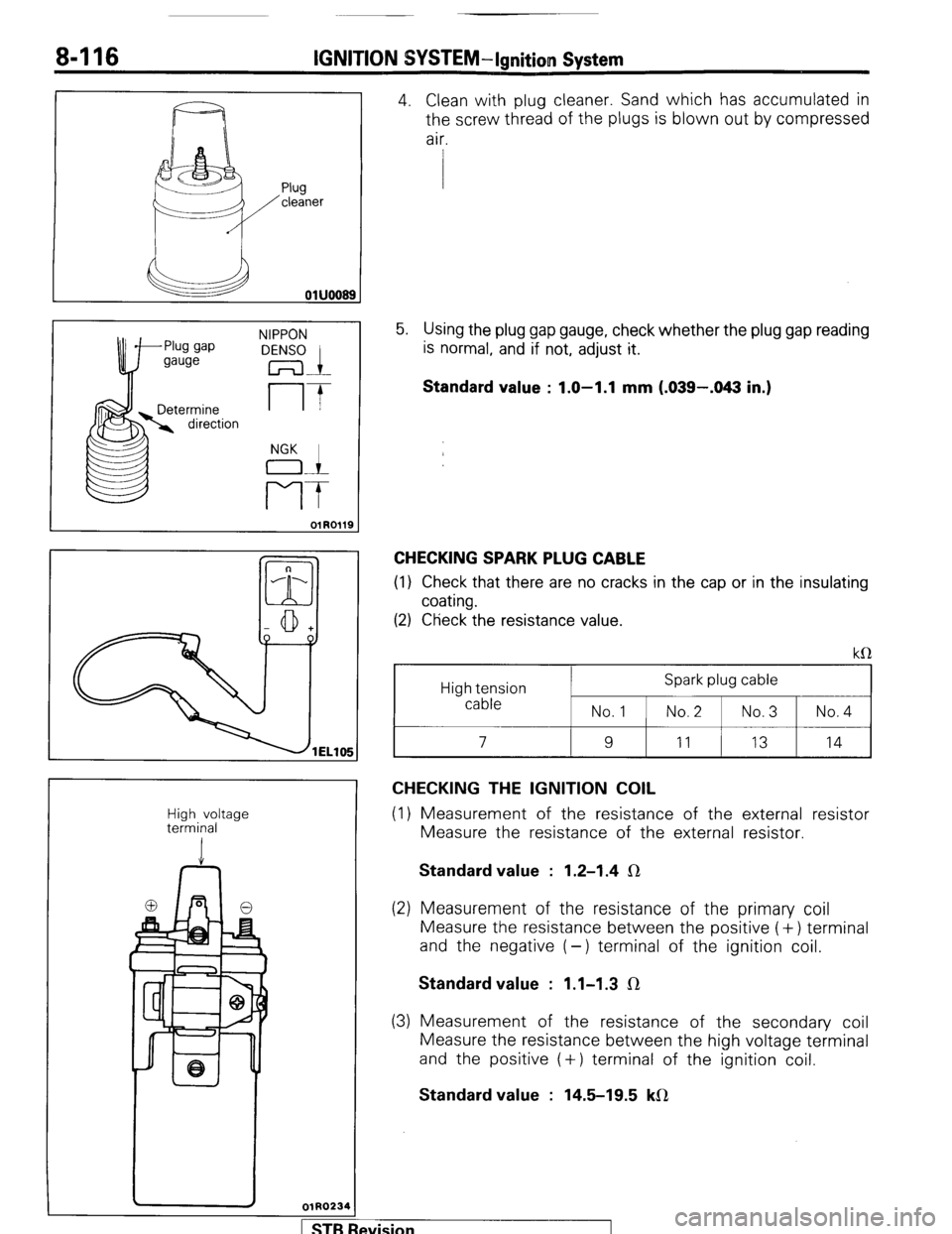
4. Clean with plug cleaner. Sand which has accumulated in
the screw thread of the plugs is blown out by compressed
air.
5. Using the plug gap gauge, check whether the plug gap reading
is normal, and if not, adjust it.
Standard value : 1.0-1.1 mm (.039-.043 in.)
CHECKING SPARK PLUG CABLE
(1) Check that there are no cracks in the cap or in the insulating
coating.
(2) Ctieck the resistance value.
High tension
cable Spark plug cable
No.1 1 No.2 1 No.3 1 No.4
I 9
I
11
I 13 I 14
CHECKING THE IGNITION COIL
(1) Measurement of the resistance of the external resistor
Measure the resistance of the external resistor. Standard value : 1.2-1.4 IR
(2) Measurement of the resistance of the primary coil
Measure the resistance between the positive (+) terminal
and the negative (-) terminal of the ignition coil. Standard value : 1.1-1.3 IR
(3) Measurement of the resistance of the secondary coil
Measure the resistance between the high voltage terminal
and the positive (+) terminal of the ignition coil. Standard value : 14.5-19.5 kfl
wision I
Page 152 of 284

8-132 METERS AND GAUGES - Service Adjustment Procedures
(5) If both the test light and gauge operate, the circuit to the
gauge unit is normal and the gauge unit itself is faulty.
If the test light flashes but the gauge does not operate, the
gauge is faulty.
If 1 neither the test light nor the gauge operates, the water
temperature gauge circuit is faulty.
Se
VVATER TEMPERATURE GAUGE UNIT ONSPEC-
TION
NOBHIKD
To check the water temperature gauge unit, first remove it
from the intake manifold.
For detailed information concerning installation of the water
temperature gauge unit, refer to GROUP 11, INTAKE AND
EXHAUST SYSTEM - Intake Manifold.
WATER TEMPERATURE GAUGE UNIT RESISTANCE CHECK
Immerse the gauge unit in hot water at 70°C (158°F) and
measure the resistance value with an ohmmeter.
Standard value: 90.5 - 117.5 LR
OIL PRESSURE GAUGE SIMPLE TEST NOEHIFA
(1) Disconnect the wiring connector from the oil pressure
gauge unit inside the engine compartment.
(2) Ground the connector at the harness through a test light.
(3) Turn the ignition key to the ON position.
(4) Check to be sure that the test light illuminates steadily and
the indicator of the oil pressure gauge moves.
(5) If both the test light and gauge operate, the circuit to the
gauge unit is normal and the gauge unit itself is faulty.
If the test light flashes but the gauge does not operate, the
gauge is faulty.
If neither the test light nor the gauge operates, the oil
pressure gauge circuit is faulty.
1 STB Revision
-7
Page 153 of 284
METERS AND GAUGES - Service Adjustment Procedures 8-133
IOil p Oil pressure ressure
gauge unit
1 I Test light
‘@‘(12V - 3.4 I
W)
16W1576
OIL PRESSURE GA GE UNIT CURRENT CHEC,‘l<,
(1) Disconnect the wiring connector from the oil pressure
gauge unit inside the engine compartment.
(2) Apply battery voltage (through the test light) to the gauge
unit side terminal.
(3) Check to be sure that the test light switches OFF when the
engine is stopped, and that it flashes while the engine is
running.
VOLTAGE METER SIMPLE TEST NOEHIGC
(1) Connect a voltmeter for testing.
(2) Turn the ignition key to the ON position.
(3) Compare the readings of the voltmeter for testing and of
the vehicle’s voltage meter. Standard value : 1OV
16V + 0.5v
+ 0.5v
1 STB Revision
Page 158 of 284
8-138 METERS AND GAUGES - s-meter Unit
16W678
DISASSEMBLY AND REASSEMBLY
INCLINOMETER
(1) Check to be sure that operation is smooth when the
inclinometer is tilted up/down and to the left and right.
(2) The i,nclinometer can be considered to be in good condi-
tion If the pointer indicates the spherical dial horizontal
centre line when the meter case is placed on a level
surface.
6
Disassembly steps
1. Oil pressure gauge
2. Inclinometer
3. Voltage meter
4. Meter glass
5. Window plate
6. Meter case
7. Meter harness
NOTE
Reverse the disassembly procedures to reassemble.
16W1561
1 ST6 Revision
Page 161 of 284

METERS AND GAUGES - Indicators and Warning Lights 8-141
INDICATORS AND WARNING
LIGHTS
Symbol
Operation
Turn signal indicator
+e3 This indicator flashes, as do the same side of turn-signal light
flashes. If the turn-signal light is burnt out, the blinking of
indicator slows down.
This indicator is common with hazard light.
0
High beam indicator
- This indicator illuminates when the headlights are on high
= beam.
=
* Door-ajar warning light
This warning light comes on when the door is either open or
not completely closed.
4 Fasten seat belt indicator
This indicator goes on for four to eight seconds when the
ignition key is in “ON” position, even if the driver has fastened
his seat belt.
BRAKE
Brake warning light
This warning light comes on when the ignition key is in “ON”
position, and goes off after the engine has started. This
warning light comes on when the parking brake is applied
or brake fluid level falls less than the specific level.
III Charging warning light This warning light comes on when the ignition key is in
- + “ON” position, and goes off after the engine has started.
This warning light comes on when the drive belt breaks
or the trouble occurs in the charging system.
Oil pressure warning light This warning light comes on when the ignition key is in “ON”
P position, and goes off after the engine has started. This
warning light comes on when the oil fails or the trouble
occurs in the oil circulating system.
00
Overdrive indicator
This indicator will illuminates when the overdrive control
OFF
switch is switched to the “OFF” position.
68R0133
A/T
A/T oil temperature warning light This A/T oil temperature warning light comes on when
TEMP automatic transmission fluid temperature becomes abnor-
mally high.
68WO68
Free-wheeling hub indicator
YEL This indicator comes on when the automatic free-wheeling
hubs are locked.
68WO80
z4 4WD indicator This indicator will light up when the transfer case shift lever is
shifted to the four wheel driving position (either the “4H” or the
“4L” position) and the ignition key is in the “ON” position.
CHECK
EGR
EGR warning light The EGR warning light will illuminate every 50,000 miles of
driving. When this occurs, bring the vehicle to an authorized
dealter to have the EGR system checked.
) STB Revision