1987 MAZDA 626 fuel
[x] Cancel search: fuelPage 24 of 1865

o
r\3
Interval
Procedure & item
Number of Months or km, whichever corns first
Months
x
1000 Km
Miles x 1000
Fuel filter (R) for carbretor model
Fuel lines and hoses
Spark plugs
Initial ignition timing
Idle Speed
E.G.R. System
Evaporative system (if equipped)
O) O
X o
Choke system
0.6
6
10
12
20
12
(R)
18
30
18
24
40
24
30
50
30
36
60
36
(R)
42
70
42
48
80
48
©1
O
O
o
o
o
o
o
o
o
o
o
o
o
o
©3
o
o
o
o
o
o
o
©4
o
o
Service data and inspection point
Fittings, connections and compo-
nents for leaks
Plug gap: Carburetor, FE (DOHC) 1.0—1.1 mm (0.039—0.043 in) FE 0.75—0.85 mm (0.030-0.033 in) Recommended spark plugs
NGK
Carbureter BPR5ES-11 BPR6ES-11
NGK FE
(Fuel injection)
BPR 5ES
BPR 6ES NGK
FE DOHC
BCPR 5E-11 BCPR 6E-11 BCPR 7E-11
Nippon Denso
Carbureter W16EXR-U11 W20EXR-U11 Nippon Denso FE
(Fuel injection)
W16EXR-U
W20EXR-U
Nippon Denso
FE DOHC Q16PR-U
Initial ignition timing
6 ±
1
° BTDC
12 ± 1° BTDC (FE DOHC)
Check the idle speed (rpm) Carburetor MTX 850—900,
ATX 900-950 (N range) FE DOHC 700-800 FE MTX 800—850,
ATX 900-950 (N range)
System inspection
System inspection
Carburetor linkage Choke diaphragm Choke valve clearance Unloader system
Page
4A-37
4B-42
5-9
5-11
4A—38 4B-29 4C—29
4B—72 4A—64
4B—76
4C-81
4A-26 4A—34 4A—34 4A—33
m z >
z o m
H >
00 r-m
H o
m O m
3
CO o X m a c i-m a
m z >
z o m
Page 27 of 1865
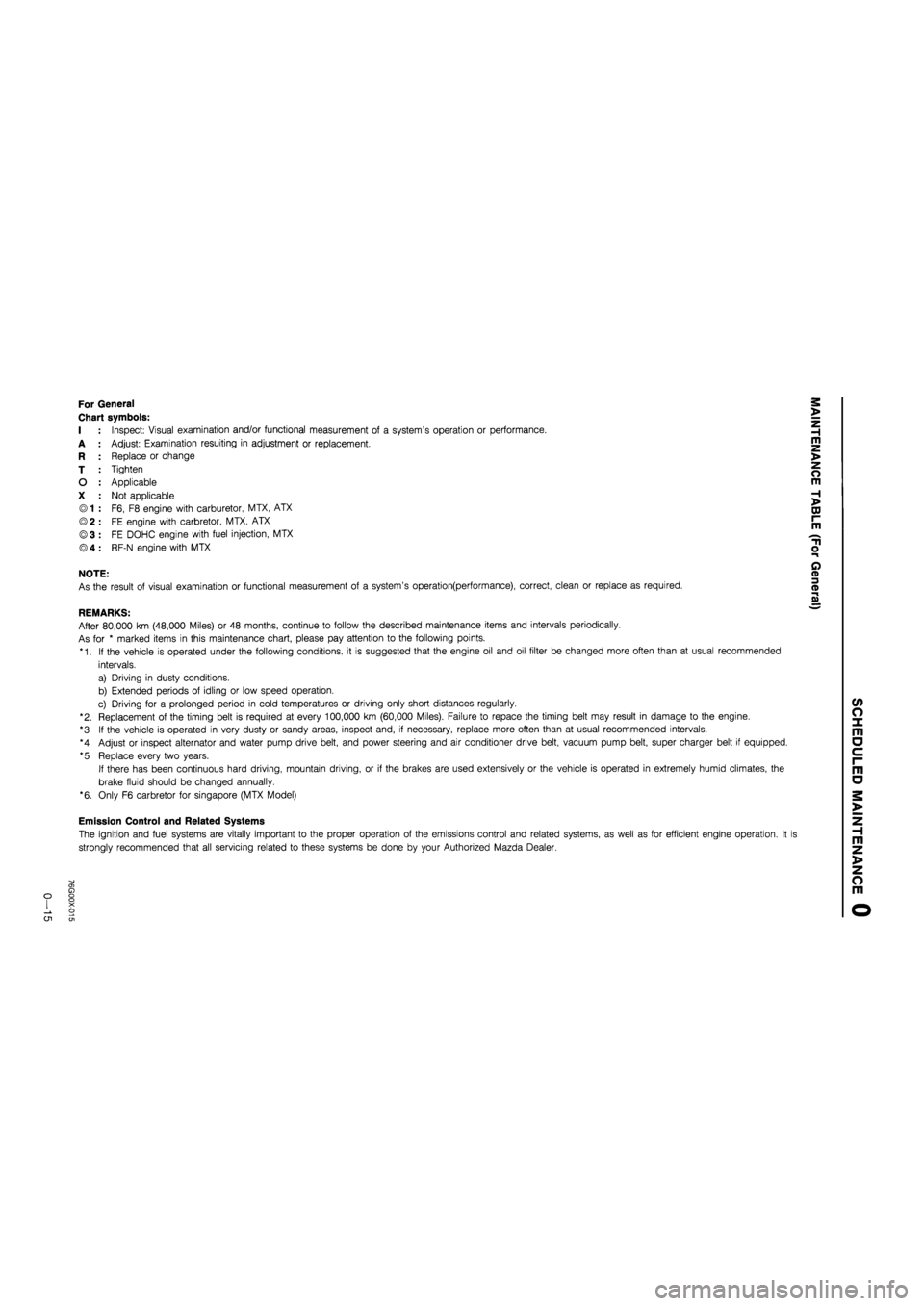
For General
Chart symbols:
I : Inspect: Visual examination and/or functional measurement of a system's operation or performance.
A : Adjust: Examination resuiting in adjustment or replacement.
R : Replace or change
T : Tighten
O : Applicable
X : Not applicable
© 1 : F6, F8 engine with carburetor, MTX, ATX
© 2 : FE engine with carbretor, MTX, ATX
©3 : FE DOHC engine with fuel injection, MTX
® 4 : RF-N engine with MTX
NOTE:
As the result of visual examination or functional measurement of a system's operation(performance), correct, clean or replace as required.
REMARKS:
After 80,000 km (48,000 Miles) or 48 months, continue to follow the described maintenance items and intervals periodically.
As for * marked items in this maintenance chart, please pay attention to the following points.
*1. If the vehicle is operated under the following conditions, it is suggested that the engine oil and oil filter be changed more often than at usual recommended
intervals.
a) Driving in dusty conditions.
b) Extended periods of idling or low speed operation.
c) Driving for a prolonged period in cold temperatures or driving only short distances regularly.
"2. Replacement of the timing belt is required at every 100,000 km (60,000 Miles). Failure to repace the timing belt may result in damage to the engine.
*3 If the vehicle is operated in very dusty or sandy areas, inspect and, if necessary, replace more often than at usual recommended intervals.
*4 Adjust or inspect alternator and water pump drive belt, and power steering and air conditioner drive belt, vacuum pump belt, super charger belt if equipped.
*5 Replace every two years.
If there has been continuous hard driving, mountain driving, or if the brakes are used extensively or the vehicle is operated in extremely humid climates, the
brake fluid should be changed annually.
*6. Only F6 carbretor for Singapore (MTX Model)
Emission Control and Related Systems
The ignition and fuel systems are vitally important to the proper operation of the emissions control and related systems, as well as for efficient engine operation. It i
strongly recommended that all servicing related to these systems be done by your Authorized Mazda Dealer.
o CJ1
Page 30 of 1865

Interval
Procedure & item
Number of Months or km, whichever corns first
Months
x 1000 Km
Miles x 1000
Engine oil
Oil filter
Fuel filter (R) only for carbretor
Fuel lines and hoses (I) only for Diesel
Spark plugs
Initial ignition timing
Idle speed (I) only for carbretor
0.6
(I)
6
10
(0
12
20
12
(R)
18
30
18
(I)
24
40
24
30
50
30
(I)
36
60
36
(R)
42
70
42
(I)
48
80
48
®1
O
o
o
o
o
o
o
©2
O
o
o
o
o
o
o
©3
O
o
o
o
o
o
©4
O
o
o
Service data and inspection point
Oil pan capacity F6, F8, FE 3.6 liters (3.8 US qt, 3.2 Imp qt)
Oil filter capacity F8, FE 12-valve (SOHC)
0.3 liters (0.32 US qt, 0.26 Imp qt)
FE (DOHC) 0.2 liters (0.21 US qt, 0.18 Imp qt) RF-N
0.4 liters (0.42 US qt, 0.35 Imp qt)
Fittings, connections and compo-
nents for leaks
Plug gap FE DOHC 0.7—0.8 mm (0.028-0.031 in) Others 0.75—0.85 mm (0.030—0.033 in) Recommended spark plugs
F6,F8,FE FE
12 VALVE,
DOHC
NGK BPR 5ES BPR 6ES BCPR 5E
BCPR 6E
Nippon
Denso W16EXR-U
W20EXR-U
Q16PR-U* Q20PR-U
Initial ignition timing F6 F8 FE (8 VALVE) (12 VALVE)
6 ±
1
° BTDC FE (DOHC) 12 ± 1° BTDC
Check the idle speed
MTX 80015? rpm
ATX F6 900 rpm (in "N" range) ATX F8, FE 900 t5? rpm (in "N" range)
FE DOHC 700—800 rpm
§ *Only FE 12 VALVE
Page
2A—6
2A-6
2B-6
4D—21
5-9
5-11
4A—38
4C-29
m z >
z o m
H >
CD I-m
T1
o
o
m z >
z o m
Page 36 of 1865
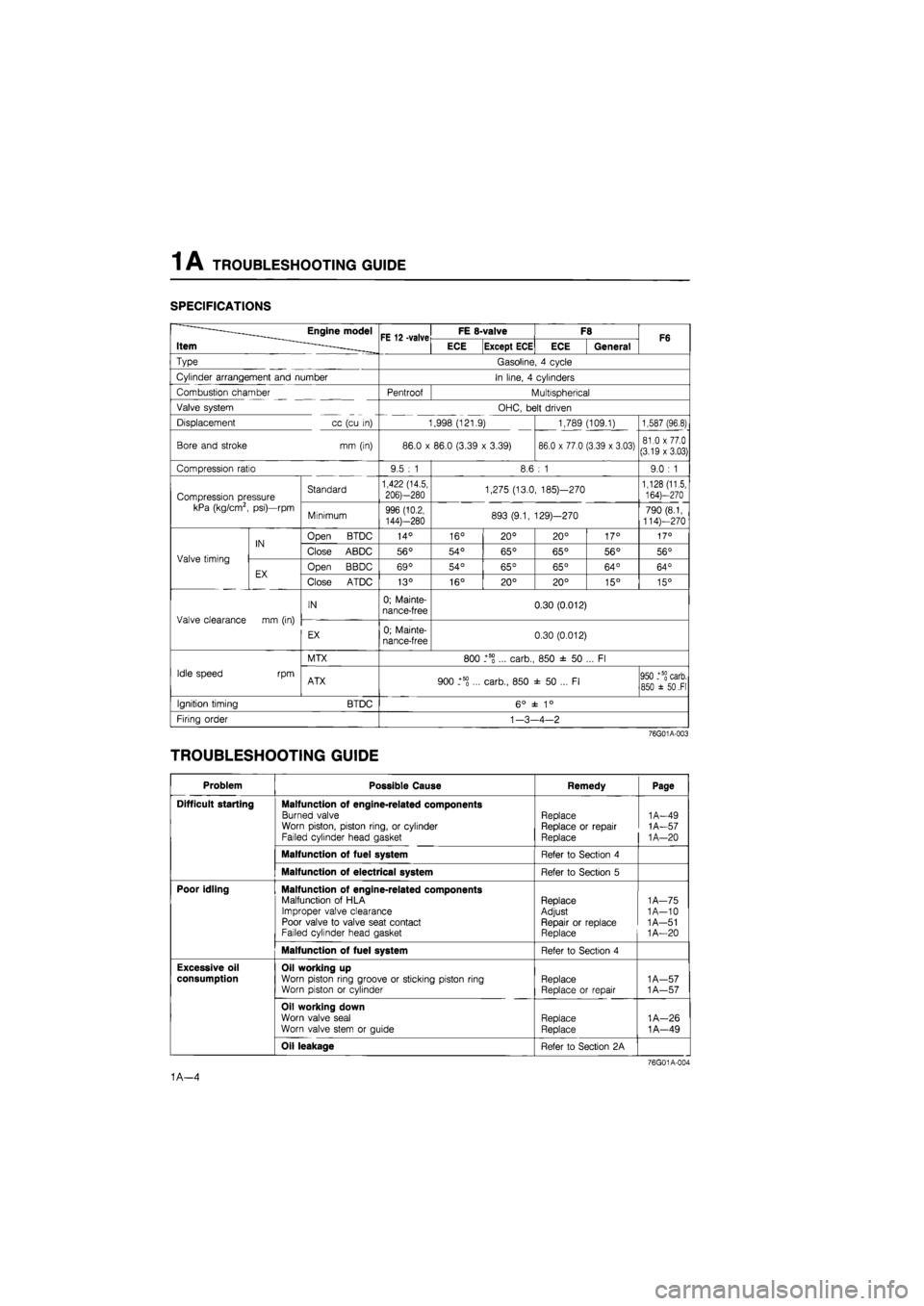
1A TROUBLESHOOTING GUIDE
SPECIFICATIONS
——Engine model
Item ^ FE 12 -valve FE 8-valve F8 F6 ——Engine model
Item ^ FE 12 -valve ECE Except ECE ECE General F6
Type Gasoline, 4 cycle
Cylinder arrangement and number In line, 4 cylinders
Combustion chamber Pentroof Multispherical
Valve system OHC, belt driven
Displacement cc (cu in) 1,998 (121.9) 1,789 (109.1) 1,587 (96.8)
Bore and stroke mm (in) 86.0 x 86.0 (3.39 x 3.39) 86.0 x 77.0 (3.39 x 3.03) 81.0 x 77.0 (3.19 x 3.03)
Compression ratio 9.5 : 1 8.6 : 1 9.0 : 1
Compression pressure kPa (kg/cm2, psi)—rpm
Standard 1,422 (14.5,
206)—280 1,275 (13.0, 185)—270 1,128 (11.5, 164)—270 Compression pressure kPa (kg/cm2, psi)—rpm Minimum 996 (10.2,
144)—280 893 (9.1, 129)—270 790 (8.1, 114)—270
Valve timing
IN Open BTDC 14° 16° 20° 20° 17° 17°
Valve timing
IN Close ABDC 56° 54° 65° 65° 56° 56° Valve timing
EX Open BBDC 69° 54° 65° 65° 64° 64° Valve timing
EX Close ATDC 13° 16° 20° 20° 15° 15°
Valve clearance mm (in)
IN 0; Mainte-nance-free 0.30 (0.012)
Valve clearance mm (in)
EX 0; Mainte-nance-free 0.30 (0.012)
Idle speed rpm
MTX 800 _+5S ... carb., 850 ± 50 ... Fl
Idle speed rpm ATX 900 _+5g ... carb., 850 ± 50 ... Fl 950 _+5§ carb. 850 ±
50
.Fl
Ignition timing BTDC 6° ± 1°
Firing order
1
-3-4-2
76G01A-003
TROUBLESHOOTING GUIDE
Problem Possible Cause Remedy Page
Difficult starting Malfunction of engine-related components
Burned valve Worn piston, piston ring, or cylinder Failed cylinder head gasket
Replace Replace or repair Replace
1A-49
1A-57
1
A—20
Malfunction of fuel system Refer to Section 4
Malfunction of electrical system Refer to Section 5
Poor idling Malfunction of engine-related components Malfunction of HLA Improper valve clearance Poor valve to valve seat contact Failed cylinder head gasket
Replace Adjust Repair or replace Replace
1
A—75 1A-10 1 A—51
1
A—20
Malfunction of fuel system Refer to Section 4
Excessive oil
consumption
Oil working up Worn piston ring groove or sticking piston ring Worn piston or cylinder Replace Replace or repair
1
A—57 1A—57
Oil working down
Worn valve seal
Worn valve stem or guide Replace
Replace
1A—26
1A—49
Oil leakage Refer to Section 2A
76G01A-004
1A—4
Page 37 of 1865

TROUBLESHOOTING GUIDE 1 A
Problem Possible Cause Remedy Page
Insufficient power Insufficient compression Malfunction of HLA Improper valve clearance Compression leakage from valve seat Seized valve stem Weak or broken valve spring Failed cylinder head gasket Cracked or distorted cylinder head Sticking, damaged, or worn piston ring Cracked or worn piston
Replace
Adjust
Repair
Replace Replace Replace Replace Replace Replace
1A—75 1A—10
1
A—51 1A—49 1A—53
1
A—20 1A—48 1A—57
1
A—57
Malfunction of fuel system Refer to Section 4
Others Slipping clutch Dragging brakes Wrong size tires
Refer to Section 6 Refer to Section 11 Refer to Section 12
Abnormal
combustion
Malfunction of engine-related components Malfunction of HLA
Improper valve clearance Sticking or burned valve
Weak or broken valve spring Carbon accumulation in combustion chamber
Replace Adjust Replace Replace
Eliminate carbon
1
A—75 1A—10 1A—49 1A—53
Malfunction of fuel system Refer to Section 4
Engine noise Crankshaft or bearing related parts
Excessive main bearing oil clearance Main bearing seized or heat-damaged Excessive crankshaft end play Excessive connecting rod bearing oil clearance Connecting rod bearing seized or heat-damaged
Replace or repair Replace
Replace or repair Replace or repair Replace
1A—65
1
A—65 1A—66 1A—67
1
A—67
Piston related parts Worn cylinder Worn piston or piston pin Seized piston Damaged piston ring Bent connecting rod
Replace or repair
Replace
Replace Replace Replace
1A—55
1
A—57
1
A—57
1
A—57 1A—59
Valves or timing related parts Malfunction of HLA* Improper valve clearance Broken valve spring Excessive valve guide clearance Malfunction of timing belt tensioner
Replace Adjust
Replace Replace Replace
1A—75 1A—10 1A—53 1A—49 1A—61
Malfunction of cooling system Refer to Section 3A
Malfunction of fuel system Refer to Section 4
Others Malfunction of water pump bearing Improper drive belt tension Malfunction of alternator bearing Exhaust gas leakage
Replace Adjust Replace Repair
1 A— 7
1
A—48
* Tappet noise may occur if the engine is not operated for an extended period of time. The noise should stop after the
engine has reached normal operating temperature.
76G01A-005
1A—5
Page 41 of 1865

TUNE-UP PROCEDURE 1A
High-Tension Lead
Check the following points. Clean or replace if
necessary.
1. Damaged lead
2. Carbon deposits
86U01X-014
76G01A-012
49 0187 280
76G01A-013
Carburetor Float Level (Carburetor)
1. Run the engine at idle.
2. Check that the fuel level is at the center of the float
level indicator window.
If necessary, adjust the fuel float level. (Refer to Sec-
tion 4A.)
Hydraulic Lash Adjuster (12 valve)
Note
Tappet noise may occur if the engine is not
operated for an extended period of time. The
noise should stop after the engine has
reached normal operating temperature.
1. Check for tappet noise. If noise exsits, check the
following points.
(1) Engine oil condition and level
(2) Engine oil pressure (Refer to Section 2A)
2. If the noise does not stop, check for movement of
each HLA by pushing down each rocker arm by
hand while at TDC of compression stroke.
3. If the rocker arm moves down, replace the HLA.
(Refer to page 1A—75.)
76G01A-014
1
A—9
Page 45 of 1865
ON-VEHICLE INSPECTION 1 A
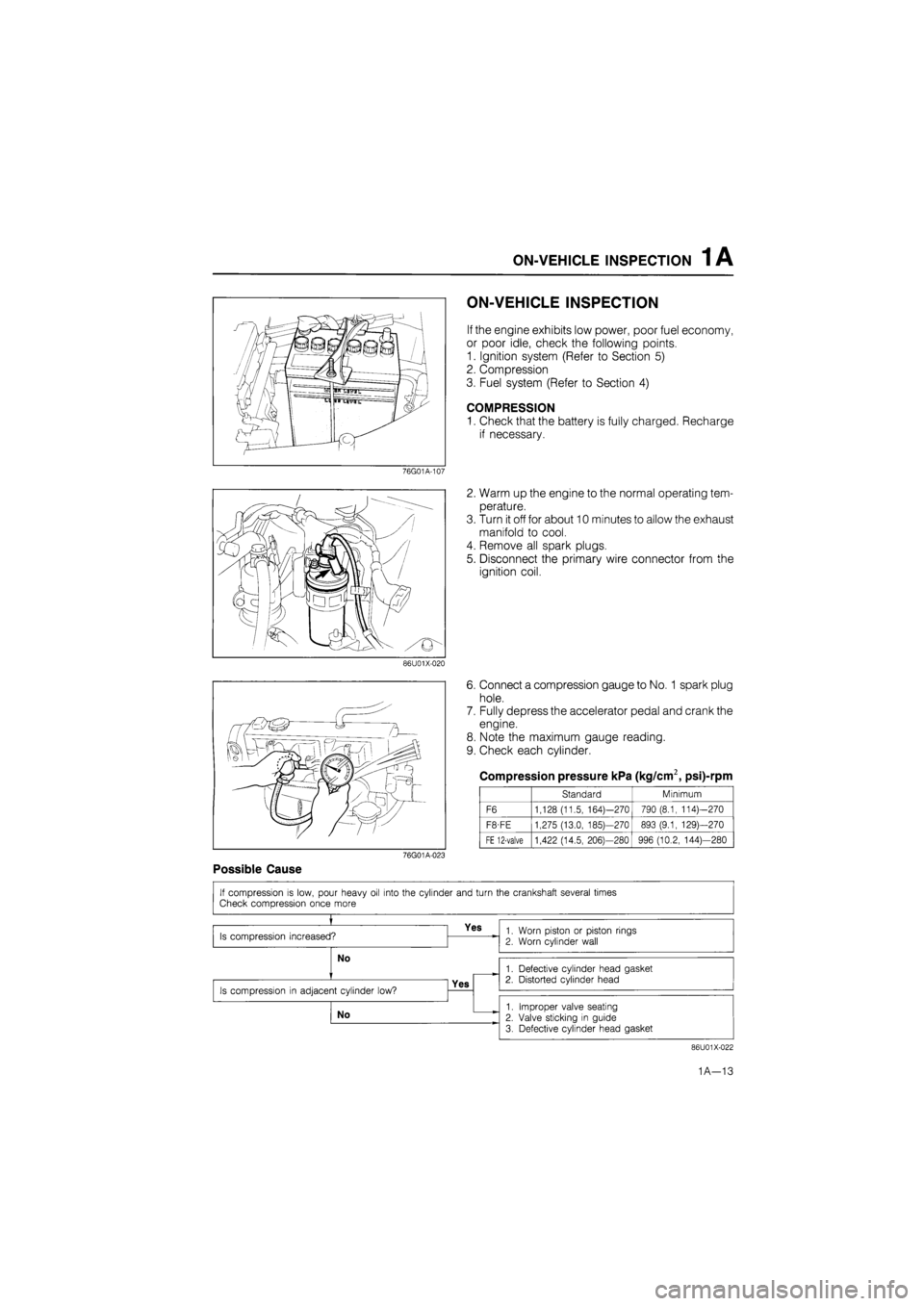
ON-VEHICLE INSPECTION
If the engine exhibits low power, poor fuel economy,
or poor idle, check the following points.
1. Ignition system (Refer to Section 5)
2. Compression
3. Fuel system (Refer to Section 4)
COMPRESSION
1. Check that the battery is fully charged. Recharge
if necessary.
76G01A-107
2. Warm up the engine to the normal operating tem-
perature.
3. Turn it off for about 10 minutes to allow the exhaust
manifold to cool.
4. Remove all spark plugs.
5. Disconnect the primary wire connector from the
ignition coil.
86U01X-020
6. Connect a compression gauge to No.
1
spark plug
hole.
7. Fully depress the accelerator pedal and crank the
engine.
8. Note the maximum gauge reading.
9. Check each cylinder.
Compression pressure kPa (kg/cm2, psi)-rpm
Standard Minimum
F6 1,128 (11.5, 164)—270 790 (8.1, 114)—270
F8-FE 1,275 (13.0, 185)—270 893 (9.1, 129)—270
FE 12-valve 1,422 (14.5, 206)—280 996 (10.2, 144)—280
76G01A-023
Possible Cause
86U01X-022
1A—13
Page 52 of 1865
1 A ON-VEHICLE MAINTENANCE (CYLINDER HEAD)
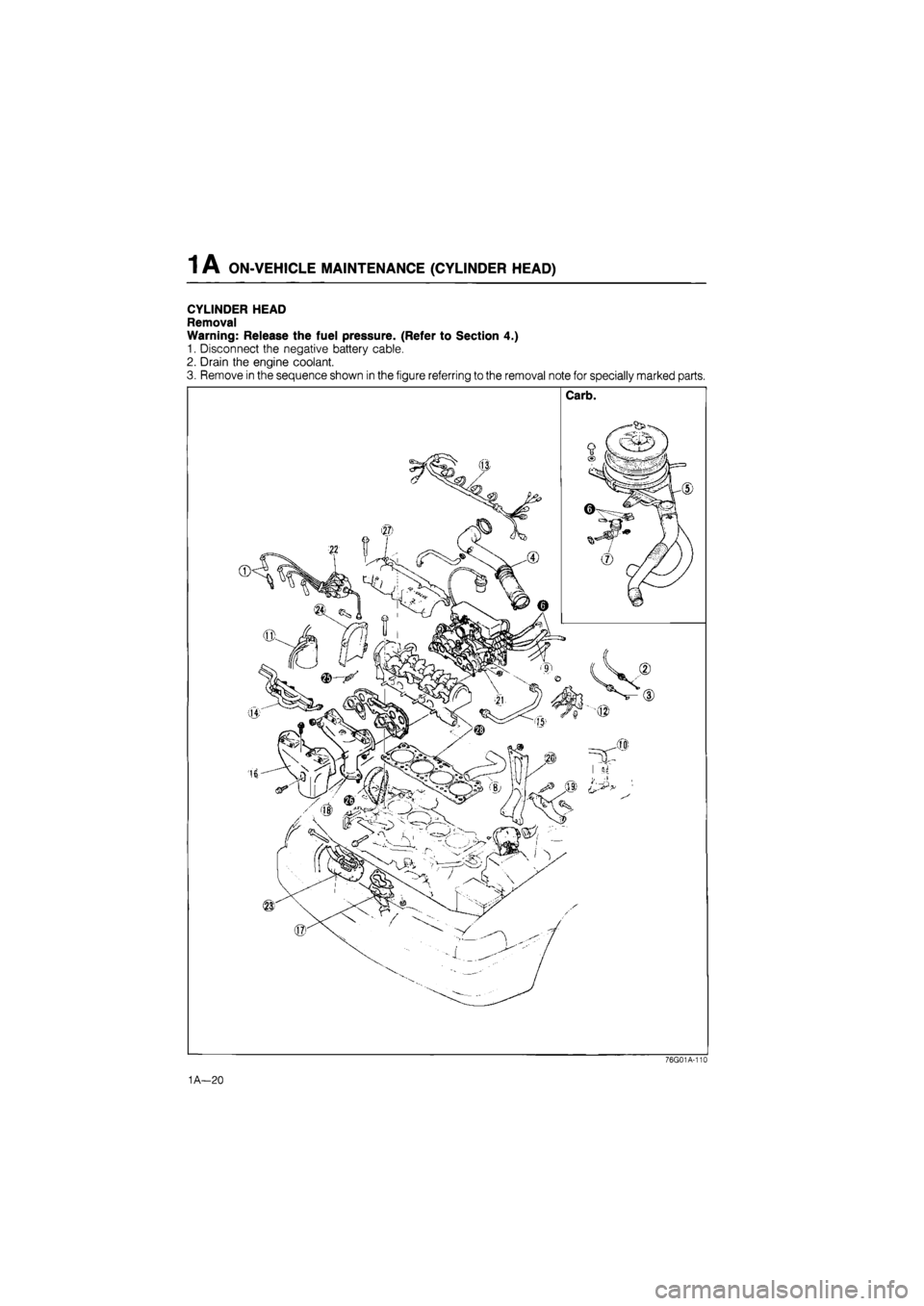
CYLINDER HEAD
Removal
Warning: Release the fuel pressure. (Refer to Section 4.)
1. Disconnect the negative battery cable.
2. Drain the engine coolant.
3. Remove in the sequence shown in the figure referring to the removal note for specially marked parts.
76G01A-110
1A—20