Page 747 of 1865

STARTER (GASOLINE ENGINE, 0.85, 0.95 KW TYPE) 5
4BG05X-082
4BG05X-083
4BG05X-084
2. Vibration of the commutator
(1) Place the armature on V blocks, and measure
the vibration by using a dial gauge.
(2) If the vibration is Limit or more, repair so that
it becomes standard by using a lathe, or re-
place the armature.
Standard vibration: 0.05 mm (0.002 in)
Limit: 0.4 mm (0.018 in)
Note
Before checking, be sure that there is no play
in the bearings.
3. Outer diameter of the commutator
Replace the armature if the outer diameter of the
commutator is grind limit or less.
4. Roughness of the commutator surface
(1) If the commutator surface is dirty, wipe it with
a cloth.
(2) If it is rough, repair it by using a lathe or fine
sandpaper.
Grind limit: 31 mm (1.22 in)
5. Segment groove depth
If the depth of the mold between segments is limit
depth or less, undercut the grooves by standard
depth.
Standard depth:
0.5—0.8 mm (0.020—0.031 in)
Limit depth: 0.2 mm (0.008 in)
Field Coil
1. Wiring damage
(1) Check for continuity between the connector
and brushes by using a circuit tester.
(2) Replace the yoke assembly if there is no con-
tinuity.
4BG05X-085
5—41
Page 755 of 1865
STARTER (GASOLINE ENGINE, 1.4 KW TYPE) 5
INSPECTION
Armature
1. Ground of armature coil
Check for continuity between the commutator and
the core using a circuit tester. Replace the arma-
ture if there is continuity.
67U05X-048
2. Insulation of armature coil
Check for continuity between the commutator and
the shaft using a circuit tester. Replace the arma-
ture if there is continuity.
67U05X-049
Runout of commutator
(1) Place the armature on V blocks, and measure
the runout using a dial gauge.
(2)
If
the runout is excessive, replace the armature.
Runout: 0.05 mm (0.002 in)
Maximum: 0.1 mm (0.004 in)
7BU05X-039
Outer diameter of commutator
Replace the armature if the outer diameter of the
commutator is less than the grind limit.
Roughness of commutator surface
Repair using a lathe or fine sandpaper if it is rough;
wipe it with a rag if it is dirty.
Grind limit: 28.8 mm (1.13 in)
7BU05X-040
5-49
Page 768 of 1865

5 STARTER (DIESEL ENGINE, 2.0 KW TYPE)
4BG05X-082
4BG05X-103
Faulty repair
Bad Good
Mica
Undercut
Segments
4BG05X-084
2. Vibration of the commutator
(1) Place the armature on V blocks, and measure
the vibration by using a dial gauge.
(2) If the vibration is Limit or more, repair so that
it becomes standard by using a lathe, or re-
place the armature.
Standard vibration: 0.05 mm (0.002 in)
Limit: 0.4 mm (0.018 in)
Note
Before checking, be sure that there is no play
in the bearings.
3. Outer diameter of the commutator
Replace the armature if the outer diameter of the
commutator is grind limit or less.
4. Roughness of the commutator surface
(1) If the commutator surface is dirty, wipe it with
a cloth.
(2) If it is rough, repair it by using a lathe or fine
sandpaper.
Grind limit: 34 mm (1.34 in)
5. Segment groove depth
If the depth of the mold between segments is limit
depth or less, undercut the grooves by standard
depth.
Standard depth:
0.5—0.8 mm (0.020—0.031 in)
Limit depth: 0.2 mm (0.008 in)
Field Coil
1. Wiring damage
(1) Check for continuity between the connector
and brushes by using a circuit tester.
(2) Replace the yoke assembly if there is no con-
tinuity.
4BG05X-085
5-62
Page 777 of 1865
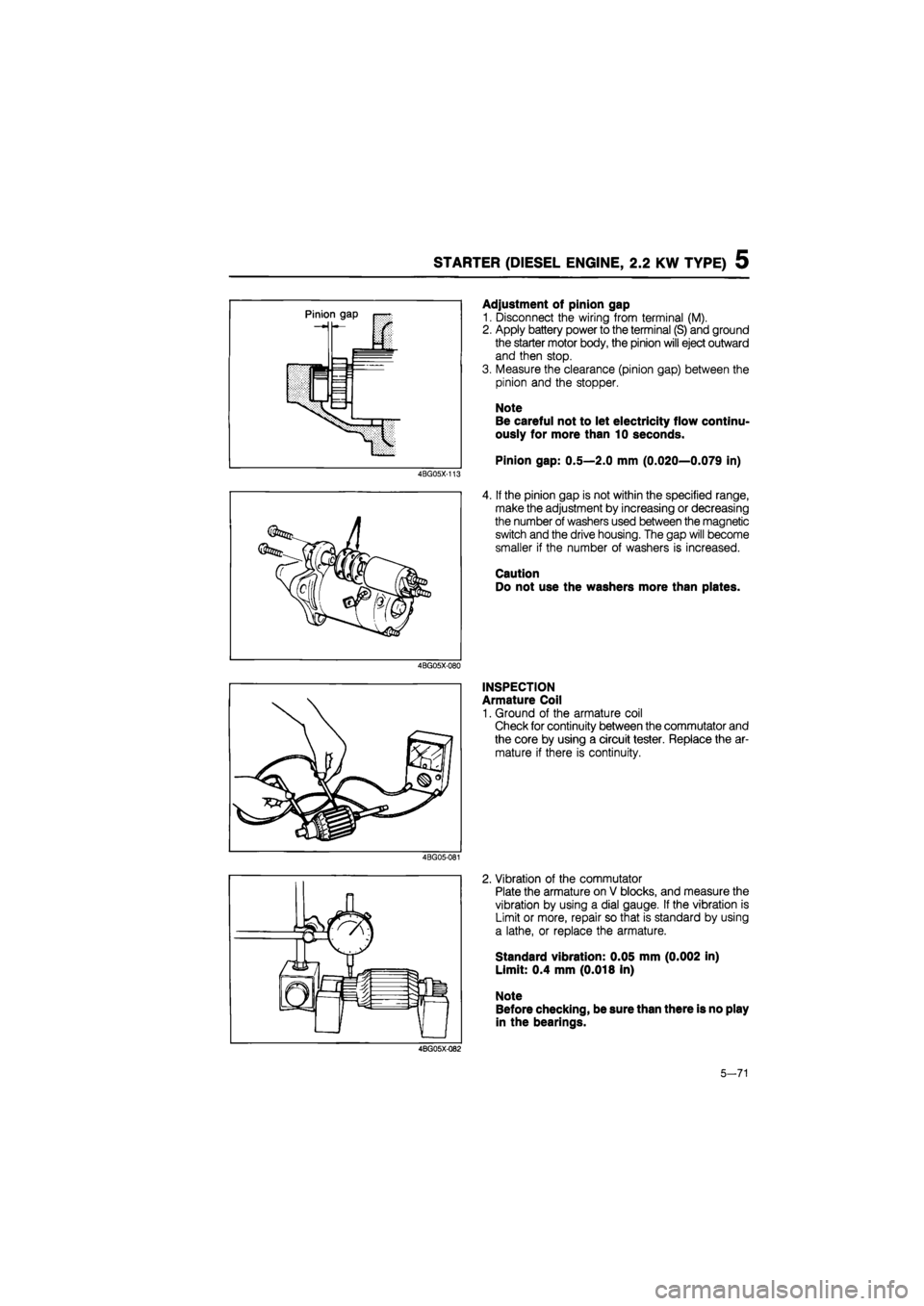
STARTER (DIESEL ENGINE, 2.2 KW TYPE) 5
4BG05X-113
4BG05X-080
Adjustment of pinion gap
1. Disconnect the wiring from terminal (M).
2. Apply battery power to the terminal (S) and ground
the starter motor body, the pinion will eject outward
and then stop.
3. Measure the clearance (pinion gap) between the
pinion and the stopper.
Note
Be careful not to let electricity flow continu-
ously for more than 10 seconds.
Pinion gap: 0.5—2.0 mm (0.020—0.079 in)
4. If the pinion gap is not within the specified range,
make the adjustment by increasing or decreasing
the number of washers used between the magnetic
switch and the drive housing. The gap will become
smaller if the number of washers is increased.
Caution
Do not use the washers more than plates.
INSPECTION
Armature Coil
1. Ground of the armature coil
Check for continuity between the commutator and
the core by using a circuit tester. Replace the ar-
mature if there is continuity.
4BG05-081
2. Vibration of the commutator
Plate the armature on V blocks, and measure the
vibration by using a dial gauge. If the vibration is
Limit or more, repair so that is standard by using
a lathe, or replace the armature.
Standard vibration: 0.05 mm (0.002 in)
Limit: 0.4 mm (0.018 in)
Note
Before checking, be sure than there is no play
in the bearings.
4BG05X-Q82
5-71
Page 790 of 1865

6 ON-VEHICLE MAINTENANCE
6-4
ON-VEHICLE MAINTENANCE
FLUID LEVEL
1. Clean the area around the reservoir and the reser-
voir cap.
2. Check the fluid level. If the level is near or below
the "MIN" mark, add clutch fluid to the "MAX"
mark.
Fluid specification:
DOT-3 or DOT-4
(FMVSS 116, or SAE J1703)
PEDAL HEIGHT
Inspection
Measure the distance from the upper center of the
pedal pad to the firewall and ensure that the distance
is within specification.
Pedal height A:
216.5—221.5 mm (8.524—8.720 in)
Adjustment
To adjust the pedal height, loosen locknut and turn
stopper bolt or clutch switch.
PEDAL FREEPLAY
Inspection
Depress the pedal lightly by hand and measure the
freeplay to ensure that it is within specification.
Pedal freeplay: 5—13 mm (0.20—0.51 in)
Adjustment
1. Adjust the free play by loosening locknut C and
turning push rod D.
2. Check that the distance from the floor to the cen-
ter of the upper surface of the pedal pad is as
specified or more when the clutch is fully dis-
engaged.
Disengagement height B:
LHD 68 mm (2.7 in)
RHD 85 mm (3.3 in)
3. Tighten locknut C after adjustment.
Page 816 of 1865
7A REMOVAL
REMOVAL
Fl except DOHC
76G07A-008
1. Battery
2. Main fuse block
3. Air cleaner assembly
4. Ventilation hose
5. Air hose
6. Ground(s)
7. Speedometer cable
8. Clutch release cylinder
9. Canister hose
10. Wheel
11. Splash sheild
12. Extension bar
13. Control rod
14. Stabilizer
15. Joint shaft
16. Gusset plate (rear)
17. Gusset plate (front)
18. Surge tank bracket
19. Starter
20. Under cover
21. Engine mount No.4
22. Engine mount No.2
23. Hunger rubber
24. Crossmember
7 A—10
Page 817 of 1865
REMOVAL 7A
DOHC
76G07A-009
1. Battery
2. Main fuse block
3. Air cleaner assembly
4. Ventilation hose
5. Air hose
6. Ground(s)
7. Speedometer cable
8. Clutch release cylinder
9. Canister hose
10. Wheel
11. Splash sheild
12. Extension bar
13. Control rod
14. Stabilizer
15. Joint shaft
16. Surge tank bracket
17. Starter
18. Engine mount No.4
19. Engine mount No.2
20. Rear member (4WS)
21. Hunger rubber
22. Crossmember
7A—11
Page 820 of 1865
7A REMOVAL
1. Remove the battery and battery carrier.
2. Disconnect the main fuse block. (Fl)
3. Disconnect the distributor lead.
4. Remove the air cleaner assembly.
76G07A-012
5. Remove the vacuum hose, the intercooler hose
(RF-CX) and the electric fan. (RF-N and RF-CX)
86U07A-021
8. Remove the front wheels.
9. Remove the splash shields.
10. Drain the transaxle oil.
86U07A-022
7A—14


