Page 564 of 885
BRAKE SYSTEM - TroubleshootingBR-5
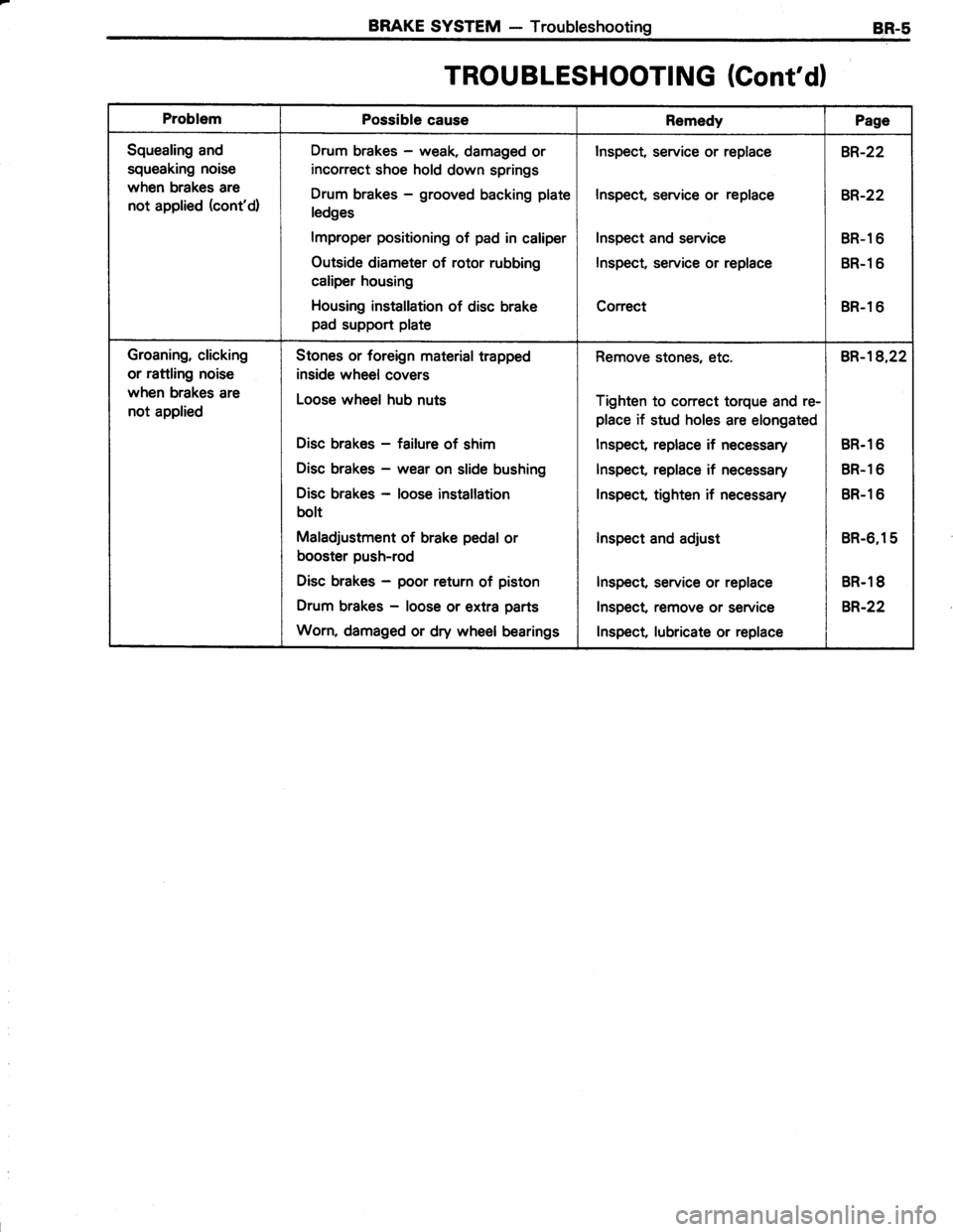
TROUBLESHOOTING (Cont'dl
ProblemPossible causeRemedyPage
Squealing and
squeaking noise
when brakes are
not applied (cont'd)
Drum brakes - weak, damaged or
incorrect shoe hold down springs
Drum brakes - grooved backing plate
ledges
lmproper positioning of pad in caliper
Outside diameter of rotor rubbing
caliper housing
Housing installation of disc brake
pad support plate
Inspect, service or replace
Inspect, service or replace
Inspect and service
Inspect, service or replace
Correct
BR-22
BR-22
BR-l 6
BR-l 6
BR-1 6
Groaning, clicking
or rattling noise
when brakes are
not applied
Stones or foreign material trapped
inside wheel covers
Loose wheel hub nuts
Disc brakes - failure of shim
Disc brakes - wear on slide bushing
Disc brakes - loose installation
bolt
Maladjustment of brake pedal or
booster push-rod
Disc brakes - poor return of piston
Drum brakes - loose or extra parts
Worn, damaged or dry wheel bearings
Remove stones, etc.
Tighten to correct torque and re-
place if stud holes are elongated
lnspect, replace if necessary
Inspect, replace if necessary
Inspect, tighten if necessary
lnspect and adjust
Inspect, service or replace
Inspect remove or service
lnspect lubricate or replace
BR-18,22
BR.1 6
BR.1 6
BR-1 6
BR-6,15
BR.1 8
B,R.22
Page 566 of 885
BRAKE SYSTEM - Checks and AdjustmentsBR-7
@@
VV
1 st 2nd
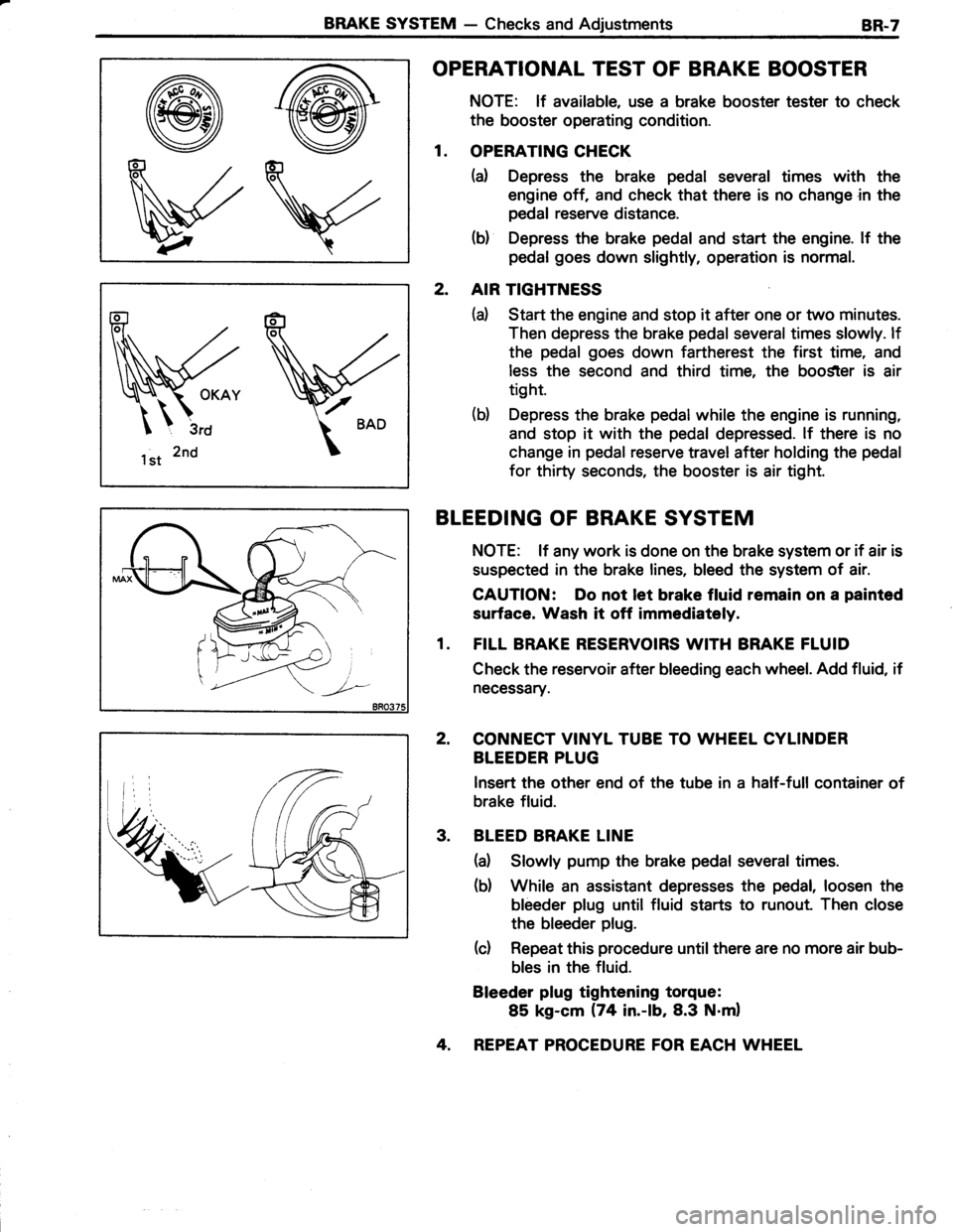
OPERATIONAL TEST OF BRAKE BOOSTER
NOTE: lf available, use a brake booster tester to check
the booster operating condition.
1. OPERATING CHECK
(a) Depress the brake pedal several times with the
engine off, and check that there is no change in the
pedal reserve distance.
(b) Depress the brake pedal and start the engine. lf the
pedal goes down slightly, operation is normal.
2. AIR TIGHTNESS
(d Start the engine and stop it after one or two minutes.
Then depress the brake pedal several times slowly. lf
the pedal goes down fartherest the first time, and
less the second and third time, the boo$ter is air
tight.
(b) Depress the brake pedal while the engine is running,
and stop it with the pedal depressed. lf there is no
change in pedal reserve travel after holding the pedal
for thirty seconds, the booster is air tight.
BLEEDING OF BRAKE SYSTEM
NOTE: lf any work is done on the brake system or if air is
suspected in the brake lines, bleed the system of air.
CAUTION: Do not let brake fluid remain on a painted
surface. Wash it off immediataly.
1. FILL BRAKE RESERVOIRS WITH BRAKE FLUID
Check the reservoir after bleeding each wheel. Add fluid, if
necessary.
2, CONNECT VINYL TUBE TO WHEEL CYLINDER
BLEEDER PLUG
lnsert the other end of the tube in a half-full container of
brake fluid.
3. BLEED BRAKE LINE
(a) Slowly pump the brake pedal several times.
(b) While an assistant depresses the pedal, loosen the
bleeder plug until fluid starts to runout. Then close
the bleeder plug.
(c) Repeat this procedure until there are no more air bub-
bles in the fluid.
Bleeder plug tightening torque:
85 kg-cm (74 in.-lb,8.3 N.m)
4. REPEAT PROCEDURE FOR EACH WHEEL
Page 568 of 885
BRAKE SYSTEM - Master CylinderBR-9
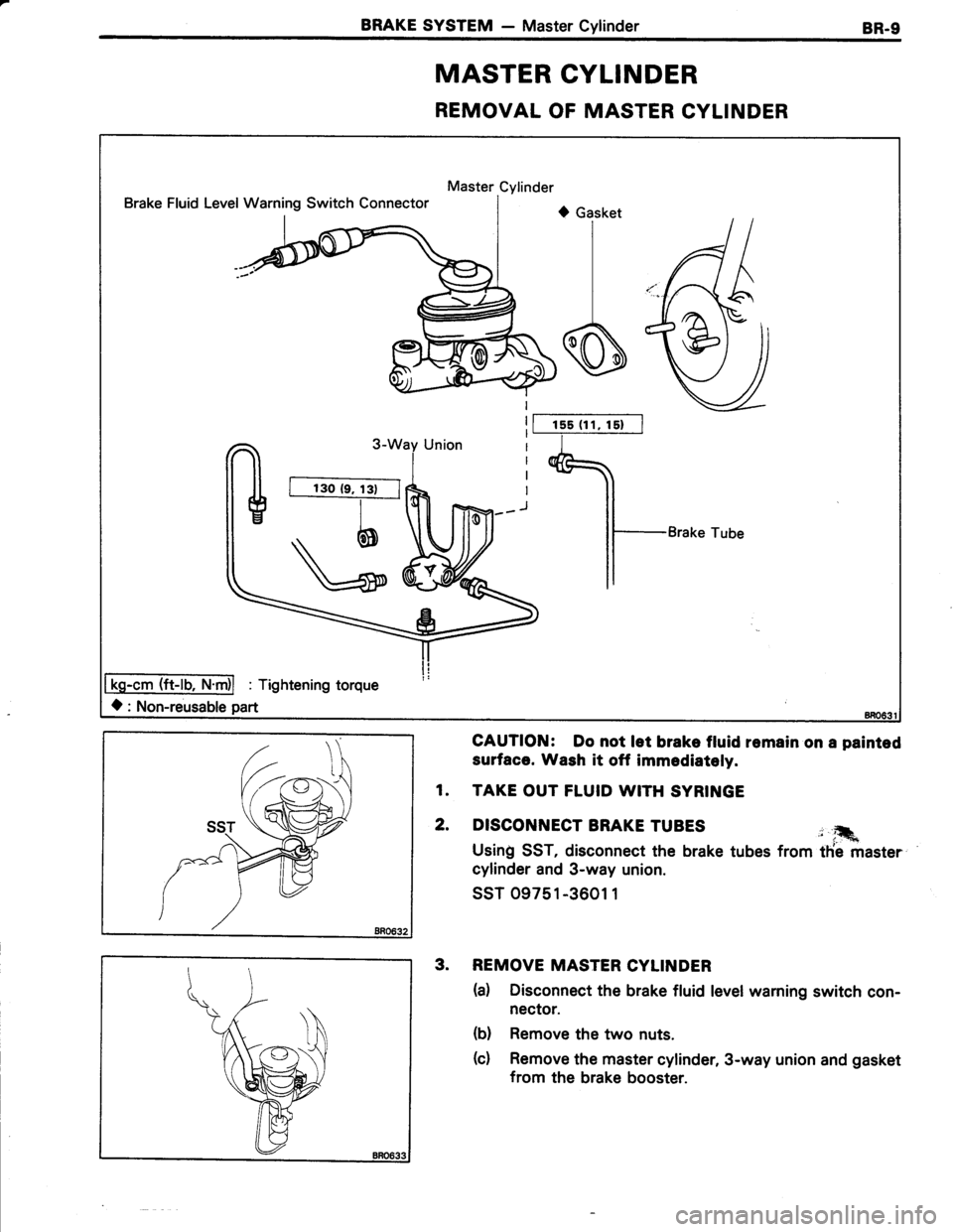
MASTER CYLINDER
REMOVAL OF MASTER CYLINDER
Master Cylinder
Brake Fluid LevelWarning Switch Connectort) Gasket
I
I
s
Brake Tube
-cm (ft-lb,
O: Non-reusable part
1s5 (1 1, 15)
Tightening torque
GAUTION: Do not let brake fluid remain on a painted
surface. Wash it off immediatoly.
1. TAKE OUT FLUID WITH SYRINGE
2. DISCONNECT BRAKE TUBES j ,.
Usin! SST, disconnect the brake tubes from tfie master
cylinder and 3-way union.
ssT 09751-3601 1
3. REMOVE MASTER CYLINDER
(d Disconnect the brake fluid level warning switch con-
nector.
(b) Remove the two nuts.
(c) Remove the master cylinder, 3-way union and gasket
from the brake booster.
Page 569 of 885
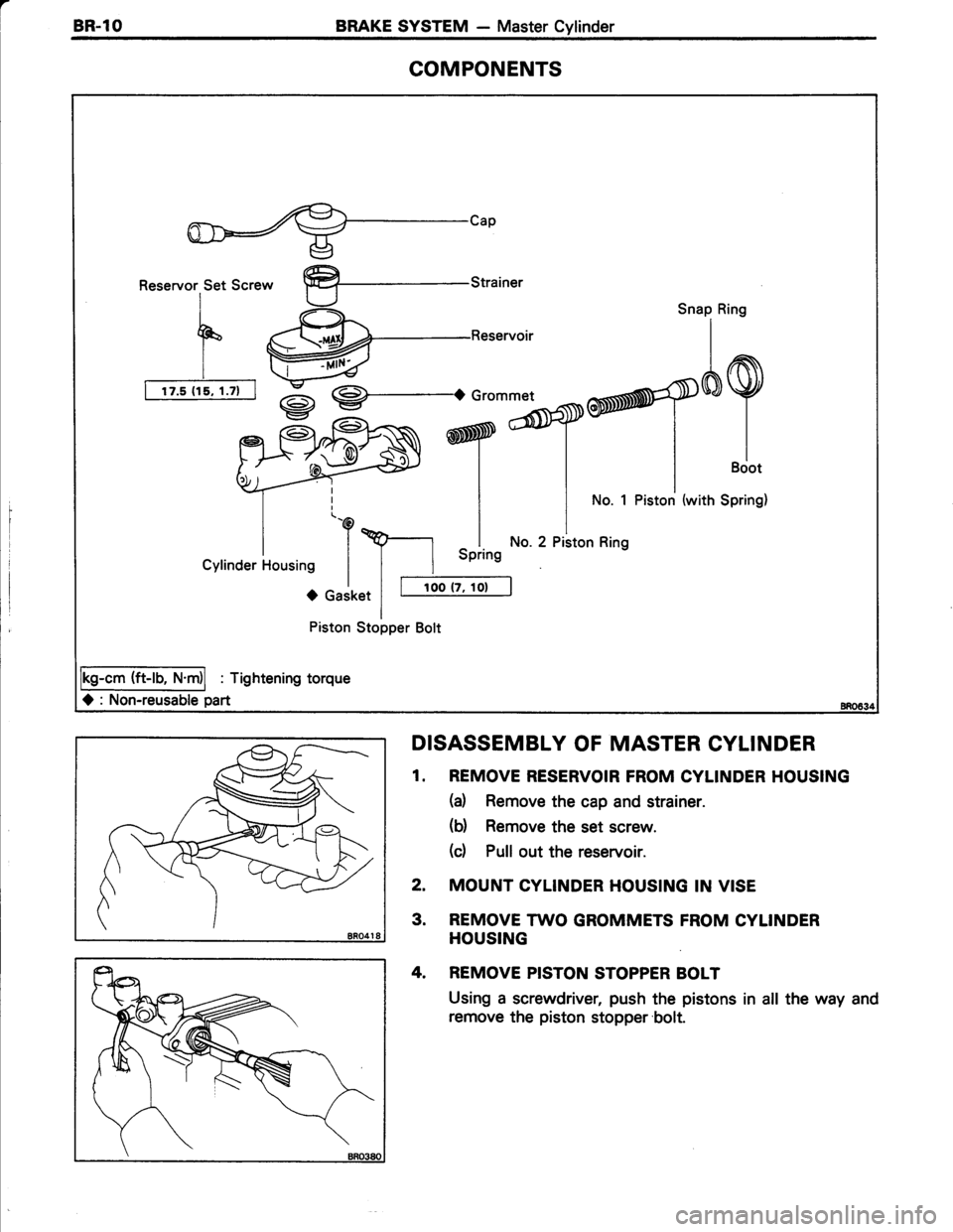
aBR.lOBRAKE SYSTEM - Master Cylinder
COMPONENTS
Reservor Set Screw
I
F(
Ir
I rzt{rtaz-l
%-Reservoir
I
9-.o
RN ry'jbTry^?
Snap Ring
}N ryofltort""* | |-+)rlllsciot
| |
*" 1 Piston (with SPring)
\p-l ^l No.2pistonRins
I I uprrng
-^ I I roo tz, rot Ierl
(ft-rb, N
O : Non-reusable part
Piston Stopper Bolt
: Tightening torque
O Gasket
DISASSEMBLY OF MASTER CYLINDER
1. REMOVE RESERVOIR FROM CYLINDER HOUSING
(a) Remove the cap and strainer.
(d Remove the set screw.
(c) Pull out the reservoir.
2. MOUNT CYLINDER HOUSING IN VISE
3. REMOVE TWO GROMMETS FROM CYLINDER
HOUSING
4. REMOVE PISTON STOPPER BOLT
Using a screwdriver, push the pistons in all the way and
remove the piston stopper'bolt.
Page 570 of 885
BRAKE SYSTEM - Master CylinderBR-11
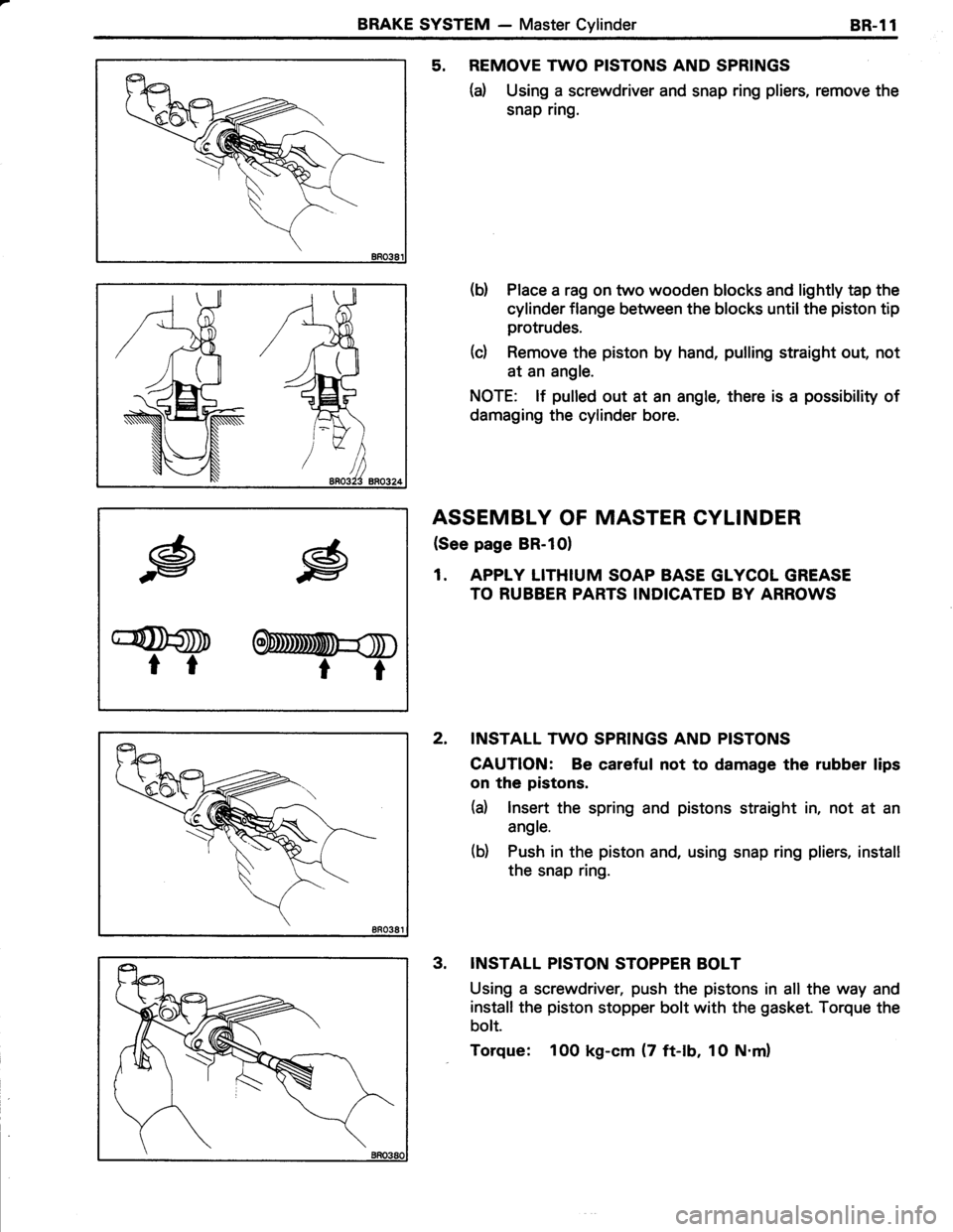
5. REMOVE TWO PISTONS AND SPRINGS
(d Using a screwdriver and snap ring pliers, remove the
snap ring.
(b) Place a rag on two wooden blocks and lightly tap the
cylinder flange between the blocks until the piston tip
protrudes.
(c) Remove the piston by hand, pulling straight out, not
at an angle.
NOTE: lf pulled out at an angle, there is a possibility of
damaging the cylinder bore.
ASSEMBLY OF MASTER CYLINDER
(See page BR-10)
1. APPLY LITHIUM SOAP BASE GLYCOL GREASE
TO RUBBER PARTS INDICATED BY ARROWS
2. INSTALL TWO SPRINGS AND PISTONS
CAUTION: Be careful not to damage the rubber lips
on the pistons.
(d lnsert the spring and pistons straight in, not at an
angle.
(b) Push in the piston and, using snap ring pliers, install
the snap ring.
INSTALL PISTON STOPPER BOLT
Using a screwdriver, push the pistons in all the way and
install the piston stopper bolt with the gasket. Torque the
bolt.
Torque: 100 kg-cm (7 ft-lb, 1O N.m)
.g
G@D
tr
.g
OnmmU=$
rt
3.
Page 571 of 885
BR-l2BRAKE SYSTEM - Master Cylinder
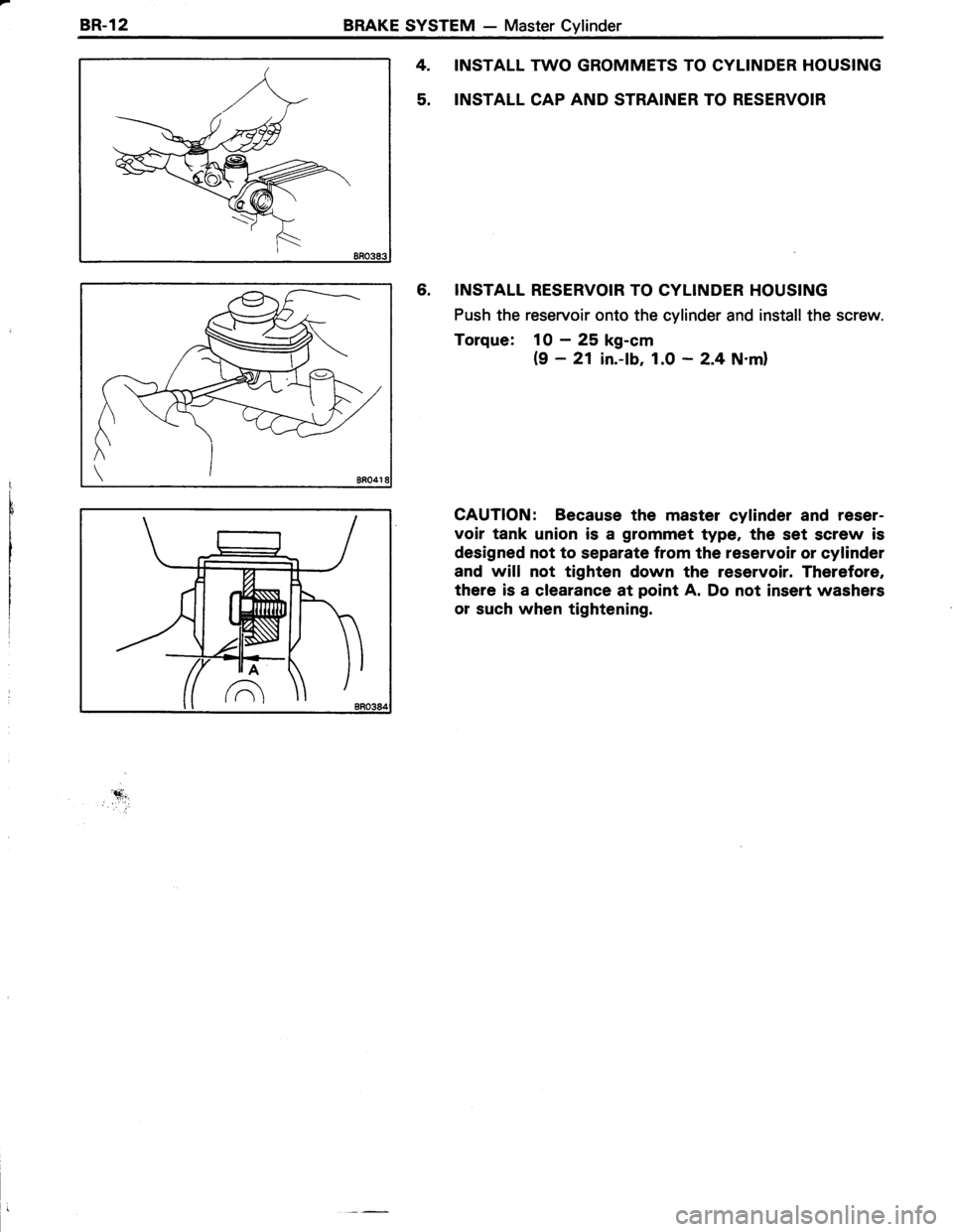
INSTALL Tv\/O GROMMETS TO CYLINDER HOUSING
INSTALL CAP AND STRAINER TO RESERVOIR
6. INSTALL RESERVOIR TO CYLINDER HOUSING
Push the reservoir onto the cylinder and install the screw.
Torque: 10 - 25 kg-cm
19 - 21 in.-lb, 1.0 - 2.4 N.ml
CAUTION: Because the master cylinder and reser-
voir tank union is a grommet type, the set screw is
designed not to separate from the reservoir or cylinder
and will not tighten down the reservoir. Therefore,
there is a clearance at point A. Do not insert washers
or such when tightening.
4.
5.
'*i,.
Page 572 of 885
BRAKE SYSTEM - Master CylinderBR-l3
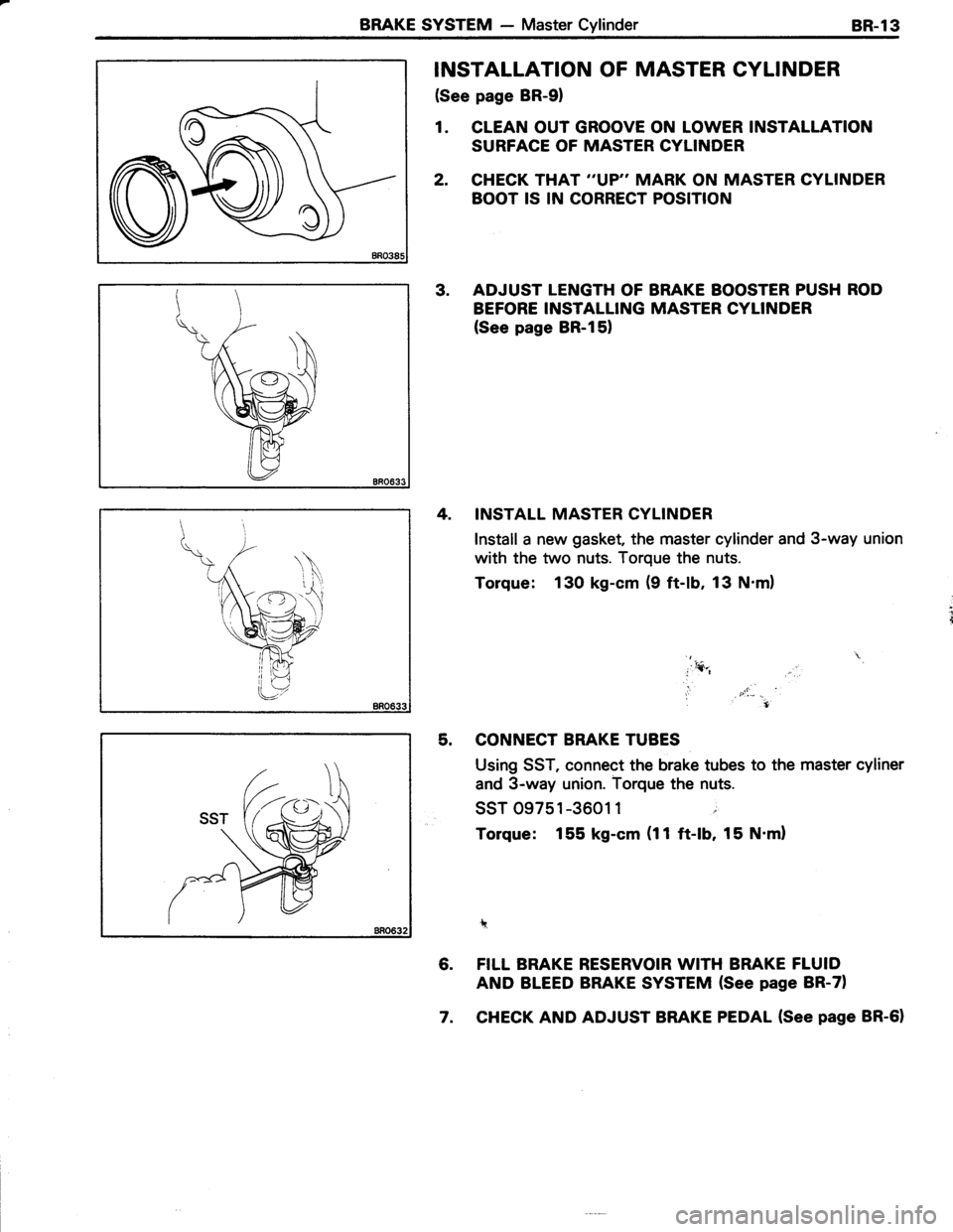
INSTALLATION OF MASTER CYLINDER
(See page BR-91
1. CLEAN OUT GROOVE ON LOWER INSTALLATION
SURFACE OF MASTER CYLINDER
2. CHECK THAT ''VP" MARK ON MASTER CYLINDER
BOOT IS IN CORRECT POSITION
3. ADJUST LENGTH OF BRAKE BOOSTER PUSH ROD
BEFORE INSTALLING MASTER CYLINDER
(See page BR-151
4. INSTALL MASTER CYLINDER
Install a new gasket, the master cylinder and 3-way union
with the two nuts. Torque the nuts.
Torque: 130 kg-cm (9 ft-lb, 13 N.ml
*
5. CONNECT BRAKE TUBES
Using SST, connect the brake tubes to the master cyliner
and 3-way union. Torque the nuts.
ssr 09751-3601 1 ;
Torque: 155 kg-cm (11ft-lb, 15 N'ml
1?
6. FILL BRAKE RESERVOIR WITH BRAKE FLUID
AND BLEED BRAKE SYSTEM {See page BR-71
7. CHECK AND ADJUST BRAKE PEDAL (See page BR-61
Page 573 of 885
8R.14BRAKE SYSTEM - Brake Booster
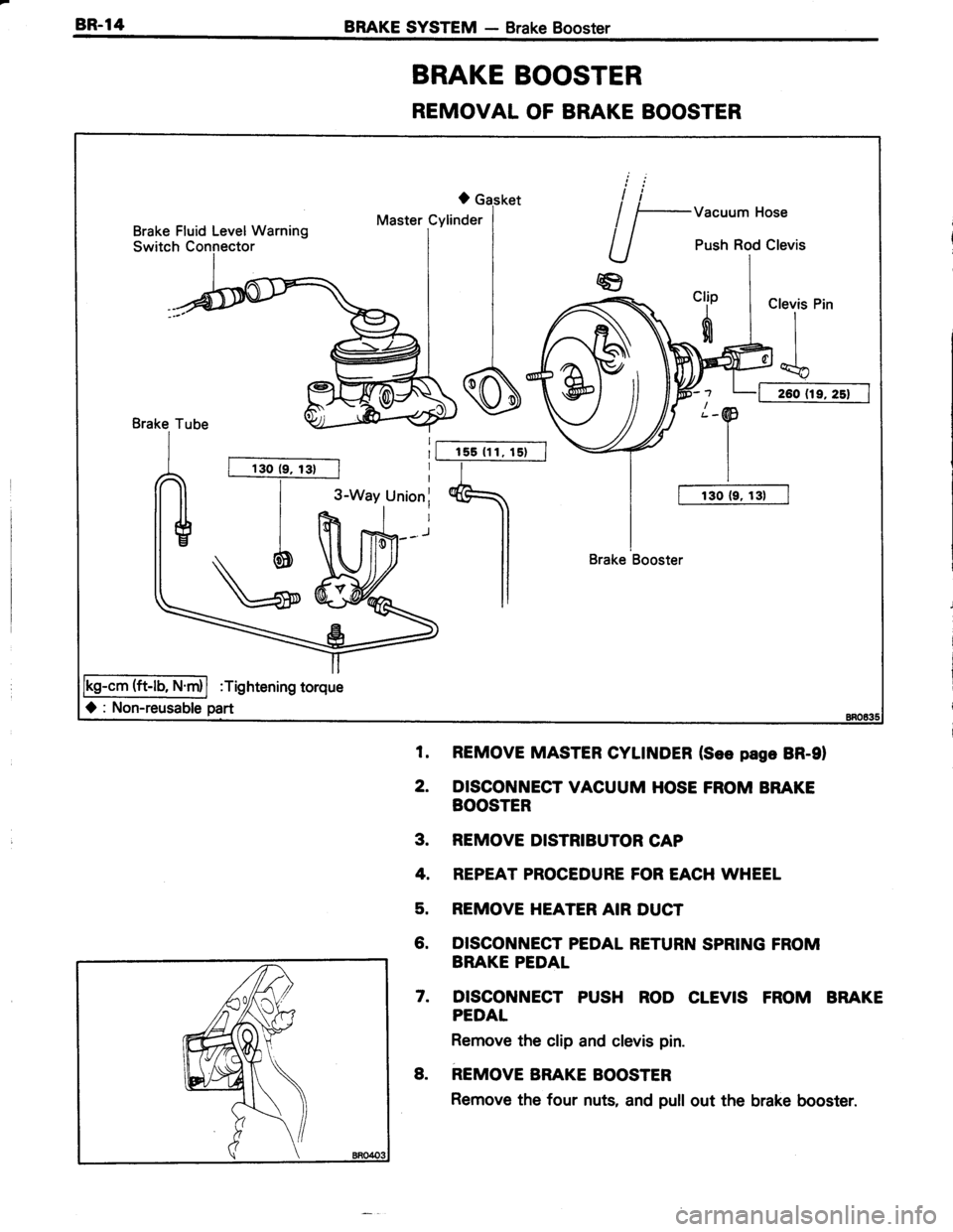
REMOVAL OF BRAKE BOOSTER
levis
II
dCI
130 (9, 131f=s(lr=' I
5
llJ
3-Way Unionl
(ft-lb, N.m):Tightening torque
0 : Non-reusable part
Brake Fluid Level Warning
Switch Connector
Brake Booster
BRAKE BOOSTER
1. REMOVE MASTER CYLINDER (See page Bn-gl
2. DISCONNECT VACUUM HOSE FROM BRAKE
BOOSTER
3. REMOVE DISTRIBUTOR CAP
4. REPEAT PROCEDURE FOR EACH WHEEL
5. REMOVE HEATER AIR DUCT
6. DISCONNECT PEDAL RETURN SPRING FROM
BRAKE PEDAL
7. DISCONNECT PUSH ROD CLEVIS FROM BRAKE
PEDAL
Remove the clip and clevis pin.
8. REMOVE BRAKE BOOSTER
Remove the four nuts, and pull out the brake booster.