1985 FORD GRANADA gearbox
[x] Cancel search: gearboxPage 52 of 255
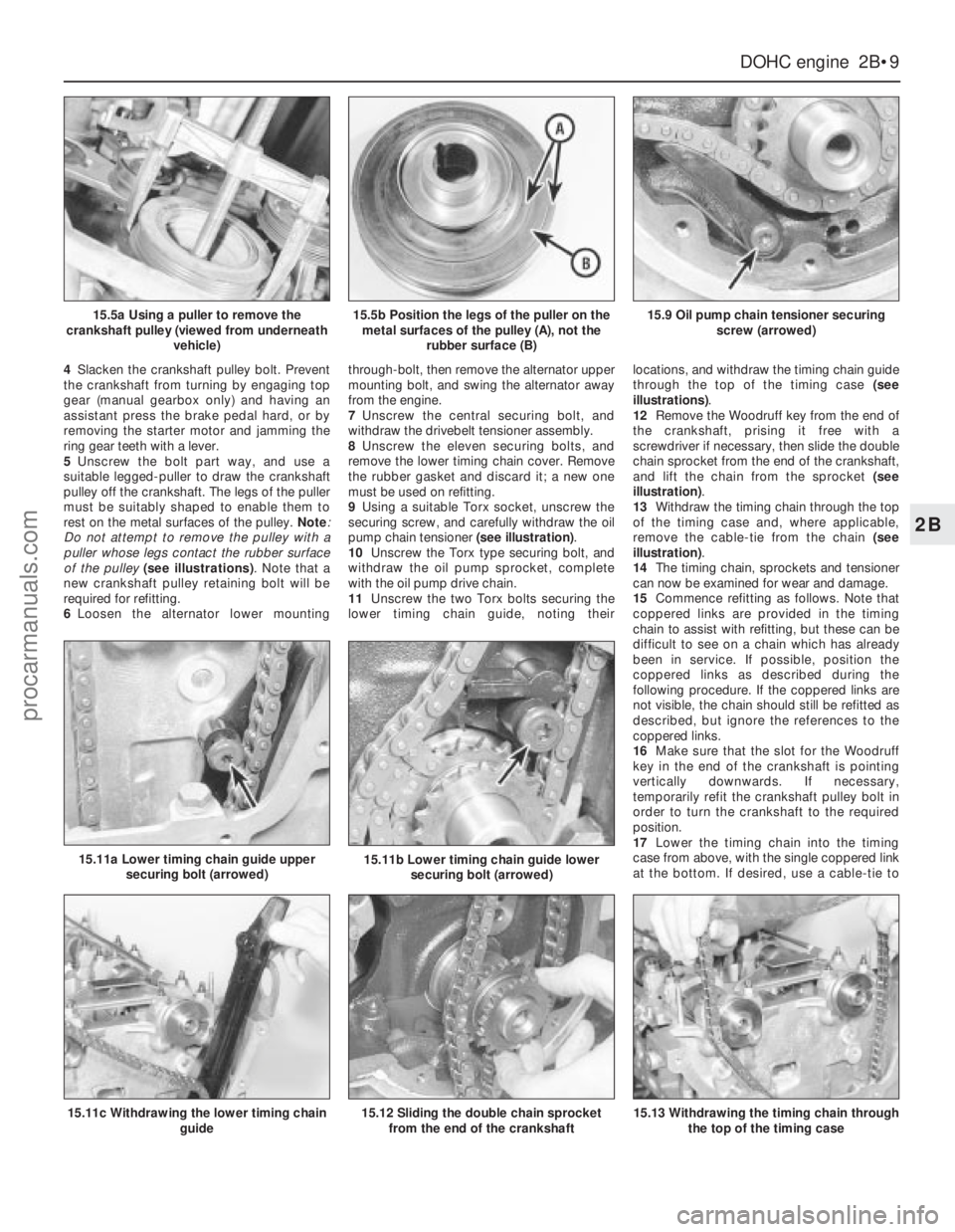
4Slacken the crankshaft pulley bolt. Prevent
the crankshaft from turning by engaging top
gear (manual gearbox only) and having an
assistant press the brake pedal hard, or by
removing the starter motor and jamming the
ring gear teeth with a lever.
5Unscrew the bolt part way, and use a
suitable legged-puller to draw the crankshaft
pulley off the crankshaft. The legs of the puller
must be suitably shaped to enable them to
rest on the metal surfaces of the pulley.Note:
Do not attempt to remove the pulley with a
puller whose legs contact the rubber surface
of the pulley(see illustrations). Note that a
new crankshaft pulley retaining bolt will be
required for refitting.
6Loosen the alternator lower mountingthrough-bolt, then remove the alternator upper
mounting bolt, and swing the alternator away
from the engine.
7Unscrew the central securing bolt, and
withdraw the drivebelt tensioner assembly.
8Unscrew the eleven securing bolts, and
remove the lower timing chain cover. Remove
the rubber gasket and discard it; a new one
must be used on refitting.
9Using a suitable Torx socket, unscrew the
securing screw, and carefully withdraw the oil
pump chain tensioner (see illustration).
10Unscrew the Torx type securing bolt, and
withdraw the oil pump sprocket, complete
with the oil pump drive chain.
11Unscrew the two Torx bolts securing the
lower timing chain guide, noting theirlocations, and withdraw the timing chain guide
through the top of the timing case (see
illustrations).
12Remove the Woodruff key from the end of
the crankshaft, prising it free with a
screwdriver if necessary, then slide the double
chain sprocket from the end of the crankshaft,
and lift the chain from the sprocket(see
illustration).
13Withdraw the timing chain through the top
of the timing case and, where applicable,
remove the cable-tie from the chain (see
illustration).
14The timing chain, sprockets and tensioner
can now be examined for wear and damage.
15Commence refitting as follows. Note that
coppered links are provided in the timing
chain to assist with refitting, but these can be
difficult to see on a chain which has already
been in service. If possible, position the
coppered links as described during the
following procedure. If the coppered links are
not visible, the chain should still be refitted as
described, but ignore the references to the
coppered links.
16Make sure that the slot for the Woodruff
key in the end of the crankshaft is pointing
vertically downwards. If necessary,
temporarily refit the crankshaft pulley bolt in
order to turn the crankshaft to the required
position.
17Lower the timing chain into the timing
case from above, with the single coppered link
at the bottom. If desired, use a cable-tie to
DOHCengine 2B•9
2B
15.5a Using a puller to remove the
crankshaft pulley (viewed from underneath
vehicle)15.5b Position the legs of the puller on the
metal surfaces of the pulley (A), not the
rubber surface (B)15.9 Oil pump chain tensioner securing
screw (arrowed)
15.12 Sliding the double chain sprocket
from the end of the crankshaft
15.11a Lower timing chain guide upper
securing bolt (arrowed)
15.13 Withdrawing the timing chain through
the top of the timing case
15.11b Lower timing chain guide lower
securing bolt (arrowed)
15.11c Withdrawing the lower timing chain
guide
procarmanuals.com
Page 58 of 255
d)Disconnect the breather hose from the
camshaft cover.
e)Remove the distributor cap and HT leads,
and the rotor arm and housing. If
necessary, mark the HT leads to aid
refitting.
2Proceed as described in paragraphs 2 to 15
inclusive of Section 18.
3Examine the surfaces of the camshaft
journals and lobes and the contact surfaces of
the cam followers for wear. If wear is
excessive, considerable noise would have
been noticed from the top of the engine when
running, and new camshafts and followers
must be fitted. It is unlikely that this level of
wear will occur unless a considerable mileage
has been covered. Note that the cam followers
cannot be dismantled for renewal of individual
components.
4Check the camshaft bearing surfaces in the
cylinder head and the bearing caps for wear. If
excessive wear is evident, the only course of
action available is to renew the cylinder head
complete with bearing caps.
5Check the cam follower bores in the
cylinder head for wear. If excessive wear is
evident, the cylinder head must be renewed.
6Check the cam follower oil grooves and the
oil ports in the cylinder head for obstructions.
7Refit the cam followers and the camshafts as
described in paragraphs 27 to 55 of Section 18.
8If the engine is in the vehicle, reverse the
operations given in paragraph 1.
Refer to Part A, Section 15 of this Chapter,
noting the following points.
a)If the engine is in the car, refer to Chapter
6 when removing and refitting the clutch,
where applicable.
b)The flywheel/driveplate securing bolts
must be renewed on refitting; the new
bolts are supplied ready-coated with
thread-locking compound (see
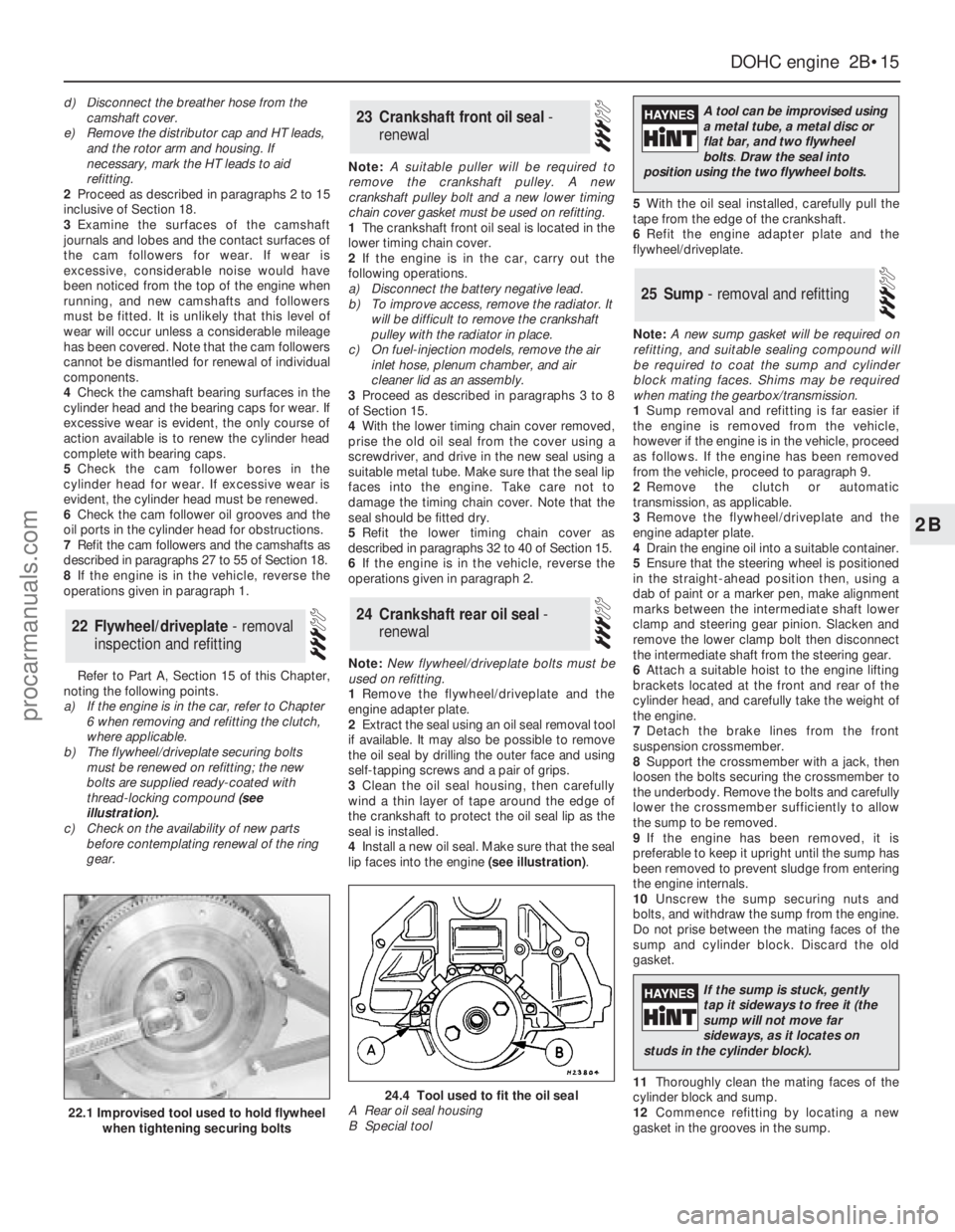
illustration).
c)Check on the availability of new parts
before contemplating renewal of the ring
gear.Note: A suitable puller will be required to
remove the crankshaft pulley. A new
crankshaft pulley bolt and a new lower timing
chain cover gasket must be used on refitting.
1The crankshaft front oil seal is located in the
lower timing chain cover.
2If the engine is in the car, carry out the
following operations.
a)Disconnect the battery negative lead.
b)To improve access, remove the radiator. It
will be difficult to remove the crankshaft
pulley with the radiator in place.
c)On fuel-injection models, remove the air
inlet hose, plenum chamber, and air
cleaner lid as an assembly.
3Proceed as described in paragraphs 3 to 8
of Section 15.
4With the lower timing chain cover removed,
prise the old oil seal from the cover using a
screwdriver, and drive in the new seal using a
suitable metal tube. Make sure that the seal lip
faces into the engine. Take care not to
damage the timing chain cover. Note that the
seal should be fitted dry.
5Refit the lower timing chain cover as
described in paragraphs 32 to 40 of Section 15.
6If the engine is in the vehicle, reverse the
operations given in paragraph 2.
Note: New flywheel/driveplate bolts must be
used on refitting.
1Remove the flywheel/driveplate and the
engine adapter plate.
2Extract the seal using an oil seal removal tool
if available. It may also be possible to remove
the oil seal by drilling the outer face and using
self-tapping screws and a pair of grips.
3Clean the oil seal housing, then carefully
wind a thin layer of tape around the edge of
the crankshaft to protect the oil seal lip as the
seal is installed.
4Install a new oil seal. Make sure that the seal
lip faces into the engine (see illustration).5With the oil seal installed, carefully pull the
tape from the edge of the crankshaft.
6Refit the engine adapter plate and the
flywheel/driveplate.
Note: A new sump gasket will be required on
refitting, and suitable sealing compound will
be required to coat the sump and cylinder
block mating faces. Shims may be required
when mating the gearbox/transmission.
1Sump removal and refitting is far easier if
the engine is removed from the vehicle,
however if the engine is in the vehicle, proceed
as follows. If the engine has been removed
from the vehicle, proceed to paragraph 9.
2Remove the clutch or automatic
transmission, as applicable.
3Remove the flywheel/driveplate and the
engine adapter plate.
4Drain the engine oil into a suitable container.
5Ensure that the steering wheel is positioned
in the straight-ahead position then, using a
dab of paint or a marker pen, make alignment
marks between the intermediate shaft lower
clamp and steering gear pinion. Slacken and
remove the lower clamp bolt then disconnect
the intermediate shaft from the steering gear.
6Attach a suitable hoist to the engine lifting
brackets located at the front and rear of the
cylinder head, and carefully take the weight of
the engine.
7Detach the brake lines from the front
suspension crossmember.
8Support the crossmember with a jack, then
loosen the bolts securing the crossmember to
the underbody. Remove the bolts and carefully
lower the crossmember sufficiently to allow
the sump to be removed.
9If the engine has been removed, it is
preferable to keep it upright until the sump has
been removed to prevent sludge from entering
the engine internals.
10Unscrew the sump securing nuts and
bolts, and withdraw the sump from the engine.
Do not prise between the mating faces of the
sump and cylinder block. Discard the old
gasket.
11Thoroughly clean the mating faces of the
cylinder block and sump.
12Commence refitting by locating a new
gasket in the grooves in the sump.
25Sump - removal and refitting
24Crankshaft rear oil seal -
renewal
23Crankshaft front oil seal -
renewal
22Flywheel/driveplate - removal
inspection and refitting
DOHCengine 2B•15
2B
22.1 Improvised tool used to hold flywheel
when tightening securing bolts
24.4 Tool used to fit the oil seal
A Rear oil seal housing
B Special tool
A tool can be improvised using
a metal tube, a metal disc or
flat bar, and two flywheel
bolts.Draw the seal into
position using the two flywheel bolts.
If the sump is stuck, gently
tap it sideways to free it (the
sump will not move far
sideways, as it locates on
studs in the cylinder block).
procarmanuals.com
Page 59 of 255
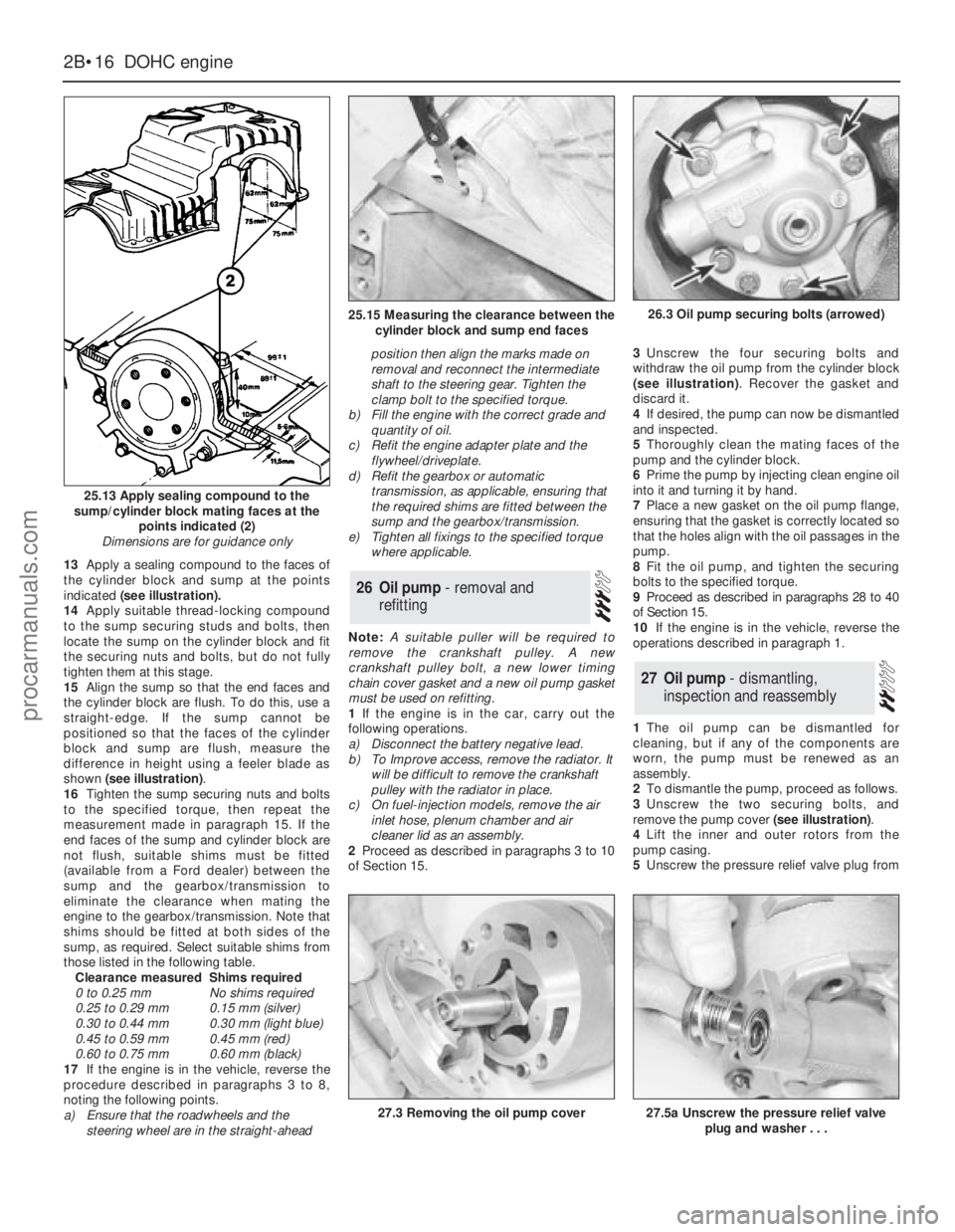
13Apply a sealing compound to the faces of
the cylinder block and sump at the points
indicated(see illustration).
14Apply suitable thread-locking compound
to the sump securing studs and bolts, then
locate the sump on the cylinder block and fit
the securing nuts and bolts, but do not fully
tighten them at this stage.
15Align the sump so that the end faces and
the cylinder block are flush. To do this, use a
straight-edge. If the sump cannot be
positioned so that the faces of the cylinder
block and sump are flush, measure the
difference in height using a feeler blade as
shown (see illustration).
16Tighten the sump securing nuts and bolts
to the specified torque, then repeat the
measurement made in paragraph 15. If the
end faces of the sump and cylinder block are
not flush, suitable shims must be fitted
(available from a Ford dealer) between the
sump and the gearbox/transmission to
eliminate the clearance when mating the
engine to the gearbox/transmission. Note that
shims should be fitted at both sides of the
sump, as required. Select suitable shims from
those listed in the following table.
Clearance measuredShims required
0 to 0.25 mmNo shims required
0.25 to 0.29 mm0.15 mm (silver)
0.30 to 0.44 mm0.30 mm (light blue)
0.45 to 0.59 mm0.45 mm (red)
0.60 to 0.75 mm0.60 mm (black)
17If the engine is in the vehicle, reverse the
procedure described in paragraphs 3 to 8,
noting the following points.
a)Ensure that the roadwheels and the
steering wheel are in the straight-aheadposition then align the marks made on
removal and reconnect the intermediate
shaft to the steering gear. Tighten the
clamp bolt to the specified torque.
b)Fill the engine with the correct grade and
quantity of oil.
c)Refit the engine adapter plate and the
flywheel/driveplate.
d)Refit the gearbox or automatic
transmission, as applicable, ensuring that
the required shims are fitted between the
sump and the gearbox/transmission.
e)Tighten all fixings to the specified torque
where applicable.
Note: A suitable puller will be required to
remove the crankshaft pulley. A new
crankshaft pulley bolt, a new lower timing
chain cover gasket and a new oil pump gasket
must be used on refitting.
1If the engine is in the car, carry out the
following operations.
a)Disconnect the battery negative lead.
b)To Improve access, remove the radiator. It
will be difficult to remove the crankshaft
pulley with the radiator in place.
c)On fuel-injection models, remove the air
inlet hose, plenum chamber and air
cleaner lid as an assembly.
2Proceed as described in paragraphs 3 to 10
of Section 15.3Unscrew the four securing bolts and
withdraw the oil pump from the cylinder block
(see illustration). Recover the gasket and
discard it.
4If desired, the pump can now be dismantled
and inspected.
5Thoroughly clean the mating faces of the
pump and the cylinder block.
6Prime the pump by injecting clean engine oil
into it and turning it by hand.
7Place a new gasket on the oil pump flange,
ensuring that the gasket is correctly located so
that the holes align with the oil passages in the
pump.
8Fit the oil pump, and tighten the securing
bolts to the specified torque.
9Proceed as described in paragraphs 28 to 40
of Section 15.
10If the engine is in the vehicle, reverse the
operations described in paragraph 1.
1The oil pump can be dismantled for
cleaning, but if any of the components are
worn, the pump must be renewed as an
assembly.
2To dismantle the pump, proceed as follows.
3Unscrew the two securing bolts, and
remove the pump cover (see illustration).
4Lift the inner and outer rotors from the
pump casing.
5Unscrew the pressure relief valve plug from
27Oil pump - dismantling,
inspection and reassembly
26Oil pump - removal and
refitting
2B•16DOHCengine
25.13 Apply sealing compound to the
sump/cylinder block mating faces at the
points indicated (2)
Dimensions are for guidance only
27.3 Removing the oil pump cover27.5a Unscrew the pressure relief valve
plug and washer . . .
25.15 Measuring the clearance between the
cylinder block and sump end faces26.3 Oil pump securing bolts (arrowed)
procarmanuals.com
Page 66 of 255
V6 engines 2C•5
2C
Crankshaft
Thrustwasher thickness:
Standard . . . . . . . . . . . . . . . . . . . . . . . . . . . . . . . . . . . . . . . . . . . . . . .2.28 to 2.33 mm
Oversize . . . . . . . . . . . . . . . . . . . . . . . . . . . . . . . . . . . . . . . . . . . . . . .2.48 to 2.53 mm
Crankshaft endfloat . . . . . . . . . . . . . . . . . . . . . . . . . . . . . . . . . . . . . . . .0.08to 0.32 mm
Permitted undersize for main and big-end bearing journals . . . . . . . . . .0.254 mm
Camshaft
Camshaft drive . . . . . . . . . . . . . . . . . . . . . . . . . . . . . . . . . . . . . . . . . . . .Chain
Cam lift (inlet and exhaust) . . . . . . . . . . . . . . . . . . . . . . . . . . . . . . . . . . .6.72 mm
Cam lobe height (inlet and exhaust) . . . . . . . . . . . . . . . . . . . . . . . . . . . .36.08 to 36.25 mm
Camshaft endfloat . . . . . . . . . . . . . . . . . . . . . . . . . . . . . . . . . . . . . . . . .0.065 to 0.165 mm
Thrust plate thickness . . . . . . . . . . . . . . . . . . . . . . . . . . . . . . . . . . . . . . .4.02 to 4.05 mm
Valves
Valve timing:
Inlet opens . . . . . . . . . . . . . . . . . . . . . . . . . . . . . . . . . . . . . . . . . . . . .24°BTDC
Inlet closes . . . . . . . . . . . . . . . . . . . . . . . . . . . . . . . . . . . . . . . . . . . . .64°ABDC
Exhaust opens . . . . . . . . . . . . . . . . . . . . . . . . . . . . . . . . . . . . . . . . . .66°BBDC
Exhaust closes . . . . . . . . . . . . . . . . . . . . . . . . . . . . . . . . . . . . . . . . . .22°ATDC
Head diameter:
Inlet valve . . . . . . . . . . . . . . . . . . . . . . . . . . . . . . . . . . . . . . . . . . . . . .39.67 to 40.06 mm
Exhaust valve . . . . . . . . . . . . . . . . . . . . . . . . . . . . . . . . . . . . . . . . . . .33.83 to 34.21 mm
Length:
Inlet valve . . . . . . . . . . . . . . . . . . . . . . . . . . . . . . . . . . . . . . . . . . . . . .106.2 to 106.9 mm
Exhaust valve . . . . . . . . . . . . . . . . . . . . . . . . . . . . . . . . . . . . . . . . . . .106.1 to 107.1 mm
Valve spring free length . . . . . . . . . . . . . . . . . . . . . . . . . . . . . . . . . . . . .55.12 mm
Torque wrench settingsNmlbf ft
Camshaft sprocket bolt . . . . . . . . . . . . . . . . . . . . . . . . . . . . . . . . . . . . .60 to 6844 to 50
Camshaft thrust plate . . . . . . . . . . . . . . . . . . . . . . . . . . . . . . . . . . . . . . .9 to 137 to 10
Timing chain guide to block bolts . . . . . . . . . . . . . . . . . . . . . . . . . . . . . .10 to 127 to 9
Timing chain tensioner to block . . . . . . . . . . . . . . . . . . . . . . . . . . . . . . .9 to 117 to 8
Oil inlet pipe to oil pump bolts . . . . . . . . . . . . . . . . . . . . . . . . . . . . . . . .9 to 137 to 10
Oil pump to block bolts . . . . . . . . . . . . . . . . . . . . . . . . . . . . . . . . . . . . .17 to 2113 to 15
Sump drain plug . . . . . . . . . . . . . . . . . . . . . . . . . . . . . . . . . . . . . . . . . . .21 to 2815to 21
Crankshaft pulley to vibration damper bolts . . . . . . . . . . . . . . . . . . . . . .27 to 3320 to 24
Crankshaft vibration damper bolt:
Stage 1 . . . . . . . . . . . . . . . . . . . . . . . . . . . . . . . . . . . . . . . . . . . . . . . .40 to 5030 to 37
Stage 2 . . . . . . . . . . . . . . . . . . . . . . . . . . . . . . . . . . . . . . . . . . . . . . . .Tighten further 80°to 90°Tighten further 80°to 90°
2.9 litre engine
Note: Unless otherwise stated, the specifications and torque wrench settings for the 2.9 litre engine are as given for the 2.8 litre engine.
General
Manufacturer’s code:
Models without catalytic converter . . . . . . . . . . . . . . . . . . . . . . . . . . .BRC
Models equipped with type N manual gearbox or automatic
transmission and a catalytic converter . . . . . . . . . . . . . . . . . . . . . .BRD
Models equipped with MT75 manual gearbox and catalytic converter . .BRE
Stroke - mm (in) . . . . . . . . . . . . . . . . . . . . . . . . . . . . . . . . . . . . . . . . . . .72.0 (2.835)
Cubic capacity - cc (cu in) . . . . . . . . . . . . . . . . . . . . . . . . . . . . . . . . . . .2936 (179.2)
Compression ratio:
BRC engine . . . . . . . . . . . . . . . . . . . . . . . . . . . . . . . . . . . . . . . . . . . . .9.5:1
BRD and BRE engine . . . . . . . . . . . . . . . . . . . . . . . . . . . . . . . . . . . . .9.0:1
Maximum power (DIN, kW @ rpm):
BRC engine . . . . . . . . . . . . . . . . . . . . . . . . . . . . . . . . . . . . . . . . . . . . .110 @ 5700
BRD and BRE engines . . . . . . . . . . . . . . . . . . . . . . . . . . . . . . . . . . . .107 @ 5500
Maximum torque (DIN, Nm @ rpm):
BRC engine . . . . . . . . . . . . . . . . . . . . . . . . . . . . . . . . . . . . . . . . . . . . .233 @ 3000
BRD engine . . . . . . . . . . . . . . . . . . . . . . . . . . . . . . . . . . . . . . . . . . . . .222 @ 3000
BRE engine . . . . . . . . . . . . . . . . . . . . . . . . . . . . . . . . . . . . . . . . . . . . .226 @ 3000
Cylinder block
Identification mark . . . . . . . . . . . . . . . . . . . . . . . . . . . . . . . . . . . . . . . . .F
Pistons
Clearance in bore . . . . . . . . . . . . . . . . . . . . . . . . . . . . . . . . . . . . . . . . . .0.028 to 0.048 mm
Piston ring end gaps:
Top and centre . . . . . . . . . . . . . . . . . . . . . . . . . . . . . . . . . . . . . . . . . .0.30 to 0.50 mm
procarmanuals.com
Page 68 of 255
meters and air inlet trunking. Also remove the
oil filler cap, which is connected to the
trunking by a crankcase ventilation hose.
5Release the securing clips and bolts and
remove the upper half of the fan shroud.
6Drain the cooling system and remove the
radiator.
7Disconnect the heater hoses from the
heater matrix and from the coolant outlet.
Unclip the hoses.
8Remove the fan and viscous clutch (where
fitted).
9Disconnect the following wiring:
a)Alternator
b)Temperature gauge sender
c)Engine management temperature sensor
d)Oil pressure switch
e)Idle speed control valve
f)Throttle position sensor
g)Injector nut-harness
h)Distributor multi-plug
i)Distributor-to-coil HT lead
10Disconnect the throttle cable. When
applicable, also disconnect the downshaft
cable or switch.
11Depressurise the fuel system and
disconnect the fuel supply and return lines
(see Chapter 4).
12Remove the steering pump and air
conditioning compressor drivebelts (as
applicable). Unbolt the steering pump and
compressor, move them aside within the limitsof their flexible hoses and support them by
wiring them to adjacent components.
13Remove the distributor cap and rotor.
14Remove the starter motor.
15Drain the engine oil. Unscrew the oil filter
with a strap or chain wrench and remove it; be
prepared for oil spillage.
16On manual gearbox models, disconnect
the clutch cable from the release lever.
17Unbolt the exhaust pipes from the
manifolds.
18On automatic transmission models, unbolt
the torque converter from the driveplate.
19Attach lifting tackle to the engine. If no
lifting eyes are fitted, pass ropes or chains
round the exhaust manifolds.
20Take the weight of the engine, then
remove the single nut on each side which
holds engine bearer to its mountings.
21From under the vehicle unbolt the engine
adapter plate from the bellhousing.
22Remove the engine-to-bellhousing bolts.
Also disconnect or unclip the battery negative
lead, the starter motor lead and the heat
shield.
23Support the transmission, preferably with
a trolley jack.
24Check that nothing has been overlooked,
then raise the engine and draw it forwards
clear of the transmission input shaft. Do not
allow the weight of the engine to hang on the
shaft, and do not lift the transmission by it.25With automatic transmission, make sure
that the torque converter stays engaged with
the oil pump in the transmission as the engine
is withdrawn.
26Lift the engine out of the engine bay and
take it to the bench.
2.4 & 2.9 litre engines
27The removal operations for these engines
are essentially as described for the 2.8 litre
version. Note the following points.
Coolant hoses
28Remove the hoses which run between the
thermostat housing and the water pump, and
the cooling system expansion tank.
29Remove the heater hoses which run
between the thermostat housing or coolant
distribution pipe and oil cooler (where fitted).
Vacuum hoses
30Disconnect the hose from the fuel
pressure regulator.
31Disconnect the hose from the plenum
chamber.
32Disconnect the hose from the throttle valve.
33Disconnect the hose from the T-piece
connector.
V6 engines 2C•7
2C
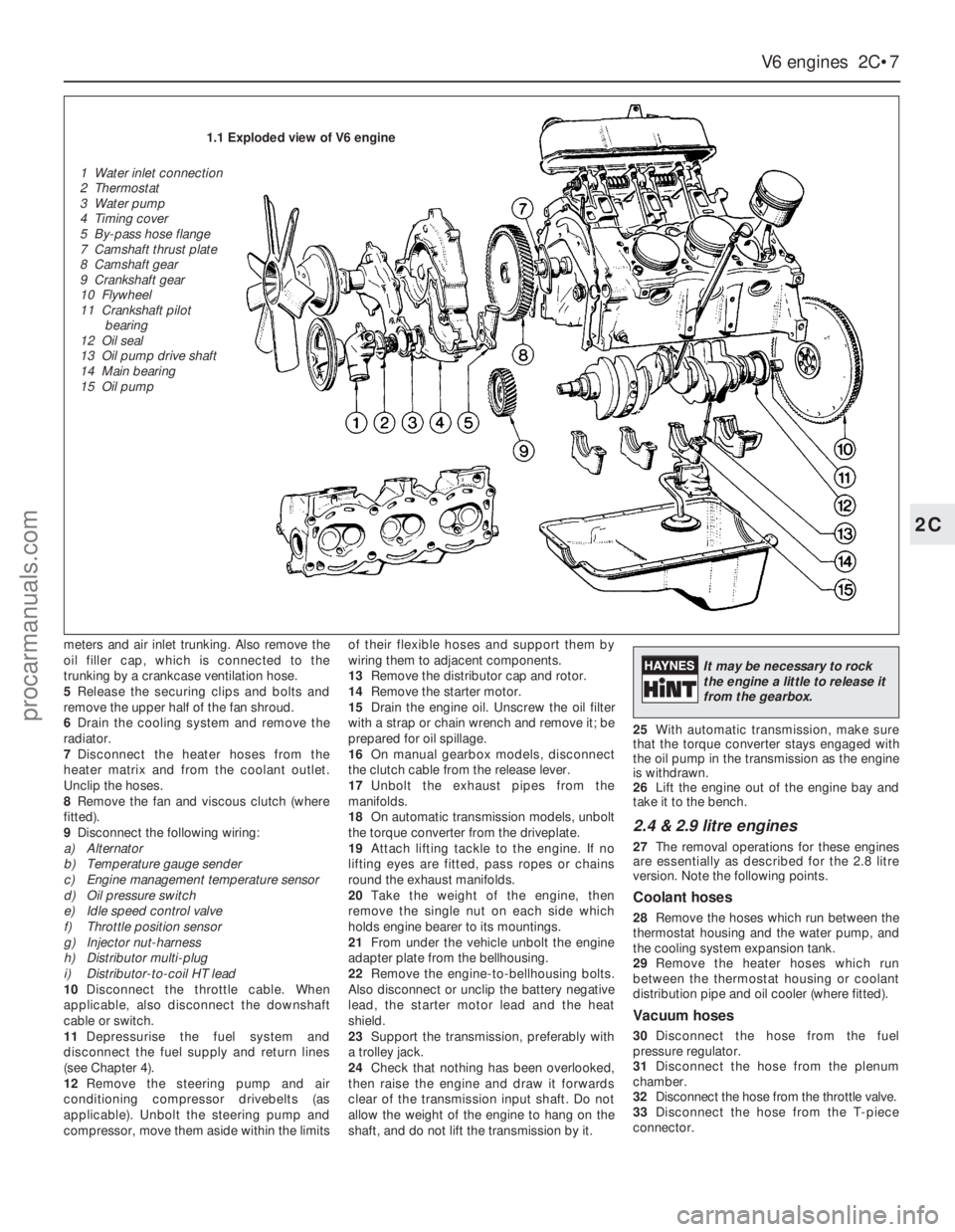
1.1 Exploded view of V6 engine
1 Water inlet connection
2 Thermostat
3 Water pump
4 Timing cover
5 By-pass hose flange
7 Camshaft thrust plate
8 Camshaft gear
9 Crankshaft gear
10 Flywheel
11 Crankshaft pilot
bearing
12 Oil seal
13 Oil pump drive shaft
14 Main bearing
15 Oil pump
It may be necessary to rock
the engine a little to release it
from the gearbox.
procarmanuals.com
Page 94 of 255
Chapter 4
Fuel and exhaust systems
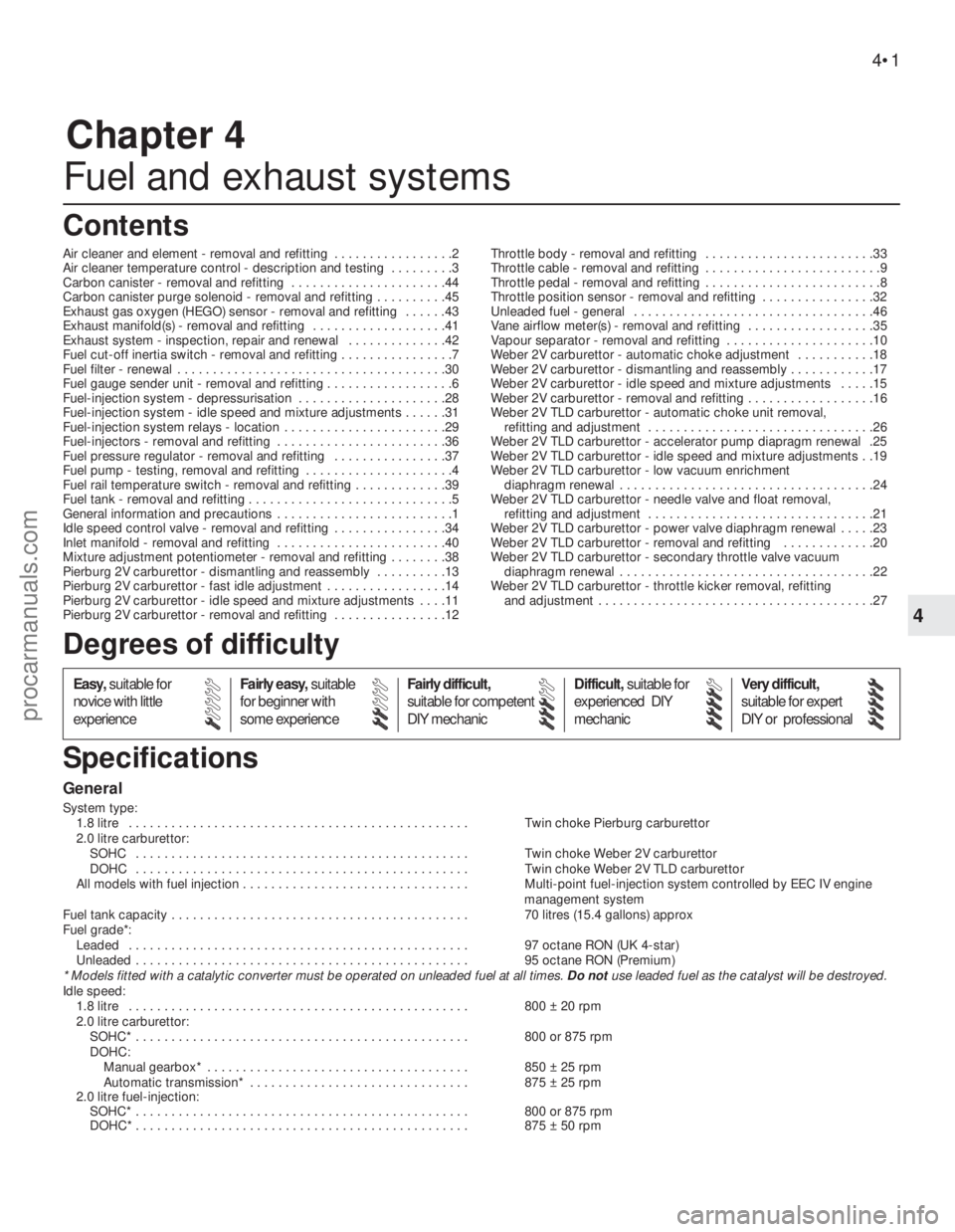
Air cleaner and element - removal and refitting . . . . . . . . . . . . . . . . .2
Air cleaner temperature control - description and testing . . . . . . . . .3
Carbon canister - removal and refitting . . . . . . . . . . . . . . . . . . . . . .44
Carbon canister purge solenoid - removal and refitting . . . . . . . . . .45
Exhaust gas oxygen (HEGO) sensor - removal and refitting . . . . . .43
Exhaust manifold(s) - removal and refitting . . . . . . . . . . . . . . . . . . .41
Exhaust system - inspection, repair and renewal . . . . . . . . . . . . . .42
Fuel cut-off inertia switch - removal and refitting . . . . . . . . . . . . . . . .7
Fuel filter - renewal . . . . . . . . . . . . . . . . . . . . . . . . . . . . . . . . . . . . . .30
Fuel gauge sender unit - removal and refitting . . . . . . . . . . . . . . . . . .6
Fuel-injection system - depressurisation . . . . . . . . . . . . . . . . . . . . .28
Fuel-injection system - idle speed and mixture adjustments . . . . . .31
Fuel-injection system relays - location . . . . . . . . . . . . . . . . . . . . . . .29
Fuel-injectors - removal and refitting . . . . . . . . . . . . . . . . . . . . . . . .36
Fuel pressure regulator - removal and refitting . . . . . . . . . . . . . . . .37
Fuel pump - testing, removal and refitting . . . . . . . . . . . . . . . . . . . . .4
Fuel rail temperature switch - removal and refitting . . . . . . . . . . . . .39
Fuel tank - removal and refitting . . . . . . . . . . . . . . . . . . . . . . . . . . . . .5
General information and precautions . . . . . . . . . . . . . . . . . . . . . . . . .1
Idle speed control valve - removal and refitting . . . . . . . . . . . . . . . .34
Inlet manifold - removal and refitting . . . . . . . . . . . . . . . . . . . . . . . .40
Mixture adjustment potentiometer - removal and refitting . . . . . . . .38
Pierburg 2V carburettor - dismantling and reassembly . . . . . . . . . .13
Pierburg 2V carburettor - fast idle adjustment . . . . . . . . . . . . . . . . .14
Pierburg 2V carburettor - idle speed and mixture adjustments . . . .11
Pierburg 2V carburettor - removal and refitting . . . . . . . . . . . . . . . .12Throttle body - removal and refitting . . . . . . . . . . . . . . . . . . . . . . . .33
Throttle cable - removal and refitting . . . . . . . . . . . . . . . . . . . . . . . . .9
Throttle pedal - removal and refitting . . . . . . . . . . . . . . . . . . . . . . . . .8
Throttle position sensor - removal and refitting . . . . . . . . . . . . . . . .32
Unleaded fuel - general . . . . . . . . . . . . . . . . . . . . . . . . . . . . . . . . . .46
Vane airflow meter(s) - removal and refitting . . . . . . . . . . . . . . . . . .35
Vapour separator - removal and refitting . . . . . . . . . . . . . . . . . . . . .10
Weber 2V carburettor - automatic choke adjustment . . . . . . . . . . .18
Weber 2V carburettor - dismantling and reassembly . . . . . . . . . . . .17
Weber 2V carburettor - idle speed and mixture adjustments . . . . .15
Weber 2V carburettor - removal and refitting . . . . . . . . . . . . . . . . . .16
Weber 2V TLD carburettor - automatic choke unit removal,
refitting and adjustment . . . . . . . . . . . . . . . . . . . . . . . . . . . . . . . .26
Weber 2V TLD carburettor - accelerator pump diapragm renewal .25
Weber 2V TLD carburettor - idle speed and mixture adjustments . .19
Weber 2V TLD carburettor - low vacuum enrichment
diaphragm renewal . . . . . . . . . . . . . . . . . . . . . . . . . . . . . . . . . . . .24
Weber 2V TLD carburettor - needle valve and float removal,
refitting and adjustment . . . . . . . . . . . . . . . . . . . . . . . . . . . . . . . .21
Weber 2V TLD carburettor - power valve diaphragm renewal . . . . .23
Weber 2V TLD carburettor - removal and refitting . . . . . . . . . . . . .20
Weber 2V TLD carburettor - secondary throttle valve vacuum
diaphragm renewal . . . . . . . . . . . . . . . . . . . . . . . . . . . . . . . . . . . .22
Weber 2V TLD carburettor - throttle kicker removal, refitting
and adjustment . . . . . . . . . . . . . . . . . . . . . . . . . . . . . . . . . . . . . . .27
General
System type:
1.8 litre . . . . . . . . . . . . . . . . . . . . . . . . . . . . . . . . . . . . . . . . . . . . . . . . Twin choke Pierburg carburettor
2.0 litre carburettor:
SOHC . . . . . . . . . . . . . . . . . . . . . . . . . . . . . . . . . . . . . . . . . . . . . . . Twin choke Weber 2V carburettor
DOHC . . . . . . . . . . . . . . . . . . . . . . . . . . . . . . . . . . . . . . . . . . . . . . . Twin choke Weber 2V TLD carburettor
All models with fuel injection . . . . . . . . . . . . . . . . . . . . . . . . . . . . . . . . Multi-point fuel-injection system controlled by EEC IV engine
management system
Fuel tank capacity . . . . . . . . . . . . . . . . . . . . . . . . . . . . . . . . . . . . . . . . . . 70 litres (15.4 gallons) approx
Fuel grade*:
Leaded . . . . . . . . . . . . . . . . . . . . . . . . . . . . . . . . . . . . . . . . . . . . . . . . 97 octane RON (UK 4-star)
Unleaded . . . . . . . . . . . . . . . . . . . . . . . . . . . . . . . . . . . . . . . . . . . . . . . 95 octane RON (Premium)
* Models fitted with a catalytic converter must be operated on unleaded fuel at all times. Do notuse leaded fuel as the catalyst will be destroyed.
Idle speed:
1.8 litre . . . . . . . . . . . . . . . . . . . . . . . . . . . . . . . . . . . . . . . . . . . . . . . . 800 ± 20 rpm
2.0 litre carburettor:
SOHC* . . . . . . . . . . . . . . . . . . . . . . . . . . . . . . . . . . . . . . . . . . . . . . . 800 or 875 rpm
DOHC:
Manual gearbox* . . . . . . . . . . . . . . . . . . . . . . . . . . . . . . . . . . . . . 850 ± 25 rpm
Automatic transmission* . . . . . . . . . . . . . . . . . . . . . . . . . . . . . . . 875 ± 25 rpm
2.0 litre fuel-injection:
SOHC* . . . . . . . . . . . . . . . . . . . . . . . . . . . . . . . . . . . . . . . . . . . . . . . 800 or 875 rpm
DOHC* . . . . . . . . . . . . . . . . . . . . . . . . . . . . . . . . . . . . . . . . . . . . . . . 875 ± 50 rpm
4•1
Easy,suitable for
novice with little
experienceFairly easy,suitable
for beginner with
some experienceFairly difficult,
suitable for competent
DIY mechanicDifficult,suitable for
experienced DIY
mechanicVery difficult,
suitable for expert
DIY or professional
Degrees of difficulty
Specifications Contents
4
procarmanuals.com
Page 96 of 255
Fuel and exhaust systems 4•3
4
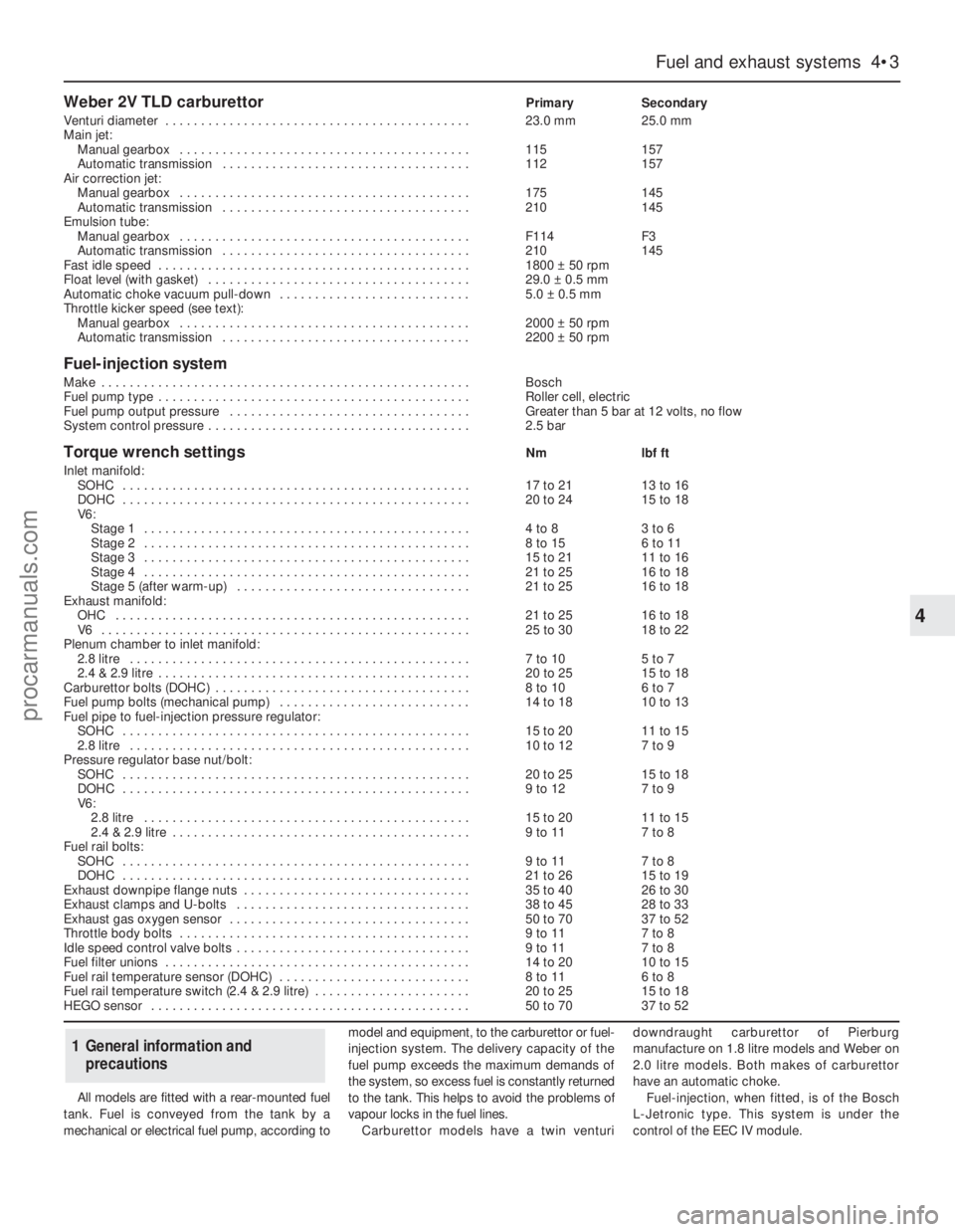
Weber 2V TLD carburettorPrimarySecondary
Venturi diameter . . . . . . . . . . . . . . . . . . . . . . . . . . . . . . . . . . . . . . . . . . .23.0 mm25.0 mm
Main jet:
Manual gearbox . . . . . . . . . . . . . . . . . . . . . . . . . . . . . . . . . . . . . . . . .115157
Automatic transmission . . . . . . . . . . . . . . . . . . . . . . . . . . . . . . . . . . .112157
Air correction jet:
Manual gearbox . . . . . . . . . . . . . . . . . . . . . . . . . . . . . . . . . . . . . . . . .175145
Automatic transmission . . . . . . . . . . . . . . . . . . . . . . . . . . . . . . . . . . .210145
Emulsion tube:
Manual gearbox . . . . . . . . . . . . . . . . . . . . . . . . . . . . . . . . . . . . . . . . .F114F3
Automatic transmission . . . . . . . . . . . . . . . . . . . . . . . . . . . . . . . . . . .210145
Fast idle speed . . . . . . . . . . . . . . . . . . . . . . . . . . . . . . . . . . . . . . . . . . . .1800 ±50 rpm
Float level (with gasket) . . . . . . . . . . . . . . . . . . . . . . . . . . . . . . . . . . . . .29.0 ±0.5 mm
Automatic choke vacuum pull-down . . . . . . . . . . . . . . . . . . . . . . . . . . .5.0 ±0.5 mm
Throttle kicker speed (see text):
Manual gearbox . . . . . . . . . . . . . . . . . . . . . . . . . . . . . . . . . . . . . . . . .2000 ±50 rpm
Automatic transmission . . . . . . . . . . . . . . . . . . . . . . . . . . . . . . . . . . .2200 ±50 rpm
Fuel-injection system
Make . . . . . . . . . . . . . . . . . . . . . . . . . . . . . . . . . . . . . . . . . . . . . . . . . . . .Bosch
Fuel pump type . . . . . . . . . . . . . . . . . . . . . . . . . . . . . . . . . . . . . . . . . . . .Roller cell, electric
Fuel pump output pressure . . . . . . . . . . . . . . . . . . . . . . . . . . . . . . . . . .Greater than 5 bar at 12 volts, no flow
System control pressure . . . . . . . . . . . . . . . . . . . . . . . . . . . . . . . . . . . . .2.5 bar
Torque wrench settingsNmlbf ft
Inlet manifold:
SOHC . . . . . . . . . . . . . . . . . . . . . . . . . . . . . . . . . . . . . . . . . . . . . . . . .17 to 2113 to 16
DOHC . . . . . . . . . . . . . . . . . . . . . . . . . . . . . . . . . . . . . . . . . . . . . . . . .20 to 2415 to 18
V6:
Stage 1 . . . . . . . . . . . . . . . . . . . . . . . . . . . . . . . . . . . . . . . . . . . . . .4 to 83 to 6
Stage 2 . . . . . . . . . . . . . . . . . . . . . . . . . . . . . . . . . . . . . . . . . . . . . .8 to 156 to 11
Stage 3 . . . . . . . . . . . . . . . . . . . . . . . . . . . . . . . . . . . . . . . . . . . . . .15 to 2111 to 16
Stage 4 . . . . . . . . . . . . . . . . . . . . . . . . . . . . . . . . . . . . . . . . . . . . . .21 to 2516 to 18
Stage 5 (after warm-up) . . . . . . . . . . . . . . . . . . . . . . . . . . . . . . . . .21 to 2516 to 18
Exhaust manifold:
OHC . . . . . . . . . . . . . . . . . . . . . . . . . . . . . . . . . . . . . . . . . . . . . . . . . .21 to 2516 to 18
V6 . . . . . . . . . . . . . . . . . . . . . . . . . . . . . . . . . . . . . . . . . . . . . . . . . . . .25 to 3018 to 22
Plenum chamber to inlet manifold:
2.8 litre . . . . . . . . . . . . . . . . . . . . . . . . . . . . . . . . . . . . . . . . . . . . . . . .7 to 105 to 7
2.4 & 2.9 litre . . . . . . . . . . . . . . . . . . . . . . . . . . . . . . . . . . . . . . . . . . . .20 to 2515 to 18
Carburettor bolts (DOHC) . . . . . . . . . . . . . . . . . . . . . . . . . . . . . . . . . . . .8 to 106 to 7
Fuel pump bolts (mechanical pump) . . . . . . . . . . . . . . . . . . . . . . . . . . .14 to 1810 to 13
Fuel pipe to fuel-injection pressure regulator:
SOHC . . . . . . . . . . . . . . . . . . . . . . . . . . . . . . . . . . . . . . . . . . . . . . . . .15 to 2011 to 15
2.8 litre . . . . . . . . . . . . . . . . . . . . . . . . . . . . . . . . . . . . . . . . . . . . . . . .10 to 127 to 9
Pressure regulator base nut/bolt:
SOHC . . . . . . . . . . . . . . . . . . . . . . . . . . . . . . . . . . . . . . . . . . . . . . . . .20 to 2515 to 18
DOHC . . . . . . . . . . . . . . . . . . . . . . . . . . . . . . . . . . . . . . . . . . . . . . . . .9 to 127 to 9
V6:
2.8 litre . . . . . . . . . . . . . . . . . . . . . . . . . . . . . . . . . . . . . . . . . . . . . .15 to 2011 to 15
2.4 & 2.9 litre . . . . . . . . . . . . . . . . . . . . . . . . . . . . . . . . . . . . . . . . . .9 to 117 to 8
Fuel rail bolts:
SOHC . . . . . . . . . . . . . . . . . . . . . . . . . . . . . . . . . . . . . . . . . . . . . . . . .9 to 117 to 8
DOHC . . . . . . . . . . . . . . . . . . . . . . . . . . . . . . . . . . . . . . . . . . . . . . . . .21 to 2615 to 19
Exhaust downpipe flange nuts . . . . . . . . . . . . . . . . . . . . . . . . . . . . . . . .35 to 4026 to 30
Exhaust clamps and U-bolts . . . . . . . . . . . . . . . . . . . . . . . . . . . . . . . . .38 to 4528 to 33
Exhaust gas oxygen sensor . . . . . . . . . . . . . . . . . . . . . . . . . . . . . . . . . .50 to 7037 to 52
Throttle body bolts . . . . . . . . . . . . . . . . . . . . . . . . . . . . . . . . . . . . . . . . .9 to 117 to 8
Idle speed control valve bolts . . . . . . . . . . . . . . . . . . . . . . . . . . . . . . . . .9 to 117 to 8
Fuel filter unions . . . . . . . . . . . . . . . . . . . . . . . . . . . . . . . . . . . . . . . . . . .14 to 2010 to 15
Fuel rail temperature sensor (DOHC) . . . . . . . . . . . . . . . . . . . . . . . . . . .8 to 116 to 8
Fuel rail temperature switch (2.4 & 2.9 litre) . . . . . . . . . . . . . . . . . . . . . .20 to 2515 to 18
HEGO sensor . . . . . . . . . . . . . . . . . . . . . . . . . . . . . . . . . . . . . . . . . . . . .50 to 7037 to 52
All models are fitted with a rear-mounted fuel
tank. Fuel is conveyed from the tank by a
mechanical or electrical fuel pump, according tomodel and equipment, to the carburettor or fuel-
injection system. The delivery capacity of the
fuel pump exceeds the maximum demands of
the system, so excess fuel is constantly returned
to the tank. This helps to avoid the problems of
vapour locks in the fuel lines.
Carburettor models have a twin venturidowndraught carburettor of Pierburg
manufacture on 1.8 litre models and Weber on
2.0 litre models. Both makes of carburettor
have an automatic choke.
Fuel-injection, when fitted, is of the Bosch
L-Jetronic type. This system is under the
control of the EEC IV module.
1General information and
precautions
procarmanuals.com
Page 116 of 255
Models up to July 1990
1The carbon canister is situated in the engine
compartment where it is mounted onto the
right-hand valance next to the suspension
strut mounting.
2To remove the canister first disconnect the
battery negative terminal. If necessary, undo
the two coolant expansion tank retaining
screws and position the tank clear of the
canister to improve access.
3Disconnect the vacuum hose from the top
of the canister.
4Slacken and remove the mounting bolt and
withdraw the canister from the engine
compartment.
5Refitting is a reverse of the removal
procedure.
Models from July 1990
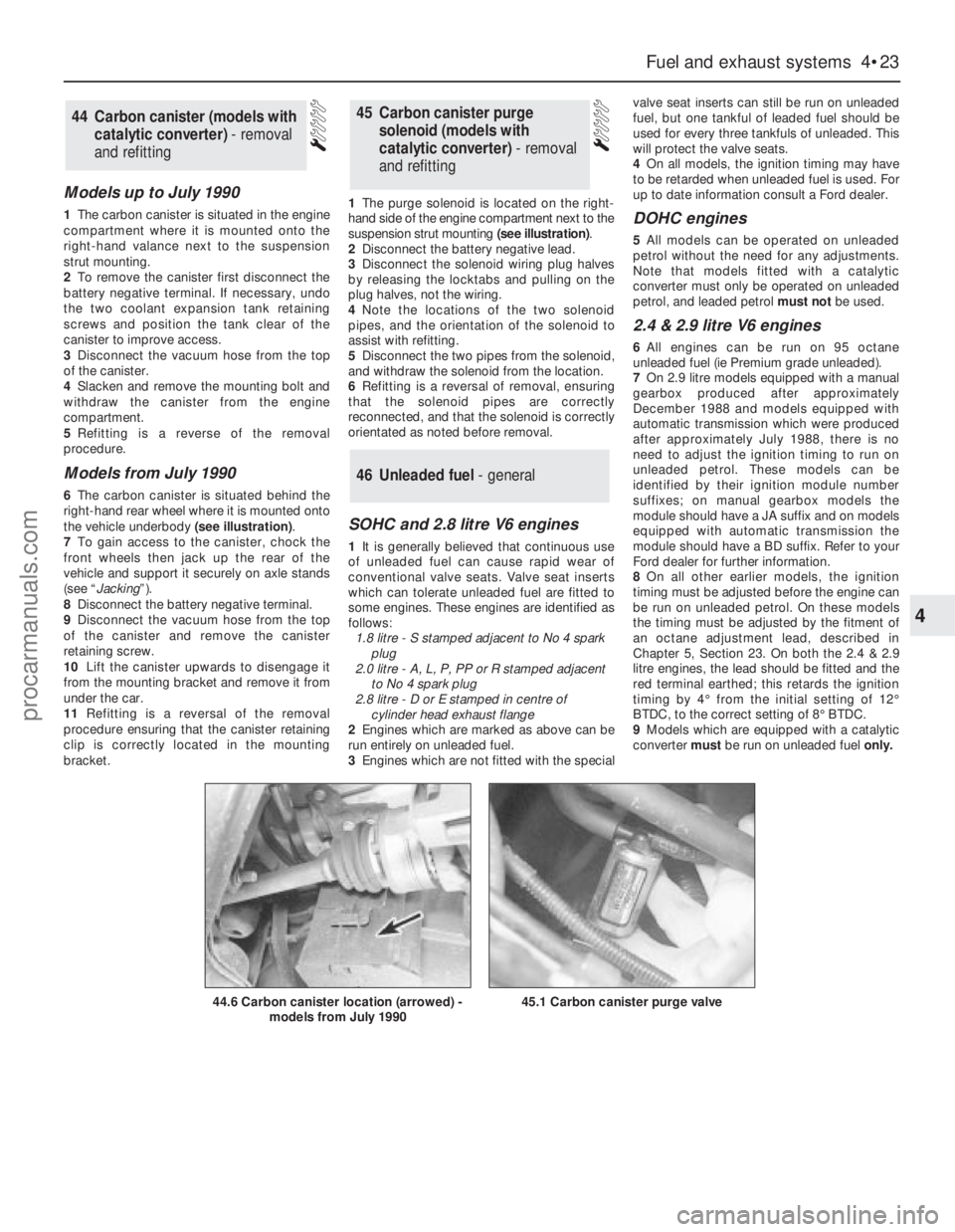
6The carbon canister is situated behind the
right-hand rear wheel where it is mounted onto
the vehicle underbody (see illustration).
7To gain access to the canister, chock the
front wheels then jack up the rear of the
vehicle and support it securely on axle stands
(see “Jacking”).
8Disconnect the battery negative terminal.
9Disconnect the vacuum hose from the top
of the canister and remove the canister
retaining screw.
10Lift the canister upwards to disengage it
from the mounting bracket and remove it from
under the car.
11Refitting is a reversal of the removal
procedure ensuring that the canister retaining
clip is correctly located in the mounting
bracket.1The purge solenoid is located on the right-
hand side of the engine compartment next to the
suspension strut mounting (see illustration).
2Disconnect the battery negative lead.
3Disconnect the solenoid wiring plug halves
by releasing the locktabs and pulling on the
plug halves, not the wiring.
4Note the locations of the two solenoid
pipes, and the orientation of the solenoid to
assist with refitting.
5Disconnect the two pipes from the solenoid,
and withdraw the solenoid from the location.
6Refitting is a reversal of removal, ensuring
that the solenoid pipes are correctly
reconnected, and that the solenoid is correctly
orientated as noted before removal.
SOHC and 2.8 litre V6 engines
1It is generally believed that continuous use
of unleaded fuel can cause rapid wear of
conventional valve seats. Valve seat inserts
which can tolerate unleaded fuel are fitted to
some engines. These engines are identified as
follows:
1.8 litre - S stamped adjacent to No 4 spark
plug
2.0 litre - A, L, P, PP or R stamped adjacent
to No 4 spark plug
2.8 litre - D or E stamped in centre of
cylinder head exhaust flange
2Engines which are marked as above can be
run entirely on unleaded fuel.
3Engines which are not fitted with the specialvalve seat inserts can still be run on unleaded
fuel, but one tankful of leaded fuel should be
used for every three tankfuls of unleaded. This
will protect the valve seats.
4On all models, the ignition timing may have
to be retarded when unleaded fuel is used. For
up to date information consult a Ford dealer.
DOHC engines
5All models can be operated on unleaded
petrol without the need for any adjustments.
Note that models fitted with a catalytic
converter must only be operated on unleaded
petrol, and leaded petrol must notbe used.
2.4 & 2.9 litre V6 engines
6All engines can be run on 95 octane
unleaded fuel (ie Premium grade unleaded).
7On 2.9 litre models equipped with a manual
gearbox produced after approximately
December 1988 and models equipped with
automatic transmission which were produced
after approximately July 1988, there is no
need to adjust the ignition timing to run on
unleaded petrol. These models can be
identified by their ignition module number
suffixes; on manual gearbox models the
module should have a JA suffix and on models
equipped with automatic transmission the
module should have a BD suffix. Refer to your
Ford dealer for further information.
8On all other earlier models, the ignition
timing must be adjusted before the engine can
be run on unleaded petrol. On these models
the timing must be adjusted by the fitment of
an octane adjustment lead, described in
Chapter 5, Section 23. On both the 2.4 & 2.9
litre engines, the lead should be fitted and the
red terminal earthed; this retards the ignition
timing by 4°from the initial setting of 12°
BTDC, to the correct setting of 8°BTDC.
9Models which are equipped with a catalytic
converter must be run on unleaded fuel only.
46Unleaded fuel - general
45Carbon canister purge
solenoid (models with
catalytic converter) - removal
and refitting44Carbon canister (models with
catalytic converter) - removal
and refitting
Fuel and exhaust systems 4•23
4
44.6 Carbon canister location (arrowed) -
models from July 199045.1 Carbon canister purge valve
procarmanuals.com