1983 FIAT UNO timing belt
[x] Cancel search: timing beltPage 170 of 303

133Drain the engine oil from the sump into a
suitable container. Disconnect the lead from
the engine oil level sensor in the sump.
134Where applicable, unscrew and remove
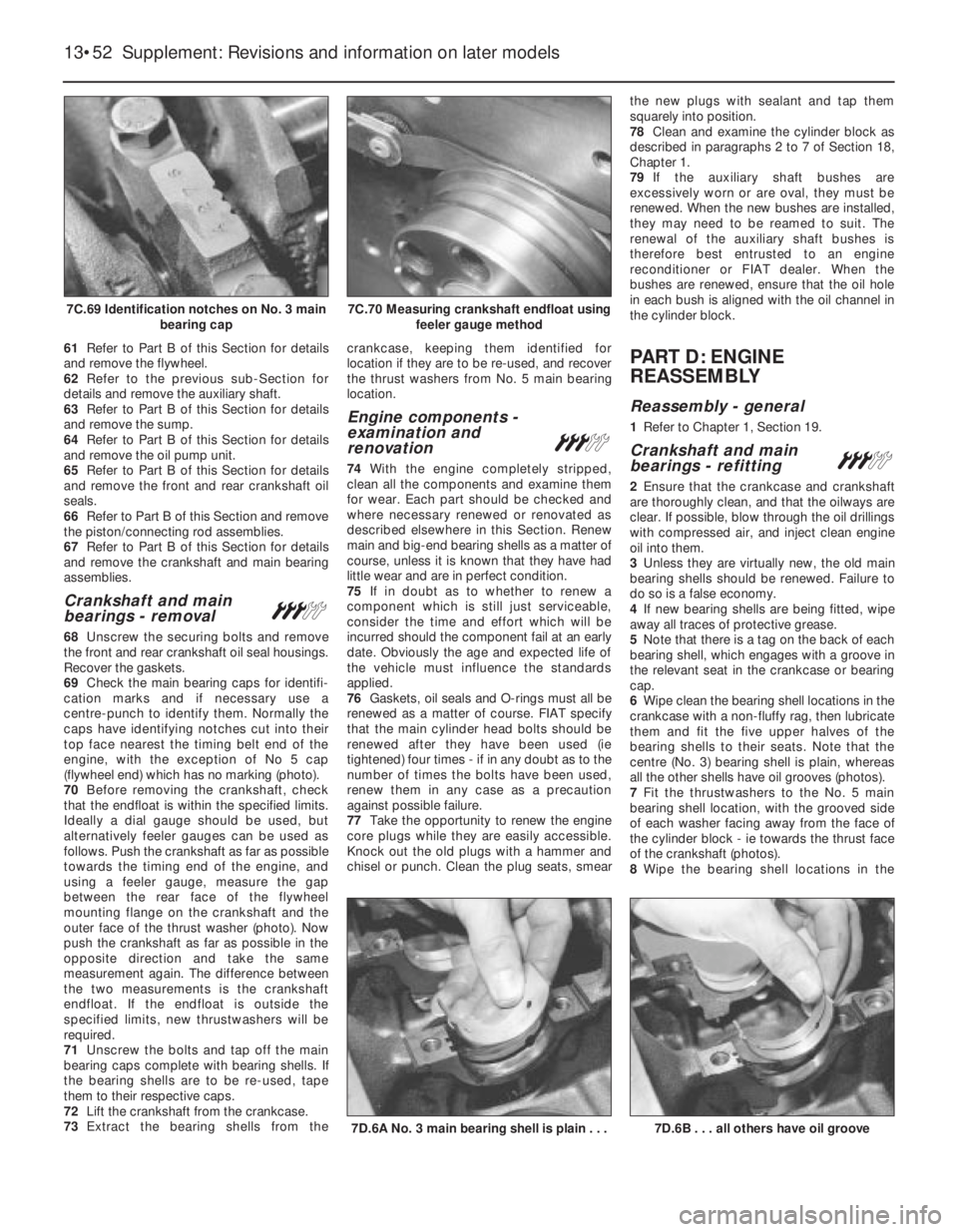
the bolts retaining the gear linkage mounting
bracket and the clutch housing lower cover
bolts. Remove the cover from the clutch
housing.
135Unscrew the sump retaining nuts and
bolts, then lower and remove the sump.
136Unscrew the timing belt rear cover
retaining bolts.
137Move the timing belt rear cover towards
the front of the car to gain access to the
retaining bolt and then unscrew and remove
the three oil seal housing retaining bolts.
Remove the crankshaft front oil seal housing.
138Note the orientation of the seal in its
housing prior to its removal. Support the
underside of the housing and carefully drive
the old oil seal from the housing using a
punch or a tubular drift of suitable diameter.
An alternative method is to punch or drill a
small hole in the face of the oil seal (but take
care not to drill into the housing) and insert a
self-tapping screw into the seal. Withdraw the
seal by gripping the screw with pliers and
pulling the seal from the housing. If necessary,
fit a second screw into the seal on the
opposite side to provide an even pull.
139Clean the mating faces of the housing
and the front of the crankcase using a suitable
scraper.
140Drive or press the new seal into positionin the housing in the reverse order of removal,
but ensure that it is correctly orientated as
noted during removal (photo).
141Refit the oil seal housing with a new
gasket and tighten the retaining bolts to the
specified torque setting (photos).
142Refit the sump as described later in this
Section using a new gasket. Tighten its
retaining nuts and bolts to the specified
torque. Refit the clutch cover and the gear
linkage mounting bracket.
143Fit the new timing belt, adjust its tension
and refit the crankshaft pulley as described
earlier in this Section.
144Reconnect the remaining components
that were detached during removal in the
reverse order and top up the engine oil level to
complete.
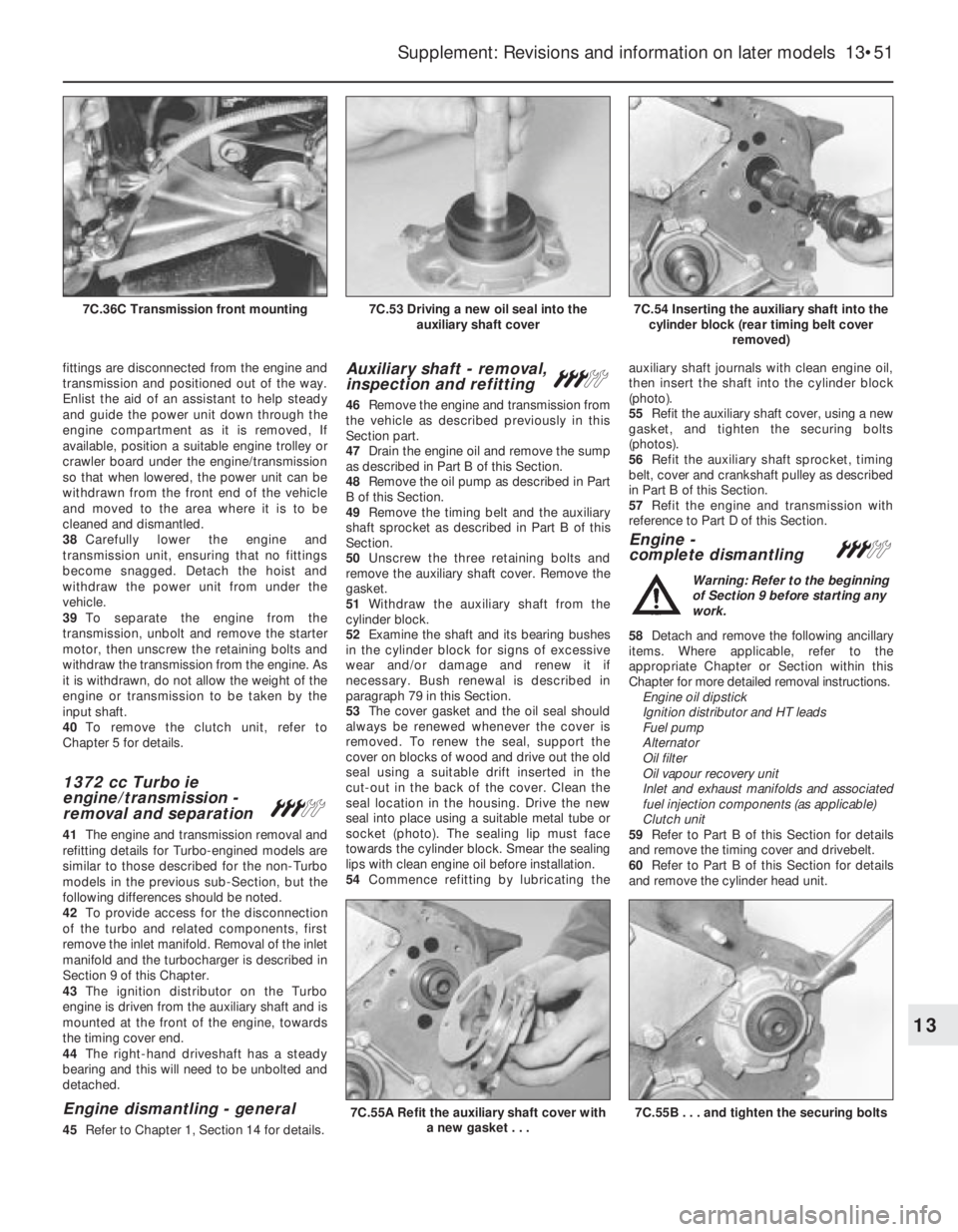
Crankshaft rear oil seal -
removal and renewal#
145If the engine is still in the car, disconnect
the battery negative lead.
146Remove the flywheel as described in the
next sub-Section.
147Punch or drill a small hole in the rear face
of the rear oil seal (but take care not to drill
into the housing) and insert a self-tapping
screw into the seal. Withdraw the seal by
gripping the screw with pliers and pulling it
from the housing. If necessary, fit a second
screw into the seal on the opposite side to
provide an even pull.
148Clean the seal housing, then locate the
Supplement: Revisions and information on later models 13•45
Fig. 13.18 Timing belt rear cover bolt
(arrowed) - 1372 cc ie and Turbo ie engines
(Sec 7B)7B.130J Compress spring and refit the split
collets7B.130I . . . and cap
7B.140 Driving a new crankshaft front oil
seal into its housing7B.141B . . . ensuring it is flush with the
face of the cylinder block7B.141A Refit the crankshaft front oil seal
housing . . .
Fig. 13.20 Removing the timing belt rear
cover on the 1372 ie and Turbo ie engines
(Sec 7B)
Fig. 13.19 Unscrew the bolts at the points
indicated to release the gear linkage
mounting bracket - 1372 cc ie and Turbo ie
engines (Sec 7B)
13
Page 176 of 303
fittings are disconnected from the engine and
transmission and positioned out of the way.
Enlist the aid of an assistant to help steady
and guide the power unit down through the
engine compartment as it is removed, If
available, position a suitable engine trolley or
crawler board under the engine/transmission
so that when lowered, the power unit can be
withdrawn from the front end of the vehicle
and moved to the area where it is to be
cleaned and dismantled.
38Carefully lower the engine and
transmission unit, ensuring that no fittings
become snagged. Detach the hoist and
withdraw the power unit from under the
vehicle.
39To separate the engine from the
transmission, unbolt and remove the starter
motor, then unscrew the retaining bolts and
withdraw the transmission from the engine. As
it is withdrawn, do not allow the weight of the
engine or transmission to be taken by the
input shaft.
40To remove the clutch unit, refer to
Chapter 5 for details.
1372 cc Turbo ie
engine/transmission -
removal and separation
#
41The engine and transmission removal and
refitting details for Turbo-engined models are
similar to those described for the non-Turbo
models in the previous sub-Section, but the
following differences should be noted.
42To provide access for the disconnection
of the turbo and related components, first
remove the inlet manifold. Removal of the inlet
manifold and the turbocharger is described in
Section 9 of this Chapter.
43The ignition distributor on the Turbo
engine is driven from the auxiliary shaft and is
mounted at the front of the engine, towards
the timing cover end.
44The right-hand driveshaft has a steady
bearing and this will need to be unbolted and
detached.
Engine dismantling - general
45Refer to Chapter 1, Section 14 for details.
Auxiliary shaft - removal,
inspection and refitting #
46Remove the engine and transmission from
the vehicle as described previously in this
Section part.
47Drain the engine oil and remove the sump
as described in Part B of this Section.
48Remove the oil pump as described in Part
B of this Section.
49Remove the timing belt and the auxiliary
shaft sprocket as described in Part B of this
Section.
50Unscrew the three retaining bolts and
remove the auxiliary shaft cover. Remove the
gasket.
51Withdraw the auxiliary shaft from the
cylinder block.
52Examine the shaft and its bearing bushes
in the cylinder block for signs of excessive
wear and/or damage and renew it if
necessary. Bush renewal is described in
paragraph 79 in this Section.
53The cover gasket and the oil seal should
always be renewed whenever the cover is
removed. To renew the seal, support the
cover on blocks of wood and drive out the old
seal using a suitable drift inserted in the
cut-out in the back of the cover. Clean the
seal location in the housing. Drive the new
seal into place using a suitable metal tube or
socket (photo). The sealing lip must face
towards the cylinder block. Smear the sealing
lips with clean engine oil before installation.
54Commence refitting by lubricating theauxiliary shaft journals with clean engine oil,
then insert the shaft into the cylinder block
(photo).
55Refit the auxiliary shaft cover, using a new
gasket, and tighten the securing bolts
(photos).
56Refit the auxiliary shaft sprocket, timing
belt, cover and crankshaft pulley as described
in Part B of this Section.
57Refit the engine and transmission with
reference to Part D of this Section.
Engine -
complete dismantling#
Warning: Refer to the beginning
of Section 9 before starting any
work.
58Detach and remove the following ancillary
items. Where applicable, refer to the
appropriate Chapter or Section within this
Chapter for more detailed removal instructions.
Engine oil dipstick
Ignition distributor and HT leads
Fuel pump
Alternator
Oil filter
Oil vapour recovery unit
Inlet and exhaust manifolds and associated
fuel injection components (as applicable)
Clutch unit
59Refer to Part B of this Section for details
and remove the timing cover and drivebelt.
60Refer to Part B of this Section for details
and remove the cylinder head unit.
Supplement: Revisions and information on later models 13•51
7C.54 Inserting the auxiliary shaft into the
cylinder block (rear timing belt cover
removed)7C.53 Driving a new oil seal into the
auxiliary shaft cover7C.36C Transmission front mounting
7C.55B . . . and tighten the securing bolts7C.55A Refit the auxiliary shaft cover with
a new gasket . . .
13
Page 177 of 303
61Refer to Part B of this Section for details
and remove the flywheel.
62Refer to the previous sub-Section for
details and remove the auxiliary shaft.
63Refer to Part B of this Section for details
and remove the sump.
64Refer to Part B of this Section for details
and remove the oil pump unit.
65Refer to Part B of this Section for details
and remove the front and rear crankshaft oil
seals.
66Refer to Part B of this Section and remove
the piston/connecting rod assemblies.
67Refer to Part B of this Section for details
and remove the crankshaft and main bearing
assemblies.
Crankshaft and main
bearings - removal#
68Unscrew the securing bolts and remove
the front and rear crankshaft oil seal housings.
Recover the gaskets.
69Check the main bearing caps for identifi-
cation marks and if necessary use a
centre-punch to identify them. Normally the
caps have identifying notches cut into their
top face nearest the timing belt end of the
engine, with the exception of No 5 cap
(flywheel end) which has no marking (photo).
70Before removing the crankshaft, check
that the endfloat is within the specified limits.
Ideally a dial gauge should be used, but
alternatively feeler gauges can be used as
follows. Push the crankshaft as far as possible
towards the timing end of the engine, and
using a feeler gauge, measure the gap
between the rear face of the flywheel
mounting flange on the crankshaft and the
outer face of the thrust washer (photo). Now
push the crankshaft as far as possible in the
opposite direction and take the same
measurement again. The difference between
the two measurements is the crankshaft
endfloat. If the endfloat is outside the
specified limits, new thrustwashers will be
required.
71Unscrew the bolts and tap off the main
bearing caps complete with bearing shells. If
the bearing shells are to be re-used, tape
them to their respective caps.
72Lift the crankshaft from the crankcase.
73Extract the bearing shells from thecrankcase, keeping them identified for
location if they are to be re-used, and recover
the thrust washers from No. 5 main bearing
location.
Engine components -
examination and
renovation
#
74With the engine completely stripped,
clean all the components and examine them
for wear. Each part should be checked and
where necessary renewed or renovated as
described elsewhere in this Section. Renew
main and big-end bearing shells as a matter of
course, unless it is known that they have had
little wear and are in perfect condition.
75If in doubt as to whether to renew a
component which is still just serviceable,
consider the time and effort which will be
incurred should the component fail at an early
date. Obviously the age and expected life of
the vehicle must influence the standards
applied.
76Gaskets, oil seals and O-rings must all be
renewed as a matter of course. FIAT specify
that the main cylinder head bolts should be
renewed after they have been used (ie
tightened) four times - if in any doubt as to the
number of times the bolts have been used,
renew them in any case as a precaution
against possible failure.
77Take the opportunity to renew the engine
core plugs while they are easily accessible.
Knock out the old plugs with a hammer and
chisel or punch. Clean the plug seats, smearthe new plugs with sealant and tap them
squarely into position.
78Clean and examine the cylinder block as
described in paragraphs 2 to 7 of Section 18,
Chapter 1.
79If the auxiliary shaft bushes are
excessively worn or are oval, they must be
renewed. When the new bushes are installed,
they may need to be reamed to suit. The
renewal of the auxiliary shaft bushes is
therefore best entrusted to an engine
reconditioner or FIAT dealer. When the
bushes are renewed, ensure that the oil hole
in each bush is aligned with the oil channel in
the cylinder block.
PART D: ENGINE
REASSEMBLY
Reassembly - general
1Refer to Chapter 1, Section 19.
Crankshaft and main
bearings - refitting#
2Ensure that the crankcase and crankshaft
are thoroughly clean, and that the oilways are
clear. If possible, blow through the oil drillings
with compressed air, and inject clean engine
oil into them.
3Unless they are virtually new, the old main
bearing shells should be renewed. Failure to
do so is a false economy.
4If new bearing shells are being fitted, wipe
away all traces of protective grease.
5Note that there is a tag on the back of each
bearing shell, which engages with a groove in
the relevant seat in the crankcase or bearing
cap.
6Wipe clean the bearing shell locations in the
crankcase with a non-fluffy rag, then lubricate
them and fit the five upper halves of the
bearing shells to their seats. Note that the
centre (No. 3) bearing shell is plain, whereas
all the other shells have oil grooves (photos).
7Fit the thrustwashers to the No. 5 main
bearing shell location, with the grooved side
of each washer facing away from the face of
the cylinder block - ie towards the thrust face
of the crankshaft (photos).
8Wipe the bearing shell locations in the
13•52 Supplement: Revisions and information on later models
7D.6B . . . all others have oil groove7D.6A No. 3 main bearing shell is plain . . .
7C.70 Measuring crankshaft endfloat using
feeler gauge method7C.69 Identification notches on No. 3 main
bearing cap
Page 178 of 303

bearing caps with a soft non-fluffy rag, then fit
the lower halves of the bearing shells to their
seats. Again, note that the centre (No. 3)
bearing shell is plain, whereas all the other
shells have oil grooves (photo).
9Lubricate the crankshaft journals and the
upper and lower main bearing shells with
clean engine oil (photo).
10Carefully lower the crankshaft into the
crankcase (photo). If necessary, seat the
crankshaft using light taps with a
rubber-faced hammer on the crankshaft
balance webs.
11Lubricate the crankshaft main bearing
journals again, the fit the No. 1 bearing cap.
Fit the two securing bolts, and tighten them as
far as possible by hand.
12Fit the No. 5 bearing cap, and as before
tighten the bolts as far as possible by hand.
13Fit the centre and then the intermediate
bearing caps, and again tighten the bolts as
far as possible by hand.
14Check that the markings on the bearing
caps are correctly orientated as noted during
dismantling - ie the identification grooves
should face towards the timing side of the
engine, then working from the centre cap
outwards in a progressive sequence, finally
tighten the bolts to the specified torque
(photo).
15Check that the crankshaft rotates freely.
Some stiffness is to be expected with new
components, but there should be no tight
spots or binding.16Check that crankshaft endfloat is within
the specified limits, as described in paragraph
70 of Part C in this Section.
17Examine the condition of the front and
rear crankshaft oil seals and renew if
necessary with reference to Part B of this
Section. It is advisable to renew the oil seals
as a matter of course unless they are in
perfect condition.
18Lubricate the oil seal lips with clean
engine oil, then carefully fit the front and rear
oil seal housings using new gaskets.
Pistons and connecting rods -
refitting
19Refer to Part B of this Section.
Oil pump - refitting
20Refer to Part B of this Section.
Sump - refitting
21Refer to Part B of this Section.
Flywheel - refitting
22Refer to Part B of this Section. When the
flywheel is bolted in position, refer to Chapter
5 for details and refit the clutch unit.
Auxiliary shaft - refitting
23Refer to Part C of this Section.
Cylinder head - refitting
24Refer to Part B of this Section. Note that
this procedure describes cylinder head
refitting complete with the camshaft housingassembly and manifolds as a complete unit.
Details of refitting the camshaft housing (and
followers) to the cylinder head will be found
separately in Part B.
Timing belt and covers -
refitting
25Refer to Part B of this Section.
Engine/transmission -
reconnection and refitting#
Note: A suitable hoist and lifting tackle will be
required for this operation. New locktabs will
be required for the exhaust
downpipe-to-manifold nuts, and suitable
exhaust assembly paste, will be required when
reconnecting the downpipes to the exhaust
manifold.
26Before attempting to reconnect the
engine to the gearbox, check that the clutch
friction disc is centralised as described in
Chapter 5, Section 8. This is necessary to
ensure that the gearbox input shaft splines
will pass through the splines in the centre of
the friction disc.
27Check that the clutch release arm and
bearing are correctly fitted, and lightly grease
the input shaft splines.
28Mate the engine and gearbox together,
ensuring that the engine adapter plate is
correctly located, and that the gearbox
locates on the dowels in the cylinder block,
then refit the engine-to-gearbox bolts and the
single nut, but do not fully tighten them at this
stage. Ensure that any brackets noted during
Supplement: Revisions and information on later models 13•53
7D.8 Locate the bearing shells into the
main bearing caps . . .7D.7B . . . sliding them into position each
side of the No. 5 main bearing
7DS.14 Tighten the main bearing cap bolts
to the specified torque setting7D.10 Lower the crankshaft into position7D.9 . . . and lubricate the shells
13
7D.7A Locate the thrust washer . . .
Page 180 of 303

Coolant pump -
removal and refitting#
11The coolant pump is located on the
crankshaft pulley end of the engine and is
driven by the timing belt.
12The pump cannot be repaired and must
be regarded as disposable.
13Drain the cooling system.
14Remove the timing belt cover and then set
No. 1 piston to TDC. To achieve this, turn the
crankshaft pulley bolt until the camshaft
sprocket timing mark is aligned with the one
on the cylinder head.
15Release the belt tensioner and slip the
timing belt off the camshaft and coolant pump
sprockets.
16Unbolt and remove the coolant pump and
clean the mounting face of all old gasket
material.
17Apply a continuous bead of RTV silicone
sealant (instant gasket) to the mounting face
of the coolant pump and bolt it into position
(photos).
18Check that the camshaft sprocket and the
crankshaft have not been moved and fit the
timing belt to the camshaft and coolant pump
sprockets. The pump sprocket does not
require setting in any particular position
before connecting the timing belt.
19Tension the belt as described in Sec-
tion 5B of this Chapter.
20Fit the timing belt cover.
21After allowing one hour for the gasket
material to cure, refill and bleed the cooling
system.
PART B:
1301 CC TURBO IE ENGINE
Description
1The cooling system on this model has flow
and return connections to the turbocharger,
and is an essential means of cooling the
turbocharger.
2The radiator cooling fan is of two-speed
type, being controlled by a two-stage
thermostatic switch screwed into the radiator
side tank.
3According to the coolant temperature level,
the fan speed is regulated to provide the most
effective cooling.
4The remote cooling system expansion tank
is mounted in the left-hand rear corner of the
engine compartment (photo).
PART C:
1372 CC IE AND 1372 CC
TURBO IE ENGINES
Description
1The cooling system layout and components
for the 1372 cc engines is shown in
Figs. 13.29 and 13.30.
2The system on each engine operates in
essentially the same manner as that
described for the other models in Chapter 2,
but the location of components and the
coolant hose routings differ according to
model. The cooling system expansion tank
location differs according to model, being
either located on the side of the radiator ormounted separately on the side of the inner
wing panel.
3On Turbo models, the cooling system also
assists in cooling the turbocharger.
Maintenance
4The maintenance procedures are
essentially the same as those described for
the other models in Chapter 2.
Cooling system - draining,
flushing and refillingÁ
Warning: Wait until the engine is
cold before starting this
procedure. Do not allow
antifreeze to come into contact
with your skin or painted surfaces of the
vehicle. Rinse off spills immediately with
plenty of water. Never leave antifreeze
lying around in an open container or in a
puddle in the driveway or on the garage
floor. Children and pets are attracted by its
sweet smell. Antifreeze is fatal if ingested.
5Disconnect the battery negative lead.
6Working inside the vehicle, turn the heater
temperature control knob fully to the right,
which will fully open the heater coolant valve.
7With the expansion tank cap removed,
place a suitable container beneath the
radiator bottom hose.
8Loosen the clip and ease the bottom hose
away from the radiator outlet (photo). Allow
the coolant to drain into the container.
9Reposition the container under the front of
the cylinder block, and unscrew the cylinder
block drain plug (photo). Allow the coolant to
drain into the container.
Supplement: Revisions and information on later models 13•55
8A.17B Tightening the coolant pump bolts8A.17A Fitting the coolant pump to the
999 cc engineFig. 13.28 Sectional view of the coolant
pump on the 999 and 1108 cc engines
(Sec 8A)
8C.9 Cylinder block drain plug8C.8 Bottom hose connection to the
radiator8B.4 Topping up the expansion tank with
antifreeze on the 1301 cc engine
13
Page 192 of 303

solenoid-operated type, actuated from the
ECU.
7Fuel pressure is regulated according to inlet
manifold vacuum pressure by a fuel pressure
regulator. Excess unpressurised fuel is
returned to the fuel tank.
Airflow meter
8This component measures the quantity of
air drawn into the engine, and converts this
into an electric signal which is transmitted to
the ECU.
9The intake air exerts a force on the floating
plate (1) (Fig. 13.39) which is connected to a
potentiometer (2).
10A compensating butterfly valve (3)
compensates for any reflex pressure which
may occur, and is subject to the braking effect
of the damper chamber (4).
11The idle mixture (air/fuel ratio) is altered by
means of the screw (8), which alters the
cross-section of the bypass channel (7).
12An integral-type temperature sensor is
fitted, the resistance value of which decreases
as the temperature of the intake air increases.
This facility is used to correct the mixture
strength within a pre-determined air
temperature range.
Throttle valve housing
13The housing incorporates a conventional
butterfly-type throttle valve, actuated by
cables and rods from the accelerator pedal.
14The idle bypass channel (2) (Fig. 13.40) is
fitted with an adjustment screw (3) to vary the
idle speed.
15The other screw (4) and locknut are usedto set the closing position of the throttle valve
plate.
Supplementary air valve
16This controls the air volume requirement
during cold starting. Essentially, the valve is an
electrically-heated bi-metallic strip, which rotates
the plate (4) (Fig. 13.41) to vary the volume of air
being drawn in through the aperture (1),
according to the temperature of the engine.
17The requirement for additional air during
cold starting is to dilute the additional fuel,
which is injected and controlled by the ECU
as a result of monitoring the engine coolant
temperature sensor.
Electrical control circuit
18The main components of the system are
the ECU and the system control relay. The
relay incorporates a fuel cut-off facility, which
cuts off the fuel supply in the event of engine
failure, the vehicle turning over, or a fuel line
breaking. The relay energises the following
electrical components.
19Coolant temperature sensor, which
signals the coolant temperature to the ECU.
20Throttle position switch, which signals the
ECU when the throttle valve plate is closed, in
order to actuate the deceleration fuel cut-off
device at speeds above 2500 rpm.21The switch also signals the ECU at full
throttle, so that the mixture can be enriched to
cope with full-power requirements.
22The system control relay also monitors the
engine speed directly from the ignition coil
primary winding.
MaintenanceÁ
23Regularly check the security of all system
hoses, wiring connections and plugs.
24At the intervals specified in Section 3,
renew the fuel filter and the air cleaner element.
Fuel filter - renewalÁ
25This is located within the engine
compartment just above the timing belt cover.
Disconnect the fuel hoses, but be prepared
for loss of fuel (photo).
26When fitting the new filter, make sure that
the arrow stamped on it is pointing towards
the fuel injector rail.
Air cleaner element -
renewal
Á
27Prise back the toggle-type clips and take
off the air cleaner lid. Remove and discard the
element, and wipe any dirt from the inside of
the casing (photos).
28Fit the new element and replace the lid.
Supplement: Revisions and information on later models 13•67
Fig. 13.41 Supplementary air valve -
1301 cc Turbo ie engine (Sec 9C)
1 Aperture
2 Bi-metallic strip
3 Passage
4 Rotating plate (closed position)Fig. 13.40 Sectional view of throttle valve
housing - 1301 cc Turbo ie engine (Sec 9C)
1 Butterfly-type throttle valve
2 Idle bypass channel
3 Idle speed adjusting screw
4 Throttle valve plate setting screwFig. 13.39 Sectional view of airflow meter -
1301 cc Turbo ie engine (Sec 9C)
1 Floating plate
2 Potentiometer
3 Compensating butterfly valve
4 Damper chamber
6 Spring
7 Bypass channel
8 CO adjusting screw
9 Tamperproof plug
Terminals
5, 7, 8, Potentiometer
9 Air temperature sensor
E Sealed (not to be touched)
9C.27A Removing the air cleaner lid9C.25 Secondary fuel filter
13
Page 287 of 303
REF•4MOT Test Checks
MExamine the handbrake mechanism,
checking for frayed or broken cables,
excessive corrosion, or wear or insecurity of
the linkage. Check that the mechanism works
on each relevant wheel, and releases fully,
without binding.
MIt is not possible to test brake efficiency
without special equipment, but a road test can
be carried out later to check that the vehicle
pulls up in a straight line.
Fuel and exhaust systems
MInspect the fuel tank (including the filler
cap), fuel pipes, hoses and unions. All
components must be secure and free from
leaks.
MExamine the exhaust system over its entire
length, checking for any damaged, broken or
missing mountings, security of the retaining
clamps and rust or corrosion.
Wheels and tyres
MExamine the sidewalls and tread area of
each tyre in turn. Check for cuts, tears, lumps,
bulges, separation of the tread, and exposure
of the ply or cord due to wear or damage.
Check that the tyre bead is correctly seated
on the wheel rim, that the valve is sound andproperly seated, and that the wheel is not
distorted or damaged.
MCheck that the tyres are of the correct size
for the vehicle, that they are of the same size
and type on each axle, and that the pressures
are correct.
MCheck the tyre tread depth. The legal
minimum at the time of writing is 1.6 mm over
at least three-quarters of the tread width.
Abnormal tread wear may indicate incorrect
front wheel alignment.
Body corrosion
MCheck the condition of the entire vehicle
structure for signs of corrosion in load-bearing
areas. (These include chassis box sections,
side sills, cross-members, pillars, and all
suspension, steering, braking system and
seat belt mountings and anchorages.) Any
corrosion which has seriously reduced the
thickness of a load-bearing area is likely to
cause the vehicle to fail. In this case
professional repairs are likely to be needed.
MDamage or corrosion which causes sharp
or otherwise dangerous edges to be exposed
will also cause the vehicle to fail.
Petrol models
MHave the engine at normal operating
temperature, and make sure that it is in good
tune (ignition system in good order, air filter
element clean, etc).
MBefore any measurements are carried out,
raise the engine speed to around 2500 rpm,
and hold it at this speed for 20 seconds. Allowthe engine speed to return to idle, and watch
for smoke emissions from the exhaust
tailpipe. If the idle speed is obviously much
too high, or if dense blue or clearly-visible
black smoke comes from the tailpipe for more
than 5 seconds, the vehicle will fail. As a rule
of thumb, blue smoke signifies oil being burnt
(engine wear) while black smoke signifies
unburnt fuel (dirty air cleaner element, or other
carburettor or fuel system fault).
MAn exhaust gas analyser capable of
measuring carbon monoxide (CO) and
hydrocarbons (HC) is now needed. If such an
instrument cannot be hired or borrowed, a
local garage may agree to perform the check
for a small fee.
CO emissions (mixture)
MAt the time of writing, the maximum CO
level at idle is 3.5% for vehicles first used after
August 1986 and 4.5% for older vehicles.
From January 1996 a much tighter limit
(around 0.5%) applies to catalyst-equipped
vehicles first used from August 1992. If the
CO level cannot be reduced far enough to
pass the test (and the fuel and ignition
systems are otherwise in good condition) then
the carburettor is badly worn, or there is some
problem in the fuel injection system or
catalytic converter (as applicable).
HC emissionsMWith the CO emissions within limits, HC
emissions must be no more than 1200 ppm
(parts per million). If the vehicle fails this test
at idle, it can be re-tested at around 2000 rpm;
if the HC level is then 1200 ppm or less, this
counts as a pass.
MExcessive HC emissions can be caused by
oil being burnt, but they are more likely to be
due to unburnt fuel.
Diesel models
MThe only emission test applicable to Diesel
engines is the measuring of exhaust smoke
density. The test involves accelerating the
engine several times to its maximum
unloaded speed.
Note: It is of the utmost importance that the
engine timing belt is in good condition before
the test is carried out.
M
Excessive smoke can be caused by a dirty
air cleaner element. Otherwise, professional
advice may be needed to find the cause.
4Checks carried out on
YOUR VEHICLE’S EXHAUST
EMISSION SYSTEM
Page 294 of 303

Engine cuts out suddenly –
ignition fault
m mLoose or disconnected LT wires
m mWet HT leads or distributor cap (after
traversing water splash)
m mCoil failure (check for spark)
m mOther ignition fault (see Chapter 4)
Engine misfires before cutting out
– fuel fault
m mFuel tank empty
m mFuel pump defective or filter blocked
(check for delivery)
m mFuel tank filler vent blocked (suction will be
evident on releasing cap)
m mCarburettor needle valve sticking
m mCarburettor jets blocked (fuel contami-
nated)
m mOther fuel system fault (see Chapter 3)
Engine cuts out – other causes
m
mSerious overheating
m mMajor mechanical failure (eg camshaft
drive)
Ignition (no-charge) warning light
illuminated
m mSlack or broken drivebelt — retension or
renew (Chapter 9)
Ignition warning light not
illuminated
m mCoolant loss due to internal or external
leakage (see Chapter 2)
m mThermostat defective
m mLow oil level
m mBrakes binding
m mRadiator clogged externally or internally
m mElectric cooling fan not operating correctly
m mEngine waterways clogged
m mIgnition timing incorrect or automatic
advance malfunctioning
m mMixture too weak
Note: Do not add cold water to an overheated
engine or damage may result
Note: Low oil pressure in a high-mileage
engine at tickover is not necessarily a cause
for concern. Sudden pressure loss at speed is
far more significant. In any event check the
gauge or warning light sender before
condemning the engine.
Gauge reads low or warning light
illuminated with engine running
m mOil level low or incorrect grade
m mDefective gauge or sender unit m mWire to sender unit earthed
m mEngine overheating
m mOil filter clogged or bypass valve defective
m mOil pressure relief valve defective
m mOil pick-up strainer clogged
m mOil pump worn or mountings loose
m mWorn main or big-end bearings
Pre-ignition (pinking) on
acceleration
m mIncorrect grade of fuel
m mIgnition timing incorrect
m mDistributor faulty or worn
m mWorn or maladjusted carburettor
m mExcessive carbon build-up in engine
Whistling or wheezing noises
m
mLeaking vacuum hose
m mLeaking carburettor or manifold gasket
m mBlowing head gasket
Tapping or rattling
m
mIncorrect valve clearances (where appli-
cable)
m mWorn valve gear
m mWorn timing chain or belt
m mBroken piston ring (ticking noise)
Knocking or thumping
m
mUnintentional mechanical contact (eg fan
blades)
m mWorn drivebelt
m mPeripheral component fault (generator,
water pump, etc)
m mWorn big-end bearings (regular heavy
knocking, perhaps less under load)
m mWorn main bearings (rumbling and
knocking, perhaps worsening under load)
m mPiston slap (most noticeable when cold)
Engine noises
Low engine oil pressure
Engine overheatsEngine cuts out and will not restart
Fault FindingREF•11
REF
Crank engine and check for spark. Note
use of insulated tool