1982 CHEVROLET CAMARO light
[x] Cancel search: lightPage 486 of 875
GM – CAMARO 1982-1992 – Repair Guide (Checked by WxMax) 486
VALVE SEATS
A visual inspection of the valve seats
should show a slightly worn and pitted
surface where the valve face contacts t he seat. Inspect the seat carefully for
severe pitting or cracks. Also, a seat t hat is badly worn will be recessed into the
cylinder head. A severely worn or rece ssed seat may need to be replaced. All
cracked seats must be replaced. A seat co ncentricity gauge, if available, should
be used to check the seat run-out. If run-out exceeds specifications the seat
must be machined (if no specification is given use 0.002 in. or 0.051mm).
CYLINDER HEAD SURFACE FLATNESS
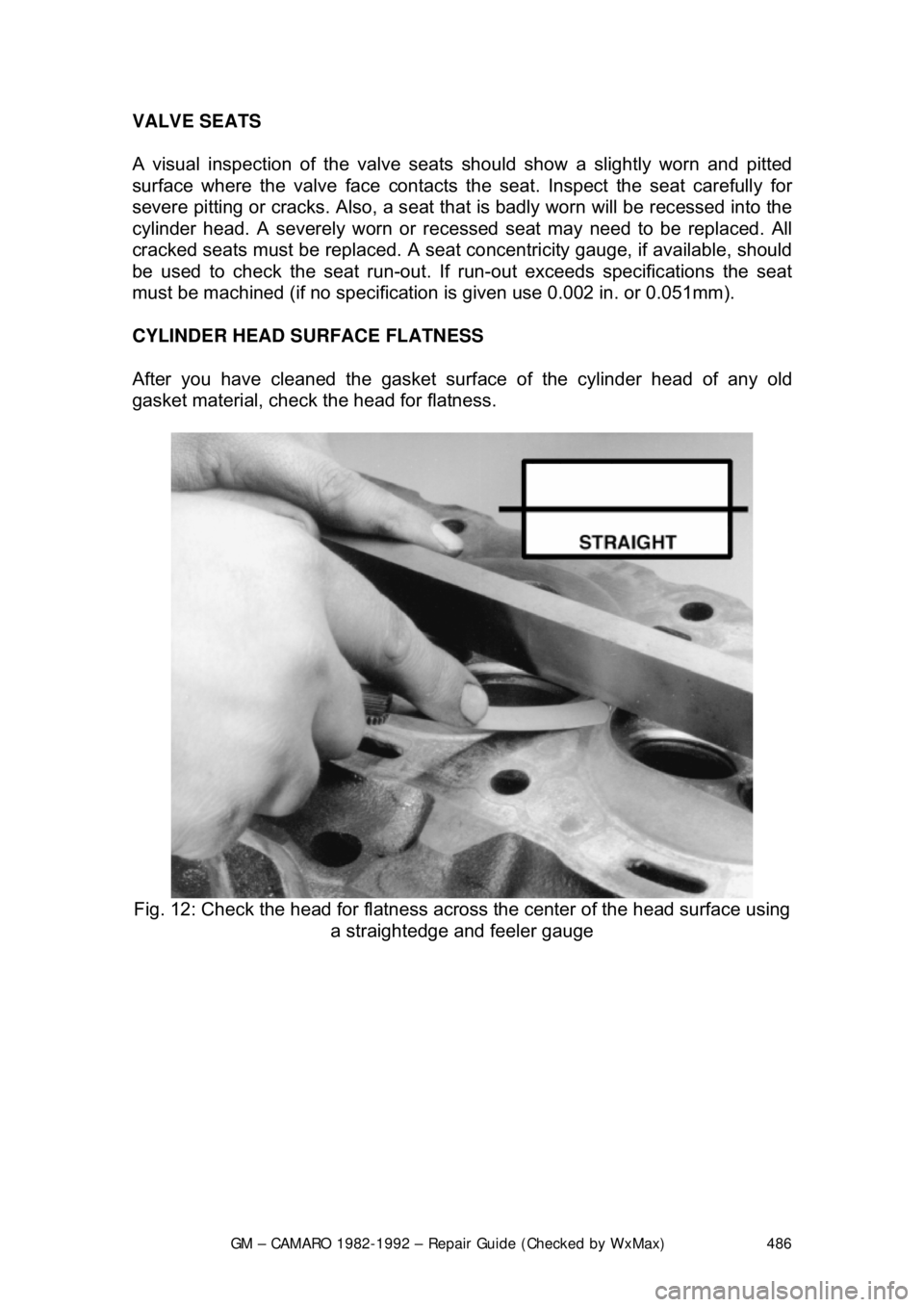
After you have cleaned the gasket surf ace of the cylinder head of any old
gasket material, check the head for flatness.
Fig. 12: Check the head for flatness across the center of the head surface using
a straightedge and feeler gauge
Page 487 of 875
GM – CAMARO 1982-1992 – Repair Guide (Checked by WxMax) 487
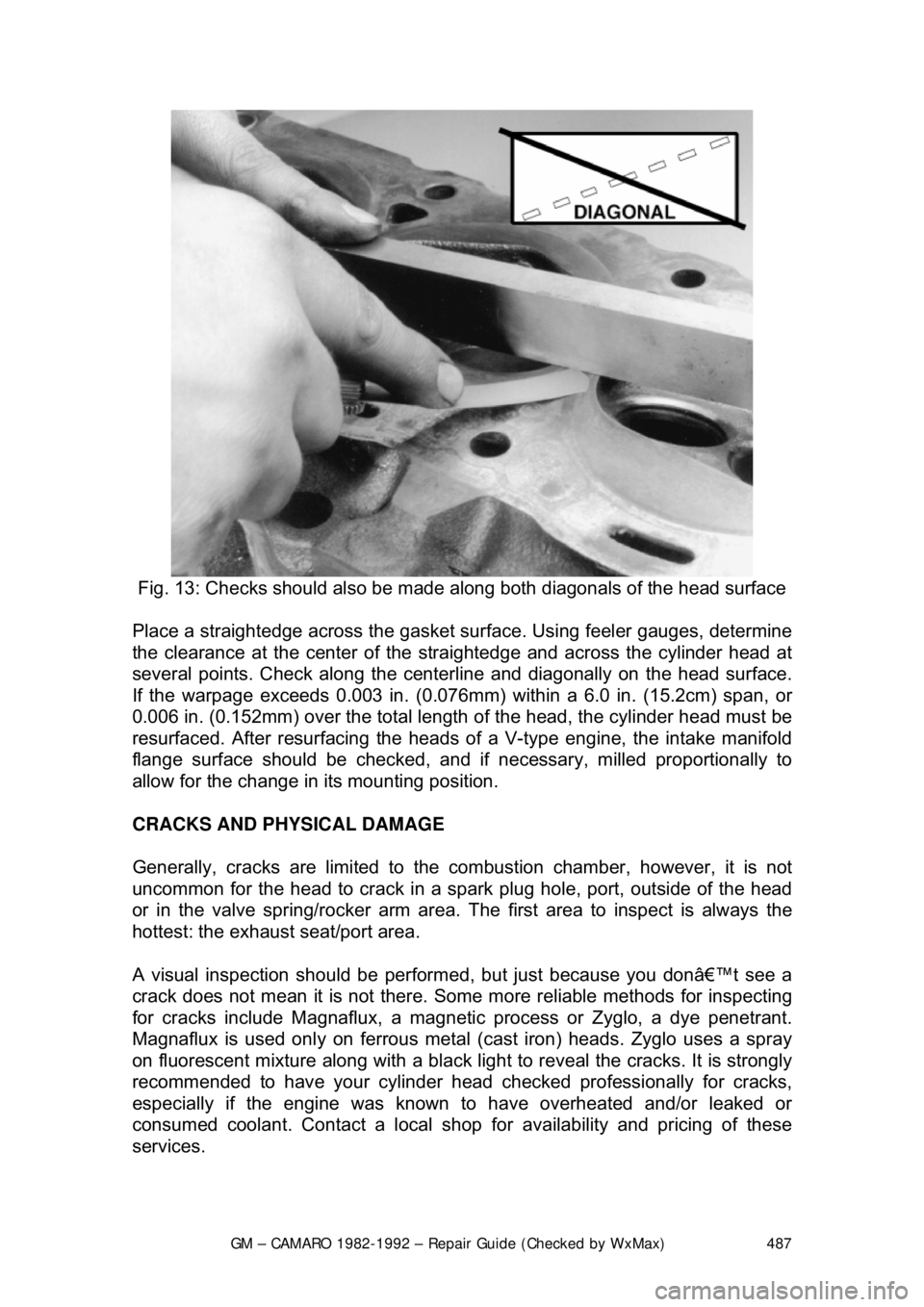
Fig. 13: Checks should also be made al ong both diagonals of the head surface
Place a straightedge across the gasket surf ace. Using feeler gauges, determine
the clearance at the cent er of the straightedge and across the cylinder head at
several points. Check along the centerli ne and diagonally on the head surface.
If the warpage exceeds 0.003 in. (0.076mm) within a 6.0 in. (15.2cm) span, or
0.006 in. (0.152mm) over the total length of the head, the cylinder head must be
resurfaced. After resurfacing the heads of a V-type engine, the intake manifold
flange surface should be checked, and if necessary, milled proportionally to
allow for the change in its mounting position.
CRACKS AND PHYSICAL DAMAGE
Generally, cracks are limited to the comb ustion chamber, however, it is not
uncommon for the head to crack in a s park plug hole, port, outside of the head
or in the valve spring/rocker arm area. The first area to inspect is always the
hottest: the exhaust seat/port area.
A visual inspection should be perform ed, but just because you don’t see a
crack does not mean it is not there. Some more reliable methods for inspecting
for cracks include Magnaflux, a magnetic process or Zyglo, a dye penetrant.
Magnaflux is used onl y on ferrous metal (cast iron) heads. Zyglo uses a spray
on fluorescent mixture along with a black light to reveal the cracks. It is strongly
recommended to have your cylinder head c hecked professionally for cracks,
especially if the engine was known to have overheated and/or leaked or
consumed coolant. Contact a local shop fo r availability and pricing of these
services.
Page 488 of 875

GM – CAMARO 1982-1992 – Repair Guide (Checked by WxMax) 488
Physical damage is usually very eviden
t. For example, a broken mounting ear
from dropping the head or a bent or broken stud and/or bol t. All of these defects
should be fixed or, if irrepairabl e, the head should be replaced.
REFINISHING & REPAIRING
Many of the procedures given for refini shing and repairing the cylinder head
components must be performed by a ma chine shop. Certain steps, if the
inspected part is not worn, can be perfo rmed yourself inexpensively. However,
you spent a lot of time and effort so far, why risk trying to save a couple bucks if
you might have to do it all over again?
VALVES
Any valves that were not replaced s hould be refaced and the tips ground flat.
Unless you have access to a valve grinding machine, this should be done by a
machine shop. If the valves are in extr emely good condition, as well as the
valve seats and guides, they may be lapped in without performing machine
work.
It is a recommended practice to lap the valves even after machine work has
been performed and/or new valves hav e been purchased. This insures a
positive seal between the valve and seat.
LAPPING THE VALVES
Before lapping the valves to the seat s, read the rest of the cylinder head
information to insure that any related parts are in acceptable enough condition
to continue.
Before any valve seat machining and/or lapping can be performed, the guides
must be within factory re commended specifications.
1. Invert the cylinder head.
2. Lightly lubricate the va lve stems and insert them into the cylinder head in
their numbered order.
3. Raise the valve from the seat and apply a sma ll amount of fine lapping
compound to the seat.
4. Moisten the suction h ead of a hand-lapping tool and attach it to the head
of the valve.
5. Rotate the tool bet ween the palms of both hands , changing the position
of the valve on the valve seat and lifting the tool often to prevent
grooving.
6. Lap the valve until a smooth, polished circle is evident on the valve and
seat.
7. Remove the tool and the valve. Wi pe away all traces of the grinding
compound and store the valve to maintain its lapped location.
SPRINGS, RETAINERS AND VALVE LOCKS
Page 491 of 875

GM – CAMARO 1982-1992 – Repair Guide (Checked by WxMax) 491
The first step for any assembly job is
to have a clean area in which to work.
Next, thoroughly clean all of the parts and components that are to be
assembled. Finally, place all of the co mponents onto a suitable work space and,
if necessary, arrange the parts to their respective positions.
1. Lightly lubricate the valve stems and insert all of the valves into the
cylinder head. If possible, maintain their original locations.
2. If equipped, install any valve spring shims which were removed.
3. If equipped, install the new valve seal s, keeping the following in mind:
• If the valve seal presses over the guide, lightly lubricate the outer
guide surfaces.
• If the seal is an O-ring type, it is installed just after compressing
the spring but before the valve locks.
4. Place the valve spring and retainer over the stem.
5. Position the spring compressor tool and compress the spring.
6. Assemble the valv e locks to the stem.
7. Relieve the spring pressure slowly and insure that neither valve lock
becomes dislodged by the retainer.
8. Remove the spring compressor tool.
9. Repeat Steps 2 through 8 until all of the springs have been installed.
ENGINE BLOCK
GENERAL INFORMATION
A thorough overhaul or rebuild of an engine block would include replacing the
pistons, rings, bearings, timing belt/chai n assembly and oil pump. For OHV
engines also include a new camshaft and lifters. The block would then have the
cylinders bored and honed oversize (or if using removable cylinder sleeves,
new sleeves installed) and the cranksha ft would be cut undersize to provide
new wearing surfaces and per fect clearances. However, your particular engine
may not have everything worn out. What if only the piston rings have worn out
and the clearances on everything else are still within factory specifications?
Well, you could just replace the rings and put it back together, but this would be
a very rare example. Chances are, if one component in your engine is worn,
other components are sure to follow, and soon. At the very least, you should
always replace the rings, bearings and oil pump. This is what is commonly
called a "freshen up".
CYLINDER RIDGE REMOVAL
Because the top piston ring does not travel to the very top of the cylinder, a
ridge is built up between the end of the trav el and the top of the cylinder bore.
Pushing the piston and connecting rod assembly past the ridge can be difficult,
and damage to the piston ring lands could occur. If the ridge is not removed
before installing a new piston or not re moved at all, piston ring breakage and
piston damage may occur.
Page 495 of 875

GM – CAMARO 1982-1992 – Repair Guide (Checked by WxMax) 495
Again, rotate the engine, this time
to position the number one cylinder bore
(head surface) up. Turn the crankshaft until the number one piston is at the
bottom of its travel, this should allow t he maximum access to its connecting rod.
Remove the number one co nnecting rods fasteners and cap and place two
lengths of rubber hose over the rod bolts/studs to protect the crankshaft from
damage. Using a sturdy wooden dowel and a hammer, push the connecting rod
up about 1 in. (25mm) from the cranks haft and remove the upper bearing insert.
Continue pushing or tapping the connecti ng rod up until the piston rings are out
of the cylinder bore. Remove the piston and rod by hand, put the upper half of
the bearing insert back into the rod, in stall the cap with its bearing insert
installed, and hand-tighten the cap fasteners. If the parts are kept in order in this
manner, they will not get lost and you wil l be able to tell which bearings came
form what cylinder if any problems are discovered and diagnosis is necessary.
Remove all the other piston assemblie s in the same manner. On V-style
engines, remove all of the pistons from one bank, then reposition the engine
with the other cylinder bank head surface up, and remo ve that banks piston
assemblies.
The only remaining component in the engine block should now be the
crankshaft. Loosen the main bearing ca ps evenly until the fasteners can be
turned by hand, then remove them and the caps. Remove the crankshaft fro\
m
the engine block. Thoroughly clea n all of the components.
INSPECTION
Now that the engine block and all of its components ar e clean, it's time to
inspect them for wear and/or damage. To accurately inspect them, you will need
some specialized tools:
• Two or three separate micromet ers to measure the pistons and
crankshaft journals
• A dial indicator
• Telescoping gauges for the cylinder bores
• A rod alignment fixture to check for bent connecting rods
If you do not have access to the proper tools, you may want to bring the
components to a shop that does.
Generally, you shouldn't expect cracks in the engine block or its components
unless it was known to leak, consume or mix engine fluids, it was severely
overheated, or there was ev idence of bad bearings and/or crankshaft damage.
A visual inspection should be performed on all of the components, but just
because you don't see a crack does not mean it is not there. Some more
reliable methods for inspecting for cracks include Magnaflux, a magnetic
process or Zyglo, a dye penetrant. M agnaflux is used only on ferrous metal
(cast iron). Zyglo uses a spray on fluoresce nt mixture along with a black light to
reveal the cracks. It is strongly recommended to have your engine block
checked professionally for cracks, especia lly if the engine was known to have
overheated and/or leaked or consumed coolant. Contact a local shop for
availability and pricing of these services.
Page 496 of 875

GM – CAMARO 1982-1992 – Repair Guide (Checked by WxMax) 496
ENGINE BLOCK
ENGINE BLOCK BEARING ALIGNMENT
Remove the main bearing caps and, if sti
ll installed, the main bearing inserts.
Inspect all of the main bearing saddles and caps for damage, burrs or high
spots. If damage is found, and it is caused from a spun main bearing, the block
will need to be align-bored or, if severe enough, replacement. Any burrs or high
spots should be carefully removed with a metal file.
Place a straightedge on the bearing saddles, in the engine block, along the
centerline of the crankshaft. If any cl earance exists between the straightedge
and the saddles, the block must be align-bored.
Align-boring consists of machining th e main bearing saddles and caps by
means of a flycutter that runs through the bearing saddles.
DECK FLATNESS
The top of the engine blo ck where the cylinder head m ounts is called the deck.
Insure that the deck surface is clean of dirt, carbon deposits and old gasket
material. Place a straightedge across the surface of the deck along its
centerline and, using feeler gauges, check the clearance along several points.
Repeat the checking procedure with th e straightedge placed along both
diagonals of the deck surface. If the reading exceeds 0.003 in. (0.076mm)
within a 6.0 in. (15.2cm) span, or 0.006 in . (0.152mm) over the total length of
the deck, it must be machined.
CYLINDER BORES
The cylinder bores house the pistons and are slightly larger than the pistons
themselves. A common piston-to-bor e clearance is 0.0015-0.0025 in.
(0.0381mm-0.0635mm). Inspect and measur e the cylinder bores. The bore
should be checked for out-of-roundness, t aper and size. The results of this
inspection will determine w hether the cylinder can be us ed in its existing size
and condition, or a rebore to the next oversize is required (or in the case of
removable sleeves, have replacements installed).
Page 498 of 875

GM – CAMARO 1982-1992 – Repair Guide (Checked by WxMax) 498
3. Measure the gauge with the microm
eter and record the reading.
4. Again, hold the gauge square in t he bore, this time parallel to the
crankshaft centerline, and ge ntly tighten the lock. Again, you will tilt the
gauge back to remove it from the bore.
5. Measure the gaug e with the micrometer and record this reading. The
difference between these two readings is the out-of-round measurement
of the cylinder.
6. Repeat steps 1 through 5, each time going to the next lower position,
until you reach the bottom of the cyli nder. Then go to the next cylinder,
and continue until all of the cylinders have been measured.
The difference between these measurements will tell you all about the wear in
your cylinders. The measurements whic h were taken 90 degrees from the
crankshaft centerline will always reflect t he most wear. That is because at this
position is where the engine power presses the piston against the cylinder bore
the hardest. This is known as thrust wear. Take your top, 90 degree
measurement and compare it to your bottom, 90 degree measurement. The
difference between them is the taper. W hen you measure your pistons, you will
compare these readings to your pist on sizes and determine piston-to-wall
clearance.
CRANKSHAFT
Inspect the crankshaft for visible signs of wear or damage. All of the journals
should be perfectly round and smooth. Slight scores are normal for a used
crankshaft, but you should hardly feel them with your fingernail. When
measuring the crankshaft wit h a micrometer, you will take readings at the front
and rear of each journal, then turn t he micrometer 90 degrees and take two
more readings, front and rear. The differ ence between the front-to-rear readings
is the journal taper and the first-to -90 degree reading is the out-of-round
measurement. Generally, there should be no taper or out-of-roundness found,
however, up to 0.0005 in. (0.0127mm) fo r either can be overlooked. Also, the
readings should fall within the factory s pecifications for journal diameters.
If the crankshaft journals fall within specif ications, it is recommended that it be
polished before being returned to service. Polishing the crankshaft insures that
any minor burrs or high spots are smoot hed, thereby reducing the chance of
scoring the new bearings.
PISTONS AND CONNECTING RODS
PISTONS
The piston should be visually inspect ed for any signs of cracking or burning
(caused by hot spots or detonation), and scuffing or excessive wear on the
skirts. The wristpin attaches the piston to the connecting rod. The piston should
move freely on the wrist pin, both sliding and pivoting. Grasp the connecting rod
securely, or mount it in a vise, and tr y to rock the piston back and forth along
the centerline of t he wristpin. There should not be any excessive play evident
between the piston and the pin. If there are C-clips retaining the pin in the piston
Page 500 of 875

GM – CAMARO 1982-1992 – Repair Guide (Checked by WxMax) 500
within specifications, install new bear
ings in the rod and take another
measurement. If the clearance is still out of specifications, and the crankshaft is
not, the rod will need to be reconditioned by a machine shop.
You can also use Plastigage to check the bearing clearances. The assembling
section has complete instructions on its use.
CAMSHAFT
Inspect the camshaft and lifters/followers as described earlier in this section.
BEARINGS
All of the engine bearings should be visua lly inspected for wear and/or damage.
The bearing should look evenly worn a ll around with no deep scores or pits. If
the bearing is severely worn, scored, pi tted or heat blued, then the bearing, and
the components that use it, should be brought to a machine shop for inspection.
Full-circle bearings (used on most camshafts, auxiliary shafts, balance shafts,
etc.) require specialized tools for re moval and installation, and should be
brought to a machine shop for service.
OIL PUMP
The oil pump is responsible for provid ing constant lubrication to the whole
engine and so it is re commended that a new oil pump be installed when
rebuilding the engine.
Completely disassemble the oil pump and thoroughly clean all of the
components. Inspect the oil pump gears and housing for wear and/or damage.
Insure that the pressure relief valve oper ates properly and there is no binding or
sticking due to varnish or debris. If all of the parts are in proper working
condition, lubricate the gears and relie f valve, and assemble the pump.
REFINISHING
Almost all engine block refinishing must be performed by a machine shop. If the
cylinders are not to be rebored, then t he cylinder glaze can be removed with a
ball hone. When removing cylinder glaz e with a ball hone, use a light or
penetrating type oil to lubricate the hone. Do not allow the hone to run dry as
this may cause excessive scoring of t he cylinder bores and wear on the hone. If
new pistons are required, t hey will need to be installed to the connecting rods.
This should be performed by a machine shop as the pistons must be installed in
the correct relationship to the rod or engine damage can occur.