1982 CHEVROLET CAMARO sensor
[x] Cancel search: sensorPage 732 of 875

GM – CAMARO 1982-1992 – Repair Guide (Checked by WxMax) 732
MINIMUM IDLE AND THROTTL
E VALVE SYNCHRONIZING
The throttle position of each throttle body must be balanced so that the throttle
plates are synchronized and open si multaneously. These adjustment
procedures must be followed AFTER performing the "Preliminary Adjustments".
1. Remove the air cleaner and plug the vacuum port on the rear TBI unit for
the thermostatic air cleaner.
2. Remove the tamper resistant pl ugs covering both unit throttle stop
screws, if necessary.
3. Block the drive wheels and apply the parking brake.
4. Connect a tachometer to measure rpm.
5. Start the engine and allo w the engine rpm to stabilize at normal operating
temperature.
6. Have a helper apply the brakes and place the transmission in DRIVE.
7. Plug the idle air pass ages of each throttle body with plugs (J-33047 or
equivalent). Make sure the plugs are seated fully in the passage so that
no air leaks exist. The engine rpm should decrease below curb idle
speed. If the engine rpm does not decreas e, check for a vacuum leak.
8. Remove the cap from the ported tube on the rear TBI unit and connect a
vacuum gauge or water manometer.
9. Adjust the rear unit throttle stop screw to obtain approximately
1/2 in. Hg
as read on the vacuum gauge, or 6 in. H
2O as read on the manometer. If
not able to adjust to this level, check that the front unit throttle stop is not
limiting throttle travel.
10. Remove the vacuum gauge or manometer from t he rear unit and install
the cap on the port ed vacuum tube.
11. Remove the cap from the ported va cuum tube on the front TBI unit and
install the gauge or manomet er as before. If the reading is not the same
as the rear unit, proceed as follows: a. Locate the throttle synchronizing screw and collar on the front TBI
unit. The screw may be welded to discourage tampering with this
adjustment. Break the weld, if ne cessary, and install a new screw
with a thread seali ng compound applied.
b. Adjust the screw to obtain approximately
1/2 in. Hg as read on the
vacuum gauge, or 6 in. H
2O on the manometer.
12. Remove the gauge or manometer fr om the ported tube and reinstall the
cap.
13. Adjust the rear throttle stop screw to obtain 475 rpm, with the
transmission in D and the parking brake applied. On manual
transmission models, leave the gear selector in N.
14. Turn the ignition OFF and pl ace automatic transmission in N.
15. Remove idle air passage plugs.
16. Start the engine. It may run at a high rpm but the engine speed should
decrease when the idle air control va lves close the air passages. Stop
the engine when the rpm decreases.
17. The throttle position sensor (TPS) voltage should be checked and adjusted, if necessary.
18. Connect the vacuum line to the TBI unit and install the air cleaner.
19. Reset the idle speed control motors by driving the vehicle to 45 mph.
Page 733 of 875

GM – CAMARO 1982-1992 – Repair Guide (Checked by WxMax) 733
THROTTLE POSITION SENSOR (TPS)
An accurate digital voltmeter is
needed to perform this adjustment.
1. Remove the air cleaner.
2. Disconnect the TPS electrical connector.
3. Install three jumper wires betwe en the TPS and the TPS wiring terminal
connections.
4. Turn the ignition ON, engine stopped, measure the voltage between
terminals B and C.
5. The display should read between 0.45-0.60 volts.
6. Loosen the screws and rotate the TPS to obtain the correct voltage, if necessary.
7. Tighten the TPS screws and turn the i gnition OFF. Remove the jumpers.
8. Reconnect the wir ing to the TPS.
9. Install the air cleaner.
Fig. 5: TPS adjustment
FUEL PRESSURE REGULATOR
REMOVAL & INSTALLATION
The removal and installation procedures fo r the Crossfire injection system's fuel
pressure regulator is identical to t he Throttle Body Injection (TBI) system.
Please refer to the TBI fuel pressure r egulator procedures earlier in this repair
guide.
THROTTLE POSITION SENSOR (TPS)
REMOVAL & INSTALLATION
1. Remove the air cleaner.
2. Disconnect the electrical connector.
3. Remove the TPS attaching screws and lockwashers.
4. Remove the TPS.
To install:
Page 734 of 875

GM – CAMARO 1982-1992 – Repair Guide (Checked by WxMax) 734
5. Install the throttle position sensor
. Make sure the TPS pickup lever is
located above the tang on the throttle actuator lever.
6. Install the TPS attaching screws.
7. Adjust the TPS voltage.
8. Reconnect the electrical connector.
9. Install the air cleaner.
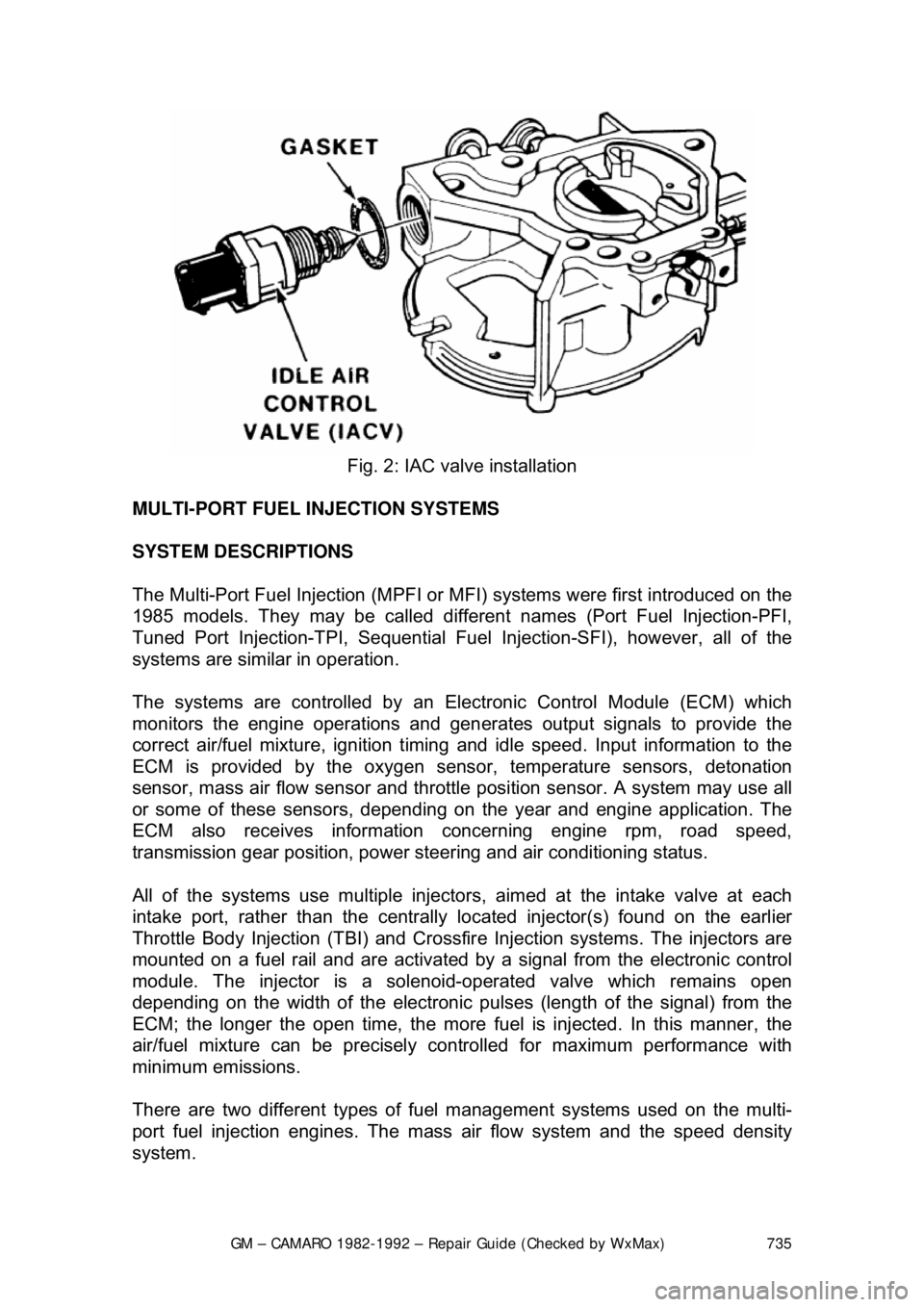
IDLE AIR CONTROL VALVE
REMOVAL & INSTALLATION 1. Remove the air cleaner.
2. Detach the electrical connection fr om the idle air control assembly.
3. Using a 1
1/4 in. wrench, remove the IAC valve from the throttle body. On
IAC valves secured with screws, remove the attaching screws.
Before installing a NEW IAC valve, measur e the distance that the conical valve
is extended. Measurement should be made from the motor housing to the end
of the cone. Distance s hould be no greater than 1
1/4 in. (32mm). If the cone is
extended too far, damage may result when the motor is installed. If necessary,
push on the end of cone until it is retracted the correct distance.
4. Installation is the reverse of remo val. Torque threaded valves to 13 ft.
lbs. (17 Nm).
Fig. 1: IAC valve pintle measurement
Page 735 of 875
GM – CAMARO 1982-1992 – Repair Guide (Checked by WxMax) 735
Fig. 2: IAC valve installation
MULTI-PORT FUEL INJECTION SYSTEMS
SYSTEM DESCRIPTIONS
The Multi-Port Fuel Injection (MPFI or MFI) systems were first introduced on the
1985 models. They may be called different names (Port Fuel Injection-PFI,
Tuned Port Injection-TPI, Sequential Fuel Injection-SFI), however, all of the
systems are similar in operation.
The systems are controlled by an Elec tronic Control Module (ECM) which
monitors the engine operations and gen erates output signals to provide the
correct air/fuel mixture, ignition timing and idle speed. Input information to the
ECM is provided by the oxygen sens or, temperature sensors, detonation
sensor, mass air flow sensor and throttle position sensor. A system may use all
or some of these sensors, depending on the year and engine application. The
ECM also receives information concerning engine rpm, road speed,
transmission gear position, power steer ing and air conditioning status.
All of the systems use multiple injector s, aimed at the intake valve at each
intake port, rather than the centrally lo cated injector(s) found on the earlier
Throttle Body Injection (TBI) and Crossfir e Injection systems. The injectors are
mounted on a fuel rail and ar e activated by a signal from the electronic control
module. The injector is a solenoi d-operated valve which remains open
depending on the width of t he electronic pulses (length of the signal) from the
ECM; the longer the open time, the more f uel is injected. In this manner, the
air/fuel mixture can be precisely c ontrolled for maximum performance with
minimum emissions.
There are two different types of f uel management systems used on the multi-
port fuel injection engines. The mass air flow system and the speed density
system.
Page 736 of 875

GM – CAMARO 1982-1992 – Repair Guide (Checked by WxMax) 736
The mass air flow systems measure the
mass of air that is drawn into the
engine cylinders, rather than just the vo lume. The sensor contains a hot-wire
sensing unit, which is made up of an electronic balanced bridge network.
Whenever current is suppli ed to the sensor, the bridge is energized and the
sensing hot-wire is heated. As the air enter s the mass air flow sensor, it passes
over and cools the hot wire. When the hot wire is cooled, it's resistance changes
and additional current is needed to k eep the bridge network balanced. This
increase in current is sent to the computer as a voltage signal and is used to
calculate the mass of the incoming air. The ECM uses this information to\
determine the duration of fuel injection pulse, ignition timing and EGR operation.
The speed density systems calculate the volume of air moving through the
intake. The ECM establishes the speed fact or through a signal from the ignition
module. The Manifold or Intake Air Temperature (MAT/IAT) and the Engine
Coolant Temperature (ECT) sensors work together to assure that proper
temperature information gets to the ECM wh ile the Manifold Absolute Pressure
(MAP) sensor monitors the changes in m anifold pressure which results from
changes in engine loading. These three se nsors contribute to the density factor.
Together, these inputs (engine speed, coolant temperature sensor, etc ...) are
the major determinants of the air/fuel mixture delivered by the fuel injection
system.
The following engines and fuel managem ent systems are covered in this
section:
• 1985-1989 2.8L MPFI - Mass Air Flow
• 1990-1992 3.1L MPFI - Speed Density
• 1985-1989 5.0L and 5.7L TPI - Mass Air Flow
• 1990-1992 5.0L and 5.7L TPI - Speed Density
Relieving Fuel System Pressure
1. Disconnect the negative battery cable to prevent fuel discharge if the key
is accidentally turned to the RUN position.
2. Loosen the fuel filler cap to reliev e the tank pressure and do not tighten
until service has been completed.
3. Connect J-34730-1 fuel pressure gauge or equivalent, to the fuel
pressure test valve. Wrap a shop towel around the fitting while
connecting the gauge to prevent spillage.
4. Place the end of the bleed hose into a suitable container and open the
valve to relieve the fuel system pressure.
ELECTRIC FUEL PUMP
REMOVAL & INSTALLATION
The fuel pump is part of t he fuel sender assembly located inside the fuel tank.
Page 743 of 875

GM – CAMARO 1982-1992 – Repair Guide (Checked by WxMax) 743
MINIMUM IDLE SPEED
The minimum idle speed should onl
y be adjusted under two conditions:
If the throttle body has been replaced.
After every other possible cause for the in correct idle speed has been explored.
There are many possible causes for incorre ct idle speed, most of which require
a high level of diagnostic skill as well as expensive testing equipment. Check
the vehicle for vacuum leaks, incorrect valve or ignition timing, deposit
accumulation in the throttle bore or valve, sticking throttle linkage or bent throttle
valves. If the vehicle will still not idle pr operly after checking these areas, it
should be diagnosed by a professional.
1. Pierce the idle stop screw with an awl. Apply leverage to remove it.
2. Make sure the IAC valve is connect ed. Short the A and B terminals of the
ALDL connector together with a length of wire.
3. Turn the ignition to the ON positi on, but do not start the engine. Wait at
least 30 seconds before proceeding.
4. With the ignition ON, disconnect the IAC valve connector.
5. Separate the set-timing connector. Th is eliminates the possibility of
changes in engine speed due to variations of engine timing.
6. Start the engine and remove t he wire shorting the A and B terminals
together. It may be necessary to hold the throttle open slightly to prevent
the engine from stalling.
7. Allow the engine to reach no rmal operating temperature.
8. Adjust the idle speed to the following: a. 2.8L Engines - 450-550 rp m A/T or 550-650 rpm M/T
b. 3.1L Engines - Refer to the underhood emissions sticker
c. 5.0L and 5.7L TPI engines - 400-450 rpm.
If these figures differ from t hose on the underhood emissions
sticker, always follow the specifications on the emissions sticker.
9. Turn the ignition OFF and connect the IAC valve harness. On models up
to 1989, adjust the Throttle Position Sensor.
THROTTLE POSITION SENSOR (TPS) 1. Install three jumper wires betw een the TPS and the harness connector.
2. Use a digital voltmeter connected to terminals A and B of the TPS.
3. Turn the ignition switch ON , but do not start the engine.
4. Loosen the TPS attaching screws and adj ust the sensor to the following:
a. 2.8L Engines - 0.50-0.60 volts
b. 5.0L and 5.7L TPI Engines - 0.47-0.61 volts
5. Tighten the attaching screws, then check that the reading has not been
disturbed.
6. With the ignition OFF, remove the jumper wires. Reconnect the TPS
harness.
Page 753 of 875

GM – CAMARO 1982-1992 – Repair Guide (Checked by WxMax) 753
THROTTLE POSITION SENSOR (TPS)
REMOVAL & INSTALLATION
1. Disconnect the negative battery cable.
2. Detach the electrical connector from the sensor.
3. Remove the attaching screws, lockw ashers and retainers. Some models
use a seal between the throttle body and the sensor, do not lose this! \
4. Remove the throttle position sensor.
To install: 5. Install the throttle position sensor seal, if applicable.
6. With the throttle valve in the norma l closed idle position, install the
sensor on the throttle body assembly. Make sure the sensor pickup lever
is properly located on the th rottle actuator lever.
7. Install the retainers, screws and lockwashers using a thread locking
compound. On models up to 1989, DO NOT tighten the screws until the
sensor is adjusted. Follow the procedures outlined earli er in this section.
COLD START VALVE
REMOVAL & INSTALLATION 1. Disconnect the negative battery cable.
2. Relieve the fuel system pressure.
3. Remove the intake manifold plenum.
4. Unplug the electrical connection.
5. Clean the fuel rail around the cold start valve tube fitting.
6. Remove the tube fitting from t he fuel rail. Use a backup wrench to
prevent it from turning.
7. Remove the cold start valve retain ing bolt and remove the valve from the
intake manifold.
To install: 8. Use new O-rings and install the valve and bolt.
9. Connect the wiring harness.
10. Connect the cold start tube at the f uel rail. Use a wrench to prevent it
from turning.
11. Install the intake manifold plenum.
12. Connect the negative battery cable. With the engine OFF and the ignition
ON, check for fuel leaks.
Page 794 of 875
GM – CAMARO 1982-1992 – Repair Guide (Checked by WxMax) 794
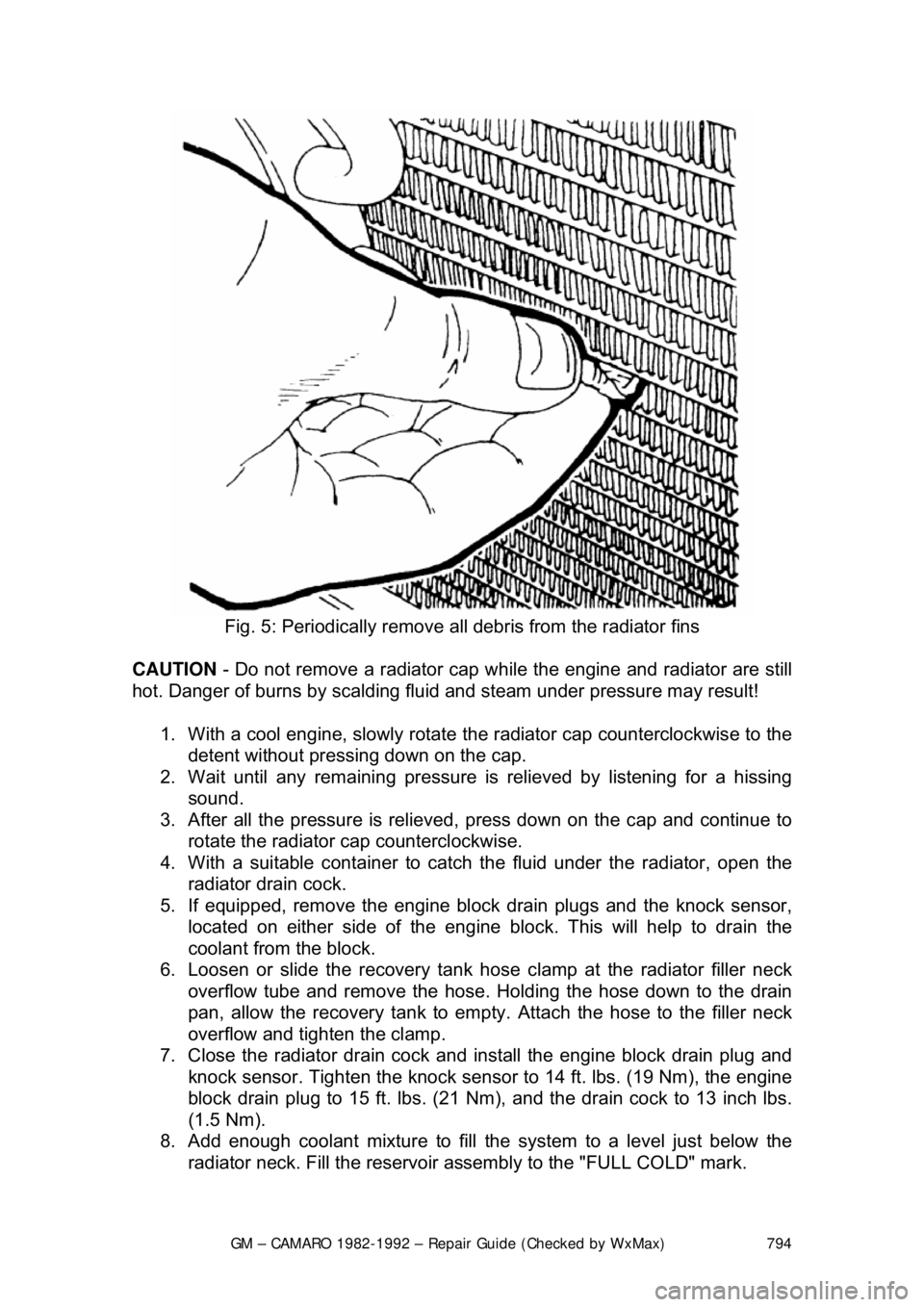
Fig. 5: Periodically remove all debris from the radiator fins
CAUTION - Do not remove a radiator cap wh ile the engine and radiator are still
hot. Danger of burns by scalding fluid and steam under pressure may result!
1. With a cool engine, slowly rotate t he radiator cap counterclockwise to the
detent without pressing down on the cap.
2. Wait until any remaini ng pressure is relieved by listening for a hissing
sound.
3. After all the pressure is relieved, press down on the cap and continue to
rotate the radiator cap counterclockwise.
4. With a suitable container to catc h the fluid under the radiator, open the
radiator drain cock.
5. If equipped, remove the engine blo ck drain plugs and the knock sensor,
located on either side of the engine block. This will help to drain the
coolant from the block.
6. Loosen or slide the recovery tank hos e clamp at the radiator filler neck
overflow tube and remove the hose. Holding the hose down to the drain
pan, allow the recovery tank to empty. Attach the hose to the filler neck
overflow and tighten the clamp.
7. Close the radiator drain cock and install the engine block drain plug and
knock sensor. Tighten the knock sensor to 14 ft. lbs. (19 Nm), the engine
block drain plug to 15 ft. lbs. (21 N m), and the drain cock to 13 inch lbs.
(1.5 Nm).
8. Add enough coolant mixture to fill the system to a level just below the
radiator neck. Fill the reservoir a ssembly to the "FULL COLD" mark.