1982 CHEVROLET CAMARO light
[x] Cancel search: lightPage 123 of 875

GM – CAMARO 1982-1992 – Repair Guide (Checked by WxMax) 123
5. Pull the parking lever 4 clicks. T
he parking brake levers on both calipers
should be against the lever stops on the caliper housings. If the levers are
not against the stops, check for binding in the rear cables and/or loosen the
cables at the equalizer nut until both left and right levers are against their
stops.
6. Adjust the equalizer adjusting nut unt il the parking brake levers on both
calipers just begin to mo ve off their stops.
7. Back off the adjuster nut until the le vers move back, barely touching their
stops.
8. Operate the parking brak e lever several times to check adjustment. After
cable adjustment, the parking brake le ver should travel no more than 14
ratchet clicks. The rear wheels shoul d not turn forward when the parking
brake lever is applied 8-16 ratchet clicks.
9. Release the parking brake lever. Both rear whee ls must turn freely in both
directions. The parking brake levers on both calipers should be resting on
their stops.
10. Remove the wheel nuts retaining t he rotors. Install the wheel and tire
assemblies.
11. Lower the vehicle.
PARKING BRAKE FREE-TRAVEL
ADJUSTMENT
1989-92 MODELS
REAR DISC BRAKES
Disc brake pads must be new or parallel to within 0.006 in. (0.15mm). Parking
brake adjustment is not valid wit h heavily tapered pads and may cause
caliper/parking brake binding. Replace tapered brak e pads. Parking brake free-
travel should only be made if the caliper has been taken apart. This adjustment
will not correct a condition where the caliper levers will not return to their stops.
1. Have an assistant apply a light brake pedal load, enough to stop the rotor
from turning by hand. This takes up all clearances and ensures that
components are correctly aligned.
2. Apply light pressure to the caliper lever.
3. Measure the free-travel between t he caliper lever and the caliper housing.
The free-travel must be 0.0024-0.028 in. (0.6-0.7mm).
4. If the free-travel is incorrect, do the following: a. Remove the adjuster screw.
b. Clean the thread adhesive re sidue from the threads.
c. Coat the threads with adhesive.
d. Screw in the adjuster screw far enough to obtain 0.024-0.028 in. (0.6-
0.7mm) free-travel between the caliper lever and the caliper housing.
5. Have an assistant release the brak e pedal, then apply the brake pedal firmly
3 times. Recheck the free-travel and adjust as necessary.
Page 126 of 875
GM – CAMARO 1982-1992 – Repair Guide (Checked by WxMax) 126
CHASSIS ELECTRICAL
UNDERSTANDING AND TROUBLESHOOTING ELECTRICAL SYSTEMS
BASIC ELECTRICAL THEORY
For any 12 volt, negative ground, electrical system to operate, the electricity
must travel in a complete circuit. This simply means that current (power) from
the positive (+) terminal of the battery must eventually return to the negative (—
) terminal of the battery. Along the way, this current will travel through wires,
fuses, switches and components. If, for any reason, the flow of current through
the circuit is interrupted, the component f ed by that circuit will cease to function
properly.
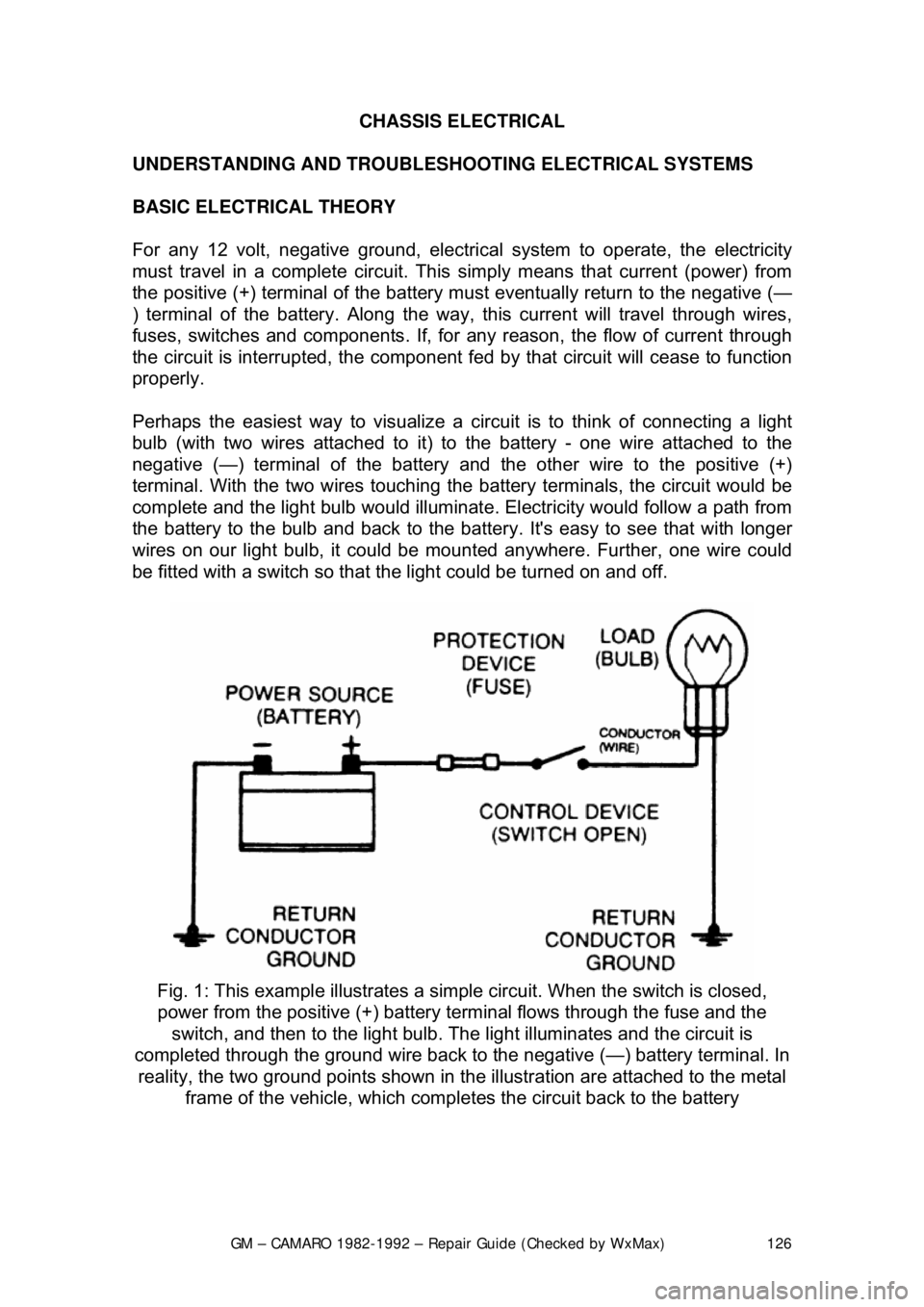
Perhaps the easiest way to visualize a circ uit is to think of connecting a light
bulb (with two wires attac hed to it) to the battery - one wire attached to the
negative (—) terminal of the battery and the other wire to the positive (+)
terminal. With the two wires touching the battery terminals, the circuit would be
complete and the light bulb would illuminat e. Electricity would follow a path from
the battery to the bulb and back to the bat tery. It's easy to see that with longer
wires on our light bulb, it could be mounted anywhere. Further, one wire could
be fitted with a switch so that t he light could be turned on and off.
Fig. 1: This example illu strates a simple circuit. Wh en the switch is closed,
power from the positive (+) battery te rminal flows through the fuse and the
switch, and then to the light bulb. The light illuminates and the circuit is
completed through the ground wire back to the negative (—) battery terminal. In
reality, the two ground point s shown in the illustration are attached to the metal
frame of the vehicle, which comple tes the circuit back to the battery
Page 132 of 875

GM – CAMARO 1982-1992 – Repair Guide (Checked by WxMax) 132
Some electrical components which require
a large amount of current to operate
use a special switch called a relay. Sinc e these circuits carry a large amount of
current, the thickness of the wire in the ci rcuit is also greater. If this large wire
were connected from the load to the c ontrol switch, the switch would have to
carry the high amperage load and the fair ing or dash would be twice as large to
accommodate the increased size of t he wiring harness. To prevent these
problems, a relay is used.
Relays are composed of a coil and a se t of contacts. When the coil has a
current passed though it, a magnetic fiel d is formed and this field causes the
contacts to move together, completing the circuit. Most relays are normally
open, preventing current from passing thr ough the circuit, but they can take any
electrical form depending on th e job they are intended to do. Relays can be
considered "remote control switches." They allow a smaller current to operate
devices that require higher amperages. W hen a small current operates the coil,
a larger current is allo wed to pass by the contacts. Some common circuits
which may use relays are the horn, headlight s, starter, electric fuel pump and
other high draw circuits.
Fig. 3: Relays are composed of a coil and a switch. These two components are
linked together so that w hen one operates, the other operat es at the same time.
The large wires in the circuit are connect ed from the battery to one side of the
relay switch (B+) and from the opposite side of the re lay switch to the load
(component). Smaller wires are connected from the relay coil to the control
switch for the circuit and from the opposite side of the relay coil to ground
LOAD
Every electrical circuit must include a "load" (something to use the electricity
coming from the source). Without this l oad, the battery would attempt to deliver
its entire power supply from one pole to another. This is called a "short circuit."
All this electricity would take a short cut to ground and cause a great amount of
damage to other components in the circui t by developing a tremendous amount
of heat. This condition could develop suffici ent heat to melt the insulation on all
the surrounding wires and reduce a multiple wire cable to a lump of plastic and
copper.
Page 136 of 875

GM – CAMARO 1982-1992 – Repair Guide (Checked by WxMax) 136
accidental grounding. It is al
so advisable to include a standard automotive fuse
in any jumper wire. This is commonly referred to as a "fused jumper". By
inserting an in-line fuse holder between a set of test leads, a fused jumper wire
can be used for bypassing open circuits. Use a 5 amp fuse to provide protection
against voltage spikes.
Jumper wires are used primarily to locate open electrical circuits, on either the
ground (—) side of the circuit or on the power (+) side. If an electrical
component fails to operate, connect t he jumper wire between the component
and a good ground. If the component operates only with the jumper installed,
the ground circuit is open. If the ground circuit is good, but the component does
not operate, the circuit between the power feed and component may be open.
By moving the jumper wire successively back from the component toward the
power source, you can isolate the area of the circuit where the open is located.
When the component stops func tioning, or the power is cut off, the open is in
the segment of wire between the jumper and the point previously tested.
You can sometimes connect the jumper wir e directly from the battery to the
"hot" terminal of the component, but firs t make sure the component uses 12
volts in operation. Some electrical components, such as fuel injectors or
sensors, are designed to operate on about 4 to 5 volts, and running 12 volts
directly to these components will cause damage.
TEST LIGHTS
Fig. 1: A 12 volt test light is used to detect the presence of voltage in a circuit
The test light is used to check circuits and components while electrical current is
flowing through them. It is used for volt age and ground tests. To use a 12 volt
test light, connect the ground clip to a good ground and probe wherever
necessary with the pick. The test light will illuminate when voltage is detected.
This does not necessarily mean that 12 volts (or any particular amount of
Page 137 of 875

GM – CAMARO 1982-1992 – Repair Guide (Checked by WxMax) 137
voltage) is present; it only means that so
me voltage is present. It is advisable
before using the test light to touch its ground clip and probe across the battery
posts or terminals to make sure the light is operating properly.
WARNING - Do not use a test light to probe electronic ignition, spark plug or
coil wires. Never use a pick-type test light to probe wiring on computer
controlled systems unless spec ifically instructed to do so. Any wire insulation
that is pierced by the test light pr obe should be taped and sealed with silicone
after testing
Like the jumper wire, the 12 volt test li ght is used to isolate opens in circuits.
But, whereas the jumper wire is used to bypass the open to operate the load,
the 12 volt test light is us ed to locate the presence of voltage in a circuit. If the
test light illuminates, there is power up to t hat point in the circuit; if the test light
does not illuminate, there is an open circui t (no power). Move the test light in
successive steps back toward the power source until the light in the handle
illuminates. The open is between the pr obe and a point which was previously
probed.
The self-powered test light is similar in design to the 12 volt test light, but
contains a 1.5 volt penlight battery in the handle. It is most often used in place
of a multimeter to check for open or shor t circuits when power is isolated from
the circuit (continuity test).
The battery in a self-powered test light does not provide much current. A weak
battery may not provide enough power to illuminate the test light even when a
complete circuit is made (especially if there is high resistance in the circuit).
Always make sure that the test battery is strong. To check the battery, briefly
touch the ground clip to the pr obe; if the light glows brightly, the battery is strong
enough for testing.
A self-powered test light should not be used on any co mputer controlled system
or component. The small amount of electr icity transmitted by the test light is
enough to damage many electr onic automotive components.
MULTIMETERS
Multimeters are an extremely useful tool for troubleshooting electrical problems.
They can be purchased in either analog or digital form and have a price range
to suit any budget. A multimeter is a voltmeter, ammeter and ohmmeter (along
with other features) combined into one instrument. It is often used when testing
solid state circuits because of its hi gh input impedance (usually 10 megaohms
or more). A brief description of the mult imeter main test functions follows:
• Voltmeter - the voltmeter is used to measure voltage at any point in a
circuit, or to measure the voltage drop across any part of a circuit.
Voltmeters usually have various scales and a selector switch to allow the
reading of different volt age ranges. The voltmeter has a positive and a
negative lead. To avoid damage to the meter, always connect the
negative lead to the negative (—) side of the circ uit (to ground or nearest
Page 138 of 875

GM – CAMARO 1982-1992 – Repair Guide (Checked by WxMax) 138
the ground side of the circuit) and
connect the positive lead to the
positive (+) side of the circuit (to t he power source or the nearest power
source). Note that the negative voltme ter lead will always be black and
that the positive voltmeter will alwa ys be some color other than black
(usually red).
• Ohmmeter - the ohmmeter is designed to read resistance (measured in
ohms) in a circuit or component. Mo st ohmmeters will have a selector
switch which permits the measurement of different ranges of resistance
(usually the selector swit ch allows the multiplication of the meter reading
by 10, 100, 1,000 and 10,000). Some ohmmeters are "auto-ranging"
which means the meter itself will dete rmine which scale to use. Since the
meters are powered by an internal battery, the ohmmeter can be used
like a self-powered test light. When the ohmmeter is connected, current
from the ohmmeter flows through the ci rcuit or component being tested.
Since the ohmmeter's internal resi stance and voltage are known values,
the amount of current flow throug h the meter depends on the resistance
of the circuit or component being test ed. The ohmmeter can also be used
to perform a continuity test for suspected open circuits. In using the
meter for making continuity checks, do not be concerned with the actual
resistance readings. Zero resistance, or any ohm reading, indicates
continuity in the circui t. Infinite resistance indi cates an opening in the
circuit. A high resistance reading w here there should be none indicates a
problem in the circuit. Checks for s hort circuits are made in the same
manner as checks for open circuits, ex cept that the circuit must be
isolated from both power and normal gr ound. Infinite resistance indicates
no continuity, while zero resi stance indicates a dead short.
WARNING - Never use an ohmmeter to check the resistance of a component or
wire while there is volt age applied to the circuit
• Ammeter - an ammeter measures the am ount of current flowing through
a circuit in units called amperes or amps. At normal operating voltage,
most circuits have a characteristic amount of amperes, called "current
draw" which can be measured usi ng an ammeter. By referring to a
specified current draw rating, then measuring the amperes and
comparing the two values, one can det ermine what is happening within
the circuit to aid in diagnosis. An open circuit, for example, will not allow
any current to flow, so the amme ter reading will be zero. A damaged
component or circuit will have an incr eased current draw, so the reading
will be high. The ammeter is always connected in series with the circuit\
being tested. All of the current that normally flows through the circuit
must also flow through the ammeter; if there is any other path for the
current to follow, the ammeter readi ng will not be accurate. The ammeter
itself has very little resistance to curr ent flow and, therefore, will not affect
the circuit, but it will measure current draw only when the circuit is closed
and electricity is flowing. Excessive current draw can blow fuses and
drain the battery, while a reduced current draw can cause motors to run \
slowly, lights to dim and other components to not operate properly.
Page 140 of 875
GM – CAMARO 1982-1992 – Repair Guide (Checked by WxMax) 140
TESTING
OPEN CIRCUITS
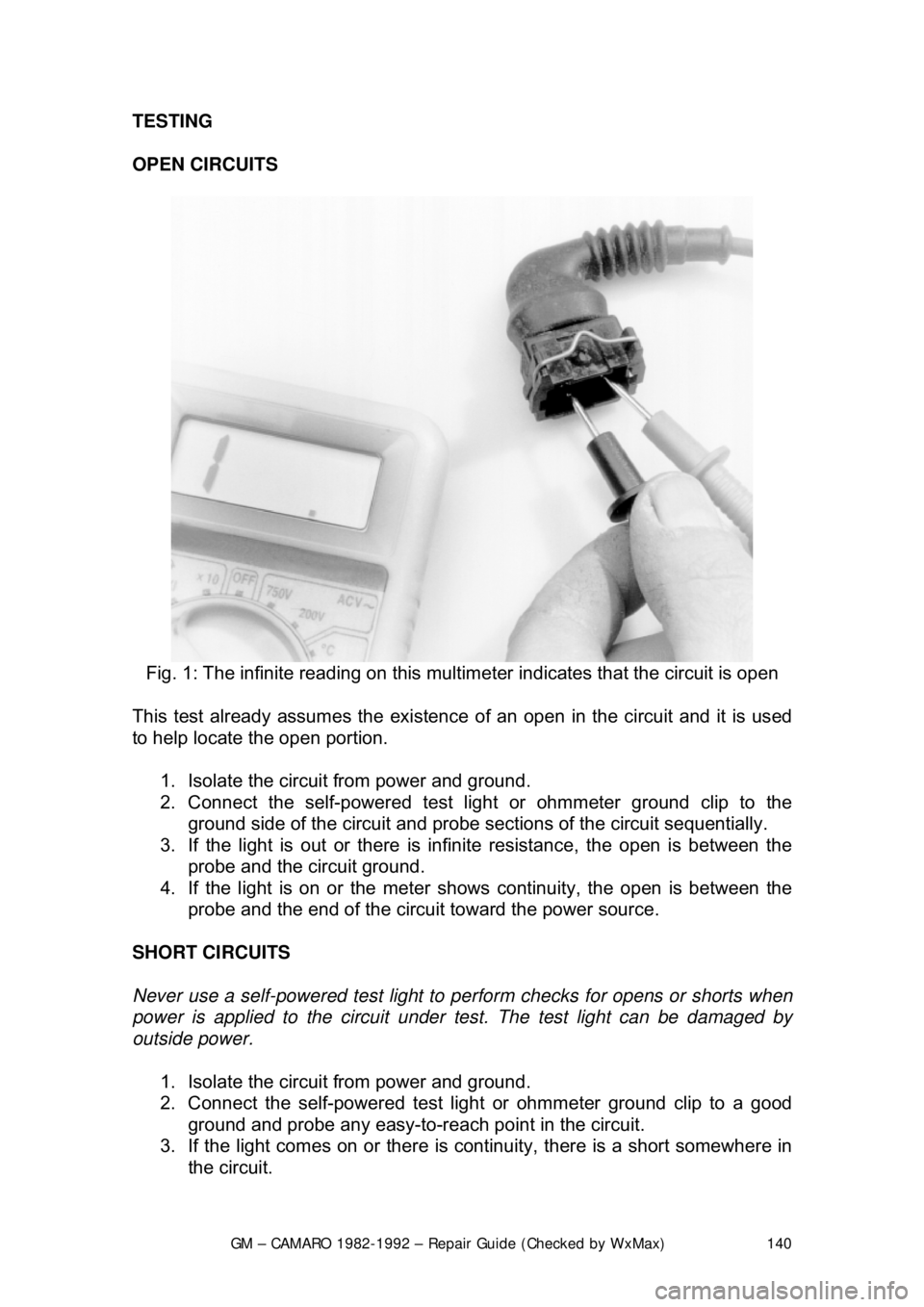
Fig. 1: The infinite reading on this mult imeter indicates that the circuit is open
This test already assumes the existence of an open in the circuit and it is used
to help locate the open portion.
1. Isolate the circuit from power and ground.
2. Connect the self-powered test light or ohmmeter ground clip to the
ground side of the circuit and probe sect ions of the circuit sequentially.
3. If the light is out or there is infinite resistanc e, the open is between the
probe and the circuit ground.
4. If the light is on or the meter s hows continuity, the open is between the
probe and the end of the circuit toward the power source.
SHORT CIRCUITS
Never use a self-powered test light to per form checks for opens or shorts when
power is applied to the circuit under te st. The test light can be damaged by
outside power.
1. Isolate the circuit from power and ground.
2. Connect the self-powered test light or ohmmeter ground clip to a good
ground and probe any easy-to-reach point in the circuit.
3. If the light comes on or there is cont inuity, there is a short somewhere in
the circuit.
Page 141 of 875
GM – CAMARO 1982-1992 – Repair Guide (Checked by WxMax) 141
4. To isolate the short, probe a test point
at either end of the isolated circuit
(the light should be on or the mete r should indicate continuity).
5. Leave the test light probe engaged and sequentiall y open connectors or
switches, remove parts, etc. until t he light goes out or continuity is
broken.
6. When the light goes out, the shor t is between the last two circuit
components which were opened.
VOLTAGE
This test determines voltage available fr om the battery and should be the first
step in any electrical troubleshooting pr ocedure after visual inspection. Many
electrical problems, especially on co mputer controlled systems, can be caused
by a low state of charge in the battery. Excessive corrosion at the battery cable
terminals can cause poor contact that will prevent proper charging and f\
ull
battery current flow.
1. Set the voltmeter selector switch to the 20V position.
2. Connect the multimeter negative lead to the battery's negative (-) post or
terminal and the positive lead to t he battery's positive (+) post or
terminal.
3. Turn the ignition switch ON to provide a load.
4. A well charged battery should register over 12 volts. If the meter reads
below 11.5 volts, the battery power may be insufficient to operate the
electrical system properly.
VOLTAGE DROP
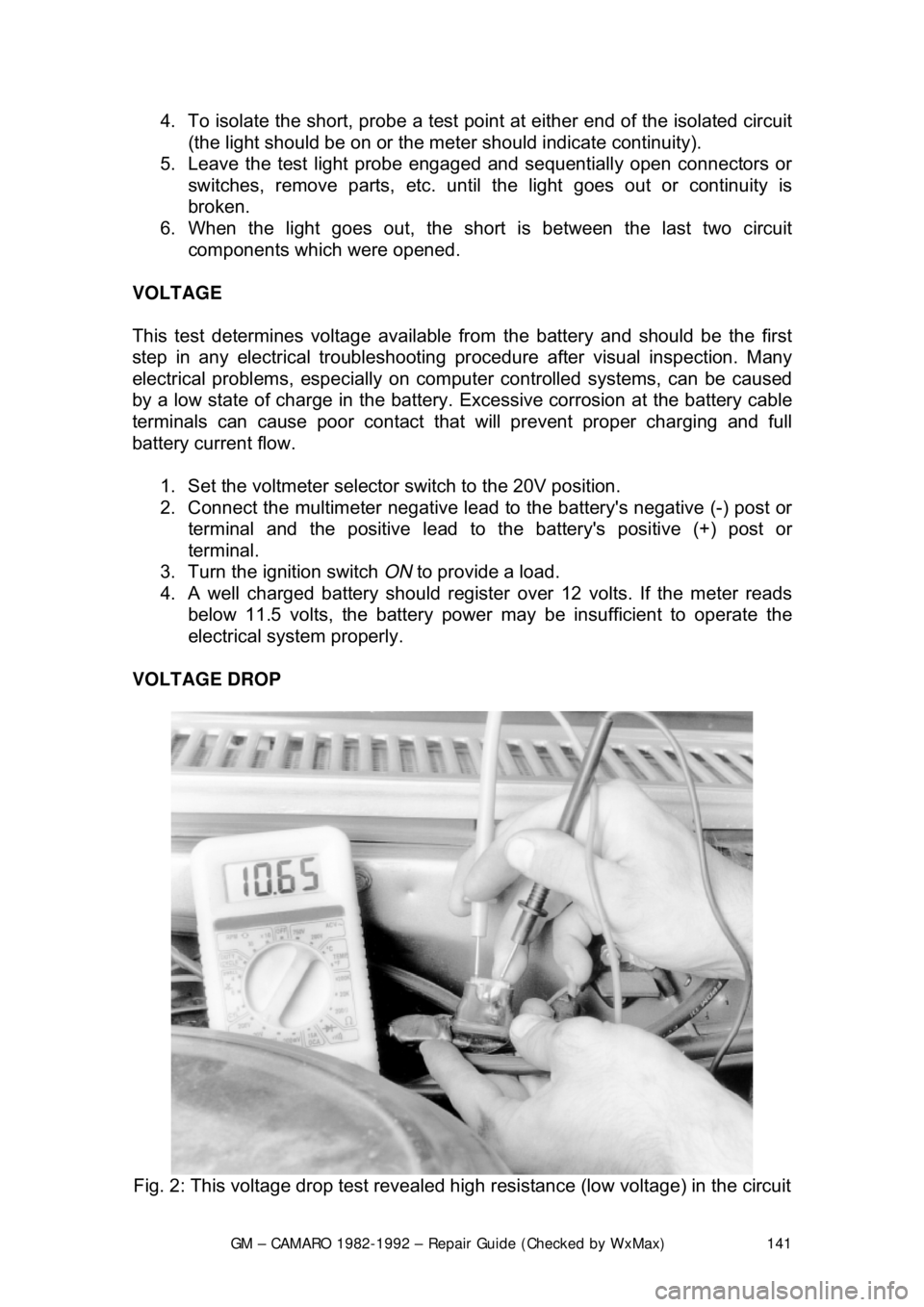
Fig. 2: This voltage drop test revealed high resistance (low voltage) in the circuit