1980 CHEVROLET CITATION service
[x] Cancel search: servicePage 65 of 95
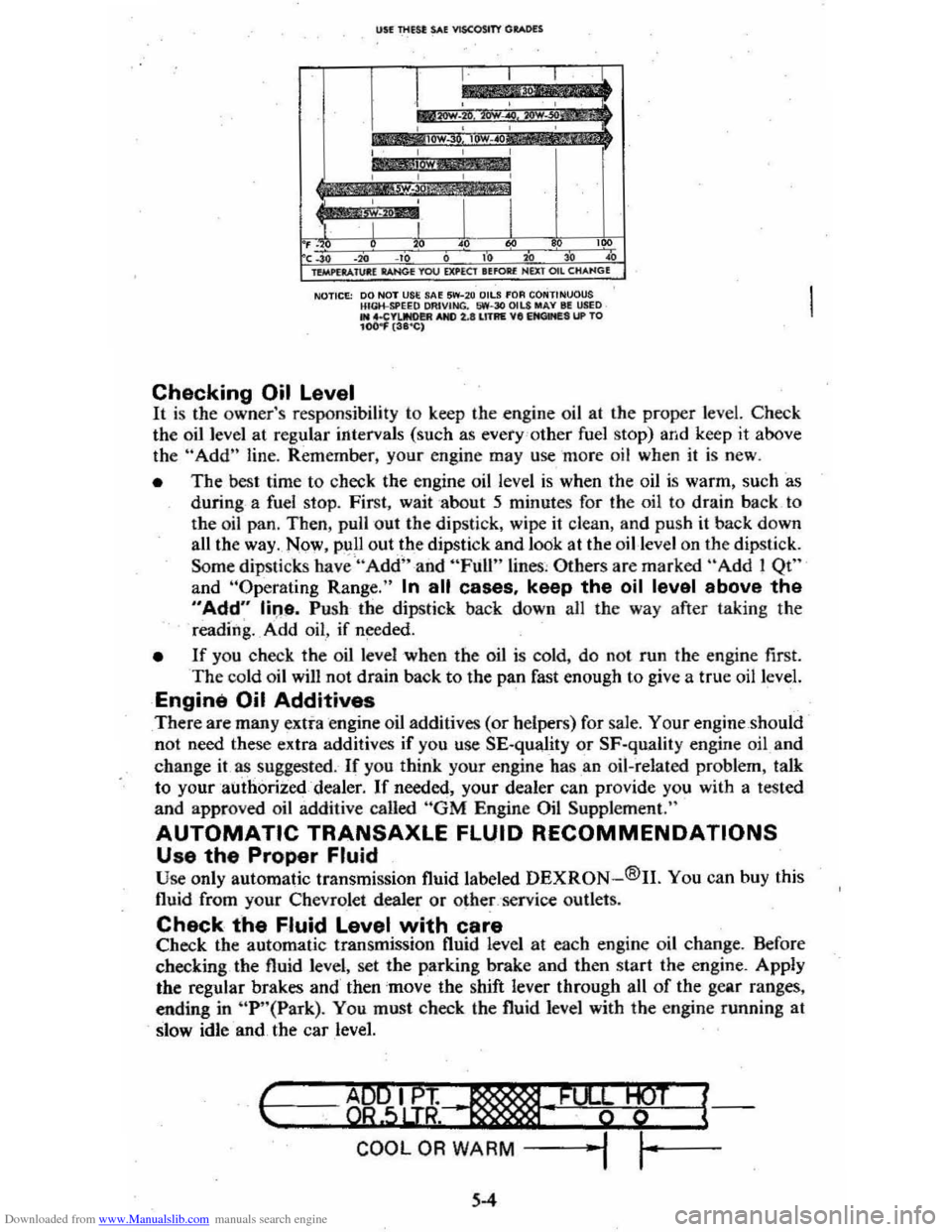
Downloaded from www.Manualslib.com manuals search engine USE Tlltst: SAE VISCOSITY GItotoDH
I , , , cl.
*
::0';'~ ,.,..~,: , , , ,
I
lOW , , , ,
,
I I I I , . , " • '" ,~, ." ., , " " " ~ lVitPl .... 1Ul:( lAN<* YOU ElU'EClltfOll( NUT OIl CHANG(
NOTICE: 00 NOT USE SA~ 5W-2 0 OilS fOA CONTINUOUS HIGH-SPEEQ OAIVING. 1,iW-30 OILS MAY III USED .. 4.CYIJNO!!R AND 2.lIll1AE VII EItClMES UP TO 104)
the oil level at regular intervals (such as every 'o ther fuel stop) and keep it above
th e "Add" line. Rem ember, your engine may use more oil when it is new .
• The best time to check the engine oil level is when the oil is warm, such as
during a fuel stop. First, wait about 5 minutes for the oil to drain back to
the oil pan, Then, pull out the dipstick, wipe
it clean, and push it back down
all the way . Now , pull out.th e dipstick and look at the oil-level on the dipstick.
Some
dipSlicks have "Add" and "Full" lines , Others are marked "Add! Qt"
and "Operaling Range." In all cases, keep the oil level above the
"Add" line. Push· the dipstick back down all the way after taking the
reading. _ A ·dd oil , if needed.
• If you check the oil level when the oil is cold, do no t run the engine first. The cold oil wilJ not drain back to the pan fast enough to give a true oil level.
Engine Oil Additives
There are many extra engine oil additives (or helpers) for sale. Your engine should
not need these extra additives if you use SE-quality or SF·quality engine oil and
change
it as suggested. If you think your engine has .an oil-related problem, talk
to your authorized dealer.
If needed, your dealer can provide you with a tested
and approved oil additive called "GM Engine Oil Supplement."
AUTOMATIC TRANSAXLE FLUID RECOMMENDATIONS
Use the Proper Fluid Use only automatic transmission fluid labe led DEXRON-®II. You can buy this
fluid from your Chevrolet dealer or
othe~,'service outlets.
Check the Fluid Level with care Check the automatic transmission fluid level at each engine oil change. Before
checking the fluid level, set the parking brake and then start the engine. AppJy
the regular brakes and then
'mov e the shift lever through all of the gear ranges,
ending in
"P '·(Park). You must check the fluid level with the engine funning at
slow idle and the car level.
I-c ..... --=---=..,~ ..... B9"""5IL.u;~~"-·, __ .........,; ..... _·F_%¥-W+--T -l{
COOL OR WARM -j ""I ,~-
5-4
Page 67 of 95
Downloaded from www.Manualslib.com manuals search engine remOve tlie cap on the coolant ~ecove~y tank : Add to the tank enough of a 50 150 . mixture of w ater and a g ood quality eth)dene glycol antifreez e to bring the level
up to the .
proper mark. Put the cap bac k on the tank .
Certain
conditi ons; "Such as air trapped in the syste m, may affe ct the coolant level
in
the radiator. You sho uld ch ec k the co olant ·Ievel ·in the radiator while you
change the engine oil and the e ng ine is col d. Follow steps I , 8, 9 and 10 und er
"Coola nt Rep lacement" for the correct way to rt!move the radiator cap .an d add
. coolant.
If you have to add coola nt more than f our tim es a yea r (ei ther to th e recov ery
tank
or to the radiat or). see your dealer. for a. c oo lin g system chec k.
NOTICE: If the proper quality antifreeze is used, there is no .nee~ to add extra inhibltOf"s or additives which claim to improve the svstem .. They may be harmful to the proper operation. I)f the system.
Cooling System Service
The cooling syste m should be serviced at the intervals specifi ed inSection A of
the Maintenan ce Sch edule fold er as follows:
I. W ash the radiatqr cap .and filler neck with clean water. See step J of "Coolant
Replacement" to remove rapiator cap. .
2. C hec k the coolant level in the radiator and have it tes ted for freeze proteCtion . Add·· ethylene gly col antifreeze, if needed, to· m aintain freeze protecti on at -37'C(-34'F),
3~ Have ·the coOlin-g sys tem and radiat or cap tested fo r a press ure capacity of
105 kPa (15 psi) . If a repl acement cap is needed"Hse an AC ca'p,or an
equivalent · cap, designed fOl: coolant recovery system ·s and spe cified for your model;
4. Tighten all radiator hose clamps and heater hose clamps and inspect an hose s.
R
eplace the hose s if they are swollen, "checked" or otherwise worn .
NOTICE: Take care when tightenjng·the hose clemps at tMI radiator. Overtightening COUld. bend or collapse .the radiator fittings.
5. Clean the front. of the radiator core and air condit ioning condenser to re m ove
dirt and oth er·objects. Al so clean the auxiliary engine oil andlor transmission -fluid ' cooler if the vehicle has them.
Coolant, Replacement
At the interval s specified in Section A of the Maintenance Schedule folder, flu sh
a
nd refill the cool ing system as follows :
1. Remove the·radiat or·cap when the engin e is ·cool :
•
Turn . t he cap s lowly to the len until ·it reaches a " stop. " Do not press down while turning the cap.
• 'Wait until any rem aining press ure (indicated by a hissing sound) is
reliev ed. then press down on the cap an d continue turning it t(j the left.
CAUTION:· To help ~lVoid the danger of being ,burned, do not remove the radiator cap while the angine and radiator are still hot s.c.lding flutd and steam can be bk)wn out under pressure if the·cap is taken off.too soon.
2. Whe n the cap is re m oved, run the eng ine until the upper radiator hose is hot.
(This shows that the thermostat is open and the coola nt is flow ing through
the . system.)
5·6
•
Page 72 of 95
Downloaded from www.Manualslib.com manuals search engine LUGGAGE/CARGO LOAO CAPACITY
Maximum Luggage Compartment Load
Coupe 155 Pounds/70.2 Kilograms
Sedan 142 Pounds/64.5 Kilograms
NOTICE: Total combined weight of luggage compartment
load, luggage rack load (when-equipped) •. and passengers must not exceed the vehicle capacity weight (shown on the Tire Placard lOcated on the.left front door).
Inflation Pressure
The: cold inflation pressures listed on the Tire Placard provide for the best balance
of tire life, riding comfort. and vehicle handling under normal driving conditions.
If only one inflation pressure is recommended on the Tire Placard, this pressure
should be used for aU vehicle loading conditions. If your vehicle has two inflation
pressures listed on the placard, the "Max LDad" pressures can be used any time,
but must be used when you carry more passengers and cargo than is allowed in
the "Optional Pressures" section. The "Optional Pressures" can be used in lightly
loaded conditions by
'those who prefer the utmost in comfort. In all loading
conditions, use of the "Max Load" pressures will result in improved fuel economy.
Incorrect tire inflation pressures
can have adverse effects on tire life and_vehicle performance. Too Iowan" air pressure·"causes increased tire flexing and heat
build-up. This weakens the tire and increases the chance of damage or failure. It
can result in tire overloading, abnormal tire wear, adverse vehicle handling, and
reduced fuel mileage. 'I'oohigh
an air pressure can result in abnormal wear, harsh
ride, and also increase the chance of dar:nage from road hazards.
Tire inflation pressures should be checked (this includes the spare tire, unless it
is a stowaway spare) and whenever your vehicle is serviced. Always checJ<.,tire
inflation pressures when tires are "cold."
1. The "cold" tire inflation pressure applies to the tire pressure when a vehicle
has
not· been driven more than-one mile (1.6 kilometers) after sitting for three
hours or more.
2. It is normal for tire pressures to increase 30 to 60 kilopascals (4 to 8 pounds
per square inch)
or more when the tires become hot from driving. Do not "bleed" or reduce tire inflation pressures after driving your vehicle. Bleeding
reduces the
"cold" inflation pressure and increase tire flexing, which can
result in tire damage and failure.
3. FOr sustained driving at speeds of 75 mph to 85 mph (120 km/h to 140 km/h),in countries where such speeds are permitted by law, cold
inflation pressures must be increased
30 kPa (4 psi) above the cold inflation
pressures stated on the Tire Placard up to the maximum for each load
range stated in
the_ chart below.
Sustained speeds of 75 mph to 85 mph (120 km/h to 140 km/h) ARE
NOT ADVISED when the 30 kPa (4 psi) adjustment would require pressures greater than the maximum for each load range stated on the chart. Sustained
driving at speeds over 85 mph (140 km/h), where permitted by law. IS NOT ADVISED unless your vehicle is equipped with special high speed tires
available from many tire dealers.
4. Forproper inflation pressures when towing trailers, see page 1-11 in this
manuat
5-11
Page 76 of 95
Downloaded from www.Manualslib.com manuals search engine UNIFORM TIRE QUALITY GRADING
The following information· relates to the tire grading system developed by the
National Highway Traffic
Safety Administration which will grade tires by tread wear, traction· and temperature performance:
TREADWEAR
The tread wear grade is a comparative rating based on the wear rate of the tire
when . tested under controlled conditions on a specified government test course.
For example, the tire graded 150 would Wear one and a half(l-1I2) times as well
on the government course as a tire graded 100. The relative performance of tires
depends upon the actual conditions
of their use, however, and may depart
significantly from the norm due to variations in driving habits, service practices
and differences in road characteristics and c1imate.
TRACTION -A. B. C
The. traction grades, from highest to lowest are A, B, and C, and they represent
the tire's ability to stop
on wet pavement as measured under controlled conditions
on
specified government test surfaces of asphalt and concrete. A tire marked C
may have poor traction performance.
Warning: The traction grade assigned to this tire is based on braking
(straight·ahead) traction tests and does not include cornering (turning) traction.
TEMPERATURE -A. B. C
The temperature grades are A (the highest), B, and C representing the tire's
resistance to the generation
of heat and its ability to dissipate heat when tested
under controlled conditions on a specified indoor laboratory teSt wheel. Sustained
high temperature can cause the material
of the tire to degenerate and reduce tire
life, and excessive temperature can lead to sudden tire failure.
The gradeC
corresponds to a level of performance which all passenger car tires must meet
under the Federal Motor Vehicle Safety Standard No. 109. Grades B and A
represent higher. levels
of performance on the laboratory test wheel than the
minimum required by law.
Warning: The temperature grade for this tire. is established for a tire that is
properly inflated and neit overloaded, Excessive speed, underinflation, or excessive
loading, either separately or in combination, can cause heat buildup and possible
tire failure,
At this time your tires mayor may not have a grade. These grades will be molded
on· the sidewal1s of passenger car tires over the next several years according to
a schedule established by the National Highway Traffic Safety Administration and
the tire manufacturers.
While the tires8vailable as standard or optional equipment on
General Motors vehicles may vary with respect to grade. all such tires meet General Motors performance standards and have been
approved for use on General Motors vehicles.
All passenger car tires must conform to Federal safety requirements
in addition to these grades.
You should replace your tires when ...
1. They are worn to a point where 1.6 millimeters (2/32 inch) or less tread
remains,
ot cord or fabric is showing.
5-\5
Page 78 of 95
Downloaded from www.Manualslib.com manuals search engine SECTION 6
OWNER ASSISTANCE
Your satisfaction and goodwill are important to your dealer and to us. Normally,
any problems with the sales transaction or the-operation of your car will be
handled by your dealer's Sales or Service departments. Sometimes, however,
despite the best intentions of all concerned, misunderstandings can occur.
If your
problem has not been handled to your satisfaction, we suggest you follow these
steps:
STEP ONE -Discuss your problem with a member of dealership management. Complaints can often be quickly resolved at that level. If the
problem has already been reviewed with the Sales or Service manager, contact the
owner
of the dealership or t~e General Manager.
STEP TWO -Contact the Chevrolet Zone Office closest to you_ (Zone offices are listed on the following pages.) IIi Canada, contact the General
Motors Zone Office. If your problem cannot be quickly resolved by the dealership
without further help, contact the Zone's Consumer Relations Department, and
provide them with:
• Your name, address and telephone ~umber
• Vehicle Identification Number (This is available from the car registration or title, or the plate attached to the left top of the instrument
panel
and visible through the windshield.)
• Dealer's name and location
• Vehicle's delivery date and present mileage
• Nature of problem
A convenient form for your use
is included in this section.
STEP THREE -Contact the Consumer Relations Representative, Chevrolet Central Office, Chevrolet Motor Division, Detroit,
Michigan 48202 (313-556-S219)_ (In Canada, contact the Customer
Services ~epresentative. General· Motors of Canada Ltd .• Oshawa. Ontario, L1 J SZ6; 416/644-6624)_ The representative will review all the
facts involved. Then, if it is felt some further action can be taken, the zone will
be so instructed. In any case, your contact will be acknowledged providing
Chevrolet's position
in the matter.
When contacting the Zone or Central
Office, please bear in mind that your
problem will likely be resolved in the dealership, using the deaLer's facilities,
equipment and personnel.
So it is suggested that you follow the above steps in
sequence when you have a problem.
Your purchase
of a Chevrolet product is greatly appreciated by both your dealer
and Chevrolet. We want to help you
any way we can to make sure you are
completely satisfied with your car.
6-1
Page 79 of 95
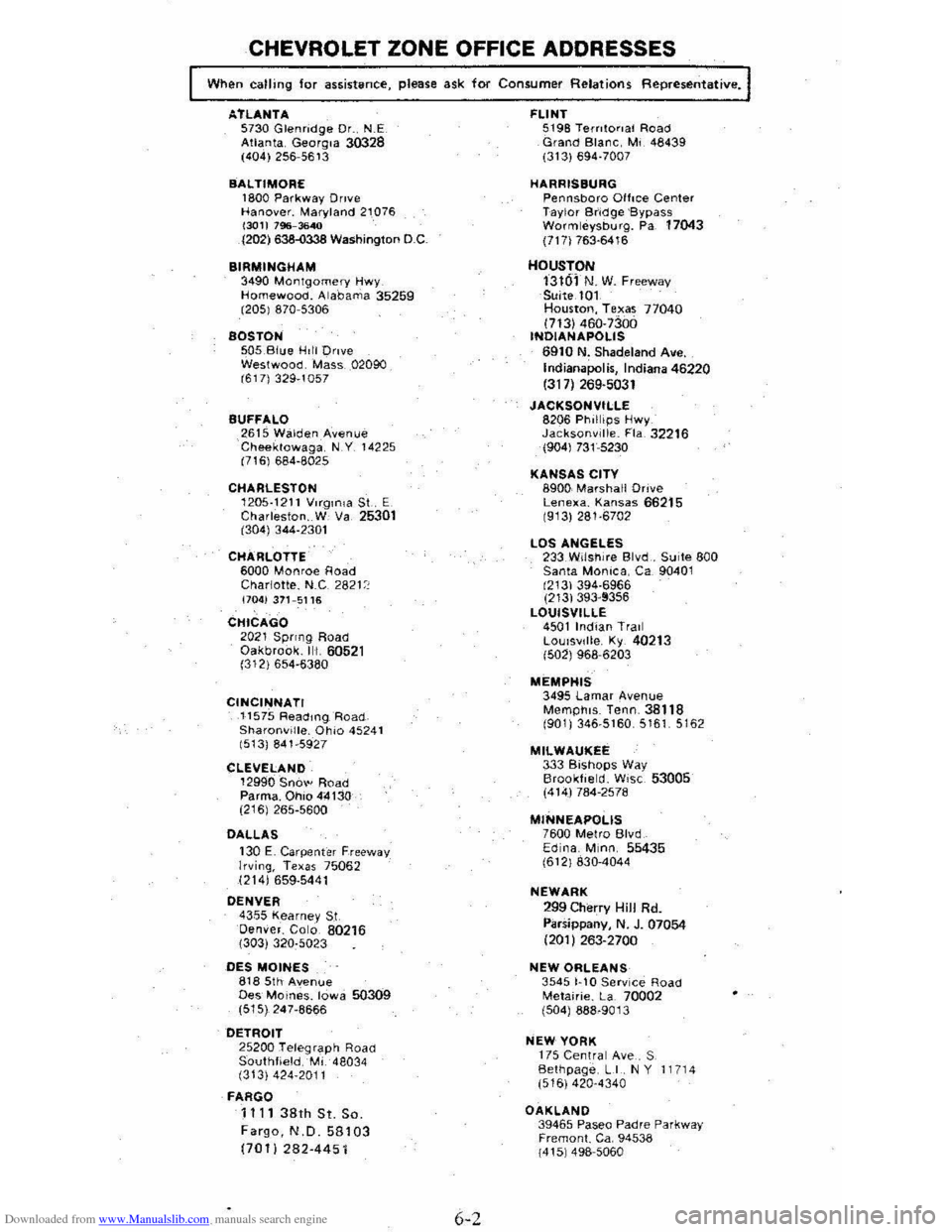
Downloaded from www.Manualslib.com manuals search engine CHEVROLET ZONE OFFICE ADDRESSES
When calling for assistance, please ask for Consumer Relations Representative .
.:.TlANTA 5730 Glenridge Dr._ N.E Atlanta. Georgia 30328 (404) 256-5613
BALTIMORE 1800 Parkway Drive
Hanover. Maryland 21076 (301) 796-3640 (202) 638-0338 Washington D.C
BIRMINGHAM 3490 Montgomery Hwy Homewood. Alabama 35259 (205) 870-5306
BOSTON 50S,Blue Hili Dnve Westwood, Mass 02090 (617) 329-1057
BUFFALO 2615 Walden Avenue
Cheektowaga, NY 14225
(716) 684-8025
CHAALESTON 1205-1211 V,rgm,a St E Charleston .. W Va. 25301
(304) 344-2301
CHARLOTTE 6000
Monroe Road
Charlotte. N.C 282P 1704) 371-5116
CHICAGO 2021 Spnng Road Oakbrook. III, 60521
(312) 654-6380
CINCINNATI 11575 ReadmgRoad Sharonville. Ohio 45241 1513) 841-5927
CLEVELAND 12990 5no\" Road
Parma. Ohio 44130 (216) 265-5600
DALLAS 130 E. Carpenter Freeway Irving, Texas 75062 1214J 659-5441 DENVER 4355 Kearney St
Denver. Colo. 80216 (303) 320:5023
DES
MOINES 818 5th Avenue Des Moines. Iowa 50309 (515)247-8666
DETROIT
25200 Telegraph Road Southfield,Mi 48034 (313) 424-2011
FARGO 1111 38th St. So. Fargo, N,D. 58103 (701) 282-445 i
6-2
FLINT 5198 Terntonal Road Grand Blanc, Mi 48439 (313) 694·7007
HARRISBURG Pennsboro Office Center
Taylor Bridge 'Bypass Wormleysburg. Pa, 17043 (717) 763-6416
HOUSTON 13101 N. W. Freeway Suite.lOl Houston, Texas 77040 (713) 460·7300 INDIANAPOLIS 6910 N. Shadeland Ave. Indianapolis, Indiana 46220 (317) 269·5031 JACKSONVILLE 8206 Phillips Hwy Jacksonville. Fla 32216 (904) 731-5230
KANSAS CITY 8900· Marshall Drive Lenexa. Kansas 66215 (913) 281·6702
LOS
ANGELES 233.Wilshire Blvd .. Suite 800
Santa Monica, Ca 90401 (213) 394·6966 (213) 393"!356 LOUISVILLE 4501 Indian Trail
LOUisville, Ky. 40213 (502) 968-6203
MEMPHIS 3495 Lamar Avenue MemphiS. Tenn, 38118 (901) 346-5160, 5161 5162
MILWAUKEE 333 Bishops Way BrOOkfield. Wisc 53005 (414) 784-2578
MINNEAPOLIS 7600 Metro Blvd Edina, Minn, 55435 (612) 830-4044
NEWARK 299 Cherry Hill Rd_ Parsippany, N. J_ 07054 (201) 263-2700
NEW ORLEANS 35451·10 Service Road
Metairie. La. 70002 (504) 888.9013
NEW YORK 175 Central Ave 5 Bethpage, LI, N Y 11714
(516) 420-4340
OAKLAND 39465 Paseo Padre Parkway Fremont. Col, 94538
{415) 498-5060
Page 83 of 95
Downloaded from www.Manualslib.com manuals search engine . SECTION 7
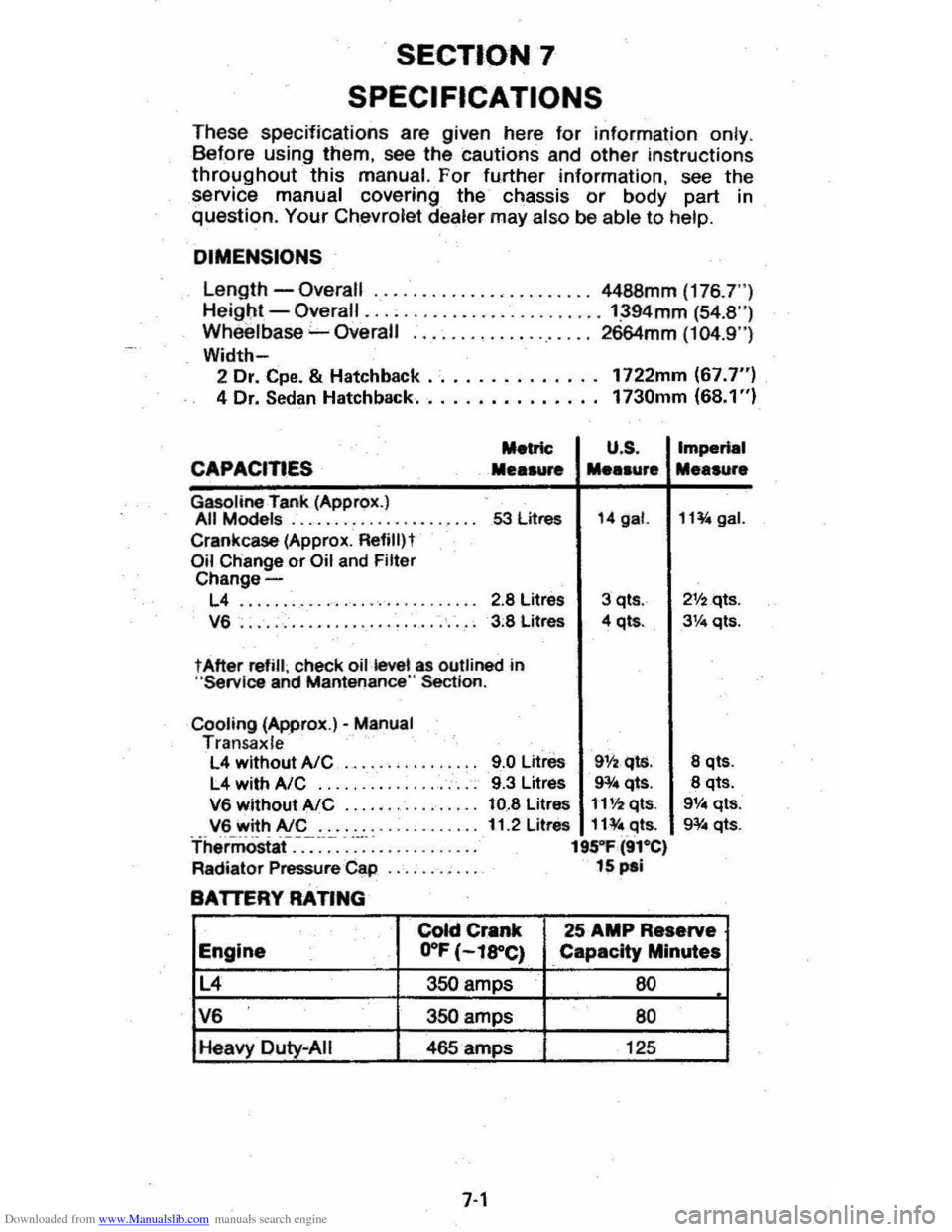
SPECIFICATIONS
T hese specifications are given here for information on ly . B efore using them, see the cautions and other instructions
throughout this manual. For fu.rther information , see the
service manual covering the chassis or body part in question. Your Chevrol et dealer may also be abl e to help.
DIMENSIONS
Length -Overall ......... , •.... , •...... 4488mm (176 .7")
He igl;lt -Overall ......................... ':394mm (54.8 ") Wh eelbase "-Overall ................... 2664mm (104.9")
Width-2 Dr. Cpe. & Hatchback .· ............. 1722mm (67.7") 4 Dr. Sedan Hatchback.. . . . . . . . . . . . .. 1730mm (68.1 ")
Metric U .S .
CAPACITIES Mea .... .... .ur.
Gasoline rank (Approx.) All Models .................... 53 litres 14 gal.
Crankcase (Approx . Refililt Oil Change or Oil and Filter Change-
L4 ........ ........... '. ' .. ... 2.8 Litres 3 qts .
V6 . . . . . , . . . . . . . . . . . . . . . . . . . . . . 3 :8 Litres 4 qt • . .
t After refill ; check oil kwel as outlined in "Service and Mantenance " Section .
Cooling (Approx.)· Manual Tran sa x le L4 without AlC ..... . , .. .
L4 withA/C .... ... ........... .
V6 without AlC ...... ...•...... V6 with AlC ....... . Thermostaf.-.-:~-~-. -....... : ....... .
Radiator Pressure Cap
BATTERY RATING
9.0 Litre. 911 •. qls. 9.3 Litres 9¥4 qts.
to.8 Litres 1'1'12 qts.
11.2 Litres 11¥ " .c:Jts. 195"1' (91·e) 15 pal
Imperial
Me.sure
11~gal.
21f2qts .
3Ve qts.
8 qt •.
8 qts. 9V .. qts.
g¥ .. qts.
colci Crank 25 AMP Reserve
Engine .. O"F (-l8"C) Capacity Minutes
L4 350 amps 60
V6 350 amps 80
Heavy Duty "AIi 465 amps 125
7-1
Page 90 of 95
Downloaded from www.Manualslib.com manuals search engine Switch Headlights .... TEMP (Temperature) .. Locks Door ...
2~19 2-17 1-2
Ignition ............................................. .. 2-5 1-1 2-2
2-25 Keys .. Theft Protection .. Lowering Seats .. Love Seat, Child & Infant: .. Lugglige/Cargo Capacity ... Luggage Rack ... Maintenance Record .. Maintenance Schedule .. Manual Transaxle Clutch Adjustment. .. .
1-10 5-11 2·29 7-12 5-.1
Maintenance ........................................... . 5-8
5-8
2-11
2· 10 2-12 4-1 4-5
1-3
Operating Tips .. Operation .. Shift Speeds. Metal Cleaners .. Metal Damage, Body ... Mirrors, Rearview .. Mobile Radios-. Monoxide Caution, Carbon .. . 2-25 2-1
2-1 2-2
2-2
2-15 Muffler ............................................... . New Car Break-In Period Octane Rating, Gasoline ... Odometer Oil, Engine Capacity .. Change Interval.. Dipstick ... Filter ... PreSsure Gage .. Pressure Light... Recommendation (Gas) .. OIL Light.. Openings, Roof... Opening The Hatchback ... Hood .. Windows ..
6-.1 5-3 (inside Back Cover) 5-3,7·1 2·1-9 2-17
5-3
2-17 (See "Roofs")
2·26 (Inside Back Cover) 1-5 Operating Speeds, New Car... 2-2 Operating Tips Fuel Economy.. 2-4 Trailer Towing.. 1-13 Transaxle... 2-9 Ventilation System.. 2.20 Operation in Foreign Countries.. 2"3 Outside Rearview Mirror.. 1.3 Overheating, Engine.. 3-3 Overseas Operation.. 2.3 Owner Assistance.. 6-1 Owner's Record... 7-11 Oxygen Sensor., 5.2 Paint Care.. 4-4
Paint Damage .. Parking;. Parking Brake .. Parking Lights .. PCV Valve & Filter .. Peda'·TI"avel, Brake ... Pedal Travel, Clutch .. Polishing & Waxing .. Pollution Control Power
4-' 2-. 2-14 7-3 7·2 2-14 5~8
.-. (See "Emission Contron
7-8
Antennas Brakes .. Door Locks .... Seats ... Steering Pressure, Oil Light ... Pressure. Tire Inflation ... Pulse Wiper ...
2-25
2-14
1-2 1-' 2·12
2-15
5-11
2-7
Pushing to Start ................................ .. 5-2 Radiator Antifreeze (Coolant) .. Cap, Prassure .. Checking Level .. Overheating .. Thermostat...
Radios & Antennas ... Raising Seats ... Rear Cargo Cover ...................... .. Compartment .. . Window Defogger .. Trailering .. Rearview Mirrors .. Reclining Seats .. Recovery Tank, Coolant .. Release
Hatc.hback
Hood .. Seatback Latch ... Reminder Lights ....
Replacement Fasteners
5-5 5-. 5-5 3-3 5-7
2-23 -2-25
2-25
2-:27
2-2,2-28 2-21 '·11 1-3 1-' 5-5
2-25 (Inside Back Cover)
1-' (See "Lights") 5-1
5-1 Replacement Maintenance Schedule .. Raplacement Owner's·Manual... 7-13 Replacement Parts ............. ....................... 7-2 Restraints .. Rocking Car When Stuck .. Roofs Carrying Cargo On ... Luggage Carrier .. Rack .. Vinyl .. Vista-Vent. ... Rotation, Tire .. Rustproofing .. Rust Protection ... Sefety Belts .. Seats (See
"Seat Belts") 3-7
1-3,2-2,9 2·29 2·29
'-5 2-26 5-12
'-5 '-5 (See "Seat Belts")
Adjustment.. 1-4 Child... 1-10 Folding.. 2-25 Latches..
1-5 Reclining.... . '-4 Seat Belts Care.. 4.3 Child Restraint ............................................ 1.10 Inspection.. 1-10 Lap/Shoulder.. 1-6 Light/Buzzer Reminder... 1;8 Pregn~nt Women .. Rear Seat. ... Self-Adjusting Brakes .. SENSOR Indicator ..
1-8 2-25 2-14 2-18,5-2 Sensor, Oxygen.... 2-18,5-2 Service & Maintenance.. 5-1 Service Station Information (InSide Back Cover) Sheet Metlll Damage... 4-5