1976 CHEVROLET VEGA oil temperature
[x] Cancel search: oil temperaturePage 33 of 87
Downloaded from www.Manualslib.com manuals search engine especially useful when driving on
dark roads since they provide ex
cellent long range illumination. The
headlight beam indicator will be on
whenever the high beams or
"brights" are in use. The Headlight
Beam
Switch controls the headlight
beams (see Page
2-12).
Light Switch
The three position light switch
controls the headlights, taillights,
parking lights, side marker lights,
instrument lights and dome lights
as shown. The headlamp circuit
is protected by a circuit breaker in
the light switch.
An overload on
the breaker will cause the lamps to
"flicker" on and off. If this condi
tion develops, have your headlamp
wiring checked immediately.
Clock
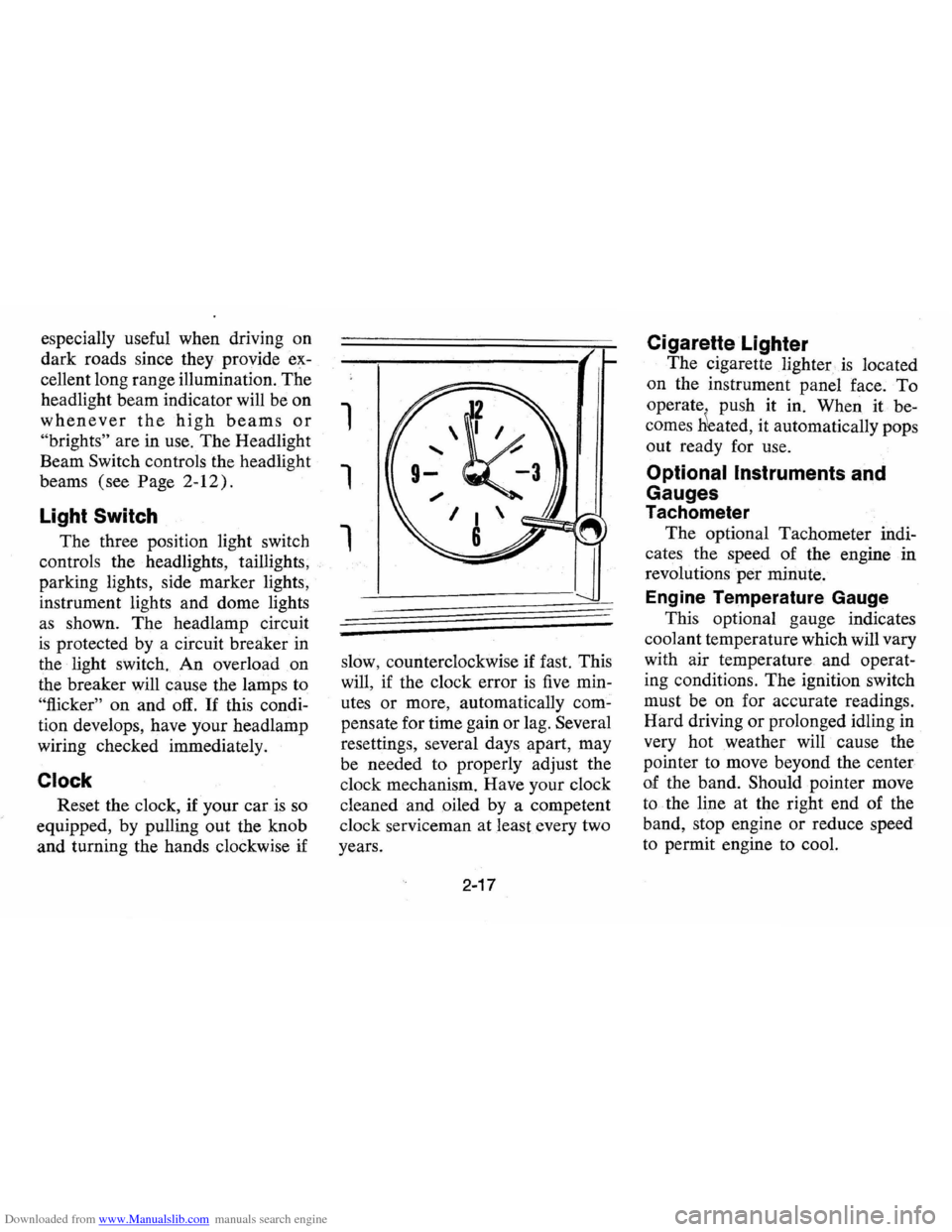
Reset the clock, if your car is so
equipped, by pulling out the knob
and turning the hands clockwise if
1
1
1
slow, counterclockwise if fast. This
will,
if the clock error is five min
utes
or more, automatically com
pensate for time gain or lag. Several
resettings, several days apart, may
be needed to properly adjust the
clock mechanism. Have your clock
cleaned and oiled by a competent
clock serviceman at least every two
years.
2-17
Cigarette Lighter
The cigarette lighter is located
on the instrument panel
face. To
operate . push it in. When it be
comes
Heated, it automatically pops
out ready for use.
Optional Instruments and
Gauges
Tachometer
The optional Tachometer indi
cates the speed of the engine in
revolutions
per minute.
Engine Temperature Gauge
This optional gauge indicates
coolant temperature which will vary
with air temperature and operat
ing conditions.
The ignition switch
must be on for accurate readings.
Hard driving
or prolonged idling in
very hot weather will cause the
pointer to move beyond the center
of the band. Should pointer move
to the line at the right end of the
band, stop engine or reduce speed
to permit engine to cool.
Page 60 of 87
Downloaded from www.Manualslib.com manuals search engine Gas Cap-The fuel tank filler cap
has a
two-step removal and in
stallation procedure plus a pres
sure-vacuum safety relief valve. It
is equipped with a double set of
locking tangs. To remove:
• Rotate cap one-half tum counter
clockwise to clear the first set of
tangs from the slots inside the
filler neck. This will allow any
residual pressure to escape.
• Pull the cap outward and rotate
one-quarter
tum counterclock
wise to clear second set of tangs
and remove the cap.
• To install, reverse this procedure.
NOTE: If this cap requires a re
placement, only a cap with these
same features should be used.
Fail
ure to use the correct cap can result
in a serious malfunction of the
sys
tem. Correct replacement caps may
be obtained from your authorized
Chevrolet dealer.
ENGINE ITEMS
Engine Oil and Filter
Recommendations'
• Use only SE engine oil.
• Change oil each 6 months or
7,500 miles, whichever occurs
first,
except under the following
conditions:
*
-driving in dusty conditions
-trailer pulling
-extensive idling
-short-trip operation at
freez
ing temperatures (engine not
thoroughly warmed-up) .
*Under these conditions, change oil
each 3 months
or 3,000 miles,
whichever occurs first.
• Operation in dust storms may
require an immediate oil change.
• Replace the oil filter at the first
oil change, and every second oil
change thereafter. AC oil filters
5-2
provide excellent engine pro
tection.
See your Chevrolet dealer for
ad
vice on the frequency of oil and
filter changes under unusual driving
conditions.
The above recommendations
ap
ply to the first change as well as
subsequent oil changes. The oil
change interval for your Chevrolet
engine
is based on the use of SE
oils and quality oil filters.
Oil
change intervals longer than those
listed above will seriously reduce
engine life and may affect
Chevro
let obligation under the provisions
of the
New Vehicle Warranty.
NOTE: Non-detergent and other
low quality oils are specifically not
recommended.
Only the use of SE
engine oils and proper oil and filter
change intervals assure you of
con
tinued proper lubrication of your
Chevrolet engine.
Page 61 of 87
Downloaded from www.Manualslib.com manuals search engine A high quality SE oil was in
stalled in your engine at the factory.
It is not necessary to change this
factory-installed oil prior to the
recommended normal change pe
riod. However, check the oil level
more frequently during the break
in period since higher oil consump
tion
is normal until the piston rings
become seated.
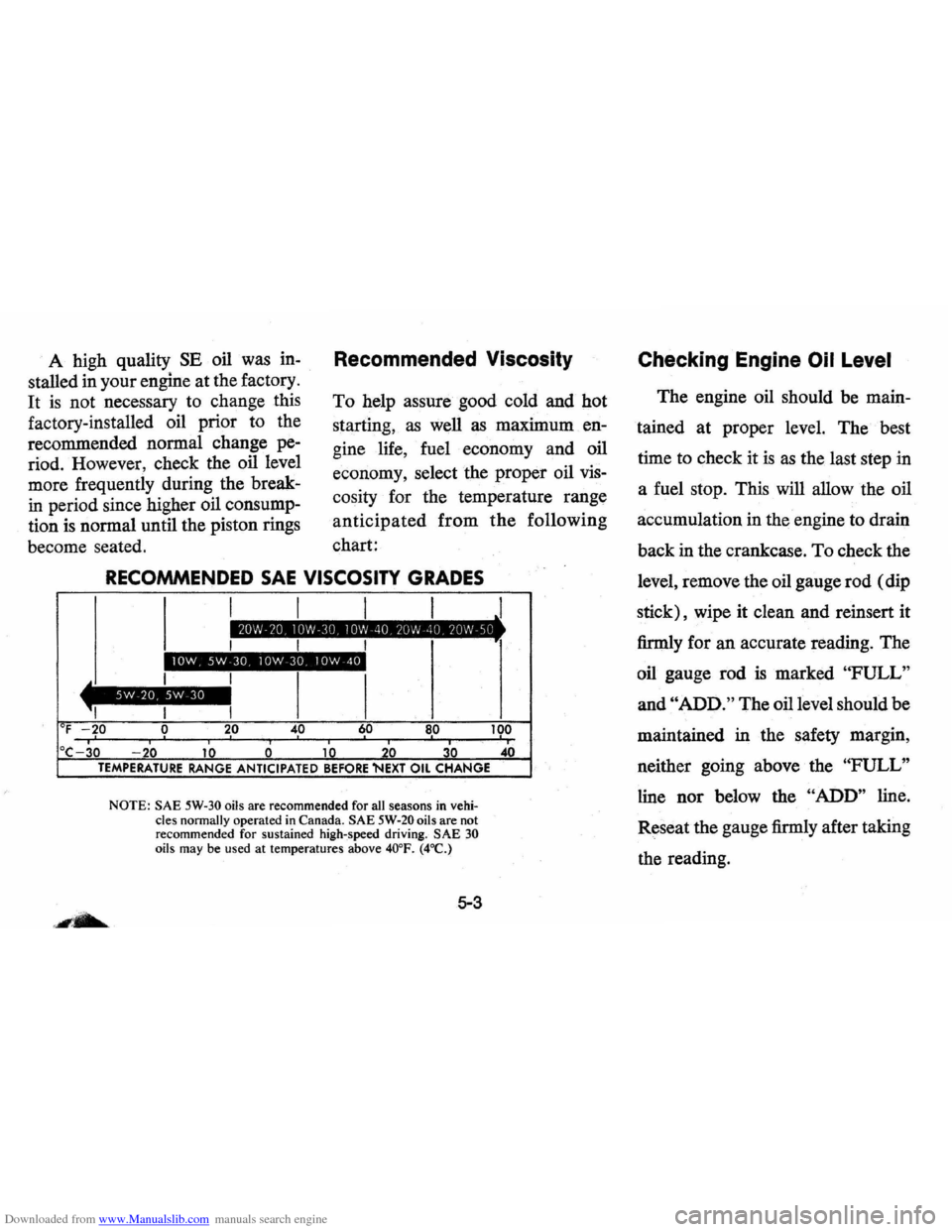
Recommended Viscosity
To help assure good cold and hot
starting, .
as well as maximum en
ginelife, fuel economy and oil
economy, select the proper oil
vis
cosity for the temperature rang¥
anticipated from the following
chart:
RECOMMENDED SAE VISCOSITY GRADES
I I I I 20N 20 lOW-3~ 10N')0 2UN ·;0 20,V sc
lOW 5w 30 lOW 30 lOW 40
TEMPERATURE RANGE ANTICIPATED BEFORE 'NEXT OIL CHANGE
NOTE : SAE 5W-30 oils are recommended for all Seasons in vehicles normally operated in Canada. SAE 5W-20 oils are not
recommended for sustained high-speed driving. SAE 30 oils may be used at temperatures above 40°F. (4°C.)
5-3
100 , i 40
Checking Engine Oil Level
The engine oil should be main
tained at proper level. The best
time to check it
is as the last step in
a fuel stop. This will allow the oil
accumulation in the engine to drain
back in the crankcase. To check the
level, remove the oil gauge rod (dip
stick), wipe it clean and reinsert it
firmly for an accurate reading. The
oil gauge rod is marked "FULL"
and "ADD." The oil level should be
maintained in the safety margin,
neither going above the
"FULL"
line nor below the "ADD" line.
Reseat the gauge firmly after taking
the reading.
Page 63 of 87
Downloaded from www.Manualslib.com manuals search engine TRANSMISSION ITEMS
Automatic Traiismission
Fluid Level
Recommendations
Use automatic transmission
fluids identified with the mark
DEXRON®-II available from your
Chevrolet dealer or local service
station.
Check the fluid level at each en
gine oil change period.
Automatic transmissions are fre
quently overfilled because the fluid
level
is checked when the fluid is
cold and the dipsick indicates fluid
should
be added. However, the low
reading may be normal since the
fluid level will rise
as the fluid tem
perature increases. A level change
of over
% inch will occur as fluid
temperature rises from
60° F. to
180° F. (16° C. to 82° C.)
Overfilling can cause foaming
and loss of fluid through the vent.
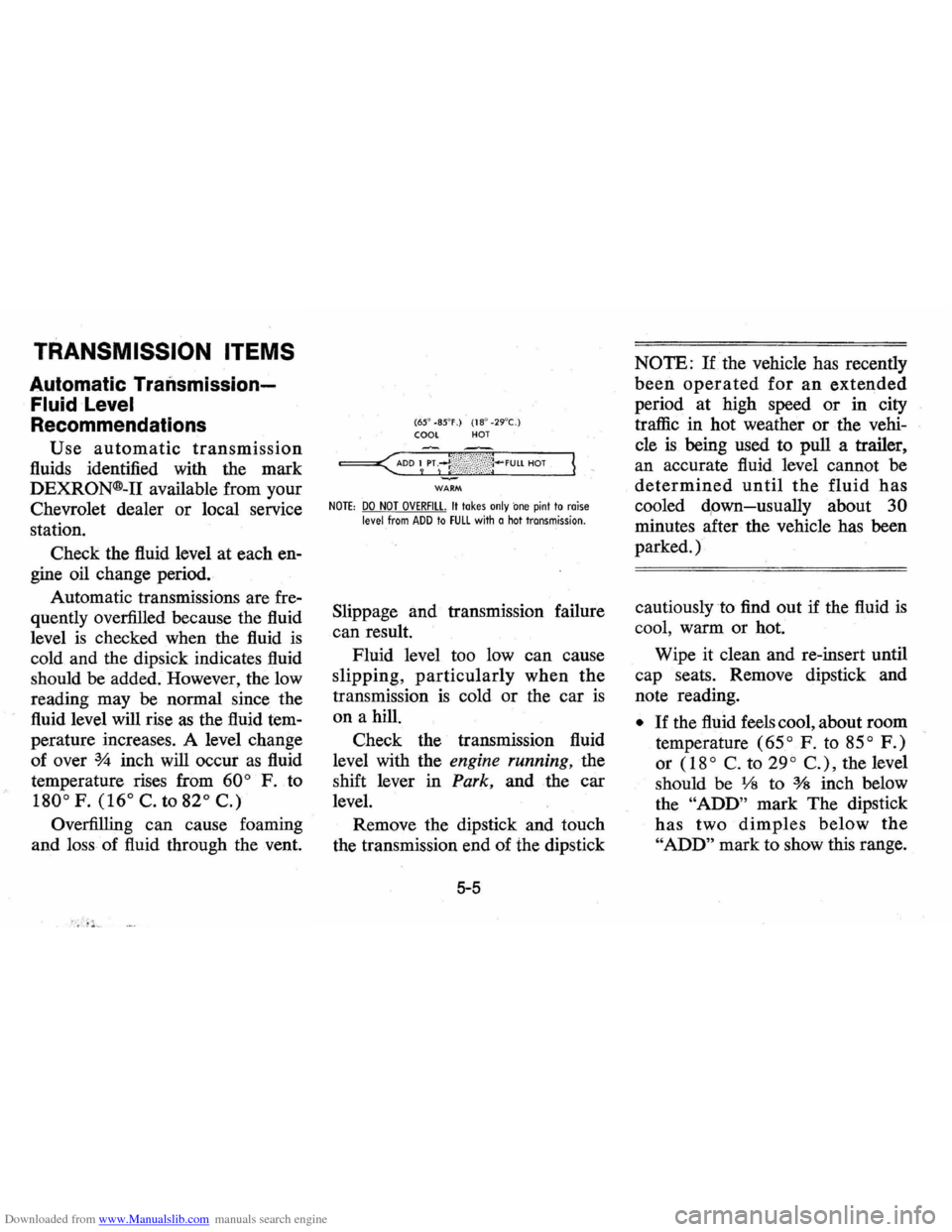
(65' -85'F .) (18 ' -29'C.) COOl HOT
WARM
NOTE: DO NOT OVERFill. It takes only 'one pint to raise level from ADD to FUll with a hot transmission.
Slippage and transmission failure
can result.
Fluid level too low can cause
slipping,
particularly when the
transmission is cold or the car is
on a hill.
Check the transmission fluid
level with the
engine running, the
shift lever in
Park, and the car
level.
Remove the dipstick and touch
the transmission end of the dipstick
NOTE: If the vehicle has recently
been operated for an extended
period at high speed or in city
traffic in hot weather
or the vehi
cle
is being used to pull a trailer,
an accurate fluid level cannot be
determined until the fluid has
cooled dpwn-usually about 30
minutes after the vehicle has been
parked.)
cautiously to find out if the fluid
is
cool, warm or hot.
Wipe it clean and re-insert until
cap seats. Remove dipstick and
note reading.
• If the fluid feels cool, about room
temperature
(65° F. to 85° F.)
or (18° C. to 29° C.), the level
should be
Vs to % inch below
the
"ADD" mark The dipstick
has two dimples below the
"ADD" mark to show this range.
Page 67 of 87
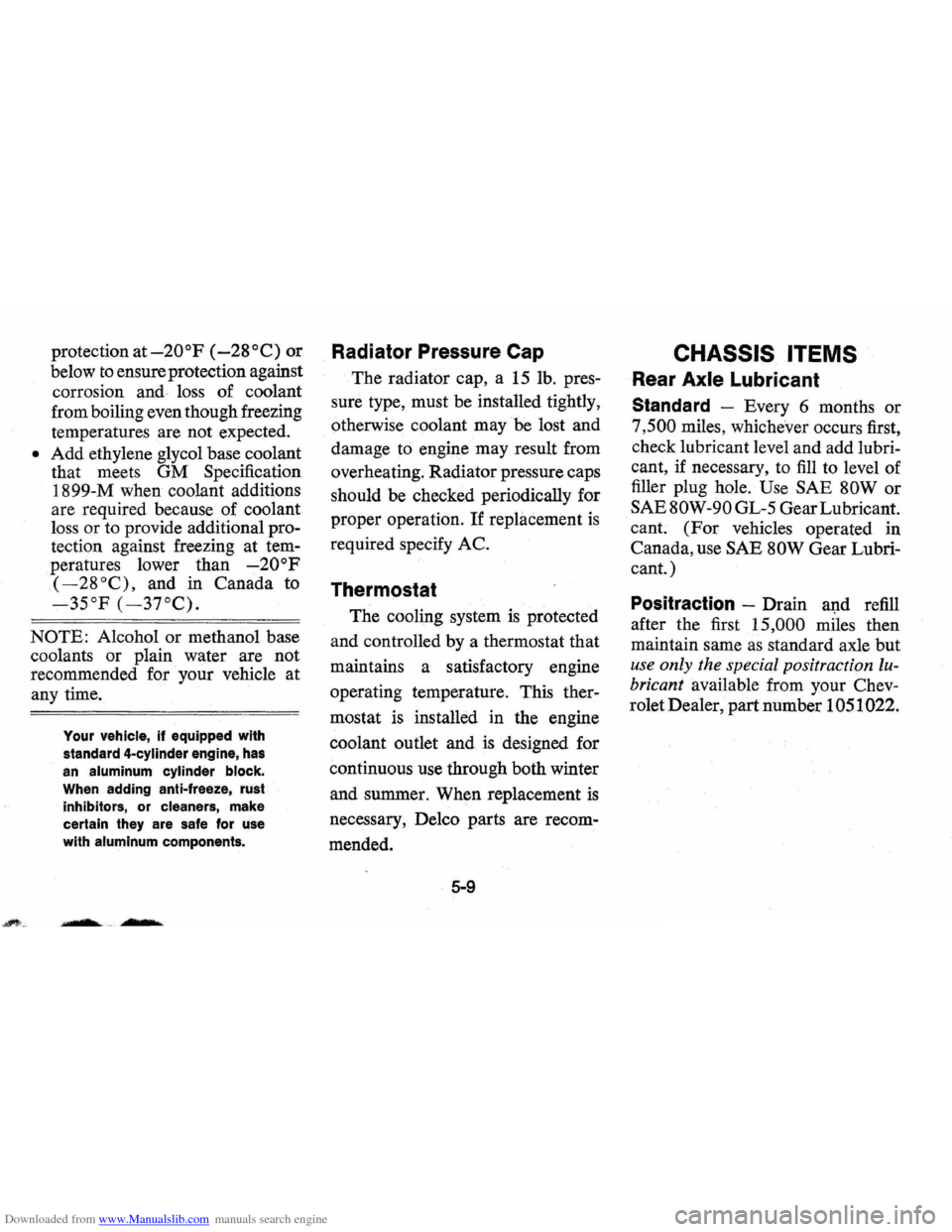
Downloaded from www.Manualslib.com manuals search engine protection at -20o
P (-28°C) or
below to ensure protection against
corrosion
and · loss of coolant
from boiling even though freezing
temperatures are not expected.
• Add ethylene glycol base coolant
that meets
GM Specification
1899-M when coolant additions
are required because of coolant
loss
or to provide additional pro
tection against freezing at tem
peratures lower than -20oP
(-28°C), and in Canada to
-35°P (-37°C).
NOTE: Alcohol or methanol base
coolants or plain water are not
recommended for your vehicle at
any time.
Your vehicle, if equipped with
standard 4-cylinder engine, has
an aluminum cylinder block.
When adding anti-freeze, rust
inhibitors, or cleaners, make
certain they are safe for
use
with aluminum components.
Radiator Pressure Cap
The radiator cap, a 15 lb. pres
sure type, must be installed tightly,
otherwise coolant may be lost and
damage
t6 engine may result from
overheating. Radiator pressure caps
should be checked periodically for
proper operation.
If replacement is
required specify AC.
Thermostat
The cooling system is protected
and controlled by a thermostat that
maintains a satisfactory engine
operating temperature. This
ther
mostat is installed in the engine
coolant outlet and
is designed for
continuous use through both winter
and summer. When replacement
is
necessary, Delco parts are recom
mended.
5-9
CHASSIS ITEMS
Rear Axle Lubricant
Standard -Every 6 months or
7,500 miles, whichever occurs first,
check lubricant level and add
lubri
cant, if necessary, to fill to level of
filler plug hole.
Use SAE 80W or
SAE80W-90GL-5 Gear Lubricant.
cant.
(Por vehicles operated in
Canada, use
SAE 80W Gear Lubri
cant.)
Positraction -Drain aJ,ld refill
after the first 15,000 miles then
maintain same
as standard axle but
use only the special positraction lu
bricant available from your Chev
rolet Dealer, part number 1051022.
Page 68 of 87
Downloaded from www.Manualslib.com manuals search engine Front Suspension
Every 6 months or 7,500 miles
Lubricate fittings with water
re
sistant EP Chassis Lubricant which
meets GM Specification
6031M.
NOTE:
Ball joints should not be
lubricated unless their temperature
is +10°F (-12°C), or higher.
During cold weather, they should
be allowed to warm up as necessary
before being lubricated.
Steering Linkage
Every 6 months or 7,500 miles,
lubricate fittings with water resist
ant
EP Chassis Lubricant which
meets GM Specification
6031M.
Power Steering System
Check the fluid level in the pump
reservoir at each oil change period.
Add GM Power Steering Fluid
(or Automatic Transmission Fluid
DEXRON®-II) as necessary to bring
level into proper range
on
filler cap indicator depending upon
fluid temperature.
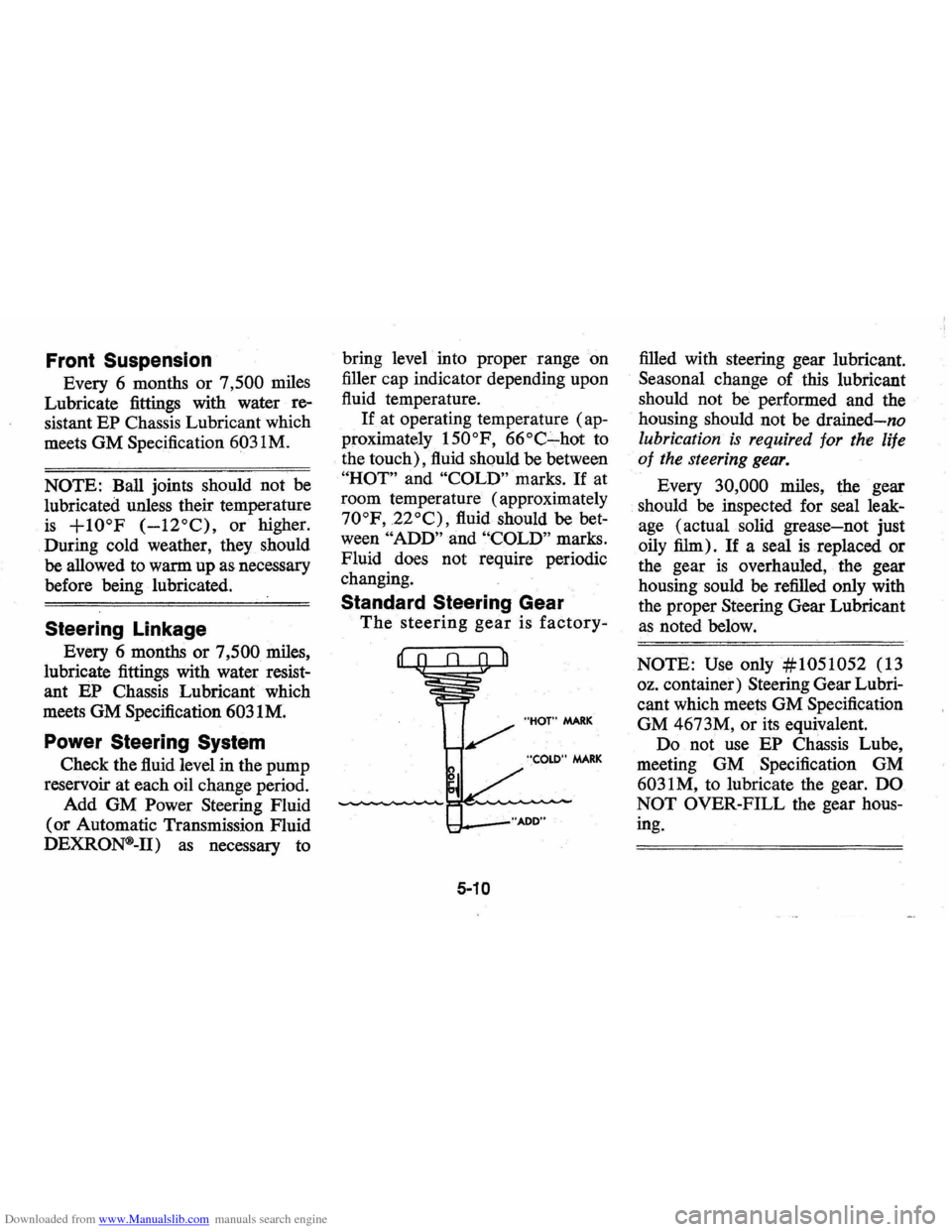
If at operating temperature (ap
proximately 150°F, 66°C-hot to
the touch), fluid should be between
"HOT" and "COLD" marks. If at
room temperature (approximately
70°F, 22°C), fluid should be bet
ween "ADD" and "COLD" marks.
Fluid does not require periodic
changing.
Standard Steering Gear
The steering gear is factory-
l-t.. __ "AOO"
5-10
filled with steering gear lubricant.
Seasonal change of this lubricant
should not be performed and the
housing should not be
drained-no
lubrication is required for the life
of the steering gear.
Every 30,000 miles, the gear
should be inspected for seal leak
age (actual solid grease-not just
oily film).
If a seal is replaced or
the gear
is overhauled, the gear
housing sould be refilled only with
the proper Steering Gear Lubricant
as noted below.
NOTE: Use only #1051052 (13
oz. container) Steering Gear
Lubri
cant which meets GM Specification
GM 4673M, or its equivalent.
Do not use
EP Chassis Lube,
meeting GM Specification GM
6031M, to lubricate the gear. DO
NOT
OVER-FILL the gear hous
ing.
Page 70 of 87
Downloaded from www.Manualslib.com manuals search engine Hood Latche$
Every 6 months or 7,500 miles,
whichever occurs first, lubricate
hood latch assembly and hood
hinge assembly
as follows:
1. Wipe off any accumulation of
dirt or contamination on latch
parts.
2 . Apply Lubriplate or equivalent
to latch pilot bolts and latch
locking plate.
.
3. Apply light engine oil to all pivot
points in release mechanism,
as
well as primary and secondary
latch mechanisms.
4. Lubricate hood hinges.
5. Make hood hinge and latch
mechanism functional check
to
assure the assembly is working
correctly .
Accelerator Linkage
Lubricate with engine oil every
15,000 miles.
Hinges
The following points should be
checked and lubricated every 6
months or
7,500 miles, whichever
occurs first:
hingeS on all doors,
fuel filler door, trunk lid, door lock
striker and door
jamb switches. '
5-12
Air Conditioning
Have your Authorized Dealer
check your Air Conditioning
sys
tem at some time during the winter
months to be sure there has been
no loss in cooling output. During
the summer , see your Authorized
Dealer immediately if you suspect
the system
is not performing as it
should.
NOTE: Your car's air condition
ing system will not operate below
ambient temperature of
300 F
( -1 0 C) , regardless of control
position.