1976 CHEVROLET VEGA motor
[x] Cancel search: motorPage 3 of 87
Downloaded from www.Manualslib.com manuals search engine A WORD TO VEGA OWNERS ...
This manual has been prepared to acquaint you with the operation and maintenance of your 1976 Vega, and to provide
important safety information. It is supplemented by two convenient folders which provide additional information on
vehicle maintenance and warranties. We urge you to read these publications carefully and follow the recommenda
tions to help assure the most enjoyable and troublefree operation of your vehicle.
When it comes to service, remember that your Chevrolet dealer knows your vehicle best and is interested in your complete satisfaction. Return to him for Guardian Maintenance Service and any other assistance you may require.
To assist dealers in handling your needs, Chevrolet maintains a number of Zone Offices throughout the country. Should you have a problem that cannot be handled through normal channels, follow the procedure presented in
Section 6 of this manual under the heading, "Owner Assistance".
We would like to take this opportunity to thank you for choosing a Chevrolet product-and assure you of our con
tinuing interest in your motoring pleasure and satisfaction.
FOR CONTINUING SATISFACTION, KEEP YOUR
GM CAR ALL GM. GENERAL MOTORS PARTS ARE
IDENTIFIED BY ONE OF THESE TRADEMARKS:
"NOTE TO CANADIAN OWNERS :
If preferred, a French Owner's Manual can be obtained from either your Dealer or by writing to General Motors of Canada Limited, Owner Relations Department, Oshawa, Ontario L1J 5Z6."
Chevrolet Motor Division
GM
"
" '"
-nelCO
Aux proprietaires canadiens
On peut se procurer un exemplaire de ce Guide en francais aupres du concessionnaire ou du service
des relations avec la clientele, General Motors of
Canada Limited, Oshawa, Ontario L1J 5Z6.
Page 4 of 87
Downloaded from www.Manualslib.com manuals search engine ------------------------:----------~ ... --,;,.._J,,; ......,.-~ ....
1976 VEGA 2'300
OWNER'S
MANUAL
This manual should be considered a perma
nent part of the vehicle, and must remain
with the vehicle at time of resale.
CHEVROLET MOTOR
DIVISION
GENERAL MOTORS
CORPORATION
DETROIT, MICHIGAN 48202
All information, illustrations and specifications con
tained in this manual are based on the latest product
information available at the time of publication. The right is reserved to make changes at any time without
notice.
For vehicles sold in Canada, substitute the name
General Motors of Canada Limited, wherever the name
Chevrolet Motor Car Division appears in this manual.
ST 303-76
"'General Motors Corporation 1976
Section
1
2
3
4
5
Table of Contents
Page
Before Driving Your Vega ............................. 1-1
Starting and Operating .. ;-............................ 2-1
Steering
Column Controls .......................... , 2-2
Floor Controls ...................................... 2-10
Instrument PaneL .................................. 2-13
Other Controls and Features ........................ , 2-27
In Case of Emergency ................................. 3-1
Appearance
Care... . . . . . . . . . . . . . . . . . . . . . . . . . . . . . . . . . .. 4-1 I
Service and Maintenance....... ...... . . . . ............ 5-1
6 Specifications,
Owner Assistance, Service
Manuals, Index, Gas Station
Information
........................................ 6-1
Applicable to CALIFORNIA Sales Only This vehicle as delivered by ,6 M Chevrolet Division is equipped with a bumper energy
absorption system meeting California S.B.42 (1971) as set forth in Sec. 34715 Vehicle Code.
Applicable to FLORIDA Sales Only This vehicle as delivered by GM Chevrolet Division is equipped with a bumper energy
absorption system meeting section 501.125, Florida Statutes, as amended June 10, 1974.
i
Page 12 of 87
Downloaded from www.Manualslib.com manuals search engine Child Restraint
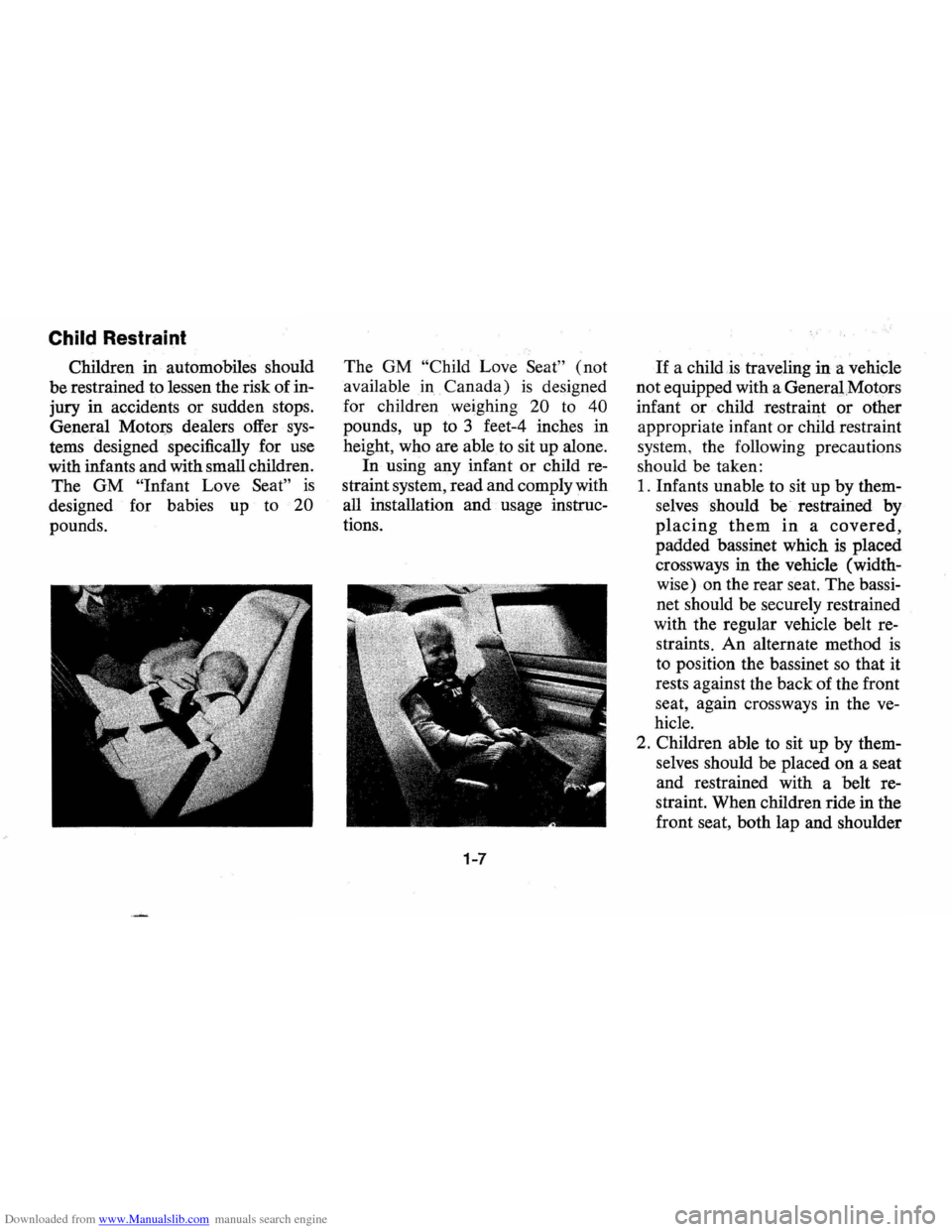
Children in automobiles should
be restrained to lessen the risk of in
jury in accidents
or sudden stops.
General
MotOl:S dealers offer sys
tems designed specifically for use
with infants and with small children.
The GM
"Infant Love Seat" is
designed for babies up to 20
pounds. The
GM
"Child Love Seat" (not
available in Canada)
is designed
for children weighing
20 to 40
pounds, up to 3 feet-4 inches in
height, who are
ableto sit up alone.
In using any infant
or child re
straint system, read and comply with
all installation and usage instruc
tions.
1-7
If a child,is traveling in a vehi<;:le
not equipped with a General Motors
infant
or child restraint or other
appropriate infant or child restraint
system , the following precautions
should be taken:
1 . Infants unable to sit up by them
selves should
be· restrained by
placing them in a covered,
padded bassinet which is placed
crossways in the vehicle (width
wise
)on the rear seat. The bassi
net should be securely restrained
with the regular vehicle belt re
straints. An alternate method
is
to position the bassinet so that it
rests against the back of the front
seat, again crossways in the ve
hicle.
2. Children able to sit up by them
selves should be placed on a seat
and restrained with a belt re
straint. When children ride in the
front seat, both lap and shoulder
Page 13 of 87
Downloaded from www.Manualslib.com manuals search engine belt should be worn. If the shoul
der belt causes neck
or face irri
tation due to the child's size, this
may be reduced in some cases by
positioning
the child further in
board.
If serious discomfort con
tinues, the child should
be lap belted
in the rear seat. Never
allow a child to stand
or kneel on
any seat.
3. General Motors recommends that
children be restrained properly
when riding. However, if unusual
conditions prohibit use of re-
1-8
straints and require that a child
must stand, he should stand on
the floor directly behind the
front
seat. This will help minimize the
possibility of injury from frontal
force impacts in the event of such
and accident.
Page 14 of 87
Downloaded from www.Manualslib.com manuals search engine Trailer Hauling
Since passenger cars are designed
and intended to be used primarily
as passenger conveyances, towing
a trailer will effect handling, dura
bility
and economy. Maximum
safety and satisfaction depends
upon proper use of correct equip
ment and avoiding overloads and
other abusive operation.
The maximum loaded trailer
weight which you can pull with
your car depends on what special
equipment has been installed on
your car. Chevrolet does not rec- ommend
towing any trailer
over
1,000 pounds gross trailer weight.
Information on trailer haul
ing capabilities, special equipment
required, and optional equipment
offered by Chevrolet
is available
from your Chevrolet Dealer or by
writing Chevrolet Motor Division,
Detroit, Michigan 48202
(or in
Canada by writing to General
Motors of Canada Limited,
Owner
Relations Department, Oshawa,
Ontario LlJ 5Z6).
To assist in attaining good han
dling of the car-trailer combination,
it
is important that the trailer
1-9
tongue load be maintained at ap
proximately 10%
of the loaded
trailer weight. Tongue loads can
be adjusted by proper distribution
of the load in the trailer, and can
be checked
by weighing separately
the loaded trailer and then the
tongue.
When towing trailers, tires should
be inflated to the highest inflation
pressures shown on the placard
affixed
to the left front door. The
allowable passenger and cargo
load, also shown on the same pla
card,
is reduced by an amount
eq ual to the trailer tongue load on
the trailer hitch.
Page 16 of 87
Downloaded from www.Manualslib.com manuals search engine Operation Foreign Countries • In
Your car is designed to operate
on unleaded fuel of approximately
91 research octane number.
If you plan to operate your car
outside the Continental limits of
the United
States or Canada, there
is a possibility that the best fuels
available in some countries are so
low in octane rating that excessive
knocking and serious engine
dam
age may result from their use. Also ,
if leaded fuels are used in vehicles
designed for unleaded fuels, it may result
in the deactivation of the
catalytic converter, if the vehicle
is
so equipped, and possibly other
related problems.
The use of leaded
fuel in a vehicle designed
for un
leaded fuel will require different
maintenance intervals.
To obtain in
formation on the octane rating and
availability of non-leaded fuels
available in the countries in which
you plan to travel, and a mainte
nance schedule to be used when
operating on leaded fuel, write to
Chevrolet Motor Division,
Service
Department, Detroit, Michigan
48202, (or in Canada write to
General Motors of Canada Limited,
Owner Relations Department,
Oshawa, Ontario LlJ 5Z6), giving:
1-11
• The vehicle identification num
ber (on plate on instrument
panel ahead of the steering wheel
and visible through the wind
shield,
or from registration slip
or title),.
• The country or countries in which
you plan to travel.
It is recommended that you not
operate your car in any country not
having fuels meeting the require
ments of your car's engine
as these
may cause engine damage for which
Chevrolet
is not responsible under
the terms of the Chevrolet New
Vehicle Warranty or Emission
Control Systems Warranty.
Page 24 of 87
Downloaded from www.Manualslib.com manuals search engine is reduced below 5 MPH.
The shift speeds chart indicates
the speeds at which each upshift of
the transmission should be
per
formed to produce the best com
promise between vehicle perform
anceand fuel economy.
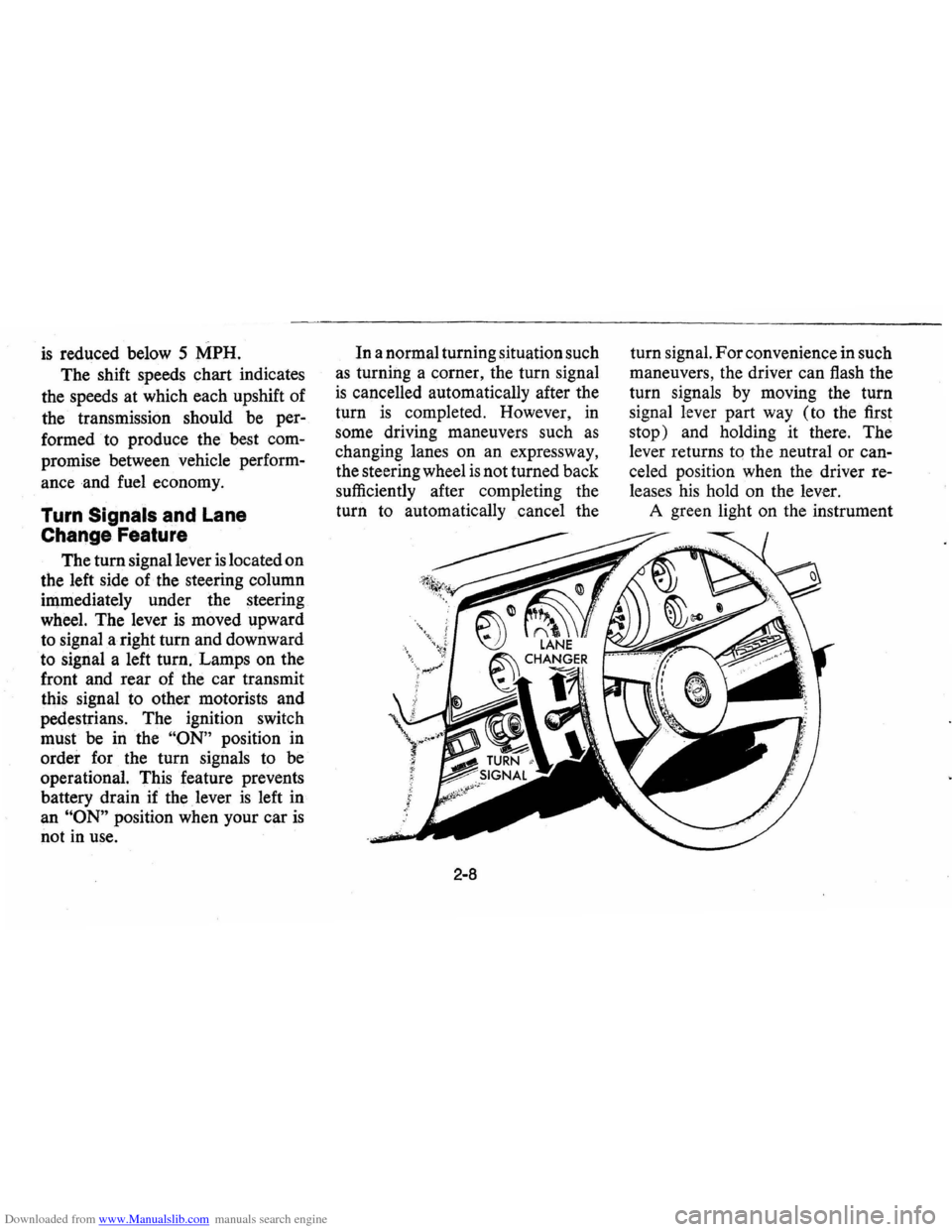
Turn Signals and Lane
Change Feature
The tum signal lever is located on
the left side of the steering column
iIllmediately under the steering
wheel. The lever
is moved upward
to signal a right turn and downward
to signal a left tum. Lamps on the
front and rear of the car transmit
this signal to other motorists and
pedestrians. The ignition switch
must be in the
"ON" position in
order for the tum signals to be
operational. This feature prevents
battery drain if the lever
is left in
an
"ON" position when your car is
not in use. In
a normal turning situation such
as turning a comer, the tum signal
is cancelled automatically after the
tum
is completed. However, in
some driving maneuvers such
as
changing lanes on an expressway,
the steering wheel
is not turned back
sufficiently after completing the
tum to automatically cancel the
2-8
tum signal. For convenience in such
maneuvers, the driver can flash the
tum signals
by moving the tum
signal lever part way (to the first
stop) and holding it there . The
lever returns
tq the neutral or can
celed position when the driver re
leases his hold on the lever.
A green light on the instrument
Page 25 of 87
Downloaded from www.Manualslib.com manuals search engine cluster flashes to indicate proper
operation of the front and rear turn
signal lamps.
If the indicator lamp
remains on and does not flash,
check for a defective lamp bulb.
If
the indicator fails to light when the
lever
is moved, check the fuse and
indicator bulb.
NOTE: For operation of hazard
flasher, see page 3-1, in
Section "In
Case of Emergency."
Horn
The horn on your car is actuated
by firmly pressing on the pad in the
center of the steering wheel.
As a good motorist,
~se of the
horn should be kept at a minimum.
However, acquaint yourself
as soon
as possible with this function of
your car, should it ever become
necessary to give a warning to a
pedestrian
or another motorist.
Power Steering
If the steering system power as
sist fails due to some malfunction,
or because the engine has stalled,
the vehicle can still be steered.
However, much greater effort
is re
quired, particularly in sharp turns.
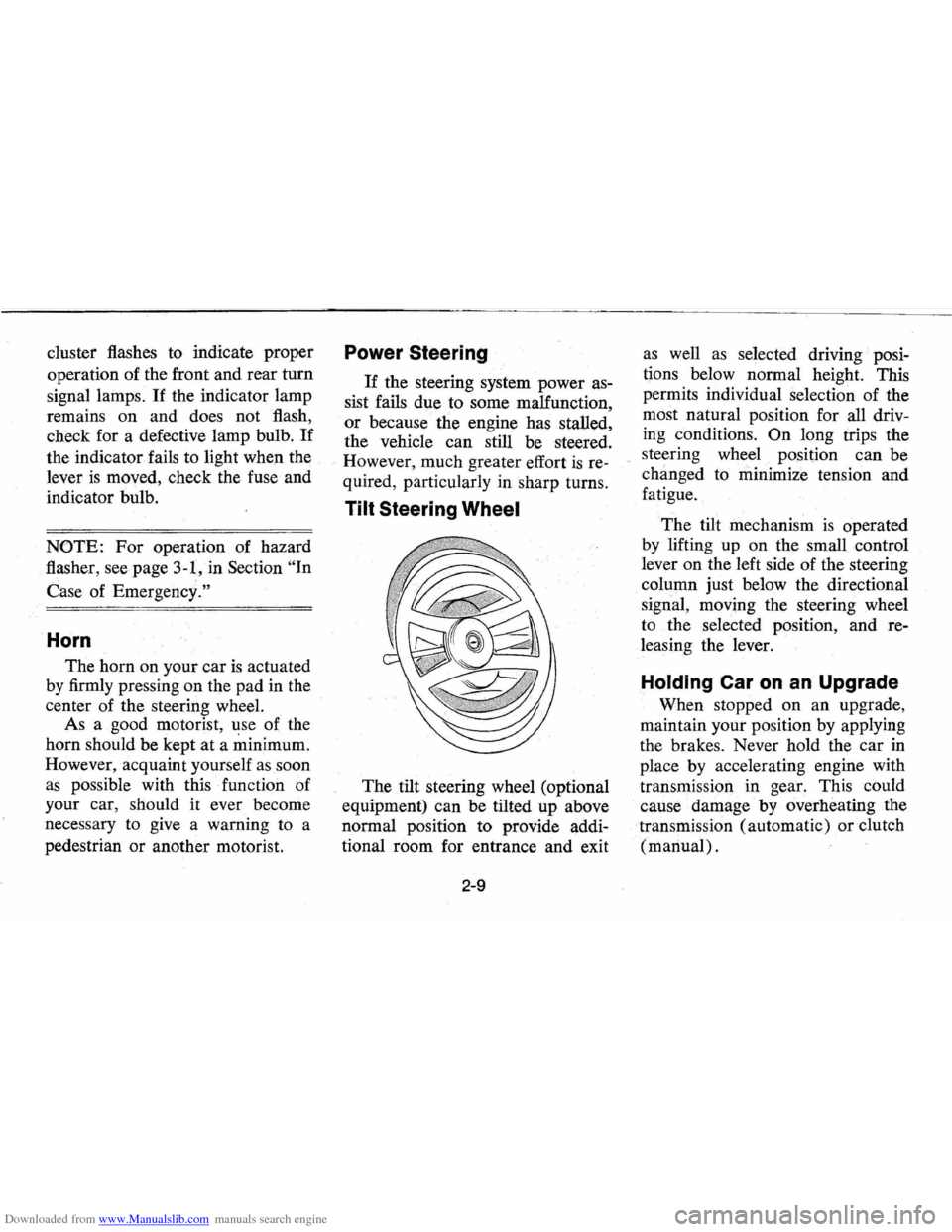
Tilt Steering Wheel
The tilt steering wheel (optional
equipment) can be tilted up above
normal position to provide addi
tional room for entrance and exit
2-9
as well as selected driving· posi
tions below normal height. This
permits individual selection of the
most natural position for
all driv
ing conditions.
On long trips the
steering wheel position can be
changed to minimize tension and
fatigue.
The tilt mechanism
is operated
by lifting up on the small control
lever on the left side of the steering
column just below the directional
signal, moving the steering wheel
to the selected position, and re
leasing the lever.
Holding Car on an Upgrade
When stopped on an upgrade,
maintain your position by applying
the brakes. Never hold the car
in
place by accelerating engine with
transmission in gear. This could
cause damage by overheating
the
. transmission (automatic) or clutch
(manual) .