1976 CHEVROLET VEGA instrument panel
[x] Cancel search: instrument panelPage 4 of 87
Downloaded from www.Manualslib.com manuals search engine ------------------------:----------~ ... --,;,.._J,,; ......,.-~ ....
1976 VEGA 2'300
OWNER'S
MANUAL
This manual should be considered a perma
nent part of the vehicle, and must remain
with the vehicle at time of resale.
CHEVROLET MOTOR
DIVISION
GENERAL MOTORS
CORPORATION
DETROIT, MICHIGAN 48202
All information, illustrations and specifications con
tained in this manual are based on the latest product
information available at the time of publication. The right is reserved to make changes at any time without
notice.
For vehicles sold in Canada, substitute the name
General Motors of Canada Limited, wherever the name
Chevrolet Motor Car Division appears in this manual.
ST 303-76
"'General Motors Corporation 1976
Section
1
2
3
4
5
Table of Contents
Page
Before Driving Your Vega ............................. 1-1
Starting and Operating .. ;-............................ 2-1
Steering
Column Controls .......................... , 2-2
Floor Controls ...................................... 2-10
Instrument PaneL .................................. 2-13
Other Controls and Features ........................ , 2-27
In Case of Emergency ................................. 3-1
Appearance
Care... . . . . . . . . . . . . . . . . . . . . . . . . . . . . . . . . . .. 4-1 I
Service and Maintenance....... ...... . . . . ............ 5-1
6 Specifications,
Owner Assistance, Service
Manuals, Index, Gas Station
Information
........................................ 6-1
Applicable to CALIFORNIA Sales Only This vehicle as delivered by ,6 M Chevrolet Division is equipped with a bumper energy
absorption system meeting California S.B.42 (1971) as set forth in Sec. 34715 Vehicle Code.
Applicable to FLORIDA Sales Only This vehicle as delivered by GM Chevrolet Division is equipped with a bumper energy
absorption system meeting section 501.125, Florida Statutes, as amended June 10, 1974.
i
Page 16 of 87

Downloaded from www.Manualslib.com manuals search engine Operation Foreign Countries • In
Your car is designed to operate
on unleaded fuel of approximately
91 research octane number.
If you plan to operate your car
outside the Continental limits of
the United
States or Canada, there
is a possibility that the best fuels
available in some countries are so
low in octane rating that excessive
knocking and serious engine
dam
age may result from their use. Also ,
if leaded fuels are used in vehicles
designed for unleaded fuels, it may result
in the deactivation of the
catalytic converter, if the vehicle
is
so equipped, and possibly other
related problems.
The use of leaded
fuel in a vehicle designed
for un
leaded fuel will require different
maintenance intervals.
To obtain in
formation on the octane rating and
availability of non-leaded fuels
available in the countries in which
you plan to travel, and a mainte
nance schedule to be used when
operating on leaded fuel, write to
Chevrolet Motor Division,
Service
Department, Detroit, Michigan
48202, (or in Canada write to
General Motors of Canada Limited,
Owner Relations Department,
Oshawa, Ontario LlJ 5Z6), giving:
1-11
• The vehicle identification num
ber (on plate on instrument
panel ahead of the steering wheel
and visible through the wind
shield,
or from registration slip
or title),.
• The country or countries in which
you plan to travel.
It is recommended that you not
operate your car in any country not
having fuels meeting the require
ments of your car's engine
as these
may cause engine damage for which
Chevrolet
is not responsible under
the terms of the Chevrolet New
Vehicle Warranty or Emission
Control Systems Warranty.
Page 17 of 87
Downloaded from www.Manualslib.com manuals search engine STARTING AND OPERATING
Engine Exhaust Gas Caution (Carbon Monoxide)
AvoId Inhaling exhaust gases because
they contaIn carbon monoxide, which by
Itselt is colorless and odorless. Carbon
monoxide Is a dangerous gas that can
cause unconsciousness and is potentially
lethal.
If at any time you suspect that exhaust
fumes are entering the passenger compartment, have the cause determined and
corrected as soon as possible. If you must
drIve under these conditions, drive only
with
all windows fully open.
The best protection agaInst carbon
monoxide entry Into the car body Is a
properly maIntaIned engine exhaust system, car body and body ventilatIon system, It Is recommended that the exhaust system
and body be Inspected by a competent
mechanIc.
• Each time the vehIcle Is raised for an 011 change.
• Whenever 8 change Is noticed In the
sound Of the exhaust system.
• Whenever the exhaust system, underbody or rear of the vehicle Is damaged.
See your MaIntenance Schedule folder
for inspection procedure.
To allow proper operation of the car's
ventilation system, keep aIr Inlet grille
forward of windshield and rear ventilation
grille on station wagon quarter. panels
clear ot snow or other
obstruction at all times, and prevent cargo from blocking
the inside vent holes on the underside of the quarter panels.
SITTING IN A PARKED CAR WITH ENGINE RUNNING FOR AN EXTENDED PERIOD IS NOT RECOMMENDED.
Do not run engine In confined areas
such as garages any more than needed
to move vehIcle In
or out of area. When vehIcle Is stopped In an UNCONFINED area with the engine runnIng for any more
than a short perIod, adjust heating or cooling system to force outsIde aIr into
car as follows:
2-1
1. On cars not equipped with air conditioning, set fan to medium or high
speed and upper control lever to any
position except OFF.
2. On cars equipped with air conditIoning, set fan to medium or high speed
and upper control lever to any position
except
OFF or MAX.
The trunk lid should be closed while drIving to help prevent inadvertently drawing exhaust gases into the car. It is
unwise to drIve at high speeds for long
durations with the trunk lid open. However, it tor some reason the trunk must remain
open for a period while moving, or electrical wiring or other cable connections to
a trailer must pass through the seal be
tween trunk
lid and body, the following
precautions should be observed:
• Close all windows.
• Adjust heating or cooling system to
force outsIde air into car as described In Items 1 and 2 above but with fan set
at hIgh speed.
• On cars equIpped with outside aIr vents In or under Instrument panel, open vents
fully.
Page 33 of 87
Downloaded from www.Manualslib.com manuals search engine especially useful when driving on
dark roads since they provide ex
cellent long range illumination. The
headlight beam indicator will be on
whenever the high beams or
"brights" are in use. The Headlight
Beam
Switch controls the headlight
beams (see Page
2-12).
Light Switch
The three position light switch
controls the headlights, taillights,
parking lights, side marker lights,
instrument lights and dome lights
as shown. The headlamp circuit
is protected by a circuit breaker in
the light switch.
An overload on
the breaker will cause the lamps to
"flicker" on and off. If this condi
tion develops, have your headlamp
wiring checked immediately.
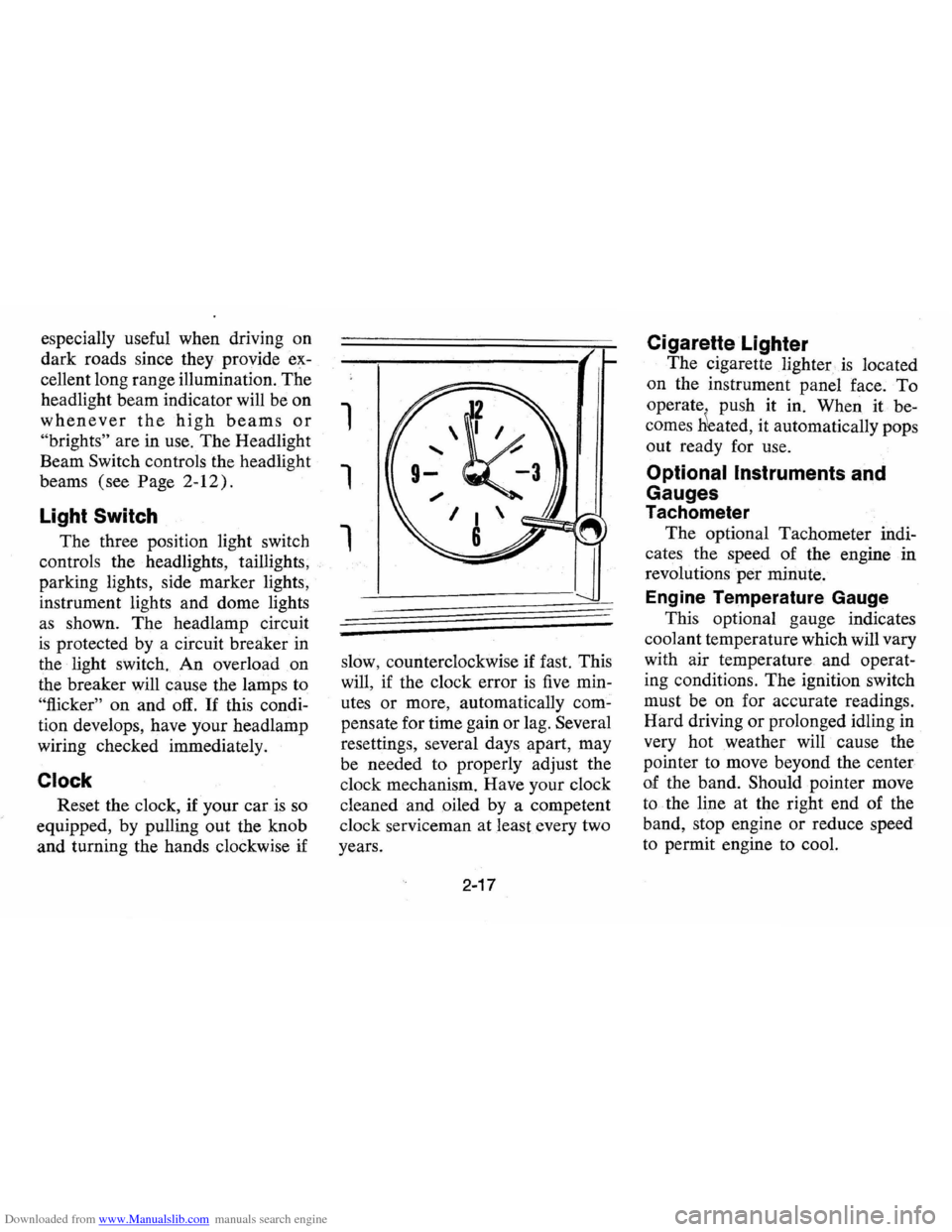
Clock
Reset the clock, if your car is so
equipped, by pulling out the knob
and turning the hands clockwise if
1
1
1
slow, counterclockwise if fast. This
will,
if the clock error is five min
utes
or more, automatically com
pensate for time gain or lag. Several
resettings, several days apart, may
be needed to properly adjust the
clock mechanism. Have your clock
cleaned and oiled by a competent
clock serviceman at least every two
years.
2-17
Cigarette Lighter
The cigarette lighter is located
on the instrument panel
face. To
operate . push it in. When it be
comes
Heated, it automatically pops
out ready for use.
Optional Instruments and
Gauges
Tachometer
The optional Tachometer indi
cates the speed of the engine in
revolutions
per minute.
Engine Temperature Gauge
This optional gauge indicates
coolant temperature which will vary
with air temperature and operat
ing conditions.
The ignition switch
must be on for accurate readings.
Hard driving
or prolonged idling in
very hot weather will cause the
pointer to move beyond the center
of the band. Should pointer move
to the line at the right end of the
band, stop engine or reduce speed
to permit engine to cool.
Page 37 of 87
Downloaded from www.Manualslib.com manuals search engine Heater
RHI
I~
OFF
COLD
FAN
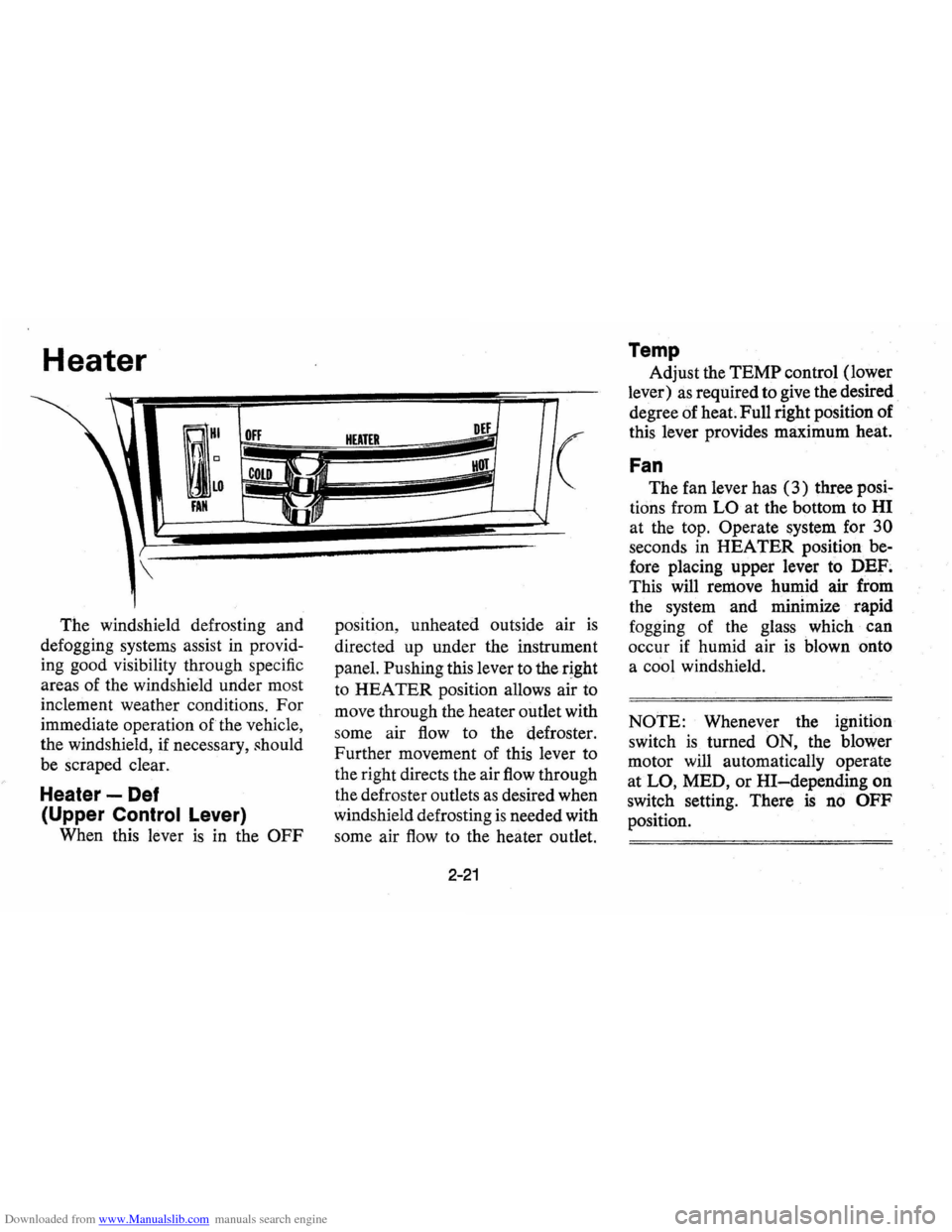
The windshield defrosting and
defogging systems assist
in provid
ing good visibility through specific
areas of the windshield under most
inclement weather conditions. For
immediate operation of the vehicle,
the windshield,
if necessary, should
be scraped clear.
Heater -Def
(Upper Control Lever)
When this lever is in the OFF
HEATER
(
posItion, unheated outside air is
directed up under the instrument
panel.
Pushing this lever to the r!ght
to HEATER position allows air to
move through the heater outlet with
some air
flow to the defroster.
Further movement of this lever to
the right directs the air
flow through
the defroster outlets
as desired when
windshield defrosting
is needed with
some air
flow to the heater outlet.
2-21
Temp
Adjust the TEMP control (lower
lever)
as required to give the desired
degree of
heat Full right position of
this lever provides maximum heat.
Fan
The fan lever has (3) three posi
tions from
LO at the bottom to HI
at the top. Operate system for
30
seconds in HEATER position be
fore placing upper lever
to DEF;
This will remove humid air from
the system
and minimize rapid
fogging of the glass which can
occur
if humid air is blown onto
a cool windshield.
NOTE: Whenever the ignition
switch
is turned ON, the blower
motor
will automatically operate
at
LO, MED, or HI-depending on
switch setting. There
is no OFF
position.
Page 38 of 87
Downloaded from www.Manualslib.com manuals search engine Heater Operating Tips
• Clear snow and ice from hood
and air inlet in front of wind
shield and air vent grille in rear
fender,
or roof side panel to im
prove heater and defroster
effi
ciency and reduce the probability
of fogging on inside of wind
shield.
• Clear windshield, rear window,
outside m.irrors and all side win
dows of ice and snow before
driving vehicle.
• Operate blower on "HIGH" for
a
few seconds before moving the
vehicle, to help clear the intake
ducts of snow to further reduce
the possibility of fogging on in
side of windshield.
• Keep all windows and vents
closed to reduce dust, road and wind
noise and uncomfortable
drafts.
• For most satisfactory heater
operation and air circulation,
operate fan on low or medium
speeds for normal operation and
high speeds for quick warm-up
and during extremely low tem
peratures.
• For adequate rear seat heating,
the area beneath the front seat
must not be blocked by carpet
ing, rags, paper or other material
and fan should operate on high
blower.
Electro-Clear Rear Window
Defogger
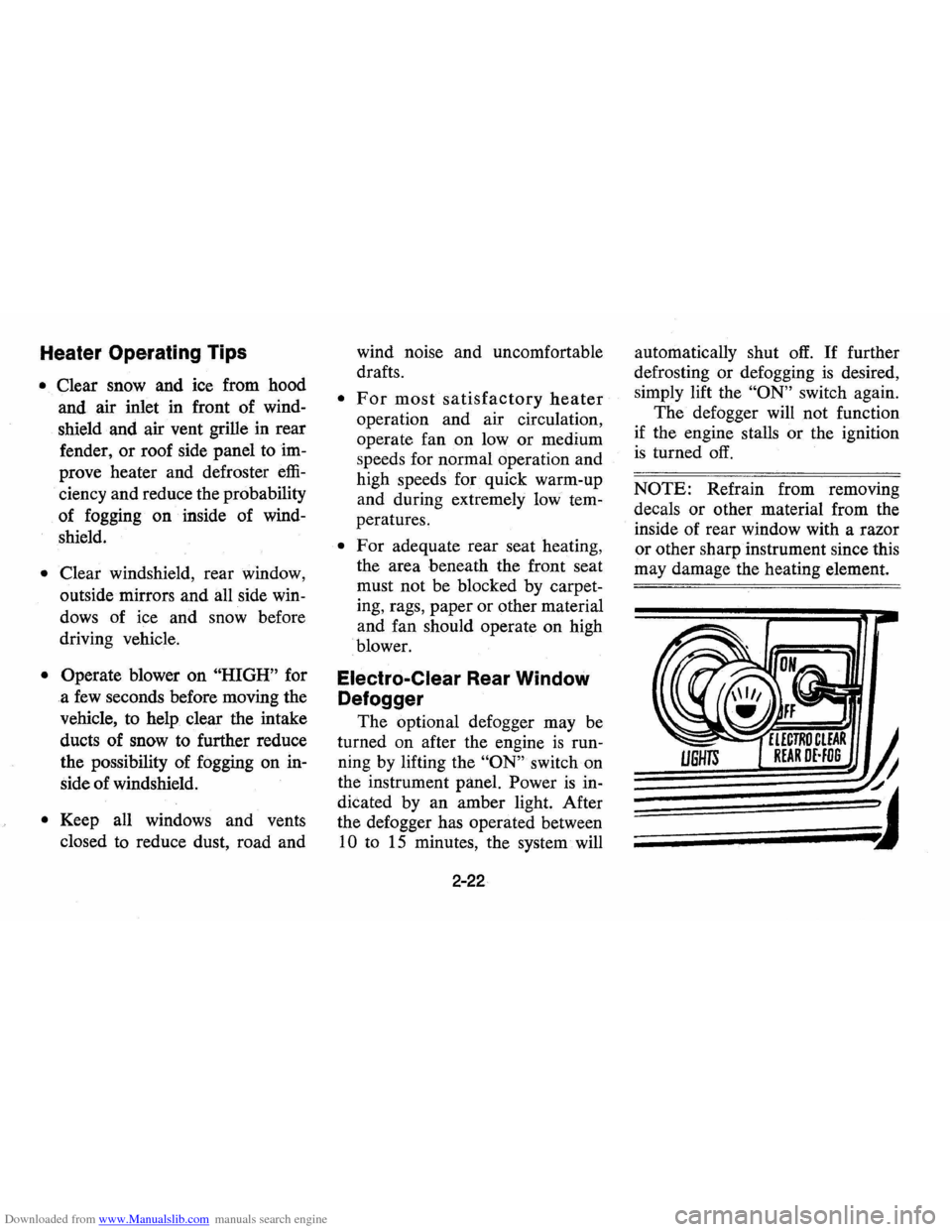
The optional defogger may be
turned on after the engine
is run
ning by lifting the
"ON" switch on
the instrument panel. Power
is in
dicated by an amber light. After
the defogger has operated between
10 to 15 minutes, the system will
2-22
automatically shut off. If further
defrosting or defogging
is desired,
simply lift the
"ON" switch again.
The defogger will not function
if the engine stalls or the ignition
is turned off.
NOTE: Refrain from removing
decals
or other material from the
inside of rear window with a razor
or other sharp instrument since this
may damage the heating element.
Page 40 of 87
Downloaded from www.Manualslib.com manuals search engine of reduced blower noise. Temper
ature lever may be adjusted
as
desired.
ECONOMY-Outside air is passed
through the system and emitted
from the
A/C outlets and the
compressor
is off. Adjust tempera
ture lever
as desired. This position
is provided for cool to moderate
weather when refrigeration
is not
required.
HTR -Outside air is discharged
from the floor outlets with some air
emitted from the defroster outlets.
Temperature lever may be adjusted
as desired. This position is recom
mended for most winter driving.
DEF -Outside air is emitted from
the defroster outlets with some
air
discharged from the floor outlets.
Temperature lever may be adjusted
as desired. This position
is recom
mended for fogging
and/or icing
conditions.
Four Season System
Air Outlets
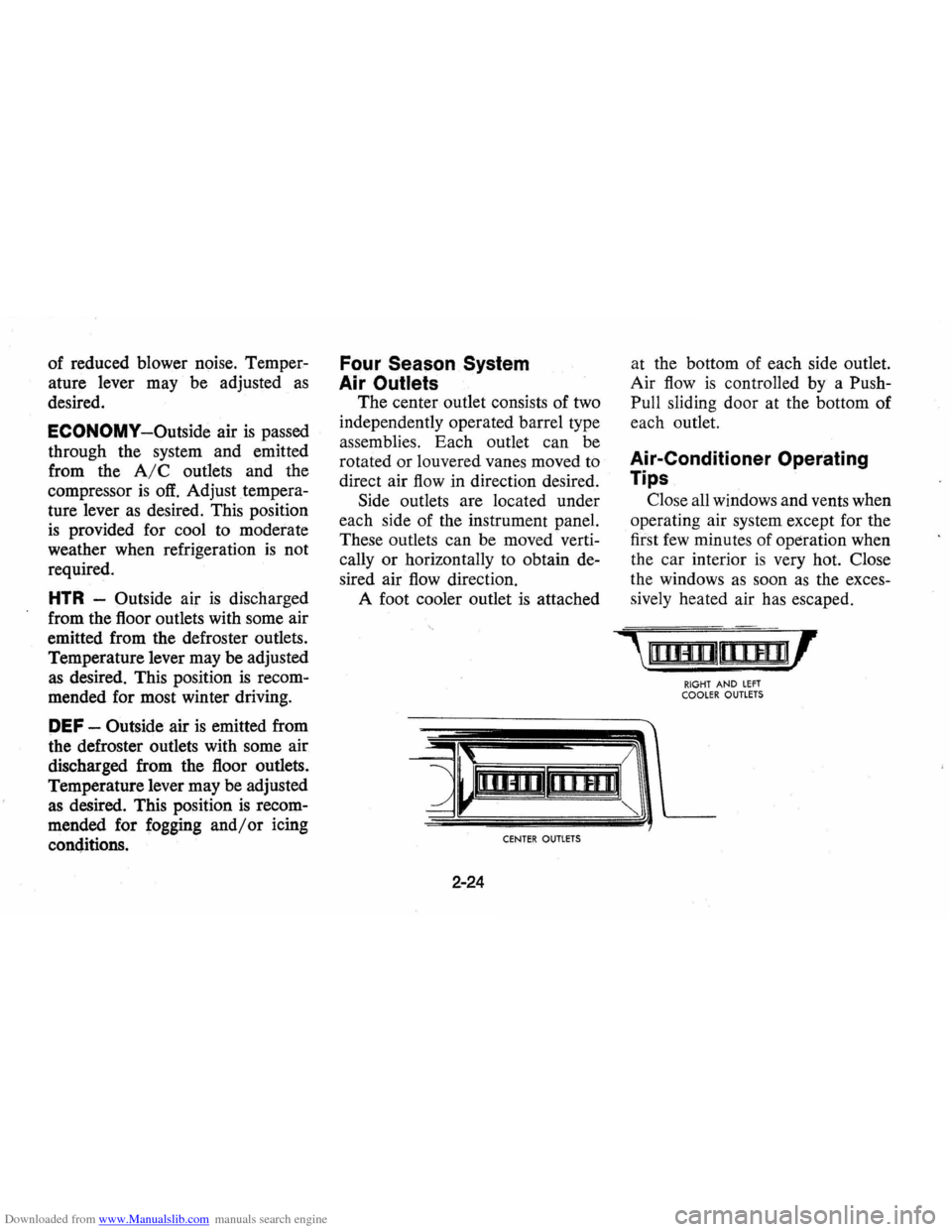
The center outlet consists of two
independently operated barrel type
assemblies. Each outlet can be
rotated or louvered vanes moved to
direct air
flow in direction desired.
Side outlets are located under
each side of the instrument panel.
These outlets can be moved verti
cally or horizontally to obtain de
sired air
flow direction.
A foot cooler outlet
is attached
CENTER OUTLETS
2-24
at the bottom of each side outlet.
Air
flow is controlled by a Push
Pull
sliding door at the bottom of
each outlet.
Air-Conditioner Operating
Tips
Close all windows and vents when
operating air system except for the
first few minutes of operation when
the car interior
is very hot. Close
the windows
as soon as the exces
sively heated air has escaped.
' 11111"111111111 1:1111'
RIGHT AND LEFT COOLER OUTLETS
Page 82 of 87
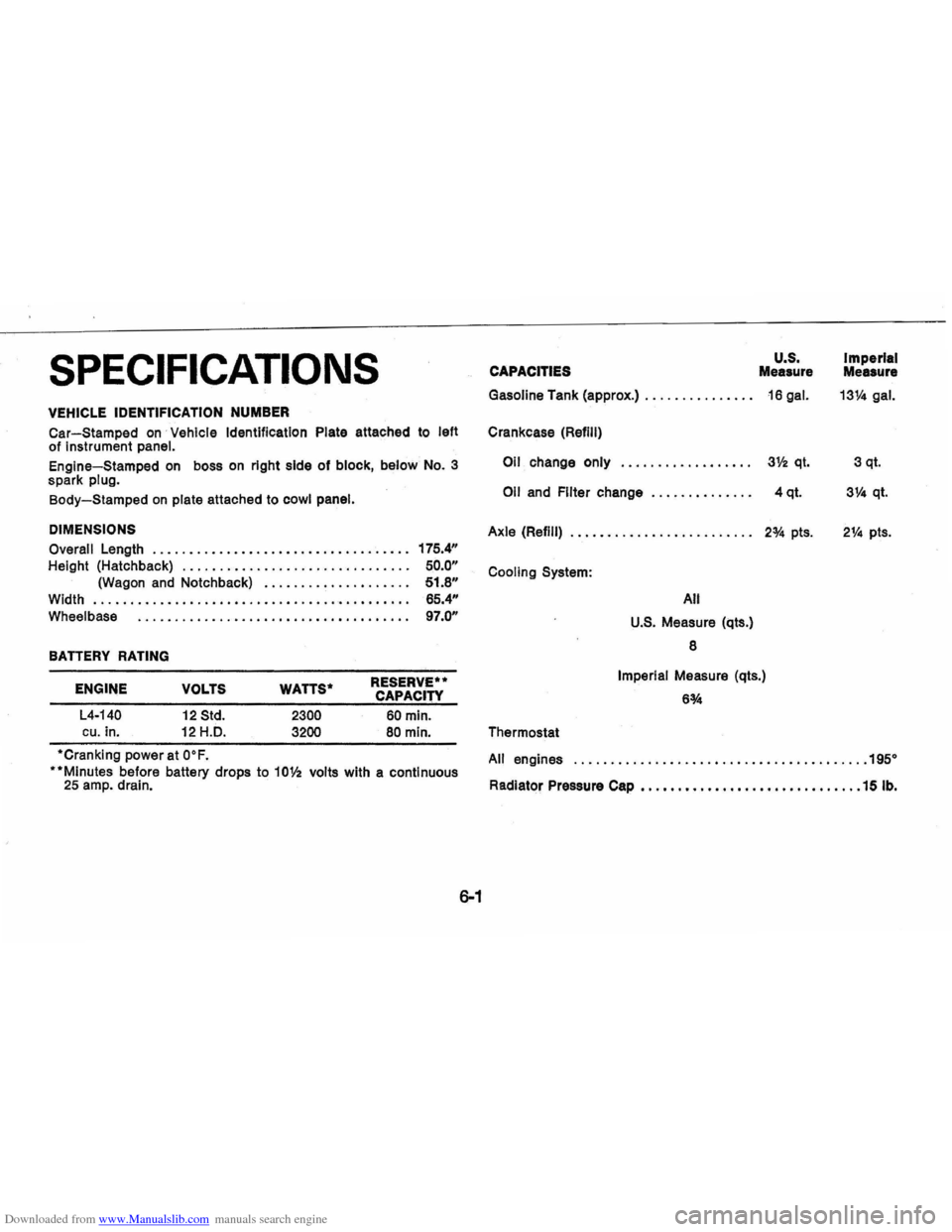
Downloaded from www.Manualslib.com manuals search engine SPECIFICATIONS
VEHICLE IDENTIFICATION NUMBER
Car-Stamped on· Vehicle Identification Plate attached to left
of Instrument panel.
Engine-Stamped
on boss on right side of block, below No. 3
spark plug.
Body-Stamped
on plate attached to cowl panel.
DIMENSIONS
Overall
Length . .........•••••.••••.•..•.•......••\
175.4"
Height (Hatchback) ............................... 50.0"
(Wagon and Notchback) ...•....•........... 51.8"
Width ..........•......••••...•.•...•..•..•.....\
. 65.4"
Wheelbase 97.0"
BATTERY RATING
ENGINE VOLTS
WATTS * RESERVE** CAPACITY
L4-140
12 Std. 2300 60 min. cu. in. 12 H.b. 3200 80 min.
'Cranking power at O°F.
"Minutes before battery drops to 10V2 volts with a continuous 25 amp. drain.
6-1
U.S. CAPACITIES Measure
Gasoline Tank (approx.) . . . . . . . . . . . .
••. 16 gal.
Crankcase
(Refill)
Oil
change only 3V2 ql.
Oil
and Filter change ..•...•....... 4 qt.
Axle (Refill) ..•.•.................... 2~ pts.
Cooling System:
Thermostat All
U.S. Measure
(qts.)
8
Imperial Measure (qts.)
6~
Imperial Measur.
13V4 gal.
3 qt.
3V4 qt.
2V4 pts.
All engines
...................•....•.........•..... 195°
Radiator Pressure Cap ••••••••••••••••••\
••••.•••.••. 15 lb.