1976 CHEVROLET VEGA clock
[x] Cancel search: clockPage 18 of 87
Downloaded from www.Manualslib.com manuals search engine STEERING COLUMN CONTROLS
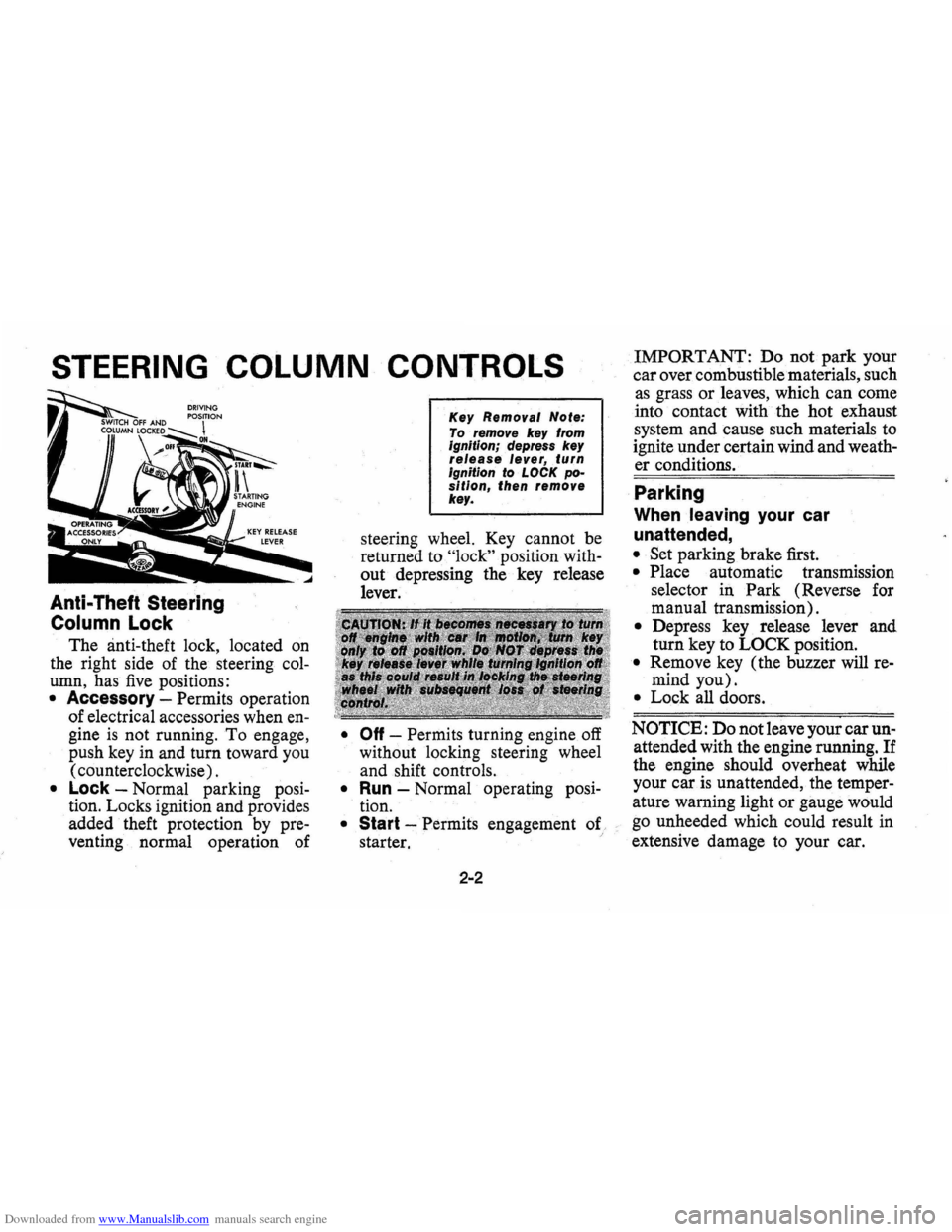
Anti-Theft Steering
Column Lock
The anti-theft lock, located on
the right side of the steering col
umn, has five positions:
• Accessory -Permits operation
of electrical accessories when
en
gine is not running. To engage,
push
key in and turn toward you
( counterclockwise) .
• Lock -Normal parking posi
tion. Locks ignition and provides
added theft protection
by pre
venting normal operation of
Key Removal Note:
To remove key from ignitionjdepress key release lever, . turn Ignition to LOCK position, then remove key.
steering wheel. Key cannot be
returned to
"lock" position with
out depressing the key release
lever.
• Off -Permits turning engine off
without locking steering wheel
and shift controls.
• Run -Normal operating posi
tion.
• Start -Permits engagement of. :
starter.
2-2
IMPORTANT: Donot park your
car over combustible materials, such
as grass or leaves, which can come
into contact with the hot exhaust
system and cause such materials to
ignite under certain wind and
weath
er conditions.
. Parking
When leaving your car
unattended,
• Set parking brake first.
• Place automatic transmission
selector in
Park (Reverse for
manual transmission).
• Depress key release lever and
turn key to
LOCK position.
• Remove key (the buzzer will re
mind you).
• Lock all doors.
NOTICE: Do not leave your car un
attended with the engine running. If
the engine should overheat while
your
caris unattended, the temper
ature warning light or gauge would
go unheeded which could result in
extensive damage to your car.
Page 29 of 87
Downloaded from www.Manualslib.com manuals search engine INSTRUMENTS AND CONTROLS
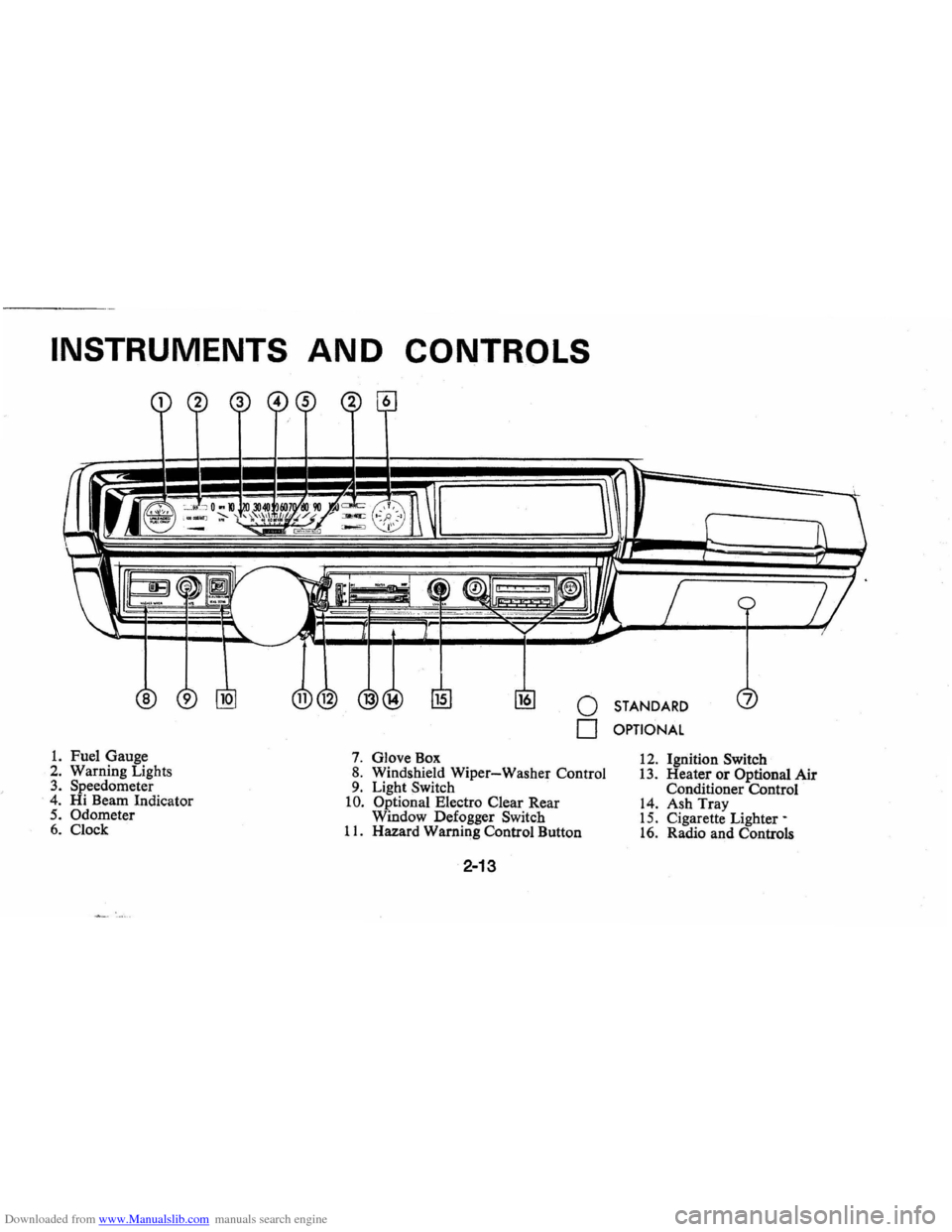
1. Fuel Gauge 2. Warning Lights 3. Speedometer . 4. Hi Beam Indicator 5. Odometer 6. Clock
o STANDARD
o OPTIONAL
7. Glove Box 8. Windshield Wiper-Washer Control 9. Light Switch . 10. Optional Electro Clear Rear
Window Defogger Switch
11. Hazard Warning Control Button
2-13
12. Ignition Switch 13. Heater or Optional Air Conditioner Control 14. Ash Tray 15. Cigarette Lighter-16. Radio and Controls
Page 32 of 87
Downloaded from www.Manualslib.com manuals search engine • The light is also designed to come
on during engine starting to
verify that the bulb
is operating
properly.
• Have system repaired if light does
not come
on during check.
• This warning light is not a substi
tute for the visual check of brake
fluid level required
as part of
normal maintenance.
If the light comes on:
• The parking brake control is not
fully released, or,
• The service brake system is par
tially inoperative.
What to do:
1. Check that parking brake is re
leased.
If it is . . .
2.
Pull off the road and stop, care
fully-remembering that:
• Stopping distances may be
greater.
• Greater pedal effort may be re
quired.
• Pedal travel may be greater. 3.
Try out brake operation by start
ing and s,topping on road shoul
der-then:
• If you judge such operation to
be safe, proceed cautiously at
a safe speed to nearest dealer
for repair.
• Or have car towed to dealer for
repair.
Continued operation of the car in this
condition
is dangerous.
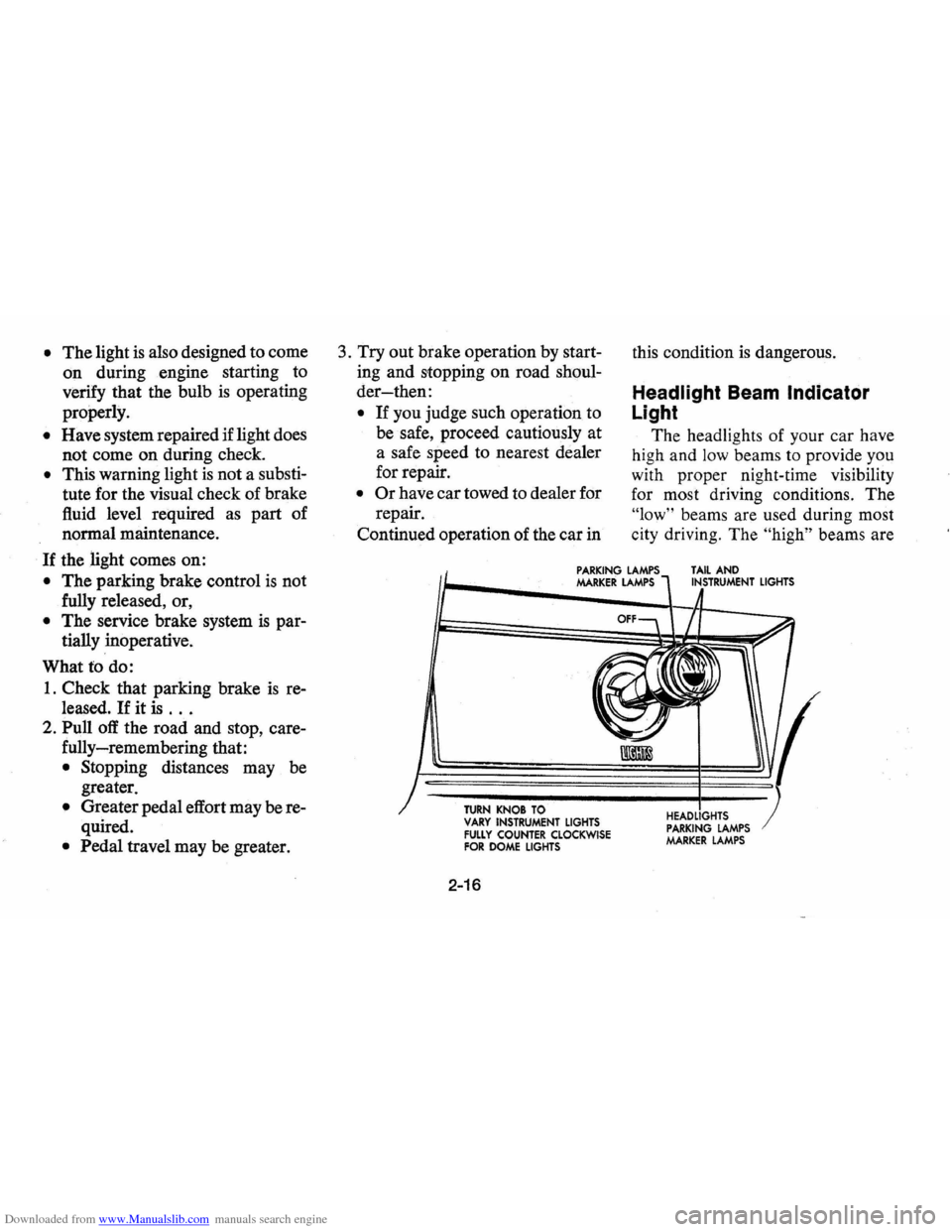
Headlight Beam Indicator
Light
The headlights of your car have
high and
low beams to provide you
with proper night-time visibility
for most driving conditions. The
"low" beams are used during most
city driving. The
"high" beams are
PARKING LAMPS MARKER LAMPS TAIL AND INSTRUMENT LIGHTS
TURN KNOB TO VARY INSTRUMENT LIGHTS FULLY COUNTER CLOCKWISE FOR DOME LIGHTS
2-16
HEADLIGHTS PARKING LAMPS MARKER LAMPS
Page 33 of 87
Downloaded from www.Manualslib.com manuals search engine especially useful when driving on
dark roads since they provide ex
cellent long range illumination. The
headlight beam indicator will be on
whenever the high beams or
"brights" are in use. The Headlight
Beam
Switch controls the headlight
beams (see Page
2-12).
Light Switch
The three position light switch
controls the headlights, taillights,
parking lights, side marker lights,
instrument lights and dome lights
as shown. The headlamp circuit
is protected by a circuit breaker in
the light switch.
An overload on
the breaker will cause the lamps to
"flicker" on and off. If this condi
tion develops, have your headlamp
wiring checked immediately.
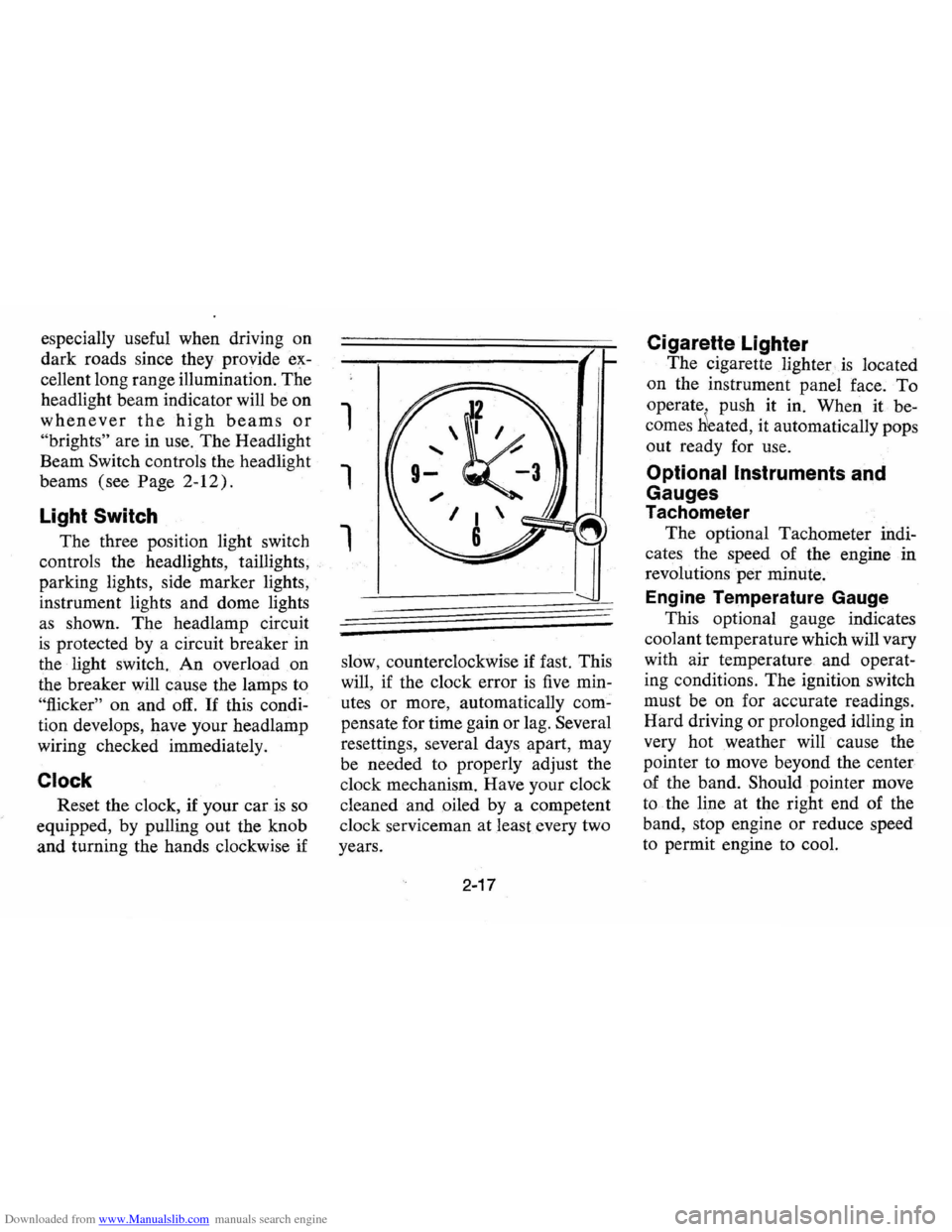
Clock
Reset the clock, if your car is so
equipped, by pulling out the knob
and turning the hands clockwise if
1
1
1
slow, counterclockwise if fast. This
will,
if the clock error is five min
utes
or more, automatically com
pensate for time gain or lag. Several
resettings, several days apart, may
be needed to properly adjust the
clock mechanism. Have your clock
cleaned and oiled by a competent
clock serviceman at least every two
years.
2-17
Cigarette Lighter
The cigarette lighter is located
on the instrument panel
face. To
operate . push it in. When it be
comes
Heated, it automatically pops
out ready for use.
Optional Instruments and
Gauges
Tachometer
The optional Tachometer indi
cates the speed of the engine in
revolutions
per minute.
Engine Temperature Gauge
This optional gauge indicates
coolant temperature which will vary
with air temperature and operat
ing conditions.
The ignition switch
must be on for accurate readings.
Hard driving
or prolonged idling in
very hot weather will cause the
pointer to move beyond the center
of the band. Should pointer move
to the line at the right end of the
band, stop engine or reduce speed
to permit engine to cool.
Page 49 of 87
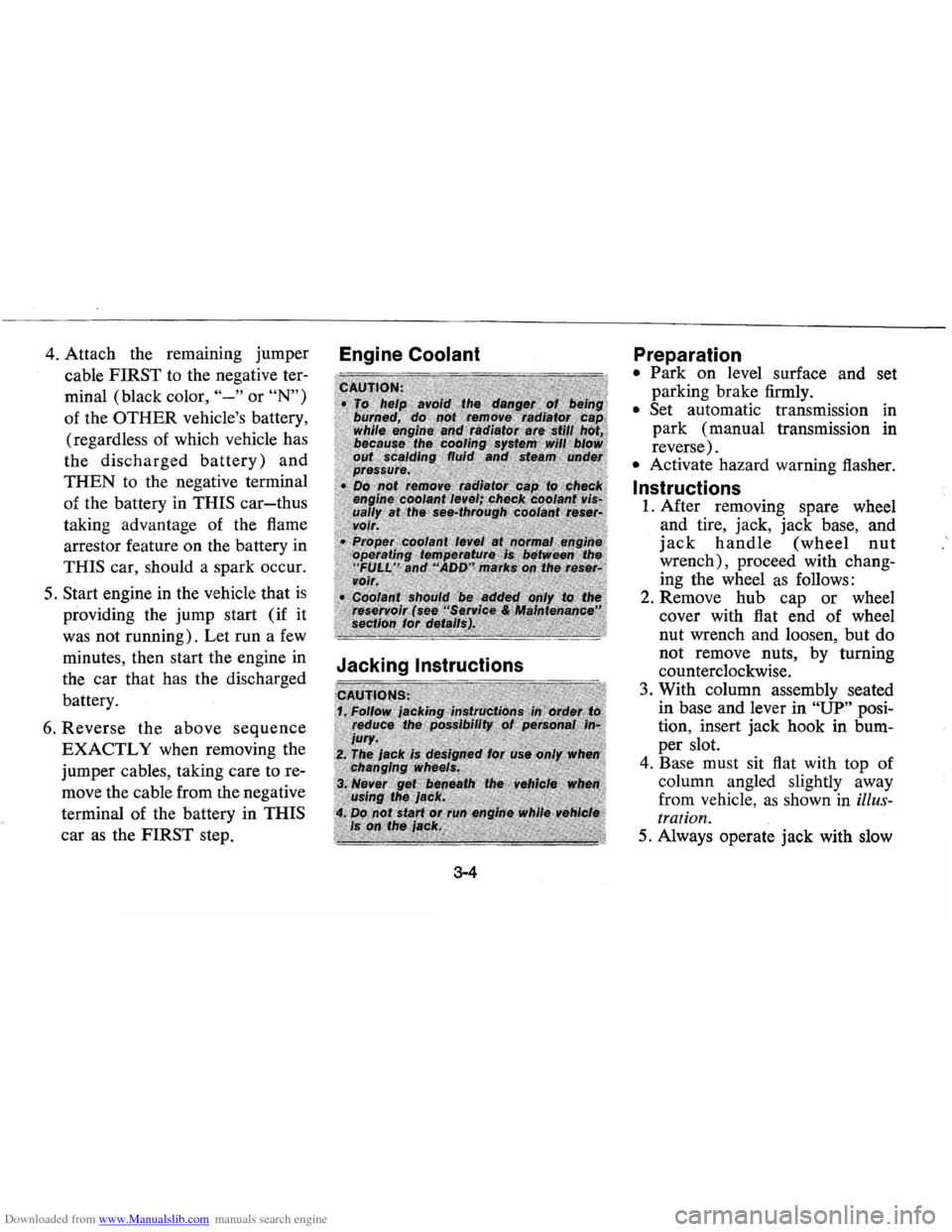
Downloaded from www.Manualslib.com manuals search engine 4. Attach the remammg jumper Engine Coolant
cable FIRST to the negative ter
minal (black color,
"-" or "N")
of the OTHER vehicle's battery,
(regardless of which vehicle has
the discharged
battery) and
THEN to the negative terminal
of the battery in THIS
car-thus
taking advantage of the flame
arrestor feature on the battery in
THIS car, should a spark occur.
5. Start engine in the vehicle that is
providing the jump start (if it
was not running). Let run a few
minutes, then start the engine in Jacking Instructions
the car that has the discharged
battery.
6. Reverse the above sequence
EXACTL Y when removing the
jumper cables, taking care to re
move the cable from
[he negative
terminal of the battery in THIS
car
as the FIRST step.
3-4
Preparation
• Park on level surface and set
parking brake firmly.
• Set automatic transmission in
park (manual transmission in
reverse).
• Activate hazard warning flasher.
Instructions
1. After removing spare wheel
and tire, jack, jack base, and
jack handle (wheel nut
wrench), proceed with chang
ing the wheel
as follows:
2. Remove hub cap or wheel
cover with flat end of wheel
nut wrench and loosen, but do
not remove nuts, by turning
counterclockwise.
3. With column assembly seated
in base and lever in
"UP" posi
tion, insert jack hook in bum
per slot.
4. Base must sit flat with top of
column angled slightly away
from vehicle,
as shown in illus
tration.
5. Always operate jack with slow
Page 50 of 87
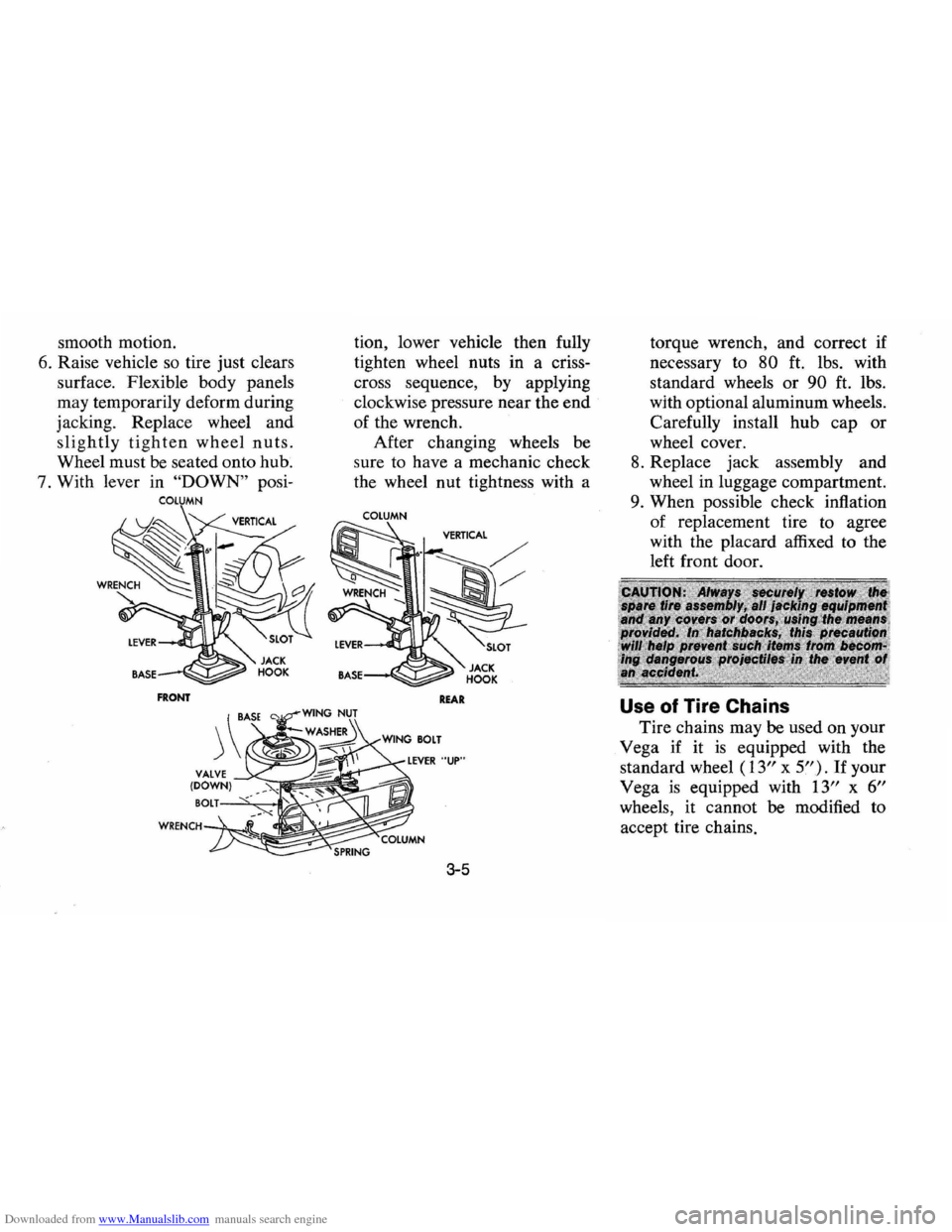
Downloaded from www.Manualslib.com manuals search engine smooth motion.
6. Raise vehicle so tire just clears
surface. Flexible body panels
may temporarily deform during
jacking. Replace wheel and
slightly tighten wheel nuts.
Wheel must be seated onto hub.
7. With lever in
"DOWN" posi
COLUMN
FRONT
tion, lower vehicle then fully
tighten wheel nuts in a criss
cross sequence, by applying
clockwise pressure near the
end
of the wrench.
After changing wheels
be
sure to have a mechanic check
the wheel nut tightness with a
COLUMN
REAR
3-5
torque wrench, and correct if
necessary to
80 ft. lbs. with
standard wheels
or 90 ft. lbs.
with optional aluminum wheels.
Carefully install
hub cap or
wheel cover.
8. Replace jack assembly and
wheel in luggage compartment.
9. When possible check inflation
of replacement tire to agree
with the placard affixed to the
left front door.
Use of Tire Chains
Tire chains may be used on your
Vega if it
is equipped with the
standard wheel
(13" x 5"). If your
Vega
is equipped with 13" x 6"
wheels, it cannot be modified to
accept tire chains.
Page 60 of 87
Downloaded from www.Manualslib.com manuals search engine Gas Cap-The fuel tank filler cap
has a
two-step removal and in
stallation procedure plus a pres
sure-vacuum safety relief valve. It
is equipped with a double set of
locking tangs. To remove:
• Rotate cap one-half tum counter
clockwise to clear the first set of
tangs from the slots inside the
filler neck. This will allow any
residual pressure to escape.
• Pull the cap outward and rotate
one-quarter
tum counterclock
wise to clear second set of tangs
and remove the cap.
• To install, reverse this procedure.
NOTE: If this cap requires a re
placement, only a cap with these
same features should be used.
Fail
ure to use the correct cap can result
in a serious malfunction of the
sys
tem. Correct replacement caps may
be obtained from your authorized
Chevrolet dealer.
ENGINE ITEMS
Engine Oil and Filter
Recommendations'
• Use only SE engine oil.
• Change oil each 6 months or
7,500 miles, whichever occurs
first,
except under the following
conditions:
*
-driving in dusty conditions
-trailer pulling
-extensive idling
-short-trip operation at
freez
ing temperatures (engine not
thoroughly warmed-up) .
*Under these conditions, change oil
each 3 months
or 3,000 miles,
whichever occurs first.
• Operation in dust storms may
require an immediate oil change.
• Replace the oil filter at the first
oil change, and every second oil
change thereafter. AC oil filters
5-2
provide excellent engine pro
tection.
See your Chevrolet dealer for
ad
vice on the frequency of oil and
filter changes under unusual driving
conditions.
The above recommendations
ap
ply to the first change as well as
subsequent oil changes. The oil
change interval for your Chevrolet
engine
is based on the use of SE
oils and quality oil filters.
Oil
change intervals longer than those
listed above will seriously reduce
engine life and may affect
Chevro
let obligation under the provisions
of the
New Vehicle Warranty.
NOTE: Non-detergent and other
low quality oils are specifically not
recommended.
Only the use of SE
engine oils and proper oil and filter
change intervals assure you of
con
tinued proper lubrication of your
Chevrolet engine.
Page 66 of 87
Downloaded from www.Manualslib.com manuals search engine Every two years or 30,000 miles,
whichever occurs first, the cooling
system should be· flushed and re
filled using
the following recom
mended procedure:
1. Remove radiator cap when en
gine
is cool:
• Rotate cap slowly counter
clockwise to detent
(Do not
press down while rotating.)
• Wait until residual pressure
(indicated by a hissing
sound) is relieved, then press
down on cap and continue
to rotate counterclockwise.
2.
Run engine, with radiator cap
removed, until upper radiator
hose
is hot (indicates thermo
stat
is open). 3.
Stop engine
and open radiator
valve to drain coolant. (Opera
tion may be speeded by remov
ing drain plugs in the block.)
4. Close valve (install block drain
plugs, if removed) and add
sufficient water to
fill system.
5. Repeat steps 1, 2, 3, and 4, a
sufficient number of times until
the drained liquid is nearly
colorless.
6. Allow system to drain com
pletely and then close radiator
drain valve tightly. (Install
block drain plugs, if removed.)
7. Remove recovery cap leaving
hoses in place. Remove coolant
recovery tank,. empty fluid,
scrub and clean bottom and
sides of tank with detergent and
water, flush well with clean
water, drain and reinstall.
5-8
8. Add sufficient ethylene glycol
coolant, meeting
GM Specifica
tion 1899-M, to provide the re
quired freezing and corrosion
protection-at least a 50 per
cent solution
-34°F, -37°C.
Fill radiator to the base of the
radiator filler neck and bring
level of coolant in the recovery
tank to the
"FULL HOT"
mark. Reinstall recovery tank
cap.
9.
Run engine, with radiator cap
removed, until radiator upper
hose becomes hot.
10. With engine idling, add coolant
to radiator until level reaches
bottom of filler neck; install cap
making certain arrows line up
with overflow tube.
It is the owner's responsibility to:
• Maintain cooling system freeze