1976 CHEVROLET VEGA light
[x] Cancel search: lightPage 41 of 87
Downloaded from www.Manualslib.com manuals search engine Chevrolet II All Transistor" Radio
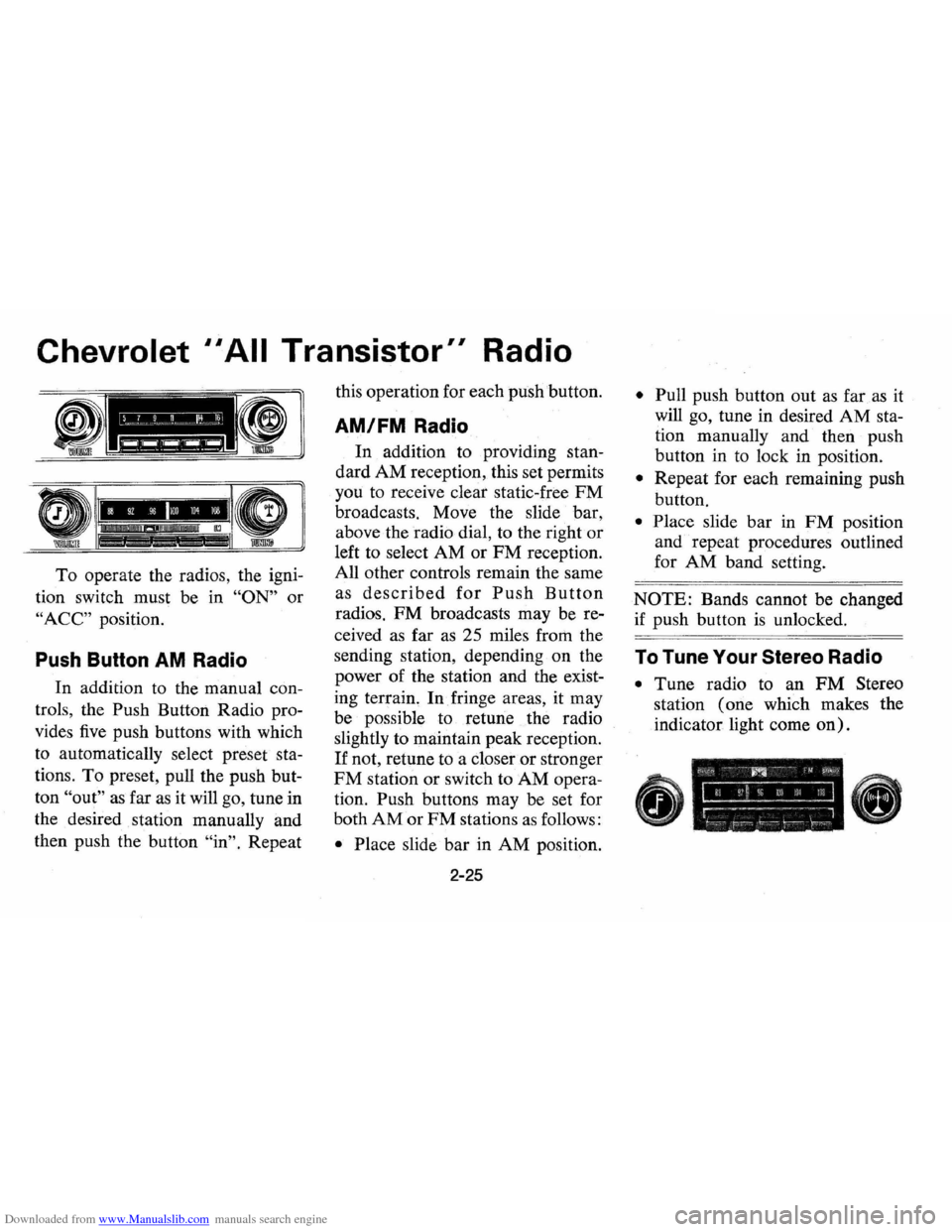
To operate the radios, the igni
tion switch must be in
"ON" or
"ACC" position.
Push Button AM Radio
In addition to the manual con
trols, the Push Button Radio pro
vides
five push buttons with which
to automatically select preset sta
tions . To preset, pull the push but
ton
"out" as far as it will go, tune in
the desired station manually and
then push the button
"in". Repeat this
operation for each push 'button.
AM/FM Radio
In addition to providing stan
dard
AM reception, this set permits
you to receive clear static-free
FM
broadcasts. Move the slide bar,
above the radio dial, to the right
or
left to select AM or FM reception.
All other controls remain the same
as
described for Push Button
radios. FM broadcasts may be re
ceived
as far as 25 miles from the
sending station, depending on the
power of the station and the exist
ing terrain.
In fringe areas, it may
be possible to
retune the radio
slightly to maintain peak reception.
If not, retune to a closer or stronger
FM station or switch to AM opera
tion. Push buttons may be set for
both
AM or FM stations as follows:
• Place slide bar in AM position.
2-25
• Pull push button out as far as it
will go, tune in desired
AM sta
tion manually and then push
button in to lock in position.
• Repeat for each remaining push
button.
• Place slide bar in FM position
and repeat procedures outlined
for
AM band setting.
NOTE: Bands cannot be changed
if push button
is unlocked.
To Tune Your Stereo Radio
• Tune radio to an FM Stereo
station (one which makes the
indicator light come
on).
Page 44 of 87
Downloaded from www.Manualslib.com manuals search engine The optional rear quarter win
dows of the sedan and Hatchback
coupe models may be opened or
closed with finger operated
swing
ing latches.
Headlamp Reminder Buzzer
The optional headlamp reminder
buzzer provides an audible warning
that the main light switch
is in one
of the
"on" positions, either park
ing lights or headlights.
The reminder buzzer
is actuated
only when the ignition switch
is
turned to "OFF" or "LOCK" posi
tion.
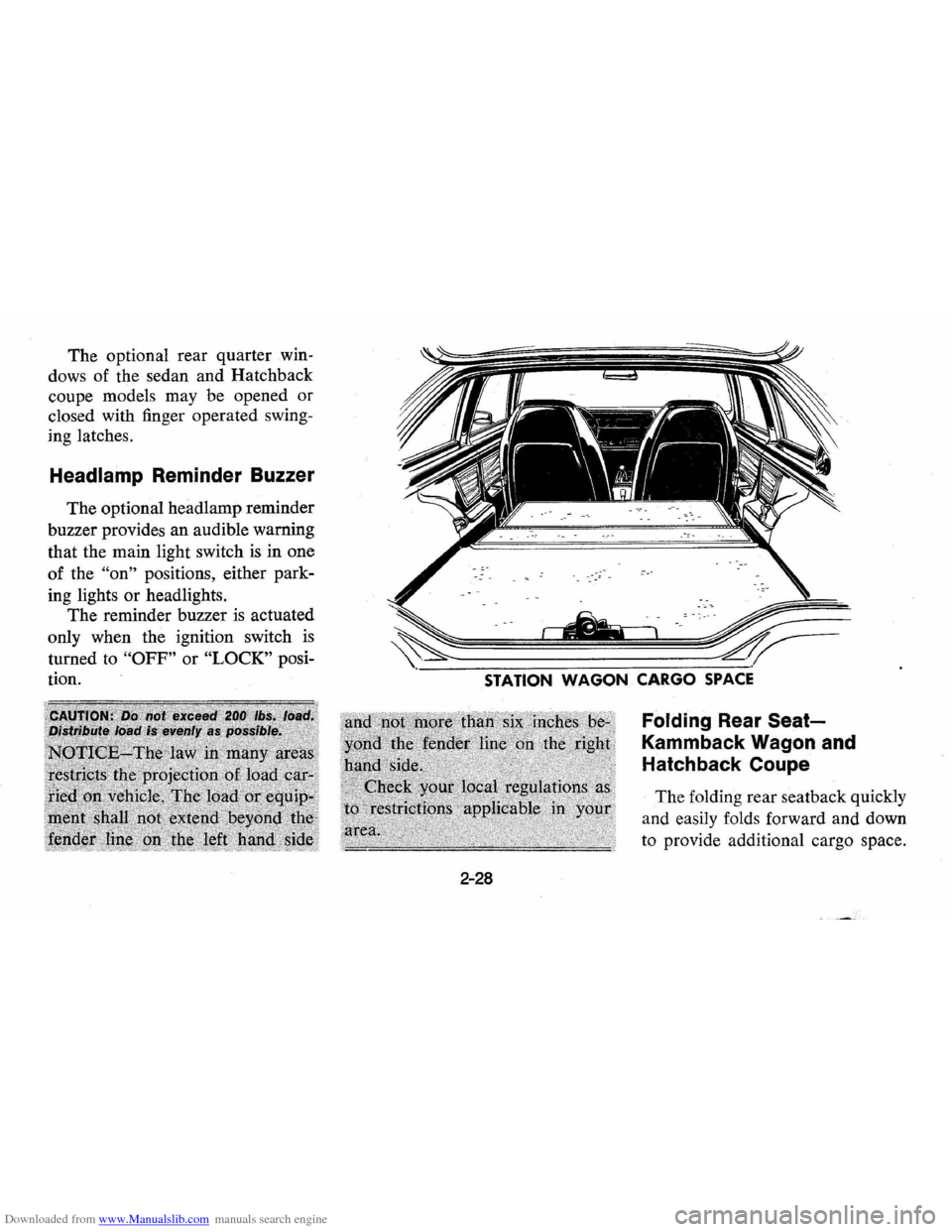
STATION WAGON CARGO SPACE
2-28
Folding Rear Seat
Kammback Wagon and
Hatchback Coupe
The folding rear seatback quickly
and easily folds forward and down
to provide additional cargo space.
Page 45 of 87
Downloaded from www.Manualslib.com manuals search engine To lower the folding seatback:
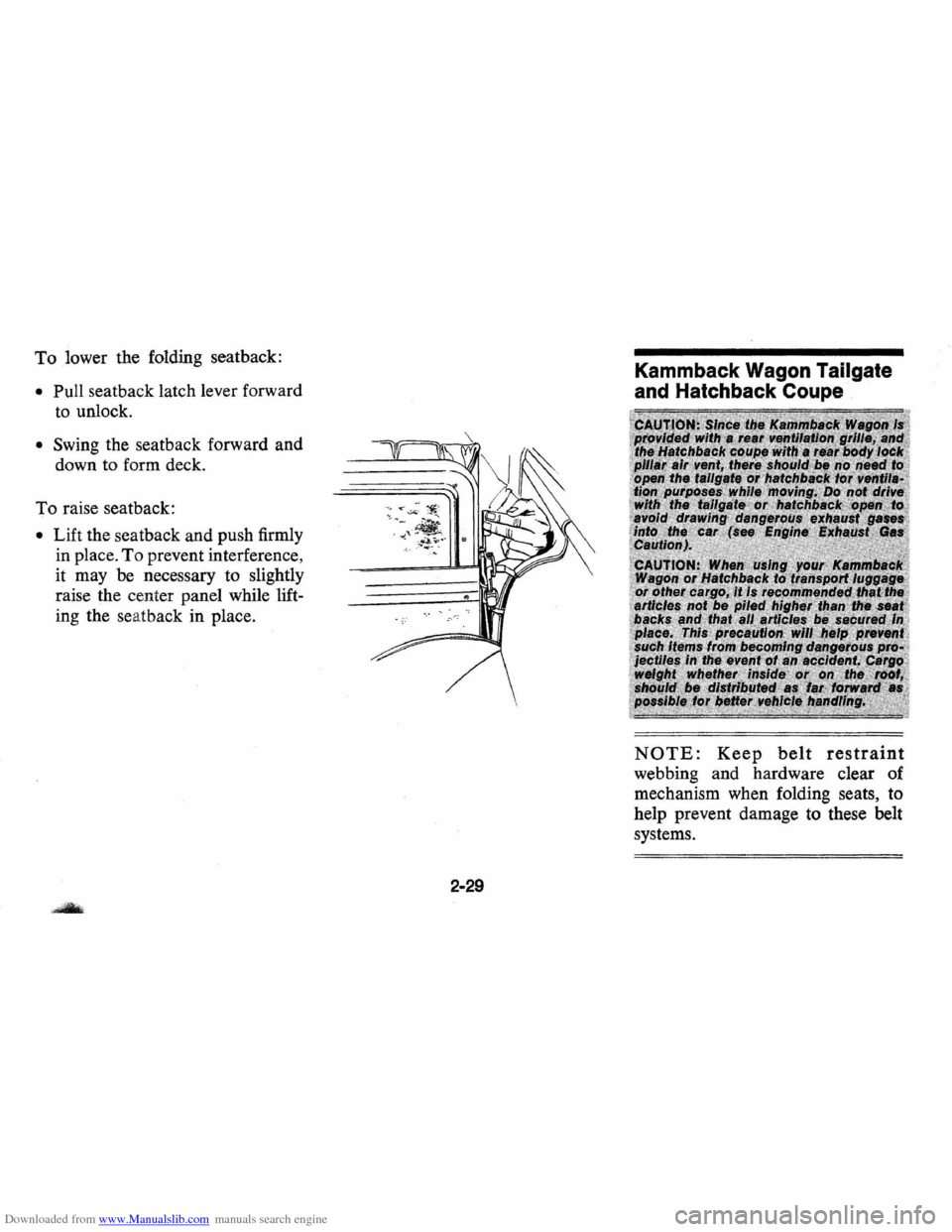
• Pull seatback latch lever forward
to unlock.
• Swing the seatback forward and
down to form deck.
To raise seatback:
• Lift the seatback and push firmly
in place . To prevent interference,
it may be necessary to slightly
raise the center panel while lift
ing the seatback in place.
2-29
Kammback Wagon Tailgate
and Hatchback Coupe
NOTE: Keep belt restraint
webbing and hardware clear of
mechanism when folding seats, to
help prevent damage to these belt
systems.
Page 46 of 87
Downloaded from www.Manualslib.com manuals search engine In Case of Emergency
Four Way Hazard
Warning
Flasher
• Use the warning flasher to warn
other drivers any time your
ve
hicle becomes a traffic hazard,
day or night.
• A void stopping on the roadway
if possible.
• Turn on the hazard warning
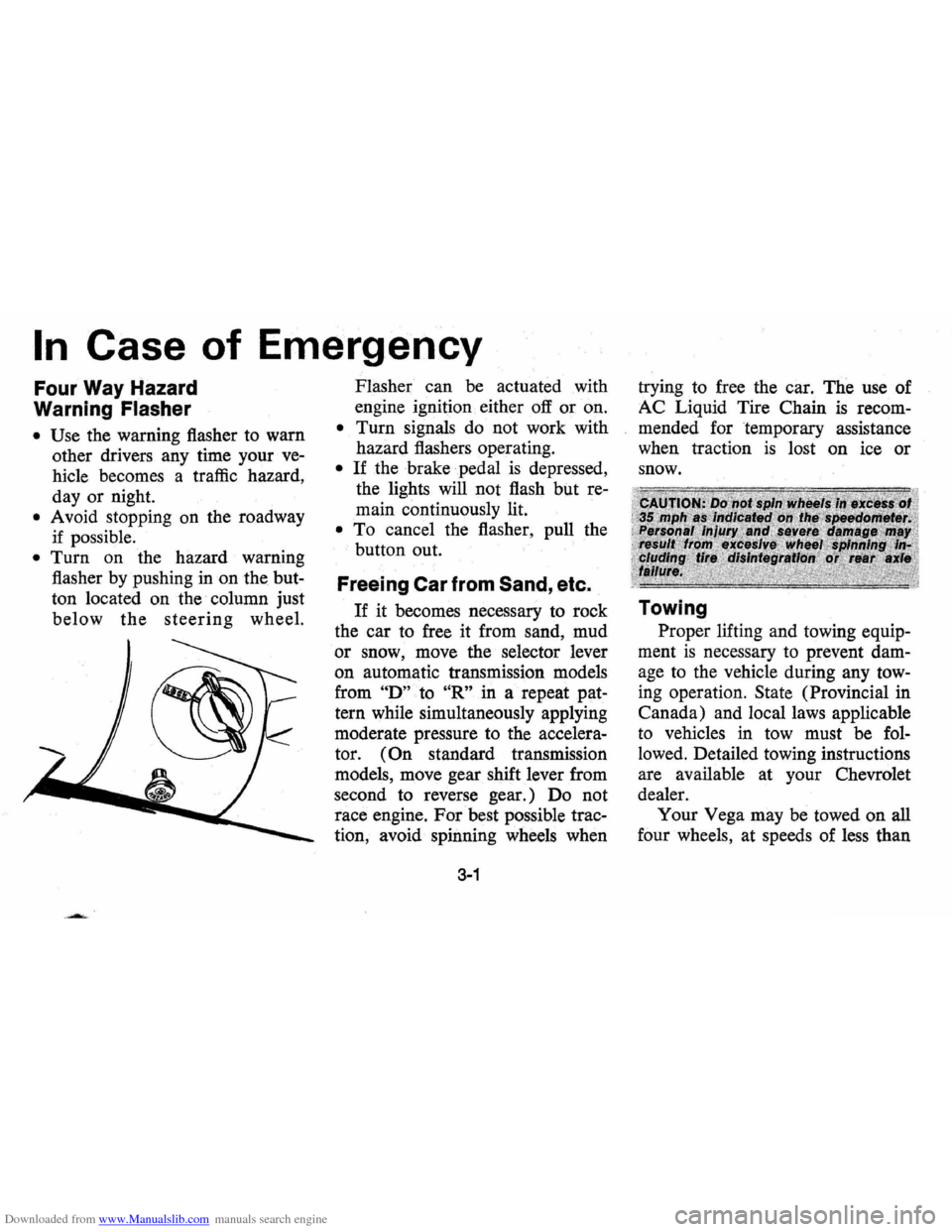
flasher by pushing
in on the but
ton located on the column just
below the steering wheel. Flasher
can
be actuated with
engine ignition either
off or on.
• Turn signals do not work with
hazard flashers operating.
• If the brake pedal is depressed,
the lights will not flash but
re
main continuously lit.
• To cancel the flasher, pull the
button out.
Freeing Car from Sand, etc.
If it becomes necessary to rock
the car to free it from sand, mud
or snow, move the selector lever
on automatic transmission models
from
"D" to "R" in a repeat pat
tern while simultaneously applying
moderate pressure
to the accelera
tor.
(On standard transmission
models, move gear shift lever from
second to reverse gear.) Do not
race engine. For best possible trac
tion, avoid· spinning wheels when
3-1
trying to free the car. The use of
AC Liquid Tire Chain
is recom
mended for temporary assistance
when traction
is lost on ice or
snow.
Towing
Proper lifting and towing equip
ment
is necessary to prevent dam
age to the vehicle during any tow
ing operation. State (Provincial in
Canada) and local laws applicable
to vehicles in tow must be
fol
lowed. Detailed towing instructions
are available at your Chevrolet
dealer. Your Vega may be towed on
all
four wheels, at speeds of less · than
Page 48 of 87
Downloaded from www.Manualslib.com manuals search engine or flame arrestor type filler/
vent caps.
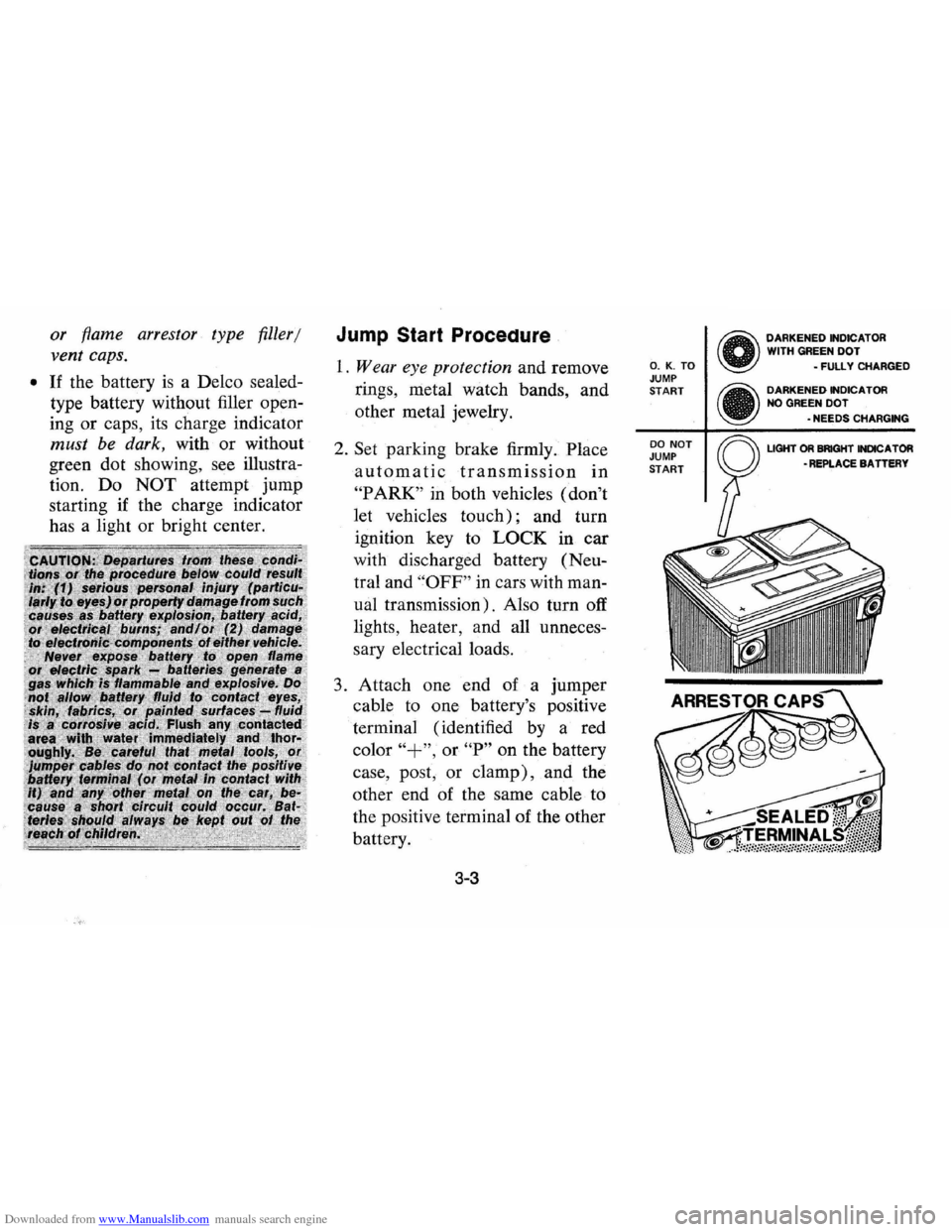
• If the battery is a Delco sealed
type battery without filler open
ing
or caps, its charge indicator
must be dark, with or without
green dot showing, see illustra
tion. Do
NOT attempt jump
starting if the charge indicator
has a light or bright center.
Jump Start Procedure
1. Wear eye protection and remove
rings, metal
watch bands, and
other metal jewelry.
2. Set parking brake firmly. Place
automatic transmission in
"P ARK" in both vehicles (don't
let vehicles
touch); and turn
ignition key to
LOCK in car
with discharged battery (Neu
tral and
"OFF" in cars with man
ual transmission). Also turn off
lights, heater, and all unneces
sary electrical loads.
3. Attach one end of a jumper
cable to one battery's positive
terminal (identified
by a· red
color
"+", or "P" on the battery
case , post , or
clamp), and the
other end of the same cable to
the positive terminal of the other
battery.
3-3
O. K . TO JUMP START
DO NOT JUMP START
o DARKENED INDICATOR
WITH GREEN DOT - FULLY CHARGED
• DARKENED INDICATOR
NO GREEN DOT
-NEEDS CHARGING
LIGHT
OR BRIGHT INDICA TOR -REPLACE BA TTERY
Page 49 of 87
Downloaded from www.Manualslib.com manuals search engine 4. Attach the remammg jumper Engine Coolant
cable FIRST to the negative ter
minal (black color,
"-" or "N")
of the OTHER vehicle's battery,
(regardless of which vehicle has
the discharged
battery) and
THEN to the negative terminal
of the battery in THIS
car-thus
taking advantage of the flame
arrestor feature on the battery in
THIS car, should a spark occur.
5. Start engine in the vehicle that is
providing the jump start (if it
was not running). Let run a few
minutes, then start the engine in Jacking Instructions
the car that has the discharged
battery.
6. Reverse the above sequence
EXACTL Y when removing the
jumper cables, taking care to re
move the cable from
[he negative
terminal of the battery in THIS
car
as the FIRST step.
3-4
Preparation
• Park on level surface and set
parking brake firmly.
• Set automatic transmission in
park (manual transmission in
reverse).
• Activate hazard warning flasher.
Instructions
1. After removing spare wheel
and tire, jack, jack base, and
jack handle (wheel nut
wrench), proceed with chang
ing the wheel
as follows:
2. Remove hub cap or wheel
cover with flat end of wheel
nut wrench and loosen, but do
not remove nuts, by turning
counterclockwise.
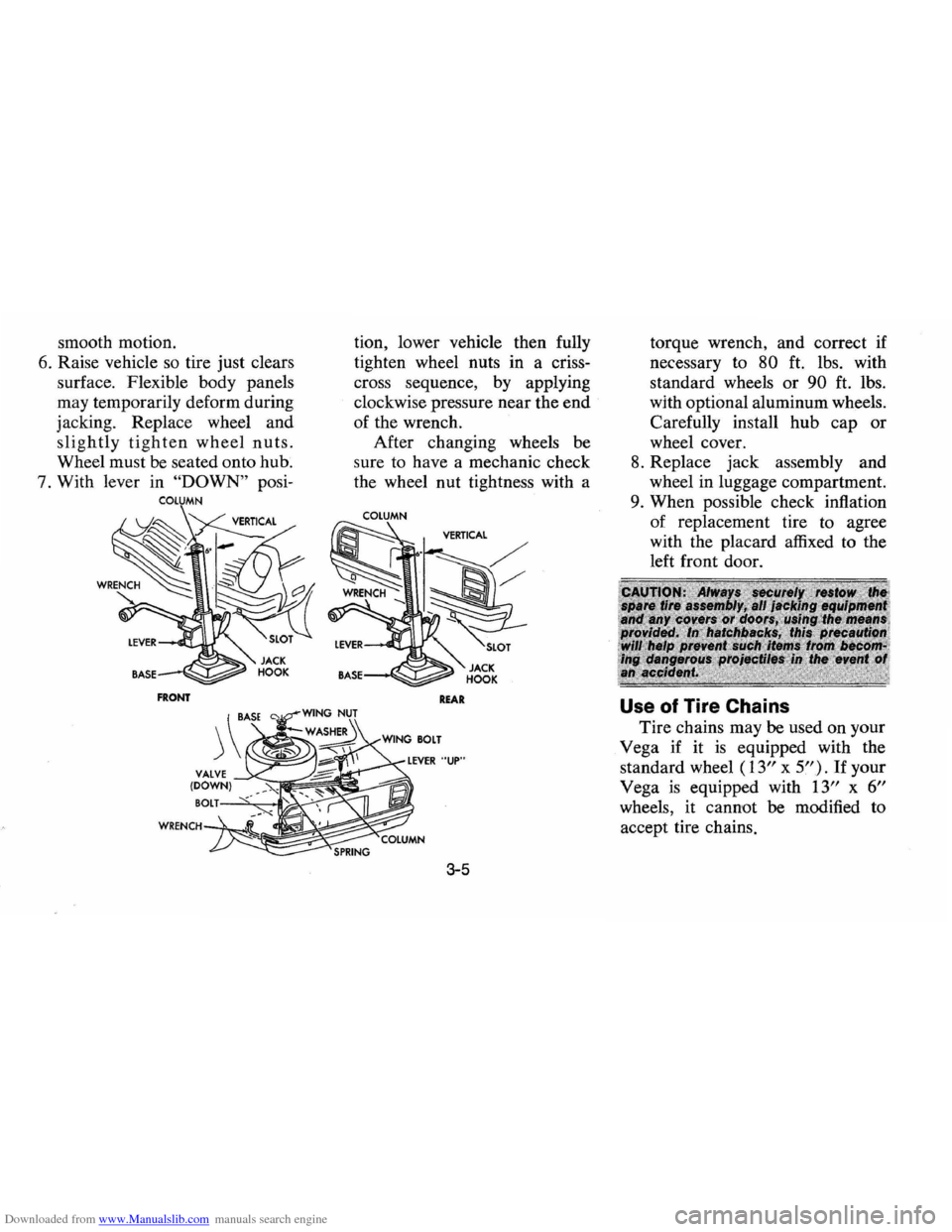
3. With column assembly seated
in base and lever in
"UP" posi
tion, insert jack hook in bum
per slot.
4. Base must sit flat with top of
column angled slightly away
from vehicle,
as shown in illus
tration.
5. Always operate jack with slow
Page 50 of 87
Downloaded from www.Manualslib.com manuals search engine smooth motion.
6. Raise vehicle so tire just clears
surface. Flexible body panels
may temporarily deform during
jacking. Replace wheel and
slightly tighten wheel nuts.
Wheel must be seated onto hub.
7. With lever in
"DOWN" posi
COLUMN
FRONT
tion, lower vehicle then fully
tighten wheel nuts in a criss
cross sequence, by applying
clockwise pressure near the
end
of the wrench.
After changing wheels
be
sure to have a mechanic check
the wheel nut tightness with a
COLUMN
REAR
3-5
torque wrench, and correct if
necessary to
80 ft. lbs. with
standard wheels
or 90 ft. lbs.
with optional aluminum wheels.
Carefully install
hub cap or
wheel cover.
8. Replace jack assembly and
wheel in luggage compartment.
9. When possible check inflation
of replacement tire to agree
with the placard affixed to the
left front door.
Use of Tire Chains
Tire chains may be used on your
Vega if it
is equipped with the
standard wheel
(13" x 5"). If your
Vega
is equipped with 13" x 6"
wheels, it cannot be modified to
accept tire chains.
Page 52 of 87
Downloaded from www.Manualslib.com manuals search engine NEVER use gasoline, nail polish
remover or acetone, lacquer
thin
ners, bleaches, etc. Some basic
steps should be remembered
l;>efore
the cleaning is attempted:
1. Remove stains as. quickly as pos
sible before they become "set".
2. Use a clean cloth or sponge and
change to a clean area
fre
quently. (A soft brush may be
used if stains persist.)
3. Use solvent type cleaners in a
well ventilated area, also, do not
saturate the stained area.
4.
If a ring should form after spot
cleaning, the entire area of the
trim assembly should be cleaned
immediately.
5. Follow instructions on the label
of the cleaner.
Cleaning General Soilage
or Water Spots from Fabric
Type Trim with Foam Type
Cleaner
G.M. Multi-Purpose Powdered
Cleaner
is excellent for this type
cleaning and for cleaning a panel
section where a minor cleaning ring
may be left from spot cleaning.
Vacuum area thoroughly to
re
move excess loose dirt. ALWAYS
clean a full trim assembly or com
plete trim section-mask adjacent
4-2
trim along stitch or welt liiles. Mix
Multi-Purpose Powdered Cleaner
in strict accordance with directions
on label of container
___ mix propor-
tionally for smaller
quantities/USE
SUDS ONLY ON A CLEAN
SPONGE or SOFT BRISTLE
BRUSH-DO NOT
WET FAB
RIC EXCESSIVELY OR RUB
HARSHL
Y WITH BRUSH. IM
MEDIATELY AFTER CLEAN
ING WIPE OFF ANY CLEANER
RESIDUE WITH SLIGHTLY
DAMP ABSORBENT TOWEL
OR CLOTH.
IMPORTANT
IMMEDIATELY AFTER WIP
ING, FORCE -DRY FABRIC
WITH AIR
HOSE, HEAT DRY
ER OR HEAT LAMP. (Use cau
tion with heat dryer or heat lamp
to prevent damage to fabric. )
When trim materials with a sheen
or luster finish are dry, wipe fabric
lightly with a soft, dry clean cloth
to restore sheen or luster.