1976 CHEVROLET VEGA light
[x] Cancel search: lightPage 53 of 87
Downloaded from www.Manualslib.com manuals search engine Spot Cleaning Fabric Type
Trim Materials with
Solvent
Type Cleaner
Before attempting to remove
spots or stains from fabric, deter
mine
as accurately as possible the
nature and age of the spot or stain.
Some spots or stains can be re
moved satisfactorily with water or
mild soap solution (refer to ac
companying
"Removal of Specific
Stains"). For best results, spots or
stains should be removed
as soon
as possible. Some types of stains
or soilage such
as lipstick, some
inks, certain types of grease etc.,
are extremely difficult and,
in some
cases, impossible to completely re
move. When cleaning this type of
stain or soilage, care must be taken
not to enlarge the soiled area.
It is
sometimes more desirable to have
a small stain than an enlarged stain
as a result of careless cleaning.
G.M.
Spot Lifter (Solvent Type)
is excellent for spot cleaning stains
containing grease, oil or fats from
fabric type trim. Excess stain
should be gently scraped off trim
material with a clean DULL knife
or scraper.
USE VERY LITTLE
CLEANER, light pressure, and
clean cloths (preferably cheese
cloth). Cleaning action should be
from outside of stain FEATHER
ING towards center of stain and
constantly changing· to a clean sec
tion of cloth.
When stain is cleaned
from · fabric, immediately dry area
with an· air
hose, heat dryer or heat
l~mp to help prevent a cleaning
flng (use caution with heat dryer
or heat
lamp to prevent damage to
fabric material).
If a ring forms,
immediately repeat the
. cleaning
operation over a slightly larger
area with special emphasis on
FEATHERING towards center of
area.
If ring still persists, mark
off adjacent trim sections and clean
4-3
entire affected trim panel sectIOn
with G.M. Multi-Purpose Powdered
Cleaner
as previously described
under
"Cleaning General Soilage
or Water
Spots with Foam Type
Cleaner."
Removal of Specific Stains
Grease or Oil Stains-Includes
grease, oil, butter, margarine shoe
polish, coffee with cream,
ch~wing
gum, cosmetic creams, vegetable
oils, wax crayon, tar and asphalts.
Carefully scrape off excess stain;
then use Spot Lifter (Solvent
Type) as previously described.
Shoe polish, wax crayons, tar and
asphalts
will stain if allowed to
remain on trim; they should be
removed
as soon as possible-use
caution
as cleaner will dissolve
them and may cause them to bleed.
Non-Greasy Stains-Includes cat
sup, coffee (black), egg, fruit, fruit
Page 54 of 87
Downloaded from www.Manualslib.com manuals search engine juice, milk, soft drinks, wine, vomit
and blood. Carefully scrape
off eX
cess stain; then sponge stain with
cool water.
If stain remains use
Multi-Purpose Powdered Cleaner
(Foam Type)
as previously de
scribed .
If odor persists after clean-'
ingvomitus or urine, treat area with
a water-baking soda solution ( 1
teaspoon baking soda to 1 cup of
tepid water) -finally , if necessary ,
clean lightly with
Spot Lifter (Sol
vent Type).
IMPORTANT: In the event white
or light-colored seat trim becomes
stained due to contact with materials
that do not have color-fast dyes
(certain types of casual clothing,
decorative paper, etc.) the
trim
must be cleaned IMMEDIATELY to
avoid permanent discoloration.
Clean with Multi-Purpose Powdered
Cleaner (Foam Type)
as previously
described.
Combination Stains-Includes
candy, ice cream, mayonnaise, chili
sauce and unknown stains. Care
fully scrape
off excess stain; then
clean first with
cool water and
allow to dry.
If stain remains, clean
with
Spot Lifter (Solvent Type).
Cleaning Vinyl or Leather
Trim
Ordinary soilage can be re
moved
·from vinyl or leather with
warm water and a mild soap such
as' saddle soap or oil soap, orap
proved equivalent. Apply a small
4-4
amount of soap solution and allow
to soak for a few minutes to loosen
d irt; then , rub briskly with a clean
damp cloth to remove
dirt-and
soap residues-this operation may
be repeated several times
if nec
essary.
Some soilage such as tars ,
asphalts, shoe polish, etc. will stain
if allowed to remain on trim-they
should be wiped off as quickly as
possible and the area cleaned with .
a clean cloth dampened with G.M.
Spot Lifter (Solvent Type).
Belt Restraint Care
• Clean only with mild soap solu
tion and lukewarm water.
• Do not bleach or dye belts since
this may severely weaken belts.
Page 58 of 87
Downloaded from www.Manualslib.com manuals search engine Part Number Size Description Usage
1050520
16 oz. Lubriplate (White Grease) Hood, Trunk and Door Hinges and Latches •
1050729 8 oz. Vinyl Top Cleaner Cleans optional vinyl tops
1050803 1
lb. Multi-Purpose
Powdered
Cleans vinyl and cloth on door trim, Cleaner seats and carpet; also tires and mats
1051055 16 oz.
Preservatone Preserves finish on vinyl fabric
1051186
22112 oz. Gem Glo Quick clean-up and wax; for slightly dirty finishes
1051398 8 oz. Spot Lifter
Spot and stain
removal on cloth and fabric
1051515
32 oz. Optikleen Windshield Washer solvent and anti-freeze
1051516
32 oz. Washer Solvent and
Same as 1050001 Gas Line De-Icer
1051772 20 oz. Presoftened Cleaner/Wax One-step cleaner and wax
1051855
32 oz. Dexron II Automatic Transmission fluid
1051858 16 oz. G.M. Super E.O.S.
(Engine Oil Supplement) Consult your Dealer for usage
4-8
Page 64 of 87
Downloaded from www.Manualslib.com manuals search engine • If it feels warm, the level should
be close to the
"ADD" mark
( either slightly above
or beloW).
• If it feels hot (cannot be held
comfortably) the level should
be
between the "ADD" and
"FULL" marks.
NOTE: DO NOT OVERFILL. It
takes only one pint to raise level
from
ADD to FULL with a hot
transmission.
Automatic Transmission
Drain
Intervals
The transmission operating tem
perature resulting from the type of
driving conditions under which
your vehicle
is used is the main
consideration in establishing the
proper frequency of transmission
fluid changes.
If you do not use your vehicle
under severe conditions, change the
fluid and filter every
60,000 miles.
Refer to section 6,
"Specifications",
for required fluid quantities.
If the vehicle is usually driven
under one
or more of the follow
ing conditions-considered severe
transmission
service-change the
transmission fluid and filter every
15,000 miles.
• In heavy city traffic.
• Where the outside temperature
regularly reaches
90° F. (32°
C.) for extended periods.
• In very hilly or mountainous
areas.
• Frequent trailer pUlling.
• Commercial uses, such as taxi,
police
car or delivery service.
Manual Transmissions
Lubricant
Level
Every 6 months or 7,500 miles,
whichever occurs first, check lubri
cant level and add lubricant, if nec
essary, to
fill to . level of filler plug
hole.
5-6
• 3-Speed and 4-Speed-Use SAE
80W or SAE 80W-90 GL-5
Gear Lubricant. (For those
vehicles normally operated in
Canada, use
SAE 80W GL5
Gear Lubricant. )
Transmission Shift Linkage
(Manual and Automatic)
Every 7,500 miles or 6 months
lubricate shift linkage and
on
manual transmission floor controls
lever contacting faces with water
resistant
EP chassis lubricant which
meets
GM specification 6031 M.
Clutch Cross -Shaft -Every
30,000 miles or sooner if necessary
-Remove the plug, install a lubri
cation fitting and lubricate with
water resistant
EP Chassis Lubri
cant which meets GM Specification
6031M.
Page 70 of 87
Downloaded from www.Manualslib.com manuals search engine Hood Latche$
Every 6 months or 7,500 miles,
whichever occurs first, lubricate
hood latch assembly and hood
hinge assembly
as follows:
1. Wipe off any accumulation of
dirt or contamination on latch
parts.
2 . Apply Lubriplate or equivalent
to latch pilot bolts and latch
locking plate.
.
3. Apply light engine oil to all pivot
points in release mechanism,
as
well as primary and secondary
latch mechanisms.
4. Lubricate hood hinges.
5. Make hood hinge and latch
mechanism functional check
to
assure the assembly is working
correctly .
Accelerator Linkage
Lubricate with engine oil every
15,000 miles.
Hinges
The following points should be
checked and lubricated every 6
months or
7,500 miles, whichever
occurs first:
hingeS on all doors,
fuel filler door, trunk lid, door lock
striker and door
jamb switches. '
5-12
Air Conditioning
Have your Authorized Dealer
check your Air Conditioning
sys
tem at some time during the winter
months to be sure there has been
no loss in cooling output. During
the summer , see your Authorized
Dealer immediately if you suspect
the system
is not performing as it
should.
NOTE: Your car's air condition
ing system will not operate below
ambient temperature of
300 F
( -1 0 C) , regardless of control
position.
Page 79 of 87
Downloaded from www.Manualslib.com manuals search engine IMPORTANT FACTS YOU SHOULD KNOW ABOUT GASOLINE MILEAGE
How you drive, where you drive,
and when you drive all have an
effect on how many miles you can
get from a gallon of gasoline. The
careful attention you give your car
as far as maintenance and repairs
are concerned will also contribute
importantly to fuel economy.
Fuel Selection
Your vehicle is designed to op
erate
only on unleaded gasoline of
at least 87 average octane num
ber (Research octane plus Motor
octane divided by two). This gaso
line should have a Research octane
number of at least 91, and a
Motor octane number of
at least
83. Unleaded gasoline
is essential
for proper emission control system
operation, and it will minimize
spark plug fouling. The use of
... AND HOW TO IMPROVE IT
leaded gasoline can damage or
severely reduce the effectiveness of
the emission control system and re
sult in loss of warranty coverage.
"Jackrabbit" Starts
Gasoline can be conserved (and
engine and tire life prolonged) by
avoiding unnecessarily rapid accel
eration away from lights and stop
signs.
Stop-And-Start Driving
Frequent stops and starts during
a trip really cut down on your miles
per gallon.
Plan even your short
shopping trips to take advantage of
through streets to avoid traffic
lights.
Pace your driving like the
professional drivers to avoid
un
necessary stops.
5-21
Excessive Idling
An idling engine uses gasoline,
too.
If you're faced with more than
a
few minutes wait and you're not
in traffic, it may be better to
"turn
off"
and start again later.
Sudden Stops
Sudden stops themselves don't
waste gasoline , but energy
is
wasted as heat in braking . Energy
in the form of gasoline
is also
needed to accelerate back to driv
ing speed.
Lubricants
A properly lubricated vehicle
means less friction between moving
parts. Consult this manual and the
maintenance schedule for the
proper lubricants to use and the
lubrication intervals.
Page 85 of 87
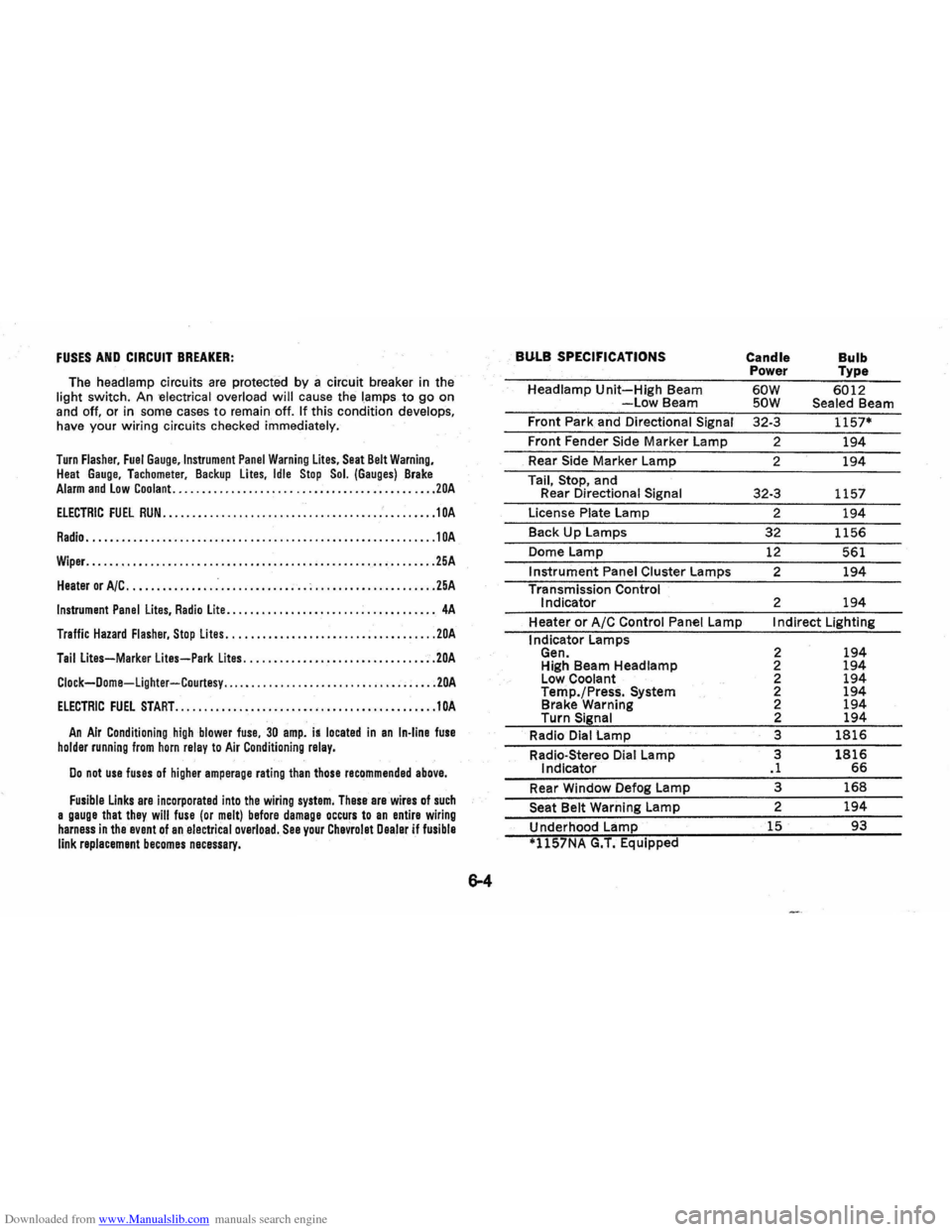
Downloaded from www.Manualslib.com manuals search engine FUSES AND CIRCUIT BREAKER:
The headlamp circuits are protected by a circuit breaker in the
light switch . An -electrical overload will cause the lamps to go on
and off. or in some cases to remain off. If this condition develops,
have your wiring circuits checked immediately.
Turn Flasher, Fuel Gauge,lnstrument Panel Warning Lites, Seat Belt Warning, Heat Gauge. Tachometer. Backup lites, Idle Stop Sol. (Gauges) Brake Alarm and Low Coolant. ............................................ 20A
ELECTRIC FUEL RUN ..................•........................•... 1 OA
Radio ............................................................ 10A
Wiper. ........................................................... 25A
Heater or A/C ............... .-............ ; .. ; ..................... 25A
Instrument Panel Lites, Radio Lite ...........•....... ................. 4A
Traffic Hazard Flasher, Stop Lites ...........•.•................•••... 20A
Tail Lites-Marker lites-Park Lites ...........•.............. .•..... 20A
Clock-Dome-Lighter-Courtesy ..... .......................... ; ..... 20A
ElECTRIC FUEL START ...•................•.•••.•......•.•.••...... 10A
An Air Conditioning high blower fuse, 30 amp. is located in an In-line fuse holder running from horn relay to Air Conditioning relay.
Do not use fuses of higher amperage rating than those recommended above.
Fusible Links are incorporated into the wiring system, These are wires of such a gauge that they will fuse (or melt) before damage occurs to an entire wiring harness in the event of an electrical overload. See your Chevrolet Dealer if fusible link replacement becomes necessary.
BULB SPECIFICATIONS
Headlamp Unit-High Beam -Low Beam
Front Park and Directional
Signal
Front Fender Side Marker Lamp
_ Rear Side Marker Lamp
Tail,
Stop, and
Rear Directional Signal
License Plate Lamp
Back
Up Lamps
Dome Lamp
Instrument Panel Cluster Lamps
Transmission Control
Indicator
Heater
or A/C Control Panel Lamp
I ndicator Lamps
Gen. High Beam Headlamp
Low Coolant
Temp./Press.
System Brake Warning
Turn Signal
Radio Dial Lamp
Radio-Stereo Dial Lamp
Indicator
Rear Window Defog Lamp
Seat Belt Warning Lamp
Underhood Lamp
*1l57NA G.T. Equipped
Candle
Bulb Power Type
60W 6012 SOW Sealed Beam
32-3
1157*
2 194
2 194
32-3 1157
2
194
32 1156
12 561
2
194
2 194
I ndirect Lighting
2
194 2 194 2 194 2 194 2 194 2 194
3 1816
3 1816 .1 66
3 168
2 194
15 93