1973 CHEVROLET CAMARO check engine
[x] Cancel search: check enginePage 56 of 84
Downloaded from www.Manualslib.com manuals search engine type cooling system is used on all
1973 Camaro air conditioned and
heavy duty cooling systems. It has
been filled at the factory with a
high-quality, inhibited, year-around
coolant that meets the standards
of General Motors Specification
1899-M. This coolant solution pro
vides freezing protection to
-20 0 F
(-32°F in Canada), and it has
been formulated to be used for
two full calendar years
or 24,000
miles, whichever first occurs, of
normal operation without draining,
provided the proper concentration
of coolant
is maintained.
• For Recovery Systems Only
Check the coolant level visually
at the see-through coolant reser
voir at each oil change interval
while the engine
is at normal
operating temperature. Do not
remove radiator cap except for
draining and refilling the system.
Coolant level should be at the
"Full Hot" mark on the reservoir.
If system is checked cold, the
coolant level should be at the
"Full Cold" mark on the reser
voir.
• For Other Than Recovery Sys
tems-Check the coolant level
only at oil change intervals, un
less there
is evidence of leaking
or overheating. Do not remove
radiator cap when solution
is
hot and under pressure. Coolant
level should be a maximum of
three inches below the level of
the filler neck when the engine
is cold.
• All Systems-Add a 50/50 mix
ture of high-quality ethylene
glycol antifreeze and water if
coolant additions are necessary.
Do not overfill.
NOTE: If recommended quality
antifreeze
is used, supplemental
inhibitors or additives claiming to
53
provide increased cooling capabil
ity are not necessary. They may be
detrimental to the efficient opera
tion of the system, and represent
an unnecessary operating expense.
Every year, the cooling system
should be serviced
as follows:
1. Wash radiator cap and filler
neck with clean water.
2. Check coolant for proper level
and freeze protection.
3. Pressure test system and radia
tor cap for proper pressure hold
ing capacity (15 psi).
If re
placement
of cap is required,
use the proper AC cap specified
for your car model.
4. Tighten hose clamps and inspect
all hoses. Replace hoses when
ever checked, swollen
or other
wise deteriorated.
5. Clean frontal area of radiator
core and air conditioning con
denser.
Page 58 of 84
Downloaded from www.Manualslib.com manuals search engine It is the owner's responsibility
to keep the freeze protection at a
level commensurate with the tem
peratures which may occur
in the
area of vehicle operation.
• Maintain cooling system freeze
protection at
_200 F or below
to ensure protection against cor
rosion and loss of coolant from
boiling, even though freezing
temperatures are not expected.
• Add ethylene glycol base cool
ant that meets GM Specification
1899-M when coolant additions
are required because of coolant
loss or to provide additional
protection against freezing at
temperatures lower than
_200
F (_320 F in Canada).
NOTE: Alcohol or methanol base
coolants
or plain water are not
recommended for your Camaro at
any time.
Radiator Pressure Cap
The radiator cap, a 15 lb. pres
sure type, must be installed tightly,
otherwise coolant may be lost and
damage to engine may result from
overheating. Radiator pressure
caps should be checked periodi
cally for proper operation.
If re
placement
is required specify AC.
Thermostat
The cooling system is protected
and controlled by a thennostat
in
stalled in the engine coolant outlet
to maintain a satisfactory operat
ing temperature of the engine. This
thermostat
is designed forcontinu
ous use through both winter and summer
and need not be changed
seasonally . When replacement
is
necessary, Delco parts are recom~
mended.
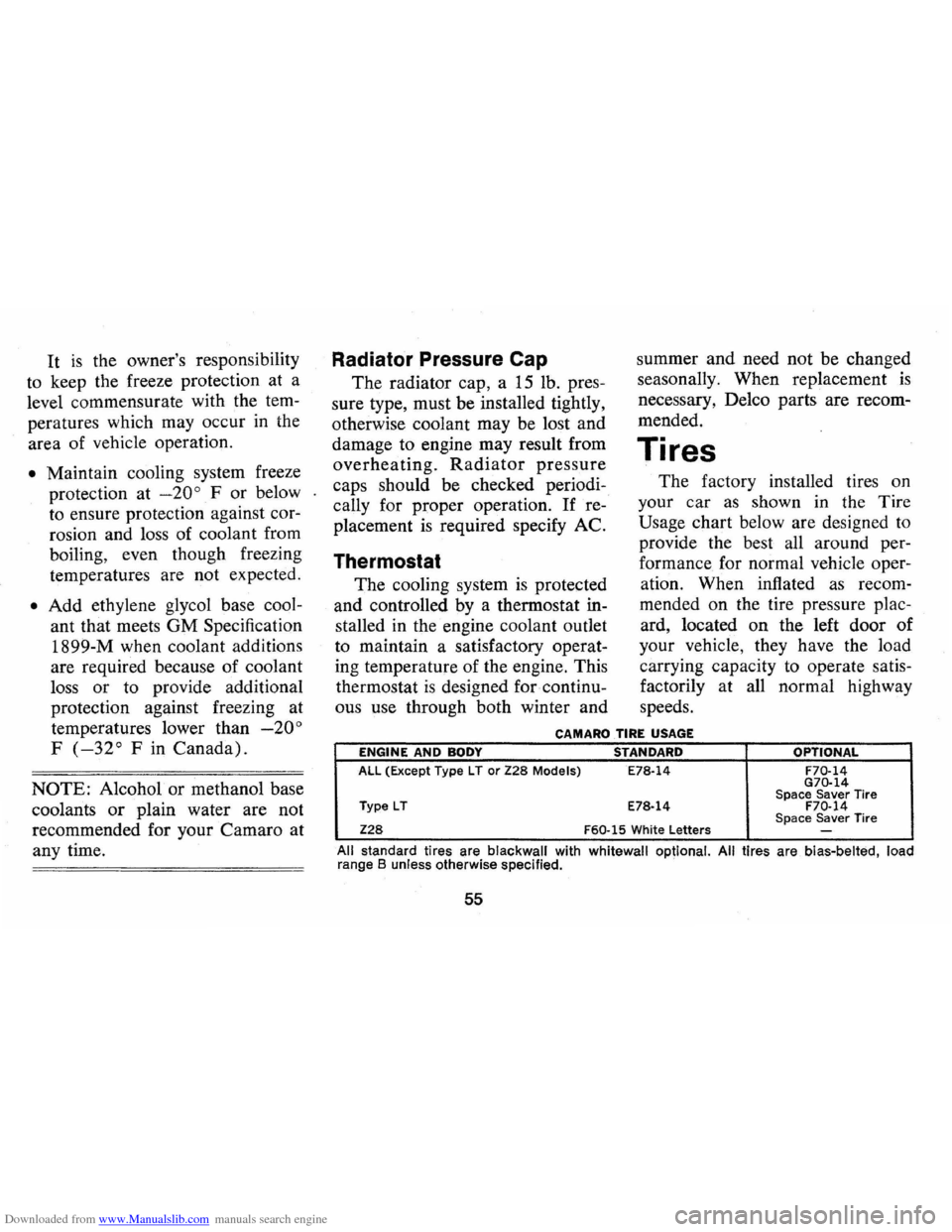
Tires
The factory installed tires on
your car
as shown in the Tire
Usage chart below are designed to
provide the best all around per
formance for normal vehicle oper
ation. When inflated
as recom
mended on the tire pressure plac
ard, located
on the left door of
your vehicle, they have the load
carrying capacity to operate satis
factorily at all normal highway
speeds.
CAMARO TIRE USAGE
ENGINE AND BODY STANDARD OPTIONAL
All (Except Type l T or Z28 Models) E78·14 F70·14 G70·14
Type lT Space Saver Tire E78·14 F70·14
Z28 F60·15 White letters Space Saver Tire -
All standard tires are blackwall with whitewall optional. All tires are bias-belted, load
range B unless otherwise specified. .
55
Page 59 of 84
Downloaded from www.Manualslib.com manuals search engine Tire Care
Tires should be checked regu
larly for proper inflation pressure,
wear, and damage. The following
information will assist you in prop
erly caring for your tires:
Inflation
Pressure-The tire in
flation pressures listed on the tire
placard have been selected to pro
vide the best tire life, riding com
fort and handling stability for nor
mal driving conditions. When in
flated at the highest pressures
shown
on the placard, the tires
have the load carrying capacity to
operate satisfactorily at all loads
up to and including the vehicle
capacity load (total pounds)
which also
is shown on the plac
ard.
In addition, for those owners
who prefer the utmost
in com
fort , the reduced tire pressures
listed on the placard may be used
when loads of 4 occupants or less
are carried.
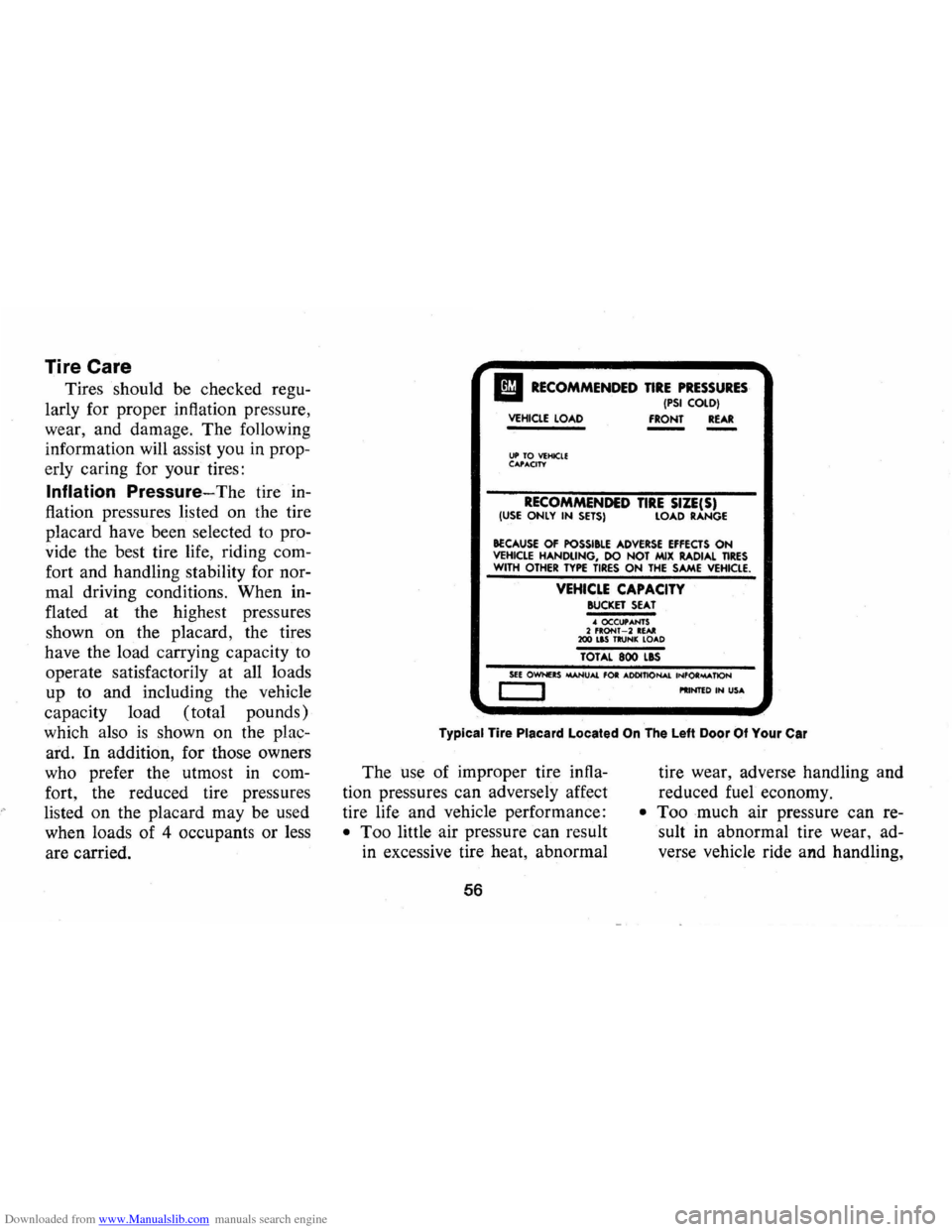
II RECOMMENDED TIRE PRESSURES . (PSI COlD) VEHICLE LOAD
FRONT REAR
UP TO VEHICLE C"',"'CITY
RECOMMENDED TIRE SIZE(S) (USE ONLY IN SETS) LOAD RANGE
BECAUSE OF POSSI&lE ADVERSE EFFECTS ON VEHICLE HANDliNG, DO NOT MIX RADIAL TIRES WITH OTHER TYPE TIRES ON THE SAME VEHICLE.
VEHICLE CAPACITY BUCKET SEAT ~ OCCU,""NTS 2 fRONT -2 RE .... 200 lIS TRUNK lO ... D
TOTAL 800 lIS
SEE OWNERS oAANU"" fOR ... OOITlONAl INfOR""'TlON c::=:J I'IINTED IN US ...
Typical Tire Placard Located On The Left Door Of Your Car
The use of improper tire infla
tion pressures can adversely affect
tire life and vehicle performance:
• Too little air pressure can result
in excessive tire heat, abnormal
56 tire
wear, adverse handling and
reduced fuel economy.
• Too much air pressure can re
sult in abnormal tire wear, ad
verse vehicle ride and handling,
Page 60 of 84
Downloaded from www.Manualslib.com manuals search engine and increased susceptibility to
damage by road impacts.
Tire pressures should be
checked when the tires are
"cold"
at least once a month (and pref
erably oftener) or before long
trips
or when heavily loaded. The
following points should be ob
served when checking and setting
tire pressures:
1. Cold tire pressure ratings are applic
able when a vehicle has been inopera
tive for 3 hours or more, or driven less than 1 mile.
2. Tire Inflation pressure may increase as
much as 6 pounds per square inch (psi)
when hot (after
vehicle has been driven 10 miles or at speeds of more than 60 miles per hour). Do not "bleed" or re
duce pressures when tires are hot from
driving.
3. For continuous high speed operation
(over 75 mph), Increase tire Inflation pressure 4 psi above the recommended
pressures up to a maximum of 32 psi cold pressure for load range B tires, or 40 psi for 0 load range tires. Sustained
speeds above 75 mph are not recommended when the 4 psi adjustment ,
would require pressures greater than
the above maximum pressures.
4. Always use a tire pressure gauge when
checking pressures as t,he appearance of a tire can be deceiving. For example,
radial ply fires, In comparison with bias ply tires at the same pressure, may have
the appearance of being under-inflated.
Vehicle Loading -Do not load
your vehicle beyond the vehicle
capacity (total pounds) shown on
the tire placard. This figure repre
sents the design capacity of the
ve
hicle, not merely of the tires.
When towing trailers, the allow
able pasenger and cargo load
must be reduced by an amount
equal to the trailer tongue load on
the trailer hitch.
(See "Trailer
Hauling"
in Section 1 of this man
ual.) Station wagon loads should
be distributed
as far forward as
possible. Vehicles equipped with
luggage racks do not have a
ve
hicle load capacity greater than
specified on the tire placard.
57
Tire Wear and Rotation -Un
even or abnormal tire wear is usu
ally the result of incorrect inflation
pressure, improper wheel align
ment, wheels being out-of-balance,
or poor driving habits. Underin
flation, incorrect toe or camber
and fast cornering produce differ
ent types of abnormal wear which
can be diagnosed by your dealer.
The original equipment tires in
corporate built-in tread wear
in
dicators to assist you in determin
ing when your tires ,have been
worn to the point of needing re
placement. These indicators ap
pear
as Ij2 inch wide bands when
tire tread depth
is 1/16 inch or
less. When the indicators appear
in two or more adjacent grooves,
tire replacement due to tread wear
is recommended.
To equalize wear, it
is recom
mended that the tires be rotated
every
6,000 miles (or sooner if
Page 63 of 84
Downloaded from www.Manualslib.com manuals search engine When driving on wet or slushy
roads, it
is possible for a wedge of
water to build up between the tire
and road surface. This phenom
enon, known
as hydroplaning.
may cause partial
or complete loss
of traction, which adversely affects
vehicle control and stopping abil
ity.
To reduce the possiblity of
traction loss, the following precau
tions should be observed:
1. Slow down during rainstorms or
when roads are slushy.
2. Slow down if road has standing
water
or puddles.
3. Replace tires when tread wear
indicators are visible .
4. Keep tires properly inflated.
For temporary assistance when
traction
is lost on ice or snow. the
use of AC Liquid Tire Chain is
recommended.
Inflation Instructions for
Space Saver Spare Tire
I. Install deflated space saver
spare
on car with valve stem at
the bottom and tighten all
five
lug nuts.
2. Remove valve qp and make
sure valve core is screwed tight
in valve stem.
3. Remove plastic cap from
in
flator.
4 . Place inflator over valve
stern
and push onto stem until sound
of gas entering tire can
be
heard .
5 . Keep pressure against valve and
hold can upright against wheel
to ensure complete draining of
fluid.
60
6 . Hold the inflator in position one
minute. After sound stops. then
remove inflator for disposal
in
proper receptacle.
7 . Replace valve cap.
NOTE: It is recommended that
the inflation pressure be checked
and adjusted to 28 psi
(Space
Saver Spare
only), as soon as pos
sible after installing tire on car.
To stow , deflate tire by remov
ing tire valve stem core with tool
on end of valve cap. Flatten tire
and replace core and cap. Do not
inhale gas.
Store tire in trunk com
partment. The
Space Saver Spare tire has
an approximate tread life of
2,000
miles; therefore, its continued use
other than for emergency purposes
is not recommended. The Space
Saver Spare
has the same warranty
as all original equipment tires.
Page 64 of 84
Downloaded from www.Manualslib.com manuals search engine However, this warranty is void if
any inflator containing sealants
is
used. Approved inflation gases are
air, carbon dioxide, nitrogen, and
Freon 22.
Underbody Maintenance
The effects of salt and other
corrosive materials used for ice
and snow removal and dust con
trol can result in accelerated rust
ing and deterioration of under
body component s such
as brake
and fuel lines, frame, underbody
floor pan, exhaust system, brac
kets, parking brake cables. These
corrosive effects, however , can be
reduced
by periodic flushing of the underbody
with plain water. In
geographic areas having a heavy
concentration of such corrosive
materials, it
is recommended that
the complete underbody be in
spected and flushed at least
once
each year, preferably after a win
ter's exposure.
Particular attention
should be given to cleaning out
underbody members where dirt
and other foreign materials may
have collected .
If desired, your Chevrolet deal
er can perform
this service for
you. In addition , he can provide
recommendations on undercoat
ing materials which will help pro
tect your vehicle from corrosion.
61
Battery Care (Energizer)
Check fluid level monthly utiliz
ing the level indicator cap marked
"Delco Eye". If the transparent eye
within the cap glows, fluid level
is
low. Add only colorless, odorless
drinking water or distilled water to
bring level to split ring in filler
opening.
Page 66 of 84
Downloaded from www.Manualslib.com manuals search engine The chart on the previous page, and the, information on the pages
which follow, contains information designed to aid the average
driver to discover, and possibly correct, conditions resulting in minor
mechanical difficulties
in his car. The chart, designed to point out
possible solutions to several
of the most common automotive malfunctions and point out a logical checking sequence, will lead step
by step to the most
likely causes and corrective procedures. If, after
making the checks and adjustments suggested, the source of the
trouble
has not been found and corrected, it is strongly recom
mended that an Authorized Chevrolet Dealer inspect the vehicle and make whatever repairs or adjustments are necessary.
FUEL SYSTEM AND ENGINE
If the ignition switch will cause the engine to "turn over" or
"crank" but the car will not start, check Steps A through 0 below.
NOTE: If continual ··f1ooding··, of the carburetor is evidenced by a
carburetor wet with fuel or black exhaust smoke, perform the
operation suggested in paragraph D only.
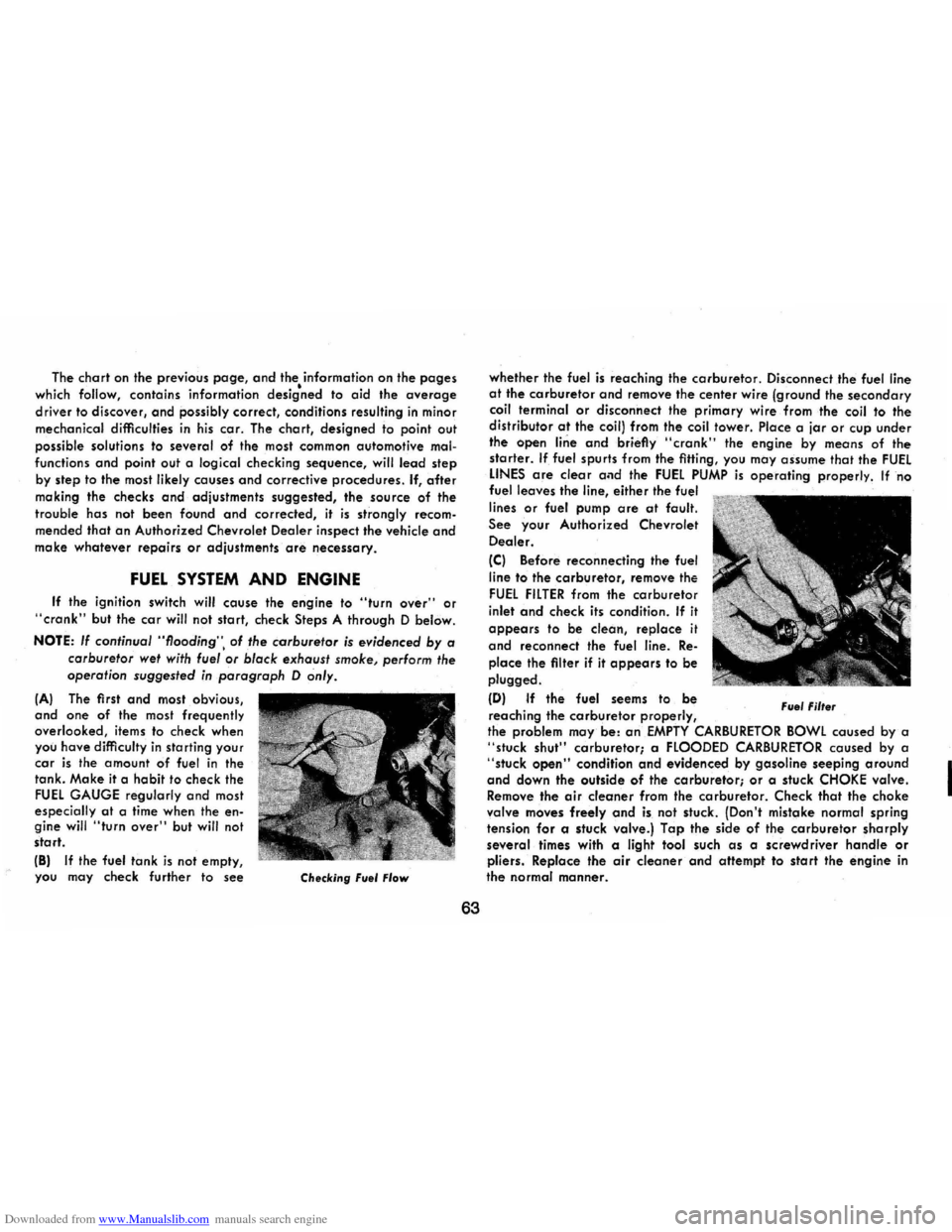
(A) The first and most obvious, and one of the most frequently
overlooked, items to check when
you have difficulty in starting your car is the amount of fuel in the
tank. Make it a habit to check the
FUEL GAUGE regularly and most
especially at a time when the engine will "turn over" but will not
start.
(8)
If the fuel tank is not empty,
you may check further to see
Checking Fuel Flow
63
whether the fuel is reaching the carburetor. Disconnect .the fuel line at the carburetor and remove the center wire (ground the secondary coil terminal or disconnect the primary wire from the coil to the
distributor at the coil) from the coil tower. Place a jar or cup under
the open line and briefly "crank" the engine by means of the
starter. If fuel spurts from the fitting, you may assume that the FUEL LINES are clear and the FUEL PUMP is operating properly. If no
fuel leaves the line, either the fuel
lines
or fuel pump are at fault.
See your Authorized Chevrolet
Dealer.
(C) Before reconnecting the fuel
line to the carburetor, remove
the
FUEL FILTER from the carburetor
inlet and check its condition. If it
appears to be clean, replace it
and recorinect the fuel line. Re
place the filter if it appears to be
plugged.
(D) If the fuel seems to be
reaching the carburetor properly, Fuel Filter
the problem may be: an EMPTY CARBURETOR BOWL caused by a "stuck shut" carburetor; a FLOODED CARBURETOR caused by a "stuck open" condition and evidenced by gasoline seeping around and down the outside of the carburetor; or a stuck CHOKE valve.
Remove the air cleaner from the carburetor. Check that the choke
valve moves freely and is not stuck. (Don't mistake normal spring
tension for a stuck valve.) Tap the side of the carburetor sharply
several times with a light tool such as a screwdriver handle or pliers. Replace the air cleaner and attempt to start the engine in the normal manner.
I
Page 67 of 84

Downloaded from www.Manualslib.com manuals search engine IE) If the car will start but stalls when hot or has a rough idle,
you can suspect a faulty IDLE ADJUSTMENT, a malfunctioning AUTOMATIC CHOKE or an extremely dirty and blocked AIR CLEANER ELEMENT. Replace paper element air cleaner if necessary. Idle adjustment or automatic choke service (other than that outlined in paragraph 0 above) should be performed by your
Chevrolet Dealer.
If the above Fuel System checks and the checks suggested under the Electrical System following do not correct the malfunction, it is recommended that you return to your Authorized Chevrolet Dealer
for further checks, adjustments or repairs.
ELECTRICAL SYSTEM If, when the ignition key is turned to "Start", the engine will not
turn over, you have good reason to suspect electrical trouble. NOTE: Never remove Delcotron bat lead without first disconnecting
battery ground cable.
IF) When there is no response at all to attempts to start the car, check the obvious-your AUTOMATIC TRANSMISSION SELECTOR LEVER must be in Neutral or Park position (manual transmission
must have clutch depressed all the way to floor) before the engine can be started. Turning the IGNITION SWITCH rapidly back and forth several times will sometimes correct a poor internal switch
contact.
IG) The BATIERY may be discharged. If so, lights will be dim and the horn will have a poor tone if it will blow at all.
Usually a garage recharge will be necessary to return the battery to operation. Occasionally, however, a long drive will recharge the battery. NOTE: If the battery is determined to be dead, and for no apparent reason, have your Authorized Chevrolet Dealer check the
battery, the GENERATOR and the VOLTAGE REGULATOR.
GENERATOR trouble should already have been indicated by the generator indicator light on the instrument panel.
64
POOR BATIERY CONNECTIONS may be suspected if the car has operated properly a short time before and now not even the horn
will operate. Check both ends of both battery cables. If the connections are corroded, a car may sometimes be restored to operation by removing all cable ends, scraping all contacting surfaces
clean with a pen knife, and reassembling. If the cables are broken,
they must be replaced. The power supply should now be restored
unless the battery is dead.
IH) If, however, the lights and horn work properly but the starter will still not turn over, check the STARTER connections. A "click" from the starter solenoid indicates that the wiring to the starter is properly installed. If the wiring seems to be clean and tightly in
stalled, the trouble is probably in the starter itself and should be referred to your Authorized Chevrolet Dealer.
When the engine will
"turn over" but will not start, the foilowing
items may be checked along with the Fuel Systems Checks listed
previously.
II) With a clean dry cloth, wipe the ceramic portions of the spark plugs dry. In particularly damp or rainy weather dampness may be
the cause of not sta rting, especi
ally when the engine is cold.
IJ) Check the cables at the top of the distributor and coil as well as each spark plug cable for
tightness.
IK) If the co r will still not sta rt,
check for spark at the spark plugs in the following manner:
Pull one of the spark plug
wires off its spark plug. Insert a
short piece of bare wire (such as Di.,ribu'or and Coil Cab I ••