1969 FORD MUSTANG engine
[x] Cancel search: enginePage 292 of 413

07-01-01
07-01-01
*.v:;V*>
-"^g&ly-
'y.y... -4^*:
GROUP
7
PART
7-1
PAGE
General Transmission Service
07-01-01
PART
7-2
C4 Automatic Transmission
07-02-01
PART
7-3
FMX Transmission
07-03-01
PART
7-4
C6 Automatic Transmission
....
PART
7-5
Specifications
PAGE
07-04-01
07-05-01
TRANSMISSION
CODE
TRANSMISSION
TYPE
AUTOMATIC
(C4)
U AUTOMATIC
(C6)
X AUTOMATIC
(FMX)
Z AUTOMATIC
(C6
SPECIAL)
D2040-A
FIG. 1—Typical Warranty Plate—Transmission Identification
PART
7-1
General
Transmission
Service
COMPONENT INDEX
AIR PRESSURE CHECKS
ANTI-STALL DASHPOT CLEARANCE
CHECK
(Engine Compartment)
CASE (Transmission)
Inspection
CONTROL PRESSURE CHECK
CONTROL VALVE BODY
Inspection
CONVERTER
Checking
Cleaning
DRAIN AND REFILL (Transmission)
ENGINE IDLE SPEED CHECK
EXTENSION HOUSING INSPECTION
FLUID AERATION CHECK
MODEL APPLICATION
All
Models
01-06
01-04
01-17
01-05
01-17
01-04
01-11
01-08
01-04
01-15
01-03
Ford
Mercury
Meteor
Cougar
Fairiane
Falcon
Montego
Mustang
Lincoln-
Continental
Thunderbird
Continental-
Mark
III
A page number indicates that the item
is for
the vehicle listed
at
the head
of
the column.
N/A indicates that the item
is not
applicable
to
the vehicle listed.
procarmanuals.com
Page 294 of 413

07-01-03
General Transmission Service
07-01-03
COMPONENT INDEX
FMX Transmission
REAR SUPPORT (FMX)
Inspection
SHIFT POINT CHECKS
STATOR ONE-WAY CLUTCH CHECK
STATOR TO IMPELLOR INTERFERENCE
CHECK
STATOR TO TURBINE INTERFERENCE
CHECK
TRANSMISSION CLEANING
TURBINE AND STATOR END PLAY
CHECK
VACUUM DIAPHRAGM ADJUSTMENT
Altitude Compensating Type
Non-Altitude Compensating Type
VACUUM UNIT CHECK
Altitude Compensating Type
Non-Altitude Compensating Type
MODEL APPLICATION
All
Models
01-06
01-12
01-12
01-12
01-11
01-12
Ford
01-17
01-16
N/A
01-08
N/A
01-05
Mercury
N/A
N/A
N/A
01-08
N/A
01-05
Meteor
01-17
01-16
N/A
01-08
N/A
01-05
Cougar
01-17
01-16
N/A
01-08
N/A
01-05
Fairlane
01-17
01-16
N/A
01-08
N/A
01-05
Falcon
N/A
N/A
N/A
01-08
N/A
01-05
Montego
01-17
01-16
N/A
01-08
N/A
01-05
Mustang
01-17
01-16
N/A
01-08
N/A
01-05
Lincoln-
Continental
N/A
N/A
01-09
N/A
01-06
N/A
Thunderbird
N/A
N/A
01-09
N/A
01-06
N/A
Continental-
Mark
III
N/A
N/A
01-09
N/A
01-06
N/A
A page number indicates that the item is for the vehicle listed at the head of the column.
N/A indicates that the item is not applicable to the vehicle listed.
Three different three-speed trans-
missions are used. The C4 Automatic,
C6 Automatic and the FMX Auto-
matic. Part 7-1 covers testing, com-
mon adjustments and repairs, and
cleaning and inspection for the three
types of transmissions. Where there
are differences in procedures or speci-
fications, the type of transmission af-
fected will be designated.
l
AUTOMATIC TRANSMISSION TESTS
When diagnosing transmission
problems, refer to the Ford Car and
Truck Diagnosis Manual for the de-
tailed information on the items that
could be causing the problem.
The following preliminary checks
should be made before proceeding
with other diagnosis checks.
TRANSMISSION FLUID LEVEL
CHECK
1.
Make sure that the vehicle is
standing level. Then firmly apply the
parking brake.
2.
Run the engine at normal idle
speed. If the transmission fluid is cold
run the engine at fast idle speed
(about 1200 rpm) until the fluid reach-
es its normal operating temperature.
When the fluid is warm, slow the en-
gine down to normal idle speed.
3.
On a vehicle equipped with a
vacuum brake release, disconnect the
release line and plug the end of the
line;
otherwise the parking brake will
not hold the transmission in any drive
position.
4.
Shift the selector lever through
all positions, and place the lever at P.
Do not turn off the engine during the
fluid level checks.
5.
Clean all dirt from the transmis-
sion fluid dipstick cap before remov-
ing the dipstick from the filler tube.
6. Pull the dipstick out of the tube,
wipe it clean, and push it all the way
back into the tube. Be sure it is prop-
erly seated.
7.
Pull the dipstick out of the tube
again, and check the fluid level. The
fluid level should be above the ADD
mark. If necessary, add enough fluid
to the transmission through the filler
tube to bring the level between the
ADD and FULL marks on the dip-
stick. Do not overfill the transmission.
Install the dipstick, making sure it is
fully seated in the tube.
8. Connect the vacuum brake re-
lease line if so equipped, and test it
for proper operation.
FLUID AERATION CHECK
A fluid level that is too high will
cause the fluid to become aerated:
Aerated fluid will cause low control
pressure, and the aerated fluid may be
forced out the vent.
Check the transmission fluid level.
Low fluid level can affect the opera-
tion of the transmission, and may in-
dicate fluid leaks that could cause
transmission damage.
TRANSMISSION FLUID
LEAKAGE CHECKS
Check the speedometer cable con-
nection at the transmission. Replace
the rubber seal if necessary.
Leakage at the oil pan gasket often
can be stopped by tightening the at-
procarmanuals.com
Page 295 of 413

07-01-04
General Transmission Service
07-01-04
taching bolts to the proper torque. If
necessary, replace the gasket.
Check the fluid filler tube connec-
tion at the transmission case or pan.
If leakage is found here, install a new
O-ring or tighten the fitting to the
specified torque.
Check the fluid lines and fittings
between the transmission and the
cooler in the radiator tank for loose-
ness,
wear, or damage. If leakage can-
not be stopped by tightening a fitting,
replace the damaged parts.
Check the engine coolant in the ra-
diator. If transmission fluid is present
in the coolant, the cooler in the radia-
tor is probably leaking.
The cooler can be further checked
for leaks by disconnecting the lines
from the cooler fittings and applying
50-75 psi air pressure to the fittings.
Remove the radiator cap to relieve the
pressure build at the exterior of the oil
cooler tank. If the cooler is leaking
and will not hold this pressure the
cooler must be replaced. Cooler re-
placement is described in the Cooling
System Section of Group 11.
If leakage is found at either the
downshift control lever shaft or the
manual lever shaft, replace either or
both seals.
Inspect the pipe plug on the left
side of the transmission case at the
front. If the plug shows leakage, tor-
que the plug to specifications. If tight-
ening does not stop the leaks, replace
the plug. On a C6 transmission, a TV
pressure plug is also provided on the
right rear side of the case.
When converter drain plugs leak,
remove drain plugs with a six-point
wrench. Coat the threads with FoMo-
Co Perfect Seal Sealing Compound or
its equivalent, and install the plugs.
Torque the drain plugs to specifica-
tion. Fluid leakage from the converter
housing may be caused by engine oil
leaking past the rear main bearing or
from oil gallery plugs, or power steer-
ing oil leakage from steering system.
Be sure to determine the exact cause
of the leak before repair procedures
are started.
Oil-soluble aniline or fluorescent dyes
premixed at the rate of 1/2 teaspoon
of dye powder to 1/2 pint of transmis-
sion fluid have proved helpful in locat-
ing the source of the fluid leakage.
Such dyes may be used to determine
whether an engine oil or transmission
fluid leak is present or if the fluid in
the oil cooler leaks into the engine
coolant system. A black light, how-
ever, must be used with the fluorescent
dye solution.
DISHED OR
FLAT WASHER
" O.D.,
a" STEEL PLATE
5/8"X \W,
DRILL TO SUIT
HEX. HEAD SCREW
3/8"-24 X Vl
HEX. NUT W—
24
WELD
TOGETHER
WING
NUT
>/2"_13
THREAD
CHAIN,
10"
LONG
RUBBER PLUG
1
Vi" DIA. X 2"
LONG Vl"
HOLE THRU
APPROXIMATELY
40 DUROMETER
FLAT WASHER
Vs" O.D.
PLUG
VALVE
STANDARD BOLT
W-13
X 4Vl"
LONG SQUARE
THREAD
END
REMOVE HEAD
AND WELD
TO
WASHER
STANDARD 1/8" FITTING-87971-S FOR
RETAPPED DRAIN PLUG THREADS-USE
1/4" OVERSIZE FITTING-87973-S
D 1067-B
WELD TOGETHER
SECURELY—MUST
NOT LEAK
FIG. 2—Converter Leak Checking Tool
CONVERTER LEAKAGE
CHECK
If there are indications that the
welds on the torque converter are
leaking, the converter will have to be
removed and the following check
made before the unit is replaced.
A leak checking tool (Fig. 2) can be
made from standard parts. The tool
can be used to check all converters.
1.
Install the plug in the converter
(Fig. 3) and expand it by tightening
the wing nut. Attach the safety chains.
2.
Install the air valve in one of the
drain plug holes.
3.
Introduce air pressure into the
converter. Check the pressure with a
tire gauge and adjust it to 20 psi.
4.
Place the converter in a tank of
water. Observe the weld areas for
bubbles. If no bubbles are observed, it
may be assumed that the welds are
not leaking.
ENGINE IDLE SPEED CHECK
Check and, if necessary, adjust the
engine idle speed, using the procedure
given in Group 10.
If the idle speed is too low, the en-
gine will run roughly. An idle speed
that is too high will cause the vehicle
to creep, have harsh engagements and
harsh closed-throttle downshifts.
ANTI-STALL DASHPOT
CLEARANCE CHECK
After the engine idle speed has been
properly adjusted, check the anti-stall
dashpot clearance. Follow the proce-
dure given in Group 10 for checking
and adjusting this clearance.
MANUAL LINKAGE CHECKS
Correct manual linkage adjustment
is necessary to position the manual
valve for proper fluid pressure direc-
tion to the different transmission com-
ponents. Improperly adjusted manual
Tire Pressure Gauge
D1921-A
FIG. 3—Converter Leak Checking
Tool Installationprocarmanuals.com
Page 296 of 413
07-01-05
General Transmission Service
07-01-05
linkage may cause crossleakage and
subsequent transmission failure. Refer
to Linkage Adjustments in Part 7-2,
7-3 or 7-4 for detailed manual linkage
adjustment procedures.
CONTROL PRESSURE
CHECK
When the vacuum diaphragm unit is
operating properly and the downshift
linkage is adjusted properly, all the
transmission shifts (automatic and
kickdown) should occur within the
road speed limits specified in Part 7-5.
If the shifts do not occur within
limits or the transmission slips during
shift point, the following procedure is
suggested to determine engine, trans-
mission, linkage, vacuum diaphragm
unit or valve body problems.
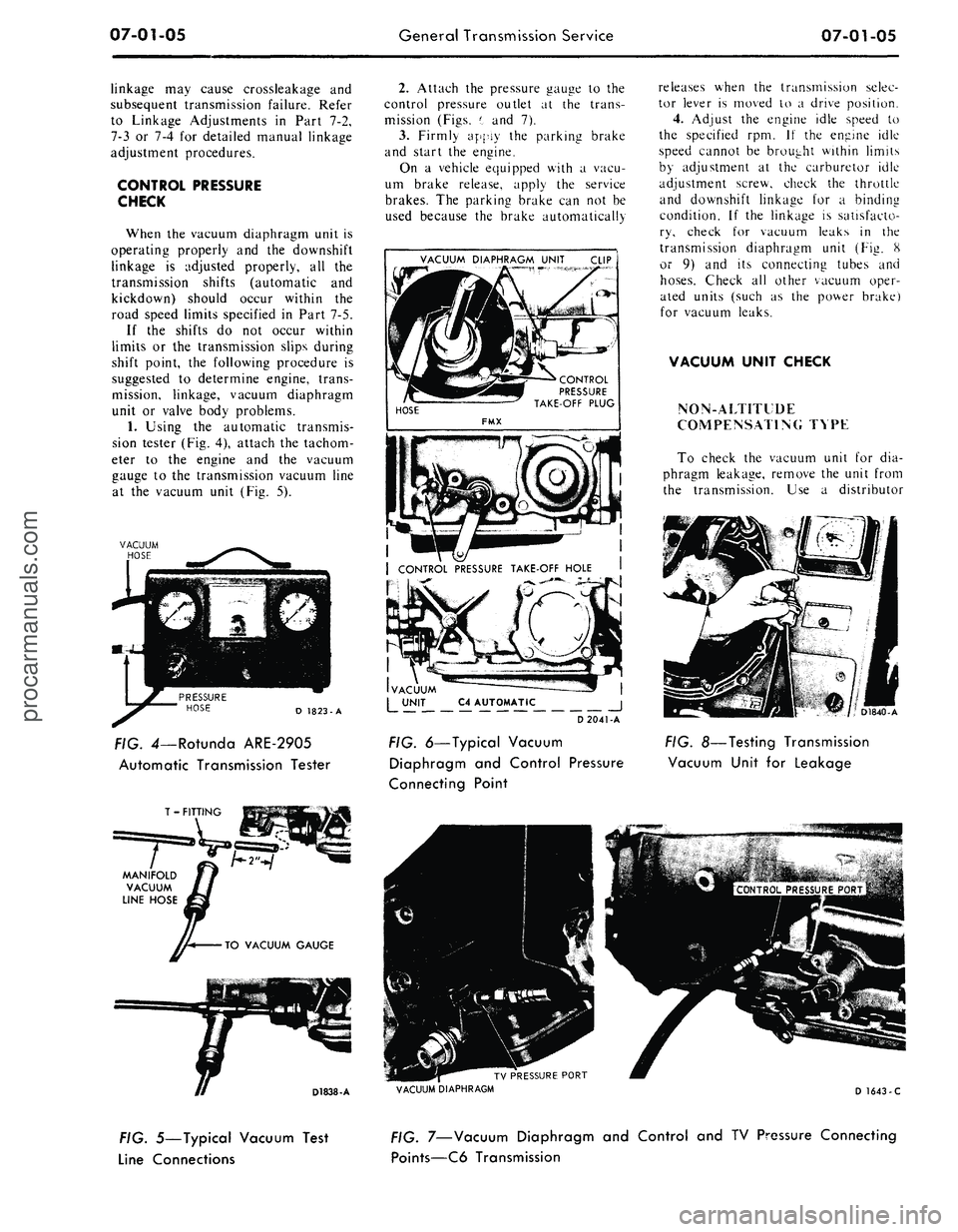
1.
Using the automatic transmis-
sion tester (Fig. 4), attach the tachom-
eter to the engine and the vacuum
gauge to the transmission vacuum line
at the vacuum unit (Fig. 5).
D 1823-A
. 4—Rotunda ARE-2905
Automatic Transmission Tester
T - FITTING
2.
Attach the pressure gauge to the
control pressure outlet at the trans-
mission (Figs. '., and 7).
3.
Firmly apply the parking brake
and start the engine.
On a vehicle equipped with a vacu-
um brake release, apply the service
brakes. The parking brake can not be
used because the brake automatically
VACUUM DIAPHRAGM UNIT
CLIP
I
| CONTROL PRESSURE TAKE-OFF HOLE
D2041-A
FIG. 6—Typical Vacuum
Diaphragm and Control Pressure
Connecting Point
releases when the transmission selec-
tor lever is moved to a drive position.
4.
Adjust the engine idle speed lo
the specified rpm. If the engine idle
speed cannot be brought within limits
by adjustment at the carburetor idle
adjustment screw, check the throttle
and downshift linkage for a binding
condition. If the linkage is satisfacto-
ry, check for vacuum leaks in the
transmission diaphragm unit (Fig. 8
or 9) and its connecting tubes and
hoses.
Check all other vacuum oper-
ated units (such as the power brake)
for vacuum leaks.
VACUUM UNIT CHECK
NON-ALTITIDE
COMPENSATING TYPE
To check the vacuum unit for dia-
phragm leakage, remove the unit from
the transmission. Use a distributor
D1840-A
FIG. 8—Testing Transmission
Vacuum Unit for Leakage
VACUUM DIAPHRAGM
D 1643 -C
FIG. 5—Typical Vacuum Test
Line Connections
FIG.
7—Vacuum
Diaphragm and Control and TV Pressure Connecting
Points—C6 Transmissionprocarmanuals.com
Page 299 of 413

07-01-08
General Transmission Service
07-01-08
3.
Install the bench testing tool on
the transmission.
4.
Remove the
1/8-inch
pipe plug
at the transmission case. Turn the
front pump in a clockwise direction at
75-100 rpm until a regular flow of
transmission fluid leaves the hole in
the transmission case. This operation
bleeds the air from the pump.
5.
Install the pressure gauge (77820
or T57L-77820-A) as shown in Fig.
13.
PRESSURE TESTS
Turn the front pump at 75-100 rpm
and note the gauge readings. The
pressure readings on the bench test
must be within the limits as outlined
in Figure 13, for the engine idle check.
If pressure gauge readings are with-
in limits in all selector lever positions,
install the vacuum diaphragm control
rod unit.
COMMON ADJUSTMENTS AND REPAIRS
TRANSMISSION FLUID DRAIN
AND REFILL
Normal maintenance and lubrica-
tion requirements do not necessitate
periodic automatic transmission fluid
changes.
If a major repair, such as a clutch
band, bearing, etc., is required in the
transmission, it will have to be re-
moved for service. At this time the
converter, transmission cooler and
cooler lines must be thoroughly
flushed to remove any dirt.
When filling a dry transmission and
converter, install five quarts of fluid.
Start the engine, shift the selector
lever as outlined below, and check and
add fluid as necessary.
Following are the procedures for
partial drain and refill due to in-
vehicle repair operation.
C4 TRANSMISSION
1.
On PEA models, disconnect the
fluid filler tube from the transmission
oil pan to drain the fluid.
On PEB and PEE models, loosen
the pan attaching bolts to drain the
fluid from the transmission.
2.
When the fluid has stopped
draining from the transmission, re-
move and thoroughly clean the pan
and the screen. Discard the pan gas-
ket.
3.
Place a new gasket on the pan,
and install the pan on the transmis-
sion.
4.
On PEA models, connect the
filler tube to the pan and tighten the
fitting securely.
5.
Add three quarts of fluid to the
transmission through the filler tube.
6. Run the engine at idle speed for
about two minutes, and then run it at
fast idle speed (about 1200 rpm) until
it reaches it's normal operating temp-
erature. Do not race the engine.
7.
Shift the selector lever through
all the positions, place it at P, and
check the fluid level. The fluid level
should be above the ADD mark. If
necessary, add enough fluid io the
transmission to bring the level be-
tween the ADD and FULL marks on
che dipstick. Do not overfill the trans-
mission.
FMX OK C6
TRANSMISSION
1.
Raise the vehicle on a hoist or
jack stands.
2.
Place a drain pan under the
transmission.
3.
Loosen the pan attaching bolts
to drain the fluid from the transmis-
sion.
4.
After the fluid has drained to the
level of the pan flange, remove the
rest of the pan bolts working from the
rear and both sides of the pan to
allow it to drop and drain slowly.
5.
When the fluid has stopped
draining from the transmission, re-
move and thoroughly clean the pan
and the screen. Discard the pan gas-
ket.
6. Place a new gasket on the pan,
and install the pan on the transmis-
sion.
7.
Add three quarts of fluid to the
transmission through the filler tube.
8. Run the engine at idle speed for
about two minutes, and then run it at
fast idle speed (about 1200 rpm) until
it reaches normal operating tempera-
ture.
Do not race the engine.
9. Shift the selector lever through
all the positions, place it at P, and
check the fluid level. The fluid level
should be above the ADD mark. If
necessary, add enough fluid to the
transmission to bring the level be-
tween the ADD and FULL marks on
the dipstick. Do not overfill the trans-
mission.
OIL COOLER TUBE
REMOVAL AND INSTALLATION
When fluid leakage is found at the
oil cooler, the cooler must be re-
placed. Cooler replacement is de-
scribed in the Cooling System Section
of Group 11.
When one or more of the fluid
cooler steel tubes must be replaced,
each replacement tube must be fabri-
cated from the same size steel tubing
as the original line.
Using the old tube as a guide, bend
the new tube as required. Add the
necessary fittings, and install the tube.
After the fittings have been tight-
ened, add fluid as needed, and check
for fluid leaks.
VACUUM DIAPHRAGM
ADJUSTMENT NON-ALTITUDE
COMPENSATING TYPE
The C4 and C6 transmissions are
equipped with an adjustable vacuum
diaphragm assembly. A similar ad-
justable diaphragm has been released
for service with the FMX transmis-
sion. However, the FMX service dia-
phragm is not interchangeable with
that used on C4 and C6 models.
The vacuum diaphragm assembly
has an adjusting screw in the vacuum
hose connecting tube (Fig. 14).
SPRING
SEAT
THIS CLEARANCE CHANGED
BY ADJUSTING SCREW
D1830-A
FIG. 14—Adjustable Vacuum Unit
The inner end of the screw bears
against a plate which in turn bears
against the vacuum diaphragm spring.
All readings slightly high or all
readings slightly low may indicate the
vacuum unit needs adjustment to cor-
rect a particular shift condition.procarmanuals.com
Page 300 of 413

07-01-09
General Transmission Service
07-01-09
For example, on a C4 transmission,
if the pressure at 10 inches of vacuum
was 120 psi and the pressure at 1.0
inch of vacuum was 170 psi, and up-
shifts and downshifts were harsh, a di-
aphragm adjustment to reduce the di-
aphragm assembly spring force would
be required.
If the pressure readings are low, an
adjustment to increase diaphragm
spring force is required.
To increase control pressure, turn
the adjusting screw in clockwise to re-
duce control pressure, back the adjust-
ing screw out by turning it counte-
rclockwise. One complete turn of the
adjusting screw (360 degrees) will
change idle line control pressure ap-
proximately 2-3 psi. After the adjust-
ment is made, install the vacuum line
and make all the pressure checks as
outlined in the Specification Section.
The diaphragm should not be ad-
justed to provide pressure below the
ranges shown in the Specification Sec-
tion in order to change shift feel. To
do so could result in soft or slipping
shift points and damage to the trans-
mission.
ALTITUDE
COMPENSATING TYPE
The altitude—compensating di-
aphragm is provided with an adjust-
ment screw located in the vacuum
connecting tube (Fig. 15). The adjus-
table feature allows control and TV
pressures to be adjusted (within limits)
to correct soft or harsh shift feel.
Control and TV pressures are in-
creased or decreased by turning the
adjusting screw.
Before replacing or adjusting the di-
aphragm, it must first be determined
that the pressure or vacuum is actual-
ly out of specification and that the
cause of the problem is not due to
other items within the transmission or
vacuum connecting lines.
If the tests outlined in the Specifi-
cation Section have been performed
and pressures are within specification
but shift feel is unsatisfactory, or if
the pressure is too high or too low at
10 inches of vacuum, the vacuum di-
aphragm may be adjusted to improve
the shift feel.
If shifts are excessively harsh, the
diaphragm should be adjusted to re-
duce control pressure by backing off
the adjusting screw (counterclock-
wise).
If shift quality is extremely soft,
control pressure should be increased
by turning the adjusting screw inward
(clockwise).
To adjust the vacuum diaphragm to
compensate for harsh shift quality,
first check control pressure in D, 2
and 1 at 10 inches manifold vacuum
and note the pressure reading ob-
tained. Remove the T-fitting from the
vacuum hose and back off the adjust-
ing screw (counterclockwise) by one
full turn. Each full turn will reduce
control pressure by approximately 2
1/2 psi at 10 inches of vacuum. Test
the vehicle for shift feel. If shift quali-
ty is still harsh, a further adjustment
should be made to reduce control
pressure. However, control pressure
should not be reduced below the speci-
fication shown for 10 inches of vacu-
um. If control pressure has been re-
duced to the low limit and shift feel is
still excessively harsh, the clutches and
band should be checked for correct
operation.
To adjust the vacuum diaphragm to
compensate for extremely soft shifts,
record the control pressure reading at
10 inches of vacuum in D, 2 and 1,
then make an initial adjustment of
one full turn inward (clockwise). Test
the vehicle for shift feel and again ad-
just the diaphragm, if necessary. Con-
trol pressure at 10 inches of vacuum
must not exceed the high limit shown
in the Specification Section.
When the necessary adjustments
have been completed and shift feel is
satisfactory, repeat all the tests out-
ADJUSTING
SCREW
PRIMARY
THROTTLE VALVE
DIAPHRAGM
SPRING
D 1639-A
FIG. 15—Altitude Compensating Type Vacuum Diaphragm
lined in the Specification Section. All
tests must be within specifications.
The adjustable vacuum unit must not
be used to allow for adjusting control
or TV pressures that are out of speci-
fications. If these pressures are found
to be out of specifications the cause
must be determined and corrected bef-
ore making any adjustment.
NEUTRAL START SWITCH
ADJUSTMENT AND
REPLACEMENT—COLUMN SHIFT
There are two types of column-
mounted neutral start switches: A and
B.
Type A switch has a parking brake
brake-release vacuum valve. Type B
switches do not have a vacuum valve.
The switches differ in appearance but
not in operation. Both switches are
actuated by a removable steel lever,
which is installed in the shifter tube
within the steering column assembly.
The following procedures outline the
steps necessary to correctly adjust and
replace the neutral start switch.
SWITCH ADJUSTMENT
Neutral Position
1.
With the selector lever held light-
ly against the neutral stop, attempt to
start the engine. If the engine starts
while holding the lever but does not
start when the lever is released, the
shift linkage should be adjusted. If the
engine does not start in either condi-
tion, adjust the switch.
2.
To adjust the switch in neutral,
place the transmission selector lever
against the stop of the neutral detent
position.
3.
Loosen the two retaining screws
that locate the switch on the steering
column (Fig. 16).
4.
With the selector lever against
the neutral stop, rotate the switch
until a start in the neutral position is
obtained. Then, tighten the switch at-
taching screws to 20 in-lbs torque.
5.
With the switch properly adjust-
ed in neutral, place the selector lever
in the 1 position and push the park
reset button (Fig. 16) to the left
(counterclockwise) until it stops. The
park reset must be performed when-
ever the switch has been adjusted.
Park Position
1.
Place the selector lever in the
park position, release the lever and at-
tempt to start. If the engine does not
start, reset the park adjustment.procarmanuals.com
Page 311 of 413
07-02-03
C4 Automatic Transmission
07-02-03
CONVERTER
FORWARD CLUTCH
PRIMARY GOVERNOR
CONVERTER
CHECK VALVE
ONE-WAY
CLUTCH
DRAIN-BACK
VALVE
FRONT LUBE
CONVERTER
PRESSURE
RELIEF VALVE
LOW AND
REVERSE
SERVO
AND DIRECT
CLUTCH
L
SECONDARY
GOVERNOR
INTERMEDIATE
BAND
ACCUMULATOR
VALVE
CUT-BACK
VALVE
2-3
BACK-OUT
VALVE
MAIN
REGU-
LATOR
VALVE
MANUAL
LOW
VALVE
1-2 SHIFT
VALVE
D2
VALVE
THROTTLE
MODULATOR
VALVE
THROTTLE
BOOST VALVE
PRESSURE
BOOSTER
VALVE
DOWNSHIFT VALVE
LINE
COASTING
BOOST
VALVE
ENGINE
MANIFOLD
VACUUM
LESS THAN
20
INCHES
PRIMARY
THROTTLE
VALVE
(CASE)
VACUUM
DIAPHRAGM
OIL
SCREEN
I) 1724-E
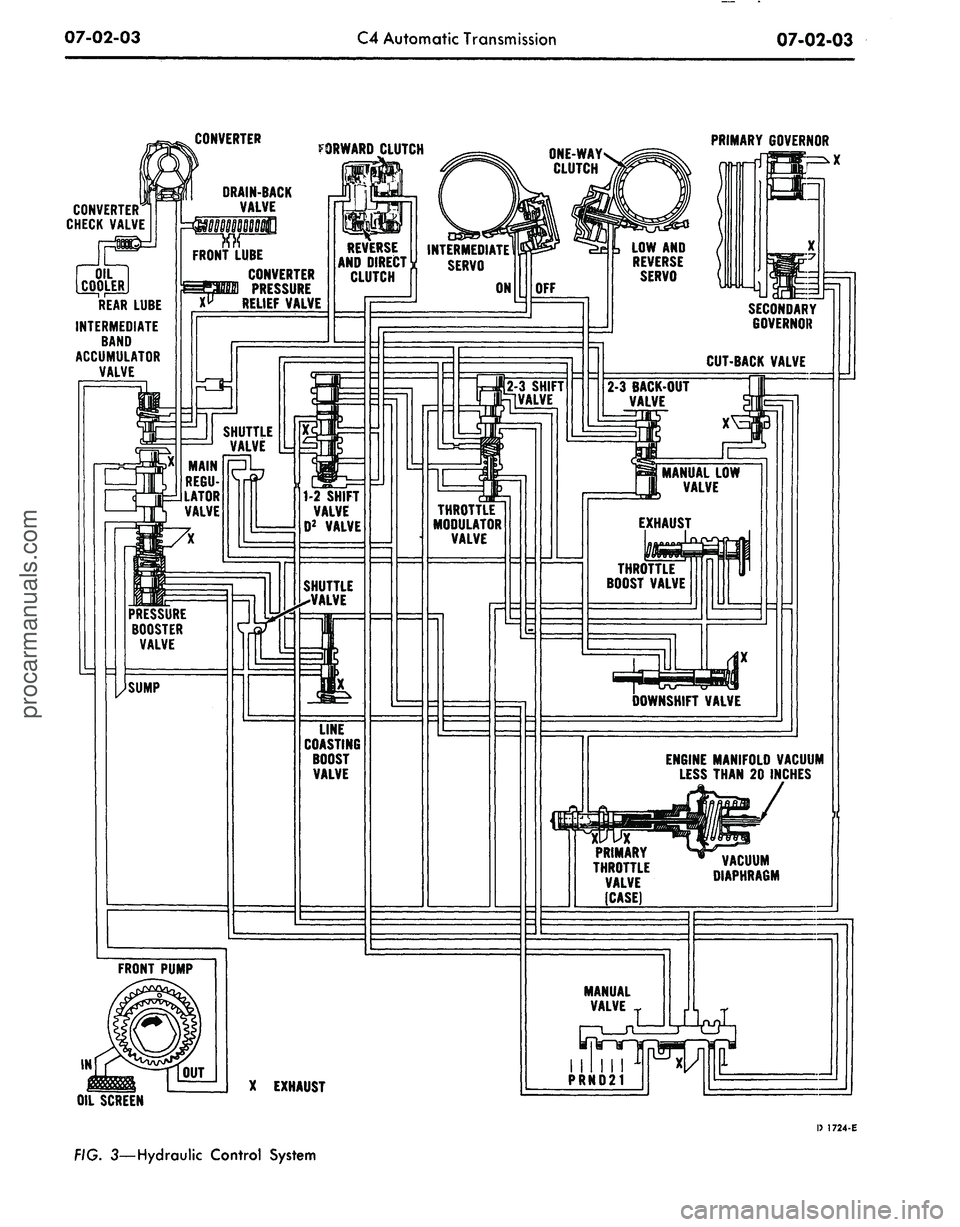
FIG. 3—Hydraulic Control Systemprocarmanuals.com
Page 315 of 413
07-02-07
C4 Automatic Transmission
07-02-07
2.
Remove the selector lever handle
from the lever.
3.
Remove the trim panel from the
top of the console.
4.
Remove the cover and dial indi-
cator as an assembly.
5.
Remove the four screws that se-
cure the selector lever retainer to the
selector lever housing. Lift the retainer
from the housing.
6. Loosen the two combination
starter neutral and back-up light
switch attaching screws (Fig. 10).
7.
Move the selector lever back and
forth until the gauge pin (No. 43 drill)
can be fully inserted into the gauge
pin holes (Fig. 10).
8. Place the transmission selector
lever firmly against the stop of the
neutral detent position.
9. Slide the combination starter
neutral and back-up light switch for-
ward or rearward as required, until
the switch actuating lever contacts the
selector lever.
10.
Tighten the switch attaching
screws and remove the gauge pin.
Check for starting in the park posi-
tion.
11.
Turn the ignition key to the
ACC position and place the selector
lever in the reverse position and check
the operation of the back-up lights.
Turn the key off.
12.
Position the selector lever re-
tainer to the selector lever housing.
Install the four attaching screws.
13.
Install the cover and dial indi-
cator.
14.
Install the trim panel on the top
of the console. Install the selector
lever handle.
MUSTANG
1.
With the manual lever properly
NEUTRAL
START
SWITCH
(D1439-A
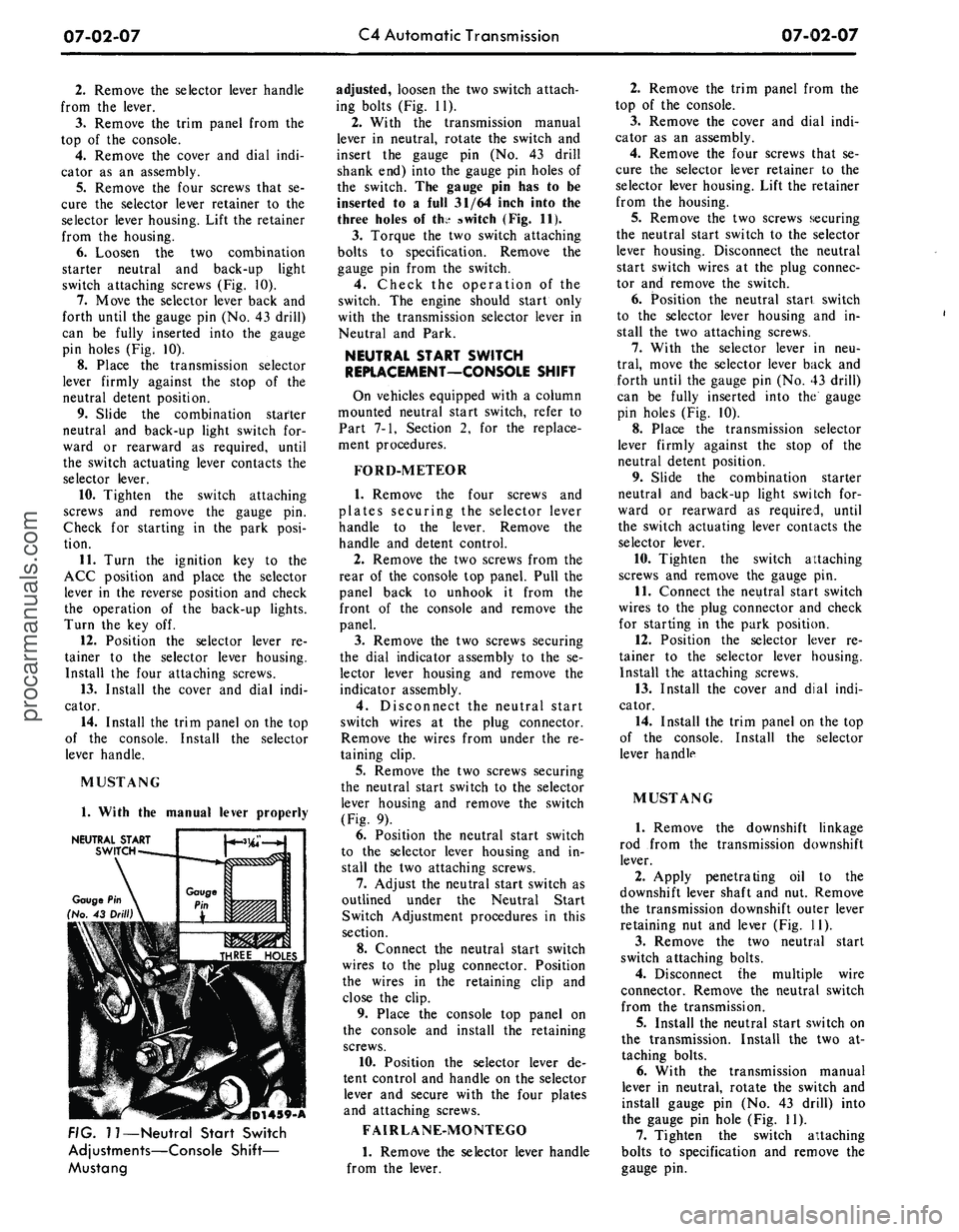
FIG. 11—Neutral Start Switch
Adjustments—Console Shift—
Mustang
adjusted, loosen the two switch attach-
ing bolts (Fig. 11).
2.
With the transmission manual
lever in neutral, rotate the switch and
insert the gauge pin (No. 43 drill
shank end) into the gauge pin holes of
the switch. The gauge pin has to be
inserted to a full 31/64 inch into the
three holes of the switch (Fig. 11).
3.
Torque the two switch attaching
bolts to specification. Remove the
gauge pin from the switch.
4.
Check the operation of the
switch. The engine should start only
with the transmission selector lever in
Neutral and Park.
NEUTRAL START SWITCH
REPLACEMENT—CONSOLE SHIFT
On vehicles equipped with a column
mounted neutral start switch, refer to
Part 7-1, Section 2, for the replace-
ment procedures.
FORD-METEOR
1.
Remove the four screws and
plates securing the selector lever
handle to the lever. Remove the
handle and detent control.
2.
Remove the two screws from the
rear of the console top panel. Pull the
panel back to unhook it from the
front of the console and remove the
panel.
3.
Remove the two screws securing
the dial indicator assembly to the se-
lector lever housing and remove the
indicator assembly.
4.
Disconnect the neutral start
switch wires at the plug connector.
Remove the wires from under the re-
taining clip.
5.
Remove the two screws securing
the neutral start switch to the selector
lever housing and remove the switch
(Fig. 9).
6. Position the neutral start switch
to the selector lever housing and in-
stall the two attaching screws.
7.
Adjust the neutral start switch as
outlined under the Neutral Start
Switch Adjustment procedures in this
section.
8. Connect the neutral start switch
wires to the plug connector. Position
the wires in the retaining clip and
close the clip.
9. Place the console top panel on
the console and install the retaining
screws.
10.
Position the selector lever de-
tent control and handle on the selector
lever and secure with the four plates
and attaching screws.
FAIRLANE-MONTEGO
1.
Remove the selector lever handle
from the lever.
2.
Remove the trim panel from the
top of the console.
3.
Remove the cover and dial indi-
cator as an assembly.
4.
Remove the four screws that se-
cure the selector lever retainer to the
selector lever housing. Lift the retainer
from the housing.
5.
Remove the two screws securing
the neutral start switch to the selector
lever housing. Disconnect the neutral
start switch wires at the plug connec-
tor and remove the switch.
6. Position the neutral start switch
to the selector lever housing and in-
stall the two attaching screws.
7.
With the selector lever in neu-
tral,
move the selector lever back and
forth until the gauge pin (No. 43 drill)
can be fully inserted into the gauge
pin holes (Fig. 10).
8. Place the transmission selector
lever firmly against the stop of the
neutral detent position.
9. Slide the combination starter
neutral and back-up light switch for-
ward or rearward as required, until
the switch actuating lever contacts the
selector lever.
10.
Tighten the switch attaching
screws and remove the gauge pin.
11.
Connect the neutral start switch
wires to the plug connector and check
for starting in the park position.
12.
Position the selector lever re-
tainer to the selector lever housing.
Install the attaching screws.
13.
Install the cover and dial indi-
cator.
14.
Install the trim panel on the top
of the console. Install the selector
lever handle
MUSTANG
1.
Remove the downshift linkage
rod from the transmission downshift
lever.
2.
Apply penetrating oil to the
downshift lever shaft and nut. Remove
the transmission downshift outer lever
retaining nut and lever (Fig. 11).
3.
Remove the two neutral start
switch attaching bolts.
4.
Disconnect the multiple wire
connector. Remove the neutral switch
from the transmission.
5.
Install the neutral start switch on
the transmission. Install the two at-
taching bolts.
6. With the transmission manual
lever in neutral, rotate the switch and
install gauge pin (No. 43 drill) into
the gauge pin hole (Fig. 11).
7.
Tighten the switch attaching
bolts to specification and remove the
gauge pin.procarmanuals.com