1969 FORD MUSTANG mustang
[x] Cancel search: mustangPage 141 of 413
03-07-03
Ford Design Non-Integral Power Steering System
03-07-03
5.
Lower the vehicle and disconnect
the fluid return hose from the reser-
voir.
6. Disconnect the fluid pressure
hose from the pump outlet fitting.
7.
Remove 1 bolt attaching the
hoses,
insulator, and the retainer to
the frame side rail and remove the
hoses,
and the insulator and retainer
as an assembly from the vehicle.
8. Remove the pressure and return
hoses from the retainer and insulator.
INSTALLATION
1.
Install the pressure and return
hoses in the insulator and retainer.
Paint stripe on pressure hose must be
aligned with slot in insulator. Paint or
tape band on return hose must be cen-
tered in insulator. Position the assem-
bly to the frame side rail and install
the attaching bolt.
2.
Place a hose clamp on the fluid
return hose and install the hose on the
power steering pump reservoir return
fitting.
3.
Torque the pump outlet fitting to
specification (Part 3-13). Then, con-
nect the pressure hose to the outlet fit-
ting and torque the fitting to specifica-
tion.
4.
Raise the vehicle and connect the
pressure and return lines to the con-
trol valve.
5.
Install the clamp to retain the
hose tubes to the control valve.
6. Lower the vehicle and fill the
power steering pump reservoir with
fluid, C1AZ-19582-A, to the proper
level (Part 3-1).
7.
Start the engine and turn the
steering wheel to each end of its travel
several times to cycle the system.
Then, check for fluid leaks.
8. Stop the engine and again check
the power steering fluid level (Part
3-1). Add fluid as required.
REMOVAL AND INSTALLATION
HOISTING INSTRUCTIONS
Damage to suspension and/or steer-
ing linkage components may occur if
care is not exercised when positioning
the hoist adapters of 2 post hoists
prior to lifting the vehicle.
If a 2 post hoist is used to lift the
vehicle, place the adapters under the
front suspension lower arms. Do not
allow the adapters to contact the
steering linkage.
STEERING GEAR
Refer to Group 3-6, Section 3 for
detailed instructions.
POWER STEERING PUMP
Refer to Group 3-10, Section 3 for
detailed instructions.
POWER STEERING CONTROL
VALVE
REMOVAL
1.
Disconnect the 4 fluid line fit-
tings at the control valve, and drain
the fluid from the lines. Turn the front
wheels to the left and right several
times to force all the fluid from the
system.
2.
Loosen the clamping nut and
bolt at the right end of the sleeve.
3.
Remove the roll pin from the
steering arm-to-idler arm rod -through
the slot in the sleeve.
4.
Remove the control valve ball
stud nut.
5.
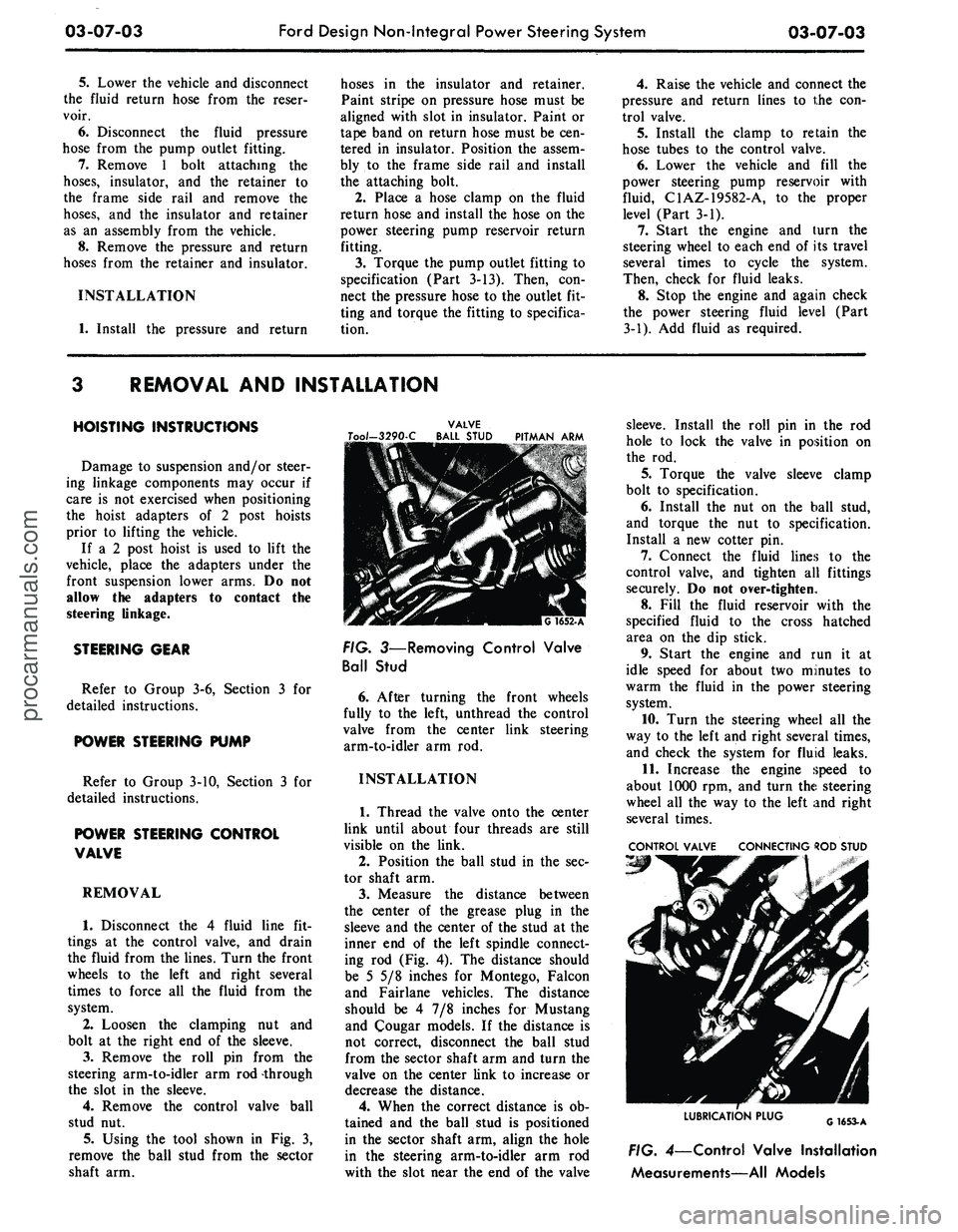
Using the tool shown in Fig. 3,
remove the ball stud from the sector
shaft arm.
VALVE
Too/-3290-C BALL STUD PITMAN ARM
FIG. 3—Removing Control Valve
Ball Stud
6. After turning the front wheels
fully to the left, unthread the control
valve from the center link steering
arm-to-idler arm rod.
INSTALLATION
1.
Thread the valve onto the center
link until about four threads are still
visible on the link.
2.
Position the ball stud in the sec-
tor shaft arm.
3.
Measure the distance between
the center of the grease plug in the
sleeve and the center of the stud at the
inner end of the left spindle connect-
ing rod (Fig. 4). The distance should
be 5 5/8 inches for Montego, Falcon
and Fairlane vehicles. The distance
should be 4 7/8 inches for Mustang
and Cougar models. If the distance is
not correct, disconnect the ball stud
from the sector shaft arm and turn the
valve on the center link to increase or
decrease the distance.
4.
When the correct distance is ob-
tained and the ball stud is positioned
in the sector shaft arm, align the hole
in the steering arm-to-idler arm rod
with the slot near the end of the valve
sleeve. Install the roll pin in the rod
hole to lock the valve in position on
the rod.
5.
Torque the valve sleeve clamp
bolt to specification.
6. Install the nut on the ball stud,
and torque the nut to specification.
Install a new cotter pin.
7.
Connect the fluid lines to the
control valve, and tighten all fittings
securely. Do not over-tighten.
8. Fill the fluid reservoir with the
specified fluid to the cross hatched
area on the dip stick.
9. Start the engine and run it at
idle speed for about two minutes to
warm the fluid in the power steering
system.
10.
Turn the steering wheel all the
way to the left and right several times,
and check the system for fluid leaks.
11.
Increase the engine speed to
about 1000 rpm, and turn the steering
wheel all the way to the left and right
several times.
CONTROL VALVE CONNECTING ROD STUD
LUBRICATION PLUG
G1653-A
FIG. 4—Control Valve Installation
Measurements—All Modelsprocarmanuals.com
Page 145 of 413

03-08-01
Ford Design Integral Power Steering Gear
03-08-01
PART
3-8
Ford Design Integral Power
Steering Gear
COMPONENT INDEX
STEERING GEAR
Adjustments
Cleaning
and
Inspection
(See
Part 03-01)
Description
Disassembly
and
Assembly
Overhaul
Removal
and
Installation
VALVE CENTERING SHIM
Removal
and
Installation
VALVE SPOOL CENTERING CHECK
MODEL APPLICATION
All Models
Ford
08-02
08-01
08-05
08-06
08-03
08-03
08-02
Mercury
08-02
08-01
08-05
08-06
08-03
08-03
08-02
Meteor
08-02
08-01
08-05
08-06
08-03
08-03
08-02
Cougar
N/A
N/A
N/A
N/A
N/A
N/A
N/A
Fairlane
N/A
N/A
N/A
N/A
N/A
N/A
N/A
Falcon
N/A
N/A
N/A
N/A
N/A
N/A
N/A
Montego
N/A
N/A
N/A
N/A
N/A
N/A
N/A
Mustang
N/A
N/A
N/A
N/A
N/A
N/A
N/A
Lincoln-
Continental
08-02
08-01
08-05
08-06
08-03
08-03
08-02
Thunderbird
08-02
08-01
08-05
08-06
08-03
08-03
08-02
Continental-
Mark
III
08-02
08-01
08-05
08-06
08-03
08-03
08-02
DESCRIPTION
The Ford integral power steering
unit
(Fig. 1) is a
torsion-bar type
of
hydraulic assisted system. This system
furnishes power
to
reduce
the
amount
of turning effort required
at the
steer-
ing wheel.
It
also reduces road shock
and vibrations.
The torsion
bar
power steering unit
includes
a
worm
and
one-piece rack
piston, which
is
meshed
to the
gear
teeth
on the
steering sector shaft.
The
unit also includes
a
hydraulic valve,
valve actuator, input shaft
and
torsion
bar assembly which
are
mounted
on
the
end of the
worm shaft
and
operat-
ed
by the
twisting action
of the tor-
sion
bar.
The torsion-bar type
of
power steer-
ing gear
is
designed with
the one
piece
rack-piston, worm
and
sector shaft
in
one housing
and the
valve spool
in an
attaching housing
(Fig. 1).
This makes
possible internal fluid passages
bet-
ween
the
valve
and
cylinder, thus
eli-
minating
all
external lines
and
hoses,
except
the
pressure
and
return hoses
between
the
pump
and
gear assembly.
The power cylinder
is an
integral
part
of the
gear housing.
The
piston
is
double acting,
in
that fluid pressure
may
be
applied
to
either side
of the
piston.
A selective metal shim located
in
the valve housing
of the
gear
is for the
purpose
of
tailoring steering gear
ef-
forts.
If
efforts
are not
within specifi-
cations they
can be
changed
by in-
creasing
or
decreasing shim thickness
as follows:
Efforts heavy
to the
left—Increase
shim thickness.
Efforts light
to the
left—Decrease
shim thickness.
A change
of one
shim size will
in-
crease
or
decrease steering efforts
ap-
proximately
1 1/2
in-lbs.
Shims
are
available
in the
following
thicknesses
and are
notched
on the
outside diameter
for
identification:
0.0057-0.0063 inch—0 notch
0.0077-0.0083 inch—1 notch
0.0097-0.0103 inch—2 notches
0.0117-0.0123 inch—3 notches
0.0137-0.0143 inch—4 notches
Do
not use
more than
one
shim.
procarmanuals.com
Page 153 of 413

03-09-01
Saginaw Design Integral Power Steering Gear
03-09-01
PART 3-9 Saginaw Design
Integral Power Steering Gear
COMPONENT INDEX
STEERING GEAR
Cleaning and Inspection (See Page 03-01)
Description
Disassembly and Assembly
Mesh Load Adjustment
Removal and Installation
Overhaul
MODEL APPLICATION
All
Models
Ford
09-01
09-03
09-01
09-02
09-04
Mercury
N/A
N/A
N/A
N/A
N/A
N/A
Meteor
N/A
N/A
N/A
N/A
N/A
N/A
Cougar
N/A
N/A
N/A
N/A
N/A
N/A
Fairlane
N/A
N/A
N/A
N/A
N/A
N/A
Falcon
N/A
N/A
N/A
N/A
N/A
N/A
Montego
N/A
N/A
N/A
N/A
N/A
N/A
Mustang
N/A
N/A
N/A
N/A
N/A
N/A
Lincoln-
Continental
N/A
N/A
N/A
N/A
N/A
N/A
Thunderbird
N/A
N/A
N/A
N/A
N/\
N/A
Continental-
Mark III
N/A
N/A
N/A
N/A
N/A
N/A
A page number indicates that the item is for the vehicle listed at the head of the column.
N/A indicates that the item is not applicable to the vehicle listed.
DESCRIPTION
The Rotary Valve Safety power
steering gear operates entirely on dis-
placing fluid to provide hydraulic fluid
pressure assists only when turning. As
the entire gear assembly is always full
of fluid, all internal components of the
gear are immersed in fluid making
periodic lubrication unnecessary. In
addition, this fluid acts as a cushion
to absorb road shocks that may be
transmitted to the driver. All fluid
passages are internal except the pres-
sure and return hoses between the
gear and pump.
The rotary valve provides a smooth
transmission through the driving range
of steering wheel effort. A torsion bar
transmits the road feel to the driver.
Response of the steering gear to effort
applied to the steering wheel has been
greatly increased.
The rack-piston nut is one piece and
is geared to the sector shaft. Lash be-
tween the sector shaft and rack-piston
nut is maintained by an adjusting
screw which is retained in the end o\'
the shaft uear (Eiiz.l).
IN-VEHICLE ADJUSTMENTS AND REPAIRS
During the breaking in period of
the vehicle, it is probable that some
of the factory adjustments will change.
These changes in adjustment do not
necessarily affect the satisfactory op-
eration of the steering gear assembly
and ordinarily do not require re-ad-
justment unless there is excessive lash
or other malfunctioning. The only ad-
justment that should be performed in
the vehicle is the total over center
position load (mesh load) to eliminate
excessive lash between the sector shaft
and rack teeth.
MESH LOAD ADJUSTMENT
1.
Disconnect the Pitman arm from
the sector shaft and remove the steer-
ing wheel hub.
2.
Disconnect the fluid return line
at the reservoir; at the same time cap
the reservoir return line pipe.
3.
Place the end of the return line
in a clean container and cycle the
steering wheel in both directions as
required, to discharge the fluid from
the gear.
4.
Turn the gear 1/2 turn off cen-
ter (either direction). Using a 24 in-
lb torque wrench on the steering wheel
nut, determine the torque required to
rotate the shaft slowly through a 20
degree arc.
5.
Turn the sear back to center and
repeating the method of reading tor-
que as in Step 4, above, loosen the
adjuster lock nut, turn the screw in-
ward with a 7/32-inch Allen wrench
until the reading is equal to 6 in-lbs
in excess of Step 4 above, and retigh-
ten the lock nut while holding the
screw in place.
6. Recheck the readings and re-
place the Pitman arm and the steering
wheel hub.
7.
Connect the fluid return line to
the reservoir and fill the reservoir
with C1AZ-I9582-A Fluid to the
proper level.
procarmanuals.com
Page 162 of 413

03-10-01
Ford-Thompson Power Steering Pump*
03-10-01
PART 3-10 Ford-Thompsonr Power Steering Pump
COMPONENT INDEX
PUMP BELT TENSION ADJUSTMENT
PUMP DRIVE BELT
Removal and Installation
POWER STEERING PUMP
Cleaning and Inspection (See Part 03-01)
Description
Disassembly and Assembly
Removal and Installation
POWER STEERING PUMP PULLEY
Removal and Installation
POWER STEERING PUMP RESERVOIR
Removal and Installation
ROTOR SHAFT SEAL
Removal and Installation
MODEL APPLICATION
All
Models
Ford
10-01
l5-O2
10-01
10-04
10-02
10-03
10-03
10-04
Mercury
10-01
10-02
10-01
10-04
10-02
10-03
10-03
10-04
Meteor
10-01
10-02
10-01
10-04
10-02
10-03
10-03
10-04
Cougar
10-01
10-02
10-01
10-04
10-02
10-03
10-03
10-04
Fairlane
10-01
10-02
10-01
10-04
10-02
10-03
10-03
10-04
Falcon
10-01
10-02
10-01
10-04
10-02
10-03
10-03
10-04
Montego
10-01
10-02
10-01
10-04
10-02
10-03
10-03
10-04
Mustang
10-01
10-02
10-01
10-04
10-02
10-03
10-03
10-04
Lincoln-
Continental
N/A
N/A
N/A
N/A
N/A
N/A
N/A
N/A
Thunderbird
10-01
10-02
10-01
10-04
10-02
10-03
10-03
10-04
Continental-
Mark
III
N/A
N/A
N/A
N/A
N/A
N/A
N/A
'N/A
A page number indicates that the item is for the vehicle listed at the head of the column.
N/A indicates that the item is not applicable to the vehicle listed.
1
DESCRIPTION
The Ford-Thompson power steering
pump is a belt driven slipper type
pump which is integral with the reser-
voir (Fig. 1). It is constructed so that
the reservoir is attached to the rear
side of the pump housing front plate
and the pump body is encased within
the reservoir (Fig. 2).
IN-VEHICLE ADJUSTMENTS AND REPAIRS
PUMP BELT TENSION
ADJUSTMENT
Pump drive belt tension cannot be
checked accurately using the
•
thumb
pressure or belt deflection methods.
Correct belt adjustment is assured
only with the use of a belt tension
gauge.
1.
Check the belt tension with a
belt tension gauge tool T63L-8620-A.
With a new belt, or one that has been
run for less than 15 minutes, the ten-
sion should be within 120-150 lbs.
With a belt that has been run for
more than 15 minutes, the tension
should be within 90-120 lbs.
2.
To adjust the belt, loosen the
mounting bolts incorporated on the
front face of the pump cover plate
(hub side) and one nut at the rear of
the reservoir. Fix a 9/16 inch open
end wrench on the nrojecting 1/2 inch
boss on the cover -'plate a"hd pry up-
ward to correct tension on 6 cyl. en-
gines.
DIPSTICK.
DRIVE
PULLEY
RELIEF VALVE
RESERVOIR
ORIFICE PLUG
G1479-B
FIG.
1—Power
Steering Pump—Sectional View
procarmanuals.com
Page 172 of 413
03-12-01
Wheels
And
Tires
03-12-01
PART
3-12
Wheels
And
Tires
COMPONENT INDEX
FRONT
HUB AND
DRUM ASSEMBLY
Removal
and
Installation
FRONT
HUB AND
ROTOR ASSEMBLY
Removal
and
Installation
FRONT WHEEL ASSEMBLY DESCRIPTION
FRONT WHEEL BEARING ADJUSTMENT
FRONT WHEEL GREASE SEAL
AND
BEARING
Removal, Installation, Repacking
HOISTING INSTRUCTIONS
LIFE GUARD TIRE
Balancing
Correcting Vibration
and
Shake
Description
Repairs
REAR WHEEL ASSEMBLY DESCRIPTION
WHEELS AND TIRES (Conventional)
Removal
and
Installation
MODEL APPLICATION
All
Models
12-07
12-07
12-01
12-02
12-05
12-02
12-01
12-03
Ford
N/A
N/A
N/A
N/A
Mercury
N/A
N/A
N/A
N/A
Meteor
N/A
N/A
N/A
N/A
Cougar
N/A
N/A
N/A
N/A
Fairlane
N/A
N/A
N/A
N/A
Falcon
N/A
N/A
N/A
N/A
Montego
N/A
N/A
N/A
N/A
Mustang
N/A
N/A
N/A
N/A
Lincoln-
Continental
12-03
12-03
12-02
12-08
Thunderbird
12-03
12-03
12-02
12-08
Continental-
Mark
III
12-03
12-03
12-02
12-08
A page number indicates that
the
item
is for the
vehicle listed
at the
head
of the
column.
N/A indicates that
the
item
is not
applicable
to the
vehicle listed.
DESCRIPTION
FRONT WHEEL ASSEMBLY
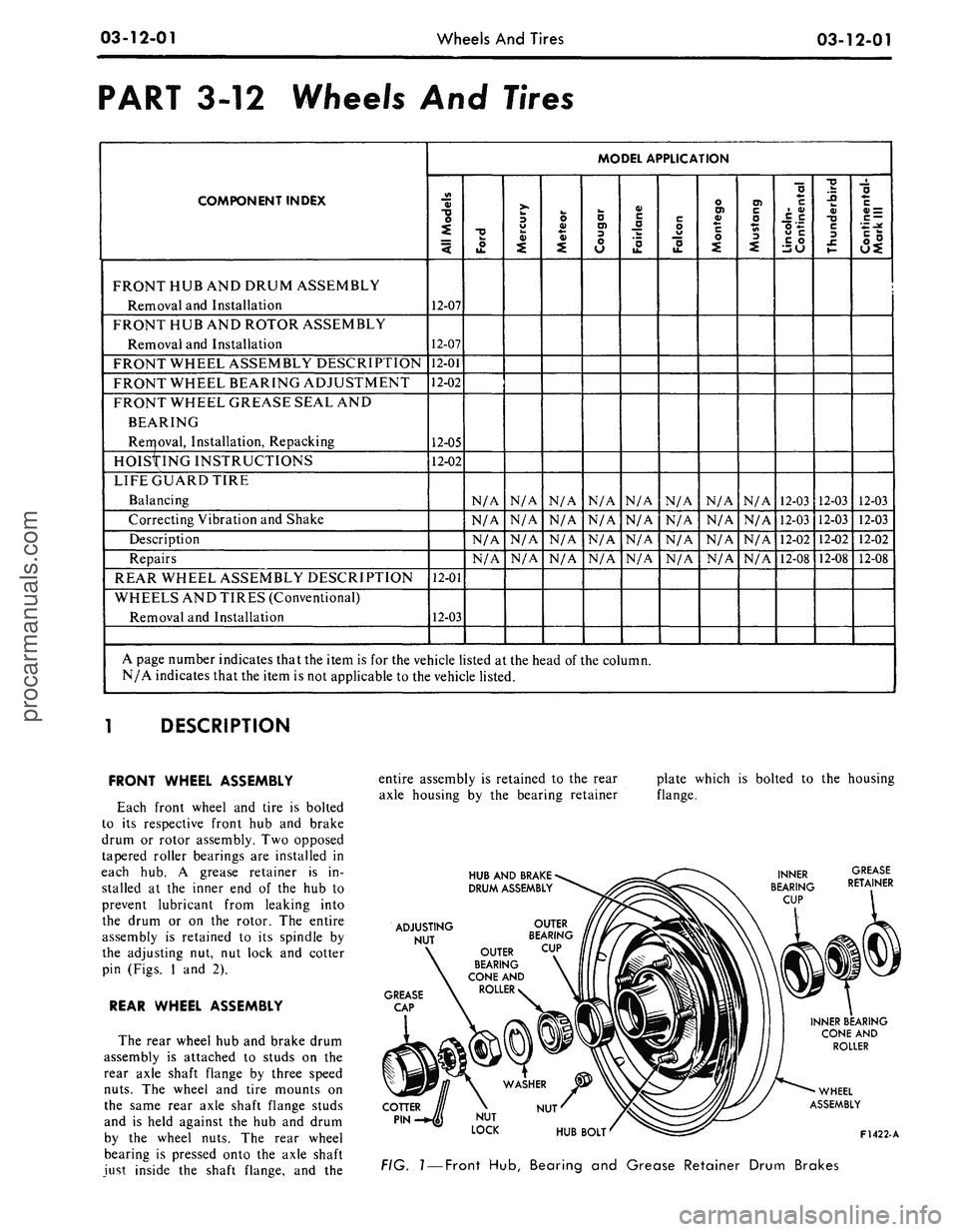
Each front wheel
and
tire
is
bolted
to
its
respective front
hub and
brake
drum
or
rotor assembly.
Two
opposed
tapered roller bearings
are
installed
in
each
hub. A
grease retainer
is in-
stalled
at the
inner
end of the hub to
prevent lubricant from leaking into
the drum
or on the
rotor.
The
entire
assembly
is
retained
to its
spindle
by
the adjusting
nut, nut
lock
and
cotter
pin (Figs.
1 and 2).
REAR WHEEL ASSEMBLY
The rear wheel
hub and
brake drum
assembly
is
attached
to
studs
on the
rear axle shaft flange
by
three speed
nuts.
The
wheel
and
tire mounts
on
the same rear axle shaft flange studs
and
is
held against
the hub and
drum
by
the
wheel nuts.
The
rear wheel
bearing
is
pressed onto
the
axle shaft
just inside
the
shaft flange,
and the
entire assembly
is
retained
to the
rear
axle housing
by the
bearing retainer
HUB
AND
BRAKE
DRUM
ASSEMBLY
plate which
is
bolted
to the
housing
flange.
ADJUSTING
NUT
GREASE
CAP
OUTER
BEARING
OUTER
CUP
BEARING
CONE
AND
ROLLER
NUT
INNER BEARING
CONE
AND
ROLLER
WHEEL
ASSEMBLY
HUB
BOLT'
^£=3^
F1422-A
FIG.
1
—
Front
Hub,
Bearing
and
Grease Retainer Drum Brakes
procarmanuals.com
Page 180 of 413

03-13-01
Specifications
03-13-01
PART 3-13 Specifications
FRONT
WHEEL
ALIGNMENT
Vehicle
Model
Mustang,
Cougar
Fairlane, Falcon
Mont
ego
Ford,
Mercury
Meteor
Thunderbird,
Mark III
Lincoln
Continental
Dimension
"C"
Inches
(I) 6.30
® 6.50
©4.20
® 4.20
©5.87
Dimension
"D"
Inches
©5.50 (Mustang)
6.35 (Cougar)
©6.72
©6.70
©6.70
©8.39
Alignment
Factors
Caster©
Camber©
Toe-in-Inches
Caster©
Camber©
Toe-in-Inches
Caster©
Camber©
Toe-in-Inches
Caster©
Camber®
Toe-in-Inches
Caster®
Camber®
Toe-in-Inches
Min.
-3/4°
+1/4°
1/16
-1
3/4°
•1/2°
1/8
0°
•1/4°
1/16
0°
•1/4°
1/16
-1/2°
•1/4°
0
Max.
+1 1/4°
+1 3/4°
5/16
+1/4°
+1°
3/8
+2°
+11/4°
5/16
+2°
+1 1/4°
5/16
-2
1/2°
+11/4°
1/4
Desired
+1/4°
+3/4°
3/16
•3/4°
+1/4°
3/16
+1°
+1/2°
3/16
+1°
+1/2°
3/16
•11/2°
+1/2°
1/8
©Maximum difference between wheels not to exceed 1/2° (setting). Maximum checking difference not to exceed 1° with caster and camber
with-
in specifications.
©Maximum difference between wheels not to exceed 1/2°.
©Vertical distance between bottom surface of spring tower on centerline of rebound bumper bolt and point on flat surface of upper suspension
arm midway between ball joint rivets.
©Shortest vertical distance between point on side member and axle housing.
©Distance from corner of lower flange sidemember front to center of bolt head (strut mounting bolt).
©Vertical distance between bottom of sidemember at center of axle bumper bracket and top of axle housing.
©Vertical distance between point on underside of crossmember pocket and point on top of drag strut.
©Distance from axle housing to surface on sidemember immediatly behind axle bumper.
WHEELBASEAND TREAD WIDTH-INCHES
FRONT WHEEL TURNING ANGLE
Vehicle Model
Mustang
Cougar
Fairlane, Montego
Falcon (except Station Wagon)
Falcon Station Wagon
Ford
Mercury, Meteor
Thunderbird (2-Door)
Thunderbird (4-Door), Mark HI
Lincoln Continental
Wheelbase
108.0
111.1
116.0
110.9
113.0
121.0
124.0
114.7
117.2
126.0
Tread
Front
58.5
58.5
58.8
58.8
58.8
63.0
63.0
62.0
62.0
62.4
Width
Rear
58.5
58.5
5«.5
58.5
58.5
64.0
64.0
62.0
62.0
61.0
Vehicle Model
Mustang,
Cougar
Fairlane, Falcon, Montego
Ford,
Mercury, Meteor
Thunderbird, Mark III
Lincoln Continental
Turning Angle of Outside Wheel
With Inside Wheel Turned 20°
18.68°
With Power Steering 17.88°
With Manual Steering 18.1°
With Power Steering 19.14°
With Manual Steering 18.96°
19.26°
17.71°
BALL JOINTS -RADIAL PLAY
STEERING WHEEL TURNING EFFORT
Vehicle Model
Cougar, Fairlane,
Falcon,
Montego,
Mustang
Ford,
Mercury,
Meteor, Thunderbird,
Mark III, Lincoln
Continental
Description
Lower Ball Joint
Upper Ball Joint
Lower Ball Joint
Upper Ball Joint
Radial Play-Max. Allowable
Replace if perceptibly loose
0.250
Inch
0.250
Inch
Replace if perceptibly loose
Vehicle Model
Ford,
Mercury, Meteor
Cougar, Fairlane, Falcon,
Montego, Mustang
Lincoln Continental, Mark III,
Thunderbird
Lbs.
Effort
5.0
6.5
3.75procarmanuals.com
Page 181 of 413

03-13-02
Specifications
03-13-02
POWER STEERING PUMP
SERVICE
SPECIFICATIONS
Description
Pump Rotor Shaft End Play
Max. Torque Allowed
to
Rotate Rotor Shaft
Stamped Housing to Plate
Assy. Screw and Washer Assy.
Reservoir
to
Stamped Housing
Nut
Cam Ring to Pressure Plate
Screw
Housing to Cover Screw
Ford-Thompson
.017 in. Max.-.003 in. Min.
15 In-Lb.
28-32 Ft.-Lb.
43-47 Ft.-Lb.
_
-
Eaton
—
_
-
—
20 In-Lb.
15-20 Ft,-Lb.
FORD-THOMPSON POWER STEERING
PUMP
TORQUE
LIMITS (FT-LBS)
Description
Pump Rear Mounting Nut
Pressure Hose Nut
Pump Attaching Nuts
Bracket
to
Engine Attaching Nuts
6-Cyl.
302-351 CID
390,427,428,429 CID
Bracket
to
Cylinder Head
Belt Adjustment Bolt
Rear Support Bracket Attaching Nuts
Bracket
to
Engine Adapter
Engine Adapter
to
Engine
Engine Adapter
to
Pump
240 CID
170-200 CID
170-200 CID
250 CID
250 CID
Ford,
Mercury,
Meteor,
Thunderbird
14-18
20-30
25-35
1216
18-25
30-40
25-35
-
45-60
-
-
-
-
Cougar, Falcon,
Fairlane, Montego,
Mustang
20-30
20-30
30-40
7-10
18-25
30-40
25-35
25-35
-
25-35
17-25
30-40
25-35
INTEGRAL
POWER
STEERING GEAR SPECIFICATIONS
Description
Type
Ratio
Turns of Steering Wheel (Lock
to
Lock-Linkage Disconnected)
Fluid Specifications
Fluid Capacity (Included in Pump Reservoir Fill)
Phosphorescent Dye Additive (For Leak Detection)
Sector Shaft End Play -Linkage Disconnected
Sector Shaft Mesh Load. Total Over Mechanical Center
Position.
Must beCDGreater Than Worm
Bearing Preload Torque, Shown Below
Worm Bearing Preload
Clearance Between Valve Spool
&
Retaining Ring
Pressure Variation Between Right
&
Left Turn (At 250
P.S.I.)
-
Check Efforts Each Side
of
Center
Clearance Between Inner Sector Seal and Housing
Ford Design
(XR-«0)
Saginaw
Design
Recirculating Ball Torsion Bar
17:1
4
17.5:1
41/8
M-2C33-F
1.6 Pints (Approx.)
M99B103-A(4 0z. per quart)
None
14 In Lb (Max)
(Exc. Lincoln)
17
In
Lb (Max.)
(Lincoln)
2-7 la
U)
.0035-.0005"
Preferable .002"
4
In
Lb Max.
Variation
.025"
.002"
Max.
14
In
Lb (Max)
4-7 In Lb®
_
—
-
©8-9 In Lb (XR-50 Exc. Lincoln) 11-12 In Lb
for
Uncoln,
4-8 In
Lb
for
Saginaw Gear.
® 3 In Lb in Excess of Valve Assy. Drag Total Worm Bearing Preload and Seal Drag
not to
Exceed
8 In
Lb.procarmanuals.com
Page 182 of 413
03-13-03
Specifications
03-13-03
MANUAL AND POWER
Vehicle
Model
Gear Type
Gear Ratio
Turns of
Strg.
Gr. (Lock to Lock)
®
Lube Type
Lube Capacity
(Lb.)
Worm Bearing
Preload (In Lb)®
Total Center
Meshload(lnLb)®
Adjustments
(All Models)
ASSIST STEERING GEAR SPECIFICATIONS
Ford,
Mercury,
Meteor
SM/VD-1
Manual
24:1
6-2/5
.97
±
.07
4-5
9-10
SMB-D
Manual
19.9:1
4-5/8
.55
±
.05
4-5
9-10
Adjusting
Mustang, Cougar
SMBK
Power Assist
and Manual®
16:1
3-3/4
ESW-M1C87-A
.55
±
.05
3-4®
8-9®
screw to bottom
of
sector
.000 -.002
SMB-F®
Manual
16:1
3-3/4
.55
±
.05
4-5
9-10
shaft T slot clearance:
Falcon,
Mont ego,
Fairlane
SMA-F
Manual
22:1
5-1/2
.87
±
.07
4-5
9-10
SMA-B
Power
Assist
16:1
4
.87
±
.07
3-4
8-9
©Production only
-
for service, use Model SMB-K.
®When used
for
improved
or
competition handling, worm bearing preload must
be
adjusted
to
4-5
In
Lb and total center meshload must
be
adjusted to 9-10 In Lb.
®Gear only
-
not attached to Pitman arm.
0Torque required
to
rotate input shaft
at
approximately 1-1/2 turns either side
of
center (gear
out of
vehicle
or
Pitman arm disconnected).
©Requiredto rotate input shaft and worm assembly past
the
center high point.
STEERING GEAR TORQUE UMITS(FT-LB)
Description
Sector Shaft Cover Bolts
Mesh Load Adjusting Screw Lock Nut
Ball Return Guide Clamp Screw
Preload Adjuster Lock Nut
Valve Housing
to
Gear Housing Screw
Race Retaining Inner Nut
Race Lock Nut
Piston End Cap
Set Screw-Rack Adjustment
Lubricant Fill Plug and Vent
Manual and Power Assist
Ford,
Mercury,
Meteor
30-40
32-40
18-42 (In-Lb)
60-80
3-9®
Fairlane, Falcon,
Montego
17-2?
32-40
18-42 (In-Lb) Pwr.
42-60 (In-Lb) Man.
60-80
3-9®
Mustang
Cougar
15-22
32-40
18-42 (In-Lb)
45-60
3-9®
Power steering
55-70
25-35
60-120 (In-Lb)
35-45
(D
®
50-75
Steering
30-35
20-30
3-6
50-110
50-100
® With tool T66P-3553-B
•
compute the torque as follows:
Length
of
Torque Wrench
X
60 Lb.
Ft.
°rque
"
Length
of
Torque Wrench
+
5.5 Inches
Example: With 13 inch torque wrench
13ln.
X
60 Lb. Ft. 13
X
60 Lb.
Ft.
13
In.
+
5.5 In.
18.5
®With tool T66P-3553-B
•
compute the torque as follows:
Length
of
torque wrench
X
25 Lb.
Ft.
Length of torque wrench
+
5.5 Inches
©Minimum
of
one thread must remain exposed when installed.
-0.703 X60- 42 (Lb.
Ft.)procarmanuals.com