1969 FORD MUSTANG mustang
[x] Cancel search: mustangPage 106 of 413

03-03-01
Automatic
Air
Leveling System
03-03-01
PART
3-3
Automatic
Air
Leveling System
COMPONENT INDEX
AIR COMPRESSOR
Disassembly
and
Overhaul
Removal
and
Installation
AIR CYLINDER
Removal
and
Installation
DESCRIPTION
HEIGHT CONTROL VALVE
Disassembly
and
Overhaul
Removal
and
Installation
MODEL APPLICATION
All
Models
Ford
03-03
03-02
03-02
03-01
03-03
03-02
Mercury
03-03
03-02
03-02
03-01
03-03
03-02
Meteor
03-03
03-02
03-02
03-01
03-03
03-02
Cougar
N/A
N/A
N/A
N/A
N/A
N/A
Fairlane
N/A
N/A
N/A
N/A
N/A
N/A
A page number indicates that the item
is for the
vehicle listed
at
the head
of
the column.
N/A indicates that
the
item
is not
applicable
to the
vehicle listed.
Falcon
N/A
N/A
N/A
N/A
N/A
N/A
Montego
N/A
N/A
N/A
N/A
N/A
N/A
Mustang
N/A
N/A
N/A
N/A
N/A
N/A
Lincoln-
Continental
N/A
N/A
N/A
N/A
N/A
N/A
Thunderbird
N/A
N/A
N/A
N/A
N/A
N/A
Continental-
Mark III
N/A
N/A
N/A
N/A
N/A
N/A
DESCRIPTION
The automatic level control
is an
accessory item
on the
Ford, Mercury
and Meteor vehicles
(Fig. 1).
This
de-
vice
is a
supplement
to the
rear coil
spring suspension,
and
will automati-
cally maintain
the
rear standing height
of
the
vehicle
at an
approximate
con-
stant position compensating
for
vary-
ing loaded conditions.
The
system
consists
of a
vacuum operated
com-
pressor, control valve,
air
cylinders
and
the
connecting lines
and
fittings.
In
the
event
of
accidental
air
loss,
the
conventional coil springs will support
the vehicle.
RUBBER
AIR
CYLINDER
WITHIN COIL SPRING
HEIGHT CONTROL
VALVE
RUBBER
AIR
CYLINDER
WITHIN COIL SPRING
RUBBER VACUUM LINE
TO
VACUUM
DISTRIBUTION CONNECTOR
RED CLAMP STATION WAGON ONLY
COMPRESSOR
NYLON
AND
STEEL LINES
FROM VALVE
TO
CYLINDERS
FIG.
1
—
Air Leveling System
FT475-A
procarmanuals.com
Page 114 of 413
03-05-01
Steering Columns And Linkage
03-05-01
PART 3-5 Steering
Columns
and Linkage
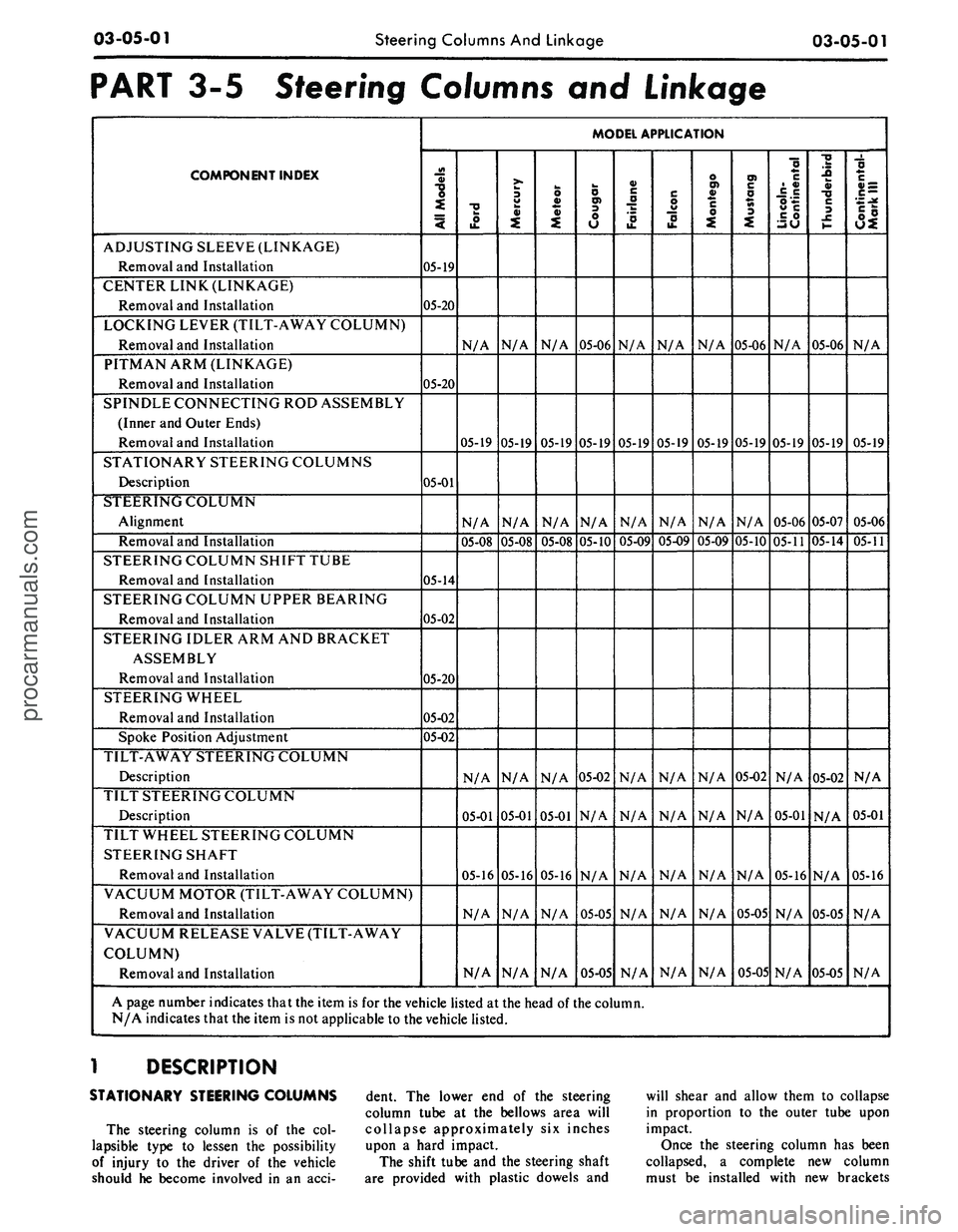
COMPONENT INDEX
ADJUSTING SLEEVE (LINKAGE)
Removal and Installation
CENTER LINK (LINKAGE)
Removal and Installation
LOCKING LEVER (TILT-AWAY COLUMN)
Removal and Installation
PITMAN ARM (LINKAGE)
Removal and Installation
SPINDLE CONNECTING ROD ASSEMBLY
(Inner and Outer Ends)
Removal and Installation
STATIONARY STEERING COLUMNS
Description
STEERING COLUMN
Alignment
Removal and Installation
STEERING COLUMN SHIFT TUBE
Removal and Installation
STEERING COLUMN UPPER BEARING
Removal and Installation
STEERING IDLER ARM AND BRACKET
ASSEMBLY
Removal and Installation
STEERING WHEEL
Removal and Installation
Spoke Position Adjustment
TILT-AWAY STEERING COLUMN
Description
TILT STEERING COLUMN
Description
TILT WHEEL STEERING COLUMN
STEERING SHAFT
Removal and Installation
VACUUM MOTOR (TILT-AWAY COLUMN)
Removal and Installation
VACUUM RELEASE VALVE (TILT-AWAY
COLUMN)
Removal and Installation
MODEL APPLICATION
All
Models
05-19
05-20
05-20
05-01
05-14
05-02
05-20
05-02
05-02
Ford
N/A
05-19
N/A
05-08
N/A
05-01
05-16
N/A
N/A
Mercury
N/A
05-19
N/A
05-08
N/A
05-01
05-16
N/A
N/A
Meteor
N/A
05-19
N/A
05-08
N/A
05-01
05-16
N/A
N/A
Cougar
05-06
05-19
N/A
05-10
05-02
N/A
N/A
05-05
05-05
Fairlane
N/A
05-19
N/A
05-09
N/A
N/A
N/A
N/A
N/A
Falcon
N/A
05-19
N/A
05-09
N/A
N/A
N/A
N/A
N/A
Montego
N/A
05-19
N/A
05-09
N/A
N/A
N/A
N/A
N/A
Mustang
05-06
05-19
N/A
05-10
05-02
N/A
N/A
05-05
05-05
Lincoln-
Continental
N/A
05-19
05-06
05-11
N/A
05-01
05-16
N/A
N/A
Thunderbird
05-06
05-19
05-07
05-14
05-02
N/A
N/A
05-05
05-05
Continental-
Mark
III
N/A
05-19
05-06
05-11
N/A
05-01
05-16
N/A
N/A
A page number indicates that the item is for the vehicle listed at the head of the column.
N/A indicates that the item is not applicable to the vehicle listed.
1 DESCRIPTION
STATIONARY STEERING COLUMNS
The steering column is of the col-
lapsible type to lessen the possibility
of injury to the driver of the vehicle
should he become involved in an acci-
dent. The lower end of the steering
column tube at the bellows area will
collapse approximately six inches
upon a hard impact.
The shift tube and the steering shaft
are provided with plastic dowels and
will shear and allow them to collapse
in proportion to the outer tube upon
impact.
Once the steering column has been
collapsed, a complete new column
must be installed with new brackets
procarmanuals.com
Page 115 of 413
03-05-02
Steering Columns
And
Linkage
03-05-02
which also will shear away during
im-
pact.
TILT STEERING COLUMNS
The steering column
is of the col-
lapsible type
to
lessen
the
possibility
of injury
to the
driver
of the
vehicle
should
he
become involved
in an
acci-
dent.
The
lower
end of the
steering
column tube
at the
bellows area will
collapse approximately
six
inches
upon
a
hard impact.
The shift tube
and the
steering shaft
are provided with plastic dowels
and
will shear
and
allow them
to
collapse
in proportion
to the
outer tube upon
impact.
Once
the
steering column
has
been
collapsed,
a
complete
new
column
must
be
installed.
The tilt column features nine driv-
ing positions (four
up and
four down
from
a
center position).
The
.column
also features
a
turn signal switch with
a lane-changer position turn indicating
position
and
emergency warning flash-
er control.
TILT-AWAY STEERING COLUMNS
The tilt-away steering column
fea-
tures nine driving positions (four
up
and four down from
a
center position)
and
a
tilt-away position that
is
auto-
matically accomplished
on
Mustang
and Cougar models when
the
ignition
key
is
turned
to the
OFF
position
and
the left door
is
opened.
On
Thunder-
bird models,
the
tilt-away occurs when
the shift lever
is
placed
in
PARK
and
the driverns door
is
opened.
The steering column
is of the col-
lapsible type
to
lessen
the
possibility
of injury
to the
driver
of the
vehicle
should
he
become involved
in an
acci-
dent.
The
lower
end of the
steering
column tube
at the
bellows area will
collapse approximately
six
inches
upon
a
hard impact.
The shift tube
and the
steering shaft
are provided with plastic dowels
and
will shear
and
allow them
to
collapse
in proportion
to the
outer tube upon
impact.
Once
the
steering column
has
been
collapsed,
a
complete
new
column
must
be
installed along with mounting
brackets which will also shear away
during impact.
IN-VEHICLE ADJUSTMENTS
AND
REPAIRS
STEERING WHEEL SPOKE
POSITION ADJUSTMENT
When
the
steering gear
is on the
high point,
the
front wheels should
be
in
the
straight-ahead position
and the
steering wheel spokes should
be in
their normal position with
the
Pitman
arm pointing directly forward.
If the
spokes
are not in
their normal posi-
tion, they
can be
adjusted without
dis-
turbing
the
toe-in adjustment (Part
3-1).
STEERING WHEEL
REPLACEMENT
1.
Disconnect
the
negative cable
from
the
battery.
2.
Working from
the
underside
of
the steering wheel spoke, remove
the
crash
pad
attaching screws. Lift
the
crash
pad
from
the
wheel.
(On
Conti-
nental Mark
III
models,
pry out the
crash
pad
insert
and
remove
the two
screws that secure
the
crash
pad. Re-
move
the
crash
pad. On
models
equipped with steering wheel mounted
speed controls, refer
to
Group
16 for
removal instructions). Remove
the
horn ring
(if so
equipped)
by
turning
it counterclockwise.
3.
Remove
the
steering wheel
nut,
and then remove
the
steering wheel
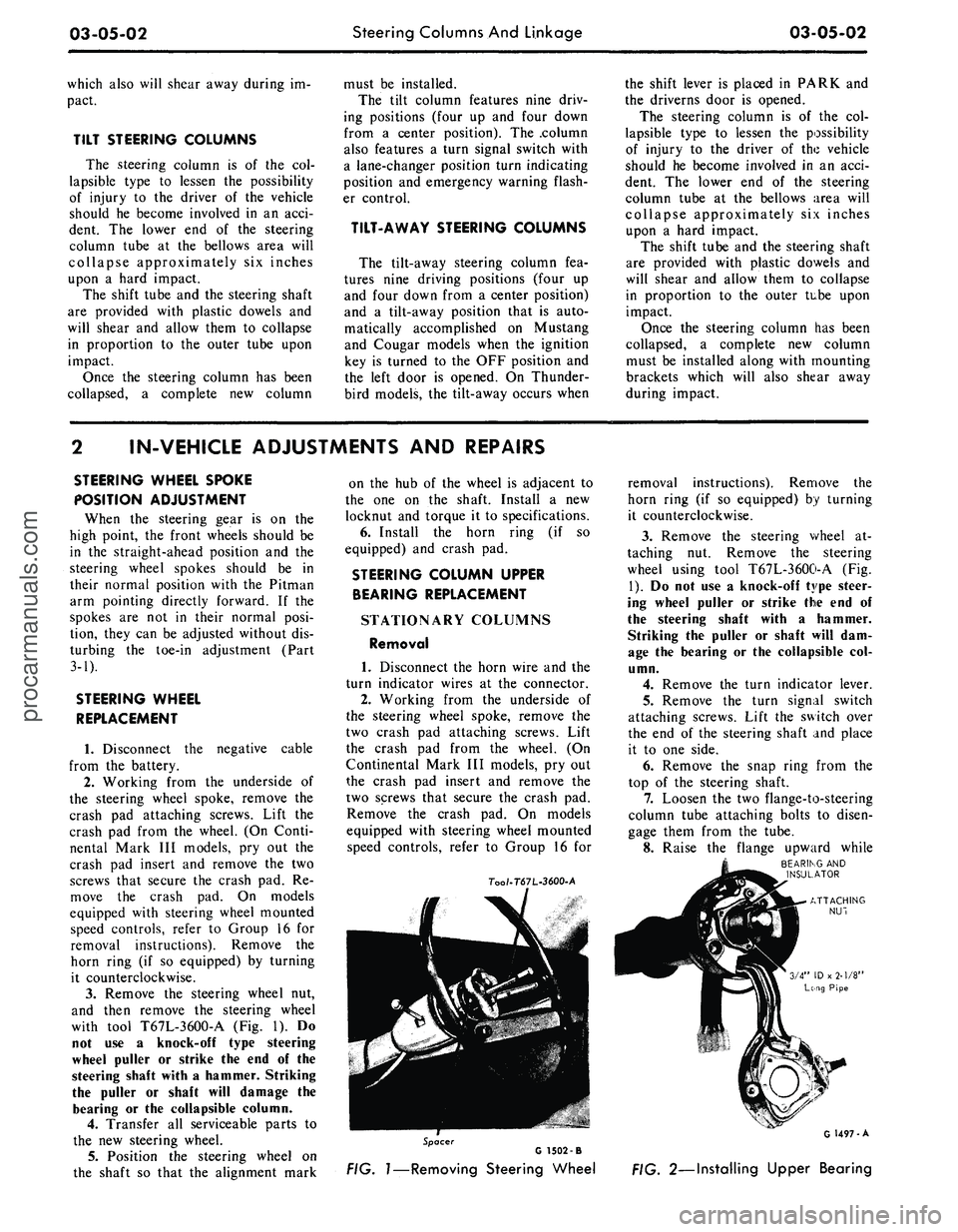
with tool T67L-3600-A
(Fig. 1). Do
not
use a
knock-off type steering
wheel puller
or
strike
the end of the
steering shaft with
a
hammer. Striking
the puller
or
shaft will damage
the
bearing
or the
collapsible column.
4.
Transfer
all
serviceable parts
to
the
new
steering wheel.
5.
Position
the
steering wheel
on
the shaft
so
that
the
alignment mark
on
the hub of the
wheel
is
adjacent
to
the
one on the
shaft. Install
a new
locknut
and
torque
it to
specifications.
6. Install
the
horn ring
(if so
equipped)
and
crash
pad.
STEERING COLUMN UPPER
BEARING REPLACEMENT
STATIONARY COLUMNS
Removal
1. Disconnect
the
horn wire
and the
turn indicator wires
at the
connector.
2.
Working from
the
underside
of
the steering wheel spoke, remove
the
two crash
pad
attaching screws. Lift
the crash
pad
from
the
wheel.
(On
Continental Mark
III
models,
pry out
the crash
pad
insert
and
remove
the
two screws that secure
the
crash
pad.
Remove
the
crash
pad. On
models
equipped with steering wheel mounted
speed controls, refer
to
Group
16 for
7oo/-T67L-3600-A
removal instructions). Remove
the
horn ring
(if so
equipped)
by
turning
it counterclockwise.
3.
Remove
the
steering wheel
at-
taching
nut.
Remove
the
steering
wheel using tool T67L-3600-A
(Fig.
1).
Do not use a
knock-off type steer-
ing wheel puller
or
strike
the end of
the steering shaft with
a
hammer.
Striking
the
puller
or
shaft will
dam-
age
the
bearing
or the
collapsible
col-
umn.
4.
Remove
the
turn indicator lever.
5.
Remove
the
turn signal switch
attaching screws. Lift
the
switch over
the
end of the
steering shaft
and
place
it
to one
side.
6. Remove
the
snap ring from
the
top
of the
steering shaft.
7.
Loosen
the two
flange-to-steering
column tube attaching bolts
to
disen-
gage them from
the
tube.
8. Raise
the
flange upward while
BEARING
AND
INSULATOR
Spacer
G 1502 -B
FIG.
1—Removing
Steering Wheel
G 1497-A
FIG. 2—Installing Upper Bearingprocarmanuals.com
Page 118 of 413
03-05-05
Steering Columns And Linkage
03-05-05
TILT-AWAY STEERING
COLUMN REPAIRS
VACUUM RELEASE VALVE-
COUGAR AND MUSTANG
Removal
1.
Working from the underside of
the instrument panel disconnect the
hose from the valve.
2.
Disconnect the wire from the
connector on the valve and the con-
nector from the relay.
3.
Remove the bracket-
to-instrument panel attaching bolt and
let the bracket swing down.
4.
Remove the two screws that se-
cure the valve to the mounting bracket
and remove the valve.
Installation
1.
Secure the valve to the mounting
bracket with the two attaching screws.
2.
Position the bracket to the in-
strument panel and install the attach-
ing bolt.
3.
Connect the wire to the terminal
on the valve.
4.
Connect the hose from the vacu-
um motor to the horizontal connector
on the valve and the hose from the
reservoir to the vertical connector.
VACUUM RELEASE VALVE—
THUNDERBIRD
Removal
1.
Remove the lower finish panel.
2.
Disconnect the vacuum hose
from the vacuum release valve.
3.
Disconnect the vacuum release
valve electrical leads at the connector.
4.
Loosen the two attaching screws
holding the bracket to the dash. Lift
up the bracket to clear the screws and
swing it down below the panel.
5.
Remove the screws attaching the
valve to the panel and remove the
valve.
Installation
1.
Position the vacuum release
valve on the bracket.
2.
Install the two attaching screws
and swing the bracket up and over the
screws. Tighten the screws.
3.
Connect the electrical leads to
the wiring harness.
4.
Connect the hose from the vacu-
um dash panel junction block to the
connector on the vacuum release valve
that points downward and forward.
Connect the hose from the vacuum
motor to the other connector on the
release valve.
5.
Install the lower finish panel.
VACUUM MOTOR-
COUGAR AND MUSTANG
Removal
1.
Working from the underside of
the instrument panel, disconnect the
hose to the valve and the wires to the
relay and valve.
2.
Remove the bracket-
to-instrument panel attaching bolt and
swing the bracket downward.
3.
Remove the clevis pin that se-
cures the cable to the vacuum motor
rod.
4.
Disconnect the starter safety
switch wire at the connector.
5.
Remove the two motor-
to-bracket attaching screws and re-
move the motor, disconnecting the
hose to the solenoid.
Installation
1.
Position the motor on the
mounting bracket and the attaching
screws.
2.
Connect the control cable to the
vacuum motor rod with the clevis pin.
3.
Position the bracket to the in-
strument panel and install the attach-
ing bolt. Make all electrical and vacu-
um connections.
4.
Readjust the cable bracket to as-
sure full engagement of the locking
pawl when in driving position.
5.
Connect the hose to the vacuum
motor.
VACUUM MOTOR—
THUNDERBIRD
Removal
1.
Remove the lower finish panel.
2.
Disconnect the vacuum hose
from the solenoid valve. Disconnect
the electrical lead.
3.
Loosen the screws that attach
the bracket to the dash and lift the
bracket up; then, swing it down.
4.
Remove the clevis pin holding
the motor to the cable.
5.
Remove the two attaching
screws, then lift the motor from the
bracket.
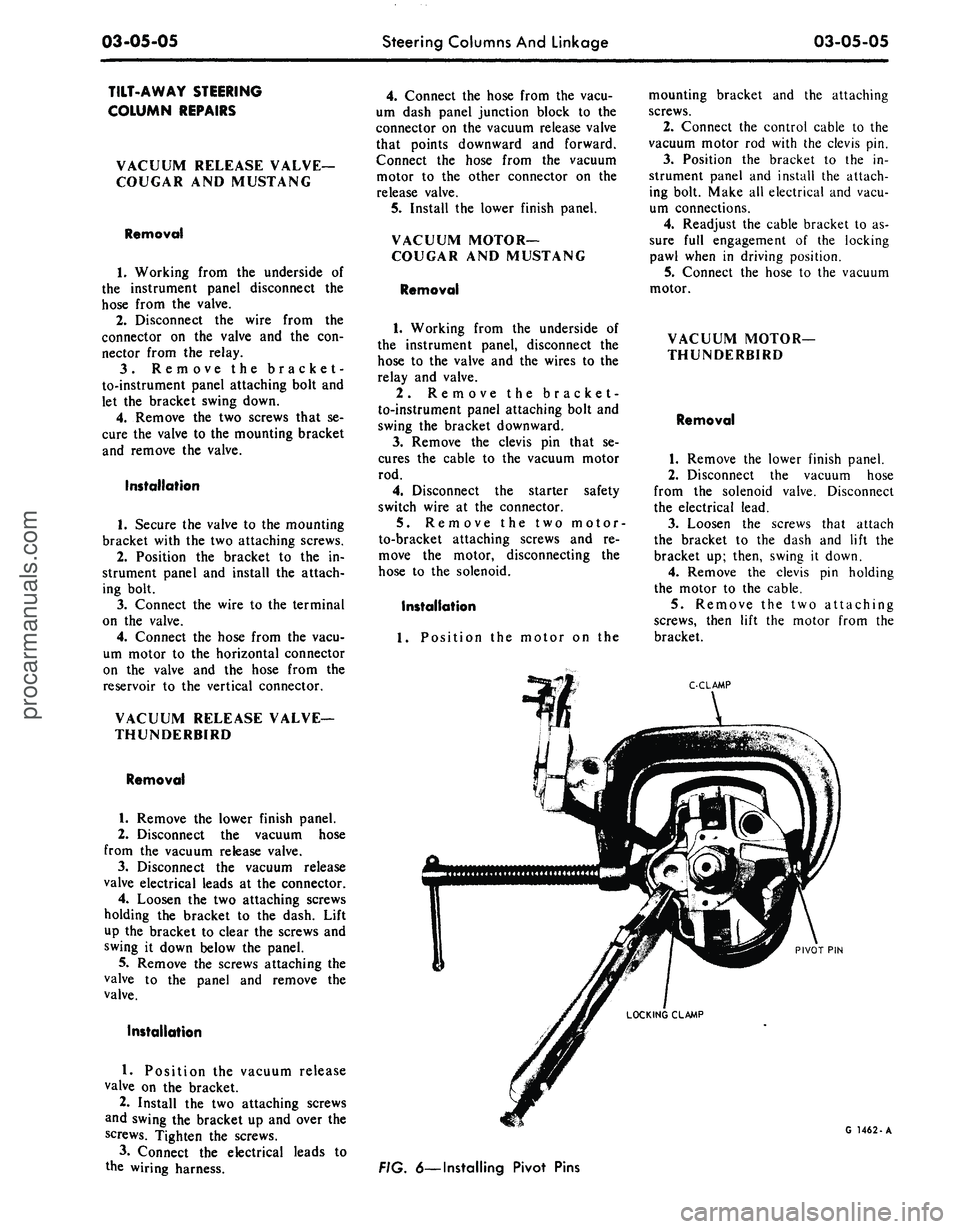
C-CLAMP
PIVOT PIN
G 1462-A
FIG. 6—Installing Pivot Pinsprocarmanuals.com
Page 123 of 413
03-05-10
Steering Columns And Linkage
03-05-10
9. Connect the battery cable to the
negative post.
10.
Check the operation of the
switches.
COUGAR, MUSTANG
Removal
cable
1.
Disconnect the battery
from the negative post.
2.
Disconnect the turn signal switch
wires at the connector.
3.
On tilt-away columns, disconnect
the tilt-control cable from the vacuum
motor and mounting bracket.
4.
Remove the bolt that secures the
flex coupling to the steering gear.
5.
Remove the nuts and bolts that
secure the column retainer and seal at
the toe plate.
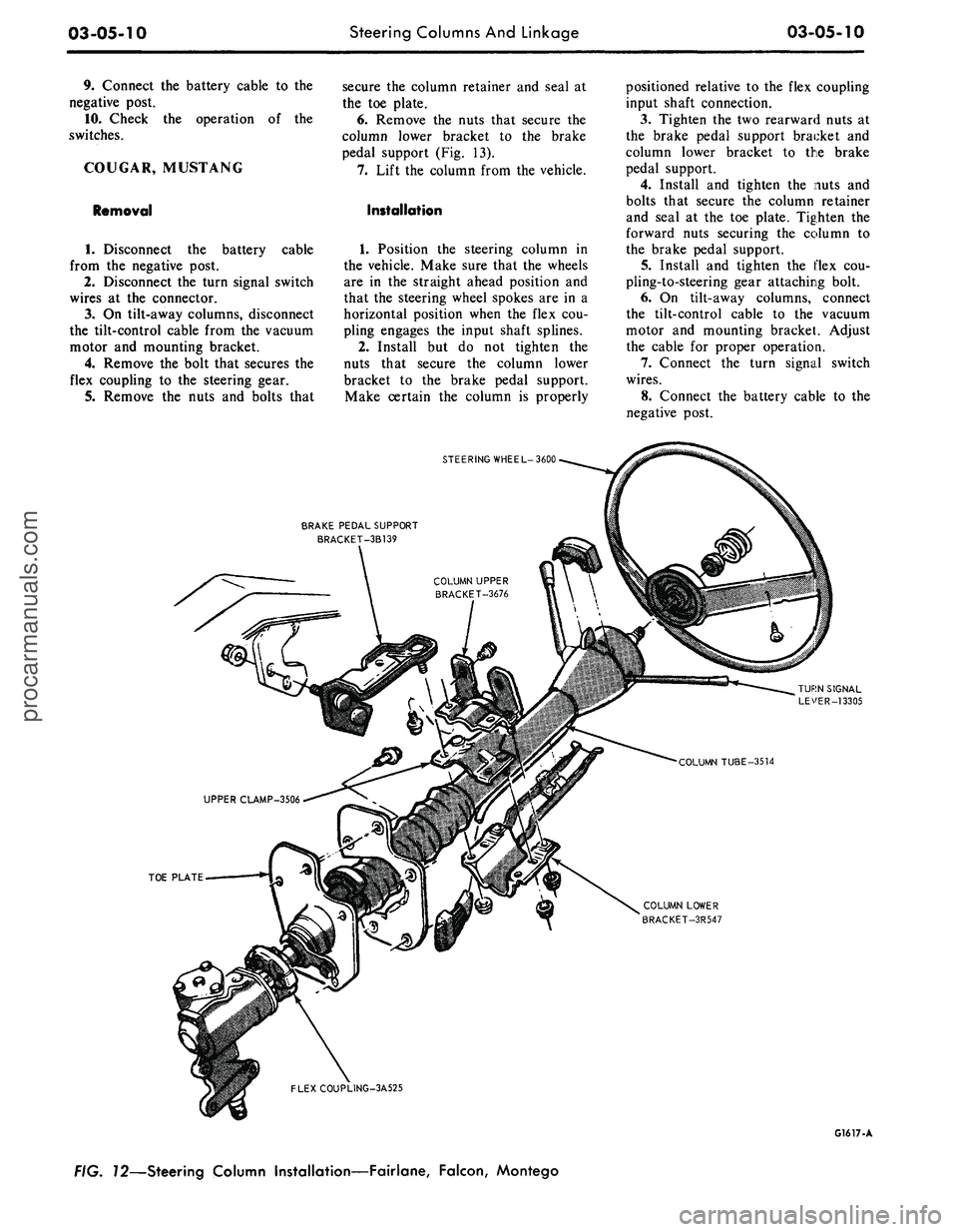
6. Remove the nuts that secure the
column lower bracket to the brake
pedal support (Fig. 13).
7.
Lift the column from the vehicle.
Installation
1.
Position the steering column in
the vehicle. Make sure that the wheels
are in the straight ahead position and
that the steering wheel spokes are in a
horizontal position when the flex cou-
pling engages the input shaft splines.
2.
Install but do not tighten the
nuts that secure the column lower
bracket to the brake pedal support.
Make certain the column is properly
positioned relative to the flex coupling
input shaft connection.
3.
Tighten the two rearward nuts at
the brake pedal support bracket and
column lower bracket to the brake
pedal support.
4.
Install and tighten the nuts and
bolts that secure the column retainer
and seal at the toe plate. Tighten the
forward nuts securing the column to
the brake pedal support.
5.
Install and tighten the flex cou-
pling-to-steering gear attaching bolt.
6. On tilt-away columns, connect
the tilt-control cable to the vacuum
motor and mounting bracket. Adjust
the cable for proper operation.
7.
Connect the turn signal switch
wires.
8. Connect the battery cable to the
negative post.
STEERING WHEEL-3600
BRAKE PEDAL SUPPORT
BRACKET-3B139
TOE PLATE
COLUMN LOWER
BRACKET-3R547
FLEXCOUPLING-3A525
G1617-A
FIG. 72—Steering Column Installation—Fairlane, Falcon, Montegoprocarmanuals.com
Page 124 of 413

03-05-11
Steering Columns
And
Linkage
03-05-11
9. Check
the
operation
of the
steer-
ing tilt mechanism
(if so
equipped)
and
the
switches.
THUNDERBIRD
AND
CONTINENTAL MARK
III
Removal
1.
Remove
the
instrument panel
lower outer finish panel, instrument
panel steering column plate
and
cover.
2.
Disconnect
the
negative cable
from
the
battery.
3.
Remove
the
bolt that attaches
the flexible coupling
to the
steering
shaft.
4.
Disconnect
the
shift
rod
from
the
lever
at the
lower
end of the
column.
5.
Remove
the
four screws that
at-
tach
the
column retainer
to the
dash
panel.
6. Working from
the
underside
of
the instrument panel disconnect
the
steering column tilt-control cable from
the vacuum motor
and
mounting
bracket
(if so
equipped)
(Fig. 14).
7.
Disconnect
the
turn signal
switch,
and
emergency flasher wires
at
the connectors. Disconnect
the
wires
from
the
neutral start switch.
8. While supporting
the
steering
column, remove
the
four bolts that
at-
tach
the
lower clamp
to the
upper
clamp
(Fig. 14).
Lift
the
column from
the vehicle.
Installation
1.
Position
the
column
in the
vehi-
cle making sure that
the
steering shaft
engages
the
flex coupling.
1.
Install
the
column retainer-
to-dash panel attaching screws,
but do
not tighten them.
3.
Install
the
lower clamp
and the
attaching nuts. Tighten
the
nuts fing-
ertight.
4.
Move
the
lower flange
as re-
quired
to
center
the
steering shaft
in
the tube. Aligning procedures
are de-
tailed
in
Part
3-1.
Tighten
the
lower
flange attaching nuts when
the
shaft
is
centered.
5.
Connect
the
shift
rod to the
shift
lever
at the
lower
end of the
column.
6. Install
and
tighten
the
flex
cou-
pling attaching bolt.
7.
Tighten
the
instrument panel-
to-clamp attaching nuts.
BRAKE PEDAL SUPPORT
STEERING WHEEL-3600
TURN SIGNAL LEVER-13305
COLUMN TUBE-3514
COLUMN LOWER BRACKET-3R547
•TOE PLATE
FLEX COUPLING-3A525
G1618-A
f/G.
73—Steering Column Installation—Cougar, Mustangprocarmanuals.com
Page 135 of 413

03-06-01
Manual Steering
03 06-01
PART
3-6
Manual Steering
COMPONENT INDEX
STEERING GEAR
Cleaning
and
Inspection
(See Part 03-01)
Description
Disassembly
and
Overhaul
Removal
and
Installation
STEERING WORM
AND
SECTOR
Adjustment
and
Repair
MODEL APPLICATION
All
Models
Ford
06-01
06-03
06-02
06-02
Mercury
06-01
06-03
06-02
06-02
Meteor
06-01
06-03
06-02
06-02
Cougar
06-01
06-03
06-02
06-02
Fairlane
06-01
06-03
06-02
06-02
Falcon
06-01
06-03
06-02
06-02
Montego
06-01
06-03
06-02
06-02
Mustang
06-01
06-03
06-02
06-02
Lincoln-
Continental
N/A
N/A
N/A
N/A
Thunderbird
N/A
N/A
N/A
N/A
Continental-
Mark
III
N/A
N/A
N/A
N/A
A page number indicates that the item
is for
the vehicle listed
at
the head
of
the column.
N/A indicates that the item
is not
applicable
to
the vehicle listed.
DESCRIPTION
STEERING GEAR
The steering gear
(Fig.
1) is of the
worm
and
recirculating ball type.
The
sector shaft
is
straddle mounted
hav-
INPUT SHAFT
ing
a
bushing located
in the
cover
above
the
gear
and a
roller bearing
in
the housing below
the
gear.
SECTOR SHAFT ADJUSTMENT SCREW
LOCK
NUT
IDENTIFICATION
TAG
SECTOR SHAFT COVER
The worm bearing preload
is con-
trolled
by the
large adjusting
nut
which
is
threaded into
the
housing.
The sector shaft mesh load
is con-
trolled
by an
adjusting screw located
in
the
housing cover.
The steering linkage consists
of the
Pitman
arm,
steering-arm-to-idler
arm
rod, idler
arm and the
spindle
con-
necting rods
(tie
rods).
A steering gear identification
tag is
provided under
one of the
cover
at-
taching bolts
(Fig.
2).
STEERING GEAR
MODEL
SERVICE IDENTIFICATION
CODE NUMBER
FIG.
1—Manual
Steering Gear
SERIAL NUMBER
OR
DATE CODE
G 1625-A
G
1626-A
FIG. 2—Steering Gear Identification
procarmanuals.com
Page 139 of 413

03-07-01
Ford Design Non-Integral Power Steering System
03-07-01
PART
3-7
Ford Design Non-Integral Power
Steering System
COMPONENT INDEX
CONTROL VALVE
Disassembly
and
Overhaul
Removal
and
Installation
CONTROL VALVE CENTERING SPRING
Adjustment
CONTROL VALVE
TO
POWER STEERING
CYLINDER HOSE
Removal
and
Installation
HOISTING INSTRUCTIONS
POWER CYLINDER
Removal
and
Installation
POWER CYLINDER SEAL
Removal
and
Installation
POWER STEERING PUMP CLEANING
AND INSPECTION
(See
Part 03-01)
Removal
and
Installation
POWER STEERING PUMP
TO
CONTROL
VALVE HOSE
Removal
and
Installation
STEERING GEAR
Cleaning
and
Inspection
(See Part 03-01)
MODEL APPLICATION
All
Models
Ford
N/A
N/A
N/A
N/A
N/A
N/A
N/A
N/A
N/A
Mercury
N/A
N/A
N/A
N/A
N/A
N/A
N/A
N/A
N/A
Meteor
N/A
N/A
N/A
N/A
N/A
N/A
N/A
N/A
N/A
Cougar
N/A
N/A
N/A
N/A
N/A
N/A
N/A
N/A
N/A
Fairlane
07-04
07-03
07-02
07-02
07-02
07-04
07-06
07-03
07-02
Falcon
07-04
07-03
07-02
07-02
07-02
07-04
07-06
07-03
07-02
Montego
07-04
07-03
07-02
07-02
07-02
07-04
07-06
07-03
07-02
Mustang
07-04
07-03
07-02
07-02
07-02
07-04
07-06
07-03
07-02
Lincoln-
Continental
07-04
07-03
07-02
07-02
07-02
07-04
07-06
07-03
07-02
Thunderbird
N/A
N/A
N/A
N/A
N/A
N/A
N/A
N/A
N/A
Continental-
Mark
III
N/A
N/A
N/A
N/A
N/A
N/A
N/A
N/A
N/A
A page number indicates that
the
item
is for the
vehicle listed
at the
head
of the
column.
N/A indicates that
the
item
is not
applicable
to the
vehicle listed.
DESCRIPTION
The Ford Non-Integral Power
Steering System
(Fig. 1) is a
hydrauli-
cally controlled linkage-type steering
system which includes
an
integral
pump
and
fluid reservoir,
a
control
valve,
a
power cylinder,
the
connecting
fluid lines,
and the
steering linkage.
The hydraulic pump
and
belt, driven
from
the
engine crankshaft, draws
fluid from
the
reservoir
and
provides
fluid pressure
for the
system. Within
the pump itself
is a
pressure-relief
valve which governs
the
pressures
within
the
steering system according
to
the
varying conditions
of
operation.
After fluid
has
passed from
the
pump
to
the
control valve
and the
power
cyl-
inder,
it
returns
to the
reservoir.
procarmanuals.com