1969 FORD MUSTANG engine
[x] Cancel search: enginePage 48 of 413
02-02-29
Brake System
02-02-29
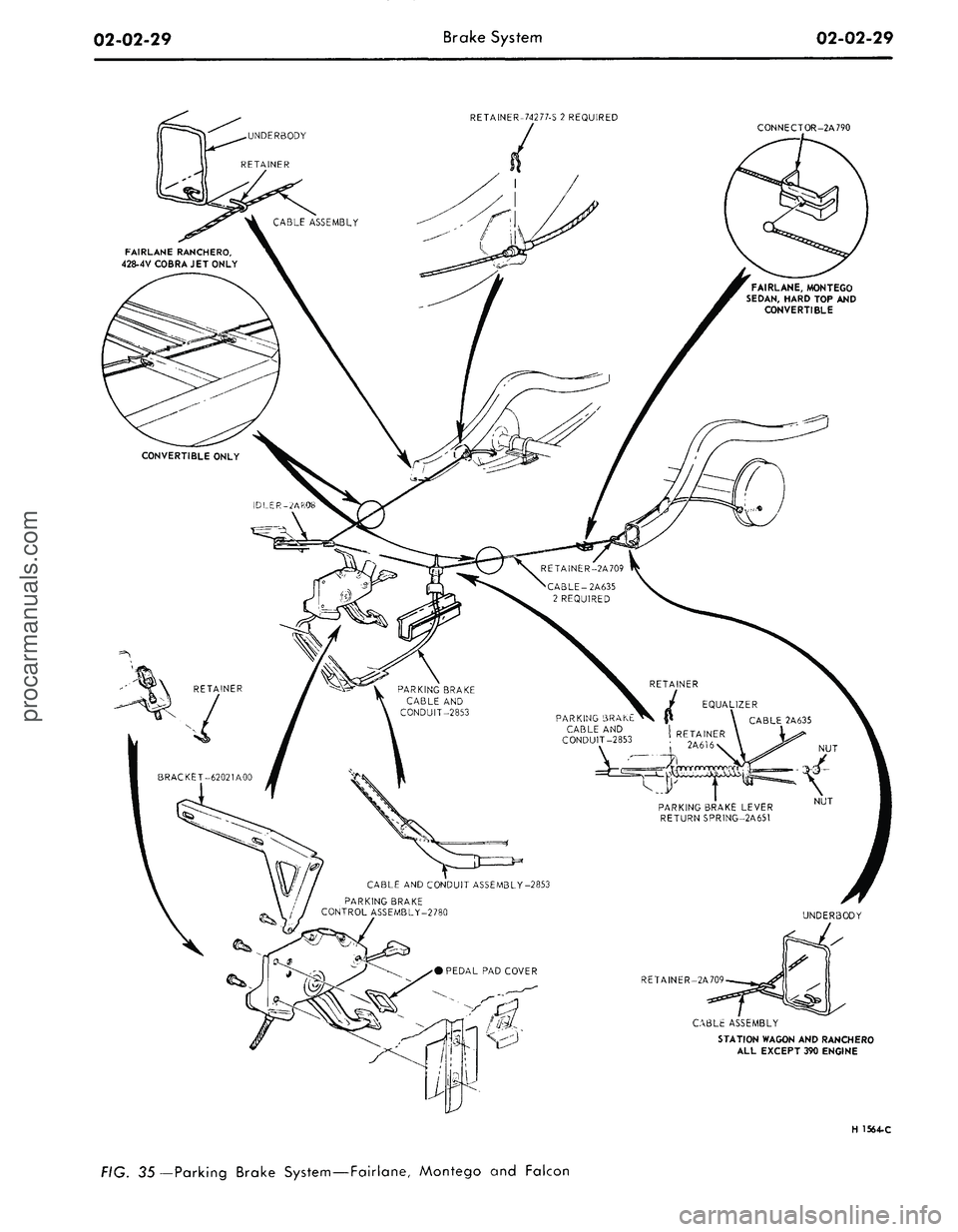
RETAINER-74277-S 2 REQUIRED
CONNECTOR-2A790
FAIRLANE, MONTEGO
SEDAN,
HARD TOP AND
CONVERTIBLE
PARKING BRAKE
CONTROL ASSEMBLY-2780
STATION WAGON AND RANCHERO
ALL EXCEPT 390 ENGINE
H 1564-C
FIG. 35 — Parking Brake System—Fairlane, Montego and Falconprocarmanuals.com
Page 53 of 413
02-02-34
Brake System
02-02-34
strument panel. Install the lower con-
trol panel retaining screws.
8. Install the windshield wiper con-
trol bezel and knob.
9. Working in the engine compart-
ment connect the wire harness and
vacuum hoses to the Automatic Tem-
perature Control box.
10.
Connect the battery cable.
11.
Raise the vehicle on a hoist.
12.
Connect the cable ball to the
equalizer and install the equalizer
lever return ^spring.
13.
Adjust the parking brake cable
tension.
14.
Lower the vehicle.
PARKING BRAKE ACTUATOR—
TO CONTROL CABLE
FORD, MERCURY
AND METEOR
Removed
1.
Raise the vehicle on a hoist.
2.
Loosen the actuator lever to
equalizer cable adjusting nut at the
equalizer (Fig. 34).
3.
Disconnect the cable ball from
the clevis on the actuator lever.
4.
Remove spring clip that retains
the cable to the frame.
5.
From inside of passenger com-
partment, remove spring clip that re-
tains the cable to the parking brake
control. Disconnect the cable ball
from the control assembly.
6. Remove the cable assembly from
the vehicle.
Installation
1.
Position the cable through the
provided openings and in the approxi-
mate final installation position.
2.
Install the hairpin retainer on the
cable at the frame crossmember.
3.
Connect the ball end of the cable
to the parking brake control. Install
the cable-to-control hairpin retaining
clip.
4.
Position the cable seal at the
dash panel, and slide the retaining clip
upward to seal the cable at the dash
opening.
5.
Connect the ball end of the cable
to the clevis on the actuator lever.
6. Adjust the parking brake (Part
2-1,
Section 2).
7.
Lower vehicle on hoist.
THUNDERBIRD AND
CONTINENTAL MARK III
Removal
Refer to Fig. 37.
1.
Partially raise the vehicle.
2.
Back off the adjusting nut at the
equalizer to relieve the tension on the
cable.
3.
Remove the spring at the actua-
tor lever and disconnect the control
cable from the clevis on the lever.
4.
Remove the clip retaining the
control cable assembly to
thq*.
frame
bracket. B
5.
Attach a length of wire to the
control cable.
6. Working inside the vehicle re-
move two screws retaining the left
scuff plate.
7.
Remove one screw and remove
the left cowl side trim panel.
8. Remove the two screws retaining
the left air duct to the inner panel and
remove the air duct.
9. Remove the two screws retaining
the dimmer switch and position the
dimmer switch back out of the way.
10.
Remove the clip retaining the
cable assembly to the control and re-
move the cable ball from the control
clevis.
11.
Pull the cable up through the
opening in the dash panel and remove
the cable from the length of wire.
Installation
1.
Attach the cable to the length of
wire and pull the cable down through
the opening in the dash panel.
2.
Position the upper end of the
control cable to the control. Connect
the cable ball to the control clevis and
install the clip retaining the cable
housing to the control.
3.
Remove the length of wire from
the cable assembly and position the
cable in the frame bracket. Install the
retainer,
4.
Connect the cable ball to the
clevis on the actuator lever and install
the actuator lever spring.
5.
Adjust the parking brake.
6. Reposition the dimmer switch
and install the retaining screws.
7.
Position the air duct to the inner
panel and install the retaining screws.
& Position the cowl side trim panel
and install the retaining screw.
9. Install the two screws in the
scuff plate.
PARKING BRAKE
EQUALIZER TO CONTROL
CABLE
FAIRLANE, MONTEGO
AND FALCON
Removal
Refer to Fig. 35.
1.
Make certain the parking brake
is fully released.
2.
Raise the vehicle on a hoist. Re-
move the two nuts that attach the
cable to the equalizer. Remove the
equalizer, spring seat and spring.
3.
Remove the hairpin retainer
holding the cable assembly to i:he body
bracket and remove the cable from
the slot in the bracket.
4.
Lower the vehicle partially.
5.
Remove the hairpin retainer
which retains the cable assembly to
the control.
6. Remove the cable bolt retaining
clip from the control clevis and dis-
connect the cable ball from the clevis.
7.
Pull the cable down through the
opening in the floor pan and frame
side rail.
Installation
1.
Route the new cable through
the frame side rail and up through
the opening in the floor pan. Pull the
cable up into position.
2.
Connect the cable ball in the con-
trol clevis.
3.
Insert the cable housing into
the control and install the hairpin re-
tainer.
4.
Raise the vehicle.
5.
Position the cable in the body
bracket and install the hairpin re-
tainer.
6. Position the spring, spring re-
tainer and equalizer on the cable and
install the two nuts.
7.
Adjust the parking brake.
MUSTANG AND COUGAR
Removal
Refer to Fig. 36.
1.
Make certain the parking brake
is fully released.
2.
Raise the vehicle on a hoist. Re-
move the two nuts that attach the
cable to the equalizer. Remove the
equalizer spring seat and spring.
3.
Remove the hairpin retainer
holding the cable assembly to the
body bracket and pull the cable out
of the side rail access holes.procarmanuals.com
Page 57 of 413
02-02-38
Brake System
02-02-38
2.
Disconnect the actuator solenoid
and warning switch harness connectors
from the control module.
3.
Remove the two wiring harness
grommets from the dash panel and
push the wiring harness and connec-
tors through the openings in the dash
panel.
4.
Working in the engine compart-
ment loosen the hose clamp and re-
move the air hose from the air filter.
5.
Remove the engine air cleaner-
Loosen the hose clamp and remove
the vacuum hose from the vacuum
manifold fitting.
6. Raise the vehicle on a hoist.
7.
Disconnect the exhaust pipes
from the exhaust manifold and sup-
port with wire to provide access to the
actuator assembly.
8. Remove the bolt retaining the
actuator ground wire to the rear outer
corner of the engine right bank.
9. Loosen the tube nuts and discon-
nect the brake system hydraulic tubes
from the hydraulic valve housing.
10.
Remove the three nuts retaining
the actuator assembly to the actuator
support bracket.
11.
Remove the three bolts that re-
tain the actuator mounting bracket to
the side rail and remove the mounting
bracket.
12.
Remove the actuator assembly
from the vehicle and place it on a
bench.
13.
Remove the air and vacuum
hoses from the actuator.
INSTALLATION
1.
Install the air and vacuum hoses
on the new actuator.
2.
Place the actuator assembly into
position under the vehicle, routing the
air and vacuum hoses up between the
engine and fender apron and inserting
the solenoid leads through the holes in
the firewall.
3.
Position the ground wire to the
rear of the engine block and install re-
taining bolt.
4.
Position the actuator mounting
bracket to the frame side rail and in-
stall the three retaining bolts.
5.
Position the actuator assembly
to the mounting bracket and install
the three retaining nuts.
6. Connect the hydraulic tubes to
the hydraulic valve assembly and
tighten the tube nuts to specifications.
7.
Connect the exhaust pipes to the
exhaust manifolds.
8. Lower the vehicle.
9. Pull the actuator solenoid and
brake warning switch wiring harness
through the two holes in the dash
panel from inside the car. Seat the
wiring harness grommets in the dash
panel.
10.
Connect the actuator solenoid
and brake warning switch wiring har-
ness connectors to the control mo-
dules.
'
11.
Position the control module in
the bracket under the glove box and
install the retaining screw.
12.
In the engine compartment con-
nect the air hose to the air filter and
position the hose clamp.
13.
Connect the vacuum hose to the
engine vacuum manifold fitting. In-
stall the engine air cleaner.
14.
Bleed the rear brake system and
centralize the pressure differential
valve.
15.
Raise the rear wheels. Apply
the brakes with the rear wheels turn-
ing to verify proper operation of the
anti-skid control system.
ANTI-SKID CONTROL MODULE
REMOVAL
Refer to Fig. 39.
1.
Remove the retaining strap hold-
ing the harnesses.
2.
Remove the screw that attaches
the forward end of the control module
retainer to the support assembly.
3.
Lower the forward end of the
control module and retainer from the
support assembly; move the module
and retainer forward slightly until the
flange clears the slot in the support
assembly.
4.
Disconnect the five wiring har-
ness plugs from the control module.
5.
Remove the control module from
the vehicle.
INSTALLATION
1.
Connect the five wiring harness
plugs to the control module. Only one
arrangement is possible.
2.
Position the control module in
the retainer, orienting the module per
the markings on it, and insert the re-
tainer flange into the slot at the rear
of the support assembly.
3.
Pivot the retainer and control
module upward and align the screw
hole in the forward end of the retainer
with the hole in the support bracket
assembly. Install the retaining screw.
4.
Test the vehicle on the hoist to
verify correct operation of the skid
control system.
5.-
Secure the wiring to the module
support extension with the retaining
strap.
ANTI-SKID CONTROL SENSOR
REMOVAL
Refer to Fig. 39.
1.
Raise the vehicle on a hoist.
2.
Remove the rear wheel and tire
assembly.
3.
Remove the three Tinnerman
nuts (3) and remove the brake drum.
4.
Disconnect the sensor lead from
the rear wiring harness.
5.
Unseat the sensor lead grommet
pushing it to the inside of the brake
assembly.
6. Remove the four nuts that retain
the sensor to the backing plate and
pull the axle shaft, sensor assembly
and wheel bearing assembly from the
axle housing.
7.
Press the wheel bearing retainer
and wheel bearing off the axle shaft
(Refer to Part 4-2).
8. Remove the sensor assembly and
press the rotor off the shaft with tool
T69P-2B384-A Detail 2 and TOOL
1225-DA.
INSTALLATION
1.
Press a new rotor onto the axle
shaft. Install a new sensor assembly
on the shaft with tool T69P-
2B384-ADetail 1 and TOOL 1225-
DA, and press the bearing and bear-
ing retainer onto the shaft (Refer to
Part 4-2).
2.
Insert the axle shaft assembly in
the rear axle housing onto the four
backing plate retaining bolts, feeding
the sensor lead through the hole in the
backing plate.
3.
Seat the sensor lead grommet in
the backing plate.
4.
Install the four nuts on the re-
taining bolts and tighten to specifica-
tions.
5.
Connect the sensor lead to the
rear wiring harness and install two re-
taining straps.
6. Install the rear brake drum and
retain with the Tinnerrhan drum re-
taining nuts.
7.
Install the rear wheel and tire as-
sembly and tighten the wheel nuts to
specifications.
8. Test the vehicle on the hoist to
verify proper operation of the skid
control system.procarmanuals.com
Page 62 of 413
02-03-01
Specifications
02-03-01
PART
2-3
Specifications
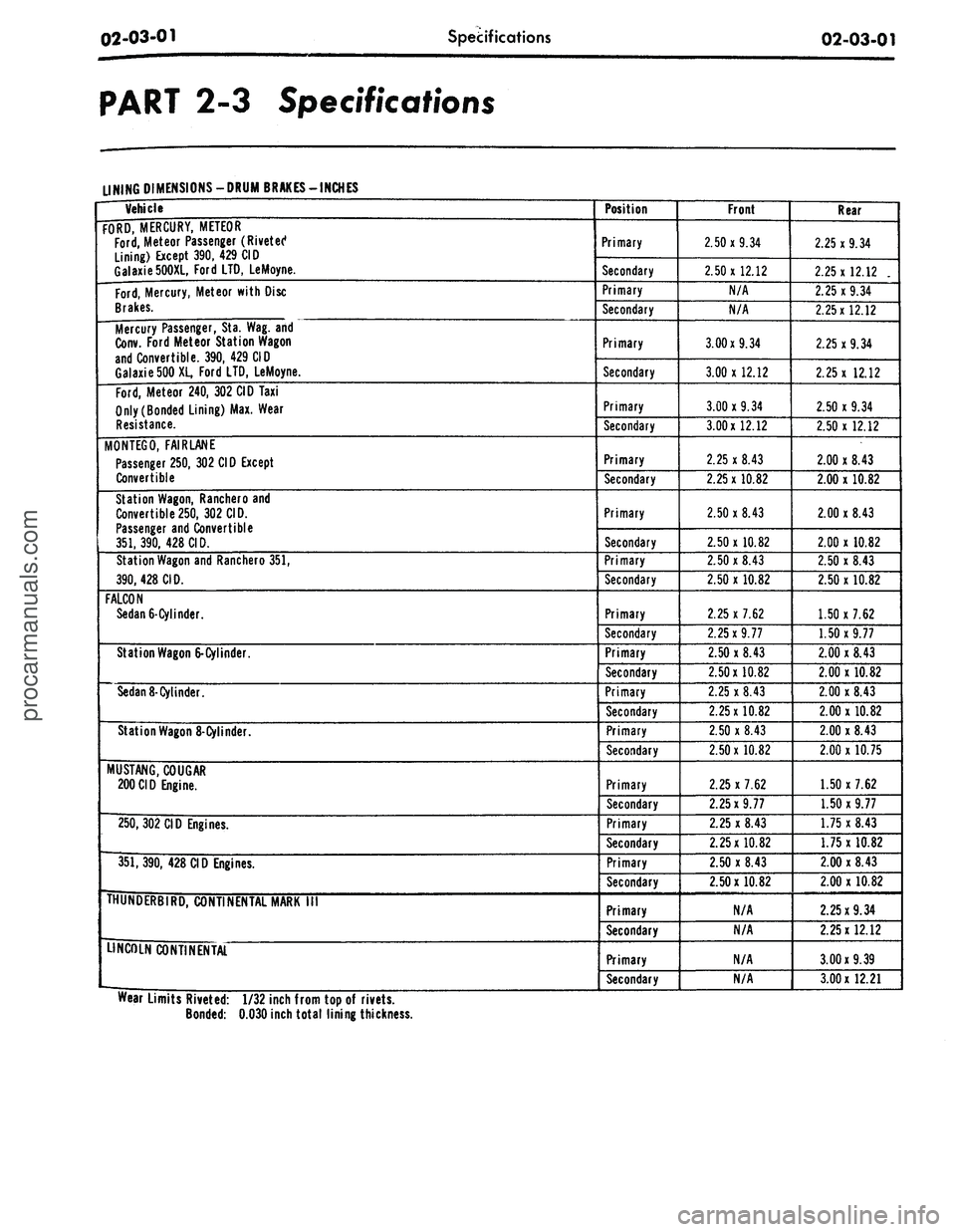
LINING
DIMENSIONS-DRUM
BRAKES-INCHES
Vehicle
FORD, MERCURY, METEOR
Ford,
Meteor Passenger (Rivetet1
Lining) Except 390, 429 CID
Galaxie500XL, Ford LTD, LeMoyne.
Ford,
Mercury, Meteor with Disc
Brakes.
Mercury Passenger, Sta. Wag. and
Conv. Ford Meteor Station Wagon
and Convertible. 390, 429 CID
Galaxie500XL, Ford LTD, LeMoyne.
Ford,
Meteor 240, 302 CID Taxi
Only (Bonded Lining) Max. Wear
Resistance.
MONTEGO,
FAIR LANE
Passenger 250, 302 CID Except
Convertible
Station Wagon, Ranchero and
Convertible250, 302 CID.
Passenger and Convertible
351,390, 428 CID.
Station Wagon and Ranchero 351,
390,
428 CID.
FALCON
Sedan
6-Cylinder.
Station Wagon
6-Cylinder.
Sedan
8- Cylinder.
Station Wagon
8-Cylinder.
MUSTANG, COUGAR
200CID Engine.
250,
302 CID Engines.
351,390, 428 CID Engines.
IHUNDERBIRD, CONTINENTAL MARK
III
LINCOLN CONTINENTAL
Position
Primary
Secondary
Primary
Secondary
Primary
Secondary
Primary
Secondary
Primary
Secondary
Primary
Secondary
Primary
Secondary
Primary
Secondary
Primary
Secondary
Primary
Secondary
Primary
Secondary
Primary
Secondary
Primary
Secondary
Primary
Secondary
Primary
Secondary
Primary
Secondary
Front
2.50x9.34
2.50x12.12
N/A
N/A
3.00x9.34
3.00x12.12
3.00x9.34
3.00x12.12
2.25 x 8.43
2.25x10.82
2.50x8.43
2.50x10.82
2.50x8.43
2.50 x 10.82
2.25 x 7.62
2.25x9.77
2.50 x 8.43
2.50x10.82
2.25 x 8.43
2.25x10.82
2.50 x 8.43
2.50x10.82
2.25 x 7.62
2.25x9.77
2.25 x 8.43
2.25x10.82
2.50 x 8.43
2.50x10.82
N/A
N/A
N/A
N/A
Rear
2.25x9.34
2.25x12.12
.
2.25x9.34
2.25x12.12
2.25x9.34
2.25 x 12.12
2.50 x 9.34
2.50x12.12
2.00 x 8.43
2.00 x 10.82
2.00x8.43
2.00 x 10.82
2.50 x 8.43
2.50 x 10.82
1.50 x 7.62
1.50x9.77
2.00 x 8.43
2.00 x 10.82
2.00 x 8.43
2.00x10.82
2.00x8.43
2.00 x 10.75
1.50 x 7.62
1.50 x 9.77
1.75 x 8.43
1.75x10.82
2.00 x 8.43
2.00 x 10.82
2.25x9.34
2.25x12.12
3.00x9.39
3.00
x
12.21
Wear Limits Riveted: 1/32 inch from top of rivets.
Bonded:
0.030
inch total lining thicknessprocarmanuals.com
Page 63 of 413

02-03-02
Specifications
02-03-02
BORE DIAMETERS-BRAKE DRUM, WHEEL CYLINDER AND MASTER
Models
Ford,
Mercury
and
Meteor
Mont ego
and
Fairlane
Falcon
Mustang
and Cougar
Thunderbird
Continental Mark
III
Lincoln Continental
Taxi and Station Wagon
Other
Pass, except Conv. 250, 302 CID Engines
Pass, and Conv. 351, 390, 428 CID Eng.
Convertible 250, 302 CID Engines
Station and Ranchero
9 Inch Brake
-
Passenger Car
10 Inch Brake
•
Station Wagon
10 Inch Brake
•
Passenger Car
200 CID Engine
351,
390, 428 CID Engine
250,
302, CID Engine
CYLINDER
Brake Drum
Inside
Diameter
11.030
11.030
10.000
10.000
10.000
10.000
9.000
10.000
10.000
9.000
10.000
10.000
11.030
11.030
11.090
Boring Umit
(Max.)
®
11.090
11.090
10.060
10.060
10.060
10.060
9.060
10.060
10.060
9.060
10.060
10.060
11.090
11.090
11.130
Wheel Cylinder Bore Dia.
Front
0
1.094
L_ U25
1.125
1.094
1.094
1.094
1.062
0
1.094
1.125
1.062
®
1.094
1.125
N/A
N/A
N/A
Rear
®
0.938
0.938
0.875
0.875
0.875
0.938
0.844®
0.938
0.875
0.844®
0.875
0.875
0.938
0.938
0.938
Master Cylinder Bore Dia.
With Power
Brake
®
1.000
1.000
0.9375
0.9375
0.9375
0.9375
0.9375
0.9375
0.9375
1.000
1.000
1.000
1.000
1.000
1.000
Less Power
Brake
®
1.000
1.000
1.000
1.000
1.000
1.000
1.000
1.000
1.000
1.000
1.000
1.000
N/A
N/A
N/A
©Max. Runout
0.007
(DMax. Allowable Hone
0.003
CD2.755 For
Ford,
Mercury, Meteor with Disc Brakes.
2.381 For Fairlane, Montego, Falcon, Mustang, Cougar with Disc Brakes.
SHOE AND LINING DIMENSIONS-
DISC BRAKES-INCHES
® Front Wheel Cylinder cannot be honed on Falcon or Mustang with
9
inch Brakes.
Lining Material
Lining Size
Lining Area
-
Square Inches
per Segment
Lining Thickness • Nominal
Lining Wear Limit (Front
Surface
of
Shoe)
•
Max.
Lining Taper -Max.
Lining to Rotor Clearance
(Brakes Released)
Ford,
Mercury, Meteor
Thunderbird, Continen-
tal Mark
III
Bonded
7.38x2.27
Outer
5.36x2.03
Inner
12.25 Outer
8.44 Inner
0.394
0.030
0.125
0.000-0.010
Fairlane, Montego
Falcon,
Mustang,
Cougar
Bonded
6.82 x 1.80 Outer
4.90x1.84 Inner
11.30 Outer
8.80 Inner
0.333
Outer
0.362
Inner
0.030
0.125
0.000
• 0.010
Lining Material
Lining Size
Lining Area
Shoe and Lining Thickness
Lining Thickness
Shoe and Lining Maximum
Wear Limit
Lining Maximum Wear Limit
(from front surface
of
shoe)
Lining to Rotor Clearance
(brakes released)
Lincoln Continental
Riveted Fomoco
5.36x1.90
10.03 Sq. In/segment
0.600
nominal
0.436
nominal
0.231
0.066
0.000-0.010
CALIPER CYLINDER BORE DIAMETER -INCHES
TORQUE LIMITS-HUB TO SPINDLE
Ford,
Mercury, Meteor, Thunderbird, Continental Mark
2.755
Mustang, Cougar, Falcon, Fairlane and Montego
2.381
Lincoln Continental
1.938
ROTOR DIMENSIONS
Car Line
Ford,
Mercury, Meteor
Thunderbird, Continental Mark
III
Fairlane, Falcon, Montego, Mustang
and Cougar
Lincoln Continental
Norn.
Thickness
1.180
1.180
0.935
1.240
Diameter
Outside
11.72
11.72
11.29
11.960
Inside
7.785
7.785
7.355
7.785
Description
Hub and Drum or Rotor Assembly to
Front Wheel Spindle
Ft-Lbs
Rotate
hub
while torquing
to 17-25 ft-lbs. Backoff
the adjusting nut 1/2 turn
and retighten to 10-15
inch pounds while rotat-
ing wheel Selectively
posi-
tion
nut
retainer
on ad-
justing nut
so
that a set
of slots are in line with
cotter pin hole. Adjusting
nut should not be rotated
in this operation. Lock
ad-
justing nut and nut retain-
er with cotter pin so that
the cotter
pin end
does
not interfere with seating
of wheel static collector
in spindle hole.procarmanuals.com
Page 67 of 413

03-01-02
Suspension — Steering, Wheels And Tires — General Service
03-01-02
1 TESTING
POWER STEERING-
PRELIMINARY TESTS
The following preliminary checks
should always be made before per-
forming any operations.
AIR BLEEDING
Air in the power steering system
(shown by bubbles in the fluid) should
be bled. After making sure that the
reservoir is filled to specification (the
fluid must be at normal operating
temperature when the check is made),
turn the steering wheel through its full
travel three or four times. Do not hold
the wheels against their stops. Re-
check the fluid level.
CHECK FLUID LEVEL
Run the engine until the fluid is at
normal operating temperature. Then
turn the steering wheel all the way to
the left and right several times, and
shut off the engine.
Check the fluid level in the power
steering reservoir. The level must show
on the cross hatching between the bot-
tom of the dipstick and the full mark
(Fig. 1). If the level is low, add
enough automatic transmission fluid
C1AZ-19582-A to raise the level to
the F mark on the dipstick. Do not
overfill the reservoir.
CHECK PUMP BELT
If the pump belt is broken, glazed,
or worn, replace it with a new belt.
Use only the specified type of belt.
Refer to Part 3-13 for belt adjustment
procedure.
CHECK FOR FLUID
LEAKS
With the engine idling, turn the
steering wheel from stop to stop sever-
al times. Check all possible leakage
points. Tighten all loose fittings, and
replace any damaged lines or defective
seats.
CHECK TURNING EFFORT
With the front wheels properly al-
igned and tire pressures correct, check
the effort required to turn the steering
wheel.
G 1508- A
FIG.
1—Power
Steering Pump
Dipstick
1.
With the vehicle on dry concrete,
set the parking brakes.
2.
With the engine warmed up and
running at idle speed, turn the steering
wheel to the left and right several
times to warm the fluid.
3.
Attach a pull scale to the rim of
the steering wheel. Measure the pull
required to turn the wheel one com-
plete revolution in each direction. The
effort required to rotate the steering
wheel should not exceed specifications
given in Part 3-13.
POWER STEERING PUMP FLOW
AND PRESSURE TESTS—
EXCEPT LINCOLN CONTINENTAL
AND CONTINENTAL MARK III
The power steering flow and pres-
sure tests will show whether the pump,
steering gear or power assist control
RETURN LINE
POWER
STEERING PUMP
Sr
valve is causing the trouble. Steps out-
lined below should be followed to de-
termine the cause of the trouble.
PUMP FLOW TEST
1.
Depending on the equipment
present on the vehicle (air condition-
ing, power brakes, standard transmis-
sion),
one of the following options
may be used to connect the pump
pressure and return hoses to the test
tool (T56L-3361O-D and T68L-
33610-A):
a. Disconnect the pressure and re-
turn lines at the power steering pump
(Fig. 2). Obtain a power steering re-
turn hose from stock and connect the
end with the fitting to the output fit-
ting of the tool using the
5/8-18
SAE
female, 1/4 N.P. thread male fitting
provided. The end of the stock hose
(without the fitting) should be con-
nected to the return tube of the pump.
Connect the pressure hose from the
tool to the outlet fitting of the pump.
b.
Disconnect the pressure line at
the pump and connect the pressure
line from the test tool to the outlet fit-
ting of the pump. Disconnect the re-
turn line at the gear and connect it to
the output fitting of the tool, using the
5/8-18
SAE female, 1/4 N.P. thread
male fitting provided.
2.
After installing the lines by the
most advantageous method, proceed
as follows:
3.
Open the manual valves A and B
fully (Fig. 2).
CALIBRATED FLOW
DETERMINING ORIFICE
PRESSURE LINE
FIG. 2—Power Steering Pump Test Circuit Diagram
PRESSURE GAGE
G1611-Aprocarmanuals.com
Page 68 of 413

03-01-03
Suspension — Steering, Wheels And Tires — General Service
03-01-03
4.
Connect a tachometer, start the
engine and operate it at idle speed
until the reservoir fluid temperature
reaches 165 to 175. This temperature
must be maintained throughout the
test. Valve B may be partially closed
to create a back pressure up to 350
psi to hasten the temperature rise. The
reservoir fluid must be at the proper
level.
5.
With the engine operating at rec-
ommended idle rpm and fluid temper-
ature noted in Step 4, close the manu-
al valve B. The minimum acceptable
pressure reading is 620 psi.
6. If the pressure gauge reading is
below the minimum specification, the
pump is at fault and should be re-
paired with necessary parts.
7.
If the reading is at or above the
minimum specification, the pump flow
is normal. Open manual valve B and
proceed to the Pump Fluid Pressure
Test.
PUMP FLUID
PRESSURE TEST
1.
Keep the lines and tools con-
nected as in the Pump Flow Test.
2.
With manual valves A and B
opened fully, operate the engine at
recommended idle speed (Fig. 2).
Close manual valve A, then manual
valve B. Do not keep both valves
closed for more than 5 seconds as this
would abnormally increase the fluid
temperature and cause undue pump
and/or gear wear.
3.
With the valves fully closed, the
pressure gauge should read 1000 psi
minimum for Ford, Mercury, Meteor
or Thunderbird and 750 psi minimum
for Cougar, Fairlane, Falcon, Monte-
go or Mustang.
4.
If the pressure gauge reading is
below the minimum specification, the
pump is at fault and should be re-
paired with necessary parts.
5.
If the pressure gauge reading is
at or above the minimum specifica-
tions,
the pump is normal and the
power steering gear or power assist
control valve is at fault.
FLUID PRESSURE TEST-
LINCOLN CONTINENTAL AND
CONTINENTAL MARK III
The pressure testing gauge set, tool
T56L-33610-D, requires modification
to make it adaptable for installation
in the power steering hydraulic sys-
tem. The parts required and the modi-
fication procedure are as follows:
OWER STEERING
PRESSURE LINE
INVERTED FLARE
CONNECTOR
%* TUBE x VA" PIPE
FLARED FEMALE COUPW
%' TUBE x VA" PIPE
G1544.A
FIG. 3—Modified Pressure Gauge
Assembly
a. Power Steering Pressure Line
(refer to the appropriate Parts Catal-
og).
b.
Inverted Flare Connector (3/8
inch OD Tube x 1/4 inch Pipe
Thread).
c. Inverted Flare Connector (5/16
inch OD Tube x 1/4 inch Pipe
Thread).
d. Flared Tube Female Coupling
(3/8 inch OD Tube x 1/4 inch Pipe
Thread).
The connectors and the coupling are
standard-type fittings and can be pur-
chased locally.
e. To modify tool T56L-33610-D,
remove the hose from the hand shut-
off valve block. Install the 3/8 inch x
1/4 inch inverted flare connector in
the valve block, and assemble the
pressure line to the connector (Fig. 3).
Assemble the 3/8 x 1/4 inch coupling
and the 5/16-inch connector to the
free end of the hose leading to the.
pressure gauge.
1.
To check the pump pressure, dis-
connect the front and rear sections of
the pressure line over the number 6
cylinder. Connect the modified pres-
sure-testing gauge assembly, tool
T56L-3361O-D, between the two sec-
tions.
2.
Make sure the hand-valve at the
gauge is fully opened. Start the engine
and cycle the steering gear from stop
to stop to warm up the fluid. Check
the fluid level in the reservoir and add
fluid, if necessary.
3.
Turn the steering wheel to the
full right and full left turn positions
and observe the gauge readings.
Hold the wheels in this position
only long enough to obtain an accu-
rate reading. Do not exceed 5 seconds.
The gauge should read between
1120 and 1250 psi. If the pressure is
less than 1120 psi, close the valve at
the gauge and note the pump pressure.
If it is low with the valve closed, it in-
dicates that the pump is not operating
properly. If the pressure goes up with
the valve closed, it indicates that the
low pressure in the system must be
due to internal leakage in the power
unit, providing all connections are
tight.
4.
Remove the pressure testing
gauge set, and connect the pressure
line at the steering gear. Fill and bleed
the system.
FRONT WHEEL ALIGNMENT
CHECKS
Do not attempt to check and adjust
front wheel alignment without first
making a preliminary inspection of
the front-end parts. Refer to Section
3.
Check all the factors of front wheel
alignment except the turning angle
before making any adjustments. The
turning angle should be checked only
after caster, camber, and toe-in have
been adjusted to specifications.
The front wheel alignment specifica-
tions given in Part 3-13, are correct
only when the vehicle is at curb load.
Before checking or adjusting the
alignment factors, the suspension
alignment spacers must be installed to
obtain the curb Height.
EQUIPMENT INSTALLATION
Equipment used for front wheel
alignment inspection must be accu-
rate.
Whenever possible, front wheel
alignment checks should be performed
on stationary wheel aligning equip-
Too/
- T65P3000-A or S
FIG. 4—Typical Front Alignment
Spacer Installation—Cougar,
Fairlane, Falcon,
Montego,
Mustangprocarmanuals.com
Page 70 of 413

03-01-05
Suspension — Steering, Wheels And Tires — General Service
03-01-05
type of equipment is used, follow the
installation and inspection instructions
provided by the equipment manufactu-
rer.
CASTER
Check the caster angle at each front
wheel.
The caster is the forward or rear-
ward tilt of the top of the wheel
spindle (Fig. 12). If the spindle tilts to
the rear, caster is positive. If the
spindle tilts to the front, caster is neg-
ative. The correct caster angle, or tilt,
is specified in Part 3-13.
On Mustang, Cougar, Fairlane,
Falcon and Montego vehicles, the
maximum caster difference for check-
ing purposes must not exceed one de-
gree.
If setting is necessary, then the
maximum difference must not exceed
1/2 degree. On all other vehicles, the
maximum caster difference must never
exceed 1/2 degree.
CAMBER
Check the camber angle at each
front wheel.
Camber is the amount the front
wheels are tilted at the top (Fig. 12).
If a wheel tilts outward, camber is
positive. If a wheel tilts inward, cam-
ber is negative. The correct camber
angle, or outward (positive) tilt is
specified in Part 3-13.
On Mustang, Cougar, Fairlane,
Falcon and Montego vehicles, the
maximum camber difference for
checking purposes must not exceed
one degree. If setting is necessary,
then the maximum difference must
not exceed 1/2 degree. On all other
vehicles, the maximum camber differ-
ence must never exceed 1/2 degree.
TOE-IN
Alignment height spacers should not
be used to check and adjust toe-in.
Toe-in should only be checked and ad-
justed after the caster and camber
have been adjusted to specifications.
Check the toe-in with the front
wheels in the straight-ahead position.
Run the engine so that the power
steering control valve will be in the
center (neutral) position (if so
equipped). Measure the distance be-
tween the extreme front and also be-
tween the extreme rear of both front
wheels. The difference between these
two distances is the toe-in or toe-out.
Correct toe-in, or inward pointing
of both front wheels at the front is
specified in Part 3-13.
FRONT WHEEL
TURNING ANGLE
When the inside wheel is turned 20
degrees, the turning angle of the out-
side wheel should be as specified in
Part 3-13. The turning angle cannot
be adjusted directly, because it is a re-
sult of the combination of caster,
camber, and toe-in adjustments and
should, therefore, be measured only
after these adjustments have been
made. If the turning angle does not
measure to specifications, check the
spindle or other suspension parts for a
bent condition.
ALIGNMENT
MARKS
G-1496-A
FIG. I?—Straight Ahead Position
Marks—Typical
POSITIVE
CAMBER
• •
NEGATIVE-*!
| ^*—
CASTER
ICL
OF TIRE
POSITIVE
CASTER
5r\
CA&U
ANGlE
F1216-A
FIG. 72—Caster and Camber
Angles
COMMON ADJUSTMENTS AND REPAIRS
After front wheel alignment factors
have been checked, make the neces-
sary adjustments. Do not attempt to
adjust front wheel alignment by bend-
ing the suspension or steering parts.
CASTER AND CAMBER
ADJUSTMENTS
FORD, MERCURY, METEOR,
THUNDERBIRDAND
CONTINENTAL MARK III
Caster and camber is adjusted by
loosening the bolts that attach the
upper suspension arm inner shaft to
the frame side rail, and moving the
inner shaft in or out in the elongated
bolt holes with the tool shown in Fig.
13.
The tool should be installed with
the tool pins in the frame holes and
the hooks over the upper arm inner
shaft. Then, tighten the tool hook nuts
snug before loosening the upper arm
inner shaft attaching bolts.
Caster
To adjust the caster angle, tighten
the tool front hook nut or loosen the
rear hook nut (Fig. 14) as required to
increase caster to the desired angle.
To decrease caster, tighten the tool
rear hook nut or loosen the front
hook nut as required (Fig. 14). The
caster angle can be checked without
tightening the inner shaft attaching
bolts.
Check the camber adjustment to
be sure it did not change during the
caster adjustment and adjust if neces-
FIG. 73—Camber and Caster
Adjusting Toolprocarmanuals.com