1969 FORD MUSTANG change wheel
[x] Cancel search: change wheelPage 147 of 413

03-08-03
Ford Design Integral Power Steering Gear
03-08-03
factory adjustments will change. These
changes in adjustment do not neces-
sarily affect the satisfactory operation
of the steering gear assembly, and
therefore ordinarily do not require
readjustment unless there is excessive
lash or other malfunctioning.
ADJUSTMENT IN
VEHICLE
The only adjustment which can be
performed is the total over center
position load, to eliminate excessive
lash between the sector and rack
teeth.
1.
Disconnect the pitman arm from
the sector shaft.
2.
Disconnect the fluid return line
at the reservoir, at the same time cap
the reservoir return line pipe.
3.
Place the end of the return line
in a clean container and cycle the
INPUT SHAFT
SECTOR SHAFT
ADJUSTMENT SCREW
C1547- A
FIG.
2—Adjusting Mesh Load
steering wheel in both directions as re-
quired, to discharge the fluid from the
gear.
4.
Remove the ornamental cover
from the steering wheel hub and turn
the steering wheel to 45 degrees from
the left stop.
5.
Using an in-lb torque wrench on
the steering wheel nut, determine the
torque required to rotate the shaft
slowly through an approximately 1/8
turn from the 45 degree position.
6. Turn the steering gear back to
center, then determine the torque re-
quired to rotate the shaft back and
forth across the center position. Loos-
en the adjuster nut, and turn the ad-
juster screw in (Fig. 2) until the read-
ing is 8-9 in-lb greater than the torque
45 degrees from the stop.
Tighten the lock nut while holding
the screw in place.
7.
Recheck the readings and replace
pitman arm and steering wheel hub
cover.
8. Connect the fluid return line to
the reservoir and fill the reservoir with
specified lubricant to the proper level.
REMOVAL AND INSTALLATION
REMOVAL
1.
Disconnect the pressure and the
return lines from the steering gear.
Plug the lines and the ports in the
gear to prevent entry of dirt.
2.
Remove the two bolts that secure
the flex coupling to the steering gear
and to the column.
3.
Raise the vehicle and remove the
sector shaft attaching nut.
4.
Remove the Pitman arm from
the sector shaft with Tool T64P-
3590-F.
Remove the tool from the
Pitman arm. Do not damage the
seals.
5.
If working on a vehicle equipped
with a standard transmission, remove
the clutch release lever retracting
spring to provide clearance for remov-
ing the steering gear.
6. Support the steering gear then
remove the three steering gear attach-
ing bolts.
7.
Work steering gear free of the
flex coupling and remove it from the
vehicle.
8. If the flex coupling stayed on the
input shaft, lift if off the shaft at this
time.
INSTALLATION
1.
Slide the flex coupling into place
on the steering shaft. Turn the steer-
ing wheel so that the spokes are in the
horizontal position.
2.
Center the steering gear input
shaft.
3.
Slide the steering gear input
shaft into the flex coupling and into
place on the frame side rail. Install
the three attaching bolts and torque
them to specification.
4.
Make sure that the wheels are in
the straight ahead position, then in-
stall the Pitman arm on the sector
shaft. Install and tighten the sector
shaft and install and tighten the at-
taching bolts to specification.
5.
Move the flex coupling into
place on the input and steering co-
lumn shaft and install and tighten the
attaching bolts to specification.
6. Connect and tighten the fluid
pressure and the return line to the
steering gear.
7.
Fill the power steering pump and
cycle the steering gear. Check for
leaks and again check the fluid level.
Add fluid as required.
MAJOR REPAIR OPERATIONS
In most cases, complete disassembly
of the power steering gear will not be
necessary. It is suggested that only
those assemblies that are faulty be dis-
assembled. Disassembly and reassem-
bly of the unit and the subassemblies
must be made on a clean workbench.
As in repairing any hydraulically op-
erated unit, cleanliness is of utmost
importance. Therefore, the bench,
tools,
and parts must be kept clean at
all times. Thoroughly clean the exter-
ior of the unit with a suitable solvent
and when necessary, drain as much of
the hydraulic oil as possible. Handle
all parts very carefully to avoid nicks,
burrs,
scratches and dirt, which could
make the parts unfit for use. Do not
clean, wash or soak seals in cleaning
solvent.
VALVE CENTERING
SHIM REPLACEMENT
1.
Hold the steering gear over a
drain pan in an inverted position and
cycle the input shaft several times to
drain the remaining fluid from the
gear.
2.
Mount the gear in a soft-jawed
vise.procarmanuals.com
Page 153 of 413

03-09-01
Saginaw Design Integral Power Steering Gear
03-09-01
PART 3-9 Saginaw Design
Integral Power Steering Gear
COMPONENT INDEX
STEERING GEAR
Cleaning and Inspection (See Page 03-01)
Description
Disassembly and Assembly
Mesh Load Adjustment
Removal and Installation
Overhaul
MODEL APPLICATION
All
Models
Ford
09-01
09-03
09-01
09-02
09-04
Mercury
N/A
N/A
N/A
N/A
N/A
N/A
Meteor
N/A
N/A
N/A
N/A
N/A
N/A
Cougar
N/A
N/A
N/A
N/A
N/A
N/A
Fairlane
N/A
N/A
N/A
N/A
N/A
N/A
Falcon
N/A
N/A
N/A
N/A
N/A
N/A
Montego
N/A
N/A
N/A
N/A
N/A
N/A
Mustang
N/A
N/A
N/A
N/A
N/A
N/A
Lincoln-
Continental
N/A
N/A
N/A
N/A
N/A
N/A
Thunderbird
N/A
N/A
N/A
N/A
N/\
N/A
Continental-
Mark III
N/A
N/A
N/A
N/A
N/A
N/A
A page number indicates that the item is for the vehicle listed at the head of the column.
N/A indicates that the item is not applicable to the vehicle listed.
DESCRIPTION
The Rotary Valve Safety power
steering gear operates entirely on dis-
placing fluid to provide hydraulic fluid
pressure assists only when turning. As
the entire gear assembly is always full
of fluid, all internal components of the
gear are immersed in fluid making
periodic lubrication unnecessary. In
addition, this fluid acts as a cushion
to absorb road shocks that may be
transmitted to the driver. All fluid
passages are internal except the pres-
sure and return hoses between the
gear and pump.
The rotary valve provides a smooth
transmission through the driving range
of steering wheel effort. A torsion bar
transmits the road feel to the driver.
Response of the steering gear to effort
applied to the steering wheel has been
greatly increased.
The rack-piston nut is one piece and
is geared to the sector shaft. Lash be-
tween the sector shaft and rack-piston
nut is maintained by an adjusting
screw which is retained in the end o\'
the shaft uear (Eiiz.l).
IN-VEHICLE ADJUSTMENTS AND REPAIRS
During the breaking in period of
the vehicle, it is probable that some
of the factory adjustments will change.
These changes in adjustment do not
necessarily affect the satisfactory op-
eration of the steering gear assembly
and ordinarily do not require re-ad-
justment unless there is excessive lash
or other malfunctioning. The only ad-
justment that should be performed in
the vehicle is the total over center
position load (mesh load) to eliminate
excessive lash between the sector shaft
and rack teeth.
MESH LOAD ADJUSTMENT
1.
Disconnect the Pitman arm from
the sector shaft and remove the steer-
ing wheel hub.
2.
Disconnect the fluid return line
at the reservoir; at the same time cap
the reservoir return line pipe.
3.
Place the end of the return line
in a clean container and cycle the
steering wheel in both directions as
required, to discharge the fluid from
the gear.
4.
Turn the gear 1/2 turn off cen-
ter (either direction). Using a 24 in-
lb torque wrench on the steering wheel
nut, determine the torque required to
rotate the shaft slowly through a 20
degree arc.
5.
Turn the sear back to center and
repeating the method of reading tor-
que as in Step 4, above, loosen the
adjuster lock nut, turn the screw in-
ward with a 7/32-inch Allen wrench
until the reading is equal to 6 in-lbs
in excess of Step 4 above, and retigh-
ten the lock nut while holding the
screw in place.
6. Recheck the readings and re-
place the Pitman arm and the steering
wheel hub.
7.
Connect the fluid return line to
the reservoir and fill the reservoir
with C1AZ-I9582-A Fluid to the
proper level.
procarmanuals.com
Page 189 of 413
04-01-02
General Axle Service
04-01-02
COMPONENT INDEX
MODEL APPLICATION
o
3
I
i
Ji
LUBRICANT LEVEL CHECK
01-10
PINION RETAINER
01-10
Cleaning and Inspection
01-10
SHIM AND BACKLASH CHANGES
01-03
Integral Carrier
Removable Carrier
01-04
N/A
01-04
01-04
01-04
01-04
01-04
01-04
N/A
N/A
N/A
U-JOINT FLANGE
01-10
Cleaning and Inspection
01-10
A page number indicates that the item is for the vehicle listed at the head of the column.
N/A indicates that the item is not applicable to the vehicle listed.
1
COMMON ADJUSTMENTS
AND
REPAIRS
IDENTIFICATION
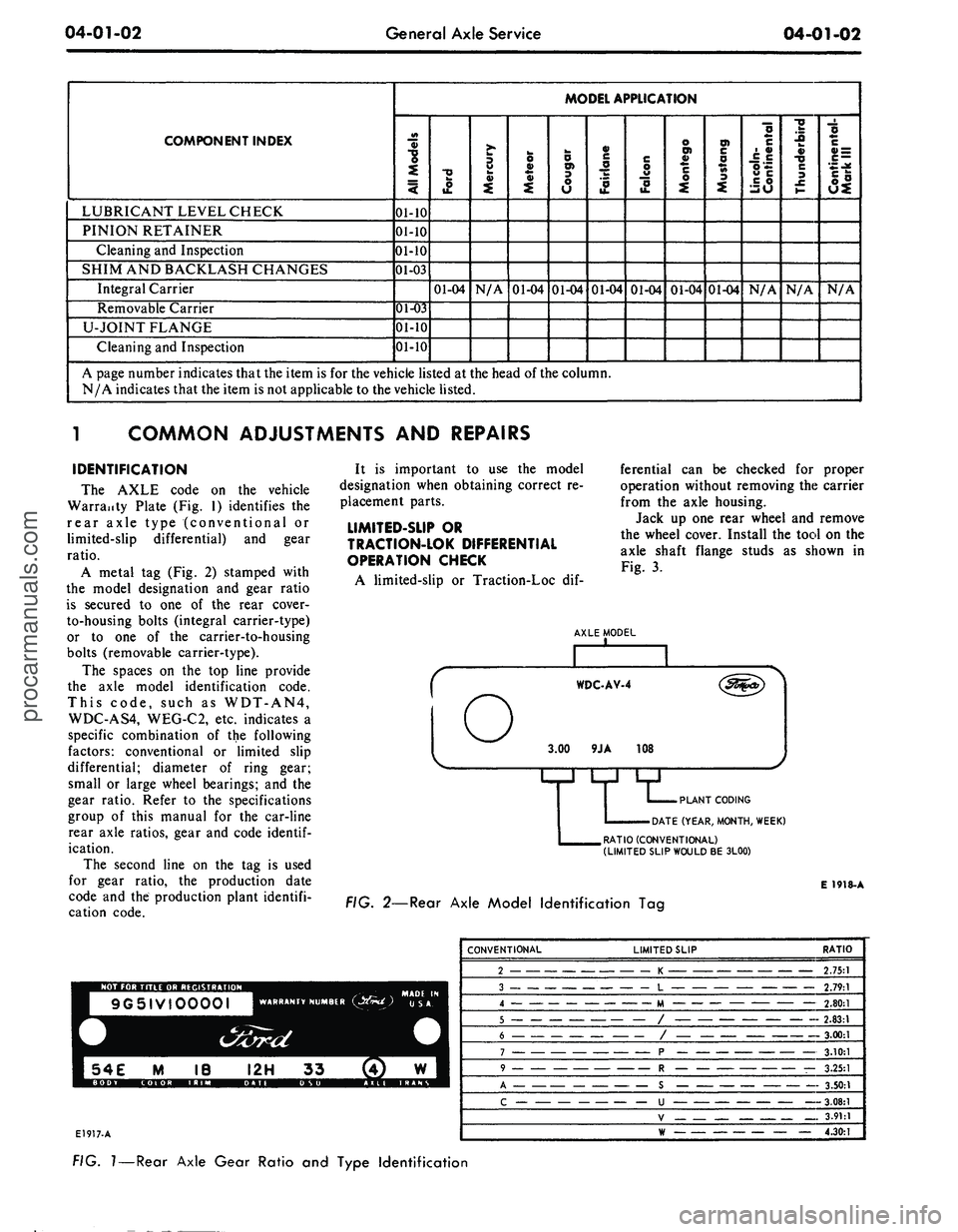
The AXLE code on the vehicle
Warranty Plate (Fig. 1) identifies the
rear axle type (conventional or
limited-slip differential) and gear
ratio.
A metal tag (Fig. 2) stamped with
the model designation and gear ratio
is secured to one of the rear cover-
to-housing bolts (integral carrier-type)
or to one of the carrier-to-housing
bolts (removable carrier-type).
The spaces on the top line provide
the axle model identification code.
This code, such as WDT-AN4,
WDC-AS4, WEG-C2, etc. indicates a
specific combination of the following
factors: conventional or limited slip
differential; diameter of ring gear;
small or large wheel bearings; and the
gear ratio. Refer to the specifications
group of this manual for the car-line
rear axle ratios, gear and code
identif-
ication.
The second line on the tag is used
for gear ratio, the production date
code and the production plant identifi-
cation code.
It is important to use the model
designation when obtaining correct re-
placement parts.
LIMITED-SUP
OR
TRACTION-LOK DIFFERENTIAL
OPERATION CHECK
A limited-slip or Traction-Loc dif-
ferential can be checked for proper
operation without removing the carrier
from the axle housing.
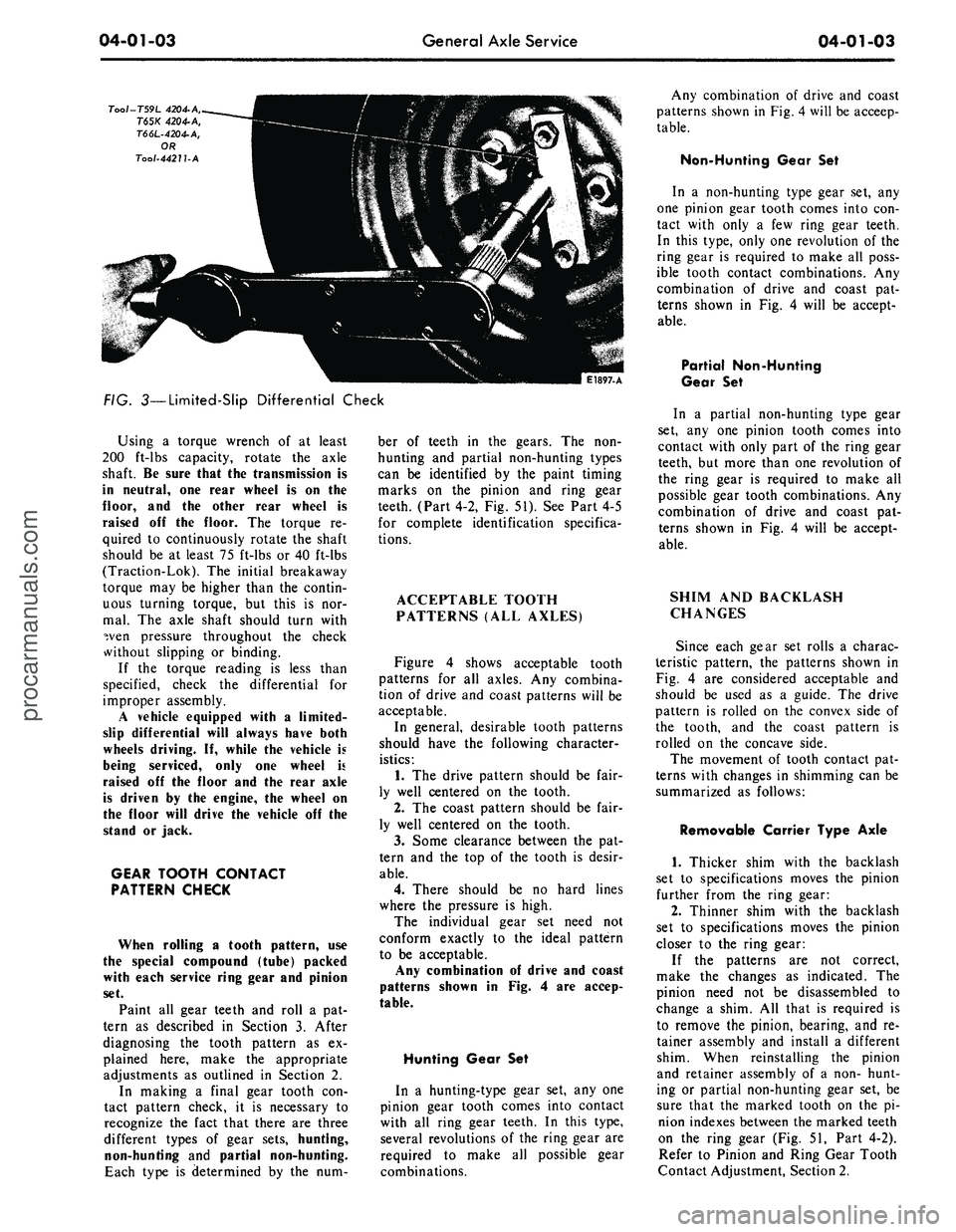
Jack up one rear wheel and remove
the wheel cover. Install the tool on the
axle shaft flange studs as shown in
Fig. 3.
AXLE MODEL
PLANT CODING
DATE (YEAR, MONTH, WEEK)
RATIO (CONVENTIONAL)
(LIMITED SLIP WOULD
BE
3L00)
E 1918-A
FIG.
2—Rear
Axle Model Identification
Tag
NOT
FOR
TITLE
OR
REGISTRATION
9G5IVI0000I
WARRANTY NUMBER
E1917-A
CONVENTIONAL
2
3
4
.
5
6
7
A
c
LIMITED SLIP
K
L
M
/
/
p
_ —
R
— —
c
—
u
V
RATIO
2.75:1
2.79:1
— 2.80:1
2.83:1
-
3.00:1
3.10:1
—
3.25:1
3.50:1
3.08:1
3.91:1
— 4.30:1
FIG.
1
— Rear Axle Gear Ratio
and
Type Identificationprocarmanuals.com
Page 190 of 413
04-01-03
General Axle Service
04-01-03
Tool-759L 4204-A,
T65K 4204-
A,
T66L-4204-A,
OR
Tool-44211-A
E1897-A
FIG. 3—Limited-Slip Differential Check
Using
a
torque wrench
of at
least
200 ft-lbs capacity, rotate
the
axle
shaft.
Be
sure that
the
transmission
is
in neutral,
one
rear wheel
is on the
floor,
and the
other rear wheel
is
raised
off the
floor.
The
torque
re-
quired
to
continuously rotate
the
shaft
should
be at
least
75
ft-lbs
or 40
ft-lbs
(Traction-Lok).
The
initial breakaway
torque
may
be
higher than
the
contin-
uous turning torque,
but
this
is nor-
mal.
The
axle shaft should turn with
^ven pressure throughout
the
check
without slipping
or
binding.
If
the
torque reading
is
less than
specified, check
the
differential
for
improper assembly.
A vehicle equipped with
a
limited-
slip differential will always have both
wheels driving.
If,
while
the
vehicle
is
being serviced, only
one
wheel
is
raised
off the
floor
and the
rear axle
is driven
by the
engine,
the
wheel
on
the floor will drive
the
vehicle
off the
stand
or
jack.
GEAR TOOTH CONTACT
PATTERN CHECK
When rolling
a
tooth pattern,
use
the special compound (tube) packed
with each service ring gear
and
pinion
set.
Paint
all
gear teeth
and
roll
a pat-
tern
as
described
in
Section
3.
After
diagnosing
the
tooth pattern
as ex-
plained here, make
the
appropriate
adjustments
as
outlined
in
Section
2.
In making
a
final gear tooth
con-
tact pattern check,
it is
necessary
to
recognize
the
fact that there
are
three
different types
of
gear sets, hunting,
non-hunting
and
partial non-hunting.
Each type
is
determined
by the num-
ber
of
teeth
in the
gears.
The non-
hunting
and
partial non-hunting types
can
be
identified
by the
paint timing
marks
on the
pinion
and
ring gear
teeth. (Part 4-2,
Fig. 51).
See
Part
4-5
for complete identification specifica-
tions.
ACCEPTABLE TOOTH
PATTERNS (ALL AXLES)
Figure
4
shows acceptable tooth
patterns
for all
axles.
Any
combina-
tion
of
drive
and
coast patterns will
be
acceptable.
In general, desirable tooth patterns
should have
the
following character-
istics:
1.
The
drive pattern should
be
fair-
ly well centered
on the
tooth.
2.
The
coast pattern should
be
fair-
ly well centered
on the
tooth.
3.
Some clearance between
the pat-
tern
and the top of the
tooth
is
desir-
able.
4.
There should
be no
hard lines
where
the
pressure
is
high.
The individual gear
set
need
not
conform exactly
to the
ideal pattern
to
be
acceptable.
Any combination
of
drive
and
coast
patterns shown
in Fig. 4 are
accep-
table.
Hunting Gear
Set
In
a
hunting-type gear
set, any one
pinion gear tooth comes into contact
with
all
ring gear teeth.
In
this type,
several revolutions
of
the
ring gear
are
required
to
make
all
possible gear
combinations.
Any combination
of
drive
and
coast
patterns shown
in
Fig.
4
will
be
acceep-
table.
Non-Hunting Gear
Set
In
a
non-hunting type gear
set, any
one pinion gear tooth comes into
con-
tact with only
a few
ring gear teeth.
In this type, only
one
revolution
of
the
ring gear
is
required
to
make
all
poss-
ible tooth contact combinations.
Any
combination
of
drive
and
coast
pat-
terns shown
in Fig. 4
will
be
accept-
able.
Partial Non-Hunting
Gear
Set
In
a
partial non-hunting type gear
set,
any one
pinion tooth comes into
contact with only part
of
the
ring gear
teeth,
but
more than
one
revolution
of
the ring gear
is
required
to
make
all
possible gear tooth combinations.
Any
combination
of
drive
and
coast
pat-
terns shown
in Fig. 4
will
be
accept-
able.
SHIM
AND
BACKLASH
CHANGES
Since each gear
set
rolls
a
charac-
teristic pattern,
the
patterns shown
in
Fig.
4 are
considered acceptable
and
should
be
used
as a
guide.
The
drive
pattern
is
rolled
on the
convex side
of
the tooth,
and the
coast pattern
is
rolled
on the
concave side.
The movement
of
tooth contact
pat-
terns with changes
in
shimming
can
be
summarized
as
follows:
Removable Carrier Type Axle
1.
Thicker shim with
the
backlash
set
to
specifications moves
the
pinion
further from
the
ring gear:
2.
Thinner shim with
the
backlash
set
to
specifications moves
the
pinion
closer
to the
ring gear:
If
the
patterns
are not
correct,
make
the
changes
as
indicated.
The
pinion need
not be
disassembled
to
change
a
shim.
All
that
is
required
is
to remove
the
pinion, bearing,
and re-
tainer assembly
and
install
a
different
shim. When reinstalling
the
pinion
and retainer assembly
of a
non-
hunt-
ing
or
partial non-hunting gear
set, be
sure that
the
marked tooth
on the pi-
nion indexes between
the
marked teeth
on
the
ring gear
(Fig.
51,
Part
4-2).
Refer
to
Pinion
and
Ring Gear Tooth
Contact Adjustment, Section
2.procarmanuals.com
Page 194 of 413

04-01-07
General Axle Service
04-01-07
Tool-4201-
C
Tool-6565 USED WITH BRACKET
FROM Too/^*207-C
FLANGE
E1743-A
procedure under Backlash and Differ-
ential Bearing Preload Adjustments.
If the tooth pattern indicates a change
in shim thickness, follow the proce-
dure under Pinion Location.
REMOVABLE CARRIER
TYPE AXLE
The shim location for the removable
carrier type axle is between the pinion
retainer and the carrier (Fig. 13).
When adjusting this type carrier re-
ducing shim thickness will move the
pinion toward the ring gear; increas-
ing shim thickness will move the pi-
nion away from the ring gear (Fig.
13).
FIG. 11—Checking Companion Flange Lateral Runout—
Thunderbird and Continental Mark III
INTEGRAL CARRIER
TYPE AXLE
8. If the runout is still excessive, re-
place the companion flange and check
the runout. If necessary, rotate the
new flange on the pinion shaft until an
acceptable runout is obtained.
If excessive runout is still evident
after replacement of the companion
flange, it will be necessary to replace
the ring and pinion gear, and repeat
the above checks until runout is within
specifications.
9. Install the driveshaft assembly
(Group 5).
PINION LOCATION
ADJUSTMENT
BACKLASH
ADJUSTMENT,
LEFT
ADJUSTING
NUT
E1476-A
FIG. 12—Pinion and Ring Gear
Tooth Contact Adjustment
—
Integral Carrier Type Axles
PINION AND RING GEAR
TOOTH CONTACT
ADJUSTMENT
Two separate adjustments affect pin-
ion and ring gear tooth contact.
They are pinion location and backlash
(Figs.
12 and 13).
Individual differences in matching
the differential housing and the gear
set require the use of shims to locate
the pinion for correct contact with the
ring gear.
When adjusting either type axle,
shim thickness should be increased or
reduced only as indicated by the tooth
pattern check described in the fore-
going Section 1.
If the tooth pattern check indicates
a change in backlash only, follow the
PINION
LOCATION
ADJUSTMENT
SHIMS
LEFT
ADJUSTING
NUT
RIGHT
ADJUSTING
BACKLASH NUT
ADJUSTMENT El 409-A
FIG. 13—Pinion and Ring Gear
Tooth Contact Adjustment—
Removable Carrier Axles
The shim location for the integral
carrier type axle, is between the pi-
nion gear and the pinion rear bearing
cone (Fig. 12). When adjusting this
type axle, increasing shim thickness
moves the pinion toward the ring
gear; reducing shim thickness moves
the pinion away from the ring gear
(Fig. 12).
BACKLASH AND DIFFERENTIAL
BEARING PRELOAD
ADJUSTMENTS (ALL AXLES)
On a Light-Duty (WER) Axle, it is
necessary to remove the rear axle
shafts prior to performing the adjust-
ment procedures. Refer to Rear Axle
Shaft Wheel Bearing and Oil Seal Re-
placement—Light-Duty (WER), Axle,
Part 4-4, Section 2.
To secure a more uniform control
of differential side bearing preload in
service repairs, a dial indicator set-up
such as shown in Fig. 12 is used.
In both types of axle (Fig. 11 and
12),
the ring gear is moved away from
or toward the pinion as described in
the following procedure.
1.
Remove the adjusting nut locks,
loosen the differential bearing cap
bolts,
then torque the bolts to 15 ft-lbs
on integral carrier type axle; 20 ft-lbs
on removable carrier type axles before
making adjustments.
2.
The left adjusting nut is on the
ring gear side of the carrier. The right
nut is on the pinion side. Loosen the
right nut until it is away from the cup.
Tighten the left nut until the ring gear
is just forced into the pinion with
0.000 backlash then rotate the pinion
several revolutions to be sure no bind-
ing is evident. (Recheck the right nutprocarmanuals.com
Page 200 of 413

04-02-03
Rear Axle — Removable Carrier Type
04-02-03
is,
it is supported by bearings both in
front of and to the rear of the pinion
gear. Two opposed tapered roller
bearings support the pinion shaft in
front of the pinion gear with a col-
lapsible spacer for 8-3/4 inch or 9
inch ring gear, and a solid spacer used
with the 9 3/8 inch ring gear. A
straight roller (pilot) bearing supports
the pinion shaft at the rear of the pi-
nion gear. Pinion and ring gear tooth
contact is adjusted by adding or re-
moving shims from between the pinion
retainer and the carrier housing.
The differential assembly is mount-
ed on two opposed tapered roller
bearings, which are retained in the
carrier by removable caps. The entire
carrier assembly is bolted to the axle
housing.
Ball bearing assemblies (rear wheel
bearings) are pressed onto the outer
ends of the axle shafts and set in the
outer ends of the axle housing. These
bearings support the semi-floating
axle shafts at the outer ends. The
inner ends of the shafts spline to the
differential side gears. Bearing retain-
er plates hold the shafts in the hous-
ing. The left and right axle shafts are
not interchangeable, the left shaft
being shorter than the right.
CASE
COVER
BELLEVILLE
SPRING
CLUTC
HUB
STEEL
PLATES
BONDED
PLATES
E1741-A
FIG. 2—Limited-Slip Differential
LIMITED-SUP DIFFERENTIAL
The axle assembly, except for the
differential case and its internal com-
ponents, is identical to the convention-
al axle.
A constant-friction locking differen-
tial,
which employs clutch plates to
control differential action, is available
as optional equipment (Fig. 2).
Four steel clutch plates are locked
into the differential cover. Three
bronze, bonded clutch plates are
splined to a clutch hub which, in turn,
is splined to the left axle shaft. A
Belleville spring washer maintains a
constant pressure between the steel
and bonded clutch plates so that the
clutch is always engaged.
TRACTION-LOK
DIFFERENTIAL
The Traction-Lok (torque sensitive)
locking differential (Fig. 3) employs a
multiple disc clutch to control differ-
ential action. Shim(s), which control
side gear mounting distance, four
steel, four friction and one composite
plate (steel on one side and friction
material on the other) stacked on a
clutch hub, and four ear guides are
housed in the differential cover. Lo-
cated in the differential case between
the side gears is a one-piece pre-load
plate and block (four-pinion) and four
calibrated pre-load springs, which
apply an initial force to the clutch
pack. Additional clutch capacity is
derived from the side gear thrust
loads.
The four friction plates are
splined to the clutch hub which in turn
is splined to the left axle shaft, and
the eared steel plates are dogged to
the case; thus, the clutch is always en-
gaged.
PINION SHAFT
4211
PINION SHAFT
RETAINING PINS
359475-S
DIFFERENTIAL
CASE-4204
CASE-TO-COVER
RETAINING SCREWS
50025-S2
SIDE GEAR
THRUST WASHER
4228
CENTER BLOCK
(SHORT PINION PINION
SHAFT SEAT) SHAFT
4420 44207
7
PINION GEAR
THRUST WASHER
4230
PINION GEARS
4215
PINION GEAR
THRUST WASHER
4230
PINION SHAFT
44207
SHIM(S)
(AS REQ'D.)
4A324
DIFFERENTIAL
CASE COVER
4204
PINION GEAR
THRUST WASHER
4230
PRE-LOAD SPRING
PINION GEAR PLATE-4A326
THRUST WASHER
4230
CLUTCH PLATE
EAR GUIDES
(4)
4A323
E 1896-A
FIG. 3—Traction-Lok Differentialprocarmanuals.com
Page 257 of 413
05-02-03
General Clutch Service
05-02-03
in the direction of the face runout
arrow and its center line is parallel to
the center line of the face runout
arrow.
18.
Determine the amount of the
face runout on the B arrow scale.
19.
The value of the circular line
beneath the amount of face runout
will be the desired reading. If the
reading is in excess of 0.014 inch the
housing alignment is unacceptable.
20.
Remove the Dia-L-lgner gauge
from the flywheel housing.
21.
Install the spark plugs and con-
nect the wires.
ENGINE IN VEHICLE
Since any change in face alignment
will change bore alignment, it may be
possible to correct bore alignment by
changing face alignment. Face align-
ment can be changed by shimming be-
tween the flywheel housing and en-
gine.
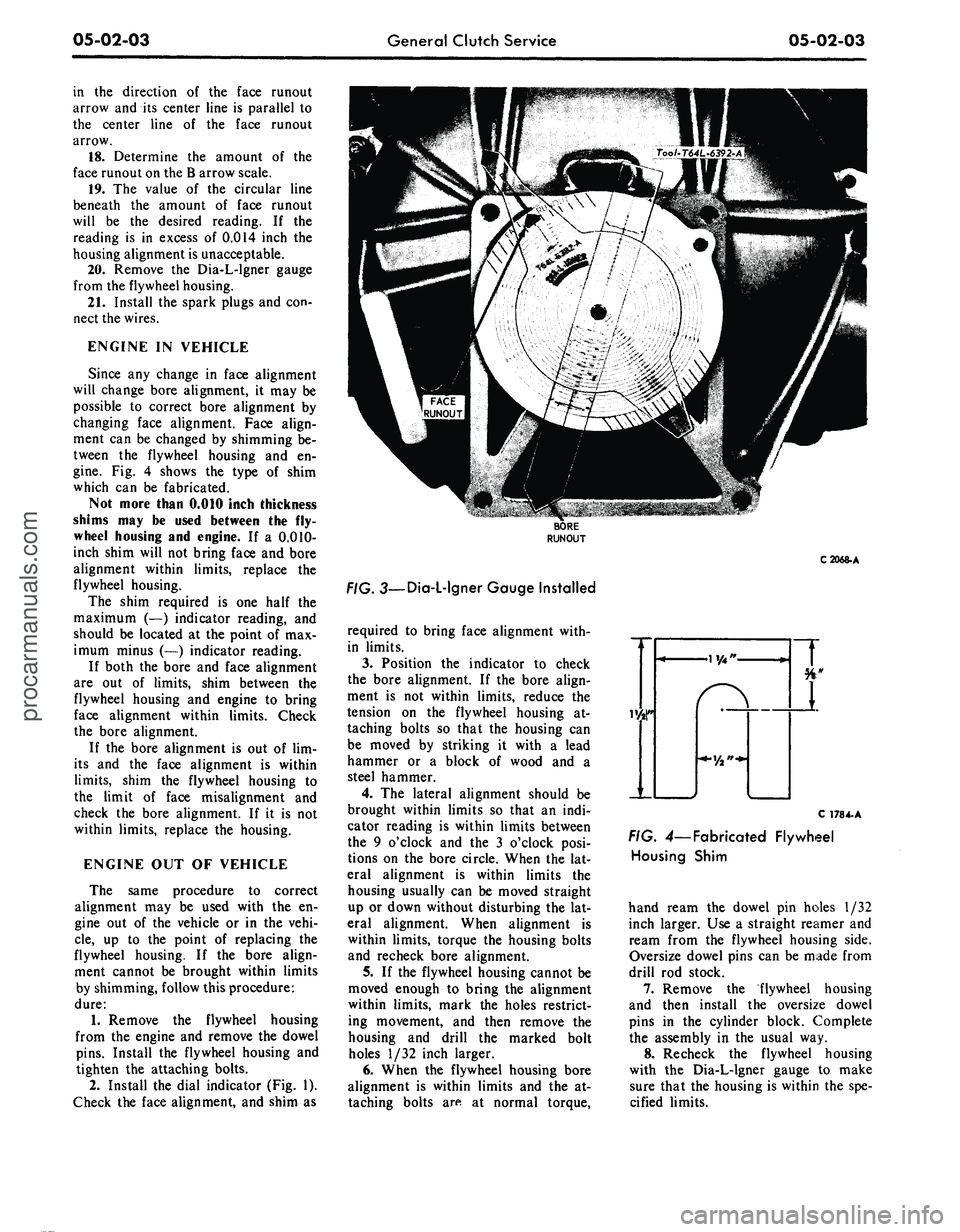
Fig. 4 shows the type of shim
which can be fabricated.
Not more than 0.010 inch thickness
shims may be used between the fly-
wheel housing and engine. If a 0.010-
inch shim will not bring face and bore
alignment within limits, replace the
flywheel housing.
The shim required is one half the
maximum (—) indicator reading, and
should be located at the point of max-
imum minus (—) indicator reading.
If both the bore and face alignment
are out of limits, shim between the
flywheel housing and engine to bring
face alignment within limits. Check
the bore alignment.
If the bore alignment is out of lim-
its and the face alignment is within
limits,
shim the flywheel housing to
the limit of face misalignment and
check the bore alignment. If it is not
within limits, replace the housing.
ENGINE OUT OF VEHICLE
The same procedure to correct
alignment may be used with the en-
gine out of the vehicle or in the vehi-
cle,
up to the point of replacing the
flywheel housing. If the bore align-
ment cannot be brought within limits
by shimming, follow this procedure:
dure:
1.
Remove the flywheel housing
from the engine and remove the dowel
pins.
Install the flywheel housing and
tighten the attaching bolts.
2.
Install the dial indicator (Fig. 1).
Check the face alignment, and shim as
C2068-A
. 3—Dia-L-lgner Gauge Installed
required to bring face alignment with-
in limits.
3.
Position the indicator to check
the bore alignment. If the bore align-
ment is not within limits, reduce the
tension on the flywheel housing at-
taching bolts so that the housing can
be moved by striking it with a lead
hammer or a block of wood and a
steel hammer.
4.
The lateral alignment should be
brought within limits so that an indi-
cator reading is within limits between
the 9 o'clock and the 3 o'clock posi-
tions on the bore circle. When the lat-
eral alignment is within limits the
housing usually can be moved straight
up or down without disturbing the lat-
eral alignment. When alignment is
within limits, torque the housing bolts
and recheck bore alignment.
5.
If the flywheel housing cannot be
moved enough to bring the alignment
within limits, mark the holes restrict-
ing movement, and then remove the
housing and drill the marked bolt
holes 1/32 inch larger.
6. When the flywheel housing bore
alignment is within limits and the at-
taching bolts are at normal torque,
C 178 4-A
FIG. 4— Fabricated Flywheel
Housing Shim
hand ream the dowel pin holes 1/32
inch larger. Use a straight reamer and
ream from the flywheel housing side.
Oversize dowel pins can be made from
drill rod stock.
7.
Remove the flywheel housing
and then install the oversize dowel
pins in the cylinder block. Complete
the assembly in the usual way.
8. Recheck the flywheel housing
with the Dia-L-lgner gauge to make
sure that the housing is within the spe-
cified limits.procarmanuals.com