1967 CHEVROLET CAMARO drain bolt
[x] Cancel search: drain boltPage 308 of 659

ENGINE COOLING 6K-3
Fig.
2— Replacing Thermostat
Water Pump
Removal
1.
Drain radiator and break loose the fan pulley bolts.
2.
Disconnect heater hose, lower radiator hose and
by pass hose (as required) at water pump.
3.
Loosen Delcotron and remove fan belt then remove
fan bolts, fan and pulley.
4.
Remove pump to cylinder block bolts and remove
pump from engine.
NOTE:
On in line engines, pull the pump
straight out of the block first, to avoid damage
to impeller.
Installation
1.
Install pump assembly on cylinder block and tighten
bolts securely. Use on new pump to block gasket(s).
2.
Install pump pulley and fan on pump hub and tighten
bolts securely.
NOTE:
A guide stud (5/16"-24 x 1-1/2" bolt
with the head removed) installed in one hole of
the fan hub will aid in aligning hub, pulley and
fan.
Remove stud after starting the remaining
three bolts.
3.
Connect hoses and fill cooling system.
4.
Install fan belt and adjust as previously outlined.
5. Start engine and check for leaks.
CHEVROLET CHASSIS SERVICE MANUAL
Page 367 of 659

CLUTCH AND TRANSMISSIONS 7-3
DETENT CAM
DETENT SPRING
DETENT CAM
2-3 SHIFT
FORK
DETENT CAM
PIVOT PIN
1ST & REV. 1ST& REV.
SHIFTER SHAFT SHIFT FORK
DETENT CAM
RETAINER RING
2-3 SHIFTER SHAFT
Fig. 3A
•*
Transmission Side Cover, Shift Fork and Detent Assembly
5. Reinstall propeller shaft and any items removed to
obtain clearance.
TRANSMISSION SIDE COVER
Removal •
1.
Disconnect control rods from levers; remove 2-3
cross shaft (Chevrolet)
2.
Shift transmission into neutral detent positions before
removing cover.
3.
Remove cover assembly from transmission case
carefully and allow oil to drain.
Disassembly (Fig. 3A)
1.
Remove the outer shifter levers.
2.
Remove both shift forks from shifter shaft assem-
blies.
Remove both shifter shaft assemblies from
cover. "OM ring seals around shifter shaft may now
be pryed out if replacement is required because of
damage.
3.
Remove detent cam spring and pivot retainer "C"
ring. Remove both detent cams.
4.
Replace damaged parts.
Assembly (Fig. 3A)
1.
With,
detent spring tang projecting up over the
2nd
and
3rd shifter shaft cover opening install the first and
reverse detent cam onto the detent cam pivot pin.
With the detent spring tang projecting up over the
first and reverse shifter shaft cover hole install the
2nd an£ 3rd detent cam.
2.
Install detent cam retaining "C" ring to pivot shaft,
and hook spring into detent cam notches.
3.
Install both shifter shaft assemblies in cover being
careful not to damage seals. Install both shift forks
to shifter shaft assemblies^ lifting up on detent cam
to allow forks to fully seat into position.
4.
Install outer shifter levers, flat washers, lock wash-
ers and bolts.
Installation
1.
Shift shifter levers into neutral detent (center) posi-
tion.
Position cover gasket on case.
2.
Carefully position side cover into place making sure'
the shift forks are aligned with their respective
mainshaft clutch sliding sleeves.
3.
Install cover attaching bolts and tighten evenly to
specified torque.
4.
Remove filler plug and add lubricant specified in
Section 0, to level of filler plug hole.
COMPONENT PART REPLACEMENT
TRANSMISSION REPLACEMENT (EXC. CORVETTE)
Removal From Vehicle
1.
Remove propeller shaft assembly.
2.
Disconnect speedometer cable at transmission.
3.
Disconnect shifter rods at transmission levers.
4.
Support engine assembly.
5. Remove transmission to clutch housing bolts.
6. Remove transmission crossmember to mount bolts.
7. Loosen transmission crossmember and move rear-
ward or remove.
8. Slide transmission rearward and remove.
Installation in Vehicle
1.
Raise transmission into position and slide forward
piloting clutch gear retainer into clutch housing.
2.
Install transmission to clutch housing retaining bolts
and lock washers, torque to 50 ft. lbs.
3.
Repositioning transmission crossmember and install
retaining bolts.
4.
Install transmission crossmember to mount bolts.
5. Connect and adjust shift rods at transmission levers
and cordon shaft to 2nd and 3rd lever on Chevrolet
Models. (Fig. 4A)
Fig. 4A - Chevrolet 2-3 Shift Lever Cordon Shaft
CHEVROLET CHASSIS SERVICE MANUAL
Page 378 of 659

CLUTCH AND TRANSMISSIONS 7-19
2.
With handle in full down position—adjust cable to ac-
quire dimension shown, be certain that cable is pulled
taut.
3.
Tighten set screw to 15-20 in. lbs.
4.
Bend excess wire and cut - be certain that wire does
not interfere with I.D. of lever or threads of shifter
knob.
NOTE: Handle must return freely from any
position.
SPEEDOMETER DRIVEN GEAR AND OIL SEAL
Replacement
Disconnect speedometer cable, remove retainer to
housing bolt and lock washer and remove retainer. In-
sert screw driver in slot in fitting and pry fitting, gear
and shaft from housing. Pry "O" ring in groove in fitting.
Install new "O" ring in groove and insert shaft Hold
the assembly so slot in fitting is toward boss on housing
and install in housing. Push fitting into housing until re-
tainer can be inserted in groove and install retainer lock
washer and bolt.
Fig.
5M - Installing Side Cover Assembly
TRANSMISSION SIDE COVER
Removal
1.
Disconnect control rods from levers.
2.
Shift transmission into second speed before removing
cover, by moving 1-2 (Rear Cover) shifter lever into
forward detent position.
3.
Remove cover assembly -from transmission case
carefully and allow oil to drain.
Disassembly (Fig. 4M)
1.
Remove the outer shifter lever nuts,*lock washers
and flat washers. Pull levers from shafts.
2.
Remove both shift forks from shifter shaft and detent
plate assemblies. Remove both shifter shaft assem-
blies from cover. Lip seals in side cover may now
be pryed out if replacement is required because of
damage.
1-2 DETENT CAM DETENT SPRING
3-4 DETENT CAM
1-2 SHIFTER SHAFT
1-2 SHIFT FORK
3-4 SHIFT
FORK
DETENT CAM \ 3-4 SHIFTER SHAFT
RETAINER RING
DETENT CAM PIVOT PIN
3.
Remove detent cam spring and pivot retainer "C"
ring. Remove both detent cams.
4.
Replace necessary parts.
Assembly (Fig. 4M)
1.
Install 1-2 detent cam to cover pivot pin first, then
install 3-4 detent cam so the detent spring notches
are offset or opposite each other. Detent cam
notches must be facing downward.
2.
Install detent cam retaining "C" ring to pivot shaft,
and hook spring into detent cam notches.
3.
Install both shifter shaft assemblies in cover being
careful not to damage lip seals. Install both shift
forks to detent plates, lifting up on detent cam to
allow forks to fully seat into position.
4.
Install outer shifter levers, flat washers, lock wash-
ers and nuts.
Installation (Fig. 5M)
1.
Shift 1-2 shifter lever into second speed (forward)
position. Position cover gasket on case.
2.
Carefully position side cover into place making sure
the shift forks are aligned with their respective
mainshaft clutch sliding sleeves.
3.
Install cover attaching bolts and tighten evenly to
15-20 ft. lbs. torque.
4.
Remove filler plug and add lubricant specified in
Section 0, to level of filler plug hole.
EXTENSION OIL SEAL
Replacement
1.
Remove propeller shaft.
2.
Pry out the extension oil seal.
3.
Prelubricate between sealing lips and press new oil
seal carefully into place in extension using J-5154 or
similar tool.
Fig.
4M - Transmission Side Cover/ Shift Fork and
Detent Assembly
CAUTION: Do not excessively force the seal
against the seat in the extension.
CHEVROLET CHASSIS SERVICE MANUAL
Page 383 of 659

CLUTCH AND TRANSMISSIONS 7-24
is at the full mark on the dip stick, it is just slightly be-
low the planetary gear unit. If additional oil is added,
bringing the oil level above the full mark, the planetary
unit will run in the oil, foaming and aerating the oil. This
aerated oil carried through the various oil pressure pas-
sages (low servo, reverse servo, clutch apply, converter,
etc.) may cause malfunction of the transmission assem-
bly, resulting in cavitation noise in the converter and
improper band or clutch application. Overheating may
also occur.
If the transmission is found consistently low on oil, a
thorough inspection should be made to find and correct
all external oil leaks.
PERIODIC OIL CHANGE
The transmission oil should be changed periodically as
recommended in Section 0, and whenever transmission is
to be removed from the vehicle for repairs.
1.
Run engine for one minute in neutral prior to chang-
ing.
2.
Be sure vehicle is level or raise from the rear only.
3.
Remove the oil pan drain plug and allow oil to drain
thoroughly into a pan or can.
Replace drain plug and refill with approximately two
quarts of oil specified in Section 0.
NOTE: To refill the transmission, remove dip
stick from oil filler tube and refill transmission
with oil specified in Section 0 using filler tube
and funnel J-4264. Then, after shifting into all
ranges at idle speed to fill all oil passages, the
engine should be run at 800-1000 rpm with the
transmission in Neutral until the oil warms up,
then add oil as required to raise the fluid level
to the full mark on the dip stick. Refill capacity
is approximately 2 qts.
4.
Fig.
1PG - Adjusting Low Band Using J-21848
PERIODIC LOW BAND ADJUSTMENT (Fig. 1PG)
Low band adjustment should be periodically performed
at 12,000 mile intervals, or sooner, as necessary if op-
erating performance indicates low band slippage.
1.
Raise vehicle and place selector lever in neutral.
2.
Remove protective cap from transmission adjusting
screw.
3.
a. On Corvette Models: Drop left exhaust pipe for
clearance.
b.
On Chevelle Models: To gain clearance between
underbody and transmission, it may be necessary
to remove rear mount bolts from crossmember,
and move transmission slightly toward passenger
side of vehicle. .
4.
Loosen adjusting screw lock nut 1/4 turn and hold in
this position with wrench.
5.
Using Special Tool J-21848 adjust band to 70 in. lbs.
and back off four (4) complete turns for a band which
has been in operation for 6,000 miles or more,.or
three (3) turns for one in use less than 6,000 miles.
CAUTION: Be sure to hold the adjusting screw
lock nut at 1/4 turn loose with a wrench during"
the.adjusting procedure.
6. Tighten the adjusting screw lock nut to specified
torque.
CAUTION: The amount of back-off is not an
approximate figure, it must be exact.
MANUAL SHIFT LINKAGE CHECK & ADJUST
(Column Type)
1.
The shift tube and lever assembly must be free in the
mast jacket. See Section 9 for alignment of steering
column assembly if necessary.
2.
To check for proper shift linkage adjustment, lift
the transmission selector lever towards the steering
wheel. Allow the selector lever to be positioned in
drive (D) by the transmission detent.
NOTE: Do not use the indicator pointer as a
reference to position the selected lever. When
performing linkage adjustment, pointer is ad-
justed last.
3.
Release the selector lever. The lever should be in-
hibited from engaging low range unless the lever is
lifted.
4.
Lift the selector lever towards the steering wheel,
and allow the lever to be positioned in neutral (N) by
the transmission detent.
5.
Release the selector lever. The lever should now
be inhibited from engaging reverse range unless the
lever is lifted.
6. A properly adjusted linkage will prevent the selector
lever from moving beyond both the neutral detent, and
the drive detent unless the lever is lifted to pass
over the mechanical stop in the steering column.
7.
In the event that an adjustment is required, place
the selector lever in drive (D) position as determined
by the transmission detent. See Steps 2 and 3.
8. Loosen the adjustment swivel at the cross-shaft,
and rotate the transmission lever so that it contacts
the drive stop in the steering column.
9. Tighten the swivel and recheck the adjustment. See
2 and 6.
CHEVROLET CHASSIS SERVICE MANUAL
Page 389 of 659
CLUTCH AND TRANSMISSIONS
7*30
V-8 Models-With Uni-Directional Linkage
1.
Remove air cleaner.
2.
Disconnect accelerator linkage at carburetor.
3.
Disconnect accelerator return and TV rod return
springs.
4.
With right hand, pull TV upper rod forward until
transmission is through detent. With left hand, open
carburetor to wide open throttle position. Carbure-
tor must reach wide open throttle position at the
same time the ball stud contacts end of slot in upper
TV rod.
5. Adjust swivel on end of upper TV rod to obtain set-
ting described in Step 4. Allowable tolerance is
approximately 1/32".
6. Connect and adjust accelerator linkage as described
in Section 6.
7. Check for throttle linkage freedom.
Neutral Safety Switch Adjustment
The adjustment at the neutral safety switch is de-
scribed in the Electrical Section 12.
Throttle Return Check Valve (Dashpot) Adjustment
The adjustment of the throttle return check valve is
described in Section 6M for each carburetor installation.
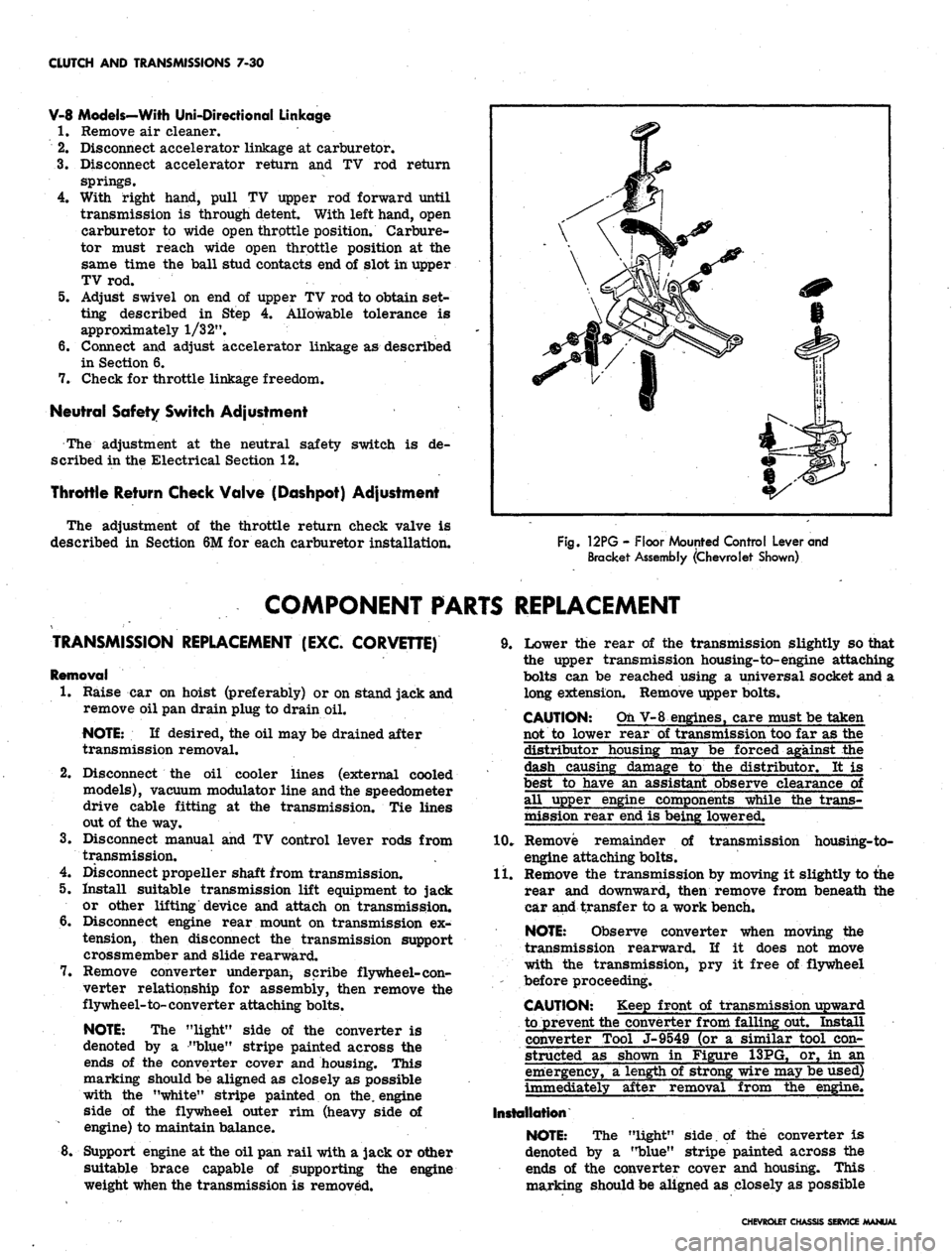
Fig.
12PG - Floor Mounted Control Lever and
Bracket Assembly (Chevrolet Shown)
COMPONENT PARTS REPLACEMENT
TRANSMISSION REPLACEMENT (EXC. CORVETTE)
Removal
1.
Raise car on hoist (preferably) or on stand jack and
remove oil pan drain plug to drain oil.
NOTE:
If desired, the oil may be drained after
transmission removal.
2.
Disconnect the oil cooler lines (external cooled
models), vacuum modulator line and the speedometer
drive cable fitting at the transmission. Tie lines
out of the way.
3.
Disconnect manual and TV control lever rods from
transmission.
4.
Disconnect propeller shaft from transmission.
5. Install suitable transmission lift equipment to jack
or other lifting device and attach on transmission.
6. Disconnect engine rear mount on transmission ex-
tension, then disconnect the transmission support
crossmember and slide rearward.
7. Remove converter underpan, scribe flywheel-con-
verter relationship for assembly, then remove the
flywheel-to-converter attaching bolts.
NOTE:
The "light" side of the converter is
denoted by a "blue" stripe painted across the
ends of the converter cover and housing. This
marking should be aligned as closely as possible
with the "white" stripe painted on the. engine
side of the flywheel outer rim (heavy side of
engine) to maintain balance.
8. Support engine at the oil pan rail with a jack or other
suitable brace capable of supporting the engine
weight when the transmission is removed.
9. Lower the rear of the transmission slightly so that
the upper transmission housing-to-engine attaching
bolts can be reached using a universal socket and a
long extension. Remove upper bolts.
CAUTION: Oh V-8 engines, care must be taken
not to lower rear of transmission too far as the
distributor housing may be forced against the
dash causing damage to the distributor. It is
best to have an assistant observe clearance of
all upper engine components while the trans-
mission rear end is being lowered.
10.
Remove remainder of transmission housing-to-
engine attaching bolts.
11.
Remove the transmission by moving it slightly to the
rear and downward, then remove from beneath the
car and transfer to a work bench.
NOTE:
Observe converter when moving the
transmission rearward. If it does not move
with the transmission, pry it free of flywheel
before proceeding.
CAUTION: Keep front of transmission upward
to prevent the converter from falling out. Install
converter Tool J-9549 (or a similar tool con-
structed as shown in Figure 13PG, or, in an
emergency, a length of strong wire may be used)
immediately after removal from the engine.
Installation
NOTE:
The "light" side, of the converter is
denoted by a "blue" stripe painted across the
ends of the converter cover and housing. This
marking should be aligned as closely as possible
CHEVROLET CHASSIS SERVICE MANUAL
Page 409 of 659

FUEL TANK AND EXHAUST SYSTEMS 8-3
CAUTION: Always drain gasoline from com-
plete fuel system including carburetor, fuel
pump and all fuel lines and fuel tank if the vehi-
cle is to be stored for any appreciable length of
time. This precaution will prevent accumulation
of gum formation and resultant poor engine
performance.
Removal and Installation (Except Station Wagon)
1.
Drain fuel tank.
2.
Raise vehicle.
3.
Disconnect fuel pickup line, ground wire.
4.
Disconnect meter wire at rear harness connector.
5. Disconnect vent pipe hose.
6. Remove tank support straps and lower tank carefully.
7. To install, reverse the removal procedure.
Removal and Installation (Station Wagon)
1.
Drain fuel tank.
2.
Raise vehicle.
3.
Remove gas tank shield at the back of the left rear
wheel; remove all screws including the screw
attachment at the bottom of the quarter panel.
4.
Disconnect fuel pickup line and gauge wires from
tank unit.
5. Remove ground wire attaching bolt at body location.
6. Remove strap assembly nut and carefully lower tank.
7. Reverse removal procedure to install.
FUEL LINES (Fig. 3)
The fuel lines extend from the fuel tank pickup to fuel
pump are routed on the underside of the right side of the
CAM
METER ASSY
GASKET
METER ASSY
ALL EXCEPT WAGONS
Fig.
4—Gauge Unit Assembly
CHEVROLET CHASSIS SERVICE MANUAL
Page 414 of 659

FUEL TANK AND EXHAUST SYSTEMS
8-8
CHEVELLE
FUEL TANKS
INDEX
Page
General Description.
g.g
Component Part Replacement
8-8
Fuel Tanks
. 8-8
Fuel Lines
8-8
Metering Units (Gauge, Sending Unit)
Fuel Tank Filler Neck Caps.
. .
Fuel Tank Vent Lines
Page
8-8
8-8
8-9
GENERAL DESCRIPTION
All models
use a 20
gallon capacity (approx.) fuel tank
mounted between
the
frame rails behind
the
rear axle.
The fuel tanks
are
basically
the
same
for
sedan, 2-seat
station wagon
and
pickup models except
for
filler neck
location
and
venting
(fig. 8).
All fuel tanks
are
vented
to the
atmosphere. Sedan
model tanks have
an
external vent hose and pipe assem-
bly
(fig. 11) and use a
non-vented fuel cap. Station wagon
and pickup model tanks
are
vented through
a
hose
and
vent pipe assembly
to the
filler neck
(fig. 8)
and
use a
vented, anti-surge type
gas cap. The
fuel caps
are two
different designs conforming
to SAE
standards
and are
not interchangeable.
The filler neck assembly
on
sedan models
is a
rear
fill design located behind
the
center
bar of the
bumper.
Station wagon
and
sedan pickup model filler neck assem-
blies
are
located
in
the left rear quarter panel.
The fuel pickup pipe
is
built integrally with
the
tank
gauge, located
at the
top-front center
of
the tank.
A
fine
mesh screen
is
located
at
the bottom-end
of the
fuel pick-
up pipe
to
prevent
the
entrance
of
foreign material into
the fuel system.
The sedan fuel tanks
are
held
in
place
by
two metal
straps attached individually
to the
underbody
at
each
end.
The straps hinge
at the
forward end and secure
the
tank
at
the
rear with
an
adjustable bolt
and nut
assembly.
The station wagon
and
pickup models have
a
frame
mounted fuel tank secured with straps
to
front and rear
supports.
COMPONENT PART REPLACEMENT
FUEL TANK
Draining Tank
The absence
of a
drain plug
in the gas
tanks makes
it
necessary
to
siphon fuel from
the
tank when draining
is
needed. Refer
to the
recommended draining procedures
previously outlined under Chevrolet Models
in
this
section.
Removal
and
Installation (Sedan Models)
1.
Raise vehicle.
2.
Drain fuel tank.
3.
Disconnect fuel pickup line
and
gauge wires from
tank unit.
4.
Disconnect vent hose from tank.
5. Remove tank support straps and lower tank carefully.
6.
To
install, reverse
the
removal procedure.
Removal
and
Installation
(Station Wagon
and
Pickup)
1.
Follow Steps
1
thru
3
outlined under sedan models.
2.
Remove tank support straps.
3.
Remove frame screw attachments from
the
front
support
(fig. 8).
4.
Guide tank forward
and
remove.
5.
To
install, reverse removal procedure.
FUEL LINES
The fuel lines, extending from fuel tank toiiuelpump,
are routed
on the
underside
of the
underbody along
the
right side
of the
vehicle opposite
the
single exhaust
sys-
tem.
The
fuel lines should occasionally
be
inspected
for
leaks,
kinks,
or
dents.
If
evidence
of
dirt
is
found
in the
carburetor
or
fuel pump
on
disassembly,
the
lines should
be disconnected
and
blown
out.
Check
the
fuel tank
strainer
for
damage
or
omission. Fuel lines
are of 5/16"
diameter tubing with beaded type ends
for
connections
of
hoses.
FUEL PIPE RETAINER
CUP
Removal
and
Installation
If fuel pipes
and
retainer clips
are
removed, Tool
J-7777 should
be
used
to
install
new
retainer clips
(fig.
10).
After removal
of the old
clip from
the
frame, position
the
new
clip
in the
location
of the old
clip. Index
the
"blind rivet"
and
press hard (hand pressure should
do)
to expand rivet.
GAUGE UNIT
AND
FUEL STRAINER
Removal
and
Installation
(Fig. 11)
1.
Drain tank
to a
level below
the
unit.
2.
Disconnect fuel pickup line
and
gauge unit wire.
3.
Use
special Tool J-8950
to
remove
cam
lock.
Re-
move unit
and
rubber gasket.
CAUTION: Carefully remove unit
so as not to
damage screen
on the end of
the pipe.
4.
Clean screen
by
blowing
out
with compressed
air.
5. Reverse procedure
to
install.
FUEL TANK FILLER NECK CAPS
The fuel tank filler neck caps
are
non-vented with
an
anti-surge feature. Station wagons have vented caps.
(Refer
to
"Fuel Tank Vent Lines").
CHEVROLET CHASSIS SERVICE MANUAL
Page 419 of 659
FUEL TANK
AND
EXHAUST SYSTEMS
8-13
CHEVY II
FUEL TANKS
INDEX
Page
Page
General Description.
8-13
Component Part Replacement
8-13
Fuel Tanks
8-13
Fuel Lines
8-14
Metering Units (Gauge Sending Unit)
8-13
Fuel Tank Filler- Neck Caps.
. . 8-14
Fuel Tank Vent Lines .......
8-14
GENERAL DESCRIPTION
ANTI-SQUEAK
MA'
ANTI-SQUEAK
MATERIAL
SEDANS
STATION WAGON
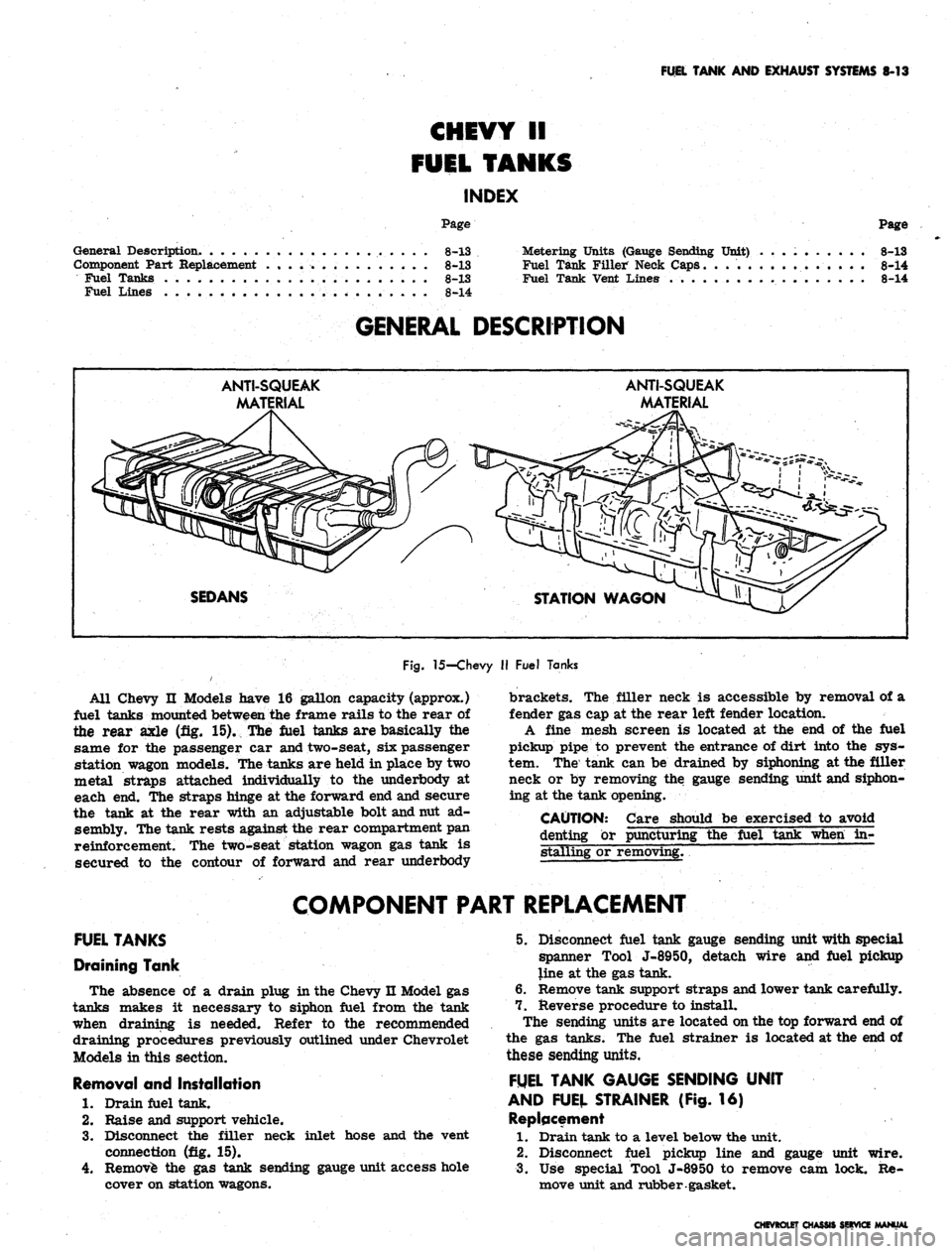
Fig.
15-Chevy
II
Fuel Tanks
All Chevy
II
Models have
16
gallon capacity (approx.)
fuel tanks mounted between
the
frame rails
to the
rear
of
the rear axle
(fig. 15). The
fuel tanks
are
basically
the
same
for the
passenger
car
and two-seat,
six
passenger
station wagon models. The tanks
are
held
in
place
by two
metal straps attached individually
to the
underbody
at
each
end. The
straps hinge
at the
forward
end
and secure
the tank
at the
rear with
an
adjustable bolt and nut
ad-
sembly. The tank rests against the rear compartment
pan
reinforcement.
The
two-seat station wagon
gas
tank
is
secured
to the
contour
of
forward
and
rear underbody
brackets.
The
filler neck
is
accessible
by
removal
of a
fender
gas cap at the
rear left fender location.
A fine mesh screen
is
located
at the end of the
fuel
pickup pipe
to
prevent
the
entrance
of
dirt into
the sys-
tem.
The
tank
can be
drained
by
siphoning
at the
filler
neck
or by
removing
the
gauge sending unit and siphon-
ing
at the
tank opening.
CAUTION: Care should
be
exercised
to
avoid
denting
or
puncturing
the
fuel tank when
in-
stalling
or
removing.
~
COMPONENT PART REPLACEMENT
FUEL TANKS
Draining Tank
The absence
of a
drain plug
in
the Chevy
n
Model
gas
tanks makes
it
necessary
to
siphon fuel from
the
tank
when draining
is
needed. Refer
to the
recommended
draining procedures previously outlined under Chevrolet
Models
in
this section.
Removal
and
Installation
1.
Drain fuel tank.
2.
Raise
and
support vehicle.
3.
Disconnect
the
filler neck inlet hose
and the
vent
connection
(fig. 15).
4.
Remove
the gas
tank sending gauge unit access hole
cover
on
station wagons.
5. Disconnect fuel tank gauge sending unit with special
spanner Tool J-8950, detach wire
and
fuel pickup
line
at the gas
tank.
6. Remove tank support straps and lower tank carefully.
7. Reverse procedure
to
install.
The sending units
are
located on
the top
forward
end of
the
gas
tanks.
The
fuel strainer
is
located
at the end of
these sending units.
FUEL TANK GAUGE SENDING UNIT
AND FUEL STRAINER
(Fig. 16)
Replacement
1.
Drain tank
to a
level below
the
unit.
2.
Disconnect fuel pickup line
and
gauge unit wire.
3.
Use
special Tool J-8950
to
remove
cam
lock.
Re-
move unit and rubber gasket.
CHEVROLET CHASSIS SERVICE MANUAL