1967 CHEVROLET CAMARO turn
[x] Cancel search: turnPage 616 of 659

ACCESSORIES 15-7
6. The car begins to descend a hill--car speed in-
creases slightly and the regulator movements oc-
curing above occur again except in reverse. The
rubber drum is turned further against spring tension
and the air bleed orifices are uncovered more. This
bleeds more air to the Servo reducing the vacuum in
the unit. The diaphragm moves away from the
vacuum port, closes the throttle slightly, and with-
draws the tapered needle from the vacuum orifice.
With the orifice enlarged, the increased vacuum
counteracts the increased air bleed and the dia-
phragm finds a balance again at a reduced throttle
opening.
7.
Driver accelerates by pressing accelerator pedal-
car speed increases and the system responds by
moving the diaphragm to decrease throttle opening.
Since a bead chain is used, the chain merely relaxes
and has no effect on throttle operation. After the
driver releases pressure from the pedal, the throttle
will close until car speed decreases to the pre-set
speed. At that point the Regulator bleeds less air
to the Servo which opens the throttle enough to
maintain the pre-set speed. The system returns to a
stable condition.
8. Driver desires higher controlled speed, presses ac-
celerator until new speed is reached, and depresses
Engagement Switch fully and releases button--speed
sensing assembly tries to turn in a direction that
would decrease the throttle opening until the driver
fully depresses the Engagement Switch. Then the
current is cut off to the solenoid which retracts; the
solenoid nose expands the "U" clip releasing its
grip on the rubber drum. The drum and disk as-
sembly then rotates to a new position because of the
higher car speed. When the solenoid retracts, it also
shuts off vacuum to the Servo and opens the vacuum
port to atmospheric pressure within the Regulator
thereby bleeding down the Servo toward idle throttle
position. As the driver releases the Engagement
Switch, the contacts cause "pull in" and "hold in" of
the solenoid respectively. The system is engaged to
maintain the car speed at the time of Engagement
Switch release.
9. Driver desires lower cruising speed, presses En-
gagement Switch fully, waits until car speed de-
creases to desired speed then releases Switch--when
the Engagement switch is fully depressed the sole-
noid is de-energized causing the vacuum switch to
bleed down the Servo to idle throttle position and the
"U"
clip of the idle bleed valve is released from the
rubber drum. The drum and disk assembly is free
to rotate to a position which corresponds to vehicle
speed as the car slows. When the driver releases
the Engagement Switch, the unit "pulls in" and "holds
in" in the normal manner. The air bleed valve is
clutched to, the rubber drum at the car speed during
switch release. Vacuum is again applied to the
Servo and throttle control is assumed by the Regu-
lator to maintain the car speed at the time of switch
release.
10.
With system in operation, driver applies brakes--
simultaneously the Vacuum Release and Electric
Release Switches operate. The Vacuum Switch
bleeds air into the Servo through the air bleed line
coming from the Regulator. The vacuum is reduced
in the Servo and the throttle returns to idle position.
The Electric Release Switch cuts off power to the
entire system and the solenoid is de-energized. If
the driver removes his foot from the brake pedal the
Electric Switch again feeds voltage to the Engage-
ment Switch and the Vacuum Switch seals the air
bleed line. If the vehicle speed is above 20 mph
when this occurs, reduced voltage will flow to the
solenoid through the 40 ohm wire which will not be
sufficient to "pull in" the unit. If vehicle speed is
below 20 mph no current will flow since the tang
on the rubber drum has opened the low limit switch
points in the Regulator. In either case, after de-
pressing the brake pedal, the system will not con-
trol car speed until the driver operates the engage-
ment switch above 20 mph.
SERVICE OPERATIONS
The components of the Cruise Master system are de-
signed to be replaced should they become inoperative.
The Regulator is calibrated in such a manner during
manufacturing that overhaul operations are impractical.
However, one adjustment may be made to the Regulator to
correct speed drop or increase at the time of
engagement.
BRAKE RELEASE SWITCHES
ELECTRIC
Service — An inoperative switch must be replaced.
Switch replacement is identical to standard brake lamp
switch replacement.
Adjustment- The brake switch plunger must clear the
pedal arm when the arm is moved 1/4 inch measured at
the switch (Figure 7).
VACUUM
Service
—
An inoperative (sticking, plugged, or leaking)
switch must be replaced. Switch replacement is similar
to brake switch replacement. Be certain that the hose to
the switch is connected firmly and is not cracked or
deteriorated.
Adjustment- The brake switch plunger must clear the
pedal arm when the arm is moved 5/16 inch measured at
the switch (Figure 7).
ENGAGEMENT SWITCH
Service
replacement.
The engagement is serviced only by
Removal
1.
Pry the engagement button out of the turn signal knob
with a small thin bladed screwdriver (Figure 2).
2.
With a small hook or long nosed pliers, remove the
switch retaining ring.
3.
.Pull switch outward utilizing the slack in the wiring
harness.
4.
With a small soldering iron, unsolder the wires and
resolder them to the correct terminals of the re-
placement switch.
CHEVROLET CHASSIS SERVICE MANUAL
Page 617 of 659

ACCESSORIES
15-8
BROWN
BRAKE
SWITCH
+12V *
BLACK
CONNECTOR
AT FUSE BLOCK
CRUISE POSITION
BUTTON RELEASED
ENGAGE POSITION
BUTTON PARTIALLY DEPRESSED^ N. ENOAOi SWITCH
TRIM POSITION N. N. I
BUHON FULLY DEPRESSED. \ ^
BROWN
BLUE
ENGAGE SWITCH
CONFIGURATION
BLACK
BLUE
REGULATOR
- SOLENOID COIL
(5 a RESISTANCE)
9 BLACK
BLUE
REGULATOR
Fig.
10 - Wiring Diagram
Replacement
1.
Insert the switch into the turn signal knob, push the
retaining ring firmly against the switch, and push the
operating button onto the switch plunger. " .
SERVO
Service
—
H the Servo unit is found to be defective, re-
placement is required. Note the condition of the hoses
and replace any which are cracked or deteriorated.
CHEVROLET CHASSIS SERVICE MANUAL
Page 618 of 659
ACCESSORIES 15-9
Adjustment- Adjust the bead chain so that it is as tight
as possible without holding the throttle open when the
carburetor is set at its lowest idle throttle position.
When connecting the bead chain (engine stopped) manually
set the fast idle cam at its lowest step and connect the
chain so that it does not hold the idle screw off the cam.
If the chain needs to be cut, cut it three beads beyond the
bead which pulls the linkage.
REGULATOR
Service - A defective regulator, that is one which is not
simply out of adjustment, must be replaced. During re-
placement, check the hoses which connect to the regulator
and replace any which are cracked or deteriorated.
Air Filter
The air filter located in the solenoid cover should be
cleaned and re-oiled at engine oil change intervals.
1.
Snap the solenoid cover off.
2.
Remove the filter and wash it in kerosene or mineral
spirits. Squeeze it dry and wet with SAE 10 engine
oil.
Squeeze out excess oil and reinstall into the
cover.
3.
Attach the cover with neoprene seal to the solenoid
housing. Be certain that the cover fits tightly to the
housing.
One regulator adjustment is possible: Engagement-
Cruising Speed Zeroing (to remove any difference be-
tween engagement and cruising speed).
NOTE:
No regulator adjustment should be
made, however, until the following items have
been checked or serviced:
1.
Bead chain properly adjusted.
2.
All hoses in good condition, properly attached, not
leaking, not pinched or kinked.
3.
Regulator air filter clean and properly oiled.
4.
Electric and vacuum release switches properly
adjusted.
Engagement—Cruising Speed Zeroing
If the cruising speed is lower than the engagement
speed, loosen the orifice tube locknut and turn the tube
outward; if higher, turn the tube inward. Each 1/8 turn
will alter the engagement-cruising speed difference one
mph. Tighten the locknut after adjustment and check the
system operation at 50 mph.
ELECTRICAL SYSTEM CHECK OUT
1.
Check fuse and connector.
2.
Check electric brake switch as follows: Unplug con-
nector at brake switch. Connect ohmmeter at points
A and B on brake switch. The ohmmeter must indi-
cate infinity when the brake pedal is depressed and
continuity when pedal is released. The cruise re-
lease brake switch (electric) is adjusted as is the
standard stop light brake switch. Replace electric
brake switch if needed.
3.
Check engagement switch and connecting wiring as
follows: Unplug push button control connector
(brown, blue, black) at electrical wiring harness con-
nector and perform the following tests. (See Fig-
ure 10)
Test #1
—
Connect ohmmeter between terminal #1 (brown
wire) and terminal #2 (blue wire). Continuity shall be
maintained until switch is depressed all the way in.
Test #2
—
Connect ohmmeter between terminal #1 (brown
wire) and terminal #3 (black). No continuity shall be
shown; however, when the button is depressed halfway,
continuity shall be indicated. When the button is pressed
all the way down, no continuity shall be shown.
Test #3 — Connect ohmmeter between terminal #2 (blue
wire) and terminal #3 (black). Button released, no con-
tinuity; however, when the button is depressed partially
and fully, continuity shall be shown.
4.
Check regulator solenoid coil, low-speed switch, and
wiring harness as follows:
a. Disconnect engagement switch wire harness con-
nector from the main wire harness connector
(brown, blue, and black wires). Connect ohm-
meter
'
between point C (blue wire in main wire
harness) and ground. (Make sure the regulator is
well grounded to chassis.) The ohmmeter should
read 45 ohms ± 2 ohms. If a resistance of
greater value is shown, then disconnect the con-
nector from the regulator and measure the re-
sistance of the blue wire from point C to D. It
should measure 40 ohms. Check the resistance
from point E (vertical bar of terminal forming T)
to ground. It should measure 5 ohms ± 1/4 ohm.
Replace either the wiring harness or solenoid as
needed if greater values are indicated. The black
harness wiring from point F to G should also be
checked for continuity.
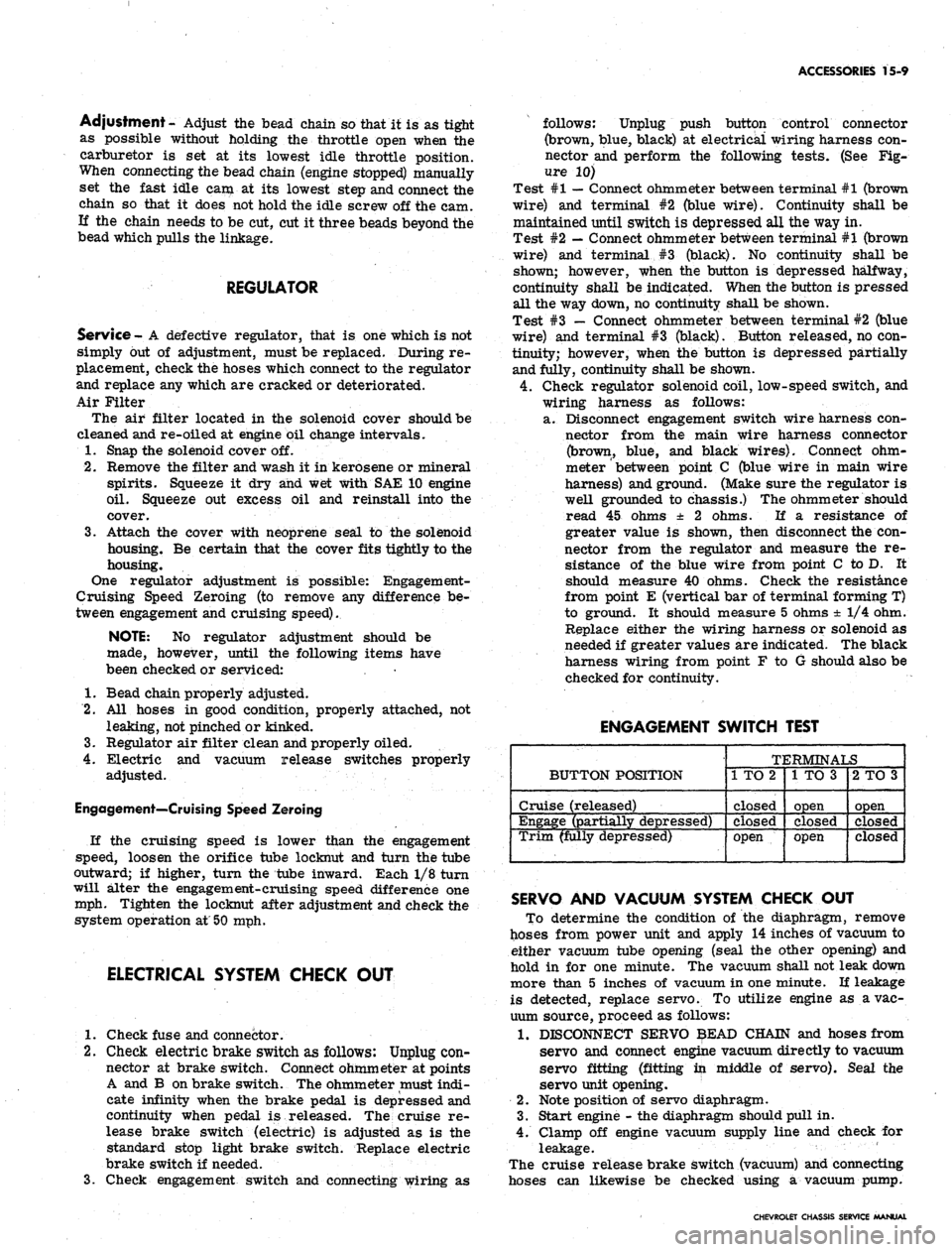
ENGAGEMENT SWITCH TEST
BUTTON POSITION
Cruise (released)
Engage (partially depressed)
Trim (fully depressed)
TERMINALS
1 TO 2
closed
Closed
open
1 TO 3
open
closed
open
2 TO 3
open
closed
closed
SERVO AND VACUUM SYSTEM CHECK OUT
To determine the condition of the diaphragm, remove
hoses from power unit and apply 14 inches of vacuum to
either vacuum tube opening (seal the other opening) and
hold in for one minute. The vacuum shall not leak down
more than 5 inches of vacuum in one minute. If leakage
is detected, replace servo. To utilize engine as a vac-
uum source, proceed as follows:
1.
DISCONNECT SERVO $EAD CHAIN and hoses from
servo and connect engine vacuum directly to vacuum
servo fitting (fitting in middle of servo). Seal the
servo unit opening.
2.
Note position of servo diaphragm.
3.
Start engine - the diaphragm should pull in.
4.
Clamp off engine vacuum supply line and check for
leakage. '
The cruise release brake switch (vacuum) and connecting
hoses can likewise be checked using a vacuum pump.
CHEVROLET CHASSIS SERVICE MANUAL
Page 622 of 659
ACCESSORIES 15-13
SYSTEM TEST
CHECKS AND ADJUSTMENTS
Automatic Level Control Test Gauge (Fig. 15)
A complete system test includes on and off-the-car
component tests.. '
On the car tests are:
Quick check of Automatic Level Control System
Compressor output test
Regulator test and adjustment
Control valve test
Time delay test
Line and fitting leak test
Trim adjustment
Off-the-car operations include:
Control valve replacement
Compressor repair
Component leak tests
a. Compressor, reservoir, and regulator
b.
Control valve
c. Superlifts
Quick Check-On Car (Reservoir Pressure at 150 PSI)
1.
Fill the fuel tank or simulate at the rate of 6 lbs./
gal.
- otherwise car should be empty.
2.
Turn engine off.
3.
Add a 2 passenger load to the rear bumper or tail-
gate.
Maintain the load until the -car lifts or AT
LEAST 20 SECONDS.
4.
After car lifts remove the load and observe until the
car lowers.
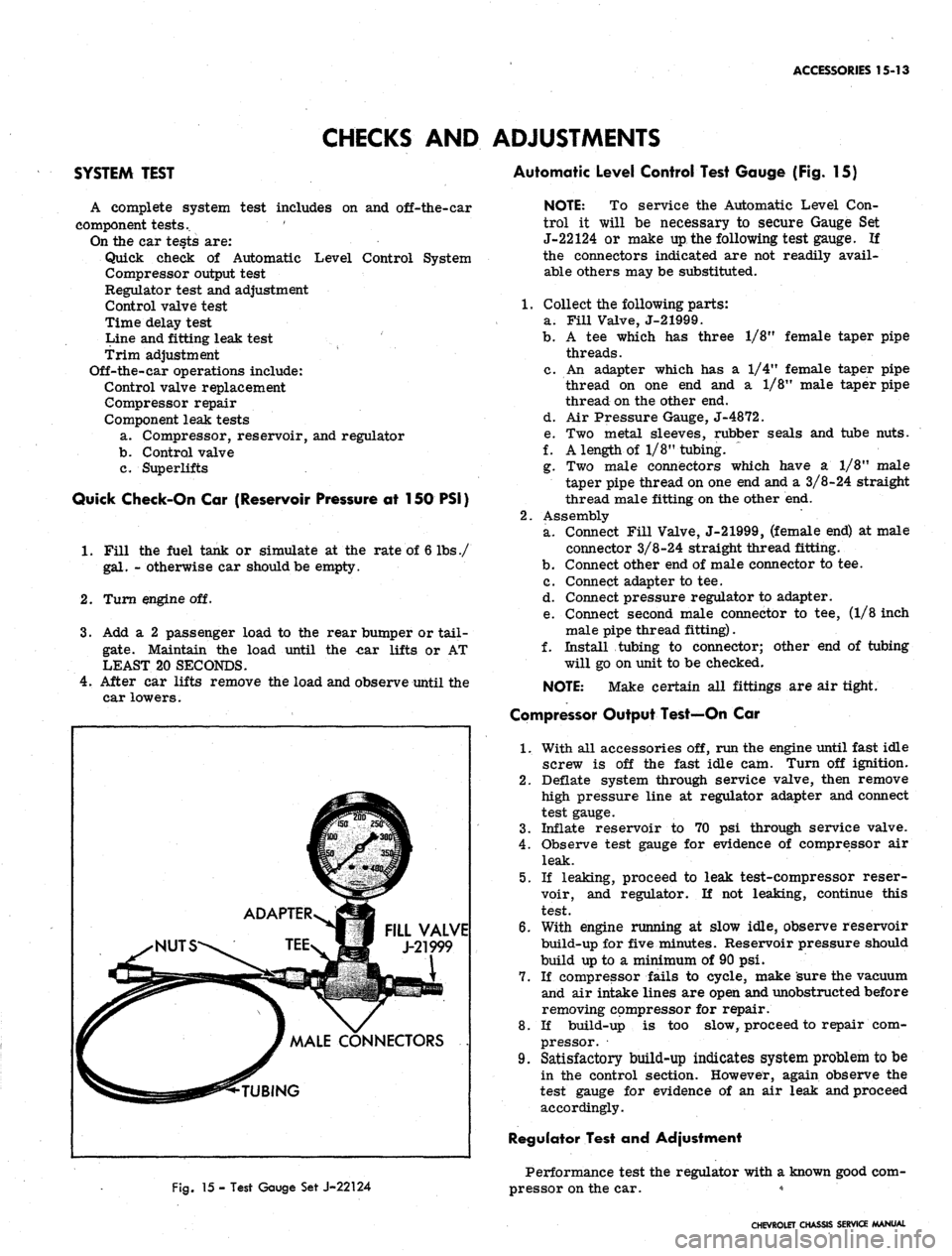
FILL VALVE
J-21999
CONNECTORS
Fig.
15 - Test Gauge Set J-22124
NOTE: To service the Automatic Level Con-
trol it will be necessary to secure Gauge Set
J-22124 or make up the following test gauge. If
the connectors indicated are not readily avail-
able others may be substituted.
1.
Collect the following parts:
a. Fill Valve, J-21999.
b.
A tee which has three 1/8M female taper pipe
threads.
c. An adapter which has a 1/4" female taper pipe
thread on one end and a 1/8" male taper pipe
thread on the other end.
d. Air Pressure Gauge, J-4872.
e. Two metal sleeves, rubber seals and tube nuts.
f. A length of 1/8" tubing. ~
g. Two male connectors which have a 1/8" male
taper pipe thread on one end and a 3/8-24 straight
thread male fitting on the other end.
2.
Assembly
a. Connect Fill Valve, J-21999, (female end) at male
connector 3/8-24 straight thread fitting.
b.
Connect other end of male connector to tee.
c. Connect adapter to tee.
d. Connect pressure regulator to adapter.
e. Connect second male connector to tee, (1/8 inch
male pipe thread fitting).
f. Install tubing to connector; other end of tubing
will go on unit to be checked.
NOTE:
Make certain all fittings are air tight.
Compressor Output Test—On Car
1.
With all accessories off, run the engine until fast idle
screw is off the fast idle cam. Turn off ignition.
2.
Deflate system through service valve, then remove
high pressure line at regulator adapter and connect
test gauge.
3.
Inflate reservoir to 70 psi through service valve.
4.
Observe test gauge for evidence of compressor air
leak.
5.
If leaking, proceed to leak test-compressor reser-
voir, and regulator. If not leaking, continue this
test.
6. With engine running at slow idle, observe reservoir
build-up for five minutes. Reservoir pressure should
build up to a minimum of 90 psi.
7.
If compressor fails to cycle, make sure the vacuum
and air intake lines are open and unobstructed before
removing compressor for repair.
8. If build-up is too slow, proceed to repair com-
pressor.
9. Satisfactory build-up indicates system problem to be
in the control section. However, again observe the
test gauge for evidence of an air leak and proceed
accordingly.
Regulator Test and Adjustment
Performance test the regulator with a known good com-
pressor on the car. *
CHEVROLET CHASSIS SERVICE MANUAL
Page 635 of 659

SPECIFICATIONS
8
Displacement
Horsepower
VALVE SYSTEM:
Lifter
Rocker
Arm
Ratio
Valve Lash
Intake
Exhaust
Face Angle
(Int.
&
Exh.
Seat Angle
(Int. & Exh.)
Seat Runout
(Int. & Exh.)
Seat Width
Stem
Clearani
Valve
Spring
(Outer)
Valve
Spring
(Inner)
Damper
Intake
Exhaust
Production
Int.
Exh.
Service
Free Length
Pressure
lbs.
@
in.
Closed
Open
Installed Height
±1/32"
Free Length
Pressure
lbs.
@
in.
Closed
Open
Installed Height
±1/32"
Free Length
Approx,# of Coils
153
90
194
120
230
140
250
155
283
195
327
210
275
300
325
350
350
295
39e
325
350
427
385
390
400
425
435
1.75:1
Hydraulic
1.50:1
One
One
Mechanical
1.70:1
Turn Down From Zero Lash
Turn Down From Zero Lash
.022"*
.024"*
.024"*
.028"*
...••:•:••
••-•. , 45« •
46°**
.002"
(Max.)
1/32" - 1/16"
1/16" - 3/32"
.0015"-.0032"
.0010"
-.0027"
.0010"-.0027"
<0010It-.0025"
.0012
'-.0027"
Hi Limit Production
+ .001"
Intake
- .002"
Exhaust
2.08"
78-86
@
1.66"
170-180
@
1.26"
1.92"
54-64 @
170-184
@
1.33"
1.90"
1.66"
180-
192
@
1.27"
1
21/32
2.03"
.
. N.A. ' ' .
N.A."
1
5/32
2.11"
84-96
@
1.88"
210-
230
@
1.46"
2.09"
94-106
...©••
1.88"
303-327
@
1.38"
1
2.21"
69-81
@
1.88"
181-205
@
1.32"
7/8
N.A.
1.94tf
4
N.A.
N.A.
N.A.
N.A.
N.A.
1,94"
4
: •
1.94"-2.00"
3
3/4
2.12"
37-45
@
1.78"
92-110
@
1.22"
13/4
2.07'*-
1.95
»
4
1/3
2.09"
94-106
®
1.88"
303-327
@
1.38"
N.A.
.
N.A.
NJl.
1.94"-
2.00"
3 3/4
*Engine at operating temperature and running.
••Aluminum Heads 45°
CHEVROLET CHASSIS SERVICE MANUAL
Page 636 of 659

CARTER
HOLLEY
Carburetor
One Barrel
YF
Four Barrel 4150
Four Barrel
4160
Two Barrel
2100
Prim.
Sec.
Prim,
Engine Displacement
(Horsepower)
153
250
194
230
250
230
250
194
327
(325)
427
(425)
327
(325
396
(350)
327
(300)
327
(350)
427
(390)
396
(350)
327
(300)
327
(350)
427
(390)
427
(400)
427
(435)
427
(400)
427
(435)
427
(400)
Transmission
Auto.
Syn.
Auto.
Syn.
Auto.
Syn.
Syn.
Syn.
Syn.
Syn.
Auto.
Syn.
All
Syn.
Auto.
Syn.
All
All
Syn.
All
Auto.
Part Number
(Mfg. Number)
i
I
sf
i
CO
52
2
1
8
Float
Level
Mechan-
ical
Primary
7/32"
.170"
.350"
170"
.350'
Secondary
.300"
.450'
.300'
Final
Use Sight Plug
Use Sight Plug
Float Drip
1-3/16"
Accelerator Pump
.015"
Idle Vent
Mechanical
.065"
.065'
Fast Idle
.025"
.035*
.025'
Final
2200
RPM
2000
RPM
2200
RPM
2000
RPM
2200
RPM
Choke, Vacuum Break
.220"
.240" .220"
.240"
,240f
.190"
.350'
.190'
.175'
.190"
.175"
.175'
,175f
.250"
.250"
Choke Unloader
.250"
.265"
.350"
.265"
.275'
.275"
Thermostat Choke
Rod
1/2
to 1 Rod
Diameter Interference
Secondary Stop
1/2 Turn After Contact
Main Meter-
ing
Jet
Primary
.096
.1015
.1015 .1023
.104
,104
#67
Secondary
#74
Metering
Rod
.0645
.047
Throttle Bore
.071
.049
.076
.051
.074
.048
.078
.051
.040
.078
.052
.045
#67
#72
#69
.073
#70
.073
#65
.076
#65
.073
#70
.073
#71
.073
#63
.076
#67
.073
#64
.076 #62
.078
.052
.045
Primary
1-11/16"
1-9/16
Secondary
1-9/16
1-3/4
1-3/4
1-9/16
1-9/16
1-1/2 1-3/4
1-1/2
i
With
Air
Injection Reactor System
#74
-
Choke Side.
#78 -
Throttle Lever Side
#82
-
Choke Side,
#80 -
Throttle Lever Side
Page 637 of 659

Carburetor
One Barrel
BV
ROCHESTER
Two Barrel
2GV
©
Quadra-Jet Four Barrel
4MV
©
Engine Displacement
(Horsepower)
194
194
230
230
250
250
283
327
(210)
283
327
(210)
283
327
(210)
283
327
(210)
283
327
(210)
283
327
(210)
283
327
(210)
283
327
(210)
327
(275)
350
(295)
327
(275)
350
(295)
396
(325)
427
(385)
(325)
427
(385)
327
(275)
350
(295)
327
(275)
350
(295)
396
(325)
427
(385)
396
(325)
427
(385)
Transmission
Auto
Syn.
Auto.
Syn.
Auto.
Syn.
Auto.
Syn.
Auto.
Syn.
Auto.
Auto.
Syn.
Auto,
Syn.
Auto,
Syn.
Auto.
Syn.
Auto.
Syn.
Part Number
to
•g
Float Level
1-9/32"
3/4"
9/32"
Float Drop
1-3/4"
1-3/4"
Accelerator Pump
1-1/8'
13/32"
Inner Hole
Idle Vent
.050'
3/8'
Fast Idle
Mechanical
3 Turns After Contact
Running
2200
RPM
2000
RPM
2200
RPM
2200
RPM
Carburetor Choke
Rod
90"
.100"
.90"
.100"
.90'
.100'
.060'
.100"
Choke Vacuum Break
140"
160"
.140" .160" .140" .160"
.110"
.120" .110" .120" .110" .130" .110
,130'
160"
.200"
.160" .240'
.160'
.200"
.16(F .240'
Choke Unloader
.350"
.215"
.260"
.300"
.260'
.300"
Thermostat Choke Rod
1/2 to 1 Rod Diameter Interference
1/2 to 1 Rod Diameter Interference
Air Valve Spring
7/8 Turn
Air Valve Lockout
.015"
(Auto. Trans. Only)
Secondary Opening
75%
Min. Contact (Syn. Trans. Only)
Secondary Lockout
.010"
(Syn.
Trans. Only)
Main Meter-
ing
Jet
Primary
059"
.060'
.058"
.059"
.058"
.060"
.052"
.054"
.052"
.054"
.052"
.054'
.052"
.054'
.071'
Throttle
Bore
Primary
1-9/16"
1-7/16"
1-3/8"
Secondary
2-1/4"
Air Valve Dashpot
.015"
With
Air
Injection Reactor System
With
Air
Conditioning
Page 639 of 659
SPECIFICATIONS
12
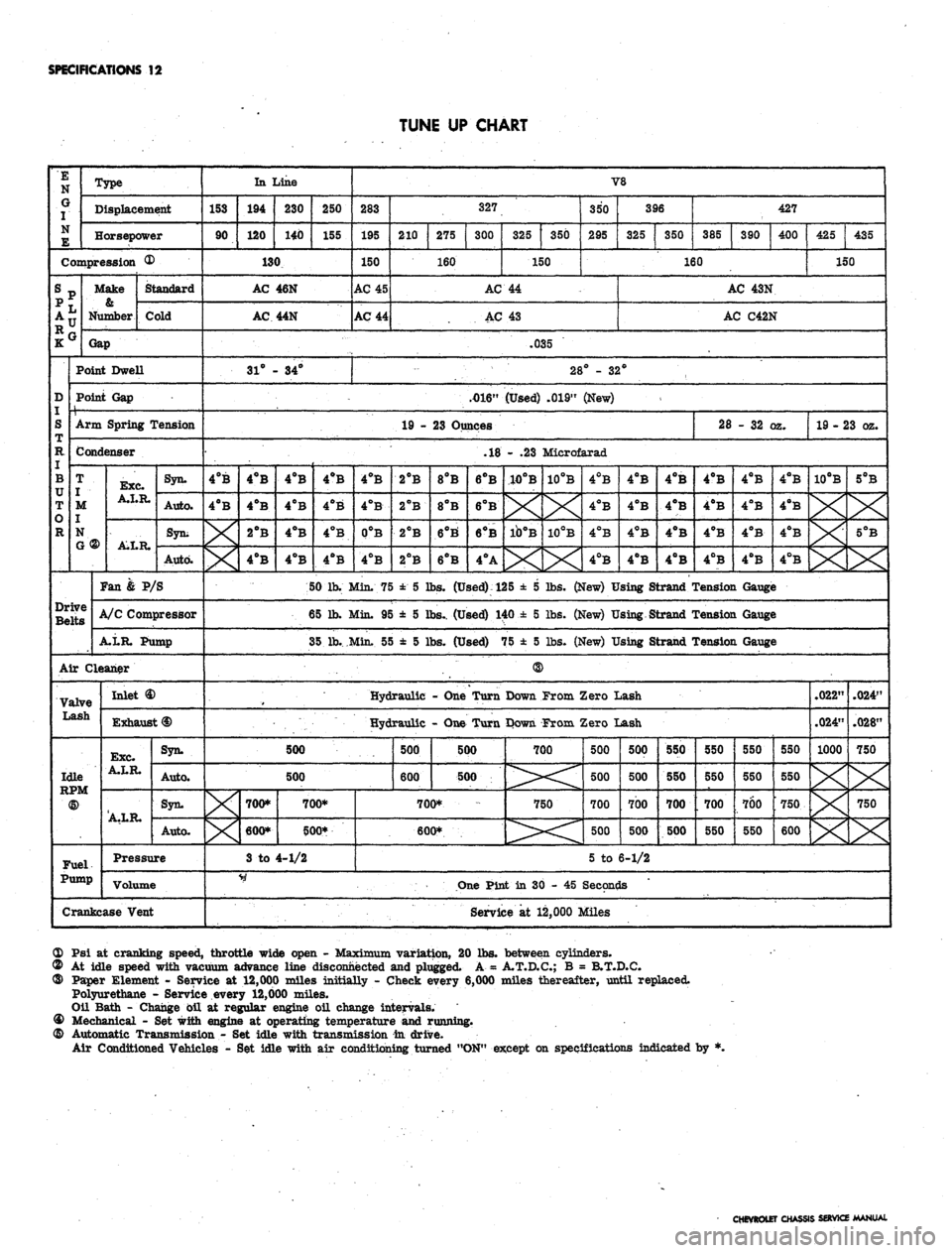
TUNE UP CHART
E
N
G
I
N
E
Type
Displacement
Horsepower
Compression ®
srp
;•
D
S
R
I
B
TT
T
o
R
Make
0.
Number
Standard
Cold
Gap
Point Dwell
Point Gap
1 ,
Arm Spring Tension
Condenser
T
I
M
j
N
G ®
Drive
Belts
Exc.
A.I.R.
AXR.
Syn.
Auto.
Syn;
Auto.
Fan & P/S
A/C Compressor
A.LR. Pump
Air Cleaner
Valve
Lash
Idle
<§>
Fuel.
Pump
Inlet
Exhaust
<§)
Exc.
A.LR.
A.LR.
Syn.
Auto.
Syn.
Auto.
Pressure
Volume
Crankcase Vent
In Line
153
90
194
120
230
140
250
155
130
AC
AC
31° -
46N
44N
• 34°
V8
283
195
150
AC 45
AC 44
327
210
275
300
160
325
350
150
350
295
396
325
350
427
385
390
400
160
AC 44
AC 43
425
435
150
AC 43N
AC C42N
.035
28° - 32°
.4)16"
(Used) .019" (New)
<
19 - 23 Ounces
4°B
4°B
4°B
4°B
2°B
4°B
4°B
4°B
4°B
4°B
28
- 32 (
yz.
19 - 23 oz.
.18 - .23 Microfarad
4°B
4°B
4°B
4ftB
4°B
4°B
0°B
4°B
50 lb. Min. 75
65 Jh. Min. 95
35 lb..Min. 5£
500
2°B
2°B
2°B
2°B
8PB
8°B
6°B'
6°B
6°B
6°B
6°B
4°A
10°B
X
ib°B
X
10PB
X
10°B
X
4°B
4°B
4°B
4°B
4°B
4°B
4°B
4°B
4°B
4°B
4°B
4°B
± 5 lbs.
(Used):
125 ± 5 lbs. (New) Using Strand '
± 5 lbs.. (Used) 140 ± 5 lbs. (New) Using Strand '
>
± 5 lbs. (Used) 75 ± 5 lbs. (New) Using Strand r
Hydraulic - One Turn Down From Zero Lash
Hydraulic - One Turn Down From Zero Lash
500
X
700*
600*
3 to
700*
500*
4-1/2
500
600
500
500
700*
600*
700
750
500
500
700
500
500
500
700
500
550
550
700
500
4°B
4°B
4°B
4°B
4°B
4°B
4°B
4°B
4°B
4°B
4°B
4°B
Tension Gauge
Tension Gauge
Tension Gauge
550
550
700
550
550
550
700
550
550
550
750
600
10°B
5°B
X
X
.022"
.024"
1000
X
X
X
.024"
.028"
750
X
750
X
5 to 6-1/2
One Pint in 30 - 45 Seconds
Service at 12,000 Miles
OD Psi at cranking speed, throttle wide open - Maximum variation, 20 lbs. between cylinders.
© At idle speed with vacuum advance line disconnected and plugged. A = A.T.D.C.; B = B.T.D.C.
® Paper Element - Service at 12,000 miles initially - Check every 6,000 miles thereafter, until replaced.
Polyurethane - Service every 12,000 miles.
Oil Bath - Change oil at regular engine oil change intervals.
® Mechanical - Set with engine at operating temperature and running.
@ Automatic Transmission - Set idle with transmission in drive.
Air Conditioned Vehicles - Set idle with air conditioning turned "ON" except on specifications indicated by *.
CHEVROLET CHASSIS SERVICE MANUAL