1967 CHEVROLET CAMARO service interval
[x] Cancel search: service intervalPage 441 of 659

SECTION
9
STEERING
CONTENTS
OF
THIS SECTION
Standard Steering
9-1
Power Steering
9-33
Special Tools
9-40
STANDARD STEERING
INDEX
Page
General Description 9.x
Maintenance and Adjustments 9.1
Adjustments
........................
9-2
Steering Gear 9-2
Steering Wheel Alignment and Higji
Point Centering. . . . 9-4
Toe-in Adjustment 9-4
Corvette Steering Ratio . . . . 9-4
Component Replacement and Repairs . . . . 9-4
Steering Wheel . . . 9-4
Regular Production 9-4
Simulated Wood . . . . 9-5
Corvette Telescoping 9-5
Steering Coupling . 9-6
Steering Gear . 9-9
Sector Shaft Seal Replacement 9-10
Steering Column 9-10
Removal 9-10
Disassembly—Syncromesh Column 9-12
Page
Assembly—Syncromesh Column . . 9-14
Disassembly—Column Mounted Powerglide
Lever or Floor Shift Column 9-16
Assembly-^Column Mounted Powerglide
Lever or Floor Shift Column g_x7
Disassembly—Tilt Column 9-19
Assembly—Tilt Column 9-21
Disassembly—Standard Corvette Column 9-23
Assembly—Standard Corvette Column 9-25
Disassembly—Corvette Telescoping Column .... 9.26
Assembly—Corvette Telescoping Column 9-27
Installation 9.27
Steering Linkage 9.29
Tie
Rods.
. 9-29
Relay Rod . . 9-31
Idler Arm . . . . 9-31
Pitman Arm. . 9-32
Steering Arms • • • • 9-32
Steering Damper 9-32
GENERAL DESCRIPTION
The regular production steering gear
is the
recirculat-
ing ball type. This gear provides
for
ease
of
handling
by
transmitting forces from worm
to
sector gear through
ball bearings.
The
steering linkage
is of
the relay type,
and extended interval lubrication design, with the pitman
arm connected
to one end of
the relay
rod. The
other
end
of
the
relay
rod is
connected
to an
idler
arm
which
is
connected
to the
frame side rail opposite
the
steering
gear.
Two
adjustable
tie
rods connect
the
relay
rod to
the steering arms.
All passenger
car
models
for 1967 are
equipped with
new energy absorbing steering columns.
The
mast jacket,
shift tube,
and
steering shaft
are
designed
to
collapse
under various front impact conditions.
All new
columns
are
of
this design, including
the
tilt option and telescope
option.
MAINTENANCE
AND
ADJUSTMENTS
The manual steering gear
is
filled
at the
factory with
a
water resistant grease. Seasonal change
of
this lubrica-
tion
is
unnecessary and
the
housing should
not be
drained.
The steering gear lubricant level should
be
checked every
36,000 miles. Whenever required, additions should
be
made using
a
water resistant
EP
chassis lubricant.
Check and fill steering gear
as
follows:
1.
Remove lower
and
outboard cover retaining screws
(fig.
1).
2.
Insert filling device
in
lower screw hole.
3.
Inject lubricant until
it
appears
in
outboard screw
hole; gear
is now
filled
to
correct level.
The steering linkage should
be
lubricated with water
resistant
EP
chassis lubricant every 6,000 miles
or six
months, whichever occurs first. Lubrication points
and
additional information
on the
chassis lubricant
to be
used
can
be
found
in
Section
0 --
General Information
and
Lubrication.
CHEVROLET CHASSIS SERVICE MANUAL
Page 618 of 659
ACCESSORIES 15-9
Adjustment- Adjust the bead chain so that it is as tight
as possible without holding the throttle open when the
carburetor is set at its lowest idle throttle position.
When connecting the bead chain (engine stopped) manually
set the fast idle cam at its lowest step and connect the
chain so that it does not hold the idle screw off the cam.
If the chain needs to be cut, cut it three beads beyond the
bead which pulls the linkage.
REGULATOR
Service - A defective regulator, that is one which is not
simply out of adjustment, must be replaced. During re-
placement, check the hoses which connect to the regulator
and replace any which are cracked or deteriorated.
Air Filter
The air filter located in the solenoid cover should be
cleaned and re-oiled at engine oil change intervals.
1.
Snap the solenoid cover off.
2.
Remove the filter and wash it in kerosene or mineral
spirits. Squeeze it dry and wet with SAE 10 engine
oil.
Squeeze out excess oil and reinstall into the
cover.
3.
Attach the cover with neoprene seal to the solenoid
housing. Be certain that the cover fits tightly to the
housing.
One regulator adjustment is possible: Engagement-
Cruising Speed Zeroing (to remove any difference be-
tween engagement and cruising speed).
NOTE:
No regulator adjustment should be
made, however, until the following items have
been checked or serviced:
1.
Bead chain properly adjusted.
2.
All hoses in good condition, properly attached, not
leaking, not pinched or kinked.
3.
Regulator air filter clean and properly oiled.
4.
Electric and vacuum release switches properly
adjusted.
Engagement—Cruising Speed Zeroing
If the cruising speed is lower than the engagement
speed, loosen the orifice tube locknut and turn the tube
outward; if higher, turn the tube inward. Each 1/8 turn
will alter the engagement-cruising speed difference one
mph. Tighten the locknut after adjustment and check the
system operation at 50 mph.
ELECTRICAL SYSTEM CHECK OUT
1.
Check fuse and connector.
2.
Check electric brake switch as follows: Unplug con-
nector at brake switch. Connect ohmmeter at points
A and B on brake switch. The ohmmeter must indi-
cate infinity when the brake pedal is depressed and
continuity when pedal is released. The cruise re-
lease brake switch (electric) is adjusted as is the
standard stop light brake switch. Replace electric
brake switch if needed.
3.
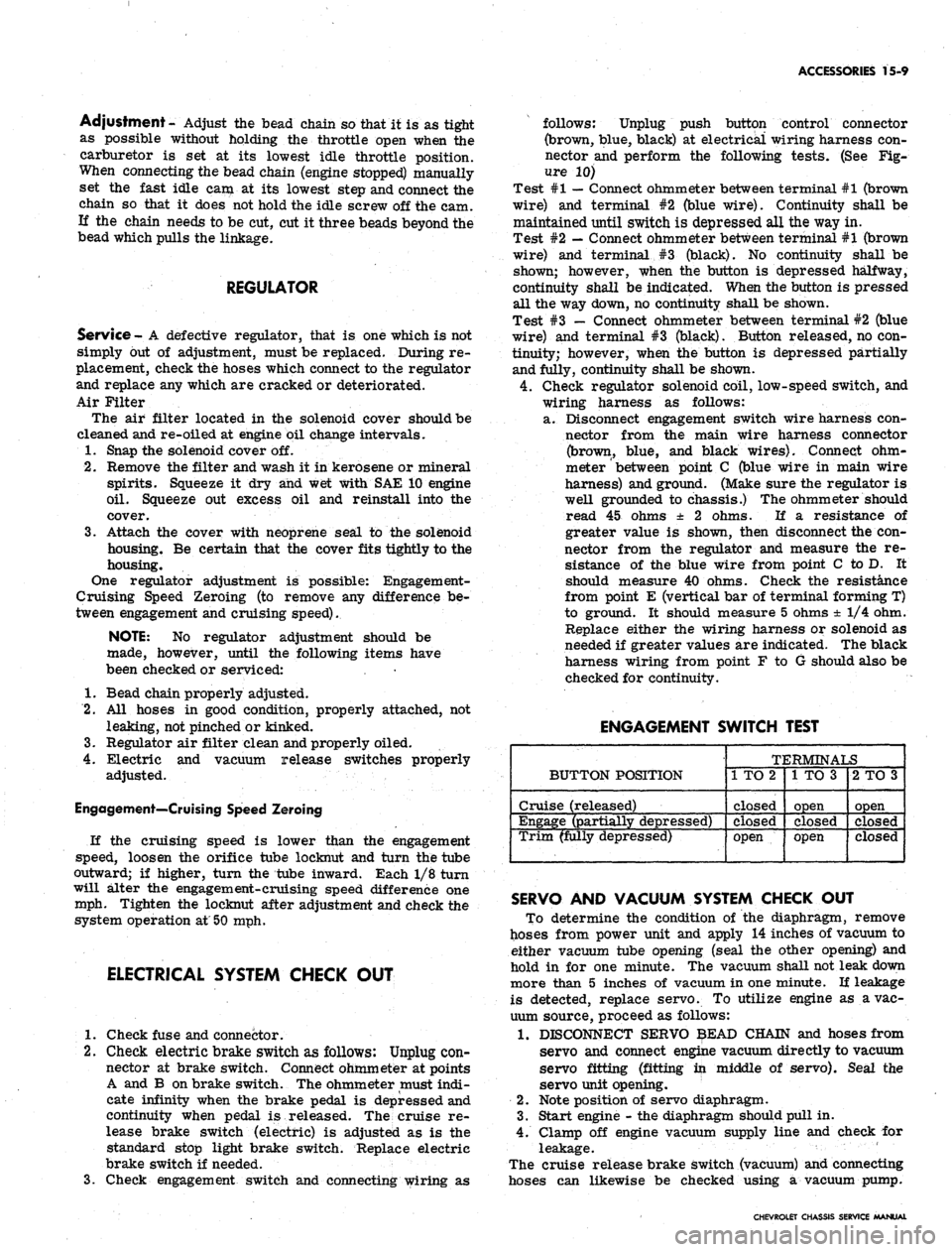
Check engagement switch and connecting wiring as
follows: Unplug push button control connector
(brown, blue, black) at electrical wiring harness con-
nector and perform the following tests. (See Fig-
ure 10)
Test #1
—
Connect ohmmeter between terminal #1 (brown
wire) and terminal #2 (blue wire). Continuity shall be
maintained until switch is depressed all the way in.
Test #2
—
Connect ohmmeter between terminal #1 (brown
wire) and terminal #3 (black). No continuity shall be
shown; however, when the button is depressed halfway,
continuity shall be indicated. When the button is pressed
all the way down, no continuity shall be shown.
Test #3 — Connect ohmmeter between terminal #2 (blue
wire) and terminal #3 (black). Button released, no con-
tinuity; however, when the button is depressed partially
and fully, continuity shall be shown.
4.
Check regulator solenoid coil, low-speed switch, and
wiring harness as follows:
a. Disconnect engagement switch wire harness con-
nector from the main wire harness connector
(brown, blue, and black wires). Connect ohm-
meter
'
between point C (blue wire in main wire
harness) and ground. (Make sure the regulator is
well grounded to chassis.) The ohmmeter should
read 45 ohms ± 2 ohms. If a resistance of
greater value is shown, then disconnect the con-
nector from the regulator and measure the re-
sistance of the blue wire from point C to D. It
should measure 40 ohms. Check the resistance
from point E (vertical bar of terminal forming T)
to ground. It should measure 5 ohms ± 1/4 ohm.
Replace either the wiring harness or solenoid as
needed if greater values are indicated. The black
harness wiring from point F to G should also be
checked for continuity.
ENGAGEMENT SWITCH TEST
BUTTON POSITION
Cruise (released)
Engage (partially depressed)
Trim (fully depressed)
TERMINALS
1 TO 2
closed
Closed
open
1 TO 3
open
closed
open
2 TO 3
open
closed
closed
SERVO AND VACUUM SYSTEM CHECK OUT
To determine the condition of the diaphragm, remove
hoses from power unit and apply 14 inches of vacuum to
either vacuum tube opening (seal the other opening) and
hold in for one minute. The vacuum shall not leak down
more than 5 inches of vacuum in one minute. If leakage
is detected, replace servo. To utilize engine as a vac-
uum source, proceed as follows:
1.
DISCONNECT SERVO $EAD CHAIN and hoses from
servo and connect engine vacuum directly to vacuum
servo fitting (fitting in middle of servo). Seal the
servo unit opening.
2.
Note position of servo diaphragm.
3.
Start engine - the diaphragm should pull in.
4.
Clamp off engine vacuum supply line and check for
leakage. '
The cruise release brake switch (vacuum) and connecting
hoses can likewise be checked using a vacuum pump.
CHEVROLET CHASSIS SERVICE MANUAL
Page 639 of 659
SPECIFICATIONS
12
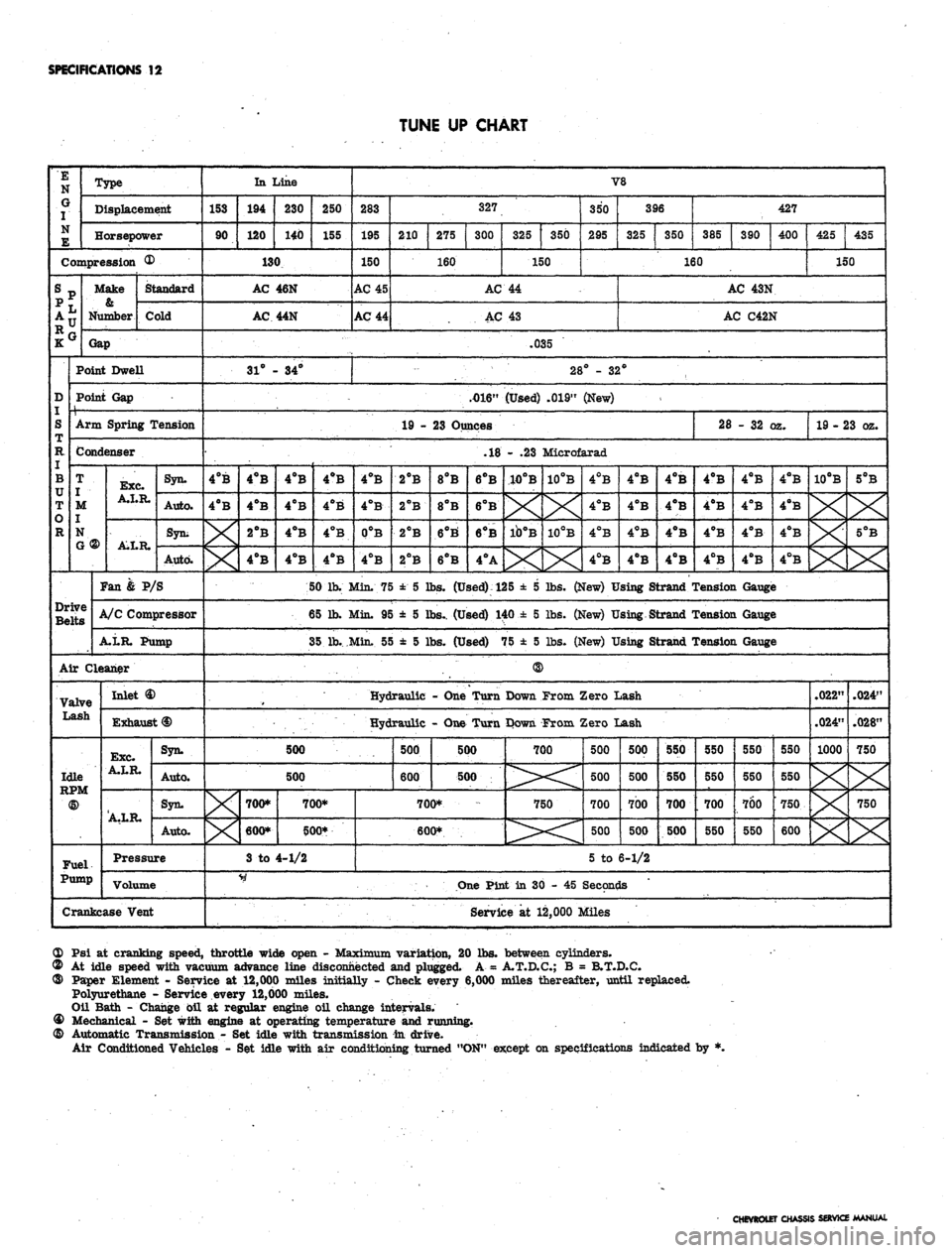
TUNE UP CHART
E
N
G
I
N
E
Type
Displacement
Horsepower
Compression ®
srp
;•
D
S
R
I
B
TT
T
o
R
Make
0.
Number
Standard
Cold
Gap
Point Dwell
Point Gap
1 ,
Arm Spring Tension
Condenser
T
I
M
j
N
G ®
Drive
Belts
Exc.
A.I.R.
AXR.
Syn.
Auto.
Syn;
Auto.
Fan & P/S
A/C Compressor
A.LR. Pump
Air Cleaner
Valve
Lash
Idle
<§>
Fuel.
Pump
Inlet
Exhaust
<§)
Exc.
A.LR.
A.LR.
Syn.
Auto.
Syn.
Auto.
Pressure
Volume
Crankcase Vent
In Line
153
90
194
120
230
140
250
155
130
AC
AC
31° -
46N
44N
• 34°
V8
283
195
150
AC 45
AC 44
327
210
275
300
160
325
350
150
350
295
396
325
350
427
385
390
400
160
AC 44
AC 43
425
435
150
AC 43N
AC C42N
.035
28° - 32°
.4)16"
(Used) .019" (New)
<
19 - 23 Ounces
4°B
4°B
4°B
4°B
2°B
4°B
4°B
4°B
4°B
4°B
28
- 32 (
yz.
19 - 23 oz.
.18 - .23 Microfarad
4°B
4°B
4°B
4ftB
4°B
4°B
0°B
4°B
50 lb. Min. 75
65 Jh. Min. 95
35 lb..Min. 5£
500
2°B
2°B
2°B
2°B
8PB
8°B
6°B'
6°B
6°B
6°B
6°B
4°A
10°B
X
ib°B
X
10PB
X
10°B
X
4°B
4°B
4°B
4°B
4°B
4°B
4°B
4°B
4°B
4°B
4°B
4°B
± 5 lbs.
(Used):
125 ± 5 lbs. (New) Using Strand '
± 5 lbs.. (Used) 140 ± 5 lbs. (New) Using Strand '
>
± 5 lbs. (Used) 75 ± 5 lbs. (New) Using Strand r
Hydraulic - One Turn Down From Zero Lash
Hydraulic - One Turn Down From Zero Lash
500
X
700*
600*
3 to
700*
500*
4-1/2
500
600
500
500
700*
600*
700
750
500
500
700
500
500
500
700
500
550
550
700
500
4°B
4°B
4°B
4°B
4°B
4°B
4°B
4°B
4°B
4°B
4°B
4°B
Tension Gauge
Tension Gauge
Tension Gauge
550
550
700
550
550
550
700
550
550
550
750
600
10°B
5°B
X
X
.022"
.024"
1000
X
X
X
.024"
.028"
750
X
750
X
5 to 6-1/2
One Pint in 30 - 45 Seconds
Service at 12,000 Miles
OD Psi at cranking speed, throttle wide open - Maximum variation, 20 lbs. between cylinders.
© At idle speed with vacuum advance line disconnected and plugged. A = A.T.D.C.; B = B.T.D.C.
® Paper Element - Service at 12,000 miles initially - Check every 6,000 miles thereafter, until replaced.
Polyurethane - Service every 12,000 miles.
Oil Bath - Change oil at regular engine oil change intervals.
® Mechanical - Set with engine at operating temperature and running.
@ Automatic Transmission - Set idle with transmission in drive.
Air Conditioned Vehicles - Set idle with air conditioning turned "ON" except on specifications indicated by *.
CHEVROLET CHASSIS SERVICE MANUAL