1967 CHEVROLET CAMARO cooling
[x] Cancel search: coolingPage 48 of 659
HEATER AND AIR CONDITIONING 1A-25
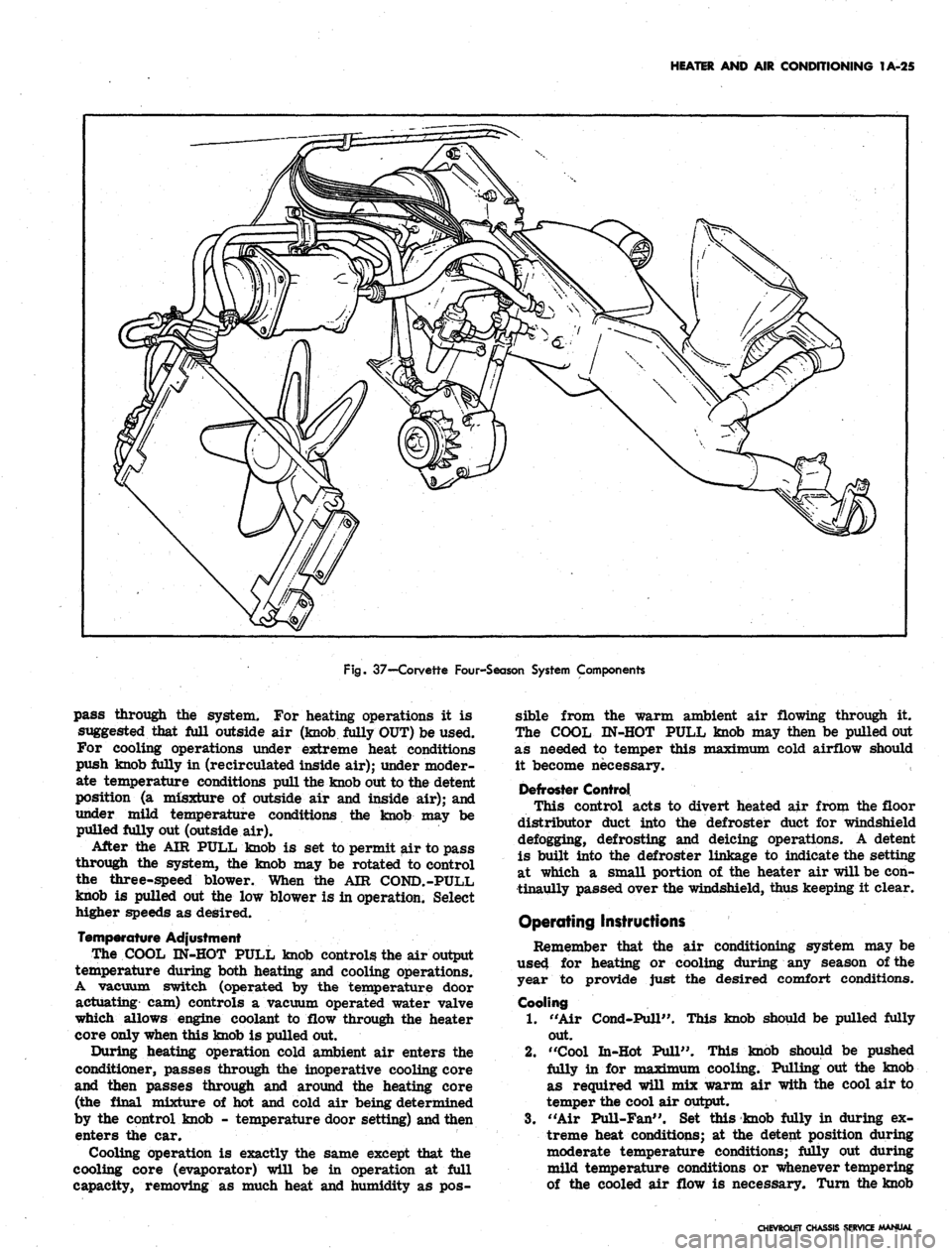
Fig.
37—-Corvette Four-Season System Components
pass through the system. For heating operations it is
suggested that Ml outside air (knob Mly OUT) be used.
For cooling operations under extreme heat conditions
push knob fully in (recirculated inside air); under moder-
ate temperature conditions pull the knob out to the detent
position (a misxture of outside air and inside air); and
under mild temperature conditions the knob may be
pulled fully out (outside air).
After the AIR PULL knob is set to permit air to pass
through the system, the knob may be rotated to control
the three-speed blower. When the AIR COND.-PULL
knob is pulled out the low blower is in operation. Select
higher speeds as desired.
Temperature Adjustment
The COOL IN-HOT PULL knob controls the air output
temperature during both heating and cooling operations.
A vacuum switch (operated by the temperature door
actuating cam) controls a vacuum operated water valve
which allows engine coolant to flow through the heater
core only when this knob is pulled out.
During heating operation cold ambient air enters the
conditioner, passes through the inoperative cooling core
and then passes through and around the heating core
(the final mixture of hot and cold air being determined
by the control knob - temperature door setting) and then
enters the car.
Cooling operation is exactly the same except that the
cooling core (evaporator) will be in operation at Ml
capacity, removing as much heat and humidity as pos-
sible from the warm ambient air flowing through it.
The COOL IN-HOT PULL knob may then be pulled out
as needed to temper this maximum cold airflow should
it become necessary.
Defroster Control
This control acts to divert heated air from the floor
distributor duct into the defroster duct for windshield
defogging, defrosting and deicing operations. A detent
is built into the defroster linkage to indicate the setting
at which a small portion of the heater air will be con-
tinaully passed over the windshield, thus keeping it clear.
Operating Instructions
Remember that the air conditioning system may be
used for heating or cooling during any season of the
year to provide just the desired comfort conditions.
Cooling
1.
"Air Cond-Pull". This knob should be pulled fully
out.
2.
"Cool In-Hot Pull". This knob should be pushed
fully in for maTriTr»"Tn cooling. Pulling out the knob
as required will mix warm air with the cool air to
temper the cool air output.
3.
"Air Pull-Fan". Set this knob fully in during ex-
treme heat conditions; at the detent position during
moderate temperature conditions; fully out during
mild temperature conditions or whenever tempering
of the cooled air flow is necessary. Turn the knob
CHEVROLET CHASSIS SERVICE MANUAL
Page 49 of 659

HEATER AND AIR CONDITIONING 1A-26
clockwise for medium and high blower speed, as
desired. Low blower speed is automatic during
cooling operations.
4.
"Def-Pull". This knob should be pushed fully in.
Additional Cooling Hints
1.
The center barrel outlet in the dash may be rotated
to deflect air as desired or used to act as a shut off
door.
2.
The right and left ball outlets may be rotated to
deflect air in the direction desired. Each outlet has
a shut off valve operated by a knob approximately
4 in. inboard. When the knob is horizontal, the valve
is open.
3.
There are two (2) additional outlets in the bottom of
the ducts approximately 6" inboard from the valve
knobs. A rotating cover will open these outlets to
provide cool air for the feet if desired.
4.
When first entering a very warm car, open the
windows for a few minutes until the interior of the
car has cooled off.
Heating
1.
"Air Pull-Fan". Pull this knob fully out. Rotate
the knob clockwise for low, medium or high blower
speed as desired. If just a small amount of heat is
desired, leave the fan on low or medium speed and
regulate the temperature with the "Cool In-Hot Pull"
knob.
2.
"Air Cond-Pull". This knob should normally be
pushed fully in. However, during cool, damp days
it is possible, by pulling this knob fully out, to de-
humidify the air by passing it through the evaporator
core before reheating to the desired outlet
temperature.
3.
"Cool In-Hot Pull". Pull this knob out as far as
necessary to provide the temperature desired.
4.
"Def-Pull". Pull this knob all the way out for
maximum defrosting or de-icing. When the knob is
partly out, a portion of the hot air is used for de-
frosting and the balance is discharged through the
heater outlet.
GENERAL INFORMATION
In any vocation or trade, there are established proce-
dures and practices that have been developed after many
years of experience. In addition, occupational hazards
may be present that require the observation of certain
precautions or use of special tools and equipment. Ob-
serving the procedures, practices and precautions of
servicing refrigeration equipment will greatly reduce the
possibilities of damage to the customers' equipment as
well as virtually eliminate the element of hazard to the
serviceman.
PRECAUTIONS IN HANDLING REFRIGERANT-12
Refrigerant-12 is transparent and colorless in both the
gaseous and liquid state. It has a boiling point of 21.7^
below zero and, therefore, at all normal temperatures
and pressures it will be a vapor. The vapor is heavier
than air and is noninflammable, nonexplosive, non-
poisonous (except when in contact with an open flame)
and noncorrosive (except when in contact with water).
The following precautions in handling R-12 should be
observed at all times.
• All refrigerant drums are shipped with a heavy metal
screw cap. The purpose of the cap is to protect the
valve and safety plug from damage. It is good .prac-
tice to replace the cap after each use of the drum.
• If it is ever necessary to transport or carry a drum
or can of refrigerant in a car, keep it in the luggage
compartment. Refrigerant should not be exposed to
the radiant heat from the sun for the resulting in-
crease in pressure may cause the safety plug to
release or the drum or can to burst..
• Drums or disposable cans should never be subjected
to high temperature when adding refrigerant to the
system. In most instances, heating the drum or can
is required to raise the pressure in the container
higher than the pressure in the system during the
operation. It would be unwise to place the drum on a
gas stove, radiator or use a blow torch while pre-
paring for the charging operation, for a serious ac-
cident can result. Don't depend on the safety
plug - many drums have burst when the safety plug
failed.' Remember, high pressure means that great
forces are being exerted against the walls of the
container. A bucket of warm water, not over 125°F,
or warm wet rags around the container is all the heat
that is required.
• Do not weld or steam clean on or near the system.
Welding or steam cleaning can result in a dangerous
pressure buildup in the system.
• When filling a small drum from a large one, never
fill the drum completely. Space should always be
allowed above the liquid for expansion. If the drum
were completely full and the temperature was in-
creased, hydraulic pressure with its tremendous
force would result.
• Discharging large quantities of R-12 into a room can
usually be done safely as the vapor would produce
no ill effects, however, in the event of an accidental
rapid discharge of the system it is recommended
that inhalation of large quantities of R-12 be avoided.
This caution is especially important if the area con-
tains a flame producing device such as a gas heater.
While R-12 normally is nonpoisonous, heavy con-
centrations.. of it in contact with a live flame will
produce a toxic gas. The same gas will also attack
all bright metal surfaces.
• Protection of the eyes is of vital importance! When
working around a refrigerating system, an accident
may cause liquid refrigerant to hit the face. If the
eyes are protected with goggles or glasses, no
serious damage can result. Just remember, any
R-12 liquid that you can touch or that touches you is
at least 21.7"F. below zero. The eyeballs can't take
much of this temperature. If R-12 liquid should
strike the eyeballs, here is what to do:
1.
Keep calm.
2.
Do not rub the eyes! Splash the affected area with
quantities of cold water to gradually get the tem-
perature above the freezing point. The use of min-
eral, cod liver or an antiseptic oil is important in
CHEVROLET CHASSIS SERVICE MANUAL
Page 55 of 659

HEATER AND AIR CONDITIONING 1A-32
5.
Check hose clamp connections. If clamp screw torque
is less than 10 lb. in., retighten to 20-25 lb. in. Do
not tighten to new hose specifications or hose leak-
age may occur.
6. If there is evidence of an oil leak, check the com-
pressor to see that the oil charge is satisfactory.
7.
Check the system controls for proper operation.
6000 MILE INSPECTION
1.
Check unit for any indication of a refrigerant leak.
2.
If there is an indication of an oil leak, check the
compressor proper oil charge.
3.
Check sight glass for proper charge of Refrigerant-
12.
4.
Tighten the compressor brace and support bolts and
check the belt tension.
5.
Check hose clamp connections as in step 5 above.
6. Check thermostatic switch setting (Universal and
All-Weather Systems.)
PERIODIC SERVICE
• Inspect condenser regularly to be sure that it is not
plugged with leaves or other foreign material.
Fig.
46—Compressor Connector Block—Typical
• Check evaporator drain tubes regularly for dirt or
restrictions.
• At least once a year, check the system for proper
refrigerant charge and the flexible hoses for brittle-
ness,
wear or leaks.
• Every 6000 miles check sight glass for low refriger-
ant level.
• Check belt tension regularly.
• Every week - during winter months or other periods
when the system is not being operated regularly- run
the system, set for maximum cooling, for 10 or 15
minutes to insure proper lubrication of seals and
moving parts.
INSTALLING GAUGE SET TO CHECK
SYSTEM OPERATION
Compressor Suction and Discharge Connector
Compressor connector assemblies used on all vehicles
are of the same basic design consisting of the inlet
(suction) and outlet (discharge) connections, gauge fittings
and muffler and, in general, the assemblies differ only in
the location of the gauge fittings.
On Universal and Four-Season Systems the outlet line
extends along side of and toward the front of the com-
pressor and the muffler in the line is bracket mounted to
the compressor body. In all Universal Systems the gauge
fittings for both low and high pressure sides of the sys-
tem are located in the connector body. On Four-Season
Systems the high pressure gauge fitting is located on the
muffler and the low pressure gauge fitting is on the POA
Valve.
The Chevy n All-Weather System compressor con-
nector assembly is similar to the Universal System
connector assembly described above except that the
muffler extends straight out from the connector and
is not bracket mounted to the compressor.
Universal and Chevy II All-Weather System
1.
Install Gauge Adapter (J-5420 or J-9459) onto the
high and low pressure hoses of the gauge set.
2.
With the engine stopped, remove the caps from the
cored valve gauge, connectors on the compressor
fittings block.
3.
Connect the gauge lines with adapters to the threaded
connectors on the compressor fittings block.
Four-Season and Comfortron Systems
Installation of the gauge set onto the Four-Season and
Comfortron systems is accomplished in the same manner
as outlined above except that system performance checks
must be performed with the low pressure hose line and
adapter attached to the fitting on the POA valve. Charging
procedures should be performed with the high pressure
gauge line connected to the high pressure gauge fitting
located on the outlet line muffler and the low pressure
gauge line attached to the POA fitting.
CAUTION: When removing gauge lines from
the compressor fittings block be sure to remove
the adapters from the fittings rather than the
gauge lines from the adapters.
PERFORMANCE TEST
This test may be conducted to determine if the system
is performing in a satisfactory manner and should be
used as a guide by the serviceman in diagnosing trouble
CHEVROLET CHASSIS SERVICE MANUAL
Page 56 of 659

HEATER AND AIR CONDITIONING 1A-33
within the system. The following fixed conditions must be
adhered to in order to make it possible to compare the
performance of the system being tested with the stan-
dards below:
1.
Doors and windows closed. (Car inside or in shade.)
2.
Hood up and engine exhaust suitably ventilated.
3.
Vehicle in NEUTRAL with engine running at 2000
rpm.
4.
Air Conditioning controls set for -
• Maximum cooling.
• High blower speed.
5.
TEMP knob and AIR knob set for full recirculating
air. On Comfortron systems* move the control lever
to REAR and pull the white vacuum hose from the
transducer. Plug the hose. An alternate method is to
install the J-22368 Tester (described later in this
section) and operate it on MANUAL control to main-
tain maximum cooling and blower speed.
6. Gauge set installed.
7.
System settled out (run-in approximately
10
minutes).
8. A thermometer placed in front of vehicle grille and
another in the right hand diffuser outlet.
PERFORMANCE DATA
The following Performance Data define normal opera-
tion of the system under the above conditions. Relative
humidity does not appear in the tables because after
running the prescribed length of time on recirculated air
and maximum cooling, the relative humidity of the air
passing over the evaporator core will remain at ap-
proximately 35% to 40% regardless of the ambient
temperature or humidity.
Should excessive head pressures be encountered at
higher ambient temperatures, an 18" fan placed in front
of the vehicle and blowing into the condenser will provide
the extra circulation of air needed to bring the pressures
to within the limits specified.
NOTE: Higher temperatures and pressures will
occur at higher ambient temperatures, fti areas
of high humidity it is possible to have ther-
mometer and gauge readings approach but not
reach the figures listed in the performance
tables and still have a satisfactory operating
unit. However, it is important to remember that
low pressure has a direct relationship to nozzle
outlet temperature. If pressure is too low, ice
will gradually form on the evaporator fins, re-
stricting airflow into the passenger area and
resulting in insufficient or no cooling.
Four-Season and Comfortron System
Chevrolet and Camaro
Chevelle
(Refrigerant
Charge
=
Temperature
of Air
Entering Condenser
Engine rpm
Compressor
Head Pressure
Evaporator Pressure
at POA
Discharge Air Temp,
at Right Hand Outlet
3
Lbs. -
70°
145-
155
38-
41
80°
170-
180
12 02
90°
.)
100°
2000
205-
215
29.5 -
39-
42
41-
43
255-
265
30.5
42-
45
110°
260-
270
psi
43-
46
120°
295-
305
45-
48
(Refrigerant Charge =
Temperature of
Air Entering
Condenser
Engine rpm
Compressor Head
Pressure
Evaporator
Pressure
at
POA
Discharge Air
Temp, at Right
Hand Outlet
3 Lbs. -
70°
150
160
37-
40
80°
175
185
12 Oz.)
90° 100°
2000
210 250
220 260
29.5 - 30.5
37-
40
38-
39-
41 42
110°
280
290
psi
40-
44
120°
290
300
41-
45
Corvette
(Refrigerant Charge =
Temp, of Air
Entering Condenser
Engine rpm
Compressor
Head Pressure
Evaporator
Pressure
at
POA
Outlet
Air
Temperature
(at Right
Outlet)
3
Lbs.
70°
150-
170
38-
40
- 4 Oz.)
80°
175-
195
29
38-
40
90°
2000
200-
200
100°
i*pm
240-
260
110°
285-
300
5-
30.5 psi
40-
42
41-
43
43-
45
120°
325-
335
45-
47
Alt Weather System
Chevy II
(Refrigerant
Charge
=
Grille Air
Temperature
Engine rpm
Compressor Head
Pressure
Compressor Suction
Pressure**
Discharge Air Temp,
at R/H Outlet**
2-1/2 Lbs.)
70°
120-
140
13
32-
37
80°
150-
160
14
CO
OO
CO
CO
90°
100°
1500
175-
185
15
35-
40
220-
230
15
36-
41
110°
240-
250
19
37-
42
120°
265-
275
19
38-
43
**When Compressor Clutch Releases
COMFORTRON SYSTEM OPERATIONAL TEST
This test, designed as a quick check of total system
operation, must be made with the engine operating at
minimum of 2000 rpm and coolant warm. Wait several
seconds between operations to allow the system to move
through its sequence of operation and arrive at the pre-
scribed mode of operation.
1.
With control lever in the OFF position, and Tem-
perature Dial at 65°F.
a. System is turned OFF, there is no air flow from
any of outlets.
2.
Control lever in HI Front and Temperature Dial set
at65°F.
CHEVROLET CHASSIS SERVICE MANUAL
Page 59 of 659

HEATER AND AIR CONDITIONING 1A-36
(These tests should be performed with the engine at operating temperature.)
SYSTEM CHECKS
Control
Head
Setting
High
Front
Lo
Front
Lo
Front
Hi
Front
Hi
Front
Tester Settings
Function
Manual
Manual
Manual
Manual
De-ice
65° on
Temp.
Dial
Hi
Front
Hi
Front
Hi
Front
Auto-
Matic
1 1
Auto-
matic
Manual
Manual
Manual
Control
Max.
Heat
Rotate
from
Max.
Heat to
Max.
Cold
150
Max.
Cold
Max.
Cold
Max.
Cold
Max.
Heat
Max.
Heat
Max.
Cold
Voltage
Trans-
ducer
Trans-
ducer
Ampli-
fier
Trans-
ducer
Probe
Probe
Trans-
ducer
Trans.
Tester Should
Indicate:
High Blower
Maximum Heat
Reduced Blower
Speed
Complete series of
blower changes from
Hi to Lo to Hi
again.
AMPLIFIE:
Remove conn, from c
Voltage reading she
Short this lead to grc
Voltage reading she
No voltage change in<
COMPRESSOR C
Cooling System
Operation
DE-ICE i
Assuming rest of
system is operating
normally: Max. Heat
1
to windshield.
SENSOR STR
•—
TRAtfSDtfC
0-3"
Vac. Reading
8 Volts Min.
9"
Min.
Vac.
Reading
0-4 Voltage Reading
If not, check
the following:
Fuse in Slock
In Line Fuse
High Blower
Delay Relay
Duct Delay
Thermistor
High Blower
Delay Sensor
Power Servo
Blower Switch
Resistor
Blower Motor
Wiring Harness
Blower Switch
Master Delay
Thermistor
Master Delay
Relay
Resistor
Power Servo
Blower Motor
CHECK
Resistor
I CHECK
Electrical Diagram
Probe Points:
1-2
8-9
10-21
20
18
19
*
9-46
-r
^2-3
15
16
Checked during
above procedure.
(This is a com-
plete step-by-step
high blower circuit
check which also
checks wiring
harness.)
4
5
6
L2-13
L4
""§2-15
39-46
1
16 1
14
22-40-42-44-15
.ontrol head temperature dial.
>uld be 9 volts minimum,
jund.
>uld be 0 volts,
iicates malfunctioning of amplifier.
JUTCJH CHUCK
Compressor Clutch
(Grille Temp, must
be above 40°.)
IRCUIT
Blower Switch
Master Delay
Relay
Transd
NGCl
ucer
Sensor String
2R CHECK
Transducer voltage
&t Max. Cold
position)
Transducer Ground
Hi Blower Outside
air (air door closed
to car body). Hot air
from heater outlets.
Hi Blower Recirc.
Air (air door open
to car body) cold air
from A/C outlets.
24-25-26-27-28
Voltmete
should re
ad
Battery Voltage
Battery Voltage
Battery Voltage
. Vtinimum
6
volts
Battery Voltage
Minimum
6
volts
Battery Vo]
Batterv Vo]
Ltage
Ltage
Battery Voltage
Batterv Voltage
3a
Bai
:terv Vo
tterv Vo
tage
tage
Minimum
6
volts
Batterv Voltage
Minimum
6
volts
Battery Voltage
Minimum
8
volts
Minimum 8 volts
Minimum 8 volts
Batterv Voltage
Minimum 8 volts
1 III • II »ll. —..• —•— . !!•• 1
Battery Voltage
3-23
20-10-21
38
29-30-31-32-33-
34-35-36
37-38
Defective Power Servo; Leak in Vacuum
System; Temp.; Door Link Disconnected
or Jammed; Defective Vacuum Relay
Valve
Defective Mode Door Diaphragm
Batterv Voltage
Battery Voltage
Zero Voltage
Battery Voltage
Battery Voltage
CHEVROLET CHASSIS SERVICE MANUAL
Page 60 of 659

HEATER AND AIR CONDITIONING 1A-37
VACUUM SYSTEM COMPONENT FUNCTION
Component
Air Door Diaphragm
Power Servo
Vacuum Relay Valve
Mode Door Diaphragm
Defroster Diaphragm
Transducer
Thermo Vacuum Valve
Vacuum Applied
Air Door Open to Outside Air
(Closed to Car Body)
Maximum Heat
Vacuum Applied to One Port Opens a Passage
Through the Valve to Allow Transducer Vacuum
to be Supplied to the Power Servo
Vacuum to Linkage Side
Air Flow Out Heater
Ducts
Full Airflow Out Heater
Outlet
Vacuum to Covered Side
Airflow Out of Upper
Outlets
Full Airflow Out Defroster
Outlets (Full De-ice)
No Vacuum Applied
Air Door Open to
Re circulated Air
(Open to Car Body)
Maximum Cooling
No Vacuum Applied Closes
Vacuum Supply to Power
Servo
Airflow Out of Upper and
Lower Outlets Door Open
1"
from 100% Lower Out-
let Position
Airflow Divided 1/3 Out
Defroster Outlets 2/3
Out Heater Outlets
Supplies Modulated Vacuum to Power Servo
Zero Voltage Applied to Transducer
Results in Maximum Vacuum Supply
10 Volts Applied to Transducer
Results in No Vacuum Supply
(Coolant Hot) Passes Vacuum When System is Calling For Outside Air
MAINTENANCE AND ADJUSTMENTS
EVAPORATOR CONTROL VALVE (POA)
(Chevrolet, Chevelle, Comoro, and Corvette
Four Season) (Chevrolet Comfortron)
The only check for proper POA valve operation is to
check the suction pressure at the valve as during a
performance test. The POA valve is an absolute valve
and will provide different gauge readings based on the
altitude where the readings are being taken. Correct
gauge reading at sea level is 29.5 psig. Gauge readings
will be one-half psi higher for each additional 1000 feet
of elevation. The following table lists gauge readings at
different altitudes. If a valve gives improper gauge
readings, it must be replaced since it is not repairable
or adjustable.
29.5
30.0
30.5
31.0
31.5
32.0
32.5
33.0
33.5
34.0
34.5
psig.
psig.
psig.
psig.
psig.
psig.
psig.
psig.
psig.
psig.
psig.
— Sea 1
— 1000
— 2000
— 3000
— 4000
— 5000
— 6000
— 7000
— 8000
— 9000
Level
ft.
ft.
ft.
ft.
ft.
ft.
ft.
ft.
ft.
— 10000 ft.
THERMOSTATIC SWITCH
(Universal and Chevy II All-Weather System)
Thermostatic switches used in Universal and All-
Weather systems differ only in the capillary tube sensing
unit.
The Chevy n All-Weather System thermostatic switch
has an air sensing capillary which is coiled and attached
to the front of the evaporator core with plastic plugs.
This type of unit is controlled by the temperature of the
air leaving the evaporator.
Universal systems make use of a thermostatic switch
with a fin sensing capillary or a self-supporting air sens-
ing capillary. This capillary controls the switch by
sensing the temperature of the metal fins or the air
leaving the fins.
Checking for Proper Operation
1.
Install the gauge set and set up the vehicle as
described under Performance Test.
2.
Movement of the temperature control knob should
result in a definite change in suction pressure and
cycling of the compressor clutch.
• If compressor continues to operate regardless of
the knob adjustment, it indicates that the points
CHEVROLET CHASSIS SERVICE MANUAL
Page 63 of 659

HEATER AND AIR CONDITIONING 1A-40
THERAAAL VACUUM
VALVE
TO ENGINE
VACUUM
SOURCE
VACUUM STORAGE
TANK
OUTSIDE AIR
DIAPHRAGM
MODE
DIAPHRAGM
VACUUM
RELAY
BLACK
DEFOG-DEICE
DIAPHRAGM
GREEN
BLACKj ||
|
BROWN
CONTROL
VALVE
Fig.
50—Comfortron Vacuum Diagram
are fused which will lead to evaporator freeze-up.
Replace the switch.
• If the compressor does not operate regardless of
the position of the knob a loss of the power
element charge is indicated provided that it has
been established that power is supplied to the
switch. This, of course, results in no cooling.
Replace the switch.
• Check the screw threads for stripped or other-
wise damaged threads.
Adjusting Switch
H, after checks above, the switch seems to be operating
properly,
follows:
adjust for proper setting if necessary, as
1.
(Chevy II All-Weather) Turn the outer air deflector
in the face plate so that the attaching screws may
be removed; Then remove the control knobs, bezels
and the thermostatic switch. (Universal) remove the
face plate retaining screws. Pull the faceplate away
from the case when ready to turn the switch adjusting
screw.
2.
Vehicle must be set up as in Step 2 above.
3.
The suction side of the system, read on the low
pressure gauge, should pull down to the pressure
shown in the chart in Performance Test under the
ambient temperature at the time the switch is being
set.
4.
If the low side pulls down lower than the prescribed
pressure at the end of each cooling cycle, turn the
adjusting screw (See Figure 54) clockwise in single
CHEVROLET CHASSIS SERVICE MANUAL
Page 64 of 659

HEATER
AND AIR
CONDITIONING
1A-41
OUTLET
1
TO EXPANSION
^
VALVE
TO
OIL
BLEED LINE
^ INLET
Fig.
51—Evaporator Pressure Control Valve—POA
turn increments until
the
suction pressure rises
to
the correct pressure.
5.
If the
pressure
is
more than
it
should
be,
turn the
adjusting screw counter-clockwise until
the
proper
pressure
is
reached.
6. After adjusting
the
switch, install the capillary to
its
normal position
and
observe
the
operation
of the
system
for
several minutes. Then
if
the operation
is
satisfactory remove the gauge
set,
replace the switch
and reinstall the face plate onto the evaporator case.
EXPANSION VALVE
A malfunction
of the
expansion valve will
be
caused
by
one of the
following conditions: valve stuck open,
valve stuck closed, broken power element,
a
restricted
screen
or an
improperly located
or
installed power
element bulb.
The
first three conditions require valve
replacement.
The
last two may be corrected by replacing
the valve inlet screen
and by
properly installing
the
power element bulb.
Attachment
of the
expansion valve bulb
to the
evap-
orator outlet line
is
very critical.
The
bulb must be
attached tightly
to the
line
and
must make good contact
with
the
line along
the
entire length
of
the bulb. A loose
bulb will result
in
high
low
side pressures and poor
cooling.
On
bulbs located outside
the
evaporator case
insulation must be properly installed.
The external equalizer line shown
in
Figure
55 is
not
used
in the
Custom
and
Chevy
II
All-Weather systems.
Indications
of
expansion valve trouble provided by the
Performance Test are
as
follows:
VALVE STUCK OPEN
OR
BROKEN POWER
ELEMENT
Noisy Compressor.
•
No Cooling
-
Freeze
Up.
VALVE STUCK CLOSED
OR
PLUGGED SCREEN
Very Low Suction Pressure.
No Cooling.
Fig.
52-P.O.A. Valve Installed
Fig.
53—Thermostatic Switch Removal
CHEVROLET CHASSIS SERVICE MANUAL