Downloaded from www.Manualslib.com manuals search engine CHEVROLET
"ALL TRANSISTOR"
RADIOS
To operate the radios, the igni
tion switch must
be in "ON" or
"ACC" position.
Antenna
For best FM operation the an
tenna must be extended to a length
of 31 inches. For best AM opera
tion
the antenna should be fully
extended.
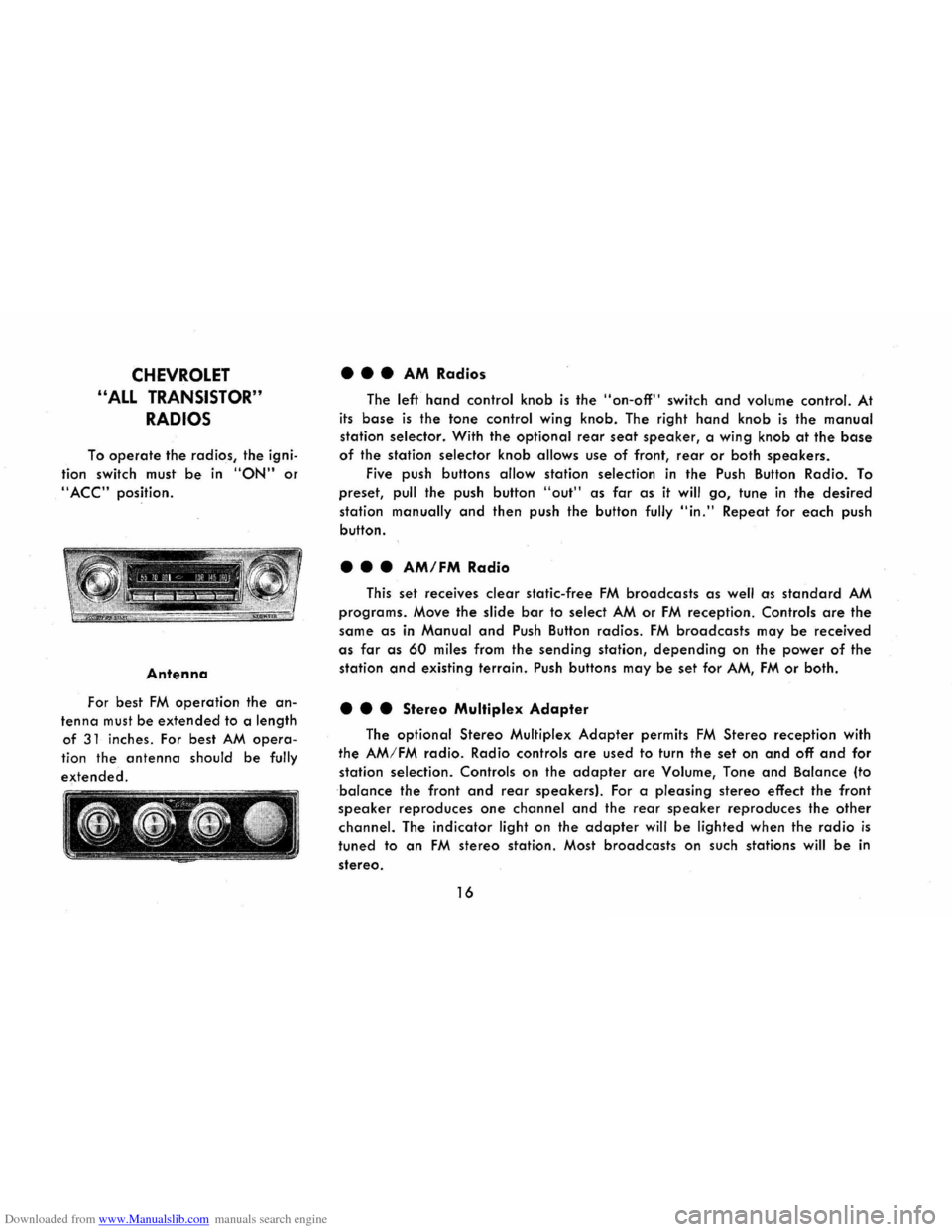
••• AM Radios
The left hand control knob is the "on-off" switch and volume control. At
its base is the tone control wing knob. The right hand knob is the manual
station selector. With
the optional rear seat speaker, a wing knob at the base
of the station selector knob allows use of front, rear or both speakers.
Five push buttons allow station selection in the Push Button Radio. To
preset, pull the push button "out" as far as it will go, tune in the desired
station manually and then push the button fully "in." Repeat for each push
button.
• • • AMI FM Radio
This set receives clear static-free FM broadcasts as well as standard AM
programs. Move the slide bar to select AM or FM reception. Controls are the
same as in Manual and Push Button radios. FM broadcasts may be received
as far as 60 miles from the sending station, depending on the power of the
station and existing terrain. Push buttons may be set for AM, FM or both.
• • • Stereo Multiplex Adapter
The optional Stereo Multiplex Adapter permits FM Stereo reception with
the AM/FM
radio. Radio controls are used to turn the set on and off and for
station selection. Controls on
the adapter are Volume, Tone and Balance (to
-balance the front and rear speakers!. For a pleasing stereo effect the front
speaker reproduces one channel and the rear speaker reproduces the other
channel. The indicator light on the adapter will be lighted when the radio is
tuned to an FM stereo station. Most broadcasts on such stations will be in
stereo.
16
Downloaded from www.Manualslib.com manuals search engine TIRE CARE
Keep your tires inflated to the recommended pres
sures.
Over-inflation can adversely affect riding comfort,
quietness and tire life while under-inflation affects vehicle
handling and tire life.
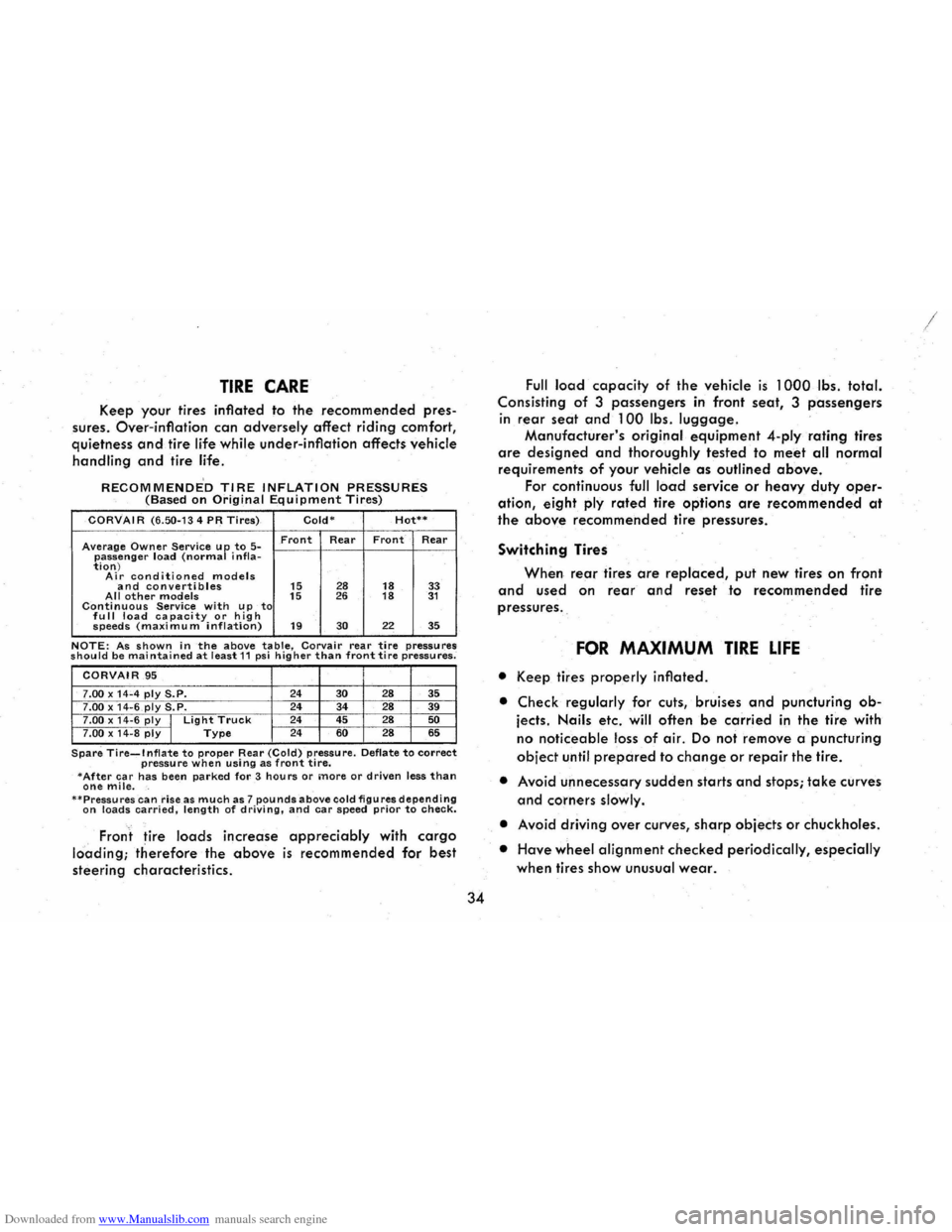
RECOMMENDED TIRE INFLATION PRESSURES (Based on Original Equipment Tires)
CORVAIR (6.50-134 PR Tires) Cold-Hot**
Average Owner Service up to 5-Front Rear Front Rear
passenger load (normal i nfla-tion) Air conditioned models and convertibles 15 28 18 33 All other models 15 26 18 31 Continuous Service with up to fu II load ca pacity or h ig h speeds (maximu m inflation) 19 30 22 35
NOTE: As shown in the above table, Corvair rear tire pressures should be maintained at least 11 psi higher than front tire pressures;
CORVAIR .95
7.00 x 14"4 ply S.P. 24 30 28 35 7.00 x 14-6 ply S.P. 24
34 28 39 7.00 x 14-6 ply I Light Truck 24
45 28 50
7 .00 x 14 -8 ply I Type 24 60 28 65
Spare Tire...,.lnflate to proper Rear (Cold) pressure. Deflate to correct pressure when using as front tire. -After car has been parked for 3 hours or more or driven less than one mile. --Pressures can riseas much as 7 pounds above cold figures depending on loads carried, length of driving, and car speed prior to check.
, Fron t tire loads increase appreciably with cargo
lci'ading; therefore the above is recommended for best
steering characteristics.
34
Full load capacity of the vehicle is 1 OOOlbs. total.
Consisting of 3 passengers in front seat, 3 passengers
in
rear seat and 100 Ibs . luggage.
Manufacturer's original equipment 4-plyrating tires
are designed and thoroughly tested to meet all normal
requirements of your vehicle as outlined above.
For continuous full load service or heavy duty oper
ation, eight ply rated tire options are recommended at
the above recommended tire pressures.
Switching Tires
When rear tires are replaced, put new tires on front
and used on rear and reset to recommended tire
pressures. ,
FOR MAXIMUM TIRE LIFE
• Ke.ep tires properly inflated.
• Check regularly for cuts, bruises and puncturing ob
jects. Nails etc. will often be carried in the tire with
no noticeable loss of air. Do not remove a puncturing
object until prepared to change or repair the tire.
• Avoid unnecessary sudden starts and stops; take curves
and corners slowly.
•
Avoid driving over curves, sharp objects or chuckholes.
•
Have wheel alignment checked periodically, especially
when tires show unusual wear.