Downloaded from www.Manualslib.com manuals search engine CORVAIR CORSA
The Corvair Corsa models are operated and main
tained as outlined for the regular Corvair. Additional
instrumentation and operating instructions peculiar to
Corsa models only are reviewed in the following pages.
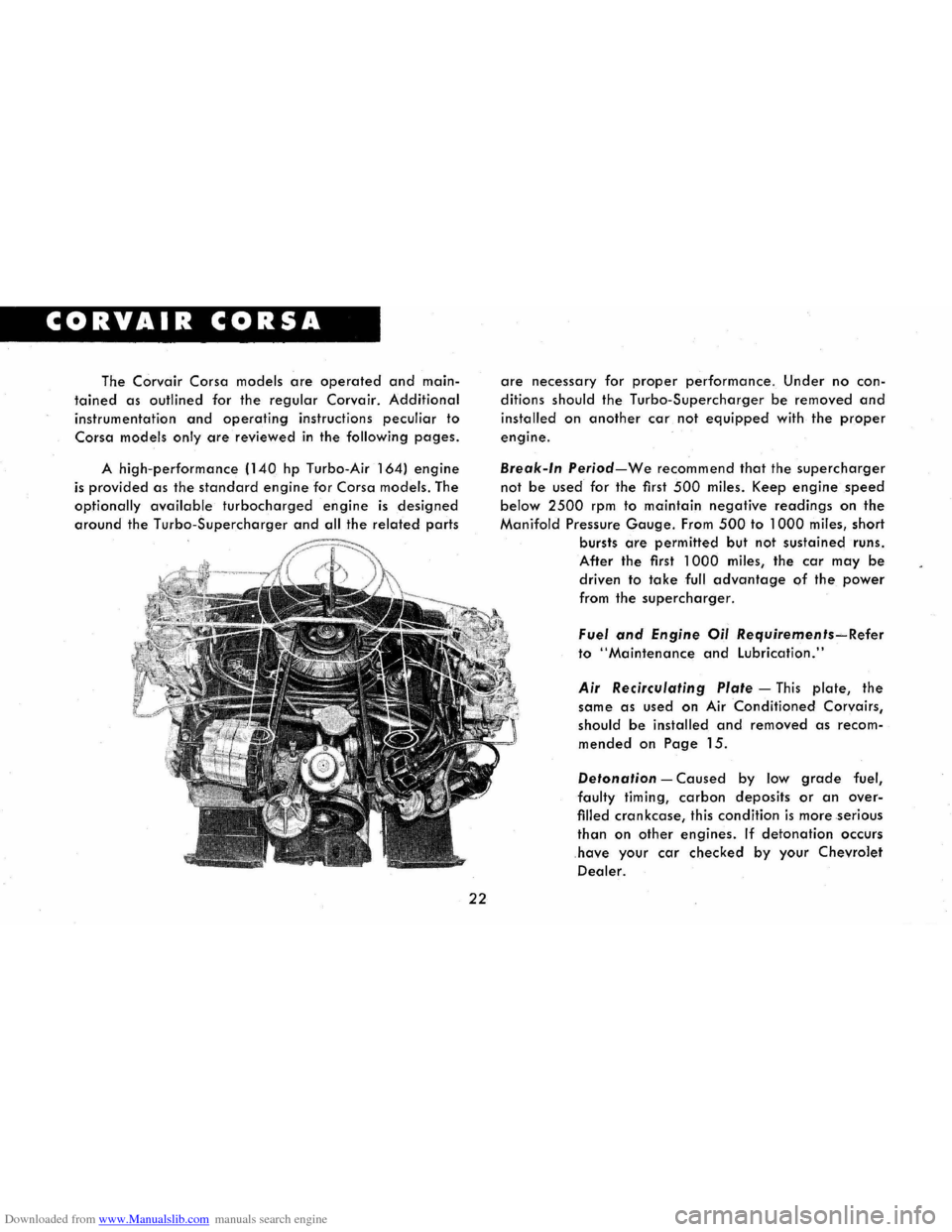
A high-performance (140 hp Turbo-Air 164) engine
is provided as the standard engine for Corsa models. The
optionally available turbocharged engine is designed
around the Turbo-Supercharger and all the related parts
22
are necessary for proper performance. Under no con
ditions should the Turbo-Supercharger be removed and
installed on another car not equipped with the proper
engine.
Break-In Period-We recommend that the supercharger
not be used for the first 500 miles. Keep engine speed
below 2500 rpm to maintain negative readings on the
Manifold Pressure Gauge. From 500 to 1000 miles, short
bursts
are permitted but not sustained runs.
After the first 1000 miles, the car may be
driven to take full advantage of the power
from the supercharger.
Fuel and Engine Oil Requirements~Refer
to "Maintenance and Lubrication."
Air Recirculating Plate -This plate, the
same as used on
Air Conditioned Corvairs,
should be installed and removed as recom
mended on Page 15.
Detonation -Caused by low grade fuel,
faulty timing, carbon deposits or an over
filled crankcase, this condition is more serious
than on other engines. If detonation occurs
have your car checked by your Chevrolet
Dealer.
Downloaded from www.Manualslib.com manuals search engine cup at the end of the spark plug
wire
and the tubular metal con
nector inside of it. If the spark
plug wire is wet or oily, wipe it
dry. Wrap a dry handkerchief or
facial tissue, folded several thick
nesses, around the wire at least
three inches back from the end
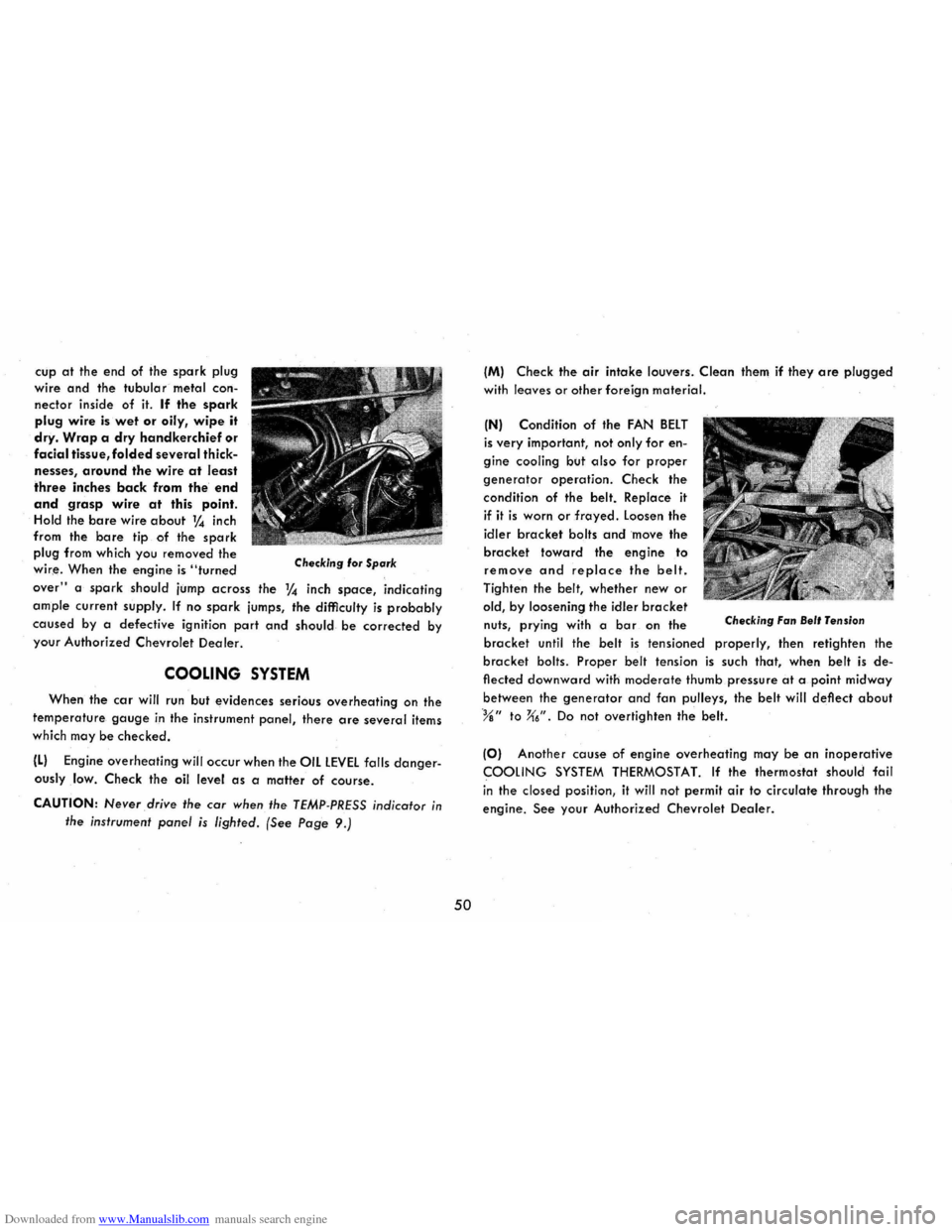
and grasp wire at this point. Hold the bare wire about 1,4 inch
from the.
bare tip of the spark
plug from which you removed the
wir,e. When the engine is "turned Checking 'or Spark
over" a spark should jump across the 1,4 inch space, indicating
ample current supply. If no spark jumps, the difficulty is probably
caused by a defective ignition part and should be corrected by
your Authorized Chevrolet
Dealer.
COOLING SYSTEM
When the car will run but evidences serious overheating on the
temperature gauge in the instrument panel, there are several items
which may
be checked.
(L) Engine overheating will occur when the OIL LEVEL falls danger
ouslylow. Check the oil level as a malter of course.
CAUTION: Never drive the car when the TEMP-PRESS indicator in
the instrument panel is lighted. (See Page 9.)
50
(M) Check the air intake louvers . Clean them if they are plugged
with leaves or other foreign material.
(N) Condition of the FAN BELT
is very important, not only for en
gine cooling but
also for proper
generator operation. Check the
condit ion of the belt. Replace
it
if it is worn or frayed. Loosen the
idler
bracket bolts and move the
bracket toward the engine to
remove and replace the belt.
Tighten the belt, whether new or
old, by loosening the idler bracket nuts, prying with a bar on the Checking Fan Bel' Tension
bracket until the belt is tensioned properly, then retighten the
bracket bolts. Proper belt tension is such that, when belt is de
flected downward with moderate thumb pressure at a point midway
between the
generator and fan pulleys, the belt will deflect about
%" to X6". Do not overtighten the belt.
(0) Another cause of engine overheating may be an inoperative
COOLING SYSTEM THERMOSTAT. If the thermostat should fail
i n the closed position, it will not permit
air to circulate through the
engine. See your Authorized Chevrolet Dealer.
Downloaded from www.Manualslib.com manuals search engine Page
luggage Compartment . . . . . . . . . . . . . . . . . . . . .. 21
Maintenance and lubrication (Periodic) ........ 37
Manifold Pressure Gauge ................... 23
Octane Requirements ....................... 32.
Oil Filter ................................. 37
Parking Brake
Operation ........................... 12
Service
..... ......................... 40
Polishing Your Corvair . . . . . . . . . . . . . . . . . . . . .. 30
Positraction Axle .......................... 7
Pushing to
Start
Manual Transmission ............. .... .. 5
Powerglide . . . . . . . . . . . . . . . . . . . . . . . . .
.. 6
Radios
................................ 16
Rear Axle ............................... 42
Rocking Car-Powerglide . . . . . . . . .. . . . . . . . . .. 7
Seats
......................... " .... 19 & 28
Front Seat Adjustment . . . . . . . . . . . . .. 19 & 28
Rear
Seat-Folding .................... 20
Second Seat . . . . . . . . . . . . . . . . . . . . . . . . .. 29
Service Brakes ............. . . . . . . . . . . . . . .. 12
Serial
and Unit Numbers . . . . . . . . . . . . . . . . . . .. 44
Spare Tire ............................... 35
Specifications . . . . . . . . . . . . .. . . . . . . . . . .. 44 & 45
52
Page
Speedometer ......................... 8 & 23
Starting the Engine ....... . . . . . . . . . . . . . . . . . 3
Steering
linkage .......................... 38
Steering Gear .... ' ................. ' .' . . . .. 37
Switching Tires .................•......... 34
Tachometer .............................. 23
Telescoping Steering Column ............... , 17
Temp-Press Indicator .................... 9 & 23
Tire
Care . . . . . . . . . . . . . . . . . . . . . . . . . . . . . . .. 34
Towing-Powerglide . . . . . . . . . . . . . . . . . . . . . . .. 7
Transmission Manual
Operation ..................... ,. 4-5
Service .......................... 41
Powerglide
Operation . . . . . . . . . . . . . . . . . . . . . .. 5-7
Service ........................ " 41
Trouble Shooting Guide . . . . . . . . . . . . . . . . . . . .. 47
Trouble Checks
lighting System
...................... .11
Turn Signal .............................. 11
Warm-up. . . . . . . . . . . . . . . . .. . . . . . . . .. . . . .. 4
Washing Your Corvair . . . . . . . . . . . . . . . . . . . . .. 30
White Sidewall Tires ....................... 31
Windshield Wipers and Washers ........... 13 & 25