1965 CHEVROLET CORVAIR wheel
[x] Cancel search: wheelPage 10 of 56
Downloaded from www.Manualslib.com manuals search engine TOWING
• Place selector lever in neutral.
• If transmission or axle are malfunctioning, tow with
rear wheels raised.
• When towing any vehicle on its front wheels, the
steering wheel should be secured to maintain a
straight forward position .
• Never tow faster than 50 mph.
ROCKING CAR
When stuck in mud, sand or snow, you may rock
the car by depressing the accelerator slightly and shift
ing the selector lever between Rand D. Avoid excessive
engine speed while performing this operation.
PARKING CAR
It is important that when your Corvair is parked the
parking brake be fully engaged. Do not count on the
transmission to hold the car. Always engage the parking
brake when parked.
POWERGLIDE DRIVING CAUTIONS
• Always engage parking brake when parked.
• Do not accelerate engine in L, 0, or R with
the brakes engaged. This can cause damage
by overheating transmission.
• Do not hold car on an upgrade by accelerat
ing engine. Use brakes.
• Use low position for hard pulls at low
speed, climbing or descending steep grades
and for push starting.
• Always stop car before shifting to reverse.
DRIVING WITH POSITRACTION REAR AXLE
The Positraction rear axle gives you constant driv
ing force on both r~ar wheels; especially helpful in the
winter and during other slippery driving conditions.
In normal use, light throttle application will supply
7
maximum traction. When starting with one rear wheel
on an excessively slippery surface, slight application of
the parking brake may be necessary to gain maximum
traction.
Page 15 of 56
Downloaded from www.Manualslib.com manuals search engine FOOT CONTROLS
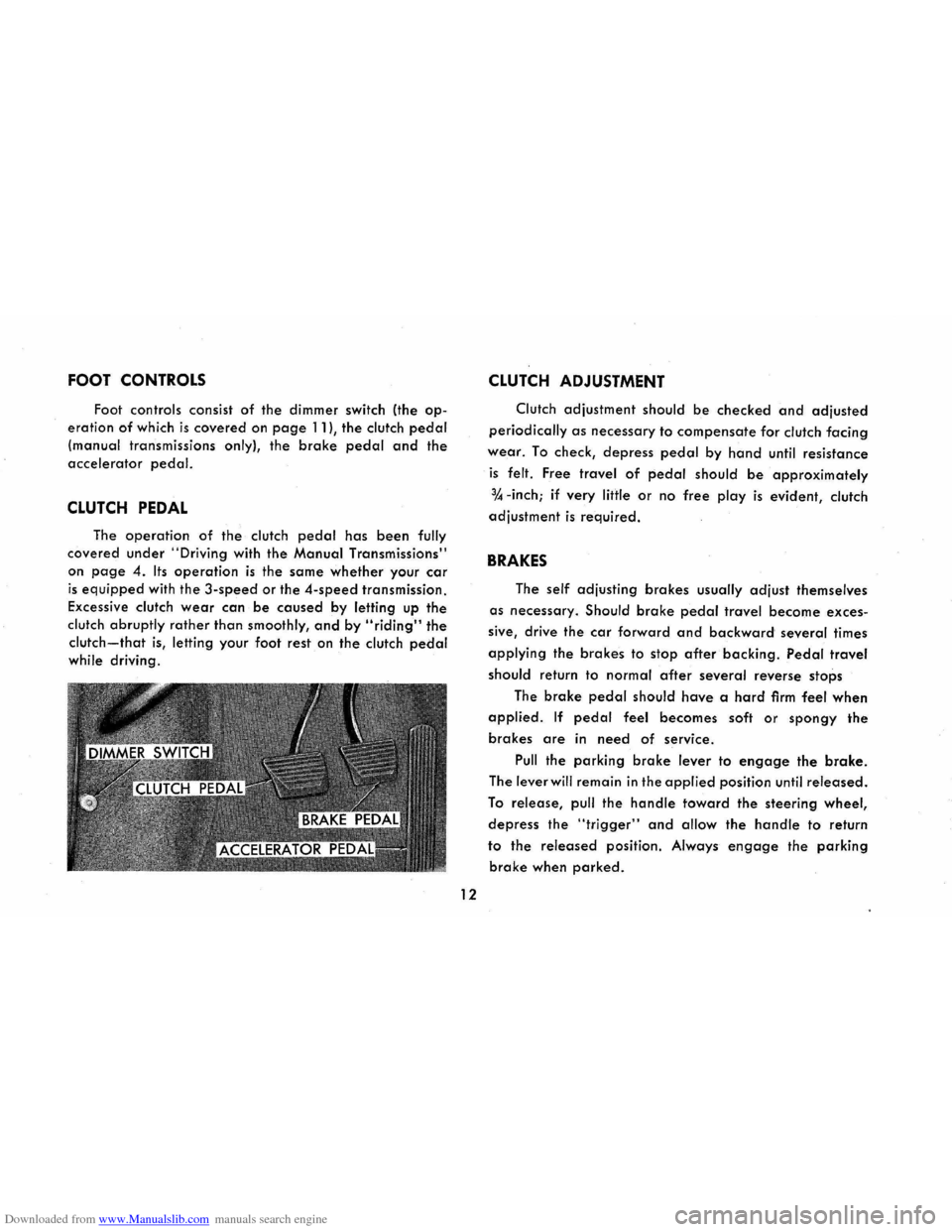
Foot controls consist of the dimmer switch (the op
eration of which is covered on page 11), the clutch pedal
(manual transmissions only), the brake pedal and the
accelerator pedal.
CLUTCH PEDAL
The operation of the clutch pedal has been fully
covered under "Driving with the Manual Transmissions"
on
page 4. Its operation is the same whether your car
is equipped with the 3-speed or the 4-speed transmission.
Excessive clutch
wear can be caused by letting up the
clutch abruptly rather than smoothly, and by "riding" the
clutch-that is, letting your foot rest on the clutch pedal
while driving.
12
CLUTCH ADJUSTMENT
Clutch adjustment should be checked and adjusted
periodically as necessary to compensate for clutch facing
wear. To check, depress pedal by hand until resistance
is felt. Free travel of pedal should be approximately
% -inch; if very little or no free play is evident, clutch
adjustment
is required.
BRAKES
The self adjusting brakes usually adjust themselves
as necessary. Should brake pedal travel become exces
sive, drive
the car forward and backward several times
applying the brakes to stop after backing. Pedal travel
should
return to normal after several reverse stops
The
brake pedal should have a hard firm feel when
applied. If pedal feel becomes soft or spongy the
brakes are in need of service.
Pull the parking brake lever to engage the brake.
The lever will remain in the applied position until released.
To release, pull the handle toward the steering wheel,
depress the "trigger" and allow the handle to return
to the released position. Always engage the parking
brake when parked.
Page 20 of 56
Downloaded from www.Manualslib.com manuals search engine TELESCOPING STEERING COLUMN
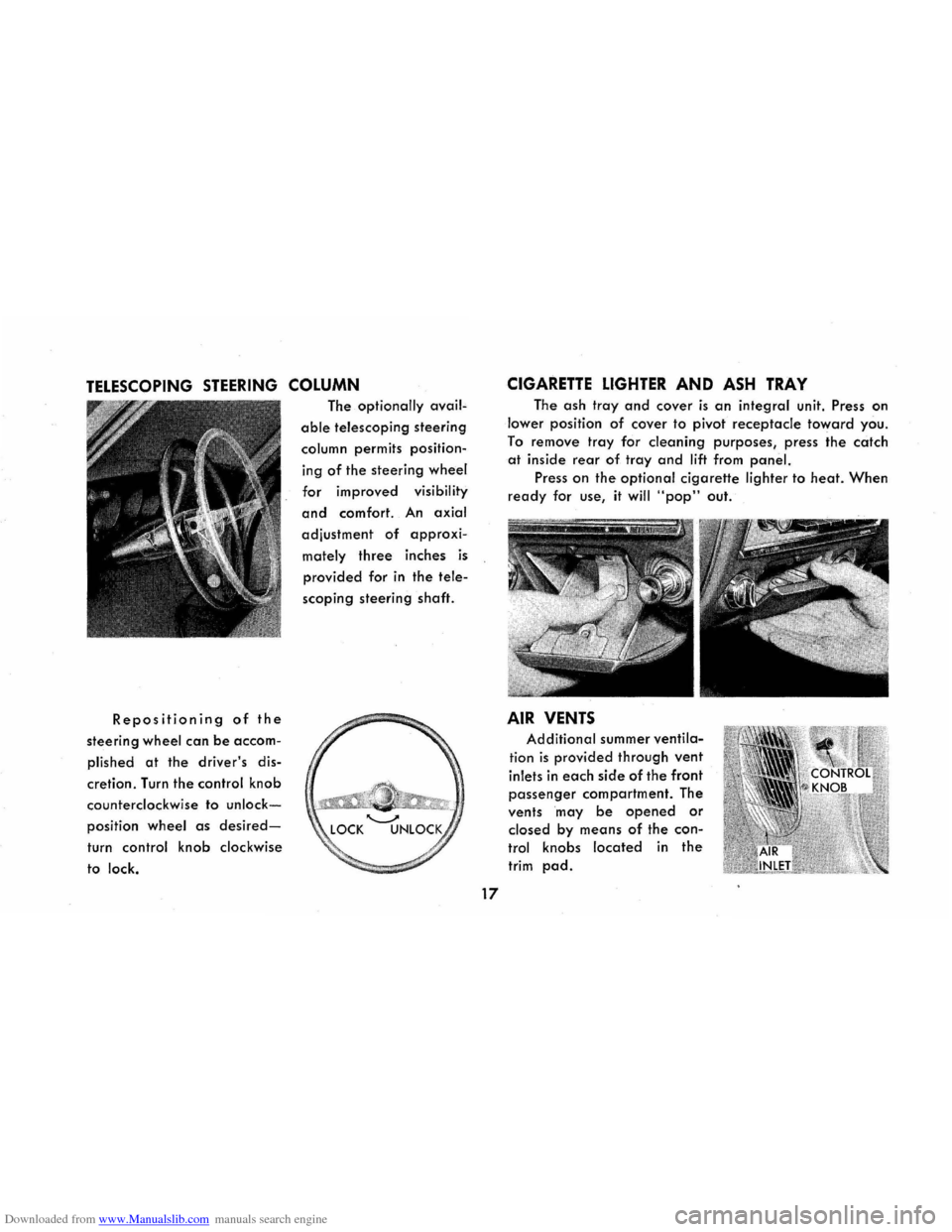
Repositioning of the
steering wheel can be accom
plished at the driver's dis
cretion.
Turn the control knob
counterclockwise to
unlock
position wheel as desired
turn control knob clockwise
to
lock.
The optionally avail
able telescoping steering
column permits position
ing
of the steering wheel
for improved visibility
and comfort. An axial
adiustment of approxi
mately three inches is
provided for in the tele
scoping steering shaft.
17
CIGARETTE LIGHTER AND ASH TRAY
The ash tray and cover is an integral unit. Press on
lower position of cover to pivot receptacle toward you.
To remove tray for cleaning purposes, press the catch
at inside rear of tray and lift from panel.
Press on the optional cigarette lighter to heat. When
ready for use, it will "pop" out.
AIR VENTS
Additional summer ventila
tion is provided through vent
inlets in each side of the front
passenger compartment. The
vents may
be opened or
closed by means of the con
trol knobs located in the
trim pad.
Page 37 of 56
Downloaded from www.Manualslib.com manuals search engine TIRE CARE
Keep your tires inflated to the recommended pres
sures.
Over-inflation can adversely affect riding comfort,
quietness and tire life while under-inflation affects vehicle
handling and tire life.
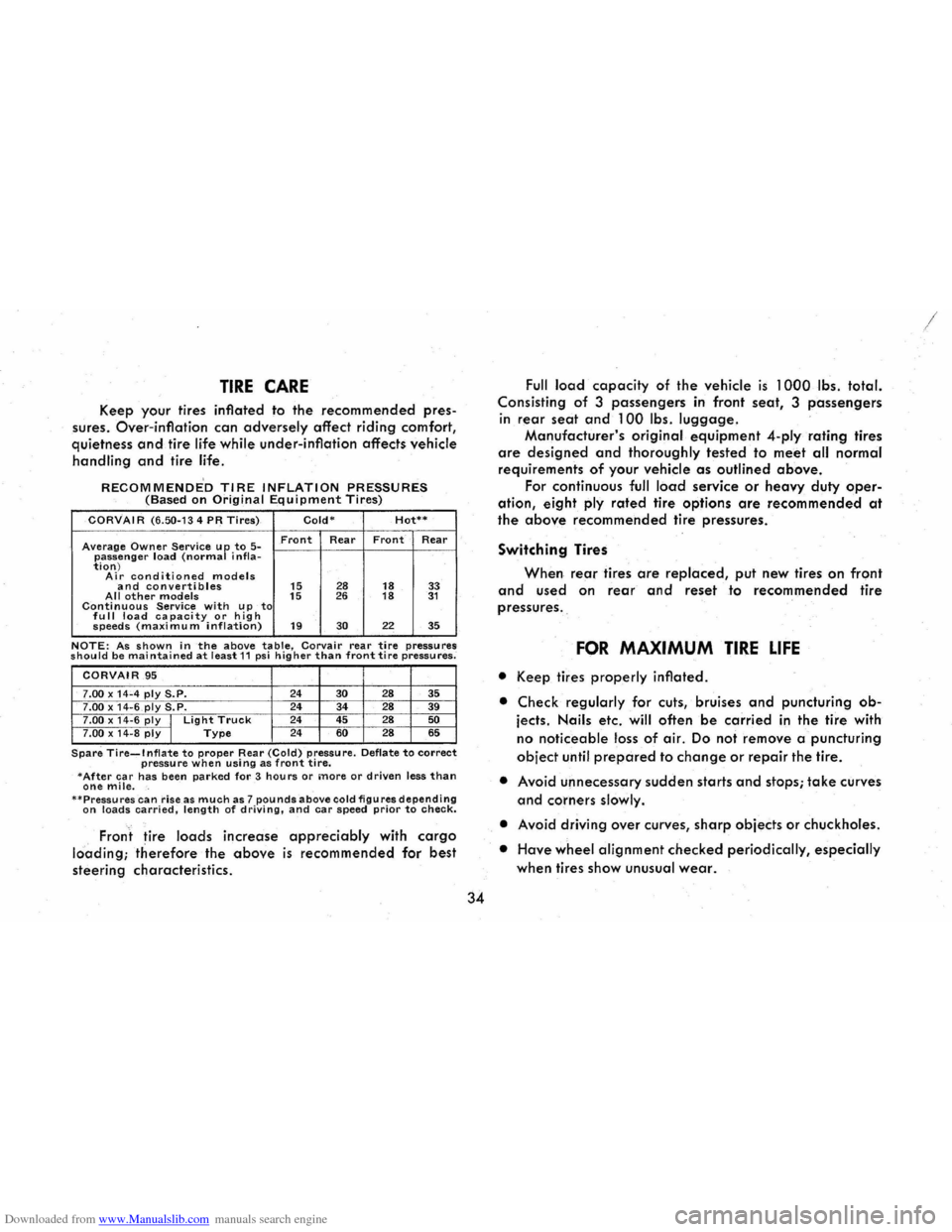
RECOMMENDED TIRE INFLATION PRESSURES (Based on Original Equipment Tires)
CORVAIR (6.50-134 PR Tires) Cold-Hot**
Average Owner Service up to 5-Front Rear Front Rear
passenger load (normal i nfla-tion) Air conditioned models and convertibles 15 28 18 33 All other models 15 26 18 31 Continuous Service with up to fu II load ca pacity or h ig h speeds (maximu m inflation) 19 30 22 35
NOTE: As shown in the above table, Corvair rear tire pressures should be maintained at least 11 psi higher than front tire pressures;
CORVAIR .95
7.00 x 14"4 ply S.P. 24 30 28 35 7.00 x 14-6 ply S.P. 24
34 28 39 7.00 x 14-6 ply I Light Truck 24
45 28 50
7 .00 x 14 -8 ply I Type 24 60 28 65
Spare Tire...,.lnflate to proper Rear (Cold) pressure. Deflate to correct pressure when using as front tire. -After car has been parked for 3 hours or more or driven less than one mile. --Pressures can riseas much as 7 pounds above cold figures depending on loads carried, length of driving, and car speed prior to check.
, Fron t tire loads increase appreciably with cargo
lci'ading; therefore the above is recommended for best
steering characteristics.
34
Full load capacity of the vehicle is 1 OOOlbs. total.
Consisting of 3 passengers in front seat, 3 passengers
in
rear seat and 100 Ibs . luggage.
Manufacturer's original equipment 4-plyrating tires
are designed and thoroughly tested to meet all normal
requirements of your vehicle as outlined above.
For continuous full load service or heavy duty oper
ation, eight ply rated tire options are recommended at
the above recommended tire pressures.
Switching Tires
When rear tires are replaced, put new tires on front
and used on rear and reset to recommended tire
pressures. ,
FOR MAXIMUM TIRE LIFE
• Ke.ep tires properly inflated.
• Check regularly for cuts, bruises and puncturing ob
jects. Nails etc. will often be carried in the tire with
no noticeable loss of air. Do not remove a puncturing
object until prepared to change or repair the tire.
• Avoid unnecessary sudden starts and stops; take curves
and corners slowly.
•
Avoid driving over curves, sharp objects or chuckholes.
•
Have wheel alignment checked periodically, especially
when tires show unusual wear.
Page 38 of 56
Downloaded from www.Manualslib.com manuals search engine Inspection and Repair
Inspect frequently for puncturing objects in the tires.
If any are found, do not attempt removal until you are
in a position to change the tire or have it repaired. Also,
check regularly that the wheel rim has sustained no
damage which could affect the air seal.
AIR CONDITIONED CARS •
COUPE CONVERTIBLE
AND SEDAN STYLES
....
35
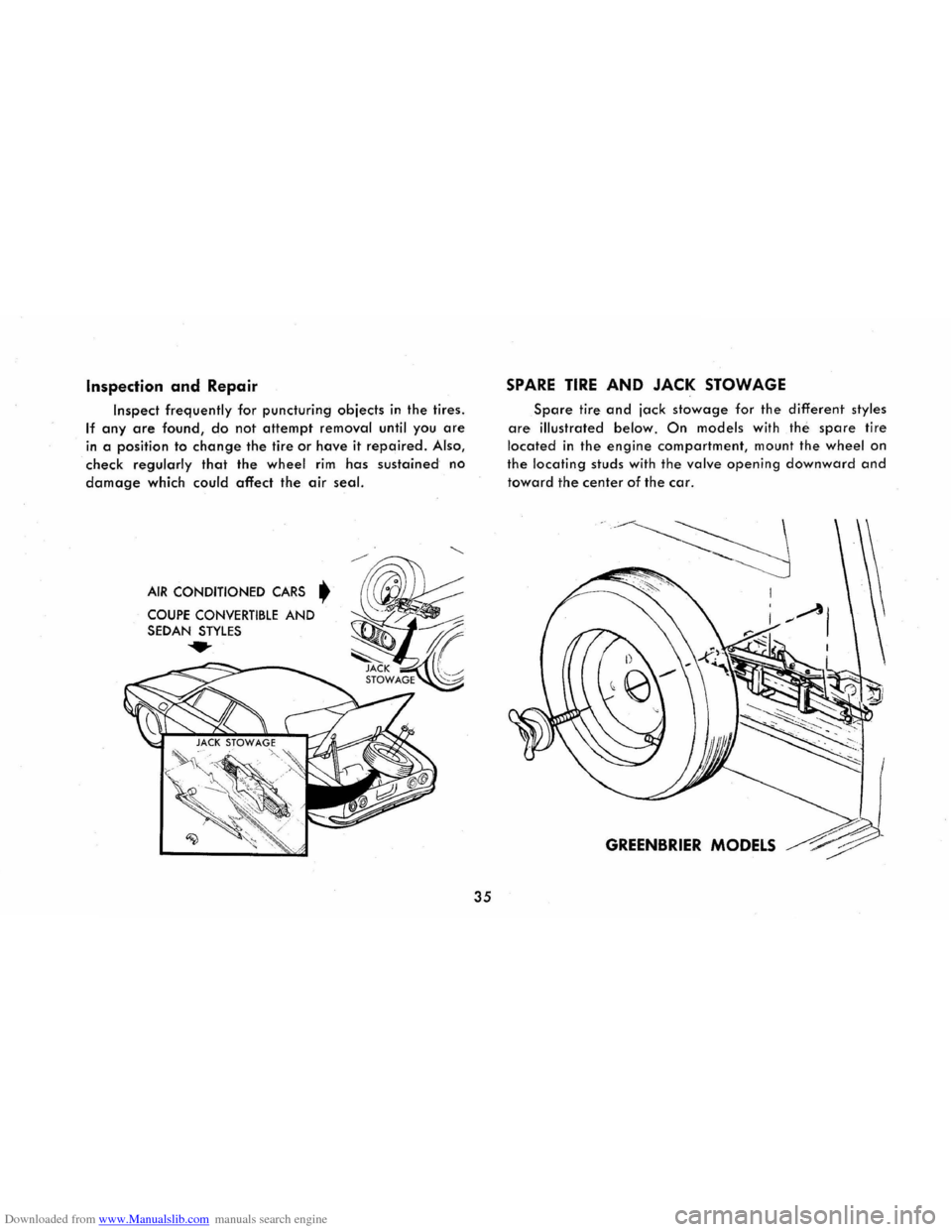
SPARE TIRE AND JACK STOWAGE
Spare tire and jack stowage for the different styles
are illustrated below. On models with the spare tire
located in the engine compartment, mount the wheel on
the locating studs with the valve opening downward and
toward the center of the car.
GREENBRIER MODELS
Page 39 of 56
Downloaded from www.Manualslib.com manuals search engine Jacking the Car
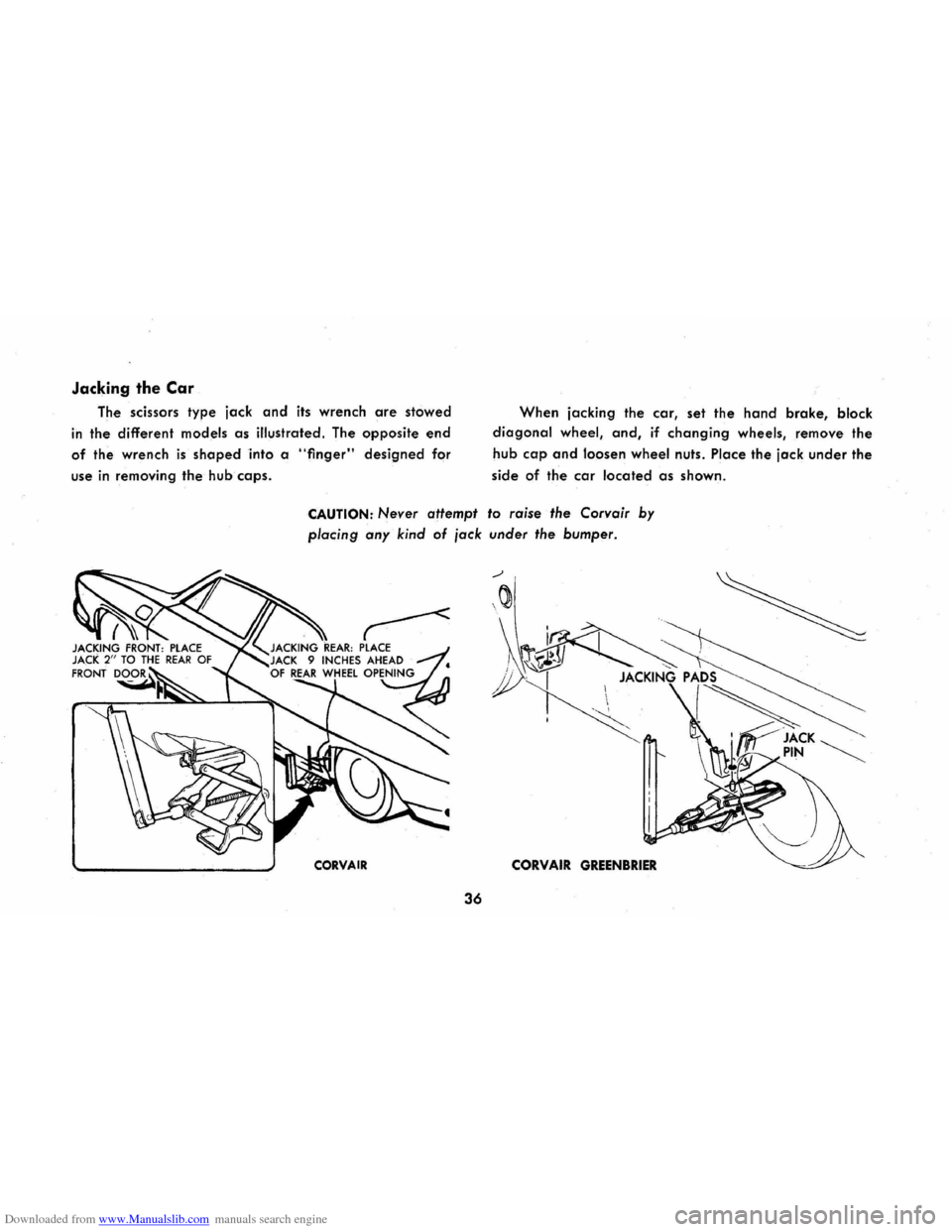
The scissors type jack and its wrench are stowed
in the different models as illustrated. The opposite end
of the wrench is shopedinto a "finger" designed for
use
in removing the hub caps.
When jacking the car, set the hand brake, block
diagonal wheel, and, if changing wheels, remove the
hub
cap and loosen wheel nuts. Place the jack under the
side of the
car located as shown .
CAUTION: Never attempt to raise the Corvair by
placing any kind of jack under the bumper.
~
_~.,..-__ ~-.;:~_ ....... _~Of REAR WHEEl OPENING
JACKING REAR: PLAC~ JACK 9 INCHES AHEAD . •
CORVAIR CORVAIR GREENBRIER
36
Page 43 of 56
Downloaded from www.Manualslib.com manuals search engine AIR CONDITIONING
After the first 6000 miles-have your Chevrolet Dealer
check the tightness of all hose damp connections.
Every 6000 miles-Check sight glass, located under the
hood, after the system has been in operation for
several minutes. Sight glass should be clear. Bubbles
or dirt indicate a leak which should be corrected
immediately by your Chevrolet Dealer.
BRAKE LININGS
Have the brake linings inspected periodically. Fre
quency of inspection will depend on traffic, terrain
and the driving habits of the driver.
BRAKE
MAIN CYLINDER
Every 6,000 miles-Check fluid level and maintain % II
below opening with G. M. Hydraulic Brake Fluid
Supreme No. 11.
PARKING BRAKE AND CLUTCH PULLEYS
AND CABLES-CORVAIR
Every 12,000 miles-Lubricate pulleys under dash. Re
move the tunnel cover under vehicle and lubricate
pulleys and cable bearing points with a water resist
ant EP Chassis Lubricant. Lubricate gearshift lever
ball
and socket (see page 41 J at the same time.
40
FRONT WHEEL BEARINGS
Clean, repack with high melting point wheel bearing
lubricant, and adjust whenever brake drums are re
moved. Replace grease seals at the same time.
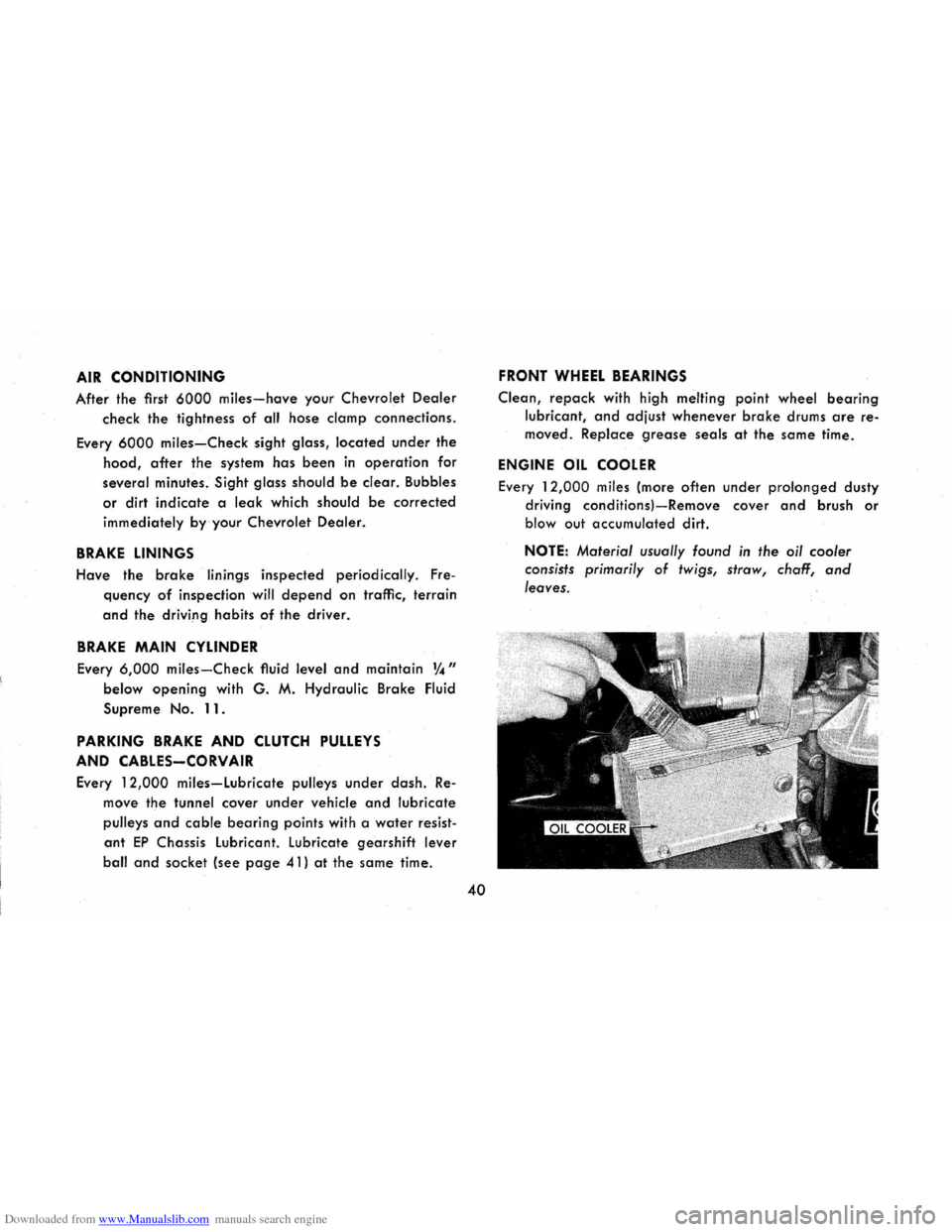
ENGINE OIL COOLER
Every 12,000 miles (more often under prolonged dusty
driving
conditionsJ-Remove cover and brush or
blowout accumulated dirt.
NOTE: Material usually found in the oil cooler
consists primarily
of twigs, straw, chaff, and
leaves.
Page 47 of 56
Downloaded from www.Manualslib.com manuals search engine SPECIFICATIONS
SERIAL AND UNIT NUMBERS
Engine Number Stamped on the engine block behind and to left of the fu el pump.
Body Number Corvair-Stamped on a plate attached to top of rear rail to left of engine mount , within the engine compartment.
Corvair Greenbrier-Stamped on a plate attached to the front inner body panel, with in the drive compartment.
Serial Number Corvair-Stamped on veh icle identification plate attached to left rear side rail, within the engine compartment. Corvair Greenbrier-Stamped on vehicle identification plate attached to the left front door lock pillar.
DIMENSIONS
length: Corvair Greenbrier ................................. 179.7 in.
Co r
vair ........................................... 183 .3 in .
Width :
Corva ir
Greenbrier ............... .•... ... .......... 70.0 in.
Co rvair ........................................... 69.7 in.
Height :
Corvair
Greenbrier ............. ........ ........... " 68.5 in.
Corvair Sport Sedan ............. .. ................ " 51.2 in.
Corvai r Sport Coupe ................................. 51.3 in.
Corva ir Convertible ...........•............ ....... " 51.5 in.
Wheel. Bas e:
Corvair Greenbri.er ... ............................. '95.0 in.
Corvair ........................................ . . 108 .0 in.
Turning Diameter:
Corvair
Greenbrier ..... .................•.......... 42.6 ft .
Corvair ........................................... 36.0 ft . Greenbrier-load length .............................. 106 .2 in. Greenbrier-load Width . .....•........................ 59.4 in. Greenbrier-load Compartment Height .. , ............... 54.0 in.
44
S ide loading Doors-Width ................. '.' ... .4.90 x 53. 5 in.
Rear loading Doors .............................. 36.0 x 44.6 in .
CAPACITIES
Gasol ine Tank :
Corvair
Greenbrier ... .............................. 18.5 gal. Co rvair ......................•..........•........ 14.0 gal. Crankcase Refill .................. ........ .. ............ 4 qt. Add for filter . . . . . . . . . . . . . . . . . . . . . . . . . . . . . . . . . . . . . . .. 1 pt .
Transmission :
3.Speed ..................•......................... . 2 pt. 4·Speed ..................... ........................ 3 pt.
D ifferent ial ... .. .............•....................... 4% pt . Cooling Sys tem ............ .. ................ Air Coo led Engine
ENGINE SPECIFICATIONS
Horsepower: 95 hp Turbo·Air 164 ... ................ ..... 95 @ 3600 rpm 110 hp Turbo·Air 164 .............. : ......... 110@ 4400 rpm 140 hp Turbo·Air 164 ..... :oO .............. 140 @ 5200 rpm 180 hp Turbocharged 164 .................... 180 @ 4000 rpm
Compression Ratio:
95 hp Turbo·Air 164 ................................. 8.25 :1 110 and 140 hp Turbo -Air 164 ........................ 9 .25:1 180 hp Turbocharged 164 ........ ... ........ _ ........ 8.25 :1
Displacement .................................... . .. 164 cu. in.
Bore and Stroke (all engines) ................. ....... 3K 6"x2 .94" Firing Order ............... ....................... 1.4·5 -2 ·3-6
Spark Plugs: 95 hp Turba·Air 164 (Gap .. 035) ............. ....... AC·46·FF 11 0 and 140 hp Turba·Air 164 and 180 hp Turbocharged 164 (Gap .030) ...........•.......... AC·44-FF