1965 CHEVROLET CORVAIR cooling
[x] Cancel search: coolingPage 17 of 56
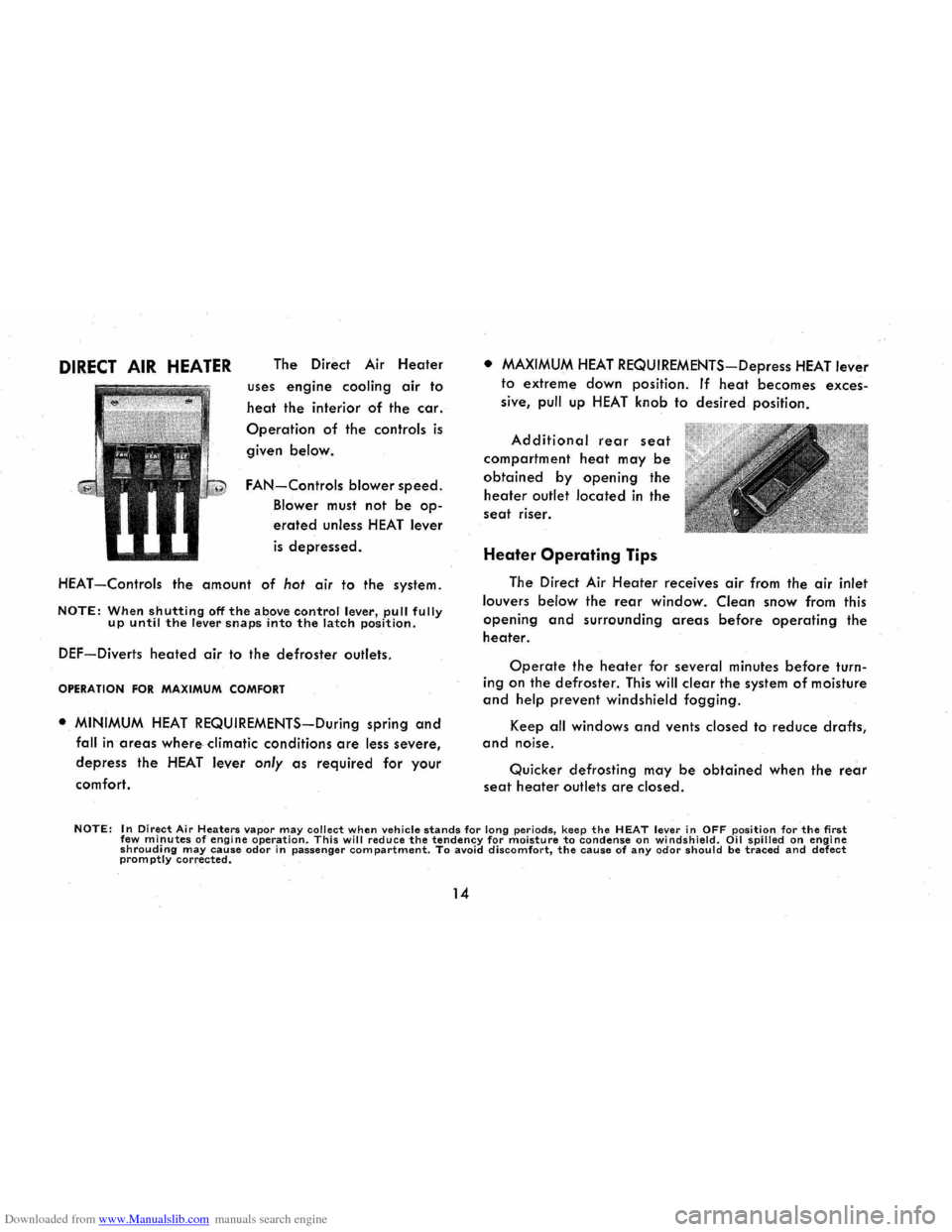
Downloaded from www.Manualslib.com manuals search engine DIRECT AIR HEATER The Direct Air Heater
uses engine cooling air to
heat the interior of the car.
Operation of the controls is
given below.
FAN-Controls blower speed.
Blower must not be op
erated unless HEAT lever
is depressed.
HEAT
-Controls the amount of hot air to the system.
NOTE: When shutting off the above control lever, pull fully up until the lever snaps into the latch position.
DEF-Diverts heated air to the defroster outlets.
OPERATION FOR MAXIMUM COMFORT
• MINIMUM HEAT REQUIREMENTS-During spring and
fall in areas where climatic conditions are less severe,
depress the HEAT
lever only as required for your
comfort.
• MAXIMUM HEAT REQUIREMENTS-Depress HEAT lever
to extreme down position. If heat becomes exces
sive, pull up HEAT
knob to desired position.
Additional rear seat
compartment heat may be
obtained by opening the
heater outlet located in the
seat riser.
Heater Operating Tips
The Direct Air Heater receives air from the air inlet
louvers below the rear window. Clean snow from this
opening and surrounding areas before operating the
heater.
Operate the heater for several minutes before turn
ing on the defroster. This will clear the system of moisture
and help prevent windshield fogging.
Keep all windows and vents closed to reduce drafts, and noise.
Quicker defrosting may be obtained when the rear
seat heater outlets are closed.
NOTE: In Direct Air Heaters vapor may collect when vehicle stands for long periods, keep the HEAT lever in OFF position for the first few minutes of engine operation. This will reduce the tendency for moisture to condense on windshield. Oil spilled on engine shrouding may cause odor in passenger compartment. To avoid discomfort, the cause of any odor should be traced and defect prom ptly corrected.
14
Page 18 of 56
Downloaded from www.Manualslib.com manuals search engine AIR CONDITIONING
The optional air conditioner provides controlled con
ditioned air at each of the three dash panel mounted
outlets.
Air conditioner and heater are two separate units
with a common control housing-The air condition con
trols function as follows.
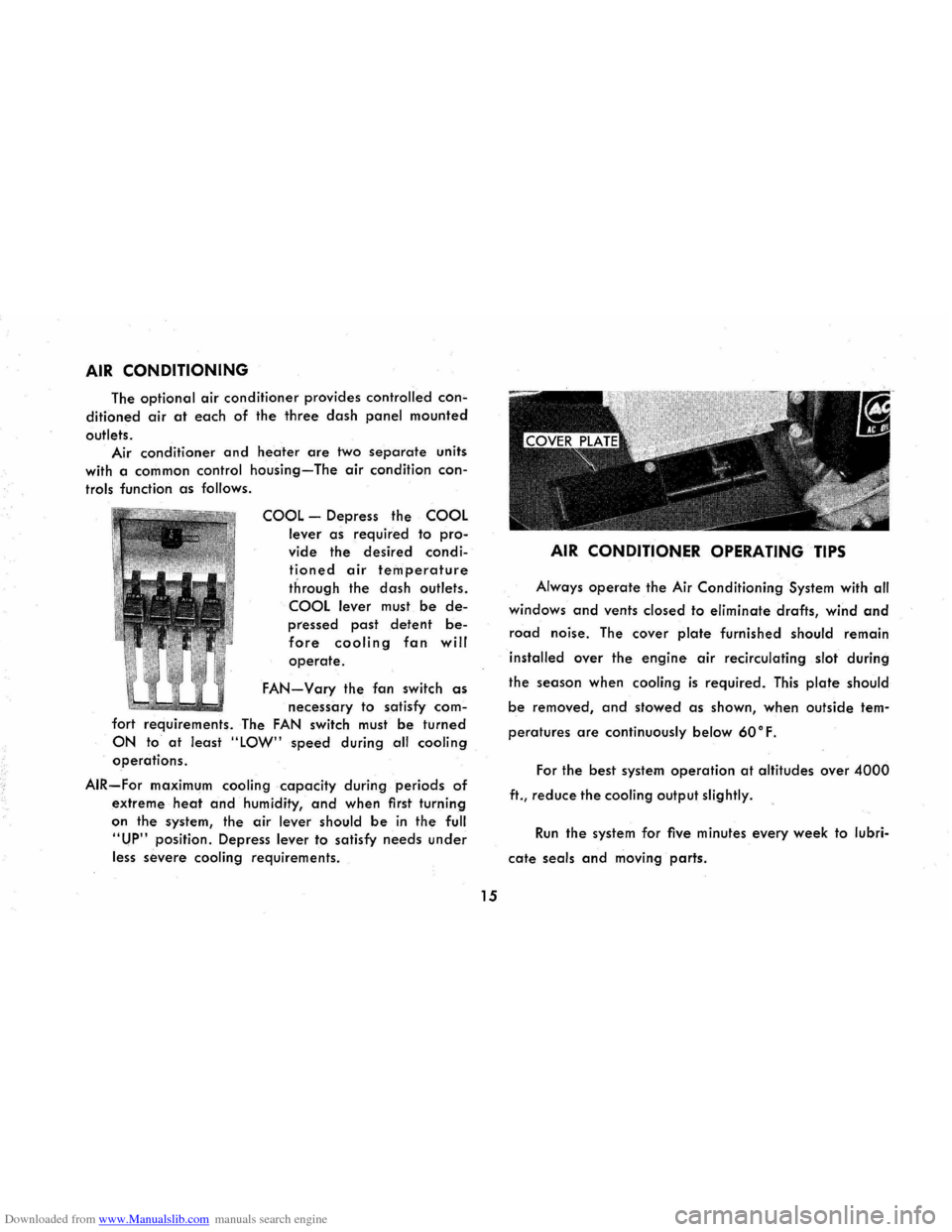
COOL -Depress the COOL
lever as required to pro
vide the desired condi
tioned air temperature
through the dash outlets.
COOL lever must be de
pressed past detent be
fore cooling fan will
operate.
FAN-Vary the fan switch as
necessary
to satisfy com
fort requirements. The FAN switch must be turned
ON to at least "LOW" speed during all cooling
operations.
AIR-For maximum cooling capacity during periods of
extreme heat and humidity, and when first turning
on the system, the air lever should be in the full
"UP" position. Depress lever to satisfy needs under
less severe cooling requirements.
15
AIR CONDITIONER OPERATING TIPS
Always operate the Air Conditioning System with all
windows and vents closed to eliminate drafts, wind and
road noise. The cover plate furnished should remain
installed over the engine air recirculating slot during
the season when cooling is required. This plate should
be removed, and stowed as shown, when outside tem
peratures are continuously below 600 F.
For the best system operation at altitudes over 4000
ft., reduce the cooling output slightly.
Run the system for five minutes every week to lubri
cate seals and moving parts.
Page 24 of 56
Downloaded from www.Manualslib.com manuals search engine LUGGAGE COMPARTMENT
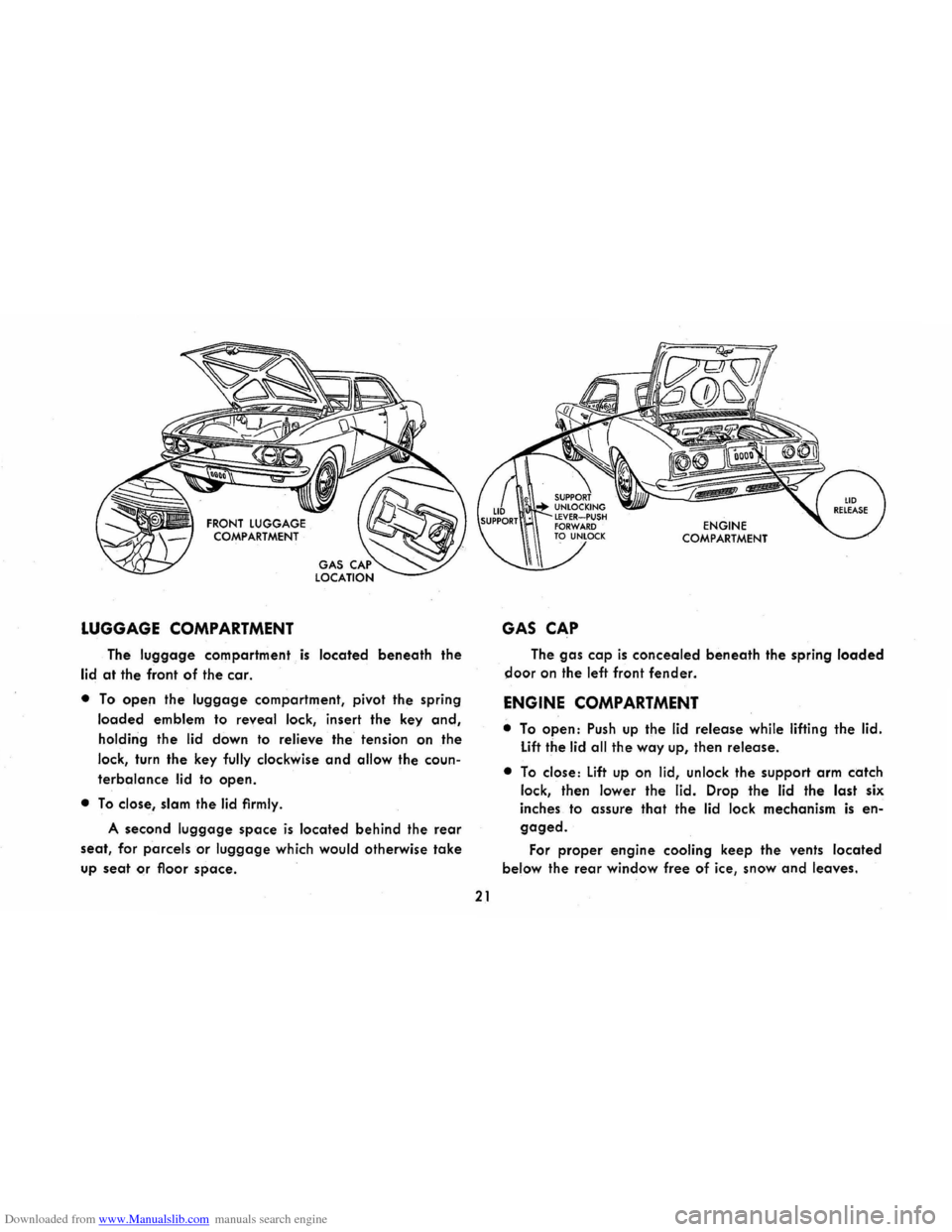
The luggage compartment is located beneath the
lid
at the front of the car .
• To open the luggage compartment, pivot the spring
loaded emblem to reveal lock, insert the key and,
holding the lid down to relieve the tension on the
lock, turn the key
fully clockwise and allow the coun
terbalance lid to open.
• To close, slam the lid firmly.
A second
luggage space is located behind the rear
seat, for parcels or luggage which would otherwise take
up
seat or floor space.
21
GAS CAP
ENGINE COMPARTMENT
The gas cap is concealed beneath the spring loaded
poor on the left front fender.
ENGINE COMPARTMENT
• To open: Push up the lid release while lifting the lid.
Lift the lid all the way up, then release.
• To close: Lift up on lid, unlock the support arm catch
lock, then lower the lid. Drop the lid the last six
inches to assure that the
lid lock mechanism is en
gaged.
For proper engine cooling keep the vents located
below the
rear window free of ice, snow and leaves.
Page 36 of 56
Downloaded from www.Manualslib.com manuals search engine you use an oil which, according to the label on the can
is (1) intended for service MS and (2) passes car makers'
tests or meets General Motors Standard GM 4745-M .
Oils conforming to these types contain detergent addi
tives. Your serviceman will be pleased to assist you in
selecting the proper oil for your car.
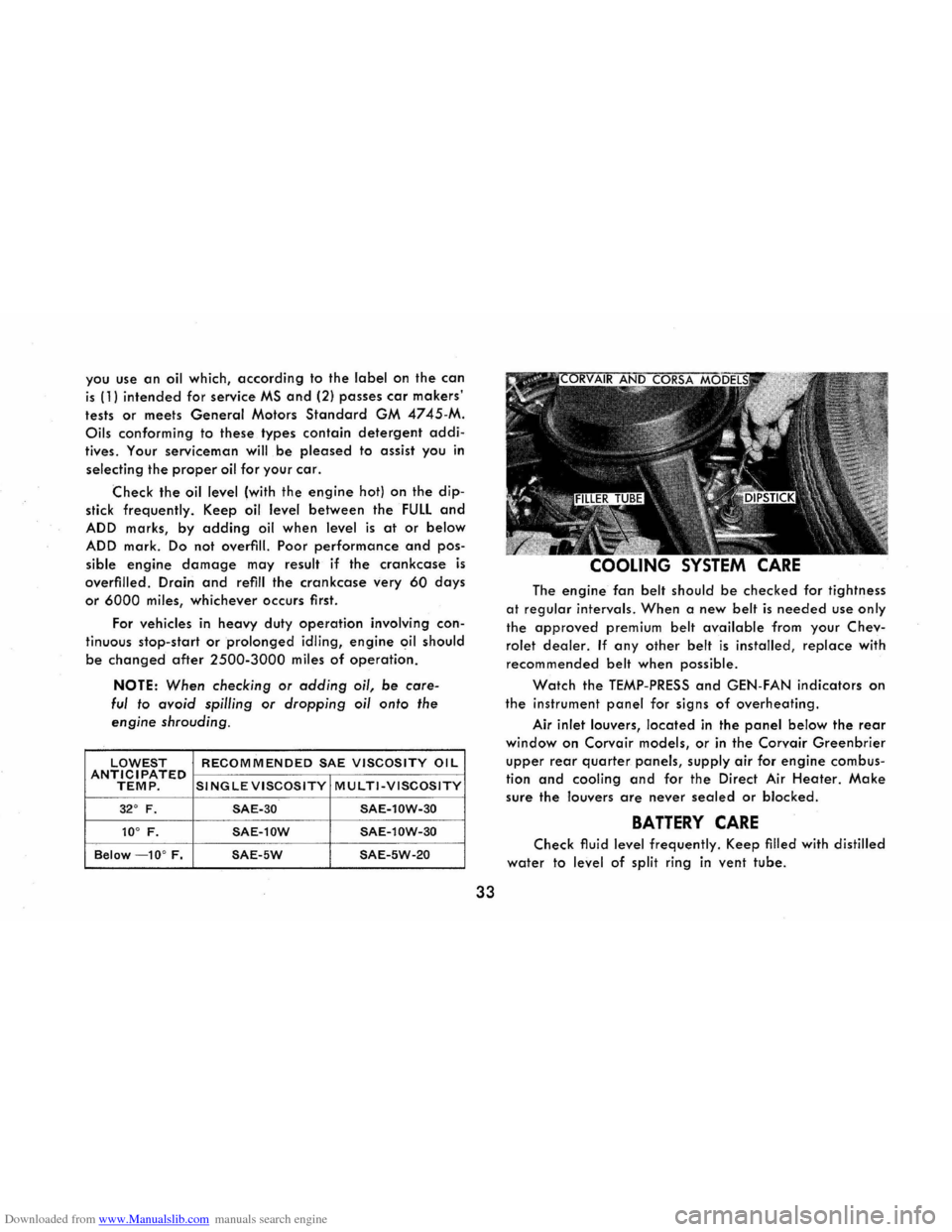
Check the oil level (with the engine hot) on the dip
stick frequently. Keep oil level between the FULL and
ADD marks, by adding oil when level is at or below
ADD mark. Do not overfill. Poor performance and pos
sible engine damage may result if the crankcase is
overfilled. Drain and refill the crankcase very 60 days
or 6000 miles, whichever occurs first.
For vehicles
in heavy duty operation involving con
tinuous stop-
start or prolonged idling, engine oil should
be changed after 2500-3000 miles of operation.
NOTE: When checking or adding oil, be care
ful to avoid spilling or dropping oil onto the
engine shrouding.
LOWEST RECOMMENDED SAE VISCOSITY OIL ANTICIPATED TEMP. SINGLE VISCOSITY MULTI-VISCOSITY
32° F. SAE-30 SAE-l0W-30
10° F. SAE-l0W SAE-l0W-30
Below -10° F. SAE-5W SAE-5W-20
33
COOLING SYSTEM CARE
The engine fan belt should be checked for tightness
at regular intervals. When a new belt is needed use only
the approved premium belt available from your Chev
rolet dealer. If any other belt is installed, replace with
recommended belt when possible .
Watch the TEMP-PRESS and GEN-FAN indicators on
the instrument panel for signs of overheating.
Air inlet louvers, located in the panel below the rear
window on Corvair models, or in the Corvair Greenbrier
upper rear quarter panels, supply air for engine combus
tion
and cooling and for the Direct Air Heater. Make
sure the louvers are never sealed or blocked.
BATTERY CARE
Check fluid level frequently. Keep filled with distilled
water to level of split ring in vent tube.
Page 47 of 56
Downloaded from www.Manualslib.com manuals search engine SPECIFICATIONS
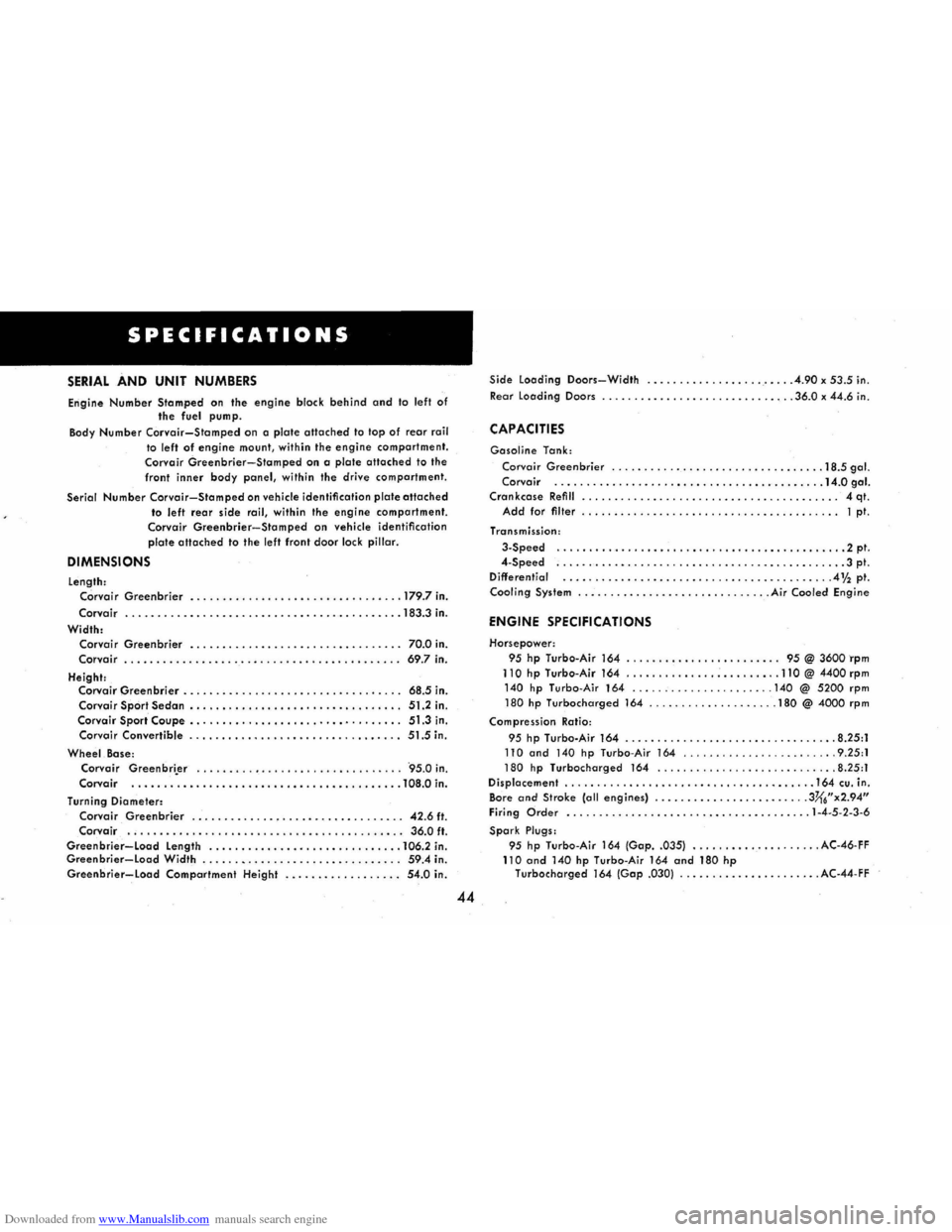
SERIAL AND UNIT NUMBERS
Engine Number Stamped on the engine block behind and to left of the fu el pump.
Body Number Corvair-Stamped on a plate attached to top of rear rail to left of engine mount , within the engine compartment.
Corvair Greenbrier-Stamped on a plate attached to the front inner body panel, with in the drive compartment.
Serial Number Corvair-Stamped on veh icle identification plate attached to left rear side rail, within the engine compartment. Corvair Greenbrier-Stamped on vehicle identification plate attached to the left front door lock pillar.
DIMENSIONS
length: Corvair Greenbrier ................................. 179.7 in.
Co r
vair ........................................... 183 .3 in .
Width :
Corva ir
Greenbrier ............... .•... ... .......... 70.0 in.
Co rvair ........................................... 69.7 in.
Height :
Corvair
Greenbrier ............. ........ ........... " 68.5 in.
Corvair Sport Sedan ............. .. ................ " 51.2 in.
Corvai r Sport Coupe ................................. 51.3 in.
Corva ir Convertible ...........•............ ....... " 51.5 in.
Wheel. Bas e:
Corvair Greenbri.er ... ............................. '95.0 in.
Corvair ........................................ . . 108 .0 in.
Turning Diameter:
Corvair
Greenbrier ..... .................•.......... 42.6 ft .
Corvair ........................................... 36.0 ft . Greenbrier-load length .............................. 106 .2 in. Greenbrier-load Width . .....•........................ 59.4 in. Greenbrier-load Compartment Height .. , ............... 54.0 in.
44
S ide loading Doors-Width ................. '.' ... .4.90 x 53. 5 in.
Rear loading Doors .............................. 36.0 x 44.6 in .
CAPACITIES
Gasol ine Tank :
Corvair
Greenbrier ... .............................. 18.5 gal. Co rvair ......................•..........•........ 14.0 gal. Crankcase Refill .................. ........ .. ............ 4 qt. Add for filter . . . . . . . . . . . . . . . . . . . . . . . . . . . . . . . . . . . . . . .. 1 pt .
Transmission :
3.Speed ..................•......................... . 2 pt. 4·Speed ..................... ........................ 3 pt.
D ifferent ial ... .. .............•....................... 4% pt . Cooling Sys tem ............ .. ................ Air Coo led Engine
ENGINE SPECIFICATIONS
Horsepower: 95 hp Turbo·Air 164 ... ................ ..... 95 @ 3600 rpm 110 hp Turbo·Air 164 .............. : ......... 110@ 4400 rpm 140 hp Turbo·Air 164 ..... :oO .............. 140 @ 5200 rpm 180 hp Turbocharged 164 .................... 180 @ 4000 rpm
Compression Ratio:
95 hp Turbo·Air 164 ................................. 8.25 :1 110 and 140 hp Turbo -Air 164 ........................ 9 .25:1 180 hp Turbocharged 164 ........ ... ........ _ ........ 8.25 :1
Displacement .................................... . .. 164 cu. in.
Bore and Stroke (all engines) ................. ....... 3K 6"x2 .94" Firing Order ............... ....................... 1.4·5 -2 ·3-6
Spark Plugs: 95 hp Turba·Air 164 (Gap .. 035) ............. ....... AC·46·FF 11 0 and 140 hp Turba·Air 164 and 180 hp Turbocharged 164 (Gap .030) ...........•.......... AC·44-FF
Page 49 of 56
Downloaded from www.Manualslib.com manuals search engine Corvair passenger cars are designed primarily for
passenger conveyance. However, it is well known that
many owners do use the Corvair to pull trailers, and
when available trailer hauling options have been used,
the owners
have experienced very satisfactory service.
When a trailer is attached to a car, the car becomes
not only a load-carrying vehicle, but a load-pulling
vehicle. The demands of this type of operation are very
different from those for which the automobile is pri
marily designed and may present problems, such as
spring
and tire loading, braking, cooling, lighting, and
steering. However, careful driving practices and the use
of factory-recommended options will better satisfy the
requirements
of trailer hauling.
If in the opinion of the manufacturer a part or com
ponent of a motor vehicle has been adversely affected
46
by misuse of the vehicle with trailer loads, such part or
component will not be covered by the manufacturer's
warranty.
The size of and equipment for trailers, including
such items as hitches and safety chains, brakes, lights,
power-weight ratios and over-all length, are generally
subject to safety regulations in all states, and it is the
responsibility of the user to make certain that he is in
full
compliance with the regulations of the states in
which he plans to operate with a trailer of the Interstate
Commerce Commission,
if applicable, before doing so.
Further, when
operating a car with a trailer attached,
the driver must realize that the performance, steering
characteristics,
and braking distance of his car have
been altered, and that he must exercise greater caution
to safely handle his car and trailer.
Page 50 of 56
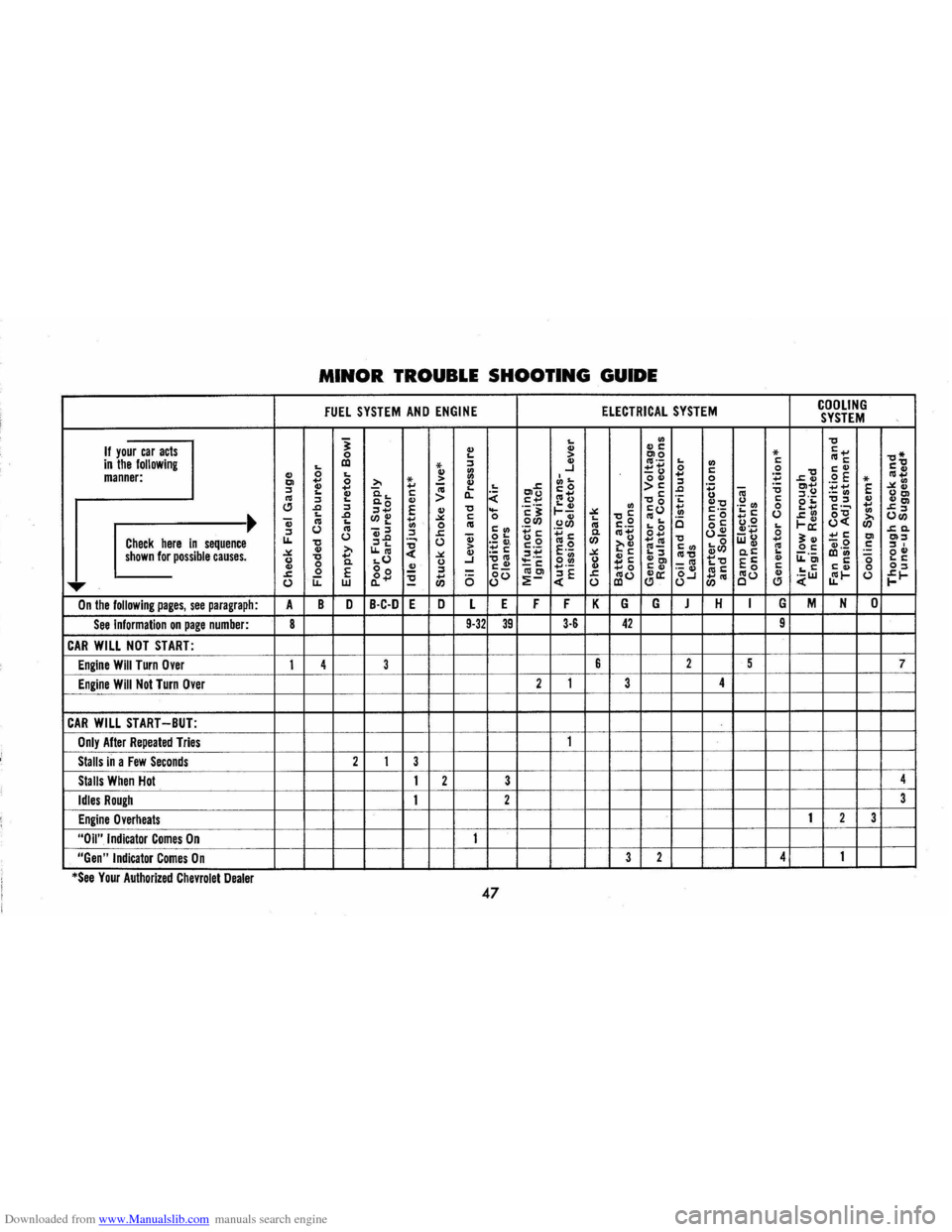
Downloaded from www.Manualslib.com manuals search engine MINOR TROUBLE SHOOTING GUIDE
FUEl SYSTEM AND ENGINE ElECTRICAL SYSTEM COOLING SYSTEM
"i ... I/) -0 If your car acts .. .. ..c * c+, 0 ... > 0)0 -0* in the following III * ::s .. cu·-... I/) c CUc c-o ... ...J +,+' 0
0 c .. .. I/) -I) C
-0 cu$ manner: .. 0 ... I/) J,5 +' ;E .2 E 0) +' 0 >, * ~ .. 0" ::s 0 ~ .. * ~I/) ::s .. +' a. ... +' cu ... ... ~ >c J:l '.jj iii -0 O)+' +,+' E g8> ... .. c > c.. :.;: 0)1) C+, -05 I) ::s.!:! .-I/) cu ::s ... 0.0 .. C+' CUI) .;: "-0 .~ en C 0'" -o::s .. Cl J:l ::s E 'c'i ..... I/) +'
0 c· .... +' ~g ... ::s+' .. -0 ..... 1--~ -oC co .!!! c·-"'c 0 ... +' 0-0 I/)
~ J:l (/)f +' ~ C
0 .. ... cu ... cO to ~I/) >, o(/) Qj cu ... I/) 0 cu O(/)
.!:!(/) cu c.2 C OC ... I-~ 0« (/) ::s 0 cu -::s ::s ~ Cl/) '';:; t: 0. CU+' "'0 O.!! Q)'.-0 ~c. 0 "J:l Qj 0'" +'c O+' iii~ ~ .. +'c 0) Check here in sequence LL. -0 ::S ... :ti' 0 .-.. , 1)0 CUo (/) >,g +'CU -0 ~c& +' -0 O)::S .. >, LL.cu > .~ c: C._ E·-cu-Cl/) cu Oc ... -C ::s, shown for possible causes. ~ « .. ::s.~ ~ "'c "'::s c.C ... III I/) 0" I) -0 +' ... 0 ~ ...J -oCU oll! I) $c: "0) cu-o
1::-0 EC .. r;:'c, "0 "'c 0. I) :::C _cu C .. 0 00 .!! C.!! +"-.. +'0 C .. C ... c c .. 0 O::s
0 E ::s -CUO) ~E .-.. cuc CUO .. ~ ~+' -0 +' (5 80 ~ ~o ~a:: 8...J t)cu CO :.;:LIJ ~I-0 ~I-..... 0 r;: LIJ (/) :::-0 Cl
On the following pages, see paragraph: A
B D B·C-D E D L E F F K G G J H I G M N 0
See information on page number: 8 9-32 39 3-6 42 9
CAR WILL NOT START:
Engine Will Turn Over 1 4 3 6
2 5 7
Engine Will Not Turn Over 2 1 3 4
CAR WILL START -BUT:
Only After Repeated Tries 1
Stalls in a Few Seconds 2 1 3
Stalls When Hot 1 2 3 4
Idles Rough 1 2 3
Engine Overheats 1 2 3
"Oil" Indicator Comes On 1
"Gen" Indicator Comes On 3 2 4 1
*See Your AuthOrized Chevrolet Dealer 47
Page 53 of 56
Downloaded from www.Manualslib.com manuals search engine cup at the end of the spark plug
wire
and the tubular metal con
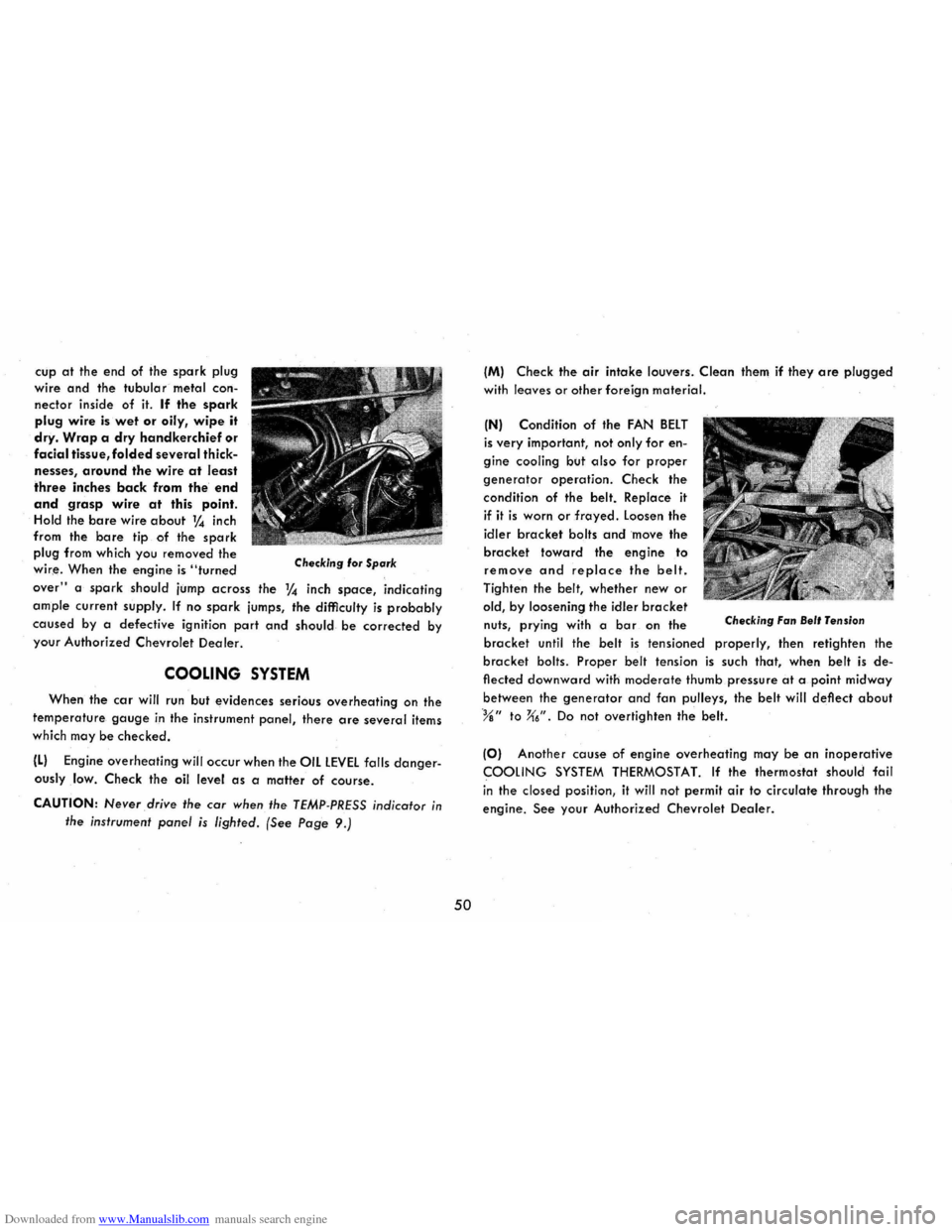
nector inside of it. If the spark
plug wire is wet or oily, wipe it
dry. Wrap a dry handkerchief or
facial tissue, folded several thick
nesses, around the wire at least
three inches back from the end
and grasp wire at this point. Hold the bare wire about 1,4 inch
from the.
bare tip of the spark
plug from which you removed the
wir,e. When the engine is "turned Checking 'or Spark
over" a spark should jump across the 1,4 inch space, indicating
ample current supply. If no spark jumps, the difficulty is probably
caused by a defective ignition part and should be corrected by
your Authorized Chevrolet
Dealer.
COOLING SYSTEM
When the car will run but evidences serious overheating on the
temperature gauge in the instrument panel, there are several items
which may
be checked.
(L) Engine overheating will occur when the OIL LEVEL falls danger
ouslylow. Check the oil level as a malter of course.
CAUTION: Never drive the car when the TEMP-PRESS indicator in
the instrument panel is lighted. (See Page 9.)
50
(M) Check the air intake louvers . Clean them if they are plugged
with leaves or other foreign material.
(N) Condition of the FAN BELT
is very important, not only for en
gine cooling but
also for proper
generator operation. Check the
condit ion of the belt. Replace
it
if it is worn or frayed. Loosen the
idler
bracket bolts and move the
bracket toward the engine to
remove and replace the belt.
Tighten the belt, whether new or
old, by loosening the idler bracket nuts, prying with a bar on the Checking Fan Bel' Tension
bracket until the belt is tensioned properly, then retighten the
bracket bolts. Proper belt tension is such that, when belt is de
flected downward with moderate thumb pressure at a point midway
between the
generator and fan pulleys, the belt will deflect about
%" to X6". Do not overtighten the belt.
(0) Another cause of engine overheating may be an inoperative
COOLING SYSTEM THERMOSTAT. If the thermostat should fail
i n the closed position, it will not permit
air to circulate through the
engine. See your Authorized Chevrolet Dealer.