2024 MAZDA CX90 brakes
[x] Cancel search: brakesPage 319 of 687
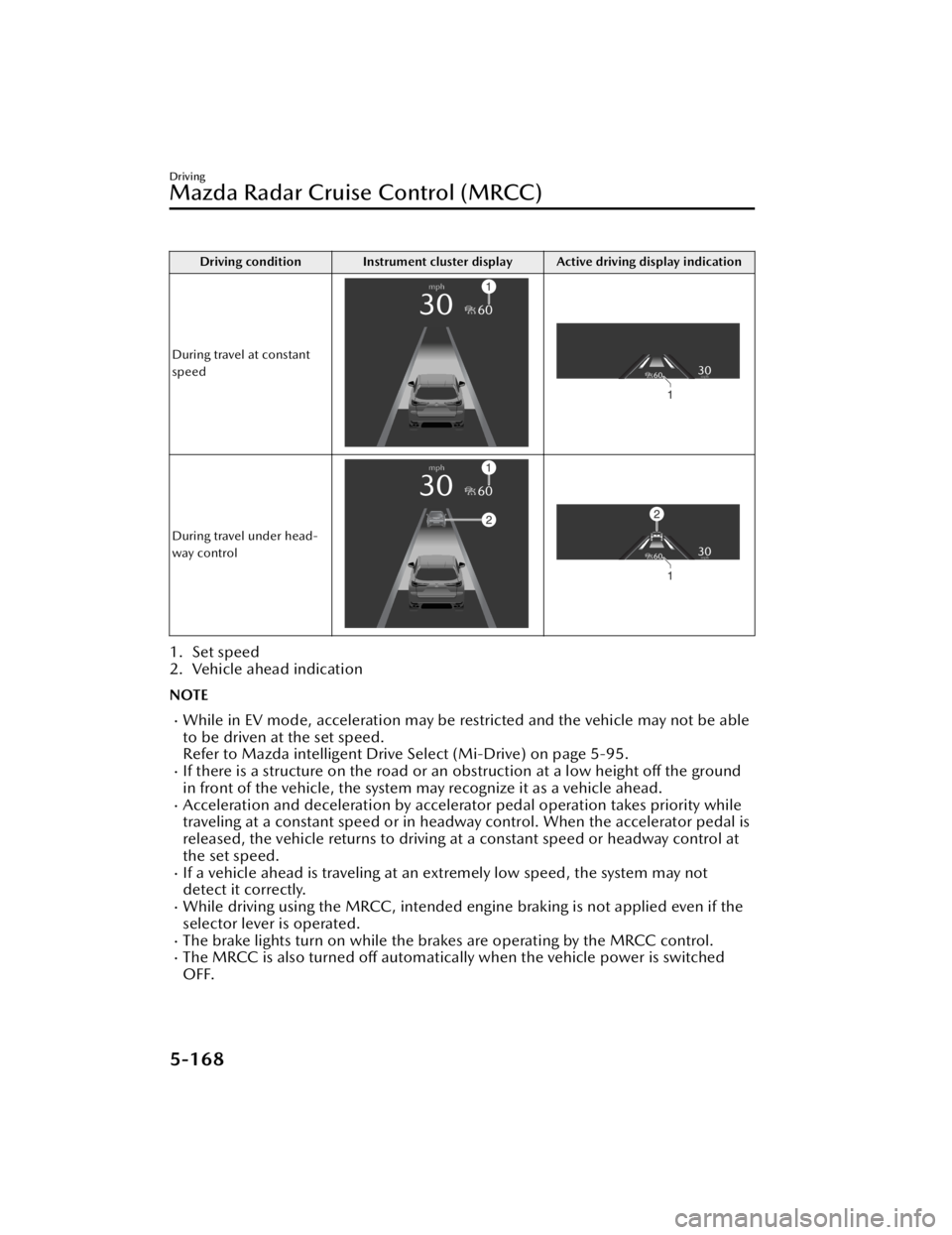
Driving condition Instrument cluster display Active driving display indication
During travel at constant
speed
During travel under head-
way control
1. Set speed
2. Vehicle ahead indication
NOTE
While in EV mode, acceleration may be restricted and the vehicle may not be able
to be driven at the set speed.
Refer to Mazda intelligent Drive Select (Mi-Drive) on page 5-95.
If there is a structure on the road or an obstruction at a low height off the ground
in front of the vehicle, the system may recognize it as a vehicle ahead.
Acceleration and deceleration by accelerator pedal operation takes priority while
traveling at a constant speed or in headway control. When the accelerator pedal is
released, the vehicle returns to driving at a constant speed or headway control at
the set speed.
If a vehicle ahead is traveling at an extremely low speed, the system may not
detect it correctly.
While driving using the MRCC, intended engine braking is not applied even if the
selector lever is operated.
The brake lights turn on while the brakes are operating by the MRCC control.The MRCC is also turned off automatically when the vehicle power is switched
OFF.
Driving
Mazda Radar Cruise Control (MRCC)
5-168
CX-90_8KG7-EA-22L_Edition1_new 2022-11-17 16:05:04
Page 326 of 687

Cruising & Traffic Support(CTS)
*
The CTS is a system that reduces the
load on the driver while the vehicle is
driven on expressways or highways.
The CTS has the following 2 functions.
Constant speed/Headway control
function
The function performs headway
control to maintain the distance with a
vehicle ahead at a constant preset
speed without you having to depress
the accelerator or brake pedal.
Steering wheel assist function
When vehicle lane lines are detected,
the function assists your steering wheel
operation to follow the vehicle lane
lines.
When vehicle lane lines are not
detected, the function assists your
steering wheel operation to follow the
trajectory of the vehicle ahead.
Warnings and Cautionsfor Using Cruising &
Tra ffi c Support (CTS)
WARNING
Do not rely completely on the CTS.
The CTS is not an automated driving
system. Therefore, the function has
limitations. Do not rely completely
on the system and always stay on
course using the steering wheel.
Set a vehicle speed within the speed
limit according to the road
conditions and the weather
conditions.
The CTS may not be able to detect a
vehicle ahead depending on the type
of vehicle ahead and its conditions,
the weather conditions, and the road
conditions. Additionally, the system
might be unable to decelerate
sufficiently if the vehicle ahead
applies the brakes suddenly or
another vehicle cuts into your lane,
which could result in an accident.
Do not use the CTS under the
following conditions. Otherwise, it
may result in an accident.
The vehicle is driven on roads other
than expressways and highways.
The vehicle is driven on roads with
sharp curves or with heavy
traffic
where sufficient distances between
vehicles cannot be kept.
The vehicle is driven on roads where
acceleration and deceleration are
frequently repeated.
The vehicle is exiting the main lane
on an expressway to enter an
interchange, a rest area, or a parking
area.
Driving
Cruising &
Tra ffi c Support (CTS)
*Some models.5-175
CX-90_8KG7-EA-22L_Edition1_new
2022-11-17 16:05:04
Page 329 of 687

Driving condition Instrument cluster display Active driving display indication
During travel at constant
speed
During travel under head-
way control
1. Set speed
2. Vehicle ahead indication
NOTE
While in EV mode, acceleration may be restricted and the vehicle may not be able
to be driven at the set speed.
Refer to Mazda intelligent Drive Select (Mi-Drive) on page 5-95.
If there is a structure on the road or an obstruction at a low height off the ground
in front of the vehicle, the system may recognize it as a vehicle ahead.
Acceleration and deceleration by accelerator pedal operation takes priority while
traveling at a constant speed or in headway control. When the accelerator pedal is
released, the vehicle returns to driving at a constant speed or headway control at
the set speed.
The Forward Sensing Camera (FSC) may not be able to detect target objects
correctly, and the CTS may not operate normally.
Refer to Forward Sensing Camera (FSC) on page 5-127.
If a vehicle ahead is traveling at an extremely low speed, the system may not
detect it correctly.
While driving using the CTS, intended engine braking is not applied even if the
selector lever is operated.
The brake lights turn on while the brakes are operating by the CTS control.
Driving
Cruising & Tra ffi c Support (CTS)
5-178
CX-90_8KG7-EA-22L_Edition1_new
2022-11-17 16:05:04
Page 348 of 687

Smart Brake Support(SBS)
*
SBS is a system designed to avoid
collisions and reduce damage in the
event of a collision by controlling the
brakes. Sensors and camera equipped
on the vehicle detect objects, and
operate brake control if there is a
possibility of your vehicle colliding with
the object.
One part of the SBS functions when
you are driving forward and the other
part functions when you are driving in
reverse.
Forward drive detection
Forward drive detection has the
following 4 functions.
Forward detection function
*
The forward detection function is
designed to assist the driver in avoiding
collisions with objects (vehicles ahead,
pedestrians, bicycles, and motorcycles)
at the front and to reduce damage in
the event of a collision.
If there is a possibility of your vehicle
colliding with a target object at the
front, you are notified of possible
danger by a screen display and a
warning sound. Furthermore, if the
possibility of a collision increases,
brake control is performed to avoid
collision and reduce damage in the
event of a collision.
In addition, when the driver depresses
the brake pedal, the brakes are applied
firmly and quickly to assist.
Tu r n -A c ro s s Tra ffi c*
The Turn-Across Traffic is designed to
assist the driver in avoiding a collision
with a vehicle approaching in the
opposite direction when making a left
turn at an intersection and to reduce
damage in the event of a collision.
If there is a possibility of your vehicle
colliding with a vehicle approaching in
the opposite direction when you make
a left turn at an intersection, you are
notified of possible danger by a screen
display and a warning sound.
Furthermore, if the possibility of a
collision increases, brake control is
performed to avoid collision and
reduce damage in the event of a
collision.
Driving
Smart Brake Support (SBS)
*Some models.5-197
CX-90_8KG7-EA-22L_Edition1_new 2022-11-17 16:05:04
Page 351 of 687

Refer to Cameras on page 5-137.
Always check the surrounding area
visually.
The operation of the SBS has certain
limitations. Always confirm the safety
around the vehicle visually when
driving.
CAUTION
If any of the following conditions is
met, turn the SBS
off to prevent a
mis-operation.
A trailer is pulled or an accessory
such as a bicycle carrier is installed
to the rear of the vehicle.
The vehicle is driven on rough
roads such as in areas where there
is grass and foliage or off-road.
Always use tires of the specified size
and the same manufacturer, brand,
and tread pattern on all 4 wheels. In
addition, do not use tires with
significantly different wear patterns
on the same vehicle. If such
improper tires are used, the SBS may
not operate normally.
How to Use the Smart
Brake Support (SBS)
NOTE
During the SBS brake control, the
brake pedal may move rearward or
become stiff. The brakes are operating,
but continue to depress the brake
pedal.
When the forward detection function
operates*
The forward detection function
operates when all of the following
conditions are met.
(If an object is a vehicle ahead)
The vehicle speed is about 4 km/h
(3 mph) or faster.
(If an object is a bicycle/pedestrian)
The vehicle speed is about 10
km/h to 80 km/h (6.3 mph to 49
mph).
The DSC does not operate.The system determines that there is a
possibility of a collision with an
object ahead.
When the forward detection function
operates, the driver is notified of the
danger by the screen display and
warning sound. Furthermore, if the
possibility of a collision increases,
brake control is performed.
Instrument cluster
Driving
Smart Brake Support (SBS)
5-200*Some models.
CX-90_8KG7-EA-22L_Edition1_new 2022-11-17 16:05:04
Page 352 of 687

1. “BRAKE!”
Active driving display
1. “BRAKE!”
NOTE
If any of the following conditions is
met, the forward detection function
may not operate normally.
The Forward Sensing Camera (FSC)
cannot detect target objects.
Refer to Forward Sensing Camera
(FSC) on page 5-127.
The front radar sensor cannot
detect target objects.
Refer to Radar Sensors on page
5-131.
When there is the possibility of a
partial contact with a target object.
The driver deliberately performs
driving operations (accelerator pedal
operation, steering wheel operation,
selector lever operation, and turn
signal lever operation).
If any of the follo wing conditions is
met, the forward detection function
may operate.
An animal or object on the road is
detected.
Passing an approaching vehicle
while rounding a curve.
Vehicle is passing through a narrow
gate or a gate with a low ceiling.
There is a metal object, bump, or a
protruding object on the road.
(Vehicles with Driver Monitoring
(DM))
If the system determines that the
driver is not paying attention to the
road, it activates the collision
warning earlier than normal.
If the forward detection function
performs brake control and the
vehicle is stopped, the system will
continue to hold the brakes for a
brief time unless there is an
operation performed by the driver.
The operation distance and volume
of the collision warning can be
changed.
Refer to the Settings section in the
Mazda Connect Owner's Manual.
The Turn-Across Tra ffi c operation
conditions*
The Turn-Across
Tra ffi c operates when
all of the following conditions are met.
The vehicle speed is about 4 km/h
to 20 km/h (3 mph to 12 mph).
The left turn signal light is turned on
and the vehicle is turning left.
A lane line between your vehicle and
the vehicle approaching in the
opposite direction is detected.
The system determines that there is a
possibility of collision with an object
ahead.
When the Turn-Across Tra ffi c operates,
the driver is notified of the danger by
the screen display and warning sound.
Furthermore, if the possibility of a
collision increases, brake control is
performed.
Instrument cluster
Driving
Smart Brake Support (SBS)
*Some models.5-201
CX-90_8KG7-EA-22L_Edition1_new 2022-11-17 16:05:04
Page 353 of 687

1. “BRAKE!”
Active driving display
1. “BRAKE!”
NOTE
If any of the following conditions is
met, the Turn-Across Traffic may not
operate normally.
The Forward Sensing Camera (FSC)
cannot detect target objects.
Refer to Forward Sensing Camera
(FSC) on page 5-127.
The front radar sensor cannot
detect target objects.
Refer to Radar Sensors on page
5-131.
The vehicle approaching in the
opposite direction is a
two-wheeled vehicle or a bicycle.
All of or only a part of a vehicle
approaching in the opposite
direction is hidden and it cannot
be recognized.
The speed of the on-coming
vehicle is too slow or too fast.
Turning at a large intersection with
two lanes or more on one side.
The accelerator pedal or brake
pedal is being operated.
The steering wheel is being
operated in the straight-ahead
position.
T h e Tu r n -A c ro s s Tra ffi c m ay n o t
operate depending on the country
where the vehicle is driven.
If any of the following conditions is
met, the Turn-Across Tra ffi c may
operate.
The steering wheel is turned
towards the on-coming traffic lane
with a vehicle approaching in the
opposite direction.
Turning right after or right before
an oncoming vehicle passes.
The direction of movement of a
vehicle approaching in the
opposite direction cannot be
predicted due to sudden right/left
turning or sudden deceleration.
The brakes are released by the brake
co n t ro l o f t h e Tu r n -A c ro s s Tra ffi c a s
soon as the danger of a collision
passes.
When Front Crossing is Operating
*
The Front Crossing operates when all
of the following conditions are met.
The vehicle is traveling straight at a
speed of about 5 km/h to 20 km/h
(3 mph to 12 mph).
The DSC/TCS is not operating.When an approaching vehicle is
traveling straight in a direction
perpendicular to your vehicle.
The approaching vehicle is traveling
at a constant speed within the range
of about 20 km/h to 60 km/h (12
mph to 37 mph).
The system determines that there is a
possibility of a collision with a
vehicle approaching from the front.
NOTE
Front Crossing may not operate
normally if any of the following
conditions is met.
If the front side radar sensors
cannot detect any target objects,
Front Crossing may not operate
correctly.
Refer to Radar Sensors on page
5-131.
Driving
Smart Brake Support (SBS)
5-202*Some models.
CX-90_8KG7-EA-22L_Edition1_new 2022-11-17 16:05:04
Page 354 of 687

The accelerator pedal or brake
pedal is being operated.
The steering wheel is being
operated.
The turn signal lever is being
operated.
If Front Crossing performs brake
control and the vehicle is stopped,
the vehicle is held stopped until the
estimated passing time of the target
vehicle has elapsed.
When the intersection accident
avoidance assist function operates*
The intersection accident avoidance
assist function operates when all of the
following conditions are met.
The vehicle speed is about 8 km/h
to 20 km/h (5 mph to 12 mph).
The DSC is not operating.The system determines that there is a
possibility of a collision with an
object ahead.
If the intersection accident avoidance
assist function operates, a screen
display and warning sound the driver
notify the driver of the danger.
Furthermore, if the possibility of a
collision increases, brake control is
performed.
Instrument cluster
1. “BRAKE!”
Active driving display
1. “BRAKE!”
NOTE
If the Forward Sensing Camera (FSC)
cannot detect objects, the
intersection accident avoidance
assist function may not operate
normally.
Refer to Forward Sensing Camera
(FSC) on page 5-127.
If the intersection accident
avoidance assist function performs
brake control and the vehicle is
stopped, the system will continue to
hold the brakes for a brief time
unless there is an operation
performed by the driver.
When the rearward detection
function operates*
The rearward detection function
operates when all of the following
conditions are met.
The vehicle speed is about 2 km/h
to 15 km/h (2 mph to 9.3 mph).
The system determines that there is a
possibility of collision with an object
at the rear.
When the rearward detection function
operates, the screen display and
warning sound notify the driver of the
danger. Furthermore, if the possibility
of a collision increases, brake control is
performed.
Instrument cluster
Driving
Smart Brake Support (SBS)
*Some models.5-203
CX-90_8KG7-EA-22L_Edition1_new 2022-11-17 16:05:04