2024 CHEVROLET CORVETTE battery
[x] Cancel search: batteryPage 240 of 362
Chevrolet Corvette Owner Manual (GMNA-Localizing-U.S./Canada/Mexico-
17272984) - 2024 - CRC - 2/20/23
Vehicle Care 239
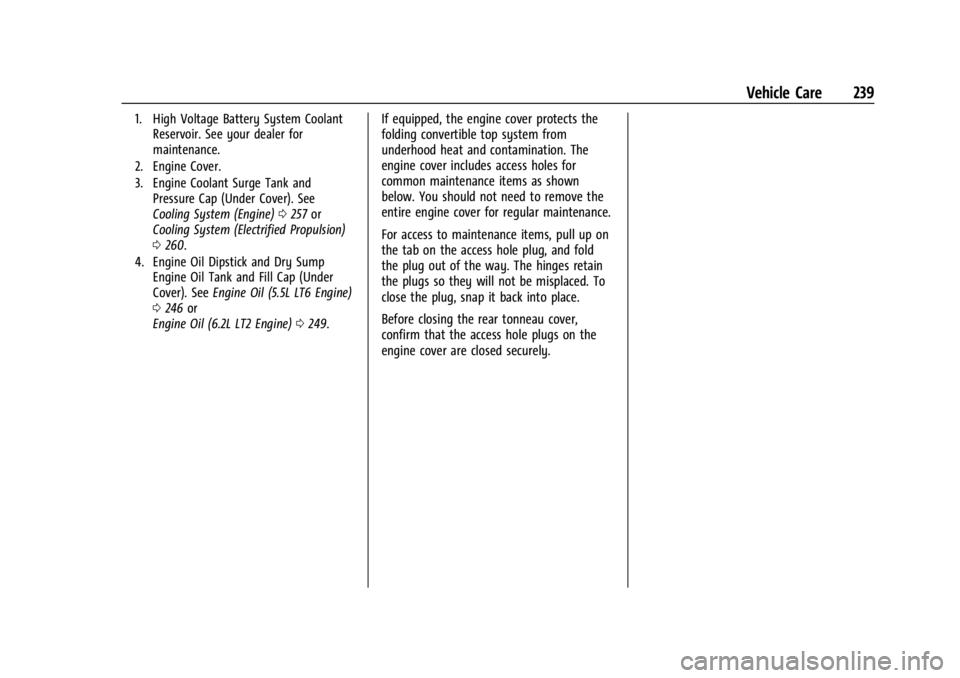
1. High Voltage Battery System CoolantReservoir. See your dealer for
maintenance.
2. Engine Cover.
3. Engine Coolant Surge Tank and Pressure Cap (Under Cover). See
Cooling System (Engine) 0257 or
Cooling System (Electrified Propulsion)
0 260.
4. Engine Oil Dipstick and Dry Sump Engine Oil Tank and Fill Cap (Under
Cover). See Engine Oil (5.5L LT6 Engine)
0 246 or
Engine Oil (6.2L LT2 Engine) 0249.If equipped, the engine cover protects the
folding convertible top system from
underhood heat and contamination. The
engine cover includes access holes for
common maintenance items as shown
below. You should not need to remove the
entire engine cover for regular maintenance.
For access to maintenance items, pull up on
the tab on the access hole plug, and fold
the plug out of the way. The hinges retain
the plugs so they will not be misplaced. To
close the plug, snap it back into place.
Before closing the rear tonneau cover,
confirm that the access hole plugs on the
engine cover are closed securely.
Page 243 of 362
Chevrolet Corvette Owner Manual (GMNA-Localizing-U.S./Canada/Mexico-
17272984) - 2024 - CRC - 2/20/23
242 Vehicle Care
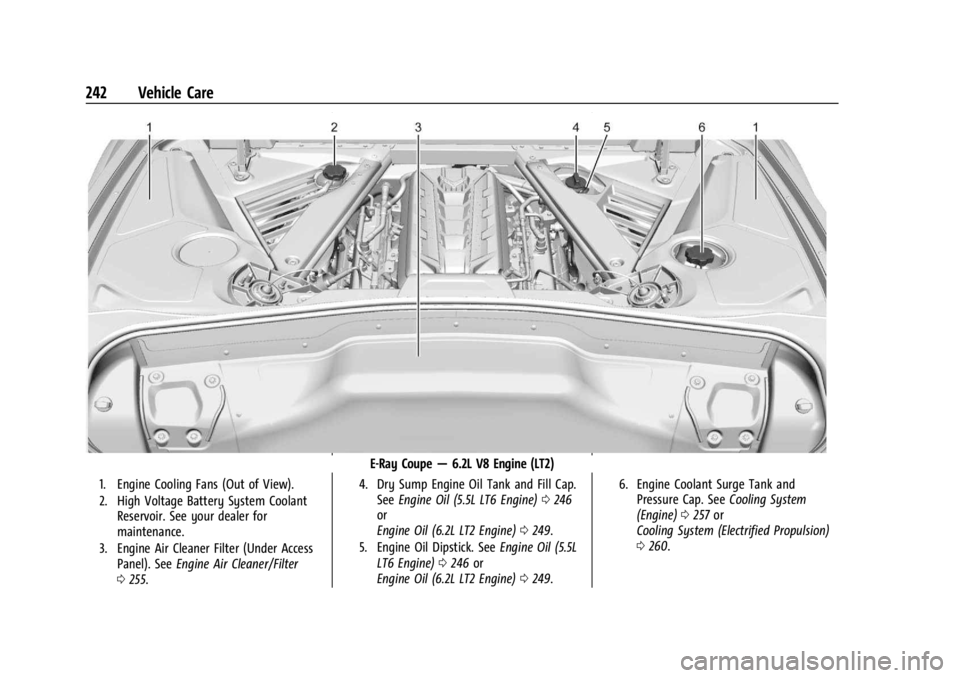
E-Ray Coupe—6.2L V8 Engine (LT2)
1. Engine Cooling Fans (Out of View).
2. High Voltage Battery System Coolant
Reservoir. See your dealer for
maintenance.
3. Engine Air Cleaner Filter (Under Access Panel). See Engine Air Cleaner/Filter
0 255. 4. Dry Sump Engine Oil Tank and Fill Cap.
See Engine Oil (5.5L LT6 Engine) 0246
or
Engine Oil (6.2L LT2 Engine) 0249.
5. Engine Oil Dipstick. See Engine Oil (5.5L
LT6 Engine) 0246 or
Engine Oil (6.2L LT2 Engine) 0249. 6. Engine Coolant Surge Tank and
Pressure Cap. See Cooling System
(Engine) 0257 or
Cooling System (Electrified Propulsion)
0 260.
Page 244 of 362
Chevrolet Corvette Owner Manual (GMNA-Localizing-U.S./Canada/Mexico-
17272984) - 2024 - CRC - 2/20/23
Vehicle Care 243
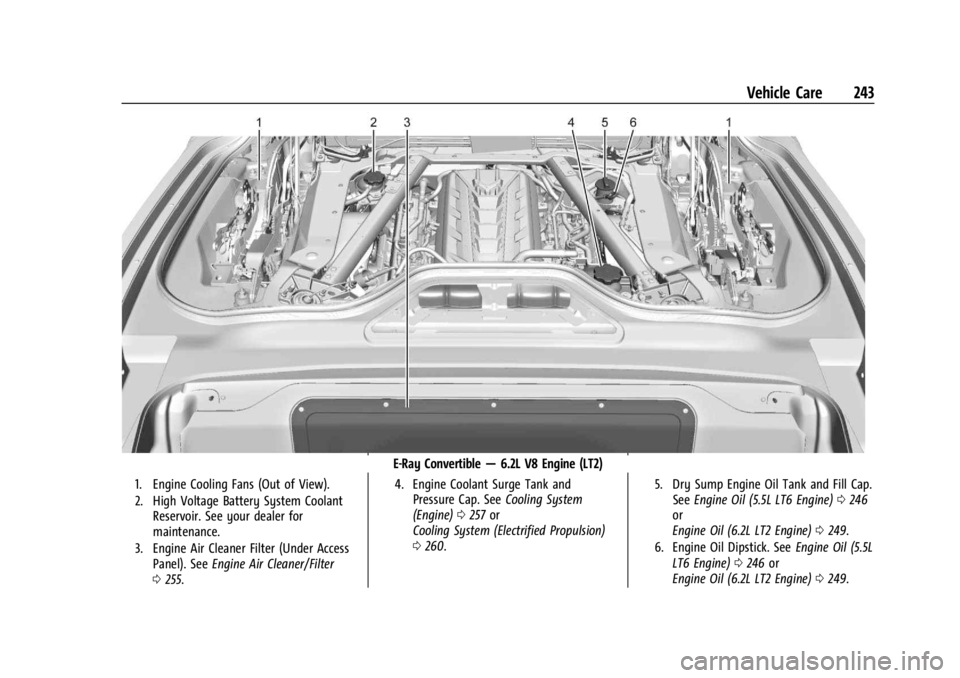
E-Ray Convertible—6.2L V8 Engine (LT2)
1. Engine Cooling Fans (Out of View).
2. High Voltage Battery System Coolant
Reservoir. See your dealer for
maintenance.
3. Engine Air Cleaner Filter (Under Access Panel). See Engine Air Cleaner/Filter
0 255. 4. Engine Coolant Surge Tank and
Pressure Cap. See Cooling System
(Engine) 0257 or
Cooling System (Electrified Propulsion)
0 260. 5. Dry Sump Engine Oil Tank and Fill Cap.
See Engine Oil (5.5L LT6 Engine) 0246
or
Engine Oil (6.2L LT2 Engine) 0249.
6. Engine Oil Dipstick. See Engine Oil (5.5L
LT6 Engine) 0246 or
Engine Oil (6.2L LT2 Engine) 0249.
Page 258 of 362
Chevrolet Corvette Owner Manual (GMNA-Localizing-U.S./Canada/Mexico-
17272984) - 2024 - CRC - 2/20/23
Vehicle Care 257
Caution
If the air cleaner/filter is off, dirt can
easily get into the engine, which
could damage it. Always have the air
cleaner/filter in place when driving.
Cooling System (Engine)
The engine cooling system allows the
engine to maintain the correct working
temperature. Vehicles equipped with
Electrified Propulsion (E-Ray) have additonal
cooling systems. See Cooling System
(Electrified Propulsion) later in this section.
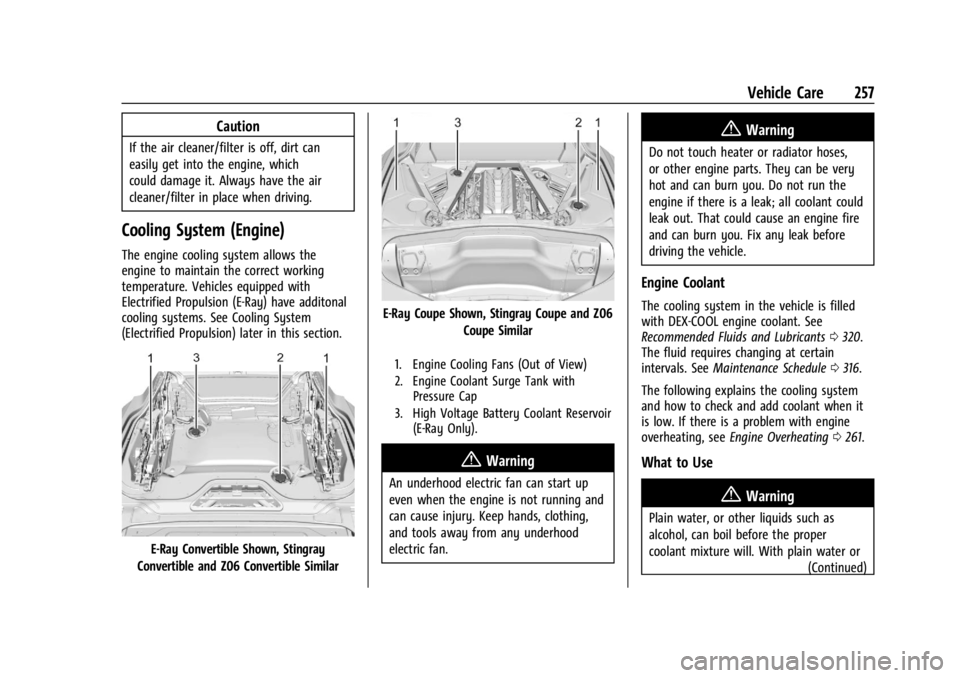
E-Ray Convertible Shown, Stingray
Convertible and Z06 Convertible Similar
E-Ray Coupe Shown, Stingray Coupe and Z06 Coupe Similar
1. Engine Cooling Fans (Out of View)
2. Engine Coolant Surge Tank withPressure Cap
3. High Voltage Battery Coolant Reservoir (E-Ray Only).
{Warning
An underhood electric fan can start up
even when the engine is not running and
can cause injury. Keep hands, clothing,
and tools away from any underhood
electric fan.
{Warning
Do not touch heater or radiator hoses,
or other engine parts. They can be very
hot and can burn you. Do not run the
engine if there is a leak; all coolant could
leak out. That could cause an engine fire
and can burn you. Fix any leak before
driving the vehicle.
Engine Coolant
The cooling system in the vehicle is filled
with DEX-COOL engine coolant. See
Recommended Fluids and Lubricants 0320.
The fluid requires changing at certain
intervals. See Maintenance Schedule 0316.
The following explains the cooling system
and how to check and add coolant when it
is low. If there is a problem with engine
overheating, see Engine Overheating 0261.
What to Use
{Warning
Plain water, or other liquids such as
alcohol, can boil before the proper
coolant mixture will. With plain water or
(Continued)
Page 261 of 362
Chevrolet Corvette Owner Manual (GMNA-Localizing-U.S./Canada/Mexico-
17272984) - 2024 - CRC - 2/20/23
260 Vehicle Care
7. Verify coolant level after the engine isshut off and the coolant is cold.
If necessary, repeat coolant fill procedure
Steps 3−7.
If the coolant still is not at the proper
level when the system cools down again,
see your dealer.
Caution
If the pressure cap is not tightly installed,
coolant loss and engine damage may
occur. Be sure the cap is properly and
tightly secured.
Cooling System (Electrified
Propulsion)
The E-Ray is equipped with Electrified
Propulsion and cooling systems for the
Traction Power Inverter Module (TPIM) and
the High Voltage Battery located in the
Engine Compartment, see Engine
Compartment Overview 0238. The TPIM and
the high voltage battery cooling system
reservoirs have tamper- resistant pressure
caps. The coolant should only be serviced by
a qualified technician.
Power Electronic/Traction Power Inverter
Module (TPIM) Cooling System
The Power Electronic Cooling System
reservoir is located in under the front hood.
Rechargeable Energy Storage System
(RESS)/High Voltage Battery Cooling
System
The High Voltage Battery Cooling System
reservoir is located in the rear hatch.
What to Use
{Warning
Plain water, or other liquids such as
alcohol, can boil before the proper
coolant mixture will. With plain water or
the wrong mixture, the engine could get
too hot but there would not be an
overheat warning. The engine could catch
fire and you or others could be burned.
For vehicles equipped with Electrified
Propulsion (E-Ray), if ambient temperatures
are anticipated below −25 °C (−13 °F) for the
high voltage coolant systems, make sure to
use premix 50/50 DEX-COOL and de-ionized
water. Never dispose of engine coolant by
putting it in the trash, pouring it on the ground, or into sewers, streams, or bodies of
water. Have the coolant changed by an
authorized service center, familiar with legal
requirements regarding used coolant
disposal. This will help protect the
environment and your health.
Caution
Do not use anything other than a mix of
DEX-COOL coolant that meets GM
Standard GMW3420 and clean, drinkable
water. Anything else can cause damage
to the engine cooling system and the
vehicle, which would not be covered by
the vehicle warranty.
Never dispose of engine coolant by putting
it in the trash, pouring it on the ground,
or into sewers, streams, or bodies of water.
Have the coolant changed by an authorized
service center, familiar with legal
requirements regarding used coolant
disposal. This will help protect the
environment and your health.
Checking Coolant
It is not necessary to regularly check coolant
unless a leak is suspected, or an unusual
noise is heard. A coolant loss could indicate
a problem. Have it inspected and repaired
Page 267 of 362
Chevrolet Corvette Owner Manual (GMNA-Localizing-U.S./Canada/Mexico-
17272984) - 2024 - CRC - 2/20/23
266 Vehicle Care
.A fluid leak in the brake hydraulic system.
Have the brake hydraulic system fixed.
With a leak, the brakes will not
work well.
Always clean the brake fluid reservoir cap
and the area around the cap before
removing it.
Do not top off the brake fluid. Adding fluid
does not correct a leak. If fluid is added
when the linings are worn, there will be too
much fluid when new brake linings are
installed. Add or remove fluid, as necessary,
only when work is done on the brake
hydraulic system.
Caution
If too much brake fluid is added, the
brake fluid can spill and cause vehicle
damage, including damage to electrical
components and surfaces. Add brake fluid
only when work is done on the brake
hydraulic system.
When the brake fluid falls to a low level,
the brake warning light comes on. See Brake
System Warning Light 092. Brake fluid absorbs water over time which
degrades the effectiveness of the brake fluid.
Replace brake fluid at the specified intervals
to prevent increased stopping distance. See
Maintenance Schedule
0316.
What to Add
Use only GM approved DOT 4 brake fluid
from a clean, sealed container. See
Recommended Fluids and Lubricants 0320.
{Warning
The wrong or contaminated brake fluid
could result in damage to the brake
system. This could result in the loss of
braking leading to a possible injury.
Always use the proper GM approved
brake fluid.
Caution
If brake fluid is spilled on the vehicle's
painted surfaces, the paint finish can be
damaged. Immediately wash off any
painted surface.
Battery - North America
Your vehicle may be equipped with a
standard 12-volt lead acid battery, 12-volt
lithium-ion battery, and/or a high voltage
battery.
See your dealer if the 12-volt lead acid
battery, 12-volt lithium-ion battery, or high
voltage battery need service.
12-Volt Lead Acid Battery
The original equipment battery is
maintenance free. Do not remove the cap
and do not add fluid.
Do not disconnect the 12-volt lead acid
battery during storage.
{Warning
WARNING: Battery posts, terminals and
related accessories can expose you to
chemicals including lead and lead
compounds, which are known to the
State of California to cause cancer and
birth defects or other reproductive harm.
Wash hands after handling. For more
information go to
www.P65Warnings.ca.gov.
See California Proposition 65 Warning 01.
Page 268 of 362
Chevrolet Corvette Owner Manual (GMNA-Localizing-U.S./Canada/Mexico-
17272984) - 2024 - CRC - 2/20/23
Vehicle Care 267
12-Volt Lithium-Ion Battery (E-Ray)
{Warning
WARNING:Battery posts, terminals and
related accessories can expose you to
chemicals including lead and lead
compounds, which are known to the
State of California to cause cancer and
birth defects or other reproductive harm.
Wash hands after handling. For more
information go to
www.P65Warnings.ca.gov.
See California Proposition 65 Warning 01.
Charging the 12-volt Lithium-ion battery
The 12-volt lithium-ion battery can be
charged using a GM approved charger
designed for lithium-Ion batteries. Follow the
instructions that come with the GM
approved charger.
{Warning
Use only GM approved jump start boxes
and charging tools. Use of unapproved
jump start boxes, charging tools, a loose
battery, or battery charger may cause
personal injury, death, or damage to the (Continued)
Warning (Continued)
vehicle. For GM approved jump start
boxes or charging tools, see
https://gmdesolutions.com.
Use the Battery Voltage info tile to
determine if your battery is low and needs
to be charged. See Instrument Cluster081
under the “Info Tiles” section for more
information.
GM recommends charging your 12-volt
lithium-ion battery when storing your
vehicle for long periods of time. See “Vehicle
Storage” later on in this section.
If the vehicle isn’t starting and the 12-volt
lithium-ion battery has run down, charging
the 12-volt lithium-ion battery may solve the
issue. See Jump Starting - North America
0 299.
High Voltage Battery (E-Ray)
Only a trained service technician should
inspect, test, or replace the high voltage
battery. The dealer has information on
how to recycle the high voltage battery.
There is also information available at
https://www.recyclemybattery.com.
{Warning
Damage to the high voltage battery or
high voltage system can create a risk of
electric shock, overheating, or fire.
If the vehicle is damaged from a
moderate to severe crash, flood, fire,
or other event, the vehicle should be
inspected as soon as possible. Until the
vehicle has been inspected, store it
outside at least 15 m (50 ft) from any
structure or anything that can burn.
Ventilate the vehicle by opening a
window or a door.
Contact Customer Assistance as soon as
possible to determine whether an
inspection is needed. See Customer
Assistance Offices 0331.
If the vehicle is in a crash, the sensing
system may shut down the high voltage
system. When this occurs, the high voltage
battery is disconnected and the vehicle will
not start. The SERVICE VEHICLE SOON
message in the Driver Information Center
(DIC) will display. Before the vehicle can
Page 269 of 362
Chevrolet Corvette Owner Manual (GMNA-Localizing-U.S./Canada/Mexico-
17272984) - 2024 - CRC - 2/20/23
268 Vehicle Care
operate again, it must be serviced at your
dealer. If a crash occurs or an airbag(s)
inflates, see“If a Crash Occurs” under
Collision Damage Repair 0335 and
What Will You See after an Airbag Inflates?
0 56 for additional information.
Propulsion power may be reduced in
extremely cold temperatures, or if the high
voltage battery is too cold.
A vehicle cover, which can reduce sun
loading on the vehicle and improve high
voltage battery life, is available from your
dealer.
See Radio Frequency Statement 0337.
Federal Communications Commission (FCC)
Radiation Exposure Statement
This equipment has been evaluated to be
installed and operated at a minimum
distance of 5.7 cm (2.2 in) between the
device and your body. The vehicle design
ensures this distance is maintained during
normal use. Changes or modifications to any
of these systems by other than an
authorized service facility could void
authorization to use this equipment. Innovation, Science, and Economic
Development (ISED) Radiation Exposure
Statement
This equipment complies with RSS-102
radiation exposure limits set forth for an
uncontrolled environment. This equipment
should be installed and operated with a
minimum distance of 5.7 cm (2.2 in) between
the radiator and any part of your body. The
vehicle design ensures this distance is
maintained during normal use. Changes or
modifications to any of these systems by
other than an authorized service facility
could void authorization to use this
equipment.
Vehicle Storage
{Warning
Batteries have acid that can burn you and
gas that can explode. You can be badly
hurt if you are not careful. Always wear
eye protection. See
Jump Starting - North
America 0299 for tips on working
around a battery without getting hurt.
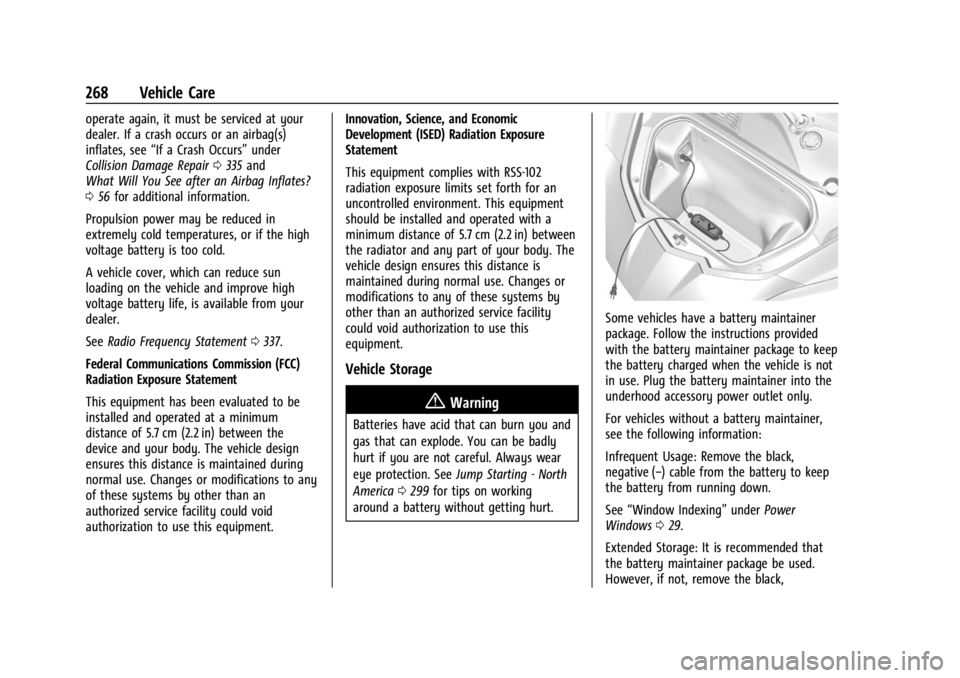
Some vehicles have a battery maintainer
package. Follow the instructions provided
with the battery maintainer package to keep
the battery charged when the vehicle is not
in use. Plug the battery maintainer into the
underhood accessory power outlet only.
For vehicles without a battery maintainer,
see the following information:
Infrequent Usage: Remove the black,
negative (−) cable from the battery to keep
the battery from running down.
See “Window Indexing” underPower
Windows 029.
Extended Storage: It is recommended that
the battery maintainer package be used.
However, if not, remove the black,