2023 TOYOTA YARIS CROSS weight
[x] Cancel search: weightPage 188 of 698

186
Owners Manual_Europe_M52N75_en
4-1. Before driving
■If trailer sway occurs
One or more factors (crosswinds, pass- ing vehicles, rough roads, etc.) can adversely affect handling of your vehicle
and trailer, causing instability.
●If trailer swaying occurs:
• Firmly grip the steering wheel. Steer straight ahead.Do not try to control trailer swaying by
turning the steering wheel. • Begin releasing the accelerator pedal immediately but very gradually to
reduce speed.
Do not increase speed. Do not apply
vehicle brakes.
If you make no extreme correction with
the steering or brakes, your vehicle and
trailer should stabilize.
●After the trailer swaying has stopped:
• Stop in a safe place. Get all occupants out of the vehicle.• Check the tires of the vehicle and the
trailer. • Check the load in the trailer.Make sure the load has not shifted.
Make sure the tongue weight is appro- priate, if possible.• Check the load in the vehicle.
Make sure the vehicle is not over- loaded after occupants get in.
If you cannot find any problems, the
speed at which trailer swaying occurred
is beyond the limit of your particular
vehicle-trailer combination. Drive at a
lower speed to prevent instability.
Remember that swaying of the towing
vehicle-trailer increases as speed
increases.
Your vehicle will handle differently
when towing a trailer. In order to
avoid accident, death or serious
injury, keep the following in mind
when towing:
■Checking connections
between trailer and lights
Stop the vehicle and check the
operation of the connection
between the trailer and lights after
driving for a brief period as well as
before starting off.
■Practicing driving with a cou-
pled trailer
Get the feel for turning, stopping
and reversing with the trailer
coupled by practicing in an area
with no or light traffic.
When reversing with a coupled
trailer, hold the section of the
steering wheel nearest to you
and rotate clockwise to turn the
trailer left or counterclockwise to
turn it right. Always rotate a little
NOTICE
■When the rear bumper strength- ening material is aluminum
Ensure the steel bracket part does not come directly in contact with that area.
When steel and aluminum come into contact, there is a reaction similar to corrosion, which will weaken the sec-
tion concerned and may result in damage. Apply a rust inhibitor to parts that will come in contact when attach-
ing a steel bracket.
Guidance
Page 190 of 698
188
Owners Manual_Europe_M52N75_en
4-1. Before driving
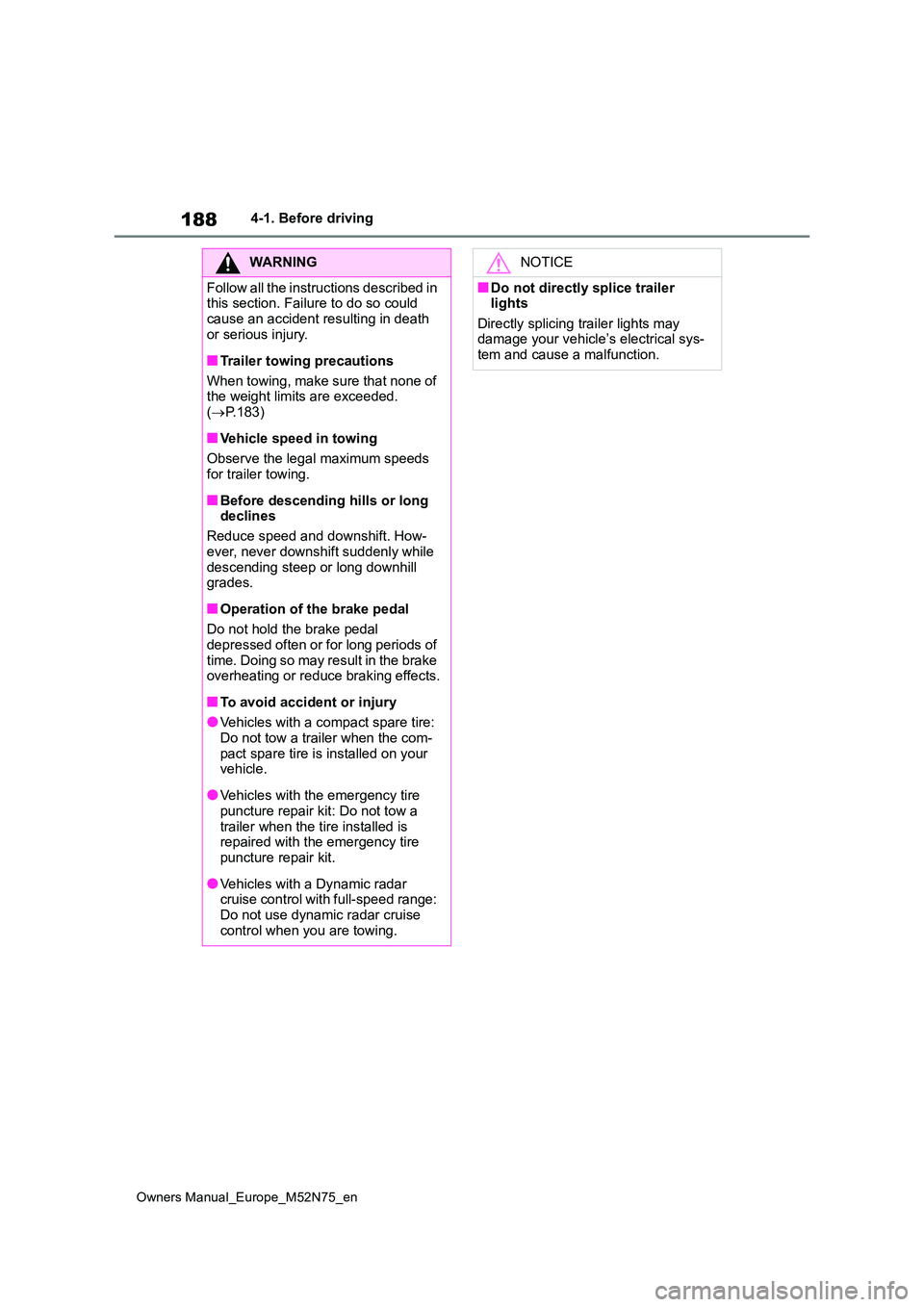
WARNING
Follow all the instructions described in this section. Failure to do so could
cause an accident resulting in death or serious injury.
■Trailer towing precautions
When towing, make sure that none of the weight limits are exceeded.
( P.183)
■Vehicle speed in towing
Observe the legal maximum speeds for trailer towing.
■Before descending hills or long declines
Reduce speed and downshift. How-
ever, never downshift suddenly while descending steep or long downhill grades.
■Operation of the brake pedal
Do not hold the brake pedal
depressed often or for long periods of time. Doing so may result in the brake overheating or reduce braking effects.
■To avoid accident or injury
●Vehicles with a compact spare tire:
Do not tow a trailer when the com- pact spare tire is installed on your vehicle.
●Vehicles with the emergency tire puncture repair kit: Do not tow a
trailer when the tire installed is repaired with the emergency tire puncture repair kit.
●Vehicles with a Dynamic radar cruise control with full-speed range:
Do not use dynamic radar cruise control when you are towing.
NOTICE
■Do not directly splice trailer lights
Directly splicing trailer lights may damage your vehicle’s electrical sys-tem and cause a malfunction.
Page 212 of 698
210
Owners Manual_Europe_M52N75_en
4-3. Operating the lights and wipers
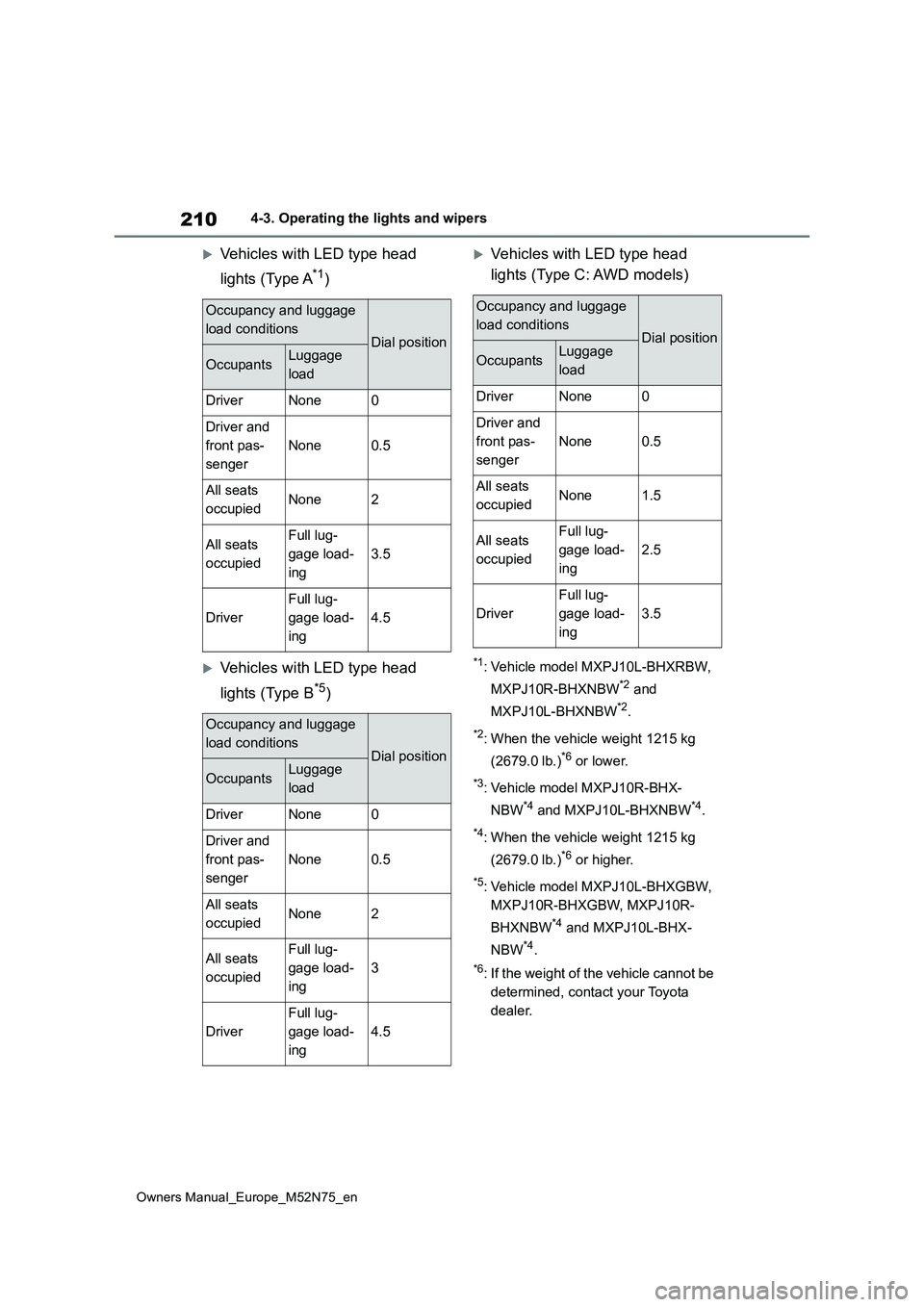
Vehicles with LED type head
lights (Type A*1)
Vehicles with LED type head
lights (Type B*5)
Vehicles with LED type head
lights (Type C: AWD models)
*1: Vehicle model MXPJ10L-BHXRBW,
MXPJ10R-BHXNBW*2 and
MXPJ10L-BHXNBW*2.
*2: When the vehicle weight 1215 kg
(2679.0 lb.)*6 or lower.
*3: Vehicle model MXPJ10R-BHX-
NBW*4 and MXPJ10L-BHXNBW*4.
*4: When the vehicle weight 1215 kg
(2679.0 lb.)*6 or higher.
*5: Vehicle model MXPJ10L-BHXGBW,
MXPJ10R-BHXGBW, MXPJ10R-
BHXNBW*4 and MXPJ10L-BHX-
NBW*4.
*6: If the weight of the vehicle cannot be
determined, contact your Toyota
dealer.
Occupancy and luggage
load conditionsDial position
OccupantsLuggage
load
DriverNone0
Driver and
front pas-
senger
None0.5
All seats
occupiedNone2
All seats
occupied
Full lug-
gage load-
ing
3.5
Driver
Full lug-
gage load-
ing
4.5
Occupancy and luggage
load conditionsDial position
OccupantsLuggage
load
DriverNone0
Driver and
front pas-
senger
None0.5
All seats
occupiedNone2
All seats
occupied
Full lug-
gage load-
ing
3
Driver
Full lug-
gage load-
ing
4.5
Occupancy and luggage
load conditionsDial position
OccupantsLuggage
load
DriverNone0
Driver and
front pas-
senger
None0.5
All seats
occupiedNone1.5
All seats
occupied
Full lug-
gage load-
ing
2.5
Driver
Full lug-
gage load-
ing
3.5
Page 397 of 698
395
6
Owners Manual_Europe_M52N75_en
6-3. Do-it-yourself maintenance
Maintenance and care
■The tire pressure warning sys-
tem must be init ialized in the
following circumstances:
When rotating front and rear tires
which have different tire inflation
pressures.
When changing the tire size.
When the tire inflation pressure
is changed such as when chang-
ing traveling speed or load
weight.
When changing between two
registered wheel sets.
When the tire pressure warning
system is initialized, the current tire
inflation pressure is set as the
benchmark pressure.
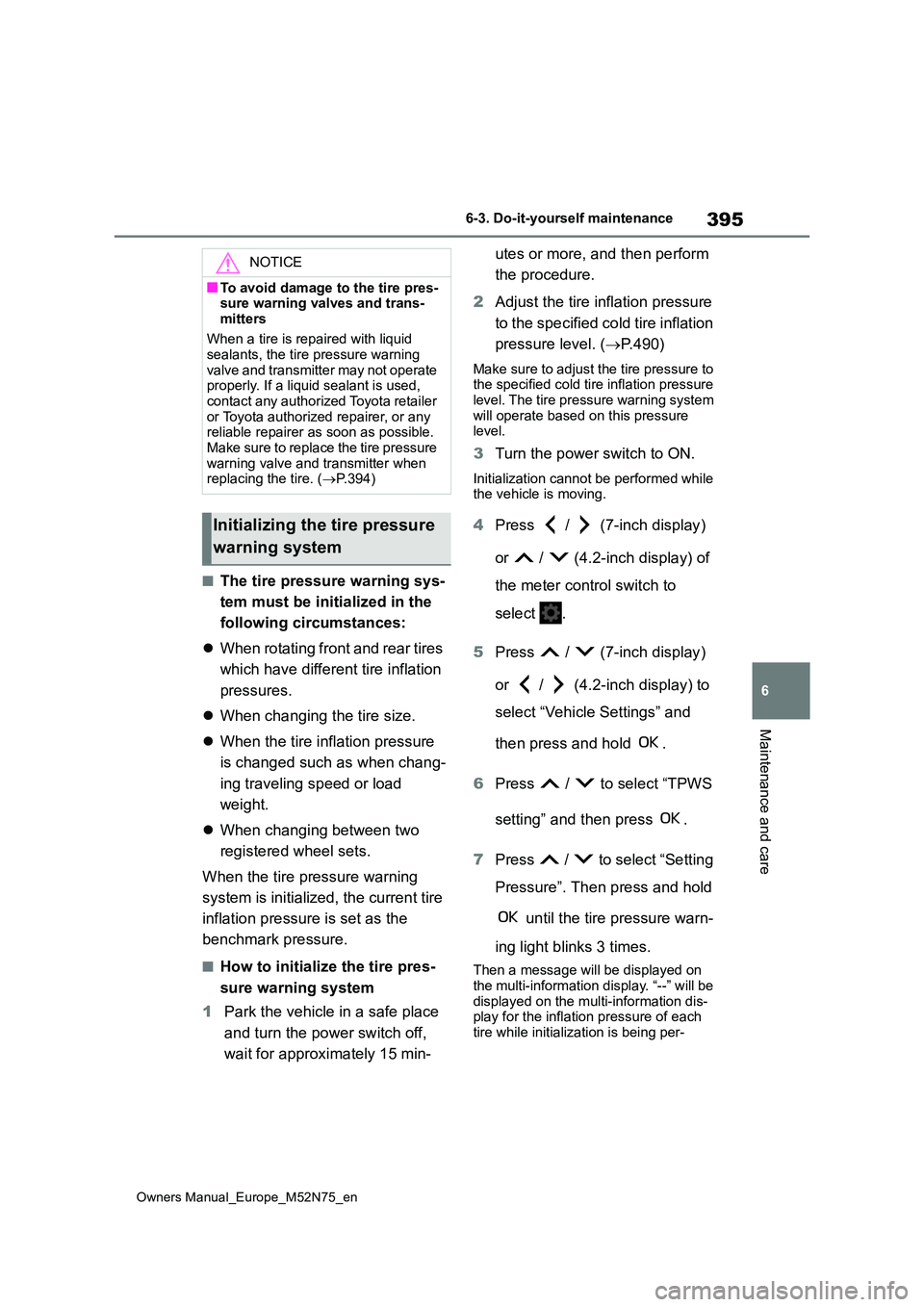
■How to initialize the tire pres-
sure warning system
1 Park the vehicle in a safe place
and turn the power switch off,
wait for approximately 15 min-
utes or more, and then perform
the procedure.
2 Adjust the tire inflation pressure
to the specified cold tire inflation
pressure level. ( P.490)
Make sure to adjust the tire pressure to the specified cold tire inflation pressure
level. The tire pressure warning system will operate based on this pressure level.
3 Turn the power switch to ON.
Initialization cannot be performed while the vehicle is moving.
4 Press / (7-inch display)
or / (4.2-inch display) of
the meter control switch to
select .
5 Press / (7-inch display)
or / (4.2-inch display) to
select “Vehicle Settings” and
then press and hold .
6 Press / to select “TPWS
setting” and then press .
7 Press / to select “Setting
Pressure”. Then press and hold
until the tire pressure warn-
ing light blinks 3 times.
Then a message will be displayed on the multi-information display. “--” will be
displayed on the multi-information dis- play for the inflation pressure of each tire while initialization is being per-
NOTICE
■To avoid damage to the tire pres-sure warning valves and trans-
mitters
When a tire is repaired with liquid sealants, the tire pressure warning
valve and transmitter may not operate properly. If a liquid sealant is used, contact any authorized Toyota retailer
or Toyota authorized repairer, or any reliable repairer as soon as possible. Make sure to replace the tire pressure
warning valve and transmitter when replacing the tire. ( P.394)
Initializing the tire pressure
warning system
Page 403 of 698
401
6
Owners Manual_Europe_M52N75_en
6-3. Do-it-yourself maintenance
Maintenance and care
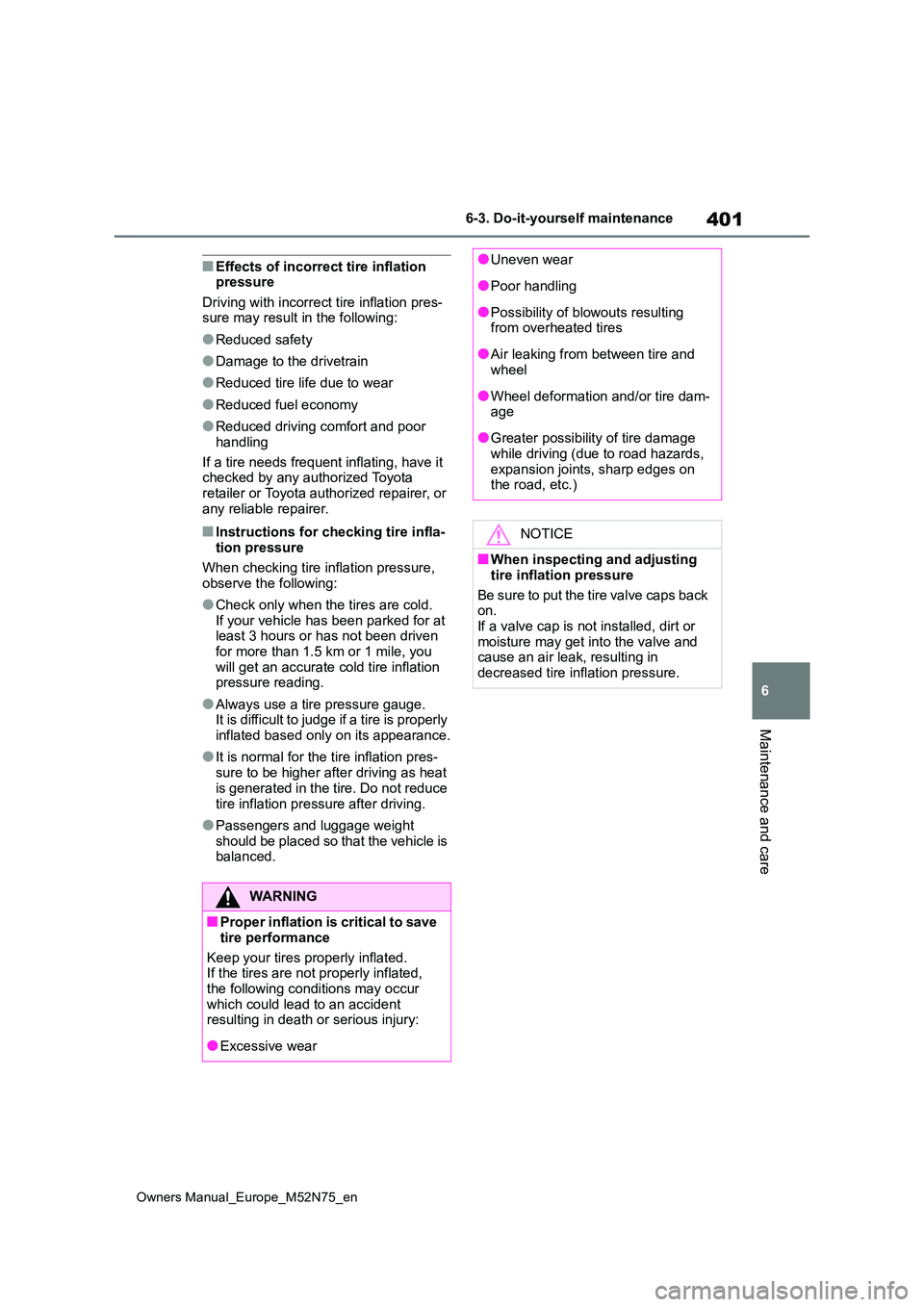
■Effects of incorrect tire inflation pressure
Driving with incorrect tire inflation pres- sure may result in the following:
●Reduced safety
●Damage to the drivetrain
●Reduced tire life due to wear
●Reduced fuel economy
●Reduced driving comfort and poor
handling
If a tire needs frequent inflating, have it checked by any authorized Toyota
retailer or Toyota authorized repairer, or any reliable repairer.
■Instructions for checking tire infla-tion pressure
When checking tire inflation pressure, observe the following:
●Check only when the tires are cold.If your vehicle has been parked for at least 3 hours or has not been driven
for more than 1.5 km or 1 mile, you will get an accurate cold tire inflation pressure reading.
●Always use a tire pressure gauge.It is difficult to judge if a tire is properly
inflated based only on its appearance.
●It is normal for the tire inflation pres-
sure to be higher after driving as heat is generated in the tire. Do not reduce
tire inflation pressure after driving.
●Passengers and luggage weight
should be placed so that the vehicle is balanced.
WARNING
■Proper inflation is critical to save
tire performance
Keep your tires properly inflated. If the tires are not properly inflated,
the following conditions may occur which could lead to an accident resulting in death or serious injury:
●Excessive wear
●Uneven wear
●Poor handling
●Possibility of blowouts resulting from overheated tires
●Air leaking from between tire and wheel
●Wheel deformation and/or tire dam-age
●Greater possibility of tire damage while driving (due to road hazards,
expansion joints, sharp edges on the road, etc.)
NOTICE
■When inspecting and adjusting
tire inflation pressure
Be sure to put the tire valve caps back on.
If a valve cap is not installed, dirt or moisture may get into the valve and cause an air leak, resulting in
decreased tire inflation pressure.
Page 405 of 698
403
6
Owners Manual_Europe_M52N75_en
6-3. Do-it-yourself maintenance
Maintenance and care
Use only Toyota wheel nuts and
wheel nut wrenches designed for
use with your aluminum wheels.
When rotating, repairing or
changing your tires, check that
the wheel nuts are still tight after
driving 1600 km (1000 miles).
Be careful not to damage the
aluminum wheels when using
tire chains.
Use only Toyota genuine balance
weights or equivalent and a plas-
tic or rubber hammer when bal-
ancing your wheels.
WARNING
●Never use oil or grease on the wheel bolts or wheel nuts.
Oil and grease may cause the wheel nuts to be excessively tight-ened, leading to bolt or disc wheel
damage. In addition, the oil or grease can cause the wheel nuts to loosen and the wheel may fall off,
causing an accident and resulting in death or serious injury. Remove any oil or grease from the wheel bolts or
wheel nuts.
■Use of defective wheels prohib-
ited
Do not use cracked or deformed wheels. Doing so could cause the tire
to leak air during driving, possibly causing an accident.
NOTICE
■Replacing tire pressure warning
valves and transmitters
●Because tire repair or replacement
may affect the tire pressure warning valves and transmitters, make sure to have tires serviced by any autho-
rized Toyota retailer or Toyota authorized repairer, or any reliable repairer. In addition, make sure to
purchase your tire pressure warn- ing valves and transmitters at any authorized Toyota retailer or Toyota
authorized repairer, or any reliable repairer.
●Ensure that only genuine Toyota wheels are used on your vehicle.Tire pressure warning valves and
transmitters may not work properly with non-genuine wheels.
Aluminum wheel precau-
tions (if equipped)
Page 486 of 698

484
Owners Manual_Europe_M52N75_en
8-1. Specifications
8-1.Spec ific ations
*1: With front bumper type A (P.431)
*2: With front bumper type B (P.431)
*3: 17-inch tires or 18-inch tires
*4: 16-inch tires
*5: 17-inch tires or 18-inch tires and AWD models
*6: 16-inch tires and AWD models
*7: 17-inch tires or 18-inch tires and 2WD models
*8: 16-inch tires and 2WD models
*9: 2WD models
*10: AWD models
Maintenance data (fuel, oil level, etc.)
Dimensions and weights
Overall length4180 mm (164.6 in.)*1
4200 mm (165.4 in.)*2
Overall width1765 mm (69.5 in.)
Overall height (unladen vehicles)1595 mm (62.8 in.)
Wheelbase2560 mm (100.8 in.)
Tread
Front1517 mm (59.7 in.)*3
1527 mm (60.1 in.)*4
Rear
1504 mm (59.2 in.)*5
1514 mm (59.6 in.)*6
1517 mm (59.7 in.)*7
1527 mm (60.1 in.)*8
Gross vehicle mass1690 kg (3726.4 lb.)*9
1775 kg (3913.8 lb.)*10
Maximum permissible axle
capacity
Front965 kg (2127.8 lb.)
Rear925 kg (2039.6 lb.)
Drawbar load (vehicles with towing packages)75 kg (165.3 lb.)
Towing capacity (vehicles with
towing packages)
Without brake550 kg (1212.7 lb.)
With brake750 kg (1653.7 lb.)
Page 507 of 698
505
8
Owners Manual_Europe_M52N75_en
8-3. Initialization
Vehicle specifications
8- 3. In it ia li za ti on
*: If equipped
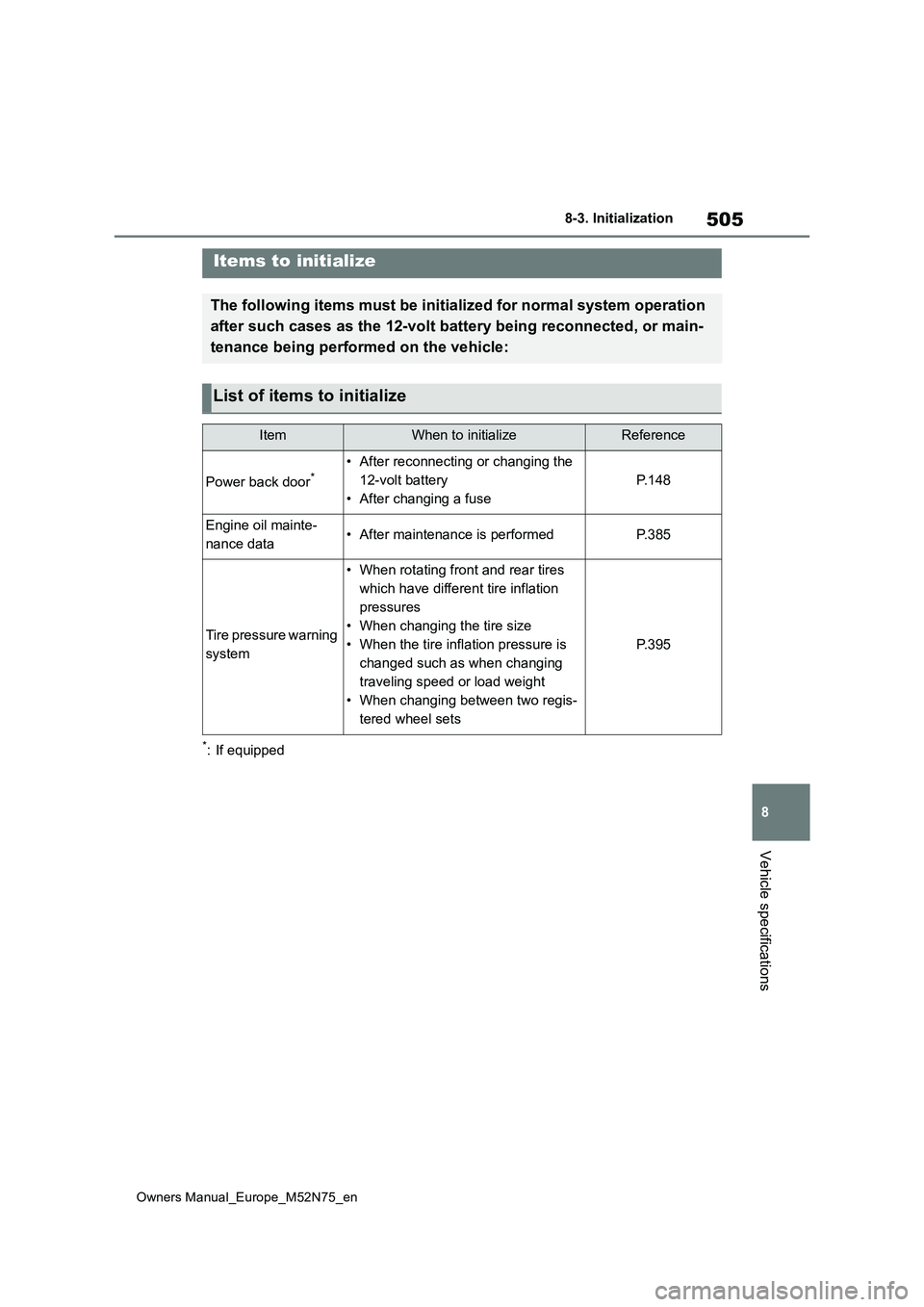
Items to initialize
The following items must be initialized for normal system operation
after such cases as the 12-volt battery being reconnected, or m ain-
tenance being performed on the vehicle:
List of items to initialize
ItemWhen to initializeReference
Power back door*• After reconnecting or changing the
12-volt battery
• After changing a fuse
P. 1 4 8
Engine oil mainte-
nance data• After maintenance is performedP. 3 8 5
Tire pressure warning
system
• When rotating front and rear tires
which have different tire inflation
pressures
• When changing the tire size
• When the tire inflation pressure is
changed such as when changing
traveling speed or load weight
• When changing between two regis-
tered wheel sets
P. 3 9 5